Academia.eduAcademia.edu

Outline

New Light on Human Prehistory in the Arabo-Persian Gulf Oasis

format_quote

34 citations

2010, Current Anthropology

https://doi.org/10.1086/657397

Abstract

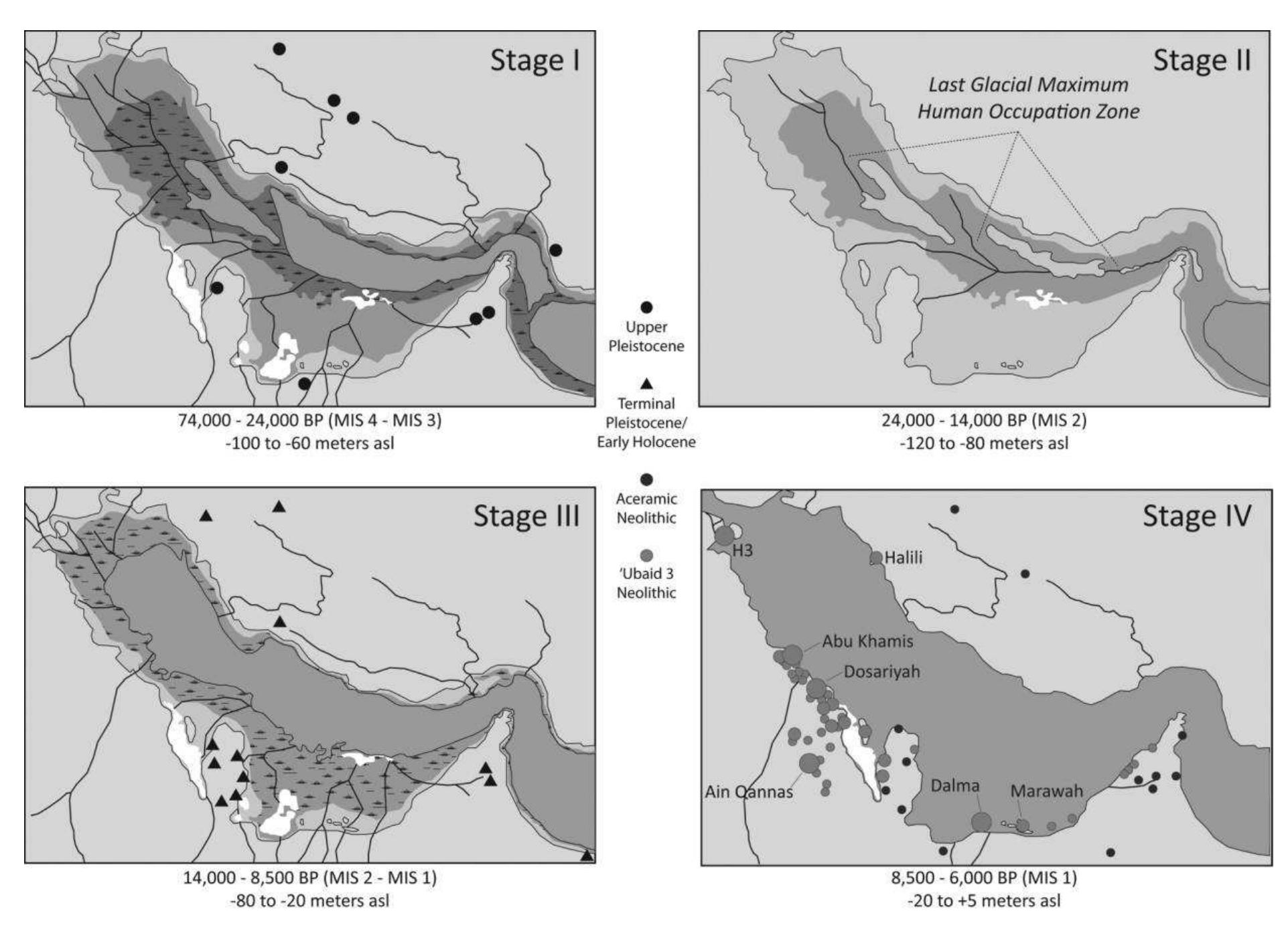
The emerging picture of prehistoric Arabia suggests that early modern humans were able to survive periodic hyperarid oscillations by contracting into environmental refugia around the coastal margins of the peninsula. This paper reviews new paleoenvironmental, archaeological, and genetic evidence from the Arabian Peninsula and southern Iran to explore the possibility of a demographic refugium dubbed the “Gulf Oasis,” which is posited to have been a vitally significant zone for populations residing in southwest Asia during the Late Pleistocene and Early Holocene. These data are used to assess the role of this large oasis, which, before being submerged beneath the waters of the Indian Ocean, was well watered by the Tigris, Euphrates, Karun, and Wadi Batin rivers as well as subterranean aquifers flowing beneath the Arabian subcontinent. Inverse to the amount of annual precipitation falling across the interior, reduced sea levels periodically exposed large portions of the Arabo-Persian Gulf, equal at times to the size of Great Britain. Therefore, when the hinterlands were desiccated, populations could have contracted into the Gulf Oasis to exploit its freshwater springs and rivers. This dynamic relationship between environmental amelioration/desiccation and marine transgression/ regression is thought to have driven demographic exchange into and out of this zone over the course of the Late Pleistocene and Early Holocene, as well as having played an important role in shaping the cultural evolution of local human populations during that interval.

Key takeaways
sparkles

AI

  1. The Gulf Oasis served as a demographic refugium for ancient populations during hyperarid periods.
  2. Human occupation in Arabia may have persisted continuously for over 100,000 years, challenging the Out of Africa model.
  3. The Gulf Oasis hypothesis suggests a significant cultural evolution in local populations during the Late Pleistocene to Early Holocene.
  4. Over 60 archaeological sites emerged around the Gulf during the Middle Holocene, indicating a demographic shift post-8000 BP.
  5. Sea-level changes and climatic oscillations influenced human settlement patterns and resource exploitation in the region.
Current Anthropology Volume 51, Number 6, December 2010 849 New Light on Human Prehistory in the Arabo-Persian Gulf Oasis by Jeffrey I. Rose The emerging picture of prehistoric Arabia suggests that early modern humans were able to survive periodic hyperarid oscillations by contracting into environmental refugia around the coastal margins of the peninsula. This paper reviews new paleoenvironmental, archaeological, and genetic evidence from the Arabian Peninsula and southern Iran to explore the possibility of a demographic refugium dubbed the “Gulf Oasis,” which is posited to have been a vitally significant zone for populations residing in southwest Asia during the Late Pleistocene and Early Holocene. These data are used to assess the role of this large oasis, which, before being submerged beneath the waters of the Indian Ocean, was well watered by the Tigris, Euphrates, Karun, and Wadi Batin rivers as well as subterranean aquifers flowing beneath the Arabian subcontinent. Inverse to the amount of annual precipitation falling across the interior, reduced sea levels periodically exposed large portions of the Arabo-Persian Gulf, equal at times to the size of Great Britain. Therefore, when the hinterlands were desiccated, populations could have contracted into the Gulf Oasis to exploit its freshwater springs and rivers. This dynamic relationship between environmental amelioration/desiccation and marine transgression/ regression is thought to have driven demographic exchange into and out of this zone over the course of the Late Pleistocene and Early Holocene, as well as having played an important role in shaping the cultural evolution of local human populations during that interval. ology (Caton-Thompson 1957; Petraglia and Alsharekh 2003; For Dilmun, the land of my lady’s heart, I will create long Rose 2004, 2006, 2007; Whalen, Davis, and Pease 1990). Such waterways, rivers and canals, whereby water will flow to studies are based on the supposition that South Arabia was quench the thirst of all beings and bring abundance to all an important conduit throughout the Pleistocene, facilitating that lives. (The promise of Enki the Lord of Sweet Waters the expansion and contraction of biota to and from East to Ninhursag the Earth Mother, from the Sumerian cre- Africa. Hence, the Paleolithic archaeological record of Arabia ation myth “Enki and Ninhursag”; Kramer 1945) can be used to assess the southern route of dispersal for Introduction: Out of Africa and Into populations expanding out of Africa. Arabia? Recent fieldwork conducted throughout the Arabian sub- continent indicates that human demography was far more complex than has been considered until now. Contrary to The investigation presented in this paper commences with expectations of a well-trodden Stone Age highway, new data the question of human expansion from Africa into Arabia collected by archaeologists working in Yemen (Crassard 2009; during the Late Pleistocene (128,000–12,000 BP). Scholars Delagnes et al. 2008; Fedele 2009), Oman (Jagher 2009; Rose often envision South Arabia as a population corridor, drawing and Usik 2009), and the United Arab Emirates (UAE; Marks on evidence from archaeozoology (Fernandes 2009; Tchernov 2009; Uerpmann, Potts, and Uerpmann 2009) suggest that 1992; Wildman et al. 2004), paleoanthropology (Lahr and parts of the peninsula may have served as population refugia, Foley 1994, 1998; Stringer 2000), human genetics (Kivisild et enabling indigenous hunter-gatherers to survive in localized al. 2004; Metspalu et al. 2004; Oppenheimer 2009; Quintana- pockets during periodic climatic downturns (Rose and Pe- Murci et al. 1999), computer modeling (Field, Petraglia, and traglia 2009). Far from finding East African–derived lithic Lahr 2007; Mithen and Reed 2002) and Paleolithic archae- technologies spilling over into Arabia, freshly unearthed evi- dence points to a conspicuous lack of connection with African Jeffrey I. Rose is a Research Fellow in the Institute of Archaeology lithic industries following the last interglacial (Rose and Usik and Antiquity at the University of Birmingham (Birmingham B15 2009). These industries tend to exhibit a distinct Arabian 2TT, United Kingdom [[email protected]]). This paper was tradition, suggesting minimal demographic input from out- submitted 16 III 09 and accepted 26 II 10. side the peninsula. Thus, it is germane to consider the pos- 䉷 2010 by The Wenner-Gren Foundation for Anthropological Research. All rights reserved. 0011-3204/2010/5106-0008$10.00. DOI: 10.1086/657397 850 Current Anthropology Volume 51, Number 6, December 2010 sibility that humans have continuously occupied parts of Ara- population. In suggesting autochthonous human groups that bia for the past 100,000 years, if not longer. survived outside of Africa from 128 kya onward, the proposed The Arabian subcontinent houses a mosaic of microenvi- model contradicts scenarios of modern human emergence ronments, some of which provided stable, predictable sources that envision a more recent expansion from Africa during of food and freshwater even during the most hyperarid phases marine isotope stage 4 (MIS 4), between 74 and 60 kya. of prehistory. At times when glacial conditions led to increased This new iteration of the old “oasis hypothesis” also offers aridity and widespread environmental degradation, reduced a novel perspective on the century-long discussion of Neo- sea levels exposed large portions of the continental shelf and lithization in southwest Asia (e.g., Bender 1975; Braidwood caused the formation of “coastal oases” fed by upwelling sub- 1973; Childe 1928; Flannery 1969, 1973; Pumpelly 1908; terranean springs (Faure, Walter, and Grant 2002). Taking Staubwasser and Weiss 2006), recently dubbed the “Neolithic into account the concentration of freshwater resources in demographic transition” (Bocquet-Appel 2008). The Gulf Oa- coastal and other low-lying areas, as well as annual rates of sis hypothesis proposes a heretofore undocumented indige- precipitation, figure 1 depicts three proposed refugia around nous community at the nexus of the ancient world, ground Arabia: (1) the Red Sea basin and ‘Asir-Yemeni highlands, (2) zero of the Agricultural and Urban revolutions. Not only does the southeast Arabian littoral zone, and (3) the exposed basin the proposed scenario introduce a new and substantial cast of the Arabo-Persian Gulf.1 of characters to southwest Asia at the critical Pleistocene- This paper focuses on prehistoric occupation within and Holocene boundary, it also supplies an ecologically driven around the Gulf Oasis, posited to have been the primary mechanism—fluctuating landscape carry capacity within an refugium in Arabia. For the purposes of this study, the Gulf isolated environment—that is thought to have played an im- Oasis is defined as the shallow inland basin that was exposed portant role in shaping cultural evolution throughout the throughout most of the Late Pleistocene and Early Holocene. region. It was bounded to the west by the sprawling deserts of the While the bulk of the archaeological record during the Arabian Peninsula, to the east by the towering peaks of the Terminal Pleistocene and Early Holocene lies submerged be- Zagros mountain range, and to the north by the Mesopota- neath the waters of the Arabo-Persian Gulf, there are more mian floodplain. From 74,000 BP to the final incursion of than 60 archaeological sites that suddenly appear along the the Indian Ocean around 8000 BP, the Gulf Oasis formed the newly established Middle Holocene shoreline, which evidence southern tip of the “Fertile Crescent” (sensu Breasted 1916). a prospering Neolithic population practicing a combination This presently inundated zone was once a low-lying floodplain of fishing, date palm cultivation, and animal husbandry. Be- beginning at the confluence of the Tigris and Euphrates Rivers fore the appearance of these sedentary/semisedentary villages, in Mesopotamia, the Karun River draining off the Iranian the few known Early Holocene archaeological sites in the Plateau, and the Wadi Batin River flowing across northern region were characterized by sparse and ephemeral hunter- Arabia. Together, these systems joined together into the Ur- gatherer camp sites scattered along the coast. The Gulf Oasis Schatt River Valley. Further downstream, the Ur-Schatt was model envisages that the wave of Middle Holocene settlements derive from an indigenous population displaced by the ad- fed by additional surface runoff from both eastern Arabia as vancing shoreline. From that perspective, Terminal Pleisto- well as the Zagros Mountains. Its deeply incised channel is cene and Early Holocene sites around the Gulf represent but still visible in the extant bathymetry (Seibold and Vollbrecht the more mobile, peripheral elements of a larger core group 1969). The Ur-Schatt catchment zone terminates at a large within the basin. lake basin (1100,000 km2) positioned in the heart of the Gulf Archaeological remains recovered from these newly some 140 m below current sea level (fig. 2). In addition to founded Middle Holocene sites exhibit a suite of character- surface runoff, freshwater within the purported oasis was also istics demonstrating a high level of cultural complexity, in- supplied by upwelling springs, known as khawakb in Bahraini cluding plant and animal domestication, aquatic subsistence, dialect, which are subterranean rivers linked to the Rub’ Al permanent structures, public architecture, pressure flaking, Khali and Zagros aquifer systems. Even today, these springs boat construction, a two-tiered settlement hierarchy, and ex- deliver freshwater to the Gulf through fissures in the porous tensive trade networks described as “mature, stable and struc- bedrock of the basin (Church 1996; Shiraz and Münster 1992; tured” on their initial appearance in the archaeological record Sultan et al. 2008). (Carter, forthcoming). By 7,000 years ago, settlements along Consequently, as potentially one of the largest and most the northern shoreline even demonstrate the first detectable stable sources of freshwater in southwest Asia for the majority use of lowland irrigation farming to carry out intensive ag- of the Late Pleistocene and the Early Holocene, it is germane ricultural production, an innovation that some have specu- to consider that the Gulf Oasis was home to a sizable human lated was the catalyst for the Urban Revolution (Adams 1972; Helbaek 1972; Hritz and Wilkinson 2006; Pournelle 2003). 1. The author acknowledges that “Arabian Gulf” and “Persian Gulf” are more typically used to refer to this body of water; however, to avoid If a local community was displaced from the Gulf Oasis, contention, this paper adopts the convention of hyphenating the two triggering a wave of settlement activity around the post-8000- designations. BP shoreline, this then leads to questions of cultural evolution Rose Human Prehistory in the Arabo-Persian Gulf Oasis 851 Figure 1. Physical map of the Arabian Peninsula depicting littoral zones exposed by reduced sea levels and proposed environmental refugia (digital elevation model base map courtesy of M. Otte). during the Terminal Pleistocene and Early Holocene. To what In order to investigate the likelihood of an indigenous com- extent was the process of Neolithization, even Mesolithization, munity within the Gulf Oasis, paleoenvironmental and ar- driven by human ecology within the fertile yet isolated Gulf chaeological evidence are synthesized, working to build a pic- Oasis? This line of reasoning invokes V. Gordon Childe and ture of prehistoric occupation over the course of the Late requires a reappraisal of his oasis hypothesis (Childe 1928, Pleistocene and Early Holocene. The first section of this paper 1936, 1952) in light of new archaeological evidence around draws on hydrology, deep sea cores, geochemistry, and land- the Gulf. scape geomorphology to describe the different environments Figure 2. Map of southwest Asia depicting exposed landscapes during the Last Glacial Maximum as well as ancient and modern drainage sys- tems. Numbers indicate Pleistocene and Early Holocene sites mentioned in the text. Rose Human Prehistory in the Arabo-Persian Gulf Oasis 853 that were present in the region and erects a rough chrono- mangrove swamps, and estuaries (Al-Hinai, Moore, and Bush logical framework with which to model stages of climate 1987; Alsharhan and Kendall 2003; Butler 1969; Diester-Haass change and marine incursion. The paper then turns to the 1973; Evans 1966; Georgiev and Stoffers 1980; Gischler et al. Late Pleistocene and Early-Middle Holocene archaeological 2005; Lambeck 1996; Saleh et al. 1999; Sarnthein 1972; Seibold record around the Arabo-Persian Gulf. In the last few years, and Vollbrecht 1969; Stoffers and Ross 1979; Sugden 1963; the number of known prehistoric sites around the Gulf coast Uchupi, Swift, and Ross 1996, 1999; Williams 1999; Wilkinson and hinterlands has soared (fig. 2). This section reviews these and Drummond 2004). Adding to its appeal, there are high- new data, taking into account relative and absolute ages, lithic quality chert deposits exposed in patches across the landscape. technology, and site distribution patterns. This evidence is Bahrain, Qatar, and the islands just off the coast of Abu Dhabi used to construct a model of human occupation around the Emirate are riddled with such outcrops (Beech, Elders, and basin over the course of the last 100,000 years. The final Shepherd 2000; Cavelier 1970; Edgell 1992; Kapel 1967). section discusses the implications of the Gulf Oasis on current The Arabo-Persian Gulf basin is the terminus of several scenarios of modern human expansion out of Africa as well major river systems (fig. 2); the majority of all freshwater in as the Neolithic demographic transition in southwest Asia. southwest Asia ultimately drains into this large depression via surface runoff and underground rivers (Alsharhan et al. 2001; Shiraz and Münster 1992; Sultan et al. 2008). Currently much Paleoclimate in the Arabo-Persian Gulf of the subterranean freshwater upwells from beneath the cen- There are few places on earth that have undergone such pro- tral Gulf through karstic limestone lining the basin, called found shifts in landscape as the Arabian Peninsula. Over the khawakb in local Bahraini dialect. “Coastal oases” are likely course of the Quaternary, the subcontinent has been affected to have formed around these khawakb when reduced sea levels almost exclusively by two climatic regimes: westerlies and the exposed the surrounding landscape and triggered increased Indian Ocean monsoon system. Westerlies are storms that pressure on the hydrostatic head of the aquifers (Faure, Wal- form over the Mediterranean and advance down the Arabo- ter, and Grant 2002). The island of Bahrain, meaning in Ar- Persian Gulf, scattering light to moderate rainfall (40–120 abic “the two seas,” is thought to reference the dual saltwater mm/yr) around the Gulf territories throughout the winter sea surrounding the island and freshwater sea upwelling from months. The Indian Ocean monsoon is responsible for sum- the submerged floor of the Gulf. On witnessing the local mer khareef storms that bring cool temperatures, high hu- exploitation of khawakb during his visit in 1603, Portuguese midity, and frequent rains to the Dhofar Mountains and explorer Pedro Teixeira wrote, coastal plain along the southern coastline of Arabia between There is water in plenty, rather brackish than sweet. The late June and early September. best is that of Nanyáh, the name of certain very deep wells The Indian Ocean monsoon is particularly sensitive to fluc- in the centre of the isle. The next is that got from the bottom tuations in global insolation patterns; during glacial periods, of the sea, as follows. The chief town of the isle, Manamà, the intertropical convergence zone (ITCZ) drifts to the south, is on the sea shore, and near it, in the depth of three or while a return to warmer conditions causes the ITCZ to shift three and a-half fathoms, are several great springs of fresh, further north and deposit seasonal rains far into the Rub’ Al clear, and wholesome water. There are some men who make Khali desert. Throughout the Pleistocene, these meteorolog- their living by bringing it up from below in waterskins, ical dynamics have caused dramatic oscillations across the which they do very cleverly and easily, where it bubbles up, interior, transforming barren sand seas into fertile grasslands and sell it cheap. Certain of the oldest Moors of the isle, and back again (e.g., Fleitmann et al. 2007; McClure 1976; with whom I spoke of this, told me that these springs were Parker and Rose 2008). Variable distribution of water and once far inland; but the sea broke in and overflowed them, as food over time likely had significant demographic implica- we see at this day. (Teixeira, Sinclair, and Ferguson 1902: tions, creating a cyclical ebb and flow of population expansion 175, italics added) and contraction from the three core refugia depicted in figure 1 into marginal zones along the periphery. Climatic conditions were not entirely favorable while the Given the extent of the exposed land within the Gulf basin, Gulf Oasis was exposed. Dune formation (Al-Hinai, Moore, the abundance of food, water, lithic raw material, and its and Bush 1987; Teller et al. 2000) and the reduction of al- conscripted geographic position, this sizable inland depression luvium deposited from Zagros drainage systems during the is thought to have formed one of the most important oases Last Glacial Maximum (LGM) signal a significant drop in in the ancient world. Situated along the eastern edge of the surface runoff between approximately 20,000 and 12,000 years peninsula, the Arabo-Persian Gulf is among the shallowest ago (Sarnthein 1972). A series of 13 piston cores sampled by seas in the world, with average depths of just 40 m. When the Atlantis II expedition to the Arabo-Persian Gulf in 1977 global sea levels dropped below this mark at the onset of MIS identified three distinct depositional phases (Stoffers and Ross 4, more than 100,000 km2 of land were continuously exposed 1979). The lowest unit, laid down between 30,000 and 12,000 for the ensuing 70,000 years. During that interval, the basin cal BP, is made up of thick detrital silt indicative of an active housed a rich mosaic of freshwater springs, river floodplains, river valley, formed by the aggradation of Ur-Schatt River 854 Current Anthropology Volume 51, Number 6, December 2010 alluvial sediments. The overlying layer, bracketed from 12,000 Peninsula. The magnitude of the sum probability curve is not to 6000 cal BP, is carbonate-rich mud signaling increasingly a measure of the amount of precipitation; rather, it represents brackish, marine conditions. This stratum is interpreted as a the statistical likelihood of wet conditions calculated from the period of rising sea levels that induced marine conditions radiometric ages of the different paleoenvironmental proxies. within the basin. The uppermost unit, laid down from 6,000 There is an inverse relationship between Arabian pluvial years ago to present, is composed of carbonate-rich marls phases and the amount of land exposed along the continental characteristic of the current depositional environment. From shelf. This suggests that at times when the interior of Arabia this, it can be inferred that sea levels have remained relatively became desiccated and uninhabitable, sea levels dropped and stable in the interim. created new coastal habitats around the margins of the pen- Cores taken from the Lower Khuzestan plain (fig. 2) depict insula. At the height of the LGM around 18 kya, reduced sea three sedimentary facies from the Late Pleistocene to the Mid- levels produced 200,000 km2 of additional land in the Gulf dle Holocene. The lowest unit is made up of silty alluvium basin—a territory roughly the size of Great Britain. It is ex- attesting to the existence of an ancient river plain before 9000 pected that nomadic groups were forced to contract toward cal BP. This floodplain horizon is capped by a peat layer that the coastal margins during periods of low sea level and aridity, formed between approximately 9000–8500 cal BP, at which particularly glacial phases associated with MIS 4 (74–60 kya) time the rising water table and advancing shoreline trans- and MIS 2 (24–12 kya). Conversely, populations would have formed the plain into a freshwater marsh and estuarine en- expanded from the exposed shelf into the hinterland during vironment. By 5500 cal BP, marine transgression had com- pluvial episodes from 55 to 24 kya and from 12 to 6 kya. pletely inundated the plain, evidenced by the transition from The Terminal Pleistocene–Early Holocene phase of post- tidal flat to coastal sabkha sedimentation (Heyvaert and Baete- glacial flooding coincides with an increase in annual precip- man 2007). itation, which generated both “pulling” mechanisms from Shoreline reconstructions of marine incursion into the amelioration of the interior that drew populations into the Arabo-Persian Gulf show that the Indian Ocean ingressed hinterlands, as well as “pushing” mechanisms caused by ma- more than 1,000 km between 12,000 and 6,000 years ago (e.g., rine inundation of the exposed lowlands. The Holocene in- Al-Farraj 2005; Bernier et al. 1995; Bruthans et al. 2006; Cooke cursion was the first time since MIS 5e (128–120 kya) that 1987; Evans, Kirkham, and Carter 2002; Ivanovich, Vita-Finzi, the Indian Ocean had ingressed so far into the basin. Con- and Hennig 1983; Lambeck 1996; Teller et al. 2000; Williams sequently, the Gulf Oasis hypothesis predicts an abrupt spike and Walkden 2002). Both Sarnthein (1972) and Dalongeville in human settlement after 8000 BP, at which time displaced and Sanlaville (1987) observe four sea stands signaled by communities were forced to retreat upslope as sea levels sub- shoreline sedimentation at 125–105-m, 64–61-m, 54–40-m, merged the floodplain. The presence of archaeological sites and ∼30-m depths. Models of lateral transgression predict a around the hinterlands of the basin support this claim, dem- relatively slow, gradual rise in sea level punctuated by a rapid onstrating a long tradition of human occupation in the region phase of incursion from 12,000 to 11,000 cal BP, followed by for more than 100,000 years, punctuated by a pronounced a second phase from 9000 to 8000 cal BP, at which times the wave of settlement activity around 7,500 years ago. These coastline advanced upward of 1 km/yr in some places (Kassler archaeological data are presented in detail in the following 1973). section. Figure 3 provides a summary of sea-level change and the paleoclimatic record in the Gulf basin from 74,000 BP to present. The eustatic sea-level data are derived from the Red Prehistoric Archaeology around the Sea curve calculated by Siddall et al. (2003) as well as analyses Arabo-Persian Gulf of geomorphic features within the Gulf basin used to date the local timing of these fluctuations (Al-Asfour 1982; Al- sharhan and Kendall 2003; Kassler 1973; Lambeck 1996).2 The The State of Paleolithic Research pluvial signal curve is taken from Parker and Rose (2008) Prehistoric archaeology in eastern Arabia began with some- and represents a sum probability based on a data set of en- what of a false start. The first documented “Paleolithic” stone vironmental proxy signals recorded throughout the Arabian tools were lithic surface scatters reported by the Danish ar- chaeological mission to Qatar in the late 1960s.3 Kapel (1967) 2. Recent paleoenvironmental investigations carried out in the North classified supposedly Mousterian artifacts as “Qatar A- Sea demonstrate the potential for several hundred years lag in dates of Group,” followed in chronological succession by “B-Group,” transgression due to differing models of sea-level change, bathymetry, isotasy, and margin of error in radiometric dates calculated from proxy “C-Group,” and “D-Group” assemblage types arranged on signals (Ward, Larcombe, and Lillie 2006). Therefore, although the ba- the basis of typological attributes rather than relative or ab- thymetry in the Gulf basin points to a rapid period of inundation between 9000 and 8000 BP, this may have actually occurred up to a millennium 3. For the purposes of this paper, undated assemblages that authors later between 8000 and 7,000 BP. More detailed investigation of the rate have attributed to specific archaeological phases are placed in quotes in of transgression in the Gulf is necessary to test these assumptions. order to clarify their indeterminate nature. Rose Human Prehistory in the Arabo-Persian Gulf Oasis 855 Figure 3. Environmental fluctuations in Arabia from marine isotope stage (MIS) 4 to MIS 1. Sea-level curve after Siddall et al. (2003, fig. 4, p. 857); exposed landmass in Gulf and paleoshoreline reconstructions from Lam- beck (1996); paleoclimatic sum probability curve after Parker and Rose (2008, fig. 4, p. 31). solute dating methods. A decade later, French archaeologists of Paleolithic archaeology in eastern Arabia and have curtailed investigating the site of Khor B on the eastern coast of Qatar any targeted investigation of this time period until quite re- excavated a Middle Holocene sequence with lithic assemblages cently. While this paper was being prepared, Al-Naimi (2009) bearing similar characteristics to the “Mousterian” A-Group presented new findings of a lithic surface scatter from Ras material (Inizan 1978, 1980). The discoveries at Khor B cast ‘Ushayriq on the northwestern coast of Qatar (19 in fig. 2) doubt on the Danish chronology, later described as “worth- with potential Middle Paleolithic (MP) and Upper Paleolithic less” (Tosi 1986:466), and caused scholars to reorganize the (UP) elements, once again raising the specter of a Pleistocene entire corpus of Qatar lithic assemblages within a Holocene population on the Qatar peninsula. timeframe. Since then, researchers have presumed the absence The first conclusive evidence of a Late Pleistocene human 856 Current Anthropology Volume 51, Number 6, December 2010 presence in eastern Arabia was unearthed in 2005 by a joint it is critical to determine whether human occupation has been expedition between the Sharjah Emirate and Tübingen Uni- continuous or intermittent during this interval. versity. While excavating a test trench in the Jebel Faya 1 rockshelter (22 in fig. 2), the team discovered a stratified The Middle and Upper Paleolithic of Eastern Arabia Paleolithic sequence composed of three archaeological hori- zons; radiometric dates place these occupations between MIS Virtually all that is known of the Late Pleistocene period from 5 and MIS 3 (Marks 2009; Uerpmann, Potts, and Uerpmann the Arabian side of the Gulf comes from the site of the Jebel 2009; Uerpmann et al. 2007).4 New surface assemblages from Faya 1 rockshelter in Sharjah Emirate, as it represents the sole other findspots around the shoreline of the basin have been findspot that has yielded radiometric dates (Marks 2009; identified that exhibit technologically and typologically similar Uerpmann, Potts, and Uerpmann 2009; Uerpmann et al. lithic material tentatively anchored to the Jebel Faya optically 2007). In four seasons of fieldwork, excavations uncovered stimulated luminescence dates (OSL; Scott-Jackson, Scott- more than 3 m of in situ archaeological material associated Jackson, and Rose 2009; Scott-Jackson et al. 2008; Wahida et with at least three distinct archaeological layers spanning most al. 2009). However, these sites (and all lithic surface scatters of the Late Pleistocene. The lowest level, assemblage C, is in Arabia for that matter) must be approached with extreme characterized by small handaxes, thick bifacial foliates, hard caution as there is a paucity of stratified Pleistocene deposits hammer blades, and centripetal cores. Assemblage B yielded multiple platform cores with flat converging and flat 90⬚ flak- and, consequently, too few absolute dates. ing surfaces, as well as a high frequency of blades produced In comparison to Arabia, considerably more is known of from these cores. Tools include burins, endscrapers, and the Middle Paleolithic (“Zagros Mousterian”) and Upper Pa- sidescrapers. In contrast to the underlying assemblage C, there leolithic (“Baradostian” or “Zagros Aurignacian”) periods in is no evidence for the use of the Levallois technique nor any the Zagros Mountains of Iran (e.g., Lindly 2005; Olszewski sign of platform faceting. Assemblage A yielded multiple plat- and Dibble 1994). Here, direct evidence for early human ex- form cores, mostly flake (rather than blade) production, no ploitation of the Arabo-Persian Gulf was discovered at Yafteh Levallois cores or debitage, and no evidence of platform fac- Cave (6 in fig. 2), where perforated marine shells carried some eting. Similar to assemblage B, some Upper Paleolithic tool 350 km upriver from the ancient shoreline of the basin were types are present, such as burins and endscrapers. Given their discovered within the dated Upper Paleolithic horizon (Otte generally nondiagnostic characteristics, it is difficult to classify et al. 2007). Although there are only a small handful of find- assemblages A and B within any known technological or ty- spots reported along the Iranian coastline of the Gulf (Conard pological category (Marks 2009). Although the radiometric et al. 2005, 2006, 2007; Dashtizadeh 2009; Ghasidian et al. dates have not yet been finalized, preliminary results indicate 2006) the abundance of Middle and Upper Paleolithic find- an age of at least MIS 5 for assemblage C, while assemblages ings in the northern and central Zagros regions suggests that A and B fall sometime between MIS 5 and MIS 2 (Uerpmann the scarcity of sites in the south is related to insufficient et al. 2007). investigation rather than absence of occupation. Taking into account the suite of technological and typo- There is a sizable gap in the distribution of Late Pleistocene logical characteristics observed in assemblage C, correspond- archaeological sites along the Gulf’s northern and north- ing to radiometric dates that place the assemblage within the western shorelines. This deficiency is probably owed to a com- timeframe of the Levantine Middle and Upper Paleolithic, bination of postdepositional factors, first and foremost the Marks (2009:305) points out a conspicuous absence of Levan- massive sedimentation of the Tigris, Euphrates, and Karun tine features such as elongated blanks, Levallois points, and river systems responsible for covering the Mesopotamian unidirectional-convergent reduction strategies, showing “ten- floodplain in tens of meters of alluvium, effectively masking dencies totally unknown in the Levant in Middle Paleolithic the Late Pleistocene landscape surface. Since the region was contexts.” Marks also notes distinct differences between Jebel the cradle of civilization, it is also likely that human activity Faya assemblage C and the potentially coeval Sibakhan sites over long periods of history also greatly contributed to wiping (sensu Rose 2006) recorded in central and southern Oman out traces of prehistoric inhabitants. (25, 27 in fig. 2), which are characterized by large flat bifacial Given the presence of Middle and Upper Paleolithic ar- forms and hard hammer blades but have no evidence for chaeological sites around the eastern and western margins of Levallois or discoidal cores (Biagi 1994; Jagher 2009; Rose 2006). Marks draws tentative correlations between assemblage the Gulf Oasis, albeit many of them undated, it is clear that C and early MSA assemblages from east/northeast Africa, cit- the area surrounding the basin was exploited by many groups ing parallel modes of façonnage reduction to manufacture of hunter-gatherers at various times throughout the Late Pleis- similar handaxe and foliate tool forms. From this, he spec- tocene. In order to test the hypothesis presented in this paper, ulates that the assemblage C archaeological level of occupation 4. At least two additional lower archaeological layers have been dis- at Jebel Faya may be attributed to human groups expanding covered at Faya; however, small sample sizes do not permit any reliable out of Africa at the beginning of the Late Pleistocene (if not description of the assemblages (Marks 2009). earlier); assemblage C then appears to develop into a region- Rose Human Prehistory in the Arabo-Persian Gulf Oasis 857 ally distinct tradition over time. Assemblages A and B bear The Middle and Upper Paleolithic of Southern Zagros no affinities with surrounding Middle/Upper Paleolithic as- Archaeological and geochronological evidence of the Middle semblages known from the Levant, Zagros, the Horn of Africa, and Upper Paleolithic periods in the Zagros Mountains come or even other parts of Arabia outside the basin, supporting primarily from lithic assemblages recovered at caves such as the notion of a continuous, autochthonous occupation within Warwasi (3 in fig. 2; Dibble and Holdaway 1994), Bisitun (2 the Gulf Oasis. in fig. 2; Coon 1951; Dibble 1984), Kunji (8 in fig. 2; Baumler At the moment, Jebel Faya 1 represents the only stratified and Speth 1994), Kobeh (4 in fig. 2; Lindly 2005), Shanidar Paleolithic site in eastern Arabia. There are, however, techno- (1 in fig. 2; Solecki and Solecki 1994), and Yafteh (6 in fig. typologically related surface scatters reported nearby at Fili 2; Otte et al. 2007). As these sites are all situated in the central around the flanks of the Hajar Mountains (21 in fig. 2; Scott- and northern Zagros Mountains several hundred kilometers Jackson, Scott-Jackson, and Rose 2009; Scott-Jackson et al. from the Gulf, they are probably too far away to be directly 2008), at Jebel Barakah on the coast in western Abu Dhabi related to the oasis population envisioned in this paper. On Emirate (20 in fig. 2; McBrearty 1993, 1999; Wahida et al. the other hand, the discovery of a perforated Arabo-Persian 2009), and at Ras ‘Ushayriq on the northwestern coast of the Qatar Peninsula (19 in fig. 2; Al-Naimi 2009). Although un- Gulf marine shell within the earliest Aurignacian stratum at dated, lithic artifacts collected at Jebel Barakah exhibit “Mid- Yafteh Cave, 350 km upriver from the current mouth of the dle Paleolithic” diagnostic features showing some overlap with Gulf, suggests some degree of interaction and/or overlapping Jebel Faya assemblage C. The predominant core reduction mobility patterns between central and southern Zagros pop- strategy is a centripetal Levallois technique, grading into bi- ulations. conical and high-backed radial cores. There are also a few As in Arabia, the chronology of the Middle Paleolithic in pieces bearing evidence of bidirectional Levallois reduction Iran is poorly understood; there are no absolute dates to and a low number of Nubian cores. In addition to an array establish the earliest appearance of Zagros Mousterian assem- of nondiagnostic tool types such as denticulates and notches, blages, only indications that it was replaced sometime around the Jebel Barakah toolkit includes a cordiform bifacial hand- 36,000 BP by a variant of the Aurignacian techno-complex axe and a bifacially retouched sidescraper (fig. 4g; Wahida et (Otte et al. 2007). The Zagros Mousterian is a Middle Pale- al. 2009). olithic industry characterized by the frequent use of discoids In the interior foothills of the Hajar mountain chain near and centripetal Levallois cores. The tools exhibit heavy, in- Fili, some 20 km east of Jebel Faya (21 in fig. 2; Scott-Jackson, vasive, semiabrupt retouch, while the most common imple- Scott-Jackson, and Rose 2009; Scott-Jackson et al. 2008) col- ments are sidescrapers and Mousterian points, followed by lected a series of lithic surface scatters bearing characteristics denticulates and notches. In contrast to the eastern Arabian similar to both Jebel Faya C and Jebel Barakah, namely, the assemblages, bifacial tools are almost completely absent. The façonnage production of bifacial tools in conjunction with signature heavy retouch on tools from this region has been discoidal cores and centripetal Levallois cores. These sites are interpreted by Lindly (2005) to indicate the seasonal occu- composed of dense, extensive scatters of lithic artifacts found pation of upland zones. Since high-quality raw material on a series of limestone ridges approximately 300 m in ele- sources are scarce in the mountains, prepared cores and blanks vation. Among the tools collected, there is a high frequency were carried into the highlands and subsequently reduced and of sidescrapers and bifacial implements such as bifacially resharpened as required over the course of an entire season, worked sidescrapers with flat invasive retouch, backed bifacial thereby accounting for the extensive and intensive retouch. knives, foliates, limandes, and a large elongated bifacial hand- Building off of this proposed transhumance scenario, it is axe (fig. 4a–4c). The Fili assemblages also exhibit elements of reasonable to suggest a mobility strategy between the Gulf Levallois technology, ranging between centripetal and uni- basin lowlands and Zagros highlands that allowed for seasonal polar-convergent reduction strategies, as well as an assortment exploitation of both zones at optimal times throughout the of biconical and high-backed radial cores (fig. 5). year. Although there is still much to be learned in regard to the The taxonomic identity of Zagros Mousterian populations Late Pleistocene archaeological sequence of eastern Arabia, is of particular interest to the Gulf Oasis hypothesis, given fragmentary data permit a few preliminary observations. (1) the postulated early modern human refugium within the ba- There were populations present around the western hinter- sin. Although it is hazardous to associate any one lithic in- land of the Gulf basin sometime earlier than 100 kya. (2) The dustry with a specific hominin group, it is possible to say Middle Paleolithic at Jebel Faya assemblage C and related with confidence that the Zagros Mousterian assemblage ex- findspots is characterized by the production of small bifacial cavated at Shanidar Cave was manufactured by Neanderthals, handaxes, bifacial foliates, discoids centripetal Levallois, and indicated by specimens found within the same stratigraphic Nubian cores. (3) The lithic artifacts from Jebel Faya assem- horizon (Solecki and Solecki 1994; Trinkaus 1983). A hominin blages A and B do not resemble any other techno-complex radius, also identified as Neanderthal, was recovered from the in southwest Asia or east Africa; therefore, these assemblages Zagros Mousterian layer at Bisitun (Trinkaus and Biglari may belong to an autochthonous lithic tradition. 2006). Thus, the limited demographic information indicates Figure 4. Bifacial foliates and other bifacial elements associated with Mid- dle Paleolithic assemblages around the Gulf basin. a–c, Fili surface sites in Sharjah Emirate from Scott-Jackson, Scott-Jackson, and Rose (2009, figs. 7, 8); d–f, Qaleh Bozi cave complex in Isfahan Province, Iran, from Biglari et al. (2009, fig. 2.6, 2.10); g, Jebel Barakah surface site, Abu Dhabi Emirate, from Wahida et al. (2009, fig. 6). Scale bar p 5 cm, shown in 1-cm increments. Rose Human Prehistory in the Arabo-Persian Gulf Oasis 859 Figure 5. Paleoshoreline configuration, drainage systems, and archaeo- logical sites around the Arabo-Persian Gulf basin during the Late Pleis- tocene and Early Holocene. The position of the shoreline during these intervals is based on Lambeck (1996, fig. 7), and the drainage channels are taken from Zarins (1998, fig. 1). Sources for archaeological site dis- tributions: Carter (2006, forthcoming); Charpentier (2008); Conard et al. (2005); Kapel (1967); Rosenberg (1985); Uerpmann, Potts, and Uerp- mann (2009). that a Neanderthal population was present in the northern were reported by an expedition to the Makran coast in the and central Zagros Mountains during the Late Pleistocene, mid-1970s (Vita-Finzi and Copeland 1980). The geological thousands of years after the earliest recorded modern human survey team, composed of nonspecialists, collected lithic ar- expansion into the Levant (Mercier et al. 1993; Schwarcz et tifacts at Konarak (18 in fig. 2) and Kuhestak (17 in fig. 2), al. 1988). which they classified as “Middle Paleolithic” from the iden- New data from southern Iran suggest some degree of re- tification of Levallois cores and blanks. This material, however, gional variation in terms of stone tool-making traditions. comes from surface scatters and should be treated cautiously. “Middle Paleolithic” findspots from the southern Zagros in- The site of Qaleh Bozi is a complex of two rockshelters clude the basal stratum at Eshkaft-i-Gavi (13 in fig. 2; Ro- and a cave overlooking the Zaiandeh Rud floodplain below senberg 1985; Scott and Marean 2009), the lowest archaeo- (Biglari et al. 2009). The “Middle Paleolithic” assemblage logical levels at Qaleh Bozi (11 in fig. 2), surface scatters found within these deposits is fundamentally different from collected near Jahrom (15 in fig. 2; Piperno 1972), Bab Anar the Mousterian of the northern Zagros. Excavators report the (14 in fig. 2; Dashtizadeh and Hossaini 2008), Jam-o-Riz Plain predominant use of simple, unidirectional blanks struck from (16 in fig. 2; Dashtizadeh 2009), and several recently recorded split cobbles, followed by discoids, globular multiple platform findspots from the central provinces of Esfahan, Fars, and cores, and façonnage reduction strategies. Striking platforms Kohgiluyeh-Boyerahmad (Conard et al. 2005, 2006, 2007; are for the most part unfaceted, and there is no evidence for Ghasidian et al. 2006). Farther to the east, two assemblages the use of the Levallois method. Bifacial tools, completely 860 Current Anthropology Volume 51, Number 6, December 2010 absent from the northern Zagros Mousterian record, make changed the name to Zagros Aurignacian (Olszewski and Dib- up an important element of the Qaleh Bozi assemblage. Fa- ble 1994). çonnage reduction was used to produce small bifacial foliates One of the only stratified and radiometrically dated UP (fig. 4d–4f), bifacial knives, and backed bifacial scrapers. To archaeological sequences from the southern Zagros was ex- explain this anomalous technology, alien to the Zagros Mous- cavated at Eshkaft-i-Gavi (13 in fig. 2), a large cave situated terian, Biglari et al. (2009:38) point out similarities with ma- at the confluence of the Kur and Sivand rivers near ancient terial from eastern Arabia: “If we do not envisage a local Persepolis. The sediments inside Eshkaft-i-Gavi yielded Mid- invention, the Qaleh Bozi industry may be intrusive to the dle and Upper Paleolithic and Epipaleolithic stone tool as- Iranian Central Plateau and could be related to the Middle semblages. A series of six radiocarbon dates on charcoal from Paleolithic industries of Oman to the south.” This suite of the UP layers cluster between 18,000 and 30,000 cal BP, reduction strategies and associated bifacial tools does indeed placing the Aurignacian occupation at this site within the resemble material Jebel Faya C, as well as Jebel Barakah and latter half of MIS 3 and first half of MIS 2 (Rosenberg 1985). Fili surface sites situated on the opposite shore of the Gulf Eshkaft-i-Gavi also yielded fragmentary human fossil remains (fig. 4). distributed throughout the Upper Paleolithic and Epipaleo- “Middle Paleolithic” surface scatters have recently been col- lithic strata. These bones represent the earliest direct evidence lected near the eastern coast of the Gulf on the Jam-o-Riz of Homo sapiens in the region and confirm the association Plain, located 23 km from the present shoreline (16 in fig. between (some) Zagros Aurignacian assemblages and ana- 2). One end of this long, narrow upland plain serves as a pass tomically modern human specimens (Scott and Marean down into the Gulf basin, providing access for groups trav- 2009). eling between the coast and mountains. Twenty-two sites were Like the preceding Mousterian phase, there again appears documented during the survey, although only a brief account to be regional variation between northern and southern Zag- of the material has yet been published. Preliminary reports ros assemblages during the UP, evidenced by recent work describe Levallois cores and flakes, tools made on blades, and carried out in southwestern Iran by a joint Tübingen-Iranian endscrapers (Dashtizadeh 2009). Scrapers comprise a low per- team working there (Conard et al. 2005, 2006, 2007; Ghasidian centage of the toolkits, in contrast to the nearby “Middle et al. 2006). Archaeologists have documented a series of di- Paleolithic” assemblages collected at Bab Anar and Jahrom minutive, single-platform bladelet assemblages different (14, 15 in fig. 2) that exhibit a high frequency and wide variety enough from the Zagros Aurignacian and Zarzian industries of scraper types (Dashtizadeh and Hossaini 2008). to warrant a separate taxonomic designation of “Late Paleo- These surface sites suggest the presence of a Late Pleistocene lithic” (Ghasidian et al. 2006). Initially, the frequency of mi- population in proximity to the eastern Gulf shoreline. It is crolithic debitage and bladelet manufacture led excavators to noteworthy that bifacial implements are absent from the Jam- classify the assemblage as Epipaleolithic; however, radiocar- o-Riz assemblages, drawing a clear distinction between this bon dates between 36,500 and 30,000 cal BP from the stratified and the façonnage assemblage excavated from the “Middle cave of Ghar-e-Boof (12 in fig. 2) suggest a much earlier date Paleolithic” horizon at Qaleh Bozi. While this observation coeval with Upper Paleolithic assemblages found throughout does not help to identify those responsible for creating these Eurasia. Excavators note that the bottom of the “Late Pale- artifacts, it does insinuate that more than one population was olithic” occupation has not yet been reached at Ghar-e-Boof, present in the region during this interval, distinguished by hinting at potentially older dates for this southern Zagros their fundamentally different use of prepared core technology industry (Conard et al. 2007). versus façonnage bifacial production. From radiocarbon dates on charcoal at Yafteh Cave, it is The subsequent UP archaeological phase in the Zagros re- possible to place the earliest appearance of the Zagros Au- gion was initially dubbed the Baradostian (Solecki 1958). This rignacian industry in the north around 35,500 cal BP (Otte UP industry was first recognized in layer C of Shanidar Cave, et al. 2007). In contrast to Ghar-e-Boof, excavators working overlying the Zagros Mousterian horizon. The type assem- at Yafteh Cave observe typical Zagros Aurignacian core re- blage was described as a combination of flake- and blade- duction strategies including centripetal flake cores and lam- based technologies used to produce burins, endscrapers, car- inar blade and bladelet production. Small centripetal flake inated pieces, sidescrapers, and points (both Mousterian and blanks were struck for the creation of specific tool forms, Font Yves/Arjeneh). While the core reduction technology and while blades and bladelets were obtained from unidirectional most of these tool types resemble the European Aurignacian, cores and the proximal ends of carinated burins. There is also the presence of Mousterian points and sidescrapers distin- the usual suite of Zagros Aurignacian tool categories present guish the industry as a regional variant. To underscore these including an abundance of bladelet tools, Arjeneh points (al- differences, the excavators of Shanidar gave it the name Bar- ternately called Font Yves points; these are rectilinear in cross adostian after the nearby Baradost Mountains that form part section and have marginal retouch creating a fusiform shape) of the northern Zagros chain. More recently, scholars em- and Dufour bladelets (semiabrupt fine ventral or alternating phasizing affinities to the larger Aurignacian techno-complex retouch limited to the lateral edges). The Yafteh Cave toolkit distributed throughout Europe and Western Asia have also includes pointed blades and bladelets, a high frequency Rose Human Prehistory in the Arabo-Persian Gulf Oasis 861 of burins, endscrapers on blades, and occasional perforators. Middle–Upper Paleolithic transition as a local event is in- In addition to the lithic assemblages, the deposit yielded the congruous with fossil evidence linking Neanderthals with Zag- aforementioned marine shells from the Arabo-Persian Gulf, ros Mousterian assemblages at Shanidar and Bisitun and with a bone awl, perforated deer canines, and a hematite pendant. modern humans associated with the Zagros Aurignacian as- The early dates, central geographic position, and classic semblage at Eshkaft-i-Gavi. In this case, technology clearly Aurignacian features observed among Zagros assemblages transcends taxonomy. have led Otte et al. (2007:94) to speculate that “the high Considering the distribution of Late Pleistocene archaeo- regions of the Zagros, mainly in modern Iran, can be proposed logical sites throughout the arid margins of the Gulf basin in as the most probable centre for the origin of the Aurignacian both Iran and Arabia, it is reasonable to presume hunter- and modern humans in Europe.” The authors describe the gatherer communities also exploited the estuaries, lagoons, region as a “demographic reservoir” from which the early springs, fresh and saltwater marshes, anastomosing rivers, and Upper Paleolithic expansion into Eurasia might have ema- alluvial floodplains found within the core of the oasis. Al- nated. This proposition, in turn, begs the question as to the though direct confirmation of the envisioned Paleolithic pop- origins of the Upper Paleolithic in the Zagros region. If, ac- ulation is now submerged, there was a substantial wave of cording to some scholars (e.g., Olszewski and Dibble 2006; settlement within a millennium following the Holocene in- Otte and Kozlowski 2007; Otte et al. 2007), the initial wave cursion that provides compelling evidence for some critical of modern human expansion into Europe radiated from the demographic event around this time (fig. 5). To that end, the Zagros and is marked by the spread of the Aurignacian cul- next subsection reviews archaeological findings from the Ter- ture, from whence came the Zagros Aurignacian? minal Pleistocene and Holocene periods that have been dis- There are a few sites in the region that have archaeological covered around the Gulf basin. sequences straddling the Middle and Upper Paleolithic boundary, including Shanidar in the northern Zagros range; The Terminal Pleistocene–Early Holocene of Eastern Arabia Warwasi, Ghar-e Khar (5 in fig. 2), and Gar Arjeneh (7 in and Southern Zagros fig. 2) in the central Zagros valleys; and Eshkaft-i-Gavi (13 in fig. 2) in southern Zagros. While producing a wealth of As the cold, hyperarid conditions of MIS 2 set in beginning information regarding lithic technologies before and after the around 24,000 BP, archaeological evidence for human habi- MP-UP transition, none of these assemblages permit a de- tation vanishes from the basin. At the Jebel Faya rockshelter, cisive answer as to the nature of the transformation itself from the uppermost Paleolithic stratum, from which assemblage A the Zagros Mousterian to the Zagros Aurignacian. Of direct was excavated, is capped by a layer of sterile sand. The ex- relevance to the thesis promoted in this paper, scholars ob- cavators have interpreted this stratigraphic sequence, as well serve certain techno-typological traits found across both Mid- as the complete absence of archaeological sites in Arabia dur- dle and Upper Paleolithic assemblage types that suggest some ing the LGM, as an indication of population discontinuity degree of continuity, including sidescrapers, Mousterian across the Pleistocene-Holocene boundary. They write that points, truncated-faceted pieces, and small radial cores the Holocene peopling of Arabia was “a process which may (Baumler and Speth 1994; Olszewski and Dibble 1994; Solecki initially have involved hunters and gatherers coming from the and Solecki 1994). At the Warwasi rockshelter, Dibble and south, soon followed by aceramic herders from the northwest Holdaway (1994) describe a virtually continuous archaeolog- using some variant of [Levantine] PPNB-related lithic tech- ical sequence spanning the Middle and Upper Paleolithic.5 nology” (Pre-Pottery Neolithic B; Uerpmann, Potts, and They note that the small, flake-based centripetal core tech- Uerpmann 2009:213). nology from the Zagros Aurignacian levels at Warwasi follows The archaeological evidence, however, does not fully sup- a general core reduction tradition rooted in the Zagros Mous- port this proposition. There is no observable overlap in lithic terian at the site. In addition, they observe that the tendency technologies, settlement patterns, or subsistence strategies be- toward heavy retouch on tools, one of the defining charac- tween contemporary archaeological sites in the Levant and teristics of the preceding Mousterian phase, is also frequent eastern Arabia. The “Levantine hypothesis” (Drechsler 2007; in the Aurignacian levels at Warwasi. Uerpmann, Potts, and Uerpmann 2009) is largely based on The survival of a significant modern human population the correlation between tanged unifacial Byblos points found within southwest Asian refugia may explain the localized or- in PPNB assemblages from the Levant with tanged unifacial igins of the Zagros Aurignacian and the elements of tech- Fasad points characteristic of the Qatar B-Group/Fasad facies nological and typological continuity between the Mousterian in Arabia (Charpentier 1996, 2008; Kapel 1967).6 Recent ex- and Aurignacian. However, the interpretation of the Zagros cavations at the Al Hatab rockshelter in the Dhofar mountains of southern Oman (27 in fig. 2) suggest that the Fasad facies 5. Excavators initially had such difficulty distinguishing the MP and UP horizons within this continuous archaeological sequence that the 6. More recently, Charpentier (1996) has renamed the Qatar B-Group lowest Aurignacian stratum was classified as Mousterian with UP ele- assemblages “Fasad facies.” To avoid confusion, this industry shall hence- ments in early site reports (Dibble and Holdaway 1990). forth be referred to as “Fasad” in this paper. 862 Current Anthropology Volume 51, Number 6, December 2010 is derived from a local South Arabian lithic tradition that (2007) have suggested that felines “chose” to domesticate predates, and is unrelated to, the PPNB Byblos points (Rose themselves, opportunistic hunters attracted to rodent popu- and Usik 2009). lations that flourished around Neolithic human settlements.8 Within the Levantine PPNB toolkit are found a variety of This observation, in turn, hints at the presence of sedentary arrowheads including el-Khiam, Helwan, Abu Maadi, Niz- or semisedentary communities in this region between 10,000 zanim, Jericho, and Amuq types; these arrowheads are found and 8000 BP. in a wide range of shapes and sizes and were often formed New radiometric dates indicate that the Fasad lithic facies, by fine pressure-flaked retouch (Gopher 1994). The Fasad considered the fossile directeur of the Levantine colonists, is facies in Arabia, on the other hand, is limited to a single point bracketed between 13,000 and 8500 cal BP (Uerpmann, Potts, type that does not show any indication of pressure flaking. and Uerpmann 2009). Domesticated fauna, on the other Uerpmann, Potts, and Uerpmann (2009:213) themselves ob- hand, do not appear until later in the archaeological record serve that “the Fasad and other blade arrowheads of Qatar B after 7500 BP and are consistently found in association with type are similar to but certainly not identical to PPNB types.” a fundamentally different lithic techno-complex referred to In both industries, points are typically manufactured on blade as the “Arabian bifacial tradition” (ABT; Charpentier 2008; blanks. However, Levantine PPNB blade blanks were struck Edens 1988; Potts 1993; Uerpmann 1992). The ABT is a dis- from single-platform unidirectional-parallel or double-plat- tinctly eastern and southern Arabian stone tool industry form bipolar naviform (hull-shaped) cores, while Fasad facies characterized by small, globular multiple-platform cores and cores exhibit simple unidirectional-convergent working sur- pressure-flaked bifacial arrowheads. Fasad points and domes- faces that are distinct in the use of the Wa’shah method (sensu ticated fauna, the two key elements of the posited Levantine Crassard 2008) to obtain elongated pointed blanks. expansion, have never been found together within the same The second line of evidence on which the Levantine hy- archaeological context and are separated in time by more than pothesis rests is the discovery of domesticated sheep, goat, a millennium. and cattle remains at Arabian Neolithic archaeological sites The model presented in this paper explains that, rather beginning around 7,500 years ago.7 The bovids are Bos taurus than radiating from the Levant, the distinct characteristics of Near Eastern origin, supported by ancient DNA samples found at eastern Arabian Neolithic sites developed from a from faunal remains at the site of Jebel Buhais 18 in Sharjah Pleistocene population native to the Gulf Oasis. Hence, ar- Emirate, which indicate a genetic origin of Arabian domes- chaeologists working in eastern Arabia have been unable to ticated cattle somewhere within the Fertile Crescent (Uerp- locate sites from the Terminal Pleistocene–Early Holocene mann and Uerpmann 2008). However, as the Gulf Oasis because populations had contracted toward the currently in- formed the southeastern extension of the Fertile Crescent for undated lowlands of the basin. Uerpmann, Potts, and Uerp- tens of thousands of years before the Terminal Pleistocene– mann (2009:208) surmise that “older dates cannot be ex- Early Holocene inundation—arguably a fertile tip of the cres- pected from coastal sites, because any sites pre-dating the sixth cent—the locus of domestication could be anywhere within millennium BC would now be under water.” To illustrate this point, the correspondence between fluc- this expanded zone. Aurochs, the wild progenitor of domes- tuating shoreline around the Gulf and human settlement is ticated cattle, are native to both Arabian and Iranian sides of depicted in figure 5. Four intervals of time have been chosen the Gulf basin. The only species of domesticated fauna within that are representative of relatively stable landscape phases. the Arabian Neolithic package that knows no wild precursor Stage I in figure 5 shows the Gulf basin from MIS 4 to MIS in Arabia is sheep; hence, this species must have been im- 3, between 74,000 and 24,000 BP. During this stage, sea levels ported from outside of Arabia (Uerpmann, Potts, and Uerp- were 60–100 m lower than they are now. Annual precipitation mann 2009). was greatly reduced during MIS 4, picking up in intensity There are new genetic data suggesting that one animal spe- after the onset of MIS 3 around 55,000 BP (fig. 3). Consid- cies may have been domesticated within Arabia itself: Felis ering the favorable conditions of the Gulf hinterlands during catus, the housecat. All modern feline populations derive, in the MIS 5 and MIS 3 climatic optima, it is not surprising to part, from Near Eastern wildcats (Felis silvestris lybica). Phy- find a scattering of Middle and Upper Paleolithic sites in logeographic analysis of Felidae mtDNA has identified the eastern Arabia and the southern Zagros—the periphery of the most ancient domesticated lineages in the deserts of Israel, refugium—within this time frame. Saudi Arabia, and the United Arab Emirates, dating to be- Archaeological sites disappear from the hinterlands of the tween 10,000 and 8000 BP (O’Brien et al. 2008). Surprisingly, Gulf during Stage II, from roughly 24,000 to 14,000 BP, when unlike other domesticates that were deliberately selected for the region had become all but uninhabitable save for the their primary and secondary food resources, Driscoll et al. postulated oasis at the heart of the basin. The “coastal oasis hypothesis” (sensu Faure, Walter, and Grant 2002) is invoked 7. The term Neolithic is used sensu stricto here to indicate archaeo- logical sites that demonstrate multiple aspects of the Neolithic package, to explain human settlement during this stage, when increased those being permanent architecture, animal husbandry, and plant cul- tivation. 8. Perhaps not so surprising for cat owners. Rose Human Prehistory in the Arabo-Persian Gulf Oasis 863 hydrostatic pressure on subterranean river systems is likely to (Niknami, Mozhgan, and Salahshour 2009). The team doc- have triggered increased freshwater upwelling along the floor umented 54 Epipaleolithic assemblages that feature a tech- of the Gulf basin. Despite the well-documented hyperarid nology based on pyramidal, unidirectional-parallel reduction phase that occurred at this time, there appears to have been of bladelet cores. The bladelets exhibit heavy retouch for man- some surface runoff flowing through the Ur-Schatt River val- ufacturing endscrapers, thumbnail scrapers, borers, burins, ley, signaled by the magnitude of Terminal Pleistocene down- and backed blades and bladelets. Regionally distinct Epipa- cutting. leolithic features such as geometric microliths (Zarzian) and Stage III, between 14,000 and 8,500 years ago, witnessed Fasad points (Arabian) are not found among the Izeh assem- the onset of postglacial flooding. Global sea levels rose sharply blages. from 80 to 20 m below current levels, inundating over 100,000 Conard et al. (2005) document a wealth of “Epipaleolithic” km2 of previously dry land within the basin. Corresponding stone tool scatters in the vicinity of Dasht-e-Rostam, south- with a rise in eustatic sea levels, there is evidence for a spike western Iran. Similar to the material from the Izeh Plain, these in Indian Ocean monsoon activity around 13,500 years ago, assemblages are characterized by a partially volumetric, coeval to the Bølling-Allerød interstadial in Europe (Ivan- unidirectional-parallel core reduction method for the man- ochko et al. 2005; Overpeck et al. 1996; Sirocko et al. 1993). ufacture of bladelet tools. In one particular valley near the While evidence for human occupation can be found around Sarab Syah spring in Fars Province (10 in fig. 2), in a drainage the margins of the Gulf basin at the onset of the Holocene, system emptying into and less than 100 km from the Gulf, archaeological traces remain scarce and comprise small, the Tübingen-Iranian team report a valley with “Epipaleo- ephemeral camp sites. There are only three radiometrically lithic” tools scattered among bedrock mortars, a grinding dated findspots from the region around the Gulf basin at this basin, and possible stone structures on an artificial terrace time: Wadi Wutayya in northern Oman (24 in fig. 2), and (Conard et al. 2006, 2007). Although not yet systematically Nad al-Thamam (23 in fig. 2) and Jebel Faya 1 (22 in fig. 2) studied or radiometrically dated, the “Epipaleolithic” sites as- in Sharjah Emirate (Uerpmann, Potts, and Uerpmann 2009). sociated with Sarab Syah spring have great potential for testing Together, these sites have produced a series of absolute dates the Gulf Oasis model, supplying evidence for a coeval south- clustering between 9680 and 8396 BP (uncalibrated). Al- ern counterpart to the Zarzian and Natufian groups respec- though the lithic material from Wadi Wutayya does not have tively found in the northern and western reaches of the Fertile any diagnostic elements, Nad al-Thamam and Jebel Faya 1 Crescent. Evidence of mortars, structures, and grinding basins assemblages include typologically distinct Fasad points that points to some degree of sedentism and plant processing in permit the attribution of this industry to the Early Holocene. the Terminal Pleistocene and/or Early Holocene. From these data, we can infer that the B-Group sites mapped Survey of the Jam-o-Riz Plain, adjacent to the eastern in Qatar (Kapel 1967), bearing a similar blade technology and shoreline of the Gulf, produced additional lithic scatters de- Fasad point production, also fall within the range of roughly scribed as “Epipaleolithic” (Dashtizadeh 2009). Core reduc- 10,000–8,000 years ago.9 tion in these assemblages is based on blade/bladelet manu- Just as in Arabia, evidence for human occupation all but facture. The most frequent tool types are endscrapers and disappears on the eastern side of the Gulf during MIS 2. There burins, while typically Zarzian elements like geometric mi- is a significant temporal gap between Zagros Aurignacian sites croliths, backed bladelets, and borers are absent. Although the and subsequent Epipaleolithic (Zarzian) sites, which date to southern Zagros sites represent just a few data points and between 15,000 and 12,000 BP. Zarzian lithic assemblages are have not undergone detailed lithic analysis or dating, the characterized by the production of short trapezoidal and tri- emerging picture of Terminal Pleistocene human occupation angular geometric microliths (Olzewski 1994). Faunal assem- in southern Iran hints at a population around the eastern blages indicate the intensive exploitation of large herbivores, Gulf basin and associated tributaries distinct from its northern leading researchers to suggest that the Terminal Pleistocene Zarzian neighbors carrying out some form of intensive plant human groups occupying this region were specialized hunter- processing. The only roughly contemporary assemblage gatherers preadapted to animal husbandry (Hesse 1989). Zar- known from Arabia that spans the Terminal Pleistocene–Early zian sites are restricted to the northern Zagros Mountains, Holocene is the Al Hatab rockshelter (27 in fig. 2), which is while preliminary data from recent archaeological surveys equally distinct in both its simple unidirectional blade tech- point to a different lithic techno-complex in the southern nology and toolkit dominated by the production of retouched Zagros around the Gulf. points, bifacial foliates, and burins (Rose and Usik 2009). Just north of the Gulf basin, the first potential Terminal Pleistocene–Early Holocene findspots were identified during Middle Holocene Settlement Activity in Eastern Arabia a survey of the Izeh alluvial plain in northeastern Khuzestan province (9 in fig. 2), about 150 km from the present shoreline There is a noticeable spike in settlement activity around the shoreline of the Gulf between 8,500 and 6,000 years ago, 9. As early as 13,000 BP if the dates from the Al Hatab rockshelter depicted in Stage IV of figure 5. In particular, the millennium are included as well. lasting from 7500 to 6500 cal BP witnessed a dramatic increase 864 Current Anthropology Volume 51, Number 6, December 2010 in the number of archaeological sites around the basin from ‘Ubaid 3 period site of H3 in Kuwait, dated to 7500–7000 cal approximately 10 to more than 60 (Beech and Shepherd 2001; BP. Excavators report finding bitumen fragments with reed Beech et al. 2005; Biagi 2006; Carter 2006; Diedrich 2006; impressions and barnacles, a small clay replica of a reed- Haerinck 2007; Howard Carter 1972; Inizan 1978, 1980; bundle boat, and a painted clay disc depicting a boat with Masry 1997; McClure and Al-Shaikh 1993; Uerpmann and masts (Carter 2006). Although there is indirect evidence for Uerpmann 1996). Although part of that jump in settlement maritime exchange networks as early as 12,000 years ago in may be a shift from ephemeral hunting camps to more sed- the Aegean (e.g., Broodbank 2006), the bitumen fragments entary occupations with permanent architectural structures, at H3 represent the oldest physical remains from a seafaring thus, greater archaeological visibility, other indications in the vessel; moreover, the masts shown on the painted clay disc material record suggest that the inhabitants of the region are the earliest indication for the use of the sail. Indirect underwent a fundamental demographic transformation. evidence for seafaring was discovered at the site of Marawah Middle Holocene sites around the Gulf are distinguished 11 off the coast of Abu Dhabi. Domesticated faunal remains by the appearance of Mesopotamian-style plain and painted were discovered on the island that could only have been trans- pottery called “‘Ubaid ware.” Stylistically, ceramics from these ported there via boat (Beech et al. 2005). This unique de- sites fall within the ‘Ubaid 3 to ‘Ubaid 5 archaeological phases velopment of advanced nautical technology around the Gulf (Oates 1983). A recent appraisal of ‘Ubaid ceramics around the Gulf places almost all of these assemblages within the is yet further evidence as to the level of complexity ‘Ubaid- ‘Ubaid 3 period;10 only a few sites possess a subsequent ‘Ubaid related groups had already achieved before becoming archaeo- 4 element, and just two findspots in Qatar and Bahrain have logically visible along the newly configured Middle Holocene a final ‘Ubaid 5 component (Carter, forthcoming). Carter’s shoreline during the ‘Ubaid 3 phase. reinterpretation of the material record is significant, suggest- Perhaps the most revolutionary characteristic of these new ing that the introduction of ‘Ubaid-related sites in eastern Middle Holocene settlements is the shift in food procurement. Arabia falls within a single millennium. Even more critical to Domesticated sheep, goat, and cattle first appear in the ar- the thesis of this paper, there is only one stratified ‘Ubaid- chaeological record at this time, along with date stones, fish, related site in eastern Arabia, Ain Qannas, that has an un- and shellfish remains and plant processing equipment. To- derlying archaeological horizon (Masry 1997), implying that gether, these data signal a fundamental transition from hunt- all other ‘Ubaid-related sites were established on previously ing and gathering to fishing, cultivating, and animal hus- unsettled land. This is corroborated by the associated lithic bandry. While it is unclear whether these were wild or assemblages, in which ‘Ubaid ceramics are consistently found domesticated date palms, a survey of the earliest date stones with ABT lithic artifacts but never in conjunction with the in the archaeological record points to an area of initial cul- earlier Fasad facies. tivation around lower Mesopotamia “in some oases in the Long-distance trade is another primary feature of ‘Ubaid- southern fringe of the Near Eastern arc” (Beech and Shepherd related settlements. The presence of ‘Ubaid pottery exported 2001:86). It is relevant that the words for date and date palm from southern Mesopotamia as far as the Strait of Hormuz tree in Sumerian (the earliest written language in southern demonstrates the existence of trade networks operating across Mesopotamia) belong to a linguistic class thought to be car- more than 1,000 km. In exchange for Mesopotamian pottery, ried over from an indigenous, pre-Sumerian language dubbed Carter (2006) proposes a variety of eastern Arabian exports “Proto-Euphratic” (Landsberger 1974; Rubio 1999).11 including pearls, shell beads, chert, livestock, and fish. The Taking into account the suite of innovative features ap- author argues that the widespread distribution of ‘Ubaid pot- pearing around the shoreline of the Gulf some 7,500 years tery at both larger settlements and more peripheral encamp- ago, there can be little doubt that the Neolithic demographic ments, as well as ceramic vessels exported from several man- ufacturing locations in southern Mesopotamia, suggests that transition had swept across eastern Arabia by this time. The “this was more than an aggregate of opportunistic exchanges, process of Neolithization, however, remains an enigma. To but was a mature, stable and structured system that persisted say that the material culture of Early Holocene hunter- for many generations” (Carter, forthcoming). The Gulf Oasis gatherers versus that of Middle Holocene fisher-herder- hypothesis supplies a parsimonious explanation for the in- cultivators is incongruous would be an understatement. This troduction of an already developed trade network in the Mid- proposed version of the oasis hypothesis predicts that the dle Holocene, allowing for an incipient interaction sphere that missing pieces of the archaeological puzzle evidencing the had begun to form around Terminal Pleistocene–Early Ho- process of Neolithization will be found in the depths beneath locene waterways within the basin. the Arabo-Persian Gulf. Trade was conducted up and down the Gulf via reed-bundle boats. Direct evidence for boat-building was discovered at the 11. Other “Proto-Euphratic” words appearing in Sumerian include reed weaver, cobbler, potter, launderer, plowman, fattener of oxen, car- 10. Sometimes referred to in the literature as ‘Ubaid 2/3 or early ‘Ubaid penter, herald, foreman, cook, gardener, smith, shepherd, land registrar, 3. mason, fisherman, craftsman, supervisor, furrow, plow, and beer. Rose Human Prehistory in the Arabo-Persian Gulf Oasis 865 Discussion likely to be found throughout the ameliorated hinterlands. By no means does this suggest that lithic material from eastern Arabia resembles that of the Levant; the two regions are fun- The Gulf Oasis and Modern Human Origins damentally different in their use of façonnage versus Levallois core reduction, respectively. There is now ample evidence indicating that prehistoric peo- There do not appear to be any technological or typology ples occupied the margins of the Gulf Oasis at various times affinities between Paleolithic assemblages in Arabia and East throughout prehistory, although radiometric dates still remain Africa after MIS 5. Scholars working around the Tihama Plain elusive. In recent years, several new Late Pleistocene archae- in southwestern Yemen (Delagnes et al. 2008), the Hadramaut ological sites have been discovered around the periphery of valley cutting across central Yemen (Crassard 2009), the Dho- the basin, all of which are located on drainage systems emp- far mountains of southern Oman (Rose and Usik 2009), and tying into the Gulf. As early humans occupied the semiarid at the Jebel Faya rockshelter (Marks 2009; Uerpmann, Potts, fringes of this refugium, it is reasonable to presume that their and Uerpmann 2009; Uerpmann et al. 2007) on the periphery range also included the mosaic of favorable microenviron- of the Gulf basin have all pointed out a lack of connection ments found within the core of the basin. with East African late MSA or Late Stone Age (LSA) assem- There are not yet physical remains to determine the taxa blages. The sole exception is the Hargeisan lithic industry of species responsible for producing Paleolithic artifacts found found along the coastline and interior of the Horn of Africa, around the Gulf. Given the human fossil record recovered which Rose and Usik (2009) have speculated to be evidence immediately adjacent to the Arabian Peninsula, in the Levant of an early human back migration from Arabia into Africa. and East Africa, it is reasonable to speculate that Late Pleis- Marks (2009:317) describes the distinct and unique charac- tocene inhabitants of Arabia were among the first anatomi- teristics of Jebel Faya assemblages A and B as exhibiting “no cally modern humans (AMH) to branch from the common obvious technological relations to anything in the Levant, ancestral population that first appeared in East Africa some Africa, or in the rest of Arabia, for that matter . . . they may 190,000 years ago (McDougall, Brown, and Fleagle 2005; represent an expansion of peoples of the Ur-Schatt River White et al. 2003). Fossil remains from Skhul and Qafzeh Valley into its southern hinterlands.” caves in Israel (40 in fig. 2) indicate that AMH had reached the Levant by at least 100,000 BP (Mercier et al. 1993; Schwarcz et al. 1988). It is equally plausible to consider that The Genetics Conundrum Neanderthal ranges included parts of Arabia and the southern Genetic analyses point to a different scenario of modern hu- Zagros at times, with the nearest specimens found just 900 man emergence than is indicated by the archaeological evi- km away at Shanidar and Bisitun caves in the northern Zagros dence. Some researchers working with mtDNA data envision and some 1,300 km away at Amud, Hayonim, Kebara, and that the initial Skhul/Qafzeh movement out of Africa was a Tabun caves in the Levant. A third possibility is that eastern failed expansion. They argue the first successful expansion Arabia was a place of admixture. Just as freshwater flowing out of Africa was associated with a genetic bottleneck release from Mesopotamia, the Zagros, and across Arabia intermin- across the southern route of dispersal during MIS 3 or MIS gles within the Gulf, so too perhaps the Late Pleistocene gene 4 (e.g., Ambrose 1998; Macaulay et al. 2005; Quintana-Murci pool was composed of elements from all three surrounding et al. 1999).12 To explain these genetically predicted late dates regions. Certainly, from the perspective of lithic technological for human expansion out of Africa, in light of relatively early patterning, the variety and geographic distribution of dates for the colonization of Sahul between 60,000 and 40,000 traditions scattered across Arabia suggests multiple sources of years ago (O’Connell and Allen 2004), researchers have sug- demographic input at different times during the Middle and gested that the successful AMH colonists were coastally Upper Paleolithic periods. In their analysis of Iranian Y chro- adapted groups that moved rapidly along the continental shelf mosome DNA, Reguiero et al. (2006:132) refer to the region rimming the Indian Ocean. This expansion is thought to have as a “tricontinental nexus” of human migration. occurred during MIS 4, at which time reduced sea levels made To date, the only potential archaeological affinities between habitable vast tracks of fertile land along the exposed coastline East Africa and southern Arabia suggesting a modern human (Field and Lahr 2006; Field, Petraglia, and Lahr 2007; Mellars range expansion across the southern route of dispersal have 2006; Stringer 2000). been found within assemblage C from Jebel Faya (Marks The puzzle pieces in this scenario of a single wave of ex- 2009). As this archaeological horizon has been tentatively pansion out of Africa do not quite fit together; there is dis- dated to MIS 5 (Uerpmann et al. 2007), it falls within the agreement between archaeological, genetic, and fossil lines of time frame of the Skhul/Qafzeh expansion rather than a later evidence. The timing of the MP-UP (MSA-LSA) transition movement out of Africa during MIS 4 and MIS 3. This timing coincides with a long-term episode of increased precipitation 12. See Endicott et al. (2009) for a summary of different modes of across the interior of Arabia as well as a high sea stand in the calibration used to establish mtDNA coalescence dates for the out-of- Gulf, hence, a period when early human groups were more Africa expansion within MIS 3. 866 Current Anthropology Volume 51, Number 6, December 2010 in the material record of east Africa and southwest Asia is 60,200 Ⳳ 8,600 BP (Thangaraj et al. 2006), while the M1 sub- roughly 45,000–30,000 BP and shows vastly different lithic clade in Ethiopia coalesces around 48,000 Ⳳ 15,000 BP trajectories between the two regions (Marks 1990), the (Quintana-Murci et al. 1999). Given these overlapping mar- mtDNA coalescence dates of the first human groups to branch gins of error, there is no reason to presume that the founder from the common ancestral population is between 85,000 and M population originated in Eeast Africa rather than south 45,000 BP, and there are fossil remains of an AMH expansion Asia or some other place therein. In the case of subclade M2, out of Africa into the Levant as early as 110,000–90,000 BP. Thangaraj et al. (2006) conclude that haplogroup M has in In all three cases, the predicted time spans for each demo- situ origins within South Asia. graphic “event” are so different they hardly overlap. Clearly, Thus, it is significant that haplogroup M occurs in low these data sets are measuring fundamentally different things. frequencies throughout Arabia (Rı́dl, Edens, and Černý 2009). One problem may lie in geographic inferences associated Among the Yemeni population in southwestern Arabia, al- with the human phylogenetic tree, which can, in part, be most every known M marker is derived from an Indian lineage traced back to a landmark study in the late 1990s that iden- unrelated to M1, leading researchers to conclude that “the tified mtDNA haplogroup M1 among modern populations in available mtDNA data today [in Arabia] show no traces of the Horn of Africa (Quintana-Murci et al. 1999). Geneticists the initial migration(s) out of Africa” (Rı́dl, Edens, and Černý recorded a high frequency of a particularly ancient human 2009:76). Taking into account the mtDNA phylogenetic struc- lineage—haplogroup M1—thought to be the earliest modern ture of populations in and around the Arabian Peninsula, human branch to have split from the ancestral haplogroup Cabrera et al. (2009:84) write that “mitochondrial lineages L3 population. As every person living outside of Africa is carried by these colonizers were not yet ripe M and N lineages derived from a branch stemming from the L3 trunk, this but their L3 ancestors.” In their proposed scenario, the post- marker is considered representative of the common ancestral MIS 4 expansion originated in Asia, not Africa, and therefore population. Thus, the discovery of haplogroup M1 in the better explains the rapid human colonization along the rim Horn of Africa, just across the Red Sea and within sight of of the Indian Ocean and ultimately into Australia between Arabia, suggested to scholars that the “Arabian Corridor” (i.e., 60 and 40 kya. Yemen, Oman, and the UAE) served as a conduit for the first That is not to say there are no mtDNA lineages in Arabia populations moving out of Africa and into Asia, thereby sug- surviving from the Late Pleistocene. Genetic samples taken gesting the existence of a posited southern dispersal route from individuals in Qatar, UAE, Oman, Socotra Island, and during MIS 4 or MIS 3 (Field, Petraglia, and Lahr 2007; Lahr Yemen (Abu-Amero et al. 2007, 2008; Černý et al. 2008; Kivi- and Foley 1994, 1998; Mellars 2006; Stringer 2000). sild et al. 2004; Rowold et al. 2007) have yielded several highly More recent studies of subclade M1 in North Africa and developed mtDNA branches, indicating that some haplo- the Levant have led to a different explanation for the geo- groups “may coincide with or originate prior to the LGM” graphic distribution of this critical genetic marker. Some re- and “human populations, therefore, could survive during ter- searchers now propose that M1 arose in southwest Asia and minal Pleistocene hyperaridity” (Rı́dl, Edens, and Černý 2009: moved back into Africa sometime between 45,000 and 40,000 76). years ago (Olivieri et al. 2006). González et al. (2007) also Two particular mtDNA haplogroups provide evidence for report the most ancient M1 lineages in North Africa and the deep genetic roots in southern Arabia: R0a and J1.14 R0a is Near East, not East Africa, suggesting an Asiatic origin for derived from haplogroup R, one of the three major founding this lineage. Other analyses within the last decade examining lineages of all modern human populations outside of Africa. Y chromosome DNA markers have produced additional evi- The highest frequencies of R0a and its derivatives are found dence of Late Pleistocene back migrations into Africa (Al- in Yemen (25%; Černý et al. 2008), Socotra Island (38%; theide and Hammer 1997; Cruciani et al. 2002; Hammer et Černý et al. 2009), Saudi Arabia (22%; Abu-Amero et al. al. 1998).13 In light of these studies, it is necessary to look 2008), and Oman (16%; Abu-Amero et al. 2007). Haplogroup outside of Africa to find the region where AMH diverged R0a has an overall Middle Eastern coalescent age around from the common ancestral trunk, that is, the locus of ex- 19,000 years ago and exhibits a high degree of diversity in pansion. southern Arabia, indicating that it has persisted in the region An additional problem with ascribing the haplogroup M for this entire span of time. Given the hypothesis proposed expansion to the initial modern human groups leaving Africa in this paper, it is noteworthy that the most ancient R0a is the timing of the M1 coalescence in east Africa versus the markers in Arabia are found in the UAE, with a predicted timing of haplogroup M coalescence elsewhere. The earliest coalescence date of 37,800 Ⳳ 12,100 (Rowold et al. 2007). coalescence dates indicating an mtDNA bottleneck release Haplogroup J1 is also well represented in Arabia, with high from the L3 ancestors are represented by the M2 subclade in frequencies in Saudi Arabia (37.5%), Qatar (17.8%), and India dated to 70,600 Ⳳ 21,000 BP (Metspalu et al. 2004) or Yemen (30%). Like R0a, this lineage is characterized by con- 13. The “in through the out door scenario” sensu Rose and Usik 14. Renamed by Torroni et al. (2006) from its former classification of (2009). (pre-HV)1. Rose Human Prehistory in the Arabo-Persian Gulf Oasis 867 siderable diversity in all its main subbranches found through- lineage of Autralasians, or they share a recent common an- out the subcontinent (J1, J1b, and J1c/J2). Of these sub- cestor with them” (Schillaci 2008:814). Examination of branches, J1b is the most common and diverse in Arabia, enamel growth increments (perikymata) on the Qafzeh spec- with a coalescence age estimation of 19,480 Ⳳ 4119 BP (Abu- imens demonstrate that 12 of the 14 fall within the lower half Amero et al. 2008). While neither R0a nor J1b reaches back of modern human variability, seven within the bottom 5% far enough in time to relate directly to the initial modern (Guatelli-Steinberg and Reid 2010). Although this study re- human expansion out of Africa, they both suggest that some veals a pattern not generally characteristic of modern pop- Late Pleistocene groups survived the LGM and persist today ulations, it does show a small degree of overlap between the within the modern Arabian gene pool.15 Qafzeh humans and modern groups.16 Both of these analyses The archaeological and genetic evidence is not irreconcil- point to the possibility that Skhul/Qafzeh related populations able. The point of disagreement is simply where one places persist outside of the Levant to this day. the initial coalescence from the basal trunk. If we consider that the population bottleneck release(s) branching from the common ancestral group emanated from southwest Asia, not Social Evolution in the Gulf Oasis Africa, the threads of archaeological, genetic, and fossil evi- The model presented in this paper proposes that the basin dence agree. The model described in this paper proposes that served as a demographic refugium, facilitating the autoch- the AMH population movement out of Africa during MIS 5 thonous development of a distinctly Arabian culture group. was not a failed wave of expansion; rather, these carriers of This is supported by the unique characteristics of lithic in- the mtDNA L3 marker were bivouacked (so to speak) in dustries from both eastern Arabia and southern Zagros. As- southwest and/or central Asian refugia, such as the Gulf Oasis, semblages A and B at the Jebel Faya 1 rockshelter have no until the ameliorated conditions that set in during MIS 3 known correlates from any surrounding region. Many of the permitted subsequent range expansions. As such, it is more recently discovered “Middle,” “Upper” and “Epipaleolithic” likely to expect several waves of expansion radiating from assemblages in southern Iran are clearly distinguished from multiple population centers at the onset of MIS 3 rather than the single expansion scenario out of Africa. lithic industries in central and northern Zagros. Undoubtedly, This is in agreement with the archaeology-based model put the landscape desiccation and low sea levels of MIS 4 (74,000– forth by Otte et al. (2007), who argue that the locus of early 60,000 BP) and MIS 2 (24,000–12,000 BP) would have af- modern human expansion into Europe originated between fected hunter-gatherer ranges and mobility patterns. At that Afghanistan and the Caucasus. In his review of archaeological time, the interior savannas of Arabia became desiccated while data from the Middle-Upper Paleolithic transitions in Europe, tens of thousands of square kilometers of fertile land in the Asia, and Africa, Marks (2005:81) arrives at a similar con- Gulf basin were exposed. It is possible these shifting envi- clusion: “The immediate origins of the explosion of ‘modern ronmental dynamics forced hunter-gatherers to increasingly behavior’ seen in Europe, but not in Africa, might be found rely on coastal resources rather than big- and medium-game at the contact between Eastern Europe and Western Asia.” hunting in the interior. The transition to aquatic subsistence Furthermore, the model of multiple expansions at the onset and “beachcombing” is often invoked to explain the rapid of MIS 3, due to the survival of the original MIS 5 AMH modern human expansion across the Indian Ocean rim (e.g., population in environmental refugia outside of Africa, is sup- Field and Lahr 2006; Field, Petraglia, and Lahr 2007; Mellars ported by analysis of modern human cranial diversity. Inter- 2006; Stringer 2000). In this case, the Gulf Oasis model pro- regional comparison of Late Pleistocene human remains in vides an environmentally driven mechanism that removed Australia indicates that “early modern humans from the Le- savannah hunting as a viable subsistence strategy during MIS vant either contributed directly to the ancestry of an early 4, forcing the adoption of aquatic subsistence as biomass and freshwater resources became concentrated on the exposed 15. In this discussion of genetic data, it is important to consider that continental shelf. DNA extracted from modern Arabian populations has inherent limita- Fluctuating environmental conditions are likely to have tions. Phylogeographic inferences based on the study of haplogroup dis- caused populations tethered to the Gulf refugium to expand tributions are subject to the complexities of human demographics over long periods of time. Just as every archaeological site undergoes post- into adjacent areas during periods of amelioration and, sub- depositional disturbance, so too do human populations move and change sequently, constrict back into the core zone during climatic in composition over time. In places of relative climatic and socio-cultural downturns. Inevitably, this continuous flirtation with land- stability this problem is less pronounced, whereas regions like the Arabian scape carrying capacity must have impacted social evolution, Peninsula, which have undergone such extreme oscillations in paleoen- vironments and politics, the modern population is not an accurate rep- as groups within the basin living under perpetually oscillating resentation of Late Pleistocene or Early Holocene residents of the sub- climatic conditions were persistently and consistently thrust continent. The combination of high sea levels and hyperaridity during the fourth millennium BC wiped out all refugia and effectively eliminated 16. It is necessary to point out, however, that a sample population of most occupants of Arabia for nearly 1,000 years, an event Uerpmann 14 individuals precludes any definitive conclusions when dealing with a (2003) dubbed the “Dark Millennium.” span of time numbering tens of thousands of years. 868 Current Anthropology Volume 51, Number 6, December 2010 into a recurring series of negative feedback loops (cf. Flannery esis” (Jacobsen 1981), was written by the inhabitants of this 1968). region. The link between flood mythology and marine in- One example of such a dynamic process in the Gulf basin cursion into the Arabo-Persian Gulf basin has already been is described by Kennett and Kennett (2006), who argue that thoroughly explored by a number of authors (see Cooke 1987; the formation of aquatic habitats along the northern shore- Hamblin 1987; Kennett and Kennett 2006; Lambeck 1996; lines of the Gulf in the Middle Holocene played a critical role Sanford 2006; Teller et al. 2000) and does not require any in the process of state formation in southern Mesopotamia. further elucidation. They present a model in which marine transgression into the This climatologically deterministic model of social evolu- Gulf basin and increased precipitation during the climatic tion in a fertile yet conscripted oasis is the reiteration of a optimum created rich coastal zones that promoted the de- very old idea. The oasis hypothesis, first envisioned by Pum- velopment of ‘Ubaid communities. The onset of aridity be- pelly (1908) and later developed by Childe (1928, 1936, 1952), ginning around 6000 BP, along with a large population den- was speculated to have occurred within the ancient oases of sity, forced inhabitants to make use of the high groundwater southwest Asia, around which dense human populations hud- table to experiment with irrigation farming. In turn, the in- dled for survival during the LGM, “united in an effort to novation of large-scale agriculture hearkens back to the “hy- circumvent the terrible power of drought” (Childe 1936:77). draulic civilizations” of Wittfogel (1956), who proposed that The Gulf may very well house Childe’s lost oasis, perhaps the irrigation had a cascading effect on social evolution and led most fertile part of the crescent until it was plunged beneath to annual scheduling (calendars), labor coordination (differ- the waters of the Indian Ocean some 8,000 years ago. entiated leadership), and increased productivity (amassed wealth). Emerging clues from the “Epipaleolithic” of Iran (e.g., Co- nard et al. 2005, 2006, 2007) and southern Oman (e.g., Rose Acknowledgments and Usik 2009) suggest that human groups were present in I wish to acknowledge all those who contributed to the writing these refugia immediately after the LGM. In the case of Sarab of this paper, in particular the CA reviewers, who provided Syah spring, Epipaleolithic artifacts were discovered in con- positive encouragement and thoughtful, constructive com- junction with plant processing equipment, hinting at intensive mentary that has helped to strengthen and crystallize the ideas plant exploitation in the southern Zagros during the Terminal presented. I am grateful to Rob Carter and Derek Kennett, Pleistocene. The lithic assemblage from the Al Hatab rock- who have helped keep me on the straight and narrow in my shelter, with OSL dates between 13,000 and 11,000 BP, sug- discussion of Holocene archaeology around the Gulf. I thank gests that subsequent Early Holocene hunter-gatherer range all my friends, family, and students who have entertained my expansions emanated from within Arabia itself. However, un- incessant and slightly obsessive prattle about this subject in til prehistoric research commences within the depths of the recent years. I am grateful to the countless Omani citizens Gulf, most archaeological evidence from the Terminal Pleis- who have so freely and generously assisted with my research tocene and Early Holocene will remain hidden. in Arabia over the past decade. Finally, I humbly acknowledge There was a virtual explosion of settlement around the all those scholars on whose work this paper is constructed; shoreline of the Gulf in the Middle Holocene, coinciding with foremost of whom are Juris Zarins and the late Serge Cleuziou, the final phase of marine incursion into the basin. More than who have both promoted iterations of this hypothesis for the just the sheer number of sites that were established within a past 3 decades. single millennium (n p 65 ), the characteristics of these sites have profound implications for social evolution in the Gulf Oasis. By the time that indigenous groups became archaeo- logically visible during the ‘Ubaid 3 phase around 7500 cal BP, these communities had already undergone a complete Comments Neolithic demographic transition and were, in fact, on the K. K. Abu-Amero, A. M. González, Vicente M. Cabrera, cusp of the Urban Revolution. This is exemplified in the suite and J. M. Larruga of features found at ‘Ubaid-related sites, including permanent Molecular Genetics Laboratory, College of Medicine, King stone structures, pottery, date palm cultivation, animal hus- Saud University, Riyadh, Saudi Arabia (abuamero@gmail bandry, fishing, extensive trade networks, and advanced boat- .com)/Department of Genetics, University of La Laguna, building. Tenerife, Canary Islands, Spain (González, Cabrera, and Three millennia after the proposed (re)settlement of in- Larruga). 27 VII 10 digenous ‘Ubaid 3 groups along the northern shoreline of the Gulf, the region became known as Sumeria and was populated In light of paleoenvironmental and archaeological evidence, by the world’s earliest literate civilization. Albeit epiphenom- Rose has proposed that the Persian Gulf basin could be a enal, it is interesting to note that the oldest known version continuous home of autochthonous modern human popu- of the ubiquitous Near Eastern flood myth, the “Eridu gen- lations that survived, outside of Africa, from around 120 ka Rose Human Prehistory in the Arabo-Persian Gulf Oasis 869 onward; that it could be a refuge, during the hyperarid MIS4 asia, but others disagree. The M lineage is absent in western stadial, for human populations diffusing from east Africa to Asia, and those present in central Asia are phylogenetically south Asia and beyond; and that it certainly was a focus of derived from eastern Asia lineages. In the Indian subconti- Neolithic expansion. In this last respect, the impressive cli- nent, the presence of basic N lineages is very rare and has a matic and sea-level fluctuations in glacial and interglacial pe- clear western Asia origin. For instance, in an article about riods in this area prompted him to resurrect the old and haplogroup N in India where the two-routes hypothesis was complementary oasis and population-pressure hypotheses criticized (Palanichamy et al. 2004), only a putative autoch- that, a century ago, suggested that the Neolithic revolution thonous N lineage named N5 was detected. However, it is was forced by the necessity to exploit every potential resource now known that it is also present in Iran (Ashrafian-Bonab, in the limited refuge that wider-range populations joined be- Lawson Handley, and Balloux 2007). As basic N lineages are cause of climatic constraints. the most frequent mtDNA lineages in Australia (Ingman and At first glance, this scenario contradicts the most accepted Gyllensten 2003), an Indian provenance for them is unlikely. genetic model explaining the modern human expansion out Nevertheless, basal N lineages have been detected in aboriginal of Africa, which, based on mitochondrial DNA phylogeog- Malays and in Indonesia (Hill et al. 2006), signaling an al- raphy, proposes an exit through the Bab-el-Mandeb strait ternative route to Australia that avoided India. It has to be during MIS 4 and a rapid coastal expansion to reach Australia mentioned that there is another lineage named R, which had around 45 kya (Endicott, Metspalu, and Kivisild 2007; Ma- a widespread Eurasian radiation, but it is derived from the caulay et al. 2005; Richards et al. 2006). However, this model basic N trunk by two mutations and different R haplogroups does not have unanimous support in the population genetics have different phylogeographic patterns overlapping, some of field. Others have suggested that in the Eem interglacial pe- them with N and others with M branches. riod, around 80 kya, when a wet hospitable Sahara existed, a The recent discovery of a well-documented Paleolithic site modern human expansion represented mostly by the hap- in Siberia, above the Arctic Circle and dated around 30 ka logroup L3 radiation occurred inside Africa (Cabrera et al. (Pitulko et al. 2004), similar to the age calculated for the 2009; Maca-Meyer et al. 2001). During a favorable 20-kyr oldest human occupation in Sri Lanka (Kennedy and Elgart window, populations diffused through the Sinai Peninsula to 1998), at the southern tip of India, also supports the coeval habitats similar to that of the African savannah, expanding existence of both northern and southern routes. northward bordering the Taurus-Zagros arc to reach the cen- Another argument used in favor of only one rapid southern tral Asian grasslands and southward to reach Arabia and the exit is that a coastal adaptation would facilitate a lineal dis- Persian Gulf basin. These adapted big- and moderate-game placement in a rather uniform environment. However, Pa- hunters carried sister L3 lineages like those that spread inside leolithic industries point mainly to game hunting and butch- Africa. In this advantageous humid period, the global pop- ering usage. Of course, it is well known that hominids ulation would have expanded in both size and geographic occasionally exploited coastal shellfish resources in difficult range. However, it has to be admitted that until very recently, periods. The case of Neanderthals in Gibraltar is a paradig- the only archaeological evidence supporting this early exit was matic one, but it marked the misery preceding extinction of the Levantine modern human fossil remains at Skhul/Qafzeh. the once-splendid big-game-adapted race. Considerable evi- As the author mentions, there are now hints pointing to a dence suggests that the consistent exploitation of marine re- presence of modern humans in southeastern Arabia at the sources was a relatively late modern human achievement (Yes- same time (Marks 2009). Climatic conditions gradually wors- ner 1984). Furthermore, geographic simulations of ened during the first stadial of the Würm Glacial around 60– population movements along the hypothesized southern route 40 kya. It can be deduced, from the behavior of present-day have demonstrated that the Ganges-Brahmaputra Delta had Australian aborigines, that when times were bad, the extended to be a significant physical barrier to this route (Field and family or the tribe would disintegrate into smaller demes and Lahr 2006). Although the phylogeography of mtDNA hap- disperse in search of any available resource. In this unfavor- logroup M strongly supports the existence of this southern able period, the majority of demes became extinct, and only expansion (Maca-Meyer et al. 2001), other genetic studies also those that found and adapted to new conditions survived. based on uniparental markers (Cordaux et al. 2003, 2004) The footprint of this harsh period in the mtDNA phylogeny have detected a sharp differentiation between indigenous pop- is the survival of only two L3 lineages outside Africa, M and ulations at the western and eastern corners of this physical N. Its phylogeography suggests that N was the only survivor barrier. of the northern route and M the only survivor of the southern Returning to the Persian Gulf, we are in agreement with route (Maca-Meyer et al. 2001) and that both suffered a long the possibility that modern humans were there at around 100 stagnation period as attested to by the lack of derived lineages ka. However, we (Abu-Amero et al. 2007, 2008) and others that share only some of the five or four mutations respectively (Černý et al. 2008; Rowold et al. 2007) failed in the search accumulated in their basal trunks until their next ramifica- for autochthonous L3 or primitive N and M lineages in Ara- tions. Those who propose only a southern route argue that bia. It could be that sampling was not extensive enough, but both lineages are simultaneously present everywhere in Eur- most probably these lineages, if really present at that time, 870 Current Anthropology Volume 51, Number 6, December 2010 were eliminated from the population by successive and strong posure of the now-submerged continental shelves of the re- bottlenecks that indubitably were suffered in arid periods. The gion might have transformed the ecological potentials for same argument holds in explaining the lack of primitive lin- Pleistocene settlement, provided refugia during periods of cli- eages in present-day populations of the Saharan belt, central matic aridity, and served as a source of population expansion Asia, and Siberia, where uniform harsh conditions reigned in the early Holocene, is an attractive one. for long inhabitable periods. A different scenario can be en- My comments mainly concern the next stage of research visaged for those territories that, similar to India, Indonesia, needed to advance these ideas. The key problem is that we or Australia, present a high richness of different biotopes to know little beyond broad generalization about what these which populations could rather easily adapt. A more recent submerged coastal regions were like or how they were affected and vivid case of this can be imagined thinking that some by sea-level change, and almost nothing at all about any sub- descendants of the people that reached America through the merged archaeology. It is too early to say whether the devel- Bering Strait ended in Amazonic tropical forests. In relation opment of springs hypothesized by Faure, Walter, and Grant to later human expansions from Arabia, indeed, there are (2002) could have transformed a landscape the size of the published and unpublished results pointing to three very in- Persian Gulf into a well-watered mosaic of wetlands. These formative mtDNA lineages. Phylogeny and phylogeography are at best hypotheses in need of testing against extensive of haplogroup N1a shows the oldest Paleolithic expansion at reconstructions of the preinundation landscape—topography, around 41 ka, most probably initiated in Arabia and extending geology, soils, vegetation, hydrology, and archaeology—using northward. The next Paleolithic wave, about 24 ka, is detected acoustic survey, underwater cameras and vehicles, and tar- by the coalescence age of R0a and J1b, the two most frequent geted coring and diving work. New work is now being devoted haplogroups in Arabia. There are also clues of later expansions to this problem, most of it currently in Europe (Benjamin et from this subcontinent. The R0a1a and 16136-J1b sub- al., forthcoming; Flemming 2004, Gaffney, Fitch, and Smith branches are signals of Neolithic movements at 10 ka, and 2009) and some of it by our own team in the southern Red the R0a2c subbranch points to Bronze age activity at about Sea (Bailey et al. 2007). Underwater work is not a trivial exercise, 3,000 years ago. These results are highly coincident with the and active discussions are underway on how to organize the archaeological record of Arabia. As mentioned in this paper, necessary research and obtain funding (SPLASHCOS 2010). there is disagreement only on the initial age of modern human This will almost certainly require large, multinational, mul- settlement in Arabia. Geneticists today lack of a deep mtDNA tidisciplinary teams, collaboration with industrial partners, genealogy in Arabia to confirm the archaeological model pro- fundamental new research on the preservation and taphon- posed by Rose, so we must wait for new genetic data to test omy of landscapes and archaeology subjected to marine in- its interdisciplinary value. undation, and substantial funding. An exploratory survey in- volving ship time can easily cost $2–3 million, and a larger-scale exercise involving a number of related projects can be an order of magnitude higher. These are not impossible targets but will require international teamwork and sustained Geoffrey N. Bailey commitment on a scale unusual even by archaeological stan- Department of Archaeology, The King’s Manor, University dards. Until such work is undertaken, much will remain spec- of York, York YO1 7EP, United Kingdom ([email protected] ulative or oversimplified. .uk). 3 VIII 10 I am skeptical about the relevance of mythology and equally The notion that coastal regions are more attractive than ad- so about reliance on genetic proxy data, given the huge mar- jacent hinterlands because of moderate climates, abundant gins of error in coalescence dates and the many other as- groundwater, ecological diversity and fertility on land, and sumptions involved. The role of the Arabian Peninsula has marine resources; that such regions have been critically im- been further obscured by genetic deduction of a rapid coastal portant as pacemakers of socioeconomic and demographic exit of modern humans from Africa at about 70 ka, suppos- change throughout prehistory; and that their role has been edly fueled by new adaptations involving marine resources largely ignored or misjudged because of sea-level change, has and seafaring. This idea appears to be supported mainly by been widely canvassed by archaeologists during the past de- calibration with first entry into Australia and New Guinea at cade both in general terms and in relation to the Arabian about 60 ka. Since this involved modern humans, long sea- Peninsula (Bailey 2009; Bailey and Flemming 2008; Bailey and crossings, and exploitation of marine resources, the assump- Milner 2002; Bailey et al. 2008; Erlandson 2001, 2007; Er- tion is that first exit from Africa involved similar adaptations landson and Fitzpatick 2006; Westley and Dix 2006; Westley at some slightly earlier time. However, there is no reason to et al. 2010). This paper usefully summarizes and adds to suppose that Australia provides an appropriate analogy for evidence presented in more detail in the volume recently ed- other parts of the world (Anderson, Barrett, and Boyle 2010); ited by Petraglia and Rose (2009), demonstrating how much that expansion into southern Asia and Australasia was a single our knowledge of the Arabian Paleolithic has changed in re- unified process; or that it was rapid, closely connected in time cent years. The hypothesis presented here that periodic ex- with exit from Africa, confined to coastlines, or necessarily Rose Human Prehistory in the Arabo-Persian Gulf Oasis 871 involved seafaring or marine resources. At the Abdur site lithic technology and that of Qatar B/Fasad are radically (Walter et al. 2000), the oyster shells that supposedly represent different, contending that the method of production and food remains and that were made much of in supporting the flaking techniques differ to the extent that they must have coastal hypothesis are actually a natural death assemblage derived from entirely different ancestral populations. Char- (Bruggemann et al. 2004), and the southern Red Sea channel pentier (2008:95–96) concurs that the Fasad point horizon was narrow enough for long periods of the Pleistocene sea- should be associated with early Holocene hunters rather level cycle to be easily crossed or circumvented without sea- than Neolithic groups, but not all experts agree, and it is to faring skills. The study of hominin dispersals deserves more be hoped that further debate will resolve this conundrum. serious engagement with the complexities of archaeological Regarding the ultimate destination of the displaced people data and interpretation than this, more serious engagement of the Persian Gulf Oasis, Rose hints at a key role in popu- between all the many disciplines that have something to con- lating “the nexus of the ancient world, ground zero of the tribute to the problem, and above all, sustained research in Agricultural and Urban revolutions.” The people of the Gulf continental shelf archaeology. Genetic inference has a role to basin would have been well adapted to marshy riverine and play but, as Rose demonstrates here, the archaeological data estuarine conditions, such as were later found in southern are key to forming and testing new hypotheses. Moreover, Mesopotamia during the formative ‘Ubaid and Uruk periods many other shallow shelf regions would have had similar and certainly would have followed such environments as they potentials at lowered sea level, so this is an issue of worldwide retreated. interest and not unique to the Persian Gulf. On the other hand, Rose also interprets the explosion of Arabian Neolithic sites from ca. 7500 BP as the result of demographic movement from the Gulf basin. Unless one completely dismisses the notion that lithic technology is passed down the generations, there are problems with as- Robert Carter signing both the populations of southern Mesopotamia and Oxford Brookes University, Gipsy Lane Campus, eastern Arabia to the same demographic origin in the Gulf Headington, Oxford OX3 0BP, United Kingdom basin. The leptolithic (blade-based) industry of early southern ([email protected]). 2 VIII 10 Mesopotamia has little in common with the Arabian bifacial This ambitious paper touches on a crucial issue in human tradition(s) that prevailed in the Arabian Peninsula between prehistory—the dispersal of anatomically modern humans 8 and 6 ka BP. It may, however, be fruitful to compare the (AMHs) out of Africa—as well as the advent of Neolithic leptolithic Qatar B/Fasad industry with that of the earliest societies to Arabia. It challenges the model of a single rapid documented horizons of southern Mesopotamia. dispersal along a southern coastal route between ca. 60 and The appearance of the ABT, and disjuncture with the pre- 40 ka BP, highlighting archaeological and genetic evidence for vious Qatar B/Fasad horizon, is one of the key issues that the existence of a significant AMH population within or bor- must be tackled to resolve the problem of population dering Arabia from ca. 128 ka BP, which survived hyperarid (dis)continuity in Arabia. One might alternatively seek the episodes formerly considered to have created a tabula rasa by genesis of the Arabian Neolithic/ABT in Yemen, where the the start of the Holocene. This review will focus on the second region’s earliest domesticates have been identified at Manay- of the two issues, namely the contribution of the proposed zah, dated to the early eighth millennium BP, in association reservoir population to the peopling and development of with bifacial lithic industries, themselves older than known those regions neighbouring the Gulf basin. The existence of bifacial industries in eastern Arabia (Martin, McCorriston, this population has rarely been considered, except for a pu- and Crassard 2009). For this reason, the possibility of a Yeme- tative role in the generation of the famous Mesopotamian ni population reservoir should be considered, or perhaps a flood myth. different migration from the Levant, later than PPNB, down Rose’s identification of Arabia’s Qatar B/Fasad point lithic western Arabia. The latter model need not preclude popu- assemblage as the product of an Epipaleolithic population lation admixture with older Arabian populations, hence the based in the Persian Gulf Oasis is likely to be contested. In genetic signals noted by Rose. One may therefore tentatively Rose’s model, these would be the satellite sites of a popu- propose, as a modification of Rose’s model, a significant pop- lation based in the Gulf basin. In contrast, according to the ulation input from the Persian Gulf Oasis into southern Mes- more widely published model, the appearance of the Qatar opotamia and eastern Arabia in the early-mid Holocene, with B/Fasad horizon indicates the dispersal of PPNB groups into a later separate phase of Neolithic colonization of Arabia from a depopulated peninsula, marking the start of the Neolithic the west. In neither area should it be assumed that Neolith- (Drechsler 2007; Uerpmann, Potts, and Uerpmann 2009). icization occurred as the result of the demic expansion of It is unfortunate that so little is known of the Qatar B/ PPNB groups. Rather, the southern Mesopotamian chalcothic Fasad horizon. Rose’s observation that no domesticates are (early ‘Ubaid) and the Arabian Neolithic (ABT) could have associated with these sites is valid, but it is undermined by emerged separately from interactions between different local the general paucity of evidence. He concludes that the PPNB reservoir populations with post-PPNB neighbors. 872 Current Anthropology Volume 51, Number 6, December 2010 man mtDNA phylogeny data clearly show that only two Viktor Černý daughter branches of the African L3 (called M and N) peopled Laboratory of Archaeogenetics, Institute of Archaeology, Eurasia some 60–80 kya (Behar et al. 2008). The main ar- Letenska 4, 118 01, Prague 1, Czech Republic gument for modern human dispersal by the southern rather ([email protected]). 24 VI 10 than the northern route is the contemporary geographical distribution of these basal branches. While the populations Jeffrey Rose’s article is an appealing example of how to merge of southern and furthermore also southeastern Asia and Aus- not only paleoclimatological and archaeological but also ar- tralia harbor both M and N branches, the western Eurasian chaeogenetic data to better infer and perhaps form a more gene pool is composed (except for one younger M1 clade) reliable image of Arabian prehistory. Such a synoptic endeavor only of derivatives of the N branch (Forster et al. 2001; Ma- is not an easy task, as the data can mirror various phenomena. caulay et al. 2005). The most parsimonious explanation of Paleoclimatology is about changes in natural environments this observation is that the initial population split of the Eur- associated with global climatic oscillations, but it usually in- asian mtDNA gene pool had taken place somewhere in the dicates nothing about whether humans were really present in Indus Valley, where a sharp boundary has been detected (Met- such environments. Archaeology can unambiguously provide spalu et al. 2004). While the ancestral population going north- direct proof of a human presence, but problems arise when west had lost M representatives through genetic drift, probably nothing has been discovered: is it proof of an absence, or the a larger population retaining both M and N branches con- absence of a proof? This is an especially important issue when tinued its “beachcombing” southern route (Oppenheimer considering the now-submerged Persian Gulf refugium. Ar- 2003). The contemporary absence of genetic traces of the chaeogenetics is the youngest discipline in prehistoric research southern route in Arabia can be explained by its harsh climatic and reveals demographic expansions of past populations by conditions during the Late Glacial Maximum, when the pop- the study of genetic variability in contemporary populations ulation died out and was later replaced by a west Eurasian (Renfrew and Boyle 2000). Vincent Sarich’s (1973) sentence, gene pool from the north. “I know my molecules had ancestors, the paleontologist can I highly value how the author of the article works with only hope that his fossils had descendants,” is generally cited paleoclimatological data to infer possible refugial zones from to demonstrate that the direct genetic link between the present population dynamics. In fact, an example of an Holocene ex- human population and the past one may not always exist in pansion can be demonstrated by our phylogenetic study of the the opposite direction. However, as a relatively new discipline, haplogroup R0a (Černý et al. 2009). This haplogroup abounds archaeogenetics still suffers growing pains, which might ex- in the Arabian Peninsula and neighboring regions of east Africa, plain why the author begins his discussion of the genetics but its younger clades (e.g., R0a1a1, R0a2f1) are found not only conundrum with “Genetic analyses point to a different sce- on Socotra but likewise in Al-Mahra, where, as demonstrated nario of modern human emergence than is indicated by the by our new whole-mtDNA genome study (unpublished), they archaeological evidence.” must have been diversifying during the Holocene. Interestingly, Age estimates of past demographic expansions are one of the geographic localization of this demographic upheaval co- the archaeogenetic issues. For example, the mutation rate of incides quite well with one of the three past population refugia the mtDNA molecule or its portions, according to which age localized recently within the Arabian Peninsula (Rose and Pe- estimates are calculated, as well as the choice of a proper traglia 2009). Hopefully, in the way the existence of the south- statistical method, are questions still widely discussed (Soares east Arabian littoral zone refugium has been shown by R0a, et al. 2009). For example, when analyzing the Late Pleistocene other haplogroups, in accordance with archaeological data, can and Holocene evolution of modern humans, some recent confirm remaining refugia, such as those in the Red Sea basin studies have recommended using a different calibration point or the Persian Gulf. than the commonly used human-chimpanzee divergence of 6 million years ago (Endicott et al. 2009). Moreover, Bayesian statistics have also been proposed as a better tool than the commonly used r statistic. Although these points would de- Jakub Rı́dl serve further attention, I think that the main reason for the Institute of Molecular Genetics of the Academy of Sciences mutual incompatibility of archaeological and archaeogenetic of the Czech Republic, Vı́deňská 1083, Prague 4, CZ-14220, data reported by Rose for Arabia lies in the relatively high Czech Republic ([email protected]). 4 VII 10 proportion of date estimates based on small fragments only. There are still very few whole mtDNA genome studies of the As has been noted many times before (see Rose and Petraglia haplogroups specific to the Arabian Peninsula, even if this is 2009), Arabia—despite its important geographic position— beginning to change. has been relatively neglected by archaeologists and molecular The scenario of one successful out-of-Africa expansion anthropologists until recently. Thus, our current knowledge through the so-called southern route questioned by Rose is is rather tentative; many archaeological sites remain undated still quite plausible, at least in archaeogenetic terms. The hu- (Petraglia and Alsharekh 2003), and systematic research of Rose Human Prehistory in the Arabo-Persian Gulf Oasis 873 genetic diversity of Arabian populations is at the beginning there was an ancient polymorphism among archaic populations stage (Abu-Amero et al. 2008; Rı́dl, Edens, and Černý 2009). in Africa. In that case, Neanderthals and all humans outside Jeffrey Rose, who has spent the last years digging the Arabian of Africa would stem from the same population whose other sand during his ongoing archaeological excavations, is be- descendants have become lost (or minor) in Africa. coming one of the major contributors to “the emerging pic- The second and probably more parsimonious scenario in- ture of prehistoric Arabia” (see references in this paper). volves interbreeding between Neanderthals and modern hu- In this paper, Rose integrates multidisciplinary data from mans. This would mean that there was a single population paleoclimatology, archaeology, and genetics in order to ex- of modern humans whose ancestors met (and mated) Ne- plore the hypothesis of the “Arabo-Persian Gulf Oasis”—a anderthals somewhere in southwest Asia and whose descen- demographic refugium allowing continual settlement of hu- dants subsequently colonized the rest of the world outside of man populations even during harsh arid periods that might Africa. Which begs the question, when and where did it hap- have played role in initial human occupation(s) of Eurasia pen? Was it in the Levant where modern humans first en- and in later development of human societies in southwest countered Neanderthals about 100 kya? Then the human re- Asia. One interesting point is how both archaeology and ge- mains found in Israeli caves Skhul and Qafzeh would netics face similar problems, especially in the case of Arabia. represent successful, rather then failed, waves out of Africa It is possible that some important archaeological sites are during MIS 5. Or does the answer lie in a demographic re- hidden today under the waters of the Indian Ocean or might fugium such as the hypothesized Gulf Oasis? It is possible to have become lost because of postdepository factors and/or imagine that groups of both—modern humans and Nean- recent human activities. Similarly, older genetic traces testi- derthals—were pushed to exploit the same resources during fying to the presence of human populations during the Middle the MIS 4 desiccation. Interestingly, the above-mentioned sce- and Upper Paleolithic times might have been erased from the narios of interbreeding between modern humans and Ne- today gene pool by population bottlenecks and/or more recent anderthals fit well with the “Arabo-Persian Gulf Oasis” model. demographic oscillations and gene flows. Jeffrey Rose has presented a viable hypothesis that can be From the geneticist’s point of view, I agree that the most further tested with new data. Indeed, the most decisive evidence ancient node of human mtDNA phylogeny outside of Africa would lie beneath the waters of the present-day Persian Gulf. seems to lie in southwest Asia—as indicated by the most diverse lineages of haplogroup M recovered in India (Met- spalu et al. 2004; Thangaraj et al. 2006). It is, therefore, rea- sonable to search for ancient haplotypes (either members of Hamed Vahdati Nasab haplogroup M or its molecular ancestor) among today pop- Department of Archaeology, Faculty of Humanities, Tarbiat ulations in Arabia; no matter whether the initial migration(s) Modares University, Tehran, Iran 14115–139 from Africa went south or north. However, almost all genetic ([email protected]). 11 VII 10 diversity in Arabia seems to postdate the hyperarid period of MIS 2, and to date there are no “ancestral” lineages recovered In this article Jeffrey Rose has combined data derived from among Arabian populations (Abu-Amero et al. 2008; Rı́dl, Paleolithic archaeology, paleoclimate studies, and genetics to Edens, and Černý 2009). Given the complex environmental propose some new innovative ideas concerning the significance and demographic history of the region (also reviewed in this of the Persian Gulf Oasis in human migration out of Africa paper), it is highly possible that they have become completely and its possible application on the emergence of Aurignacian lost. The only evidence that human populations could survive industries within the Zagros Mountains. The importance of during MIS 2 comes from haplogroups J1b and R0a, as their Persian Gulf coastal regions has been well known since the coalescence time is about 20 kya (Abu-Amero et al. 2007, beginning of the 1970s when some sporadic surveys were con- 2008; Rowold et al. 2007). The crucial point here is the dating. ducted in the surrounding areas focusing solely on finding early Recently, there is an ongoing debate about the calibration of hominids migration footprints (Hume 1976; Vita-Finzi and the molecular clock that is used to calculate mtDNA coales- Copeland 1980). Due to the severe climate conditions and lack cence times. To cut the long story short, the computations of enthusiasm among the local archaeologists in the neighbor- based on “phylogenetic” calibration and constant substitution ing countries, not that many Paleolithic field missions have rate are being considered as overestimated by some research- been conducted in the region. As a consequence, there still ers (see Endicott et al. 2009 and references therein). This may remain large gaps concerning the Late Pleistocene occupations also hold true for J1b and R0a lineages. in the studied area. Although the article has perfectly surveyed New insights into the evolution and dispersal of modern all published data in this regard, there are some ambiguities humans come from a draft sequence of the Neanderthal nuclear concerning some of the claims by the author. genome published this year (Green et al. 2010). Some parts of The terms “Arabo-Persian Gulf” or “Gulf” cannot be sci- the Neanderthal genome are shared with present-day Europeans entifically applied to the studied region, which has been called and Asians but not with Africans. There are two possible ex- “Persian Gulf” for the last two millennia. This name is also planations of this phenomenon. The first explanation is that the only accepted term in United Nations documents. Al- 874 Current Anthropology Volume 51, Number 6, December 2010 though due to some political reasons some of the neighboring nical issues concerning the natural formation of the sites and countries to this region have been trying to apply some other surveying strategies must be taken to account in order to make terminologies to the mentioned geographical zone, it is vital the assemblages comparable. One obvious reason behind such that in archaeological texts the researchers stand neutral in differences in Paleolithic assemblages could be because of dif- political debates and use the geographical names based on the ferent settlement patterns by different groups of people, de- UN official documents. pending on the duration of occupations and site function, In a few instances in the article, it was mentioned that the which both had been under direct influence of bioenviron- Paleolithic artifacts recovered from the Arabian Peninsula are mental factors. On the other hand, some of the Paleolithic data different from contemporaneous artifacts in East Africa and (Jam-o-Riz and Sarab Syah) came from surface collections, instead show some resemblance to those from the Levant and which cannot be compared with those from excavations. Zagros. The combination of Zagros and Levantine Paleolithic Rose proposes that eastern Arabia could be considered as assemblages is a problematic issue since it is widely accepted a place for admixture of anatomically early modern humans that these two regions represent two very distinct forms of and Neanderthals; however, he does not provide any con- artifact assemblages, particularly when it comes to the Middle vincing material to support such claim. In absence of any Paleolithic (Minzoni-Deroche 1994). In addition to that, the hominid remains in eastern Arabia, detail techno-typological author indicates that centripetal Levallois cores are among the comparisons between the late Pleistocene assemblages of major features of the Zagros Mousterian. This claim is not Skhul and Qafzeh and those from eastern Arabia could help entirely true, especially when it comes to the Middle Paleo- to develop a strong case for such claim. lithic sites excavated in this region. Although sites such as Bisitun, Kunji, Mar Tarik, and Warwasi (all contain Middle Paleolithic layers) posses artifacts made by the Levallois tech- nique, the majority of their assemblages were made on small Juris Zarins raw material sources, and as a consequence of that, their blank Office of the Advisor to HM the Sultan for Cultural Af- size is relatively small and tools mostly represent medium and fairs, P.O. Box 1, al Hafa-al Baleed, PC 216 Salalah, Oman heavy retouches. Low frequency of Levallois technique has ([email protected]). 16 VII 10 been considered as one of the major differences between Mid- dle Paleolithic assemblages of Zagros highlands and the Le- Overall, this is a fine synthesis of the latest evidence for the vant. projected hypothetical occupation of East Arabia and the Locating geographical origins for Aurignacian industry has Perso-Arab Gulf. I would like to add a few comments con- been one of the major concerns of the Paleolithic researchers, cerning the region that should illustrate the close relationship and as it was plainly discussed in this article, there have been between Arabia, southern Iraq, the Gulf, and the Levant—a claims for nominating Zagros Mountains in this matter. How- fact not usually emphasized in the past. Concerning paleo- ever, neither Otte (Otte et al. 2007) nor Olszweski and Dibble climate and the Arabian Peninsula, the boundary between the (1994, 2006) present convincing cases to support such a claim. westerlies and the Indian Ocean monsoon is commonly called Apparently one of the most fundamental requirements in this the intertropical convergence zone (El-Moslimany 1990; Fon- regard would be sites containing uninterrupted archaeological tugne and Duplessy 1986; Prell 1984). The boundary line sequences from Middle to Upper Paleolithic in the Zagros fluctuates considerably, and in the hyperarid last glacial Mountains. Yafteh, which was originally excavated by Hole (18,000 BP), Zötl places it at the extreme southwest portion and Flannery (1967) and just recently was reexamined by Otte of the peninsula. In 8000 BP it reached just beyond the Nafud (Otte et al. 2007) does not have Middle Paleolithic layers. On Desert (Zötl 1984:313, fig. 122). A similar pattern is illustrated the other hand, the Warwasi rockshelter seems a suitable can- by Butzer (1995:129, maps 2, 3). In both reconstructions, we didate, having archaeological layers assigning to Middle and can see the effects reaching past the Nafud, not just the Rub Upper Paleolithic and Epipaleolithic; however, some meth- al Khali, thus linking the paleoclimate of Saudi Arabia with odological problems at the time of excavation (using 20-cm Iraq, Kuwait, Jordan, and Syria. This can be demonstrated by layers) might raise the issue that there might have been some the presence of paleolakes and streams in this larger region. admixtures among the layers. Therefore, it seems a bit pre- A series of interdunal lakes in the Nafud date to the late mature to consider the Zagros Mountains as the geographical Quaternary and Early Holocene wet phases (MIS 2–4; Garrard place for the origin of Aurignacian industry. and Harvey 1981; Schulz and Whitney 1986, 1987; Whitney Throughout the article the differences between Paleolithic 1983). Such lakes have been studied as far north as the Pal- assemblages from the Zagros highlands and those coming from myra basin (Fujii et al. 1987; Sakaguchi 1987). In addition, the southern Zagros and northern parts of Persian Gulf were relic runoff streams from southern Syria, western Iraq, and discussed. Based on the published data it seems that such dif- the Jordan flowing into the Mesopotamian basin (Zarins 1989: ferences exist, especially between the lowland sites such as Esh- 32–33, fig. 2; 1990:32, fig. 1) can be seen as part of the larger kafte Gavi, Sarab Syah, Jam-o-Riz, and Qaleh Bozi and those pattern of Arabian Peninsula precipitation as well. The un- in the highlands (Bisitun, Kunji, Warwasi); however, some tech- derground system resulting from this runoff providing aquifer Rose Human Prehistory in the Arabo-Persian Gulf Oasis 875 water is well known (Al-Sayari and Zötl 1978:93–163, 182– dismiss its relevance outright. While it is not valid to start 193; Naimi 1965; Sowayan and Allayla 1989) and represents with the premise that the ubiquitous flood story might be presumably interglacial rainfall periods since at least the Early rooted in an actual event, it is scientifically permissible to Pleistocene. (The more recently traced Jowf-Hadhramaut- switch the question around and ask whether marine incursion Wadi Masila drainage represents a similar system entering into into the Gulf basin impacted the development of local folk- the Indian Ocean; Cleuziou, Inizan, and Marcolongo 1992). lores, particularly given that the population living along the The connection between alternating fluvial deposits and ex- northern coast became fully literate within three millennia of posed river systems in the Gulf plain originating in the north- the final inundation. During the last phase of postglacial ern Gulf and Mesopotamia was first investigated in the middle flooding, the shoreline was ingressing at a pace of multiple nineteenth century and are summarized by Al-Zamel (1983), kilometers per generation; therefore, it is reasonable to sup- Larsen (1975), Lees and Falcon (1952), and Zarins (1992). pose this would have left an impression on incipient sedentary Middle Holocene Gulf archaeology and the origins of the communities (trying to) settle along the rapidly advancing enigmatic Sumerians must center on the excavations under- shoreline. Epigraphic evidence suggests this was indeed the taken at Eridu, the town in which the Sumerians originated case, with the oldest flood accounts impressed on Ur III clay and created civilization. Eridu is situated on a typical large tablets from Lower Mesopotamia, followed by a virtually un- northeast Arabian lake of the type cited above and on the broken chain of transmission through Akkadian, Babylonian, western edge of the Wadi Batin delta entering the South Mes- Hebrew, and Qur’anic iterations. In the words of Douglas opotamian trough. This lake was undoubtedly the Sumerian Adams, “If it looks like a duck, and quacks like a duck, we “waters of the deep,” or abzu (Green 1975). Excavations in have at least to consider the possibility that we have a small the middle twentieth century provided a very long ‘Ubaid aquatic bird of the family Anatidae on our hands” (Adams sequence of domestic and religious architecture beginning by 1987). ca. 5500/5000 BC (Safar, Mustafa, and Lloyd 1981). It was I wholeheartedly agree with Bailey’s summation of the largely abandoned as a city by the Middle-Late Uruk periods, modern human coastal expansion hypothesis, that “the study presumably due to the disappearance of the lake (Zarins 1992: of hominin dispersals deserves more serious engagement with 65), and by the Early Dynastic (ED) period became a pil- the complexities of archaeological data and interpretation grimage center. The connections of the city (and other ‘Ubaid than this.” Although rapid coastal migration is an attractive Mesopotamian centers) with the Gulf cannot be overstated model, there is no archaeological evidence along the Arabian (for the projected shoreline in 6000 BC, see Nutzel 1975; or south Asian littoral to support such a scenario. Given the Zarins 1992:64, fig. 5). In addition, we can revive the early data currently available, it is more plausible to consider an study of Landsberger, who suggested that perhaps his Su- interior expansion onto the ameliorated savannas of Arabia merian substrate language Proto-Euphratean could be iden- during MIS 5 (Rose 2007; Rose and Usik 2009; J. I. Rose, V. tified with the ‘Ubaid period (Landsberger 1943–1944; Rubio I. Usik, A. E. Marks, Y. H. Hilbert, K. M. Price, J.-M. Geiling, 1999). Finally, we can add a comment on the terms “Dilmun” A. Beshkani, et al., unpublished manuscript). and “Bahrain.” As noted a number of years ago, D. Potts Carter homes in on a significant disparity between Middle stated (1985) that the term “Bahrain” among Arab historians Holocene lithic industries in eastern Arabia versus southern referred to the adjoining mainland of eastern Arabia until Mesopotamia. The former region is characterized by the Fasad well past the medieval period with the island called Awal. Industry, followed abruptly by the distinct Arabian bifacial Similarly, the term “Dilmun,” first used in the Uruk IVa pe- tradition (ABT), which I suggest in the paper is associated riod texts (Nissen 1985), again most likely referred to the with the influx of displaced groups from the Gulf refugium. same mainland with its much more extensive ‘Ubaid-ED re- In southern Mesopotamia, however, we find a laminar rather mains (Piesinger 1983). “Dilmun” came to refer to the island than façonnage technology, contrary to what the Gulf Oasis only sometime during or after the Sargonic/Ur III period. hypothesis predicts. In light of this discrepancy, Carter spec- ulates that the ABT might be attributed to a separate de- mographic expansion of cattle herders from a population res- ervoir in Yemen. While we do not have the chronological resolution to adequately assess this possibility, new archaeo- Reply logical evidence does suggest that there were indigenous groups in southern and southwestern Arabia during the Ter- I thank the commentators for their critical reviews and val- minal Pleisocene and Early Holocene (Fedele 2009; Mc- uable insights helping to articulate the Gulf Oasis hypothesis. Corriston and Martin 2009; Rose and Usik 2009). This prop- I begin my response addressing the aspect of this paper that osition is further bolstered by the recent discovery of deeply is least informative, albeit most tantalizing—that of mythol- rooted mtDNA haplogroup R0a lineages in Yemen and So- ogy. In regard to the place of the Near Eastern deluge myth qotra, indicating a population expansion from the south in in this discussion, I agree with Bailey insofar that it should the Early Holocene (Černý et al. 2009). Regardless of the be relegated to anecdotal. However, I do not think we should source of the ABT, Carter’s point about multiple expansions 876 Current Anthropology Volume 51, Number 6, December 2010 into Arabia is one of great importance and should be carefully not a model to be accepted or rejected outright. My intention considered in future investigations. is to provide an updated prism with which to view human A few of the responses discuss shortcomings in the field of emergence in southwest Asia, as well as to “add a new cast archaeogenetics. These are vital warnings to heed, particular of characters” to the discussion of the Neolithic demographic given the almost giddy acceptance by archaeologists of phy- transition. Since the work of Field (1932) and Caton-Thomp- logeographic inference and genetic confluence dating to son and Gardner (1939), scholars have long suspected that model Late Pleistocene demographic movements. These cal- the Arabian Peninsula holds clues vital to understanding the culations are riddled with assumptions and ambiguity de- incipient development of our species. Within the past decade, pending on which statistical method one chooses and which we have finally begun to unearth such clues, and indeed, DNA marker one considers; yet in recent years, scholars have important pieces of the puzzle have come to light. These new accommodated their arguments to fit these models. This trend data do not uphold conventional models of human emer- should be reversed as new archaeological data are discovered, gence, however, and demand a reevaluation of some funda- with direct physical evidence used to calibrate the molecular mental ideas. clock. —Jeffrey I. Rose Abu-Amero et al. call to attention another problem with archaeogenetic research in Arabia. They observe the absence of autochthonous L3 or primitive N and M lineages anywhere throughout the peninsula, arguing “most probably, these lin- References Cited eages, if really present at that time, were eliminated from the population by the successive and strong bottlenecks that in- Abu-Amero, K. K., A. M. González, J. M. Larruga, T. M. Bosley, and V. M. Cabrera. 2007. Eurasian and African mitochondrial DNA dubitably suffered in arid periods.” In particular, we should influences in the Saudi Arabian population. BMC Evolutionary consider climatic conditions between roughly 6000 and 5000 Biology 7:32. BP, referred to as “the Dark Millennium” (Uerpmann 2003), Abu-Amero, K. K., J. M. Larruga, V. M. Cabrera, and A. M. González. at which time there is a virtual disappearance of archaeological 2008. Mitochondrial DNA structure in the Arabian Peninsula. sites from the Arabian Peninsula. This phase coincides with BMC Evolutionary Biology 8:45. Adams, D. 1987. Dirk Gently’s holistic detective agency. New York: an abrupt weakening of the Indian Ocean monsoon that Pocket Books. punctuated the end of the Holocene climatic optimum, jux- Adams, R. M. 1972. Settlement and irrigation patterns in ancient taposed against sea levels that where higher than they had Akkad. In The city and area of Kish. M. Gibson, ed. Pp. 182–208. been in over 100,000 years; thereby cutting off all coastal Miami: Field Research Projects. refugia as the interior became increasingly desiccated. While Adams, R. M., P. Parr, M. Ibrahim, and A. S. al-Mughannum. 1977. Preliminary report on the first phase of the Comprehensive Survey certainly not the only tabula rasa episode to cause a strong Program. Atlal 1:21–40. genetic bottleneck in Arabia, the widespread demographic Al-Asfour, T. A. 1982. Changing sea-level along the north coast of decline experienced during this millennium would have un- Kuwait Bay. London: Kegan Paul International. doubtedly obscured much of the peninsula’s Pleistocene her- Al-Farraj, A. 2005. An evolutionary model for sabkha development itage. on the north coast of the UAE. Journal of Arid Environments 63: 740–755. In his comments, Rı́dl discusses the recently published draft Al-Hinai, K. G., J. M. Moore, and P. R. Bush. 1987. LANDSAT image sequence of the Neanderthal nuclear genome (Green et al. enhancement study of possible submerged sand-dunes in the Ara- 2010), which suggests that Neanderthals interbred with mod- bian Gulf. International Journal of Remote Sensing 8(2):251–258. ern humans somewhere in southwest Asia. This is an intrigu- Al-Naimi, F. A. 2009. A possible Upper Paleolithic and Early Ho- ing proposition in light of recent discoveries in southern locene flint scatter at Ras ‘Ushayriq, western Qatar. Poster pre- Oman that provide unambiguous evidence for a modern hu- sented at the Seminar for Arabian Studies, London, July 23–25. Al-Sayari, S. and J. G. Zötl, eds. 1978. Quaternary period in Saudi man dispersal from Africa into Arabia during late MIS 5 (J. Arabia. Vienna: Springer. [JZ] I. Rose, V. I. Usik, A. E. Marks, Y. H. Hilbert, K. M. Price, Alsharekh, A. 1995. The archaeology of central Saudi Arabia. PhD J.-M. Geiling, A. Beshkani, et al., unpublished manuscript). thesis, University of Cambridge. At the same time, we find an utterly different, coeval lithic Alsharhan, A. S. and C. G. St. C. Kendall. 2003. Holocene coastal industry in Jebel Faya assemblage C situated in the hinterlands carbonates and evaporites of the southern Arabian Gulf and their ancient analogues. Earth Science Reviews 61:191–243. of the Gulf basin. These distinct technologies may represent Alsharhan A. S., Z. A. Rizk, A. E. M. Nairn, D. W. Bakhit, and S. A. different demographic reservoirs associated with populations Alhajari. 2001. Hydrogeology of an arid region: the Arabian Gulf in southern (Homo sapiens?) versus eastern (Neanderthal?) and adjoining areas. New York: Elsevier. Arabia. However, as Nasab cautions in his comments, there Altheide, T. K., and M. F. Hammer. 1997. Evidence for a possible is no fossil evidence from Arabia to support any such claim. Asian origin of YAP’ Y chromosomes. American Journal of Human Genetics 61:462–466. Until that time, the place of admixture must remain purely Al-Zamel, A. 1983. Geology and oceanography of recent sediments within the realm of speculation. of Jazirat Bubiyan and Ras As-Sabiyah, Kuwait, Arabian Gulf. PhD Ultimately, the purpose of this paper is to argue that the thesis, University of Sheffield. [JZ] Gulf Oasis hypothesis is parsimonious and warrants testing, Ambrose, S. 1998. Chronology of the later Stone Age and food pro- Rose Human Prehistory in the Arabo-Persian Gulf Oasis 877 duction in East Africa. Journal of Archaeological Science 25:377– berg, K. Taheri, and J. Darvish. 2009. Test excavations at the Middle 392. Paleolithic sites of Qaleh Bozi, southwest of central Iran, a pre- Amirkhanov, H. A. 1994. Research on the Paleolithic and Neolithic liminary report. In Iran Paleolithic. M. Otte, F. Biglari, and J. of Hadramaut and Mahra. Arabian Archaeology and Epigraphy 5: Jaubert, eds. Pp. 29–38. BAR International Series S1968. Oxford: 217–228. Archaeopress. ———. 2006. Stone Age of south Arabia. Moscow: Nauka. [In Rus- Bocquet-Appel, J.-P. 2008. Explaining the Neolithic demographic sian.] transition. In The Neolithic demographic transition and its conse- Anderson, A., J. Barrett, and K. Boyle, eds. 2010. Global origins of quences. J.-P. Bocquet-Appel and O. Bar-Yosef, eds. Pp. 35–56. seafaring. Cambridge: McDonald Institute for Archaeological Re- Dordrecht: Springer. search. [GNB] Braidwood, R. J. 1973. The early village in southwestern Asia. Journal Ashrafian-Bonab, M., L. J. Lawson Handley, and F. Balloux. 2007. Is of Near Eastern Studies 32:34–39. urbanization scrambling the genetic structure of human popula- Breasted, J. H. 1916. Ancient times: a history of the early world. Boston: tions? a case study. Heredity 98:151–156. [KKA/VMC/AMG/JML] Ginn. Bailey, G. N. 2009. The Red Sea, coastal landscapes and hominin Broodbank, C. 2006. The origins and early development of Medi- dispersals. In The evolution of human populations in Arabia. M. D. terranean maritime activity. Journal of Mediterranean Archaeology Petraglia and J. I. Rose, eds. Pp. 15–37. Dordrecht: Springer. [GNB] 19(2):199–230. Bailey, G. N., J. S. Carrión, D. A. Fa, C. Finlayson, G. Finlayson, and Bruggemann, J. H., R. T. Buffler, M. M. M. Guillaume, R. C. Walter, J. Rodrı́guez-Vidal, eds. 2008. The coastal shelf of the Mediter- R. von Cosel, B. N. Ghebretensae, and S. M. Berhe. 2004. Stra- ranean and beyond: corridor and refugium for human populations tigraphy, palaeoenvironments and model for the deposition of the in the Pleistocene. Quaternary Science Reviews 27(23–24):2095– Abdur Reef Limestone: context for an important archaeological 2099. [GNB] site from the last interglacial on the Red Sea coast of Eritrea. Bailey, G. N., and N. C. Flemming. 2008. Archaeology of the con- Palaeogeography, Palaeoclimatology, Palaeoecology 20:179–206. tinental shelf: marine resources, submerged landscapes and un- [GNB] derwater archaeology. Quaternary Science Reviews 27(23–24):2153– Bruthans, J., M. Filippi, M. Geršl, M. Zare, J. Melková, A. Pazdur, 2166. [GNB] and P. Bosák. 2006. Holocene marine terraces on two salt diapirs Bailey, G. N., N. Flemming, G. C. P. King, K. Lambeck, G. Momber, in the Persian Gulf, Iran: age, depositional history and uplift rates. L. Moran, A. Alsharekh, and C. Vita-Finzi. 2007. Coastlines, sub- Journal of Quaternary Science 21(8):843–857. merged landscapes and human evolution: the Red Sea Basin and Bulgarelli, G. M. 1988. Evidence of Paleolithic industries in northern the Farasan Islands. Journal of Island and Coastal Archaeology 2(2): Yemen. In Yemen, 3,000 years of art and civilisation in Arabia Felix. 127–160. [GNB] W. Daum, ed. Pp. 32–33. Innsbruck: Pinguin. Bailey, G. N., and N. J. Milner. 2002. Coastal hunters and gatherers Butler, G. P. 1969. Modern evaporate deposition and geochemistry and social evolution: marginal or central? Before Farming 3–4(1): of coexisting brines, the Sabkha, Trucial Coast, Arabian Gulf. Jour- 1–15. [GNB] nal of Sedimentary Petrology 39(1):70–89. Baumler, M. F., and J. D. Speth. 1994. Middle Paleolithic assemblage Butzer, K. W. 1995. Environmental change in the Near East and from Kunji Cave, Iran. In The Paleolithic prehistory of the Zagros- human impact on the land. In Civilizations of the ancient Near Taurus. D. I. Olszewski and H. L. Dibble, eds. Pp. 1–74. University East. J. Sasson, ed. Pp. 123–151. New York: Scribner. [JZ] Museum Symposium Series, vol. 5. Philadelphia: University of Cabrera, V. M., K. K. Abu-Amero, J. M. Larruga, and A. M. González. Pennsylvania. 2009. The Arabian Peninsula: gate for human migrations out of Beech, M., R. Cuttler, D. Moscrop, H. Kallweit, and J. Martin. 2005. Africa or cul-de-sac? a mitochondrial DNA phylogeographic per- New evidence for the Neolithic settlement of Marawah Island, Abu spective. In The evolution of human populations in Arabia: paleoen- Dhabi, United Arab Emirates. Proceedings of the Seminar for Ara- vironments, prehistory and genetics. M. Petraglia and J. Rose, eds. bian Studies 35:37–56. Pp. 79–87. Dordrecht: Springer. Beech, M., J. Elders, and E. Shepherd. 2000. Reconsidering the ‘Ubaid Carter, R. 2006. Boat remains and maritime trade in the Persian Gulf of the Southern Gulf: new results from excavations on Dalma during the sixth and fifth millennia BC. Antiquity 80:52–63. Island, U. A. E. Proceedings of the Seminar for Arabian Studies 30: ———. 2010. The social and environmental context of Neolithic 41–47. seafaring in the Persian Gulf. In The global origins and development Beech, M., and E. Shepherd. 2001. Archaeobotanical evidence for of seafaring. A. Andersen, J. Barrett, and K. Boule, eds. Pp. 191– early date consumption on Dalma Island, United Arab Emirates. 202. Cambridge: McDonald Institute for Archaeological Research. Antiquity 75:83–89. Caton-Thompson, G. 1957. The evidence of South Arabian paleoliths Behar, D. M., R. Villems, H. Soodyall, J. Blue-Smith, L. Pereira, E. in the question of Pleistocene land connections with Africa. Pan- Metspalu, R. Scozzari, et al. 2008. The dawn of human matrilineal African Congress on Prehistory 3:380–384. diversity. American Journal of Human Genetics 82:1130–1140. [VČ] Caton-Thompson, G., and E. W. Gardner. 1939. Climate, irrigation, Bender, B. 1975. Farming in prehistory. London: Baker. and early man in the Hadramaut. Geographic Journal 93(1):18– Benjamin, J., C. Bonsall, K. Pickard, and A. Fischer, eds. Forthcoming. 35. Underwater archaeology and the submerged prehistory of Europe. Cavelier, C. 1970. Geologic description of the Qatar Peninsula (Ara- Oxford: Oxbow. [GNB] bian Gulf). Doha: Government of Qatar, Department of Petroleum Bernier, P., R. Dalongeville, B. Dupuis, and V. de Medwecki. 1995. Affairs. 39 pp. Holocene shoreline variations in the Persian Gulf: example of the Černý, V., C. J. Mulligan, J. Rı́dl, M. Žaloudková, C. Edens, M. Hájek, Umm al-Qowayn lagoon (UAE). Quaternary International 29/30: and L. Pereira. 2008. Regional differences in the distribution of 95–103. the sub-Saharan, west Eurasian, and south Asian mtDNA lineages Biagi, P. 1994. An Early Paleolithic site near Saiwan (Sultanate of in Yemen. American Journal of Physical Anthropology 136:128–137. Oman). Arabian Archaeology and Epigraphy 5:81–88. Černý, V., L. Pereira, M. Kujanová, A. Vaı́ková, M. Hájek, M. Morris, ———. 2006. The shell-middens of the Arabian Sea and Persian and C. J. Mulligan. 2009. Out of Arabia: the settlement of Island Gulf: maritime connections in the seventh millennium BP? Ad- Soqotra as revealed by mitochondrial and Y chromosome genetic umatu 14:7–22. diversity. American Journal of Physical Anthropology 138(4):439– Biglari, F., M. Javeri, M. Mashkour, M. Yazdi, S. Shidrang, M. Teng- 447. 878 Current Anthropology Volume 51, Number 6, December 2010 Charpentier, V. 1996. Entre sables du Rub’ al Khali et mer d’Arabie, Second International Congress of the Society of South Asian Ar- préhistoire récente du Dhofar et d’Oman: les industries à pointes chaeologists, Kazeroun, Iran, April 13–15. de “Fasad.” Proceedings of the Seminar for Arabian Studies 26:1– de Bayle des Hermens, R. 1976. Première mission de recherches 12. préhistoriques en République arabe du Yemen. L’Anthropologie 80: ———. 2008. Hunter-gatherers of the “empty quarter of the early 5–37. Holocene” to the last Neolithic societies: chronology of the late Delagnes, A., R. Macchiarelli, J. Jaubert, S. Peigne, J.-F. Tournepiche, prehistory of south-eastern Arabia (8000–3100 BC). Proceedings of P. Bertran, R. Cassard, et al. 2008. Middle Paleolithic settlement the Seminar for Arabian Studies 38:93–116. in Arabia: first evidence from a stratified archaeological site in Childe, V. G. 1928. The most ancient East: the Oriental prelude to western Yemen. Meeting of the Paleoanthropological Society, Van- European prehistory. London: Kegan Paul, Trench, Trubner & Co. couver, British Columbia, March 25–26. ———. 1936. Man makes himself. London: Watts. de Maigret, A. 1984. Archaeological activities in the Yemen Arab ———. 1952. New light on the most ancient East. London: Routledge Republic, 1984. East and West 34:423–454. & Kegan Paul. ———. 1985. Archaeological activities in the Yemen Arab Republic, Church, T. M. 1996. An underground route for the water cycle. 1985. East and West 35:337–397. Nature 380(6575):579. ———. 1986. Archaeological activities in the Yemen Arab Republic, Cleuziou, S., M. Inizan, and B. Marcolongo. 1992. Le peuplement 1986. East and West 36:376–470. pre et protohistorique du systeme fluviatile fossile du Jawf-Had- Dibble, H. L. 1984. The Mousterian industry from Bisitun Cave ramaut du Yemen. Palaeorient 18(2):5–29. [JZ] (Iran). Paléorient 10(2):23–34. Conard, N. J., E. Ghasidian, S. Heydari, R. Naderi, and M. Zeidee. Dibble, H. L., and S. J. Holdaway. 1990. Le Paléolithique moyen de 2006. The 2006 season of the Tübingen Iranian Stone Age research l’abri sous roche de Warwasi et ses relations avec le Moustérien project in the provinces of Fars and Markazi. Archaeological Reports du Levant. L’Anthropologie 94:619–642. 6:1–18. ———. 1994. The Middle Paleolithic industries of Warwasi, in The ———. 2007. The 2007 season of the Tübingen Iranian Stone Age Paleolithic prehistory of the Zagros-Taurus. D. I. Olszewski and H. research project in Dasht-e Rostam, Fars Province. Archaeological L. Dibble, eds. Pp. 75–100. University Museum Symposium Series, Reports 7:1–13. vol. 5. Philadelphia: University of Pennsylvania. Conard, N. J., E. Ghasidian, S. Heydari, and M. Zeidee. 2005. Report Diedrich, C. G. 2006. Discoveries of Neolithic prehistoric sites at on the 2005 survey of the Tübingen-Iranian Stone Age research Pleistocene carbonate rock shelters on the east coast of the UAE. project in the provinces of Esfahan, Fars and Kohgiluyeh-Boye- Arabian Archaeology and Epigraphy 17:131–138. rahmad. Archaeological Reports 5:9–34. Diester-Haass, L. 1973. Holocene climate in the Persian Gulf as de- Cooke, G. A. 1987. Reconstruction of the Holocene coastline of duced from grain-size and pteropod distribution. Marine Geology Mesopotamia. Geoarchaeology 2(1):15–28. 14:207–223. Coon, C. 1951. Cave explorations in Iran. Philadelphia: University of Drechsler, P. 2007. Spreading the Neolithic over the Arabian Pen- Pennsylvania Museum Press. insula. Proceedings of the Seminar for Arabian Studies 37:93–109. Cordaux, R., N. Saha, G. R. Bentley, R. Aunger, S. M. Sirajuddin, Driscoll, C. A., M. Menotti-Raymond, A. L. Roca, K. Hupe, W. E. and M. Stoneking. 2003. Mitochondrial DNA analysis reveals di- Johnson, E. Geffen, E. H. Harley, et al. 2007. The Near Eastern verse histories of tribal populations from India. European Journal origin of cat domestication. Science 317(5837):519–523. of Human Genetics 11:253–264. [KKA/AMG/VMC/JML] Edens, C. 1988. The Rub’ al-Khali “Neolithic” revisited: the view Cordaux, R., G. Weiss, N. Saha, and M. Stoneking. 2004. The north- from Nadqan. In Araby the blest: studies in Arabian archaeology east Indian passageway: a barrier or corridor for human migra- D. Potts, ed. Pp. 15–43. Copenhagen: Tusculanum. tions? Molecular Biology and Evolution 21:1525–1533. [KKA/AMG/ ———. 2001. A bladelet industry in southwestern Saudi Arabia. VMC/JML] Arabian Archaeology and Epigraphy 12(2):137–142. Crassard, R. 2008. The “Wa’shah method”: an original laminar deb- Edgell, H. S. 1992. Basement tectonics of Saudi Arabia as related to itage from Hadramawt, Yemen. Proceedings of the Seminar for Ara- oil field structures. In Basement tectonics. M. J. Rickard, ed. Pp. bian Studies 38:3–14. 169–193. Dordrecht: Kluwer. ———. 2009. The Middle Paleolithic of Arabia: the view from the El-Moslimany, A. P. 1990. Ecological significance of common non- Hadramawt region, Yemen. In Evolution of human populations in arboreal pollen: examples from drylands of the Middle East. Review Arabia: paleoenvironments, prehistory and genetics. M. Petraglia and of Paleobotany and Palynology 65:1–9. [JZ] J. Rose, eds. Pp. 151–168. Dordrecht: Springer. Endicott, P., S. Y. W. Ho, M. Metspalu, and C. Stringer. 2009. Eval- Cruciani, F., P. Santolamazza, P. Shen, V. Macaulay, P. Moral, A. uating the mitochondrial timescale of human evolution. Trends in Olckers, D. Modiano, et al. 2002. A back migration from Asia to Ecology & Evolution 24(9):515–521. sub-Saharan Africa is supported by high-resolution analysis of Endicott, P., M. Metspalu, and T. Kivisild. 2007. Genetic evidence of human Y-chromosome haplotypes. American Journal of Human modern human dispersals in South Asia: Y chromosome and mi- Genetics 70:1197–1214. tochondrial DNA perspectives: the world through the eyes of two Dalongeville, R., and P. Sanlaville. 1987. Confrontations des datations haploid genomes. In The evolution and history of human popula- isotopiques aux données géomorphologique et archéologiques à tions in south Asia. M. D. Petraglia and B. Allchin, eds. Pp. 229– propos des variations relatives du niveau marin sur la rive arabe 244. Dordrecht: Springer. [KKA/AMG/VMC/JML] du Golfe Persique. In Chronologies in the Near East, relative chro- Erlandson, J. M. 2001. The archaeology of aquatic adaptations: par- nologies and absolute chronology 16,000–4,000 BP. O. Aurenche, J. adigms for a new millennium. Journal of Archaeological Research Evin, and F. Hours, eds. Pp. 567–584. BAR International Series 9:287–350. [GNB] 379. Oxford-Lyon: Colloque International du CNRS. ———. 2007. The kelp highway hypothesis: marine ecology, coastal Dashtizadeh, A. 2009. Paleolithic remains from the north coast of migration theory, and the peopling of the Americas. Journal of the Persian Gulf: preliminary results from the Jam-o-Riz Plain, Island and Coastal Archaeology 2:161–174. [GNB] Bushehr Province, Iran. Antiquity 83(319), http://www Erlandson, J. M., and S. M. Fitzpatrick. 2006. Oceans, islands, and .antiquity.ac.uk/projgall/dashtizadeh319/. coasts: current perspectives on the role of the sea in human pre- Dashtizadeh, A., and S. A. Hossaini. 2008. Report of discoveries of history. Journal of Island and Coastal Archaeology 1:5–32. [GNB] Paleolithic remains in Bab Anar Plain, SE of Fars Province, Iran. Evans, G. 1966. The recent sedimentary facies of the Persian Gulf Rose Human Prehistory in the Arabo-Persian Gulf Oasis 879 region. Philosophical Transactions of the Royal Society of London ing the Upper Pleistocene and Holocene and Jubba in the Great 259(1099):291–298. Nafud, northern Arabia. Atlal 5:137–148. [JZ] Evans, G., A. Kirkham, and R. A. Carter. 2002. Quaternary devel- Georgiev, V. M., and P. Stoffers. 1980. Surface textures of quartz opment of the United Arab Emirates coast: new evidence from grains from Late Pleistocene to Holocene sediments of the Persian Marawah Island, Abu Dhabi. GeoArabia 7(3):441–458. Gulf/Gulf of Oman: an application of the scanning electron mi- Faure, H., R. C. Walter, and D. R. Grant. 2002. The coastal oasis: croscope. Marine Geology 36:85–96. Ice Age springs on emerged continental shelves. Global and Plan- Ghasidian, E., A. Azadi, S. Heydari, and N. J. Conard. 2006. Late etary Change 33:47–56. Paleolithic cultural traditions in the Basht region of the south- Fedele, F. 2009. Early Holocene in the highlands: data on the peopling western Zagros of Iran. In Proceedings of the 15th World Congress of the eastern Yemen plateau, with a note on the Pleistocene evi- UISPP, Lisbon, September 4–9. Vol. 28: Iran Paleolithic. M. Otte, dence. In Evolution of human populations in Arabia: paleoenviron- F. Biglari, and J. Jaubert, eds. Oxford: British Archaeological Re- ments, prehistory and genetics. M. Petraglia and J. Rose, eds. Pp. ports. 215–236. Dordrecht: Springer. Gischler, E., A. J. Lomando, S. H. Alhazeem, J. Fiebig, A. Eisenhauer, Fernandes, C. A. 2009. Bayesian coalescent inference from mito- and W. Oschmann. 2005. Coral climate proxy data from a marginal chondrial DNA variation of the colonization time of Arabia by reef area, Kuwait, northern Arabian-Persian Gulf. Palaeogeography, the hamadryas baboon (Papio hamadryas hamadryas) In Evolution Palaeoclimatology, Palaeoecology 228:86–95. of human populations in Arabia: paleoenvironments, prehistory and Gopher, A. 1994. Arrowheads of the Neolithic Levant: a seriation genetics M. Petraglia and J. Rose, eds. Pp. 89–102. Dordrecht: analysis. Winona Lake, IN: Eisenbrauns. Springer. González, A. M., J. M. Larruga, K. K. Abu-Amero, Y. Shi, J. Pestano, Field, H. 1932. The cradle of Homo sapiens. American Journal of and V. M. Cabrera. 2007. Mitochondrial lineage M1 traces and Archaeology 36(4):426–430. early human backflow to Africa. BMC Genomics 8:223. Field, J., M. Petraglia, and M. M. Lahr. 2007. The southern dispersal Green, M. 1975. Eridu in Sumerian literature. PhD dissertation, Uni- hypothesis and the south Asian archaeological record: examination versity of Chicago. [JZ] of dispersal routes through GIS analysis. Journal of Anthropological Green, R. E., J. Krause, A. W. Briggs, T. Maricic, U. Stenzel, M. Archaeology 26:88–108. Kircher, N. Patterson, et al. 2010. A draft sequence of the Nean- Field, J. S., and M. M. Lahr. 2006. Assessment of the southern dis- dertal genome. Nature 328:710–722. [JR] persal: GIS-based analyses of potential routes at oxygen isotopic Guatelli-Steinberg, D., and D. J. Reid. 2010. The distribution of per- stage 4. Journal of World Prehistory 19(1):1–45. ikymata on Qafzeh anterior teeth. American Journal of Physical Flannery, K. V. 1968. Archaeological systems theory and early Meso- Anthropology 141(1):152–157. america. In Anthropological archaeology in the Americas. B. J. Meg- Haerinck, E. 2007. Heading for the Straits of Hormuz, an’Ubaid site gers, ed. Pp. 67–87. Washington, DC: Anthropological Society of in the Emirate of Ajman (U.A.E.). Arabian Archaeology and Epig- Washington. raphy 2:84–90. ———. 1969. Origins and ecological effects of early domestication Hamblin, D. J. 1987. Has the Garden of Eden been located at last? in Iran and the Near East. In The domestication and exploitation Smithsonian 18(2):127–135. of plants and animals. P. J. Ucko and G. W. Dimbleby, eds. Pp. Hammer, M. F., T. Karafet, A. Rasanayagam, T. Wood, T. K. Altheide, 73–100. London: Duckworth. T. Jenkins, R. C. Griffiths, A. R. Templeton, and S. L. Zegura. 1998. ———. 1973. The origins of agriculture. Annual Review of Anthro- Out of Africa and back again: nested cladistic analysis of human pology 2:271–310. Y chromosome variation. Molecular Biology and Evolution 15(4): Fleitmann, D., S. J. Burns, A. Mangini, M. Mudelsee, J. Kramers, I. 427–441. Villa, U. Neff, et al. 2007. Holocene ITCZ and Indian monsoon Hawkins, S., and J. C. Payne. 1963. A surface collection of flints from dynamics recorded in stalagmites from Oman and Yemen (So- Habarut in southern Arabia. Man 63:185–188. cotra). Quaternary Science Reviews 26:170–188. Helbaek, H. 1972. Samarran irrigation agriculture at Choga Mami Flemming, N. C., ed. 2004. Submarine prehistoric archaeology of the in Iraq. Iraq 34(1):35–48. North Sea: research priorities and collaboration with industry. CBA Hesse, B. 1989. Paleolithic faunal remains from Ghar-i-Khar, western Research Report 141. York: English Heritage and Council for Brit- Iran. In Early animal domestication and its cultural context. P. J. ish Archaeology. [GNB] Crabtree, D. V. Campana, and K. Ryan, eds. Pp. 37–45. Philadel- Fontugne, M., and J. C. Duplessy. 1986. Variation of the monsoonal phia: University of Pennsylvania Museum of Archaeology and An- regime during the Upper Quaternary. Evidence from the carbon thropology. isotopic record of organic matter in north Indian Ocean sediment Heyvaert, V. M. A., and C. Baeteman. 2007. Holocene sedimentary cores. Paleogeography, Paleoclimatology, and Paleoecology 56:69–88. evolution and palaeocoastlines of the Lower Khuzestan plain [JZ] (southwest Iran). Marine Geology 242:83–108. Forster, P., A. Torroni, C. Renfrew, and A. Rohl. 2001. Phylogenetic Hill, C., P. Soares, M. Mormina, V. Macaulay, W. Meehan, J. Black- star contraction applied to Asian and Papuan mtDNA evolution. burn, D. Clarke, et al. 2006. Phylogeography and ethnogenesis of Molecular Biology and Evolution 18:1864–1881. [VČ] aboriginal Southeast Asians. Molecular Biology and Evolution 23: Fujii, S., T. Akazawa, Y. Nishiaki and H. Wada. 1987. Thaniyyet 2480–2491. [KKA/AMG/VMC/JML] Wuker: a Pre-Pottery Neolithic B site on the lacustrine terrrace of Hole, F., and K. V. Flannery. 1967. The prehistory of southwestern Paleopalmyra Lake. In Paleolithic site of the Douara Cave and pa- Iran: a preliminary report. Proceedings of the Prehistoric Society 33: leogeography of Palmyra Basin in Syria. T. Akazawa and Y. Saka- 147–206. [HVN] guchi, eds. Pp. 29–39. Tokyo: University of Tokyo Press. [JZ] Howard Carter, Theresa. 1972. The Johns Hopkins University re- Gaffney, V., S. Fitch, and D. Smith, eds. 2009. Europe’s lost world: connaissance expedition to the Arab-Iranian Gulf. Bulletin of the the rediscovery of Doggerland. CBA Research Report 160. York: American Schools of Oriental Research 207:6–40. Council for British Archaeology. [GNB] Hritz, C., and T. J. Wilkinson. 2006. Using shuttle radar topography Garbini, G. 1970. Antichità Yemenite. Annali Instituto Orientale di to map ancient water channels in Mesopotamia. Antiquity 80:415– Napoli 30:537–548. 424. Garrard, A., and C. Harvey. 1981. Environment and settlement dur- Hume, G. W. 1976. The Ladizian: an industry of the Asian chopper– 880 Current Anthropology Volume 51, Number 6, December 2010 chopping tool complex in Iranian Baluchistan. Philadelphia: Dor- Maca-Meyer, N., A. M. González, J. M. Larruga, C. Flores, and V. ance. [HVN] M. Cabrera. 2001. Major genomic mitochondrial lineages delineate Ingman, M., and U. Gyllensten. 2003. Mitochondrial genome vari- early human expansions. BMC Genetics 2:13. [KKA/AMG/VMC/ ation and evolutionary history of Australian and New Guinean JML] aborigines. Genome Research 13:1600–1606. [KKA/AMG/VMC/ Macaulay, V., C. Hill, A. Achilli, C. Rengo, D. Clarke, W. Meehan, JML] J. Blackburn, et al. 2005. Single, rapid coastal settlement of Asia Inizan, M. L. 1978. Première mission archéologique Française a Qa- revealed by analysis of complete mitochondrial genomes. Science tar. Paleorient 4:347–351. 308:1034–1036. ———. 1980. Premiers resultats des fouilles prehistoriques de la Marks, A. E. 1990. The Middle and Upper Paleolithic of the Near region de Khor. In Mission archéologique Française a Qatar. J. East and the Nile Valley: the problem of cultural transformations. Tixier, ed. Pp. 51–97. Doha: Dar al-Uloom. In The emergence of modern humans: an archaeological perspective. Inizan, M. L., and L. Ortlieb. 1987. Prehistoire dans la region de P. Mellars, ed. Pp. 56–80. Edinburgh: Edinburgh University Press. Shabwa au Yemen du sud. Paleorient 13:5–22. ———. 2005. Comments after four decades of research on the Mid- Ivanochko, T. S., R. J. Ganeshram, G.-J. Brummer, G. Ganssen, S. dle to Upper Paleolithic transition. Mitteilungen der Gesellschaft Jung, S. Moreton and D. Kroon. 2005. Variations in tropical con- für Urgeschichte 14:81–86. vection as an amplifier of global climate change at the millennial ———. 2009. The Paleolithic of Arabia in an inter-regional context. scale. Earth and Planetary Science Letters 235:302–314. In Evolution of human populations in Arabia: paleoenvironments, Ivanovich, M., C. Vita-Finzi, and G. J. Hennig. 1983. Uranium-series prehistory and genetics. M. Petraglia and J. Rose, eds. Pp. 293–309. dating of mollusks from uplifted Holocene beaches in the Persian Dordrecht: Springer. Gulf. Nature 302:408–410. Martin, L., J. McCorriston, and R. Crassard. 2009 Early Arabian Jacobsen, T. 1981. The Eridu genesis. Journal of Biblical Litera- pastoralism at Manayzah in Wadi Sana, Hadramawt. Proceedings ture 100:513–529. of the Seminar for Arabian Studies 39:271–282. [RC] Jagher, R. 2009. Recent research in southern Arabia and reflection Masry, A. H. 1997. Prehistory in northeastern Arabia: the problem of on the prehistoric evidence. In Evolution of human populations in interregional interaction. 2nd Edition. London: Kegan Paul. Arabia: paleoenvironments, prehistory and genetics. M. Petraglia and McBrearty, S. 1993. Lithic artefacts from Abu Dhabi’s western region. J. Rose, eds. Pp. 139–150. Dordrecht: Springer. Tribulus: Bulletin of the Emirate National History Group 3:12–14. Kapel, H. 1967. Atlas of the Stone-Age cultures of Qatar. Copenhagen: ———. 1999. Earliest tools from the Emirate of Abu Dhabi, United Aarhus University Press. Arab Emirates. In Fossil vertebrates of Arabia—with emphasis on Kassler, P. 1973. The structural and geomorphic evolution of the the Late Miocene fauna, geology, and paleoenvironments of the Emir- Persian Gulf. In The Persian Gulf: Holocene carbonate sedimentation ate of Abu Dhabi, United Arab Emirates. P. Whybrow and A. Hill, and diagenesis in a shallow epicontinental sea. B. H. Purser, ed. Pp. eds. Pp. 373–388. New Haven, CT: Yale University Press. 11–32. New York: Springer. McClure, H. A. 1976. Radiocarbonchronology of Late Quaternary Kennedy, K. A. R., and A. A. Elgart. 1998. South Asia: India and Sri lakes in the Arabian Desert. Nature 263:755–756. Lanka. In Hominid remains: an up-date. Edited by R. Orban and McClure, H. A., and N. Y. Al-Shaikh. 1993. Paleogeography of an P. Semal, pp. 1–96. Brussels: Institut royal des Sciences naturelles ‘Ubaid archaeological site, Saudi Arabia. Arabian Archaeology and de Belgique. [KKA/AMG/VMC/JML] Epigraphy 4:107–125. Kennett, D. J., and J. P. Kennett. 2006. Early state formation in McCorriston, J., and L. Martin. 2009. Southern Arabia’s early pastoral southern Mesopotamia: sea levels, shorelines, and climate change. population history: some recent evidence. In Evolution of human Journal of Island and Coastal Archaeology 1:67–99. populations in Arabia: paleoenvironments, prehistory and genetics. Kivisild, T., R. Maere, E. Metspalu, A. Rosa, A. Antonio, E. Pennarun, M. Petraglia and J. Rose, eds. Pp. 237–250. Dordrecht: Springer. J. Parik, T. Geberhiwot, E. Usanga, and R. Villems. 2004. Ethiopian McDougall, I., F. Brown, and J. G. Fleagle. 2005. Stratigraphic place- mitochondrial DNA heritage: tracking gene flow across and around ment and age of modern humans from Kibish, Ethiopia. Nature the Gate of Tears. American Journal of Human Genetics 75:752– 433:733–736. 770. Mellars, P. 2006. Why did modern humans populations disperse from Kramer, S. N. 1945. Enki and Ninhursag: a Sumerian “Paradise” Africa ca. 60,000 year ago? a new model. Proceedings of the National myth. Bulletin of the American School of Oriental Research, Sup- Academy of Sciences of the USA 103(25):9381–9386. plementary Studies. 1:1–40. Mercier, N., H. Valladas, O. Bar-Yosef, B. Vandermeersch, C. B. Lahr, M. M., and R. A. Foley. 1994. Multiple dispersals and modern Stringer, and J.-L. Joron. 1993. Thermoluminescence date for the human origins. Evolutionary Anthropology 3:48–60. Mousterian burial site of Es-Skhul, Mt. Carmel. Journal of Ar- ———. 1998. Towards a theory of modern human origins: geog- chaeological Science 20:169–174. raphy, demography, and diversity in recent human evolution. Year- Metspalu M., T. Kivisild, E. Metspalu, J. Parik, G. Hudjashov, K. book of Physical Anthropology 41:137–176. Kaldma, P. Serk, et al. 2004. Most of the extant mtDNA bound- Lambeck, K. 1996. Shoreline reconstructions for the Persian Gulf aries in south and southwest Asia were likely shaped during the in- since the Last Glacial Maximum. Earth and Planetary Science Letters itial settlement of Eurasia by anatomically modern humans. BMC 142:43–57. Genetics 5:26. Landsberger, B. 1943–1944. Die Anfaenge der Zivilization in Me- Minzoni-Deroche, A. 1994. Middle and Upper Paleolithic in the sopotamien. Ankara Üniversitesi Dil ve Tarih Coğrafya Dergisi 2: Taurus-Zagros region. In The Paleolithic prehistory of the Zagros- 431–437. [JZ] Taurus. D. I. Olszewski and H. L. Dibble, eds. Pp. 147–158. Uni- ———. 1974. Three essays on the Sumerians. Los Angeles: Undena. versity Museum Symposium Series, vol. 5. Philadelphia: University Larsen, C. 1975. The Mesopotamian delta region: a reconsideration of Pennsylvania. [HVN] of Lees and Falcon. Journal of the American Oriental Society 95: Mithen, S., and M. Reed. 2002. Stepping out: a computer simulation 43–57. [JZ] of hominid dispersal from Africa. Journal of Human Evolution 43: Lees, G.-M., and N. Falcon. 1952. The geographical history of the 433–462. Mesopotamian Plains. Geographical Journal 118:24–39. [JZ] Naimi, A. 1965. The groundwater of northeastern Saudi Arabia. Pa- Lindly, J. M. 2005. The Zagros Mousterian: a regional perspective. per presented at the 5th Arab Petroleum Congress, Cairo, April Anthropological Papers 56. Tempe: Arizona State University. 16–23. [JZ] Rose Human Prehistory in the Arabo-Persian Gulf Oasis 881 Niknami, K. A., J. Mozhgan, and N. A. Salahshour. 2009. New Epi- trade in eastern coastal Arabia in the 4th/3rd millennium BC. PhD palaeolithic-Protoneolithic sites on the Izeh Plain, south-western dissertation, University of Wisconsin–Madison. [JZ] Iran. Antiquity 83(321), http://www.antiquity.ac.uk/antiquityNew/ Piperno, M. 1972. Jahrom, a Middle Paleolithic site in Fars, Iran. projgall/jayez321/. East and West 22:183–197. Nissen, H. J. 1985. Ortsnamen in den Archaischen Texten aus Uruk. Pitulko, V. V., P. A. Nikolsky, E. Y. Girya, A. E. Basilyan, V. E. Tum- Orientalia 54:226–233. [JZ] skoy, S. A. Koulakov, S. N. Astakhov, E. Y. Pavlova, and M. A. Nutzel, W. 1975. The formation of the Arabian Gulf from 14,000 Anisimov. 2004. The Yana RHS site: humans in the Arctic before BC. Sumer 31:101–111. [JZ] the last glacial maximum. Science 303:52–56. [KKA/AMG/VMC/ Oates, J. 1983. Ubaid Mesopotamia reconsidered. In The hilly flanks JML] and beyond: essays in the prehistory of southwestern Asia presented Potts, D. T. 1985. Reflections on the history and archaeology of to Robert J. Braidwood. T. C. Young, P. E. C. Smith, and P. Mor- Bahrain. Journal of the American Oriental Society 105:675–710. [JZ] tensen, eds. Pp. 251–281. Chicago: Oriental Institute of the Uni- ———. 1993. The late prehistoric, protohistoric, and early historic versity of Chicago. periods in eastern Arabia (ca. 5000–1200 BC.). Journal of World O’Brien, S. J., W. Johnson, C. Driscoll, J. Pontius, J. Pecon-Slattery, Prehistory 7(2):163–212. and M. Menotti-Raymond. 2008. State of cat genomics. Trends in Pournelle, J. R. 2003. Marshland of cities: deltaic landscapes and the Genetics 24(6):268–279. evolution of Mesopotamian civilization. PhD dissertation, University O’Connell, J. F., and J. Allen. 2004. Dating the colonization of Sahul of California, San Diego. (Pleistocene Australia–New Guinea): a review of recent research. Prell, W. D. 1984. Monsoon climate of the Arabian Sea during the Journal of Archaeological Science 31:835–853. later Quaternary: a response to changing solar radiation. In Mil- Olivieri, A., A. Achilli, M. Pala, V. Battaglia, S. Fornarino, N. Al- ankovitch and climate, pt. I. A. Berger, J. Imbrie, J. Hays, G. Kukla, Zahery, R. Scozzari, et al. 2006. The mtDNA legacy of the Levantine and B. Salzman, eds. Pp. 349–366. Dordrecht: Reidel. [JZ] early Upper Paleolithic in Africa. Science 314:1767–1770. Pullar, J. 1974. Harvard archaeological survey in Oman, 1973: flint Olszewski, D. I. 1994. The Zarzian occupation at Warwasi Rock- sites in Oman. Arabian Seminar 4:33–48. shelter, Iran. In The Paleolithic prehistory of the Zagros-Taurus. D. Pumpelly, R. 1908. Prehistoric civilizations of Anau: origins, growth, I. Olszewski and H. L. Dibble, eds. Pp. 207–236. University Mu- and influence of environment. Washington, DC: Carnegie Institu- seum Symposium Series, vol. 5. Philadelphia: University of Penn- tion. sylvania. Quintana-Murci, L., O. Semino, H. Bandelt, G. Passarino, K. Olszewski, D. I., and H. L. Dibble, eds. 1994. The Paleolithic prehistory McElreavey, and A. S. Santachiara-Benerecetti. 1999. Genetic evi- of the Zagros-Taurus. University Museum Symposium Series, vol. dence of an early exit of Homo sapiens sapiens from Africa through 5. Philadelphia: University of Pennsylvania. eastern Africa. Nature Genetics 23:437–441. ———. 2006. To be or not to be Aurignacian: the Zagros Upper Regueiro, M., A. M. Cadenas, T. Gayden, P. A. Underhill, and R. J. Paleolithic. In Towards a definition of the Aurignacian. O. Bar-Yosef Herrera. 2006. Iran: tricontinental nexus for Y-chromosome driven and J. Zilhao, eds. Pp. 355–373. Lisbon: Trabalhos de Arqueologia. migration. Human Heredity 61:132–143. Oppenheimer, S. 2003. Out of Eden: the peopling of the world. London: Renfrew, C., and C. Boyle, eds. 2000. Archaeogenetics: DNA and the Constable. [VČ] population prehistory of Europe. Cambridge: McDonald Institute ———. 2009. The great arc of dispersal of modern humans: Africa for Archaeological Research. [VČ] to Australia. Quaternary International, doi:10.1016/j.quaint.2008 Richards, M., H. J. Bandelt, T. Kivisild, and S. Oppenheimer. 2006. .05.015. A model for the dispersal of modern humans out of Africa. In Otte, M., F. Biglari, D. Flas, S. Shidrang, N. Zwyns, M. Mashkour, Human mitochondrial DNA and the evolution of Homo sapiens. R.Naderi, et al. 2007. The Aurignacian in the Zagros region: new H. J. Bandelt, V. Macaulay, and M. Richards, eds. Pp. 225–265. research at Yafteh Cave, Lorestan, Iran. Antiquity 81:82–96. Heidelberg: Springer. [KKA/AMG/VMC/JML] Otte, M., and J. Kozlowski. 2007. L’Aurignacien du Zagros. Liège: Rı́dl, J., C. Edens, and V. Černý. 2009. Mitochondrial DNA structure ERAUL. of Yemeni population: regional differences and the implications Overpeck, J., D. Anderson, S. Trumbore, and W. Prell. 1996. The for different migratory contributions. In Evolution of human pop- southwest Indian monsoon over the last 18000 years. Climate Dy- ulations in Arabia: paleoenvironments, prehistory and genetics. M. namics 12:213–225. Petraglia and J. Rose, eds. Pp. 69–78. Dordrecht: Springer. Palanichamy, M. G., C. Sun, S. Agrawal, H. J. Bandelt, Q. P. Kong, Rose, J. I. 2002. Survey of prehistoric sites in Mahra, eastern Yemen. F. Khan, C. Y. Wang, T. K. Chaudhuri, V. Palla, and Y. P. Zhang. Adumatu 6:7–20. 2004. Phylogeny of mitochondrial DNA macrohaplogroup N in ———. 2004. The question of Upper Pleistocene connections be- India, based on complete sequencing: implications for the peopling tween East Africa and South Arabia. Current Anthropology 45(4): of south Asia. American Journal of Human Genetics 75:966–978. 551–555. [KKA/AMG/VMC/JML] ———. 2006. Among Arabian sands: defining the Paleolithic of south- Parker, A. G., and J. I. Rose. 2008. Climate change and human origins ern Arabia. PhD dissertation, Southern Methodist University, Dal- in southern Arabia. Proceedings of the Seminar for Arabian Studies las. 38:25–42. ———. 2007. The Arabian Corridor migration model: archaeological Parr, P., J. Zarins, M. Ibrahim, J. Waechter, A. Garrard, C. Clarke, evidence for hominin dispersals into Oman during the Middle and M. Bidmead, and H. Al-Badr. 1978. Preliminary report on the Upper Pleistocene. Proceedings of the Seminar for Arabian Studies second phase of the Northern Province Survey 1397/1977. Atlal 37:219–237. 2:29–50. Rose, J. I., and M. Petraglia. 2009. Tracking the origin and evolution Petraglia, M. D., and A. Alsharekh. 2003. The Middle Paleolithic of of human populations in Arabia. In Evolution of human populations Arabia: implications for modern human origins, behaviour and in Arabia: paleoenvironments, prehistory and genetics. M. Petraglia dispersals. Antiquity 77(298):671–684. and J. Rose, eds. Pp. 1–14. Dordrecht: Springer. Petraglia, M. D., and J. I. Rose, eds. 2009. The evolution of human Rose, J. I., and V. I. Usik. 2009. The “Upper Paleolithic” of South populations in Arabia: paleoenvironments, prehistory and genetics. Arabia. In Evolution of human populations in Arabia: paleoenvi- Dordrecht: Springer. [GNB] ronments, prehistory and genetics. M. Petraglia and J. Rose, eds. Piesinger, C. 1983. Legacy of Dilmun: the roots of ancient maritime Pp. 169–186. Dordrecht: Springer. 882 Current Anthropology Volume 51, Number 6, December 2010 Rosenberg, M. 1985. Report on the 1978 sondage at Eshkaft-e Gavi. chondrial molecular clock. American Journal of Human Genetics Iran 23:51–62. 84:740–759. [VČ] Rowold, D. J., J. R. Luis, M. C. Terreros, and R. J. Herrera. 2007. Solecki, R. 1958. The Baradostian industry and the Upper Paleolithic Mitochondrial DNA geneflow indicates preferred usage of the Le- in the Near East. PhD dissertation, Columbia University, New York. vant Corridor over the Horn of Africa passageway. Journal of Hu- Solecki, R., and R. Solecki. 1994. The pointed tools from the Mous- man Genetics 52:436–447. terian occupations of Shanidar Cave, northern Iraq. In The Pa- Rubio, G. 1999. On the alleged “pre-Sumerian substratum.” Journal leolithic prehistory of the Zagros-Taurus. D. I. Olszewski and H. L. of Cuneiform Studies 51:1–16. Dibble, eds. Pp. 119–146. University Museum Symposium Series, Safar, F., M. Mustafa, and S. Lloyd. 1981. Eridu. Baghdad: Ministry vol. 5. Philadelphia: University of Pennsylvania. of Culture and Information. [JZ] Sowayan, A., and R. Allayla. 1989. Origin of the saline ground water Sakaguchi, Y. 1987. Paleoenvironments in Palmyra District during in Wadi Ar-Rumah, Saudi Arabia. Ground Water 27:481–490. [JZ] the Late Quaternary. In Paleolithic site of the Douara Cave and SPLASHCOS. 2010. Submerged prehistoric archaeology and land- paleogeography of Palmyra Basin in Syria. T. Akazawa and Y. Saka- scapes of the continental shelf. EU/RTD COST Action TD0902. guchi, eds. Pp. 1–27. Tokyo: Tokyo University Press. [JZ] http://php.york.ac.uk/projects/splashcos/(accessed 13 July 2010). Saleh, A., F. Al-Ruwaih, A. Al-Reda, and A. Gunatilaka. 1999. A [GNB] reconnaissance study of a clastic coastal sabkha in northern Ku- Staubwasser, M., and H. Weiss. 2006. Holocene climate and cultural wait, Arabian Gulf. Journal of Arid Environments 43:1–19. evolution in late prehistoric–early historic west Asia. Quaternary Sanford, W. 2006. Thoughts on Eden, the Flood, and the Persian Research 66:372–387. Gulf. Paper presented at the Geological Society of America Fall Stoffers, P., and D. A. Ross. 1979. Late Pleistocene and Holocene Meetings, Toronto, October 25–28, 1998. sedimentation in the Persian Gulf–Gulf of Oman. Sedimentary Sarich, V. M. 1973. Just how old is the hominid line? Yearbook of Geology 23:181–208. Physical Anthropology 17:98–112. [VČ] Stringer, C. 2000. Coasting out of Africa. Nature 405:24–26. Sarnthein, M. 1972. Sediments and history of the postglacial trans- Sugden, W. 1963. Some aspects of sedimentation in the Persian Gulf. gression in the Persian Gulf and northwestern Gulf of Oman. Journal of Sedimentary Research 33(1):355–364. Marine Geology 12:245–266. Sultan, M., N. Sturchio, S. Al Sefry, A. Milewski, R. Becker, I. Nasr, Schillaci, M. A. 2008. Human cranial diversity and evidence for an and Z. Sagintayev. 2008. Geochemical, isotopic, and remote sens- ancient lineage of modern humans. Journal of Human Evolution ing constraints on the origin and evolution of the Rub Al Khali 54:814–826. aquifer system, Arabian Peninsula. Journal of Hydrology 356:70– Schultz, E., and J. Whitney. 1986. Upper Pleistocene and Holocene 83. lakes in the An-Nafud, Saudi Arabia. Hydrobiologia 143:175–190. Tchernov, E. 1992. Biochronology, paleoecology and dispersal events [JZ] of hominids in the southern Levant. In The evolution and dispersal ———. 1987. Upper Pleistocene and Holocene paleoenvironments of modern humans in Asia. T. Akazawa, K. Aoki, and T. Kimura, in the An-Nafud, Saudi Arabia. In Current research in African earth eds. Pp. 149–188. Tokyo: Hokusen-Sha. sciences. G. Matheis and H. Schandelmeier, eds. Pp. 433–446. Rot- Teixeira, P., W. F. Sinclair, and D. Ferguson. 1902. The travels of Pedro terdam: Balkema. [JZ] Teixeira. London: Hakluyt Society. Schwarcz, H., R. Grün, B. Vandermeersch, O. Bar-Yosef, H. Valladas, Teller, J. T., K. W. Glennie, N. Lancaster, and A. K. Singhvi. 2000. Calcareous dunes of the United Arab Emirates and Noah’s Flood: and E. Tchernov. 1988. ESR dates for the hominid burial site of the postglacial reflooding of the Persian (Arabian) Gulf. Quater- Qafzeh in Israel. Journal of Human Evolution 17(8):733–738. nary International 68–71:297–308. Scott, J. E., and C. W. Marean. 2009. Paleolithic hominin remains Thangaraj, K., G. Chaubey, V. K. Singh, A. Vanniarajan, I. Thanseem, from Eshkaft-e Gavi (southern Zagros Mountains, Iran): descrip- A. G. Reddy, and L. Singh. 2006. In situ origin of deep rooting tion, affinities, and evidence for butchery. Journal of Human Evo- lineages of mitochondrial Macrohaplogroup “M” in India. BMC lution 57:248–259. Genomics 7:151. Scott-Jackson, J., W. Scott-Jackson, and J. I. Rose. 2009. Paleolithic Torroni, A., A. Achilli, V. Macaulay, M. Richards, and H.-J. Bandelt. stone tool assemblages from Sharjah and Ras al Khaimah in the 2006. Harvesting the fruit of the human mtDNA tree. Trends in United Arab Emirates. In Evolution of human populations in Arabia: Genetics 22(6):339–345. paleoenvironments, prehistory and genetics. M. Petraglia and J. Rose, Tosi, M. 1986. The emerging picture of prehistoric Arabia. Annual eds. Pp. 125–138. Dordrecht: Springer. Review of Anthropology 15:461–490. Scott-Jackson, J., W. Scott-Jackson, J. I. Rose, and S. Jasim. 2008. Trinkaus, E. 1983. The Shanidar Neanderthals. New York: Academic Upper Pleistocene stone tools from Sharjah, UAE. Initial inves- Press. tigations: interim report. Proceedings of the Seminar for Arabian Trinkaus, E., and F. Biglari. 2006. Middle Paleolithic human remains Studies 38:43–53. from Bisitun Cave, Iran. Paléorient 32:105–111. Seibold, E., and K. Vollbrecht. 1969. Die Bodengestalt des Persischen Uchupi, E., S. A. Swift, and D. A. Ross. 1996. Gas venting and late Golfs. Reihe C Geologie und Geophysik C2:29–56. Quaternary sedimentation in the Persian (Arabian) Gulf. Marine Shiraz, G. F., and K. P. Münster. 1992. A morphotectonic study of Geology 129:237–269. environmental impact on ground water in southern Iran and under ———. 1999. Late Quaternary stratigraphy, paleoclimate and neo- the Persian Gulf. Geologische Rundschau 81(2):581–587. tectonism of the Persian (Arabian) Gulf region. Marine Geology Siddall, M., E. J. Rohling, A. Almogi-Labin, C. Hemleben, D. 160:1–23. Meischner, I. Schmelzer, and D. A. Smeed. 2003. Sea level fluc- Uerpmann, M. 1992. Structuring the Late Stone Age of southeastern tuations during the last glacial cycle. Nature 423:853–858. Arabia. Arabian Archaeology and Epigraphy 3:65–109. Sirocko, F., M. Sarnthein, H. Erlenkeuser, H. Lange, M. Arnold, and ———. 2003. The Dark Millennium: remarks on the Final Stone J. C. Duplessy. 1993. Century-scale events in monsoonal climate Age in the Emirates and Oman. In Proceedings of the 1st Inter- over the past 24,000 years. Nature 364:322–324. national Conference on the Archaeology of the United Arab Emirates. Soares, P., L. Ermini, N. Thomson, M. Mormina, T. Rito, A. Rohl, D. T. Potts, H. Naboodah, and P. Hellyer, eds. Pp. 73–84. Abu A. Salas, S. Oppenheimer, V. Macaulay, and M. B. Richards. 2009. Dhabi, April 15–18. London: Trident. Correcting for purifying selection: an improved human mito- Uerpmann, H.-P., D. Potts, and M. Uerpmann. 2009. Holocene Rose Human Prehistory in the Arabo-Persian Gulf Oasis 883 (re-)occupation of eastern Arabia. In Evolution of human popu- Wildman, D. E., T. J. Bergman, A. al-Aghbari, K. N. Sterner, T. K. lations in Arabia: paleoenvironments, prehistory and genetics. M. Newman, J. E. Phillips-Conroy, C. J. Jolly, and T. R. Disotell. 2004. Petraglia and J. Rose, eds. Pp. 205–214. Dordrecht: Springer. Mitochondrial DNA evidence for the origin of hamadryas ba- Uerpmann, M., and H.-P. Uerpmann. 1996. ‘Ubaid pottery in the boons. Molecular Phylogenetics and Evolution 32:287–296. eastern Gulf: new evidence from Umm a-Qaiwain (U. A. E.). Wilkinson, B. H., and C. N. Drummond. 2004. Facies mosaics across Arabian Archaeology and Epigraphy 7:125–139. the Persian Gulf and around Antigua: stochastics and deterministic ———. 2008. Neolithic faunal remains from al-Buhais 18 (Sharjah, products of shallow-water sediment accumulation. Journal of Sed- UAE). In The natural environment of Jebel al-Buhais: past and imentary Research 74(4):513–526. present, vol. 2 of The archaeology of Jebel al-Buhais. H.-P. Uerp- Williams, A. H. 1999. Glacioeustatic cyclicity in Quaternary carbonates mann, M. Uerpmann, and S. A. Jasim, eds. Pp. 97–132. Tübingen: of the southern Arabian Gulf: sedimentology, sequence stratigraphy, Kerns. paleoenvironments and climatic record. PhD thesis, Aberdeen Uni- Uerpmann, H.-P., M. Uerpmann, J. Kutterer, M. Händel, S. A. Jasim, versity. and A. Marks. 2007. The Stone Age sequence of Jebel Faya in the Williams, A. H., and G. M. Walkden. 2002. Late Quaternary high- Emirate of Sharjah (UAE). Paper presented at the Seminar for stand deposits of the southern Arabian Gulf: a record of sea-level Arabian Studies, London, July 19–21. and climate change. In The tectonic and climatic evolution of the Van Beek, G., G. Cole, and A. Jamme. 1963. An archaeological re- Arabian Sea region. P. D. Clift, D. Kroon, C. Gaedicke, and J. Craig, connaissance in Hadramaut, South Arabia: a preliminary report. eds. Pp. 371–386. Special publication 195. London: Geological So- Annual Report of the Smithsonian Institution 1963:521–545. ciety. Vita-Finzi, C., and L. Copeland. 1980. Surface find from the Iranian Wittfogel, K. A. 1956. The hydraulic cilivizations. In Man’s role in Makran. Iran 18:149–155. changing the face of the earth. W. L. Thomas Jr., ed. Pp. 152–164. Wahida, G., W. Y. al-Tikriti, M. Beech, and A. al-MuQbali. 2009. Chicago: University of Chicago Press. Early Middle Paleolithic assemblage in Abu Dhabi Emirate. In Yesner, D. R. 1984. Population pressure in coastal envionments: an Evolution of human populations in Arabia: paleoenvironments, pre- archaeological test. World Archaeology 16:108–127. [KKA/AMG/ history and genetics. M. Petraglia and J. Rose, eds. Pp. 117–124. VMC/JML] Dordrecht: Springer. Zarins, J. 1989. Jebel Bishri and the Amorite homeland: the PPNB Walter, R. C., R. T. Buffler, J. J. Bruggemann, M. M. M. Guillaume, phase. In To the Euphrates and beyond. O. M. G. Haex, H. H. S. M. Berhe, B. Negassi, Y. Libsekal, et al. 2000. Early human Curvers, and P. M. M. G. Akkermans, eds. Pp. 29–51. Rotterdam: occupation of the Red Sea coast of Eritrea during the last inter- Balkema. [JZ] glacial. Nature 405:65–69. [GNB] ———. 1990. Early pastoral nomadism and the settlement of Lower Ward, I., P. Larcombe, and M. Lillie. 2006. The dating of Doggerland: Mesopotamia. Bulletin of the American Schools of Oriental Research post-glacial geochronology of the southern North Sea. Environ- 280:31–65. [JZ] mental Archaeology 11(2):207–218. ———. 1992. Early Settlement of southern Mesopotamia: a review Westley, K., G. N. Bailey, W. Davies, A. Firth, N. C. Flemming, V. of recent historical, geological, and archaeological research. Journal Gaffney, and P. Gibbard. 2010. Report of the Paleolithic Working of the American Oriental Society 112:55–77. [JZ] Group. In English Heritage maritime and marine historic environ- ———. 1998. View from the south: the greater Arabian Peninsula. ment research framework. J. Ransley, ed. London: English Heritage. In Prehistoric archaeology of Jordan. D. Henry, ed. Pp. 179–194. [GNB] BAR International Series 705. Oxford: Archaeopress. Westley, K., and J. Dix. 2006. Coastal environments and their role ———. 2001. The land of incense: archaeological work in the Gov- in prehistoric migrations. Journal of Maritime Archaeology 1:9–28. ernorate of Dhofar, Sultanate of Oman, 1990–1995. Muscat: Sultan [GNB] Qaboos University. Whalen, N., J. W. Davis, and D. Pease. 1990. Early Pleistocene mi- Zarins, J., and H. al-Badr. 1986. Archaeological investigation in the grations into Saudi Arabia. Atlal 12:59–75. southern Tihama Plain II (including Sihi, 217–107 and Sharja, Whalen, N., and D. Pease. 1991. Archaeological survey in southwest 217–172) 1405/1985. Atlal 10:36–57. Yemen, 1990. Paleorient 17:127–131. Zarins, J., A. Murad, and K. al-Yish. 1981. Comprehensive archae- Whalen, N., and K. E. Schatte. 1997. Pleistocene sites in southern ological survey program: the second preliminary report on the Yemen. Arabian Archaeology and Epigraphy 8:1–10. Southwestern Province. Atlal 5:9–42. Whalen, N., J. Siraj-Ali, and W. Davis. 1984. Excavation of Acheulean Zarins, J., A. Rahbini, and M. Kamal. 1982. Preliminary report on sites near Saffaqah, Saudi Arabia. Atlal 8:43–58. the archaeological survey of the Riyadh area. Atlal 6:25–38. Whalen, N., J. Siraj-Ali, H. Sindi, D. Pease, and M. Badein. 1988. A Zarins, J., N. Whalen, M. Ibrahim, A. Mursi, and M. Khan. 1980. complex of sites in the Jeddah-Wadi Fatima area. Atlal 11:77–87. Comprehensive archaeological survey program: preliminary report Whalen, N., M. Zoboroski, and K. Schubert. 2002. The Lower Pa- on the Central and Southwestern Province Survey: 1979. Atlal 4: leolithic in southwestern Oman. Adumatu 5:27–34. 9–36. White, T. D., B. Asfaw, D. DeGusta, H. Gilbert, G. D. Richards, G. Zarins, J., and J. Zahrani. 1985. Recent archaeological investigations Suwa, and F. C. Howell. 2003. Pleistocene Homo sapiens from the in the southern Tihama Plain (including Aththar, 217–108 and Middle Awash, Ethiopia. Nature 423:742–747. Sihi, 217–107). Atlal 9:65–108. Whitney, J. 1983. Erosional history and surficial geology of western Zötl, J. G. 1984. Geochronological climate of the Quaternary. In Saudi Arabia. USGS-TR-04–1. Jedda: Ministry of Petroleum and Quaternary period in Saudi Arabia, vol. 2. A. R. Jado and J. G. Mineral Resources. [JZ] Zötl, eds. Pp. 297–314. Vienna: Springer. [JZ]

References (281)

  1. Abu-Amero, K. K., A. M. Gonza ´lez, J. M. Larruga, T. M. Bosley, and V. M. Cabrera. 2007. Eurasian and African mitochondrial DNA influences in the Saudi Arabian population. BMC Evolutionary Biology 7:32.
  2. Abu-Amero, K. K., J. M. Larruga, V. M. Cabrera, and A. M. Gonza ´lez. 2008. Mitochondrial DNA structure in the Arabian Peninsula. BMC Evolutionary Biology 8:45.
  3. Adams, D. 1987. Dirk Gently's holistic detective agency. New York: Pocket Books.
  4. Adams, R. M. 1972. Settlement and irrigation patterns in ancient Akkad. In The city and area of Kish. M. Gibson, ed. Pp. 182-208. Miami: Field Research Projects.
  5. Adams, R. M., P. Parr, M. Ibrahim, and A. S. al-Mughannum. 1977. Preliminary report on the first phase of the Comprehensive Survey Program. Atlal 1:21-40.
  6. Al-Asfour, T. A. 1982. Changing sea-level along the north coast of Kuwait Bay. London: Kegan Paul International.
  7. Al-Farraj, A. 2005. An evolutionary model for sabkha development on the north coast of the UAE. Journal of Arid Environments 63: 740-755.
  8. Al-Hinai, K. G., J. M. Moore, and P. R. Bush. 1987. LANDSAT image enhancement study of possible submerged sand-dunes in the Ara- bian Gulf. International Journal of Remote Sensing 8(2):251-258.
  9. Al-Naimi, F. A. 2009. A possible Upper Paleolithic and Early Ho- locene flint scatter at Ras 'Ushayriq, western Qatar. Poster pre- sented at the Seminar for Arabian Studies, London, July 23-25.
  10. Al-Sayari, S. and J. G. Zo ¨tl, eds. 1978. Quaternary period in Saudi Arabia. Vienna: Springer. [JZ]
  11. Alsharekh, A. 1995. The archaeology of central Saudi Arabia. PhD thesis, University of Cambridge.
  12. Alsharhan, A. S. and C. G. St. C. Kendall. 2003. Holocene coastal carbonates and evaporites of the southern Arabian Gulf and their ancient analogues. Earth Science Reviews 61:191-243.
  13. Alsharhan A. S., Z. A. Rizk, A. E. M. Nairn, D. W. Bakhit, and S. A. Alhajari. 2001. Hydrogeology of an arid region: the Arabian Gulf and adjoining areas. New York: Elsevier.
  14. Altheide, T. K., and M. F. Hammer. 1997. Evidence for a possible Asian origin of YAP' Y chromosomes. American Journal of Human Genetics 61:462-466.
  15. Al-Zamel, A. 1983. Geology and oceanography of recent sediments of Jazirat Bubiyan and Ras As-Sabiyah, Kuwait, Arabian Gulf. PhD thesis, University of Sheffield. [JZ]
  16. Ambrose, S. 1998. Chronology of the later Stone Age and food pro- duction in East Africa. Journal of Archaeological Science 25:377- 392. Amirkhanov, H. A. 1994. Research on the Paleolithic and Neolithic of Hadramaut and Mahra. Arabian Archaeology and Epigraphy 5: 217-228.
  17. ---. 2006. Stone Age of south Arabia. Moscow: Nauka. [In Rus- sian.]
  18. Anderson, A., J. Barrett, and K. Boyle, eds. 2010. Global origins of seafaring. Cambridge: McDonald Institute for Archaeological Re- search. [GNB]
  19. Ashrafian-Bonab, M., L. J. Lawson Handley, and F. Balloux. 2007. Is urbanization scrambling the genetic structure of human popula- tions? a case study. Heredity 98:151-156. [KKA/VMC/AMG/JML]
  20. Bailey, G. N. 2009. The Red Sea, coastal landscapes and hominin dispersals. In The evolution of human populations in Arabia. M. D. Petraglia and J. I. Rose, eds. Pp. 15-37. Dordrecht: Springer. [GNB]
  21. Bailey, G. N., J. S. Carrio ´n, D. A. Fa, C. Finlayson, G. Finlayson, and J. Rodrı ´guez-Vidal, eds. 2008. The coastal shelf of the Mediter- ranean and beyond: corridor and refugium for human populations in the Pleistocene. Quaternary Science Reviews 27(23-24):2095- 2099. [GNB]
  22. Bailey, G. N., and N. C. Flemming. 2008. Archaeology of the con- tinental shelf: marine resources, submerged landscapes and un- derwater archaeology. Quaternary Science Reviews 27(23-24):2153- 2166. [GNB]
  23. Bailey, G. N., N. Flemming, G. C. P. King, K. Lambeck, G. Momber, L. Moran, A. Alsharekh, and C. Vita-Finzi. 2007. Coastlines, sub- merged landscapes and human evolution: the Red Sea Basin and the Farasan Islands. Journal of Island and Coastal Archaeology 2(2): 127-160. [GNB]
  24. Bailey, G. N., and N. J. Milner. 2002. Coastal hunters and gatherers and social evolution: marginal or central? Before Farming 3-4(1): 1-15. [GNB]
  25. Baumler, M. F., and J. D. Speth. 1994. Middle Paleolithic assemblage from Kunji Cave, Iran. In The Paleolithic prehistory of the Zagros- Taurus. D. I. Olszewski and H. L. Dibble, eds. Pp. 1-74. University Museum Symposium Series, vol. 5. Philadelphia: University of Pennsylvania.
  26. Beech, M., R. Cuttler, D. Moscrop, H. Kallweit, and J. Martin. 2005. New evidence for the Neolithic settlement of Marawah Island, Abu Dhabi, United Arab Emirates. Proceedings of the Seminar for Ara- bian Studies 35:37-56.
  27. Beech, M., J. Elders, and E. Shepherd. 2000. Reconsidering the 'Ubaid of the Southern Gulf: new results from excavations on Dalma Island, U. A. E. Proceedings of the Seminar for Arabian Studies 30: 41-47.
  28. Beech, M., and E. Shepherd. 2001. Archaeobotanical evidence for early date consumption on Dalma Island, United Arab Emirates. Antiquity 75:83-89.
  29. Behar, D. M., R. Villems, H. Soodyall, J. Blue-Smith, L. Pereira, E. Metspalu, R. Scozzari, et al. 2008. The dawn of human matrilineal diversity. American Journal of Human Genetics 82:1130-1140. [VC ˇ] Bender, B. 1975. Farming in prehistory. London: Baker.
  30. Benjamin, J., C. Bonsall, K. Pickard, and A. Fischer, eds. Forthcoming. Underwater archaeology and the submerged prehistory of Europe. Oxford: Oxbow. [GNB]
  31. Bernier, P., R. Dalongeville, B. Dupuis, and V. de Medwecki. 1995. Holocene shoreline variations in the Persian Gulf: example of the Umm al-Qowayn lagoon (UAE). Quaternary International 29/30: 95-103.
  32. Biagi, P. 1994. An Early Paleolithic site near Saiwan (Sultanate of Oman). Arabian Archaeology and Epigraphy 5:81-88.
  33. ---. 2006. The shell-middens of the Arabian Sea and Persian Gulf: maritime connections in the seventh millennium BP? Ad- umatu 14:7-22.
  34. Biglari, F., M. Javeri, M. Mashkour, M. Yazdi, S. Shidrang, M. Teng- berg, K. Taheri, and J. Darvish. 2009. Test excavations at the Middle Paleolithic sites of Qaleh Bozi, southwest of central Iran, a pre- liminary report. In Iran Paleolithic. M. Otte, F. Biglari, and J. Jaubert, eds. Pp. 29-38. BAR International Series S1968. Oxford: Archaeopress.
  35. Bocquet-Appel, J.-P. 2008. Explaining the Neolithic demographic transition. In The Neolithic demographic transition and its conse- quences. J.-P. Bocquet-Appel and O. Bar-Yosef, eds. Pp. 35-56. Dordrecht: Springer.
  36. Braidwood, R. J. 1973. The early village in southwestern Asia. Journal of Near Eastern Studies 32:34-39.
  37. Breasted, J. H. 1916. Ancient times: a history of the early world. Boston: Ginn.
  38. Broodbank, C. 2006. The origins and early development of Medi- terranean maritime activity. Journal of Mediterranean Archaeology 19(2):199-230.
  39. Bruggemann, J. H., R. T. Buffler, M. M. M. Guillaume, R. C. Walter, R. von Cosel, B. N. Ghebretensae, and S. M. Berhe. 2004. Stra- tigraphy, palaeoenvironments and model for the deposition of the Abdur Reef Limestone: context for an important archaeological site from the last interglacial on the Red Sea coast of Eritrea. Palaeogeography, Palaeoclimatology, Palaeoecology 20:179-206.
  40. Bruthans, J., M. Filippi, M. Gers ˇl, M. Zare, J. Melkova ´, A. Pazdur, and P. Bosa ´k. 2006. Holocene marine terraces on two salt diapirs in the Persian Gulf, Iran: age, depositional history and uplift rates. Journal of Quaternary Science 21(8):843-857.
  41. Bulgarelli, G. M. 1988. Evidence of Paleolithic industries in northern Yemen. In Yemen, 3,000 years of art and civilisation in Arabia Felix. W. Daum, ed. Pp. 32-33. Innsbruck: Pinguin.
  42. Butler, G. P. 1969. Modern evaporate deposition and geochemistry of coexisting brines, the Sabkha, Trucial Coast, Arabian Gulf. Jour- nal of Sedimentary Petrology 39(1):70-89.
  43. Butzer, K. W. 1995. Environmental change in the Near East and human impact on the land. In Civilizations of the ancient Near East. J. Sasson, ed. Pp. 123-151. New York: Scribner. [JZ]
  44. Cabrera, V. M., K. K. Abu-Amero, J. M. Larruga, and A. M. Gonza ´lez. 2009. The Arabian Peninsula: gate for human migrations out of Africa or cul-de-sac? a mitochondrial DNA phylogeographic per- spective. In The evolution of human populations in Arabia: paleoen- vironments, prehistory and genetics. M. Petraglia and J. Rose, eds. Pp. 79-87. Dordrecht: Springer.
  45. Carter, R. 2006. Boat remains and maritime trade in the Persian Gulf during the sixth and fifth millennia BC. Antiquity 80:52-63.
  46. ---. 2010. The social and environmental context of Neolithic seafaring in the Persian Gulf. In The global origins and development of seafaring. A. Andersen, J. Barrett, and K. Boule, eds. Pp. 191- 202. Cambridge: McDonald Institute for Archaeological Research.
  47. Caton-Thompson, G. 1957. The evidence of South Arabian paleoliths in the question of Pleistocene land connections with Africa. Pan- African Congress on Prehistory 3:380-384.
  48. Caton-Thompson, G., and E. W. Gardner. 1939. Climate, irrigation, and early man in the Hadramaut. Geographic Journal 93(1):18- 35.
  49. Cavelier, C. 1970. Geologic description of the Qatar Peninsula (Ara- bian Gulf). Doha: Government of Qatar, Department of Petroleum Affairs. 39 pp.
  50. C ˇerny ´, V., C. J. Mulligan, J. Rı ´dl, M. Z ˇaloudkova ´, C. Edens, M. Ha ´jek, and L. Pereira. 2008. Regional differences in the distribution of the sub-Saharan, west Eurasian, and south Asian mtDNA lineages in Yemen. American Journal of Physical Anthropology 136:128-137.
  51. C ˇerny ´, V., L. Pereira, M. Kujanova ´, A. Vaı ´kova ´, M. Ha ´jek, M. Morris, and C. J. Mulligan. 2009. Out of Arabia: the settlement of Island Soqotra as revealed by mitochondrial and Y chromosome genetic diversity. American Journal of Physical Anthropology 138(4):439- 447.
  52. Charpentier, V. 1996. Entre sables du Rub' al Khali et mer d'Arabie, pre ´histoire re ´cente du Dhofar et d'Oman: les industries a `pointes de "Fasad." Proceedings of the Seminar for Arabian Studies 26:1- 12.
  53. ---. 2008. Hunter-gatherers of the "empty quarter of the early Holocene" to the last Neolithic societies: chronology of the late prehistory of south-eastern Arabia (8000-3100 BC). Proceedings of the Seminar for Arabian Studies 38:93-116.
  54. Childe, V. G. 1928. The most ancient East: the Oriental prelude to European prehistory. London: Kegan Paul, Trench, Trubner & Co.
  55. ---. 1936. Man makes himself. London: Watts.
  56. ---. 1952. New light on the most ancient East. London: Routledge & Kegan Paul.
  57. Church, T. M. 1996. An underground route for the water cycle. Nature 380(6575):579.
  58. Cleuziou, S., M. Inizan, and B. Marcolongo. 1992. Le peuplement pre et protohistorique du systeme fluviatile fossile du Jawf-Had- ramaut du Yemen. Palaeorient 18(2):5-29. [JZ]
  59. Conard, N. J., E. Ghasidian, S. Heydari, R. Naderi, and M. Zeidee. 2006. The 2006 season of the Tu ¨bingen Iranian Stone Age research project in the provinces of Fars and Markazi. Archaeological Reports 6:1-18.
  60. ---. 2007. The 2007 season of the Tu ¨bingen Iranian Stone Age research project in Dasht-e Rostam, Fars Province. Archaeological Reports 7:1-13.
  61. Conard, N. J., E. Ghasidian, S. Heydari, and M. Zeidee. 2005. Report on the 2005 survey of the Tu ¨bingen-Iranian Stone Age research project in the provinces of Esfahan, Fars and Kohgiluyeh-Boye- rahmad. Archaeological Reports 5:9-34.
  62. Cooke, G. A. 1987. Reconstruction of the Holocene coastline of Mesopotamia. Geoarchaeology 2(1):15-28.
  63. Coon, C. 1951. Cave explorations in Iran. Philadelphia: University of Pennsylvania Museum Press.
  64. Cordaux, R., N. Saha, G. R. Bentley, R. Aunger, S. M. Sirajuddin, and M. Stoneking. 2003. Mitochondrial DNA analysis reveals di- verse histories of tribal populations from India. European Journal of Human Genetics 11:253-264. [KKA/AMG/VMC/JML]
  65. Cordaux, R., G. Weiss, N. Saha, and M. Stoneking. 2004. The north- east Indian passageway: a barrier or corridor for human migra- tions? Molecular Biology and Evolution 21:1525-1533. [KKA/AMG/ VMC/JML]
  66. Crassard, R. 2008. The "Wa'shah method": an original laminar deb- itage from Hadramawt, Yemen. Proceedings of the Seminar for Ara- bian Studies 38:3-14.
  67. ---. 2009. The Middle Paleolithic of Arabia: the view from the Hadramawt region, Yemen. In Evolution of human populations in Arabia: paleoenvironments, prehistory and genetics. M. Petraglia and J. Rose, eds. Pp. 151-168. Dordrecht: Springer.
  68. Cruciani, F., P. Santolamazza, P. Shen, V. Macaulay, P. Moral, A. Olckers, D. Modiano, et al. 2002. A back migration from Asia to sub-Saharan Africa is supported by high-resolution analysis of human Y-chromosome haplotypes. American Journal of Human Genetics 70:1197-1214.
  69. Dalongeville, R., and P. Sanlaville. 1987. Confrontations des datations isotopiques aux donne ´es ge ´omorphologique et arche ´ologiques a propos des variations relatives du niveau marin sur la rive arabe du Golfe Persique. In Chronologies in the Near East, relative chro- nologies and absolute chronology 16,000-4,000 BP. O. Aurenche, J. Evin, and F. Hours, eds. Pp. 567-584. BAR International Series 379. Oxford-Lyon: Colloque International du CNRS.
  70. Dashtizadeh, A. 2009. Paleolithic remains from the north coast of the Persian Gulf: preliminary results from the Jam-o-Riz Plain, Bushehr Province, Iran. Antiquity 83(319), http://www .antiquity.ac.uk/projgall/dashtizadeh319/.
  71. Dashtizadeh, A., and S. A. Hossaini. 2008. Report of discoveries of Paleolithic remains in Bab Anar Plain, SE of Fars Province, Iran. Second International Congress of the Society of South Asian Ar- chaeologists, Kazeroun, Iran, April 13-15.
  72. de Bayle des Hermens, R. 1976. Premie `re mission de recherches pre ´historiques en Re ´publique arabe du Yemen. L'Anthropologie 80: 5-37.
  73. Delagnes, A., R. Macchiarelli, J. Jaubert, S. Peigne, J.-F. Tournepiche, P. Bertran, R. Cassard, et al. 2008. Middle Paleolithic settlement in Arabia: first evidence from a stratified archaeological site in western Yemen. Meeting of the Paleoanthropological Society, Van- couver, British Columbia, March 25-26.
  74. de Maigret, A. 1984. Archaeological activities in the Yemen Arab Republic, 1984. East and West 34:423-454.
  75. ---. 1985. Archaeological activities in the Yemen Arab Republic, 1985. East and West 35:337-397.
  76. ---. 1986. Archaeological activities in the Yemen Arab Republic, 1986. East and West 36:376-470.
  77. Dibble, H. L. 1984. The Mousterian industry from Bisitun Cave (Iran). Pale ´orient 10(2):23-34.
  78. Dibble, H. L., and S. J. Holdaway. 1990. Le Pale ´olithique moyen de l'abri sous roche de Warwasi et ses relations avec le Mouste ´rien du Levant. L'Anthropologie 94:619-642.
  79. ---. 1994. The Middle Paleolithic industries of Warwasi, in The Paleolithic prehistory of the Zagros-Taurus. D. I. Olszewski and H. L. Dibble, eds. Pp. 75-100. University Museum Symposium Series, vol. 5. Philadelphia: University of Pennsylvania.
  80. Diedrich, C. G. 2006. Discoveries of Neolithic prehistoric sites at Pleistocene carbonate rock shelters on the east coast of the UAE. Arabian Archaeology and Epigraphy 17:131-138.
  81. Diester-Haass, L. 1973. Holocene climate in the Persian Gulf as de- duced from grain-size and pteropod distribution. Marine Geology 14:207-223.
  82. Drechsler, P. 2007. Spreading the Neolithic over the Arabian Pen- insula. Proceedings of the Seminar for Arabian Studies 37:93-109.
  83. Driscoll, C. A., M. Menotti-Raymond, A. L. Roca, K. Hupe, W. E. Johnson, E. Geffen, E. H. Harley, et al. 2007. The Near Eastern origin of cat domestication. Science 317(5837):519-523.
  84. Edens, C. 1988. The Rub' al-Khali "Neolithic" revisited: the view from Nadqan. In Araby the blest: studies in Arabian archaeology D. Potts, ed. Pp. 15-43. Copenhagen: Tusculanum.
  85. ---. 2001. A bladelet industry in southwestern Saudi Arabia. Arabian Archaeology and Epigraphy 12(2):137-142.
  86. Edgell, H. S. 1992. Basement tectonics of Saudi Arabia as related to oil field structures. In Basement tectonics. M. J. Rickard, ed. Pp. 169-193. Dordrecht: Kluwer.
  87. El-Moslimany, A. P. 1990. Ecological significance of common non- arboreal pollen: examples from drylands of the Middle East. Review of Paleobotany and Palynology 65:1-9. [JZ]
  88. Endicott, P., S. Y. W. Ho, M. Metspalu, and C. Stringer. 2009. Eval- uating the mitochondrial timescale of human evolution. Trends in Ecology & Evolution 24(9):515-521.
  89. Endicott, P., M. Metspalu, and T. Kivisild. 2007. Genetic evidence of modern human dispersals in South Asia: Y chromosome and mi- tochondrial DNA perspectives: the world through the eyes of two haploid genomes. In The evolution and history of human popula- tions in south Asia. M. D. Petraglia and B. Allchin, eds. Pp. 229- 244. Dordrecht: Springer. [KKA/AMG/VMC/JML]
  90. Erlandson, J. M. 2001. The archaeology of aquatic adaptations: par- adigms for a new millennium. Journal of Archaeological Research 9:287-350. [GNB]
  91. ---. 2007. The kelp highway hypothesis: marine ecology, coastal migration theory, and the peopling of the Americas. Journal of Island and Coastal Archaeology 2:161-174. [GNB]
  92. Erlandson, J. M., and S. M. Fitzpatrick. 2006. Oceans, islands, and coasts: current perspectives on the role of the sea in human pre- history. Journal of Island and Coastal Archaeology 1:5-32. [GNB]
  93. Evans, G. 1966. The recent sedimentary facies of the Persian Gulf region. Philosophical Transactions of the Royal Society of London 259(1099):291-298.
  94. Evans, G., A. Kirkham, and R. A. Carter. 2002. Quaternary devel- opment of the United Arab Emirates coast: new evidence from Marawah Island, Abu Dhabi. GeoArabia 7(3):441-458.
  95. Faure, H., R. C. Walter, and D. R. Grant. 2002. The coastal oasis: Ice Age springs on emerged continental shelves. Global and Plan- etary Change 33:47-56.
  96. Fedele, F. 2009. Early Holocene in the highlands: data on the peopling of the eastern Yemen plateau, with a note on the Pleistocene evi- dence. In Evolution of human populations in Arabia: paleoenviron- ments, prehistory and genetics. M. Petraglia and J. Rose, eds. Pp. 215-236. Dordrecht: Springer.
  97. Fernandes, C. A. 2009. Bayesian coalescent inference from mito- chondrial DNA variation of the colonization time of Arabia by the hamadryas baboon (Papio hamadryas hamadryas) In Evolution of human populations in Arabia: paleoenvironments, prehistory and genetics M. Petraglia and J. Rose, eds. Pp. 89-102. Dordrecht: Springer.
  98. Field, H. 1932. The cradle of Homo sapiens. American Journal of Archaeology 36(4):426-430.
  99. Field, J., M. Petraglia, and M. M. Lahr. 2007. The southern dispersal hypothesis and the south Asian archaeological record: examination of dispersal routes through GIS analysis. Journal of Anthropological Archaeology 26:88-108.
  100. Field, J. S., and M. M. Lahr. 2006. Assessment of the southern dis- persal: GIS-based analyses of potential routes at oxygen isotopic stage 4. Journal of World Prehistory
  101. Flannery, K. V. 1968. Archaeological systems theory and early Meso- america. In Anthropological archaeology in the Americas. B. J. Meg- gers, ed. Pp. 67-87. Washington, DC: Anthropological Society of Washington.
  102. ---. 1969. Origins and ecological effects of early domestication in Iran and the Near East. In The domestication and exploitation of plants and animals. P. J. Ucko and G. W. Dimbleby, eds. Pp. 73-100. London: Duckworth.
  103. ---. 1973. The origins of agriculture. Annual Review of Anthro- pology 2:271-310.
  104. Fleitmann, D., S. J. Burns, A. Mangini, M. Mudelsee, J. Kramers, I. Villa, U. Neff, et al. 2007. Holocene ITCZ and Indian monsoon dynamics recorded in stalagmites from Oman and Yemen (So- cotra). Quaternary Science Reviews 26:170-188.
  105. Flemming, N. C., ed. 2004. Submarine prehistoric archaeology of the North Sea: research priorities and collaboration with industry. CBA Research Report 141. York: English Heritage and Council for Brit- ish Archaeology. [GNB]
  106. Fontugne, M., and J. C. Duplessy. 1986. Variation of the monsoonal regime during the Upper Quaternary. Evidence from the carbon isotopic record of organic matter in north Indian Ocean sediment cores. Paleogeography, Paleoclimatology, and Paleoecology 56:69-88.
  107. Forster, P., A. Torroni, C. Renfrew, and A. Rohl. 2001. Phylogenetic star contraction applied to Asian and Papuan mtDNA evolution. Molecular Biology and Evolution 18:1864-1881. [VC ˇ] Fujii, S., T. Akazawa, Y. Nishiaki and H. Wada. 1987. Thaniyyet Wuker: a Pre-Pottery Neolithic B site on the lacustrine terrrace of Paleopalmyra Lake. In Paleolithic site of the Douara Cave and pa- leogeography of Palmyra Basin in Syria. T. Akazawa and Y. Saka- guchi, eds. Pp. 29-39. Tokyo: University of Tokyo Press. [JZ]
  108. Gaffney, V., S. Fitch, and D. Smith, eds. 2009. Europe's lost world: the rediscovery of Doggerland. CBA Research Report 160. York: Council for British Archaeology. [GNB]
  109. Garbini, G. 1970. Antichita `Yemenite. Annali Instituto Orientale di Napoli 30:537-548.
  110. Garrard, A., and C. Harvey. 1981. Environment and settlement dur- ing the Upper Pleistocene and Holocene and Jubba in the Great Nafud, northern Arabia. Atlal 5:137-148. [JZ]
  111. Georgiev, V. M., and P. Stoffers. 1980. Surface textures of quartz grains from Late Pleistocene to Holocene sediments of the Persian Gulf/Gulf of Oman: an application of the scanning electron mi- croscope. Marine Geology 36:85-96.
  112. Ghasidian, E., A. Azadi, S. Heydari, and N. J. Conard. 2006. Late Paleolithic cultural traditions in the Basht region of the south- western Zagros of Iran. In Proceedings of the 15th World Congress UISPP, Lisbon, September 4-9. Vol. 28: Iran Paleolithic. M. Otte, F. Biglari, and J. Jaubert, eds. Oxford: British Archaeological Re- ports.
  113. Gischler, E., A. J. Lomando, S. H. Alhazeem, J. Fiebig, A. Eisenhauer, and W. Oschmann. 2005. Coral climate proxy data from a marginal reef area, Kuwait, northern Arabian-Persian Gulf. Palaeogeography, Palaeoclimatology, Palaeoecology 228:86-95.
  114. Gopher, A. 1994. Arrowheads of the Neolithic Levant: a seriation analysis. Winona Lake, IN: Eisenbrauns.
  115. Gonza ´lez, A. M., J. M. Larruga, K. K. Abu-Amero, Y. Shi, J. Pestano, and V. M. Cabrera. 2007. Mitochondrial lineage M1 traces and early human backflow to Africa. BMC Genomics 8:223.
  116. Green, M. 1975. Eridu in Sumerian literature. PhD dissertation, Uni- versity of Chicago. [JZ]
  117. Green, R. E., J. Krause, A. W. Briggs, T. Maricic, U. Stenzel, M. Kircher, N. Patterson, et al. 2010. A draft sequence of the Nean- dertal genome. Nature 328:710-722. [JR]
  118. Guatelli-Steinberg, D., and D. J. Reid. 2010. The distribution of per- ikymata on Qafzeh anterior teeth. American Journal of Physical Anthropology 141(1):152-157.
  119. Haerinck, E. 2007. Heading for the Straits of Hormuz, an'Ubaid site in the Emirate of Ajman (U.A.E.). Arabian Archaeology and Epig- raphy 2:84-90.
  120. Hamblin, D. J. 1987. Has the Garden of Eden been located at last? Smithsonian 18(2):127-135.
  121. Hammer, M. F., T. Karafet, A. Rasanayagam, T. Wood, T. K. Altheide, T. Jenkins, R. C. Griffiths, A. R. Templeton, and S. L. Zegura. 1998. Out of Africa and back again: nested cladistic analysis of human Y chromosome variation. Molecular Biology and Evolution 15(4): 427-441.
  122. Hawkins, S., and J. C. Payne. 1963. A surface collection of flints from Habarut in southern Arabia. Man 63:185-188.
  123. Helbaek, H. 1972. Samarran irrigation agriculture at Choga Mami in Iraq. Iraq 34(1):35-48.
  124. Hesse, B. 1989. Paleolithic faunal remains from Ghar-i-Khar, western Iran. In Early animal domestication and its cultural context. P. J. Crabtree, D. V. Campana, and K. Ryan, eds. Pp. 37-45. Philadel- phia: University of Pennsylvania Museum of Archaeology and An- thropology.
  125. Heyvaert, V. M. A., and C. Baeteman. 2007. Holocene sedimentary evolution and palaeocoastlines of the Lower Khuzestan plain (southwest Iran). Marine Geology 242:83-108.
  126. Hill, C., P. Soares, M. Mormina, V. Macaulay, W. Meehan, J. Black- burn, D. Clarke, et al. 2006. Phylogeography and ethnogenesis of aboriginal Southeast Asians. Molecular Biology and Evolution 23: 2480-2491. [KKA/AMG/VMC/JML]
  127. Hole, F., and K. V. Flannery. 1967. The prehistory of southwestern Iran: a preliminary report. Proceedings of the Prehistoric Society 33: 147-206. [HVN]
  128. Howard Carter, Theresa. 1972. The Johns Hopkins University re- connaissance expedition to the Arab-Iranian Gulf. Bulletin of the American Schools of Oriental Research 207:6-40.
  129. Hritz, C., and T. J. Wilkinson. 2006. Using shuttle radar topography to map ancient water channels in Mesopotamia. Antiquity 80:415- 424.
  130. Hume, G. W. 1976. The Ladizian: an industry of the Asian chopper- chopping tool complex in Iranian Baluchistan. Philadelphia: Dor- ance.
  131. Ingman, M., and U. Gyllensten. 2003. Mitochondrial genome vari- ation and evolutionary history of Australian and New Guinean aborigines. Genome Research 13:1600-1606. [KKA/AMG/VMC/ JML] Inizan, M. L. 1978. Premie `re mission arche ´ologique Franc ¸aise a Qa- tar. Paleorient 4:347-351.
  132. ---. 1980. Premiers resultats des fouilles prehistoriques de la region de Khor. In Mission arche ´ologique Franc ¸aise a Qatar. J. Tixier, ed. Pp. 51-97. Doha: Dar al-Uloom.
  133. Inizan, M. L., and L. Ortlieb. 1987. Prehistoire dans la region de Shabwa au Yemen du sud. Paleorient 13:5-22.
  134. Ivanochko, T. S., R. J. Ganeshram, G.-J. Brummer, G. Ganssen, S. Jung, S. Moreton and D. Kroon. 2005. Variations in tropical con- vection as an amplifier of global climate change at the millennial scale. Earth and Planetary Science Letters 235:302-314.
  135. Ivanovich, M., C. Vita-Finzi, and G. J. Hennig. 1983. Uranium-series dating of mollusks from uplifted Holocene beaches in the Persian Gulf. Nature 302:408-410.
  136. Jacobsen, T. 1981. The Eridu genesis. Journal of Biblical Litera- ture 100:513-529.
  137. Jagher, R. 2009. Recent research in southern Arabia and reflection on the prehistoric evidence. In Evolution of human populations in Arabia: paleoenvironments, prehistory and genetics. M. Petraglia and J. Rose, eds. Pp. 139-150. Dordrecht: Springer.
  138. Kapel, H. 1967. Atlas of the Stone-Age cultures of Qatar. Copenhagen: Aarhus University Press.
  139. Kassler, P. 1973. The structural and geomorphic evolution of the Persian Gulf. In The Persian Gulf: Holocene carbonate sedimentation and diagenesis in a shallow epicontinental sea. B. H. Purser, ed. Pp. 11-32. New York: Springer.
  140. Kennedy, K. A. R., and A. A. Elgart. 1998. South Asia: India and Sri Lanka. In Hominid remains: an up-date. Edited by R. Orban and P. Semal, pp. 1-96. Brussels: Institut royal des Sciences naturelles de Belgique. [KKA/AMG/VMC/JML]
  141. Kennett, D. J., and J. P. Kennett. 2006. Early state formation in southern Mesopotamia: sea levels, shorelines, and climate change. Journal of Island and Coastal Archaeology 1:67-99.
  142. Kivisild, T., R. Maere, E. Metspalu, A. Rosa, A. Antonio, E. Pennarun, J. Parik, T. Geberhiwot, E. Usanga, and R. Villems. 2004. Ethiopian mitochondrial DNA heritage: tracking gene flow across and around the Gate of Tears. American Journal of Human Genetics 75:752- 770.
  143. Kramer, S. N. 1945. Enki and Ninhursag: a Sumerian "Paradise" myth. Bulletin of the American School of Oriental Research, Sup- plementary Studies. 1:1-40.
  144. Lahr, M. M., and R. A. Foley. 1994. Multiple dispersals and modern human origins. Evolutionary Anthropology 3:48-60.
  145. ---. 1998. Towards a theory of modern human origins: geog- raphy, demography, and diversity in recent human evolution. Year- book of Physical Anthropology 41:137-176.
  146. Lambeck, K. 1996. Shoreline reconstructions for the Persian Gulf since the Last Glacial Maximum. Earth and Planetary Science Letters 142:43-57.
  147. Landsberger, B. 1943-1944. Die Anfaenge der Zivilization in Me- sopotamien. Ankara U ¨niversitesi Dil ve Tarih Cog ˘rafya Dergisi 2: 431-437. [JZ]
  148. ---. 1974. Three essays on the Sumerians. Los Angeles: Undena.
  149. Larsen, C. 1975. The Mesopotamian delta region: a reconsideration of Lees and Falcon. Journal of the American Oriental Society 95: 43-57. [JZ]
  150. Lees, G.-M., and N. Falcon. 1952. The geographical history of the Mesopotamian Plains. Geographical Journal 118:24-39. [JZ]
  151. Lindly, J. M. 2005. The Zagros Mousterian: a regional perspective. Anthropological Papers 56. Tempe: Arizona State University.
  152. Maca-Meyer, N., A. M. Gonza ´lez, J. M. Larruga, C. Flores, and V. M. Cabrera. 2001. Major genomic mitochondrial lineages delineate early human expansions. BMC Genetics 2:13. [KKA/AMG/VMC/ JML] Macaulay, V., C. Hill, A. Achilli, C. Rengo, D. Clarke, W. Meehan, J. Blackburn, et al. 2005. Single, rapid coastal settlement of Asia revealed by analysis of complete mitochondrial genomes. Science 308:1034-1036.
  153. Marks, A. E. 1990. The Middle and Upper Paleolithic of the Near East and the Nile Valley: the problem of cultural transformations. In The emergence of modern humans: an archaeological perspective. P. Mellars, ed. Pp. 56-80. Edinburgh: Edinburgh University Press.
  154. ---. 2005. Comments after four decades of research on the Mid- dle to Upper Paleolithic transition. Mitteilungen der Gesellschaft fu ¨r Urgeschichte 14:81-86.
  155. ---. 2009. The Paleolithic of Arabia in an inter-regional context. In Evolution of human populations in Arabia: paleoenvironments, prehistory and genetics. M. Petraglia and J. Rose, eds. Pp. 293-309. Dordrecht: Springer.
  156. Martin, L., J. McCorriston, and R. Crassard. 2009 Early Arabian pastoralism at Manayzah in Wadi Sana, Hadramawt. Proceedings of the Seminar for Arabian Studies 39:271-282. [RC]
  157. Masry, A. H. 1997. Prehistory in northeastern Arabia: the problem of interregional interaction. 2nd Edition. London: Kegan Paul.
  158. McBrearty, S. 1993. Lithic artefacts from Abu Dhabi's western region. Tribulus: Bulletin of the Emirate National History Group 3:12-14.
  159. ---. 1999. Earliest tools from the Emirate of Abu Dhabi, United Arab Emirates. In Fossil vertebrates of Arabia-with emphasis on the Late Miocene fauna, geology, and paleoenvironments of the Emir- ate of Abu Dhabi, United Arab Emirates. P. Whybrow and A. Hill, eds. Pp. 373-388. New Haven, CT: Yale University Press.
  160. McClure, H. A. 1976. Radiocarbonchronology of Late Quaternary lakes in the Arabian Desert. Nature 263:755-756.
  161. McClure, H. A., and N. Y. Al-Shaikh. 1993. Paleogeography of an 'Ubaid archaeological site, Saudi Arabia. Arabian Archaeology and Epigraphy 4:107-125.
  162. McCorriston, J., and L. Martin. 2009. Southern Arabia's early pastoral population history: some recent evidence. In Evolution of human populations in Arabia: paleoenvironments, prehistory and genetics.
  163. McDougall, I., F. Brown, and J. G. Fleagle. 2005. Stratigraphic place- ment and age of modern humans from Kibish, Ethiopia. Nature 433:733-736.
  164. Mellars, P. 2006. Why did modern humans populations disperse from Africa ca. 60,000 year ago? a new model. Proceedings of the National Academy of Sciences of the USA 103(25):9381-9386.
  165. Mercier, N., H. Valladas, O. Bar-Yosef, B. Vandermeersch, C. B. Stringer, and J.-L. Joron. 1993. Thermoluminescence date for the Mousterian burial site of Es-Skhul, Mt. Carmel. Journal of Ar- chaeological Science 20:169-174.
  166. Metspalu M., T. Kivisild, E. Metspalu, J. Parik, G. Hudjashov, K. Kaldma, P. Serk, et al. 2004. Most of the extant mtDNA bound- aries in south and southwest Asia were likely shaped during the in- itial settlement of Eurasia by anatomically modern humans. BMC Genetics 5:26.
  167. Minzoni-Deroche, A. 1994. Middle and Upper Paleolithic in the Taurus-Zagros region. In The Paleolithic prehistory of the Zagros- Taurus. D. I. Olszewski and H. L. Dibble, eds. Pp. 147-158. Uni- versity Museum Symposium Series, vol. 5. Philadelphia: University of Pennsylvania. [HVN]
  168. Mithen, S., and M. Reed. 2002. Stepping out: a computer simulation of hominid dispersal from Africa. Journal of Human Evolution 43: 433-462.
  169. Naimi, A. 1965. The groundwater of northeastern Saudi Arabia. Pa- per presented at the 5th Arab Petroleum Congress, Cairo, April 16-23. [JZ]
  170. Niknami, K. A., J. Mozhgan, and N. A. Salahshour. 2009. New Epi- palaeolithic-Protoneolithic sites on the Izeh Plain, south-western Iran. Antiquity 83(321), http://www.antiquity.ac.uk/antiquityNew/ projgall/jayez321/.
  171. Nissen, H. J. 1985. Ortsnamen in den Archaischen Texten aus Uruk. Orientalia 54:226-233. [JZ]
  172. Nutzel, W. 1975. The formation of the Arabian Gulf from 14,000 BC. Sumer 31:101-111. [JZ]
  173. Oates, J. 1983. Ubaid Mesopotamia reconsidered. In The hilly flanks and beyond: essays in the prehistory of southwestern Asia presented to Robert J. Braidwood. T. C. Young, P. E. C. Smith, and P. Mor- tensen, eds. Pp. 251-281. Chicago: Oriental Institute of the Uni- versity of Chicago.
  174. O'Brien, S. J., W. Johnson, C. Driscoll, J. Pontius, J. Pecon-Slattery, and M. Menotti-Raymond. 2008. State of cat genomics. Trends in Genetics 24(6):268-279.
  175. O'Connell, J. F., and J. Allen. 2004. Dating the colonization of Sahul (Pleistocene Australia-New Guinea): a review of recent research. Journal of Archaeological Science 31:835-853.
  176. Olivieri, A., A. Achilli, M. Pala, V. Battaglia, S. Fornarino, N. Al- Zahery, R. Scozzari, et al. 2006. The mtDNA legacy of the Levantine early Upper Paleolithic in Africa. Science 314:1767-1770.
  177. Olszewski, D. I. 1994. The Zarzian occupation at Warwasi Rock- shelter, Iran. In The Paleolithic prehistory of the Zagros-Taurus. D. I. Olszewski and H. L. Dibble, eds. Pp. 207-236. University Mu- seum Symposium Series, vol. 5. Philadelphia: University of Penn- sylvania.
  178. Olszewski, D. I., and H. L. Dibble, eds. 1994. The Paleolithic prehistory of the Zagros-Taurus. University Museum Symposium Series, vol.
  179. ---. 2006. To be or not to be Aurignacian: the Zagros Upper Paleolithic. In Towards a definition of the Aurignacian. O. Bar-Yosef and J. Zilhao, eds. Pp. 355-373. Lisbon: Trabalhos de Arqueologia.
  180. Oppenheimer, S. 2003. Out of Eden: the peopling of the world. London: Constable. [VC ˇ] ---. 2009. The great arc of dispersal of modern humans: Africa to Australia. Quaternary International, doi:10.1016/j.quaint.2008 .05.015.
  181. Otte, M., F. Biglari, D. Flas, S. Shidrang, N. Zwyns, M. Mashkour, R.Naderi, et al. 2007. The Aurignacian in the Zagros region: new research at Yafteh Cave, Lorestan, Iran. Antiquity 81:82-96.
  182. Otte, M., and J. Kozlowski. 2007. L'Aurignacien du Zagros. Lie `ge: ERAUL.
  183. Overpeck, J., D. Anderson, S. Trumbore, and W. Prell. 1996. The southwest Indian monsoon over the last 18000 years. Climate Dy- namics 12:213-225.
  184. Palanichamy, M. G., C. Sun, S. Agrawal, H. J. Bandelt, Q. P. Kong, F. Khan, C. Y. Wang, T. K. Chaudhuri, V. Palla, and Y. P. Zhang. 2004. Phylogeny of mitochondrial DNA macrohaplogroup N in India, based on complete sequencing: implications for the peopling of south Asia. American Journal of Human Genetics 75:966-978.
  185. Parker, A. G., and J. I. Rose. 2008. Climate change and human origins in southern Arabia. Proceedings of the Seminar for Arabian Studies 38:25-42.
  186. Parr, P., J. Zarins, M. Ibrahim, J. Waechter, A. Garrard, C. Clarke, M. Bidmead, and H. Al-Badr. 1978. Preliminary report on the second phase of the Northern Province Survey 1397/1977. Atlal 2:29-50.
  187. Petraglia, M. D., and A. Alsharekh. 2003. The Middle Paleolithic of Arabia: implications for modern human origins, behaviour and dispersals. Antiquity 77(298):671-684.
  188. Petraglia, M. D., and J. I. Rose, eds. 2009. The evolution of human populations in Arabia: paleoenvironments, prehistory and genetics. Dordrecht: Springer. [GNB]
  189. Piesinger, C. 1983. Legacy of Dilmun: the roots of ancient maritime trade in eastern coastal Arabia in the 4th/3rd millennium BC. PhD dissertation, University of Wisconsin-Madison. [JZ]
  190. Piperno, M. 1972. Jahrom, a Middle Paleolithic site in Fars, Iran. East and West 22:183-197.
  191. Pitulko, V. V., P. A. Nikolsky, E. Y. Girya, A. E. Basilyan, V. E. Tum- skoy, S. A. Koulakov, S. N. Astakhov, E. Y. Pavlova, and M. A. Anisimov. 2004. The Yana RHS site: humans in the Arctic before the last glacial maximum. Science 303:52-56. [KKA/AMG/VMC/ JML] Potts, D. T. 1985. Reflections on the history and archaeology of Bahrain. Journal of the American Oriental Society 105:675-710. [JZ]
  192. ---. 1993. The late prehistoric, protohistoric, and early historic periods in eastern Arabia (ca. 5000-1200 BC.). Journal of World Prehistory 7(2):163-212.
  193. Pournelle, J. R. 2003. Marshland of cities: deltaic landscapes and the evolution of Mesopotamian civilization. PhD dissertation, University of California, San Diego.
  194. Prell, W. D. 1984. Monsoon climate of the Arabian Sea during the later Quaternary: a response to changing solar radiation. In Mil- ankovitch and climate, pt. I. A. Berger, J. Imbrie, J. Hays, G. Kukla, and B. Salzman, eds. Pp. 349-366. Dordrecht: Reidel. [JZ]
  195. Pullar, J. 1974. Harvard archaeological survey in Oman, 1973: flint sites in Oman. Arabian Seminar 4:33-48.
  196. Pumpelly, R. 1908. Prehistoric civilizations of Anau: origins, growth, and influence of environment. Washington, DC: Carnegie Institu- tion.
  197. Quintana-Murci, L., O. Semino, H. Bandelt, G. Passarino, K. McElreavey, and A. S. Santachiara-Benerecetti. 1999. Genetic evi- dence of an early exit of Homo sapiens sapiens from Africa through eastern Africa. Nature Genetics 23:437-441.
  198. Regueiro, M., A. M. Cadenas, T. Gayden, P. A. Underhill, and R. J. Herrera. 2006. Iran: tricontinental nexus for Y-chromosome driven migration. Human Heredity 61:132-143.
  199. Renfrew, C., and C. Boyle, eds. 2000. Archaeogenetics: DNA and the population prehistory of Europe. Cambridge: McDonald Institute for Archaeological Research. [VC ˇ] Richards, M., H. J. Bandelt, T. Kivisild, and S. Oppenheimer. 2006. A model for the dispersal of modern humans out of Africa. In Human mitochondrial DNA and the evolution of Homo sapiens. H. J. Bandelt, V. Macaulay, and M. Richards, eds. Pp. 225-265. Heidelberg: Springer. [KKA/AMG/VMC/JML]
  200. Rı ´dl, J., C. Edens, and V. C ˇerny ´. 2009. Mitochondrial DNA structure of Yemeni population: regional differences and the implications for different migratory contributions. In Evolution of human pop- ulations in Arabia: paleoenvironments, prehistory and genetics. M. Petraglia and J. Rose, eds. Pp. 69-78. Dordrecht: Springer.
  201. Rose, J. I. 2002. Survey of prehistoric sites in Mahra, eastern Yemen. Adumatu 6:7-20.
  202. ---. 2004. The question of Upper Pleistocene connections be- tween East Africa and South Arabia. Current Anthropology 45(4): 551-555.
  203. ---. 2006. Among Arabian sands: defining the Paleolithic of south- ern Arabia. PhD dissertation, Southern Methodist University, Dal- las.
  204. ---. 2007. The Arabian Corridor migration model: archaeological evidence for hominin dispersals into Oman during the Middle and Upper Pleistocene. Proceedings of the Seminar for Arabian Studies 37:219-237.
  205. Rose, J. I., and M. Petraglia. 2009. Tracking the origin and evolution of human populations in Arabia. In Evolution of human populations in Arabia: paleoenvironments, prehistory and genetics. M. Petraglia and J. Rose, eds. Pp. 1-14. Dordrecht: Springer.
  206. Rose, J. I., and V. I. Usik. 2009. The "Upper Paleolithic" of South Arabia. In Evolution of human populations in Arabia: paleoenvi- ronments, prehistory and genetics. M. Petraglia and J. Rose, eds. Pp. 169-186. Dordrecht: Springer.
  207. Rosenberg, M. 1985. Report on the 1978 sondage at Eshkaft-e Gavi. Iran 23:51-62.
  208. Rowold, D. J., J. R. Luis, M. C. Terreros, and R. J. Herrera. 2007. Mitochondrial DNA geneflow indicates preferred usage of the Le- vant Corridor over the Horn of Africa passageway. Journal of Hu- man Genetics 52:436-447.
  209. Rubio, G. 1999. On the alleged "pre-Sumerian substratum." Journal of Cuneiform Studies 51:1-16.
  210. Safar, F., M. Mustafa, and S. Lloyd. 1981. Eridu. Baghdad: Ministry of Culture and Information. [JZ]
  211. Sakaguchi, Y. 1987. Paleoenvironments in Palmyra District during the Late Quaternary. In Paleolithic site of the Douara Cave and paleogeography of Palmyra Basin in Syria. T. Akazawa and Y. Saka- guchi, eds. Pp. 1-27. Tokyo: Tokyo University Press. [JZ]
  212. Saleh, A., F. Al-Ruwaih, A. Al-Reda, and A. Gunatilaka. 1999. A reconnaissance study of a clastic coastal sabkha in northern Ku- wait, Arabian Gulf. Journal of Arid Environments 43:1-19.
  213. Sanford, W. 2006. Thoughts on Eden, the Flood, and the Persian Gulf. Paper presented at the Geological Society of America Fall Meetings, Toronto, October 25-28, 1998.
  214. Sarich, V. M. 1973. Just how old is the hominid line? Yearbook of Physical Anthropology 17:98-112. [VC ˇ] Sarnthein, M. 1972. Sediments and history of the postglacial trans- gression in the Persian Gulf and northwestern Gulf of Oman. Marine Geology 12:245-266.
  215. Schillaci, M. A. 2008. Human cranial diversity and evidence for an ancient lineage of modern humans. Journal of Human Evolution 54:814-826.
  216. Schultz, E., and J. Whitney. 1986. Upper Pleistocene and Holocene lakes in the An-Nafud, Saudi Arabia. Hydrobiologia 143:175-190.
  217. ---. 1987. Upper Pleistocene and Holocene paleoenvironments in the An-Nafud, Saudi Arabia. In Current research in African earth sciences. G. Matheis and H. Schandelmeier, eds. Pp. 433-446. Rot- terdam: Balkema. [JZ]
  218. Schwarcz, H., R. Gru ¨n, B. Vandermeersch, O. Bar-Yosef, H. Valladas, and E. Tchernov. 1988. ESR dates for the hominid burial site of Qafzeh in Israel. Journal of Human Evolution 17(8):733-738.
  219. Scott, J. E., and C. W. Marean. 2009. Paleolithic hominin remains from Eshkaft-e Gavi (southern Zagros Mountains, Iran): descrip- tion, affinities, and evidence for butchery. Journal of Human Evo- lution 57:248-259.
  220. Scott-Jackson, J., W. Scott-Jackson, and J. I. Rose. 2009. Paleolithic stone tool assemblages from Sharjah and Ras al Khaimah in the United Arab Emirates. In Evolution of human populations in Arabia: paleoenvironments, prehistory and genetics. M. Petraglia and J. Rose, eds. Pp. 125-138. Dordrecht: Springer.
  221. Scott-Jackson, J., W. Scott-Jackson, J. I. Rose, and S. Jasim. 2008. Upper Pleistocene stone tools from Sharjah, UAE. Initial inves- tigations: interim report. Proceedings of the Seminar for Arabian Studies 38:43-53.
  222. Seibold, E., and K. Vollbrecht. 1969. Die Bodengestalt des Persischen Golfs. Reihe C Geologie und Geophysik C2:29-56.
  223. Shiraz, G. F., and K. P. Mu ¨nster. 1992. A morphotectonic study of environmental impact on ground water in southern Iran and under the Persian Gulf. Geologische Rundschau 81(2):581-587.
  224. Siddall, M., E. J. Rohling, A. Almogi-Labin, C. Hemleben, D. Meischner, I. Schmelzer, and D. A. Smeed. 2003. Sea level fluc- tuations during the last glacial cycle. Nature 423:853-858.
  225. Sirocko, F., M. Sarnthein, H. Erlenkeuser, H. Lange, M. Arnold, and J. C. Duplessy. 1993. Century-scale events in monsoonal climate over the past 24,000 years. Nature 364:322-324.
  226. Soares, P., L. Ermini, N. Thomson, M. Mormina, T. Rito, A. Rohl, A. Salas, S. Oppenheimer, V. Macaulay, and M. B. Richards. 2009. Correcting for purifying selection: an improved human mito- chondrial molecular clock. American Journal of Human Genetics 84:740-759. [VC ˇ] Solecki, R. 1958. The Baradostian industry and the Upper Paleolithic in the Near East. PhD dissertation, Columbia University, New York.
  227. Solecki, R., and R. Solecki. 1994. The pointed tools from the Mous- terian occupations of Shanidar Cave, northern Iraq. In The Pa- leolithic prehistory of the Zagros-Taurus. D. I. Olszewski and H. L. Dibble, eds. Pp. 119-146. University Museum Symposium Series, vol. 5. Philadelphia: University of Pennsylvania.
  228. Sowayan, A., and R. Allayla. 1989. Origin of the saline ground water in Wadi Ar-Rumah, Saudi Arabia. Ground Water 27:481-490. [JZ] SPLASHCOS. 2010. Submerged prehistoric archaeology and land- scapes of the continental shelf. EU/RTD COST Action TD0902. http://php.york.ac.uk/projects/splashcos/(accessed 13 July 2010).
  229. Staubwasser, M., and H. Weiss. 2006. Holocene climate and cultural evolution in late prehistoric-early historic west Asia. Quaternary Research 66:372-387.
  230. Stoffers, P., and D. A. Ross. 1979. Late Pleistocene and Holocene sedimentation in the Persian Gulf-Gulf of Oman. Sedimentary Geology 23:181-208.
  231. Stringer, C. 2000. Coasting out of Africa. Nature 405:24-26.
  232. Sugden, W. 1963. Some aspects of sedimentation in the Persian Gulf. Journal of Sedimentary Research 33(1):355-364.
  233. Sultan, M., N. Sturchio, S. Al Sefry, A. Milewski, R. Becker, I. Nasr, and Z. Sagintayev. 2008. Geochemical, isotopic, and remote sens- ing constraints on the origin and evolution of the Rub Al Khali aquifer system, Arabian Peninsula. Journal of Hydrology 356:70- 83.
  234. Tchernov, E. 1992. Biochronology, paleoecology and dispersal events of hominids in the southern Levant. In The evolution and dispersal of modern humans in Asia. T. Akazawa, K. Aoki, and T. Kimura, eds. Pp. 149-188. Tokyo: Hokusen-Sha.
  235. Teixeira, P., W. F. Sinclair, and D. Ferguson. 1902. The travels of Pedro Teixeira. London: Hakluyt Society.
  236. Teller, J. T., K. W. Glennie, N. Lancaster, and A. K. Singhvi. 2000. Calcareous dunes of the United Arab Emirates and Noah's Flood: the postglacial reflooding of the Persian (Arabian) Gulf. Quater- nary International 68-71:297-308.
  237. Thangaraj, K., G. Chaubey, V. K. Singh, A. Vanniarajan, I. Thanseem, A. G. Reddy, and L. Singh. 2006. In situ origin of deep rooting lineages of mitochondrial Macrohaplogroup "M" in India. BMC Genomics 7:151.
  238. Torroni, A., A. Achilli, V. Macaulay, M. Richards, and H.-J. Bandelt. 2006. Harvesting the fruit of the human mtDNA tree. Trends in Genetics 22(6):339-345.
  239. Tosi, M. 1986. The emerging picture of prehistoric Arabia. Annual Review of Anthropology 15:461-490.
  240. Trinkaus, E. 1983. The Shanidar Neanderthals. New York: Academic Press.
  241. Trinkaus, E., and F. Biglari. 2006. Middle Paleolithic human remains from Bisitun Cave, Iran. Pale ´orient 32:105-111.
  242. Uchupi, E., S. A. Swift, and D. A. Ross. 1996. Gas venting and late Quaternary sedimentation in the Persian (Arabian) Gulf. Marine Geology 129:237-269.
  243. ---. 1999. Late Quaternary stratigraphy, paleoclimate and neo- tectonism of the Persian (Arabian) Gulf region. Marine Geology 160:1-23.
  244. Uerpmann, M. 1992. Structuring the Late Stone Age of southeastern Arabia. Arabian Archaeology and Epigraphy 3:65-109.
  245. ---. 2003. The Dark Millennium: remarks on the Final Stone Age in the Emirates and Oman. In Proceedings of the 1st Inter- national Conference on the Archaeology of the United Arab Emirates. D. T. Potts, H. Naboodah, and P. Hellyer, eds. Pp. 73-84. Abu Dhabi, April 15-18. London: Trident.
  246. Uerpmann, H.-P., D. Potts, and M. Uerpmann. 2009. Holocene (re-)occupation of eastern Arabia. In Evolution of human popu- lations in Arabia: paleoenvironments, prehistory and genetics. M. Petraglia and J. Rose, eds. Pp. 205-214. Dordrecht: Springer.
  247. Uerpmann, M., and H.-P. Uerpmann. 1996. 'Ubaid pottery in the eastern Gulf: new evidence from Umm a-Qaiwain (U. A. E.). Arabian Archaeology and Epigraphy 7:125-139.
  248. ---. 2008. Neolithic faunal remains from al-Buhais 18 (Sharjah, UAE). In The natural environment of Jebel al-Buhais: past and present, vol. 2 of The archaeology of Jebel al-Buhais. H.-P. Uerp- mann, M. Uerpmann, and S. A. Jasim, eds. Pp. 97-132. Tu ¨bingen: Kerns.
  249. Uerpmann, H.-P., M. Uerpmann, J. Kutterer, M. Ha ¨ndel, S. A. Jasim, and A. Marks. 2007. The Stone Age sequence of Jebel Faya in the Emirate of Sharjah (UAE). Paper presented at the Seminar for Arabian Studies, London, July 19-21.
  250. Van Beek, G., G. Cole, and A. Jamme. 1963. An archaeological re- connaissance in Hadramaut, South Arabia: a preliminary report. Annual Report of the Smithsonian Institution 1963:521-545.
  251. Vita-Finzi, C., and L. Copeland. 1980. Surface find from the Iranian Makran. Iran 18:149-155.
  252. Wahida, G., W. Y. al-Tikriti, M. Beech, and A. al-MuQbali. 2009. Early Middle Paleolithic assemblage in Abu Dhabi Emirate. In Evolution of human populations in Arabia: paleoenvironments, pre- history and genetics. M. Petraglia and J. Rose, eds. Pp. 117-124. Dordrecht: Springer.
  253. Walter, R. C., R. T. Buffler, J. J. Bruggemann, M. M. M. Guillaume, S. M. Berhe, B. Negassi, Y. Libsekal, et al. 2000. Early human occupation of the Red Sea coast of Eritrea during the last inter- glacial. Nature 405:65-69. [GNB]
  254. Ward, I., P. Larcombe, and M. Lillie. 2006. The dating of Doggerland: post-glacial geochronology of the southern North Sea. Environ- mental Archaeology 11(2):207-218.
  255. Westley, K., G. N. Bailey, W. Davies, A. Firth, N. C. Flemming, V. Gaffney, and P. Gibbard. 2010. Report of the Paleolithic Working Group. In English Heritage maritime and marine historic environ- ment research framework. J. Ransley, ed. London: English Heritage.
  256. Westley, K., and J. Dix. 2006. Coastal environments and their role in prehistoric migrations. Journal of Maritime Archaeology 1:9-28.
  257. Whalen, N., J. W. Davis, and D. Pease. 1990. Early Pleistocene mi- grations into Saudi Arabia. Atlal 12:59-75.
  258. Whalen, N., and D. Pease. 1991. Archaeological survey in southwest Yemen, 1990. Paleorient 17:127-131.
  259. Whalen, N., and K. E. Schatte. 1997. Pleistocene sites in southern Yemen. Arabian Archaeology and Epigraphy 8:1-10.
  260. Whalen, N., J. Siraj-Ali, and W. Davis. 1984. Excavation of Acheulean sites near Saffaqah, Saudi Arabia. Atlal 8:43-58.
  261. Whalen, N., J. Siraj-Ali, H. Sindi, D. Pease, and M. Badein. 1988. A complex of sites in the Jeddah-Wadi Fatima area. Atlal 11:77-87.
  262. Whalen, N., M. Zoboroski, and K. Schubert. 2002. The Lower Pa- leolithic in southwestern Oman. Adumatu 5:27-34.
  263. White, T. D., B. Asfaw, D. DeGusta, H. Gilbert, G. D. Richards, G. Suwa, and F. C. Howell. 2003. Pleistocene Homo sapiens from the Middle Awash, Ethiopia. Nature 423:742-747.
  264. Whitney, J. 1983. Erosional history and surficial geology of western Saudi Arabia. USGS-TR-04-1. Jedda: Ministry of Petroleum and Mineral Resources. [JZ]
  265. Wildman, D. E., T. J. Bergman, A. al-Aghbari, K. N. Sterner, T. K. Newman, J. E. Phillips-Conroy, C. J. Jolly, and T. R. Disotell. 2004. Mitochondrial DNA evidence for the origin of hamadryas ba- boons. Molecular Phylogenetics and Evolution 32:287-296.
  266. Wilkinson, B. H., and C. N. Drummond. 2004. Facies mosaics across the Persian Gulf and around Antigua: stochastics and deterministic products of shallow-water sediment accumulation. Journal of Sed- imentary Research 74(4):513-526.
  267. Williams, A. H. 1999. Glacioeustatic cyclicity in Quaternary carbonates of the southern Arabian Gulf: sedimentology, sequence stratigraphy, paleoenvironments and climatic record. PhD thesis, Aberdeen Uni- versity.
  268. Williams, A. H., and G. M. Walkden. 2002. Late Quaternary high- stand deposits of the southern Arabian Gulf: a record of sea-level and climate change. In The tectonic and climatic evolution of the Arabian Sea region. P. D. Clift, D. Kroon, C. Gaedicke, and J. Craig, eds. Pp. 371-386. Special publication 195. London: Geological So- ciety.
  269. Wittfogel, K. A. 1956. The hydraulic cilivizations. In Man's role in changing the face of the earth. W. L. Thomas Jr., ed. Pp. 152-164. Chicago: University of Chicago Press.
  270. Yesner, D. R. 1984. Population pressure in coastal envionments: an archaeological test. World Archaeology 16:108-127. [KKA/AMG/ VMC/JML]
  271. Zarins, J. 1989. Jebel Bishri and the Amorite homeland: the PPNB phase. In To the Euphrates and beyond. O. M. G. Haex, H. H. Curvers, and P. M. M. G. Akkermans, eds. Pp. 29-51. Rotterdam: Balkema. [JZ]
  272. ---. 1990. Early pastoral nomadism and the settlement of Lower Mesopotamia. Bulletin of the American Schools of Oriental Research 280:31-65. [JZ]
  273. ---. 1992. Early Settlement of southern Mesopotamia: a review of recent historical, geological, and archaeological research. Journal of the American Oriental Society 112:55-77. [JZ]
  274. ---. 1998. View from the south: the greater Arabian Peninsula. In Prehistoric archaeology of Jordan. D. Henry, ed. Pp. 179-194. BAR International Series 705. Oxford: Archaeopress.
  275. ---. 2001. The land of incense: archaeological work in the Gov- ernorate of Dhofar, Sultanate of Oman, 1990-1995. Muscat: Sultan Qaboos University.
  276. Zarins, J., and H. al-Badr. 1986. Archaeological investigation in the southern Tihama Plain II (including Sihi, 217-107 and Sharja, 217-172) 1405/1985. Atlal 10:36-57.
  277. Zarins, J., A. Murad, and K. al-Yish. 1981. Comprehensive archae- ological survey program: the second preliminary report on the Southwestern Province. Atlal 5:9-42.
  278. Zarins, J., A. Rahbini, and M. Kamal. 1982. Preliminary report on the archaeological survey of the Riyadh area. Atlal 6:25-38.
  279. Zarins, J., N. Whalen, M. Ibrahim, A. Mursi, and M. Khan. 1980. Comprehensive archaeological survey program: preliminary report on the Central and Southwestern Province Survey: 1979. Atlal 4: 9-36.
  280. Zarins, J., and J. Zahrani. 1985. Recent archaeological investigations in the southern Tihama Plain (including Aththar, 217-108 and Sihi, 217-107). Atlal 9:65-108.
  281. Zo ¨tl, J. G. 1984. Geochronological climate of the Quaternary. In Quaternary period in Saudi Arabia, vol. 2. A. R. Jado and J. G. Zo ¨tl, eds. Pp. 297-314. Vienna: Springer. [JZ]

FAQs

sparkles

AI

What are the key findings regarding human occupation in the Gulf Oasis?add

The study reveals that humans may have occupied parts of the Gulf Oasis for over 100,000 years, contradicting previous beliefs of migration from Africa. Data suggest the Gulf Oasis acted as a demographic refugium, sustaining indigenous populations during arid periods.

How do climatic changes affect human settlement patterns in the region?add

Climatic fluctuations led to cyclical population expansions and contractions along the Gulf.

What does recent archaeological evidence suggest about Pleistocene technologies?add

Archaeological evidence shows a distinct Arabian lithic tradition, with minimal demographic input from East Africa post-last interglacial.

When did significant Neolithic settlement occur around the Gulf?add

A spike in settlement activity is observed around 7500 cal BP, indicating a fundamental demographic transition.

What implications does the Gulf Oasis model have on human migration narratives?add

The Gulf Oasis model necessitates a reevaluation of existing narratives about human expansion out of Africa, suggesting multiple demographic waves.

About the author
Universidade do Algarve, Faculty Member

Dr. Jeff Rose is an archaeologist and anthropologist specializing in the prehistory of the Arabian Peninsula and surrounding regions. His areas of interest touch upon a variety of subjects including modern human evolution & dispersals, Middle-Upper Palaeolithic transition, human ecology, Neolithization, lithic technology, archaeogenetics, rock art, geoarchaeology, submerged landscapes, and prehistoric oral traditions. He holds a B.A. in Classics from the University of Richmond, an M.A. in Archaeology from Boston University, and an M.A. and Ph.D. in Anthropology from Southern Methodist University. Over the past four decades, Jeff has conducted archaeological fieldwork in North America, Wales, Ukraine, Israel, Portugal, Yemen, Qatar, UAE, Oman, and Mozambique. His discoveries have been featured on BBC, PBS, Arte, National Geographic, and other channels. He has also presented award-nominated documentary series on world history, archaeology, and religion. In recognition of his pioneering research, Jeff was given the lifetime achievement award of National Geographic Emerging Explorer in 2012. He is currently a researcher at the Interdisciplinary Centre for Archaeology and Evolution of Human Behaviour (ICArEHB) at the Universidade do Algarve in Portugal.

Papers
63
Followers
2,420
View all papers from Jeff Rosearrow_forward