Michel Weber and Pierfrancesco Basile (eds.), Subjectivity, Process, and
Rationality, Frankfurt/Lancaster, ontos verlag, Process Thought XIV, 2006.
blurb:
This volume gathers prominent international scholars to celebrate the
complex legacy of Reiner Wiehl, whose work has been instrumental in
bringing together the European tradition of prima philosophia as
represented by Plato, Spinoza, Kant and Hegel, with the adventurous
speculative renewal of the twentieth century by Alfred North
Whitehead. Grouped into four sections (Process and Universals, Nature and
Subjectivity, Ethics and Civilization, Psychology and Phenomenology) the
fifteen papers collected in this book cover a range of topics which is as
wide and as intertwined as Wiehl’s own expertise. The common thread
running through all contributions is the problematic nature of subjectivity
and especially of its process slant, which easily eludes the static and
abstract schemes of rationality.
Apart from the experiences of subjects there is
nothing, nothing, nothing, bare nothingness.
(A. N. Whitehead, Process and Reality)
Contents
Preface .........................................................................................................................7
I. Process and Universals
Process Philosophy and the Problem of Universals
Reiner Wiehl ...........................................................................................................13
Abstraction and Individuation in Whitehead and Wiehl
Anderson Weekes....................................................................................................39
II. Nature and Subjectivity
Prehension
John B. Cobb, Jr. ..................................................................................................123
Whitehead, Hume and the Phenomenology of Causation
Pierfrancesco Basile ..............................................................................................137
Subjectivity, System and Intersubjectivity
Joseph A. Bracken ................................................................................................159
Maxwell’s Field and Whitehead’s Events
Leemon B. McHenry.............................................................................................177
III. Ethics and Civilization
Morality and Scientific Naturalism
David Ray Griffin .................................................................................................193
Can Specific Rules be Deduced from Moral Principles?
John W. Lango......................................................................................................221
Ethical Quantities
Nicholas Rescher ...................................................................................................241
The Wand of the Enchanter
George Allan .........................................................................................................249
Creativity, Efficacy and Vision
Michel Weber........................................................................................................263
6 Contents
IV. Psychology and Phenomenology
Truthfulness and Memory
Michael Hampe .....................................................................................................285
Empathy and Reliability
Bernd Weidmann ..................................................................................................303
On Gadamer, Phenomenology and Historical Relativism
Alon Segev .............................................................................................................311
Max Scheler on Love and Hate
Helmut Maaßen.....................................................................................................335
About the Authors ...................................................................................................345
Analytical Table of Contents...................................................................................349
Process Thought Series............................................................................................354
Preface
The present volume gathers prominent international scholars from
Continental Europe and the US to celebrate the complex legacy of Reiner
Wiehl, whose work has been instrumental in bringing together the
European tradition of “prima philosophia,” as represented by Plato,
Spinoza, Kant, Hegel and to a certain extent Nietzsche, with the
adventurous speculative renewal of the twentieth century by such authors
as Martin Heidegger, Karl Jaspers and Alfred North Whitehead. Like
Philippe Devaux (1902–1979) in Belgium, Enzo Paci (1911–1976) in Italy
and Jean Wahl (1888–1974) in France, Wiehl is one of the very few
European thinkers to have understood the importance of that historical
synergy and especially to have insisted on the dazzling virtues of
Whitehead’s ontology. Particularly significant in this respect are his
seminal Introduction to the German translation of Adventures of Ideas
(1971) and two recent books, Metaphysik und Erfahrung (1996) and
Subjektivität und System (2000). Wiehl has made important contributions to
various aspects of the process paradigm: accordingly, essays with a range
of focus as wide as Wiehl’s own expertise are gathered in this volume.
“Phenomenology,” “Pragmatism,” “Existentialism,” “Post-modernism,”
“Analytic Philosophy”—all these denominations are likely to be well-
known to the reader. What is, however, process philosophy? What are its
characteristic doctrines and concerns?
Since it seemed appropriate to have Reiner Wiehl himself answer these
questions, Part I (“Process and Universals”) begins with one of his most
recent papers (“Process Philosophy and the Problem of Universals”), which
has been written and translated for this occasion and in which the problem
of the distinctive nature of process philosophy is explicitly addressed.
Wiehl first draws a distinction between a broad and a narrow sense in
which the expression “process philosophy” can be understood, and then
provides an illustration of how the process paradigm in the strict sense
impacts upon traditional philosophical issues by considering the main ways
in which it modifies the classical doctrine of universals. Wiehl’s
intellectually challenging paper is followed by a long and equally
challenging response by Anderson Weekes (“Abstraction and Individuation
8 Pierfrancesco Basile & Michel Weber
in Whitehead and Wiehl”), where different theories of individuation are
carefully distinguished and the question is raised as to the exact nature of
Whitehead’s position. Besides providing a detailed commentary of Wiehl’s
interpretation of Whitehead on the problem of universals, Weekes
discusses some apparent contradictions in Whitehead’s theory. Moreover,
he argues that the problem of individuation is set upon a wholly new basis,
for whereas traditional theories of individuation assume individuality as a
static phenomenon, Whitehead’s metaphysics understands it as a dynamic
process with multiple phases and aspects.
Notoriously, Whitehead arrived at his complex ontology by way of
generalisation from two main sources: our experiences (starting with his
own), the actualities we know better because we know them from “within,”
and the basic notions of post-Maxwellian physical theory. In Part II
(“Nature and Subjectivity”) John Cobb (“Prehension”) introduces one of
the most basic concepts in Whitehead’s philosophy, prehension, arguing
that an analysis of experience based upon that concept is more adequate
than materialism, Humean empiricism and Kantian dualism. The following
paper by Pierfrancesco Basile (“Whitehead, Hume and the Phenomenology
of Causation”) continues the line of thought initiated by Cobb by giving a
closer look at Whitehead’s critique of Hume. Moving beyond the mere
epistemological plane, Joseph Bracken (“Subjectivity, System and
Intersubjectivity”) focuses upon the Whiteheadian concept of “society,”
which is meant to capture the intrinsic solidarity and internality of all
constituents of reality. Although Bracken is appreciative of Whitehead’s
approach, he argues that Whitehead fails to provide a satisfactory
explanation of how distinct constituents (Whitehead’s actual occasions)
can give rise to a complex capable of acting as a single individual, not
merely as a collection of parts; Whitehead’s theory stands therefore in need
of correction and supplementation. With the last paper of Part II we turn to
the other source of Whitehead’s speculative generalizations, modern
physics: Leemon B. McHenry (“Maxwell’s Field and Whitehead’s Events:
The Adventure of a Revolutionary Idea”) investigates the influence of
James Clerk Maxwell’s electromagnetic theory and of the concept of a
physical field on Whitehead’s ontology of events.
Whether consciously or unconsciously, the sort of worldview we hold is
likely to influence our decisions with regard to issues of practical concern,
as well as our general attitude towards life and its challenges. In Part III
(“Ethics and Civilization”) David Ray Griffin (“Morality and Scientific
Naturalism: Overcoming the Conflicts”) argues that the widespread denial
of moral realism is based upon a mistaken conception of naturalism, one
that should be replaced by a naturalistic worldview based upon the
Preface 9
philosophy of Whitehead. In an analytical fashion, problems concerning the
logic of moral arguments are addressed by John W. Lango (“Can Specific
Rules be Deduced from Moral Principles?”) who, inspired by Whitehead’s
conception of coherence (which involves more than mere logical
coherence), advocates an ethical coherentism that involves deductive
reasoning. This might seem surprising at first sight, for coherentism and
deductivism are usually held to be contradictory positions, yet Lango
contends that it is foundationalism, rather than deductive reasoning per se,
that is incompatible with coherentism. Nicholas Rescher (“Ethical
Quantities”) provides vivid illustrations of the difficulties we encounter in
providing quantitative ethical specifications. How many escaping guilty
does it take to justify one condemned innocent? We are at loss in providing
any criteria for determining the correct number, yet we cannot avoid this
sort of questions in ordinary life. In the two remaining papers of this
section, George Allan (“The Wand of the Enchanter”) explores
Whitehead’s account of the origin and essence of civilization, whereas
Michel Weber (“Creativity, Efficacy and Vision: Ethics and Psychology in
an Open Universe”) tackles the question of how psychology and ethics
should be reinterpreted in an open universe of the sort envisaged by
radically empiricist thinkers such as James and Whitehead.
Although Whitehead’s philosophy fades from view in Part IV
(“Psychology and Phenomenology”), the sort of issues with which he was
concerned do not. The problem of subjectivity is addressed in a more
concrete and direct fashion by Michael Hampe (“Truthfulness and
Memory: Philosophical Notes on Trauma”), whose reflections upon the
nature and significance of traumatic experiences issue in a critique of
reductionist explanations, once represented by Huxley’s epiphenomenalism
and today by the more refined yet still incomplete accounts of neuro-
psychology. If people should begin to view themselves solely in terms of
scientific descriptions, Hampe writes, then “the realm of what is humanly
possible would be dramatically reduced.” The critique of reductionism is
thus motivated by a larger concern about the existential and moral quality
of our lives. The “mystery” of the human psyche (no irony involved) is also
the topic of Bernd Weidmann’s essay (“Empathy and Reliability: Albert
Fraenkel as seen by his Patients Hesse and Jaspers”), which canvasses a
portrait of Albert Fraenkel’s personality and professional ethos through the
recollections of two of his patients. The relation of subjectivity and the
historicity of our cultural heritages is discussed from an hermeneutical
perspective by Alon Segev (“On Gadamer, Phenomenology and Historical
Relativism”), whose paper emphasizes the phenomenological components
in Gadamer’s writings with the aim of criticizing the mistaken
interpretations of Rorty and Habermas.
10 Pierfrancesco Basile & Michel Weber
The book ends with a paper by Helmut Maaßen (“Max Scheler on Love
and Hate: A Phenomenological Approach”), where Scheler’s conception of
love is analyzed in the context of his general theory of emotions. It is quite
appropriate that a book such as this one, in which the idea of reality and of
subjectivity as being in constant process occupies the centre of the stage,
should end with an open question, for Maaßen asks us to consider whether
our love is to be directed upwards towards a vision of God, as it is held by
Augustine, or down to every-day life, as suggested by James Joyce. It is
also fitting that, as the interested reader will see, his paper should end on a
light note: after all, the ability to smile is oftentimes the best antidote to that
crystallization of ideas Whitehead labeled “fallacy of misplaced
concreteness”—the cause of avoidable evils in the larger world that
incessantly grows outside the fascinating yet limited boundaries of
philosophical speculation.
A common thread runs through all contributions: the problematic nature
of subjectivity and especially of its process slant, which easily eludes the
static and abstract schemes of rationality. We regard it as a positive—
indeed Whiteheadian—characteristic of this book that different ways of
tackling philosophical problems are featured, for the question of the
adequacy of the method used in philosophical speculation has to remain an
open one.
This book would not have seen the light without the conjoint efforts of
many colleagues and friends. We are indebted to Reiner Wiehl and Bernd
Weidmann for their kind and competent assistance during the preparation
of this volume. A very special thank must go to Anderson Weekes, who has
tackled the rather difficult task of translating Professor Wiehl’s paper while
also commenting upon it in a way that is both scholarly accurate and
philosophically acute. Finally, we wish to thank all contributors, including
those who for reasons of time and space could not participate in the present
volume: Andrea Poma and Joachim Klose.
Pierfrancesco Basile & Michel Weber
September 2006
I.
Process and Universals
Process Philosophy and the
Problem of Universals
Reiner Wiehl
1. What is Process Philosophy?
What is process philosophy?∗ What specific characteristic defines it as
such? On a first approximation, this question refers to the whole of
European philosophy, especially to its origins—the classical Greek
philosophy of Plato and Aristotle and its pre-Socratic roots—as well as to
medieval and modern philosophy.1 Indisputably, Aristotle may be
considered the first acme of European process philosophy. One need only
think of the significance of his concept of motion (kinēsis) and its
involvement with the founding notion of his philosophy, the concept of
actualization (energeia or entelecheia). When Aristotle criticizes the
philosophy of Plato, his great teacher and predecessor, it is precisely from
this viewpoint of a “process philosophy” that his critique is primarily
accomplished. For he charges Plato with an inadequate understanding of
motion and of the complexly ordered totality to which motions give rise.2 It
is just this critique that enables us to glimpse in Plato not so much the
Pythagorean as, on the contrary, the criticized Heraclitean. And Aristotle is
by no means the only one to see Plato—the very Plato who created the
theory of Ideas—as the founder of process philosophy. Throughout the
Middle Ages the most important Platonic text was the Timaeus, which can
be grouped together with the Theaetetus and the Sophist to show that the
motility [Bewegtheit] of being was an issue already anticipated by Plato. In
the modern period, in the philosophy of the twentieth century, we must
mention Henri Bergson and Alfred North Whitehead not only as path-
∗ The author’s notes appear as footnotes with Arabic numbering, endnotes with
Roman numbering refer to the translator’s additional notes.
14 Reiner Wiehl
breaking proponents of process philosophy, but also as thinkers who
recurred to the just-noted feature of Platonic philosophy in working out
their own views.3
To read the whole of European philosophy as process philosophy means
distinguishing different modes and kinds of processuality. It means seeing
the concepts of motion [Bewegung] and processuality [Prozessualität] as
the decisive keynotes in every variation of philosophical emphasis. Thus,
for example, there is the happening of motion in the occurrences
[Vorgänge] of nature, and there is the unique motion of the cosmos as a
whole; but also there are specific processes of human cognition throughout
its varied types, all of which efficaciously express the motion of the soul
and the mind. Furthermore, with its concept of God medieval philosophy
added to the manifold types and forms of motion that make up the nucleus
of any process philosophy the idea of creation [Schöpfung], which is
fundamental in process thinking. What is creation? It is primarily the
creation of a world, but also the creation of all creaturely being to the
extent that it is not sufficiently explained through knowledge based on
scientific research. Scientific knowledge renders many things intelligible,
even the genesis of living things. At the same time, however, it always
harbors questions about its own limits and thus also gives rise to the
philosophical question of epistemological critique. So it is not by accident
that the imprint of process theory upon modern philosophy is found in
philosophical logic and in the general theory of knowledge. Taking its
departure from Kant, a theory of the “motion of the concept” was
developed and found its consummate elaboration in Hegel’s speculative
logic, as well as in the theory of the cognitive process developed by the
neo-Kantian school.4
In regard to the overall development of the European tradition of process
philosophy, we can make the following observation. Since the founding of
this tradition by Plato, the categories of motion, becoming [Werden] and
creation, as well as their counter-notion, the Idea, have remained
fundamental throughout. The meaning of this decisive counter-notion is
complex. What is fundamental is that the Idea, along with all of its closely-
allied concomitant determinations, embodies an authority that makes
possible the articulation of an antithesis to ceaseless coming-to-be and
passing-away. It is the assumption of Ideas that makes it possible to secure
a fixed point of reference in the continual flux of things and in the ceaseless
change of appearances. Thus, in its purest form, this notion of the Idea
represents the transcending of moved and mutable being. The Idea is the
being of the eternal.
Process Philosophy and the Problem of Universals 15
Universals cannot be simply identified with Ideas.5 While such an
identification is a question of terminological usage, it is also a question of
the specific form that process philosophy takes. Interpreting the whole of
European philosophy as process philosophy, including the Platonic theory
of Ideas, requires a distinction between a broader and a narrower concept of
this philosophy. In the broadest sense, every form that European
philosophy has taken is process philosophy insofar as it is founded on an
opposition between the changeable and the unchangeable (and that means:
insofar as philosophical thinking is framed by these concepts in a way that
qualifies as metaphysics). This general and broad understanding contrasts
with an understanding of process philosophy in the proper and narrow
sense. The latter can be distinguished by an array of theorems that do not
by any means all require one another and which, accordingly, make it
possible to discriminate the different subtypes of such a “process
philosophy proper.” Process philosophy in the proper sense consists in a
specific delimitation of the basic concepts of process philosophy taken in
the widest sense: in a specification or modification in the meanings of (1)
creation, (2) motion and (3) Idea.
(1) The narrower specification of the traditional, wide-ranging concept of
creation is given expression in the definition of the term “creativity.”
Regardless of its direct linguistic descent from the tradition of Judeo-
Christian creation theology, the concept of “creativity” has acquired a
specific intonation in recent process philosophy that forbids any immediate
equation of the principle of “creation” with the principle of “creativity.”
Creativity is not the cause of the world’s coming into being, nor the cause
of the genesis of a being,i but rather the principle or ground of novelty.6 It
thus presupposes the happening of eventsii as such, for it is a principle of
the formation and shaping of events [ein Gestaltungsprinzip des
Geschehens]. By contrast, the act of creation as traditionally understood is
in no way necessarily bound up with the idea of novelty. On the contrary,
creation is understood in the broad tradition of mythico-theological
“process philosophy” as a unique, one-time occurrence. In contradistinction
to the idea of novelty, this implies something incomparable. Through this
incomparable occurrence something comes to be that has more so the
character of the supra-temporal and eternal than the novel.
(2) The second modification in meaning concerns the definition of motion
or, more precisely, the motility of beings [des Seienden] and the mutability
[Veränderlichkeit] of things. Process philosophy in the narrower sense
presents a radical critique of the ontology of things and substances. Here
the character of what-is in its primordial form is not that of things or
substances. The principle of “creativity” thus does not refer primarily to
16 Reiner Wiehl
things or to substances, but to events or processes. Strictly speaking, it is
not things which are novel, but something pertaining to events. In regard to
motion and processes, process philosophy’s critique of things and
substances means: motion is not primarily something attributed to
something, not something secondary and derivative, not a state of existing
things, but rather that which the givenness of things presupposes as an
anterior ground. This critique of thing-ontology is a consequence of the
Eleatic aporias about motion. The primordiality of motion, of events, is
incompatible with the primordiality of enduring things, of which some
properties change while others stay the same. If the motility of what-is (of
beings) is construed radically, then the seeming fixity and durability of
things dissolve into phenomena, into mere appearances. “Phenomenalism”
is thus the consequence of an explicit or implicit ontology that presupposes
motion and things, motility and thinghood, as equiprimordial givens.
Phenomenalism and skepticism accompany process philosophy in the
broader sense from the beginning.iii
(3) The precise delineation of the third specification—that is, the
narrower specification of the concept of “Idea”—poses particular
difficulties. In Platonism originally Ideas represent, in contrast to motion
and the moveable [dem Beweglichen], what truly and properly is; they
represent that which bestows permanence and duration upon what is
moveable and moved—both as such and for its human accessibility. These
Ideas thereby distinguish themselves from things and objects of all sorts
because the latter belong to the realm of the mutable or perishable [des
Veränderlichen bzw. Vergänglichen]. In this way one of the essential
determinations of Ideas emerges: their transcendence with respect to things
and objective states of affairs insofar as the latter belong to the realm of the
moveable.
There is a long tradition of process philosophy that does not take its
departure from the Platonic heritage described here, but owes its allegiance
instead to the Aristotelian heritage, which must be seen as the inversion of
Platonic philosophy, albeit under the aegis of “ideal types” and potent
simplification. This tradition, which basically dominates the entire
European tradition, consists for one thing in the inversion according to
which being that is moveable and moved acquires primacy over the
unmoved and eternal—a primacy, at least, that is valid for us humans in our
quotidian grasp of objects and the world. To be sure, in a sense this
primacy is circumscribed. For, in contradistinction to an assumed pure
motion that can be thought only in the form of a constant and invariable
motility [unveränderliche Bewegtheit] of the eternal, all earthly motion is
bound up with things and objective states of affairs and is, by dint of this
Process Philosophy and the Problem of Universals 17
connection, already possessed of a certain constancy and fixity.
Nevertheless, the status of Ideas is thereby fundamentally altered. For one
thing, the Ideas, insofar as they are still posited as conditions of a kind of
permanence at all, forfeit their status as that which truly and properly is.
What truly is are rather things in their motility under the presupposition of
a being conceived in the manner of Ideas,iv but without Ideas being
conceded the status of truth. Ideas are not what truly is. They are items of
givenness [Gegebenheiten] that the human being acquires from a particular
perception and makes serviceable for an application beyond the present
moment.
The two philosophical positions described here are distinguished in the
traditional nomenclature as realism (about Ideas) and nominalism. Process
philosophy in the narrower and proper sense can be seen as a revision of
these two positions, which have dominated classical philosophy. This
revision results immediately from the two previously-noted characteristics
of process philosophy in the narrower and proper sense: from the
assumption that true and proper being [Sein] is the being of motion or
process and that no proper and primordial being belongs to things and their
objective states of affairs.
These assumptions entail a peculiar and at first sight seemingly
paradoxical consequence for process philosophy in the narrower sense.
They imply that a primordial and essential ontological valence attaches to
Ideas as well as to processes. Under the stated conditions there cannot be
any question whether Ideas exist, but only how. For, if only the moved, the
moveable, exists to begin with, then the possibility of determining the
moveable as this or that moveable, as this or that determinately thus and so
moved moveable, must be sought in Ideas. The question of the what and
how of the givenness of Ideas leads now to the concept of universals and
thereby to the assumption of a hierarchy of linguistically bound
determinations of concepts ordered in levels of generality and particularity.
As universals, ideas are bound up with such hierarchies, whose conceptual
structure involves, not last, valuations.v Ideas, construed in this way as
universals, are bound up with hierarchies of value-determinations. In
respect to their opposite orientations, such hierarchies can be either open or
closed in both the upward and the downward directions.vi The downward
termini of such hierarchies are what we call “individuals,” the upward
“universals.”7 Accordingly, open hierarchies evince a transcendence of
individuality and universality.vii
In connection with the hierarchy of value-determinations given
concomitantly with Ideas, traditional process philosophy contains an
ambiguity that cannot be resolved within the bounds of its own ontology.
18 Reiner Wiehl
At issue is the ambiguity of the specific reference of these hierarchies,
which refer either to the moveable as such or to the moveable via the
assumption of things and their properties. In other words: the noted
ambiguity roots in the obscurity and absent clarification of the relation
between motions and things. Thus, it remains uncertain whether motion is
something pertaining to things or things are something pertaining to events
(that is, whether motion is an event to which things give rise or things are
structures to which events give rise).viii
A further indeterminacy is involved in this ambiguity of traditional
process philosophy. This has to do with the meaning of transcendence. One
of the two meanings of transcendence construes it in reference to the
totality of a given hierarchy of concepts and value-determinations. The
other meaning arises from the primal relationship (to be discussed below)
that the hierarchy of concepts and values enters into with things or events.
It involves the transcendence of a part of the hierarchy—in the extreme
case, the transcendence of the highest or of the lowest in the hierarchy—
vis-à-vis the being [Seienden] for which the hierarchy functions as a
predicative order [Bestimmungsordnung].ix
2. Types of Universals and their
Ontological Referents
The second meaning of transcendence corresponds at least partially to the
problematic known as the controversy over universals, which owes its
origin to the implicit divergence between Platonic and Aristotelian
philosophy and historically became the main bone of contention in
medieval philosophy.x Now if process philosophy in the narrower sense
accords things and their objective states of affairs a merely derivative
ontological status that can be made intelligible only by reference to the
primordial ontological givenness of processes and Ideas, then several
important consequences follow. They concern the basic assumption about
Ideas and their referral to processes. For one thing, it follows that Ideas and
their allied hierarchies of concepts and values have events (and what is
processually given in concomitance with events) as their primordial
referents.xi If for any hierarchy of ideas there has to be a respective basis
which constitutes the basis for the validity of the hierarchy of
determinations, then this basis is not to be found in things, which function
as the basis for the concepts of individuality, specification, and generality.
Under the stated conditions, the basis must rather be sought in the events
themselves and in their givenness. But from this follows a second
Process Philosophy and the Problem of Universals 19
consequence: there must be—given in the events themselves—a structure
and a differentiation with sufficient affinity to the hierarchical order of
Ideas that the referral of the hierarchy of concepts and values to events is
made possible. This differentiated structure is not primarily that of the
distinction between the general and the particular, which is a conceptual
distinction, but that of width and depth. This implicit order is that of space-
time. It is as little a purely spatial order as it is a purely temporal one.
Rather, space and time constitute the fundamental order of events to which
the hierarchical orders of Ideas refer.xii
How different this is from the Kantian theory of the world is plainly
evident.8 It has in common with Kant’s theory only the distinction between
the patterns of order relevant to motion and to concepts. But an important
consequence for determining the nature of universals is bound up with the
second peculiarity of process philosophy explicated in the previous
paragraph. A single complex of interconnected events represents for itself a
universe in the sense that different Ideas and concomitantly different
hierarchies of concepts and values can be and in reality actually are related
to this historical universe. There is not merely one historical universe, but
many universes, which do not exist without relation or interconnection.xiii
The real and possible interconnections must therefore admit of
measurement according to their respective width and depth. To this width
and depth corresponds a structure of form, which we designate as space-
time.
A historical universe is relative to all those events that are contained in it
and which, relative to it, have their respective width and depth. Historical
worlds, too—that is, not just Ideas or conceptual determinations—manifest
particular hierarchies of their own. There are also, in respect to width and
depth, differences in primordiality and equiprimordiality. Process
philosophy in the narrower sense thus leads with strict consistency to two
different forms of universals and to correspondingly different hierarchies,
namely, to a hierarchy of generality and particularity and to a hierarchy of
width and depth. Generality and particularity are conceptual distinctions
that apply to things, while width and depth are processual-historical
distinctions that apply to events.
Bound up with this is a deep-running revision of the traditional theory of
relations.9 Since in view of the primordiality of events and of Ideas only a
secondary ontological significance is accorded to things and substances,
not only does the classical distinction in the theory of universals between
realism, nominalism, and conceptualism become obsolete, but also the
simple and straightforward distinction between internal and external
relations vanishes. What takes its place initially is the more complex
20 Reiner Wiehl
distinction between historical and conceptual relations. But this
presupposes that the two primordial givens, the happening of events and
ideal determinacies, cannot be reduced to one or the other type of relation
(i.e., to the historical or the conceptual). It is one of the mistakes of Kant’s
transcendental idealism that he reduced the interconnection of events to the
corresponding type of relation, that is, to the intuition-forms of space and
time. And on this basis it was merely a matter of logical consistency when
his successors in the Marburg school derived the two types of relation from
one another and dissolved the relations of space-time into conceptual
relations. These reductions may be of use for laying the foundations of a
mathematical logic, but for the understanding of reality they were false
leads. The two primal forms of relationality (historical and conceptual),
which correspond to the two primal types of universality (width and depth,
on the one hand, and generality and particularity, on the other), have a
common formal property: they are both internal or inner relations. This is a
defect inasmuch as the conditions of possible external relations are not
fulfilled ipso facto with the givenness of internal relations. Internal
relations are such that the relata cannot be separated from their relations
and are thus given only in an inseparable connection with the relations.
Since there are not only monadic and dyadic relations, but also polyadic
relations, any given relation of one sort or another can be considered in
terms of the completeness with which it fulfills the conditions of an internal
relation, e.g., patterns are structures of internal relationality whose relata
need not be completely internal.
Internal relationality thus represents the formal primary form [die formale
Grundform] which relations take among events, on the one hand, and
among Ideas, on the other. To the extent that there is a primal form in
common here, it can be grounded theoretically on the fundamental concept
of removal/distantiation [Entfernung], i.e., on the formal primary difference
between proximity and distance.xiv This difference constitutes the
fundamental form common to the two primary relations of events and of
Ideas: that is, it constitutes the fundamental differentia of width and depth,
on the one hand, and of generality and particularity, on the other.
Proximity and distance represent a formal primary distinction [eine
formale Grundunterscheidung] that neutralizes motion into rest and stylizes
rest as potential motion. The distinction between proximity and distance
conceived in this general form contains no preferential metric. A measure
for proximity and distance first arises from the specific determinations of
the connection between events and Ideas. Now removal, as a general
primary form, represents, to be sure, an abstraction from the basic thesis of
process philosophy in the narrower and proper sense. According to this
Process Philosophy and the Problem of Universals 21
thesis events or processes enjoy an absolute ontological primacy—not only
vis-à-vis things and thingly objects, but also vis-à-vis the order-structures of
Ideas. In that distances (removal) neutralize motions and stylize states of
rest, they methodically conceal that primacy of the motility of what-is (of
beings).
This absolute ontological primacy of process and event makes a third
class or type of internal relation necessary.xv Accordingly, processes or
events are not only related internally to other events in their world, but also
to Ideas and their structure of internal relations. Consequently, processes
refer internally to internal relations of other events and to internal relations
of Ideas, which in turn also contain relations to other items of givenness.
Processes thus represent for process philosophy in the narrower sense a
more or less complex structure of internal relations. This structure has for
its own part the ontological status of an event.xvi In the happening of this
event multiple and various internal relations are ordered, and they are
ordered in such a way that different operations contribute to their order. To
such an order belong coordination and subordination, but also exclusion
and abstraction. The unity of a discrete, unified event requires the
assumption of a corresponding principle of unity. According to the basic
thesis of process philosophy—that the most primordial givens are the
events themselves—the principle of the unity of a discrete event can be
nothing other than the happening of the event itself. It makes no sense to
seek the unity of a particular event outside of the event itself.
3. Processes and Subjects in Modern
Philosophy
The principle of unity of a particular discrete event is the principle of
subjectivity. According to process philosophy in the narrower sense, a
subject is not to be understood as Idea—not as a conceptually specified
nexus of values—but as event.xvii Subjectivity as the principle of unity of a
discrete event is the relevant event considered from the standpoint of its
immanent unity and in respect of its immanent ground of unity. In regard to
its formal structure, subjectivity is a particular kind of self-reference.
Process philosophy understands this reference of the subject to itself as a
“self-becoming” [“Werden zu sich”],10 as an event in which an incipient
self [ein anfängliches Selbst] becomes a determinate self, in itself finalized:
the respective self of that particular event [Geschehen]. Subjectivity as
process is an autopoietic event. But in this connection a more precise
distinction has to be made: between autopoiesis and autogenesis.11 A
22 Reiner Wiehl
subject does not produce itself. It is not the creator of itself. The genesis of
a subject represents for it a long antecedent history, which disappears into
the width and depth of its antecedent world. The event that constitutes a
single subject originates out of countless other histories, whose
interconnection makes up its antecedent history. In various definite ways,
these histories imbue the happening of the subjectivity that is being
constituted. The incipient subject cannot be precisely delineated in its
incipience. The incipience of it consists in a process of dissociation from its
more or less complex antecedent history. Considered externally, the
incipient subject at its inception appears as the happening of the contraction
of an antecedent world. In the process of dissociation from this anterior
world, the contraction constitutes the beginning of an interior world of its
own that is unique in itself. The incipient happening of a subject is the
incipient happening of the elaboration of an interior world. The happening
of the self-becoming of a finalized subject is the elaboration of the
particular exclusive uniqueness of that finalized subject. The autopoietic
act of the subject accordingly consists in an incipient (initial) delimitation
of its self-being from its anterior environment and the development of this
independent self-being into an exclusively determined self. But the
autopoietic event does not imply the standing still of the world. In the self-
formation of the discrete self, its pre-given world—its antecedent world—
develops itself into a world of the self’s own, into its world, in which the
self exists.
Modern process philosophy is for one thing characterized by the
assumption of a primordial primacy of processes over things. According to
this assumption, processes are the most primordial entities, the elementary
building blocks of the world, from the specific collocation of which in each
instance the givenness of objective things can first be accounted for. But
the specifically modern character of process philosophy finds its particular
expression in the positing of an ontological equiprimordiality of processes
and subjects. Thanks to this assumed equiprimordiality, the elementary
processes are not just events with an immanent teleological structure
according to which an initial determination [eine anfängliche Bestimmung]
develops itself towards a particular goal, prompted partly by external
factors, partly from out of an inner specificity of form. Rather, the goal-
oriented happening assumed here is explicated in modern process
philosophy by means of the modern principle of subjectivity. Accordingly,
the initial determination of a process is a determination just as much
indebted to subjective activity as the concluding determinacy with which
the respective process finds the fulfillment of its initial (incipient)
determination. The incipient subject is accordingly in its incipient activity
an unsatisfied striving that ultimately finds a definite fulfillment developed
Process Philosophy and the Problem of Universals 23
from within itself. This fulfillment is the fulfillment of that which the thus-
characterized subject of an incipient event was able and wanting ultimately
to become and conclusively to be.
According to the ontological assumption of process philosophy
summarized above, subjectivity is the elementary life-form of happening in
its processuality, and processuality is the history-form of subjectivity.
Human subjectivity and human historicity are to be conceived in terms of
these elementary forms of what-is. In order to understand concepts
appropriate to human behavior such as consciousness, will, and action,
process philosophy requires a special system of categories which enables
the construction of ever more complex connective structures—connective
structures that can be developed out of the elementary life-forms and
history-forms.12 Human consciousness thus presupposes in its manifold
forms of expression and configuration complex combinations of processes.
It further presupposes in these combinations abstractions through which the
manifold data in the processual happening are some of them separated out,
others combined with one another, and still others transformed. The
elementary combination of the life-form of subjectivity with the historical
form of processuality constitutes that basic principle of process philosophy
that was previously called the principle of creativity and distinguished from
the traditional principle of creation. It is precisely through this
interpretation of processuality as subjectivity that creativity is distinguished
from causality. Not all events are as such completely determined. Not all
interconnections among events are from the first absolutely determined
through an inner or outer regularity of law. In process philosophy in the
narrower sense, determination in the sense of complete and definitive
determinacy is solely a limiting case of the possible connection of events.
Thanks to the basic principle of creativity, a possible occasion [Anlass]
for the genesis of novelty is given with every new event, in view of the
subjectivity dwelling within it. The possibility of strict determinism is
thereby abrogated. The connective structure both within historical worlds
and among various such worlds is determined by definite probabilities of
combination. These probabilities have their ontological ground in the
synergy of creativity and subjectivity occurring in the discrete processes
interconnected in such structures. The synergy of creativity and subjectivity
in the bringing about of novelty is more primordial than the efficacy of
human freedom. Just as human consciousness presupposes a complex
connective structure of events and subjective actions, so, too, human
freedom presupposes the conditions of the possibility of the genesis of
novelty in the respective world of the subject of action concerned. Human
freedom is, incidentally, by no means restricted in its function to the
24 Reiner Wiehl
production of novelty. The capabilities and functions of human freedom are
incomparably more complex and multifarious. Human freedom can be
deployed not last for the preservation of the past and what is deemed
valuable. But even this use of freedom presupposes a given world in which
the genesis of novelty is possible and actual. Causality (in the sense of law-
conforming determination) and human freedom do not constitute opposites
that unconditionally exclude one another. Both the one and the other
belong to the broader and more encompassing realm of the possible
efficacy of creativity and subjectivity. Consequently, causal operations can
be distinguished according to how much room they leave for the genesis of
novelty and furthermore according to the manner in which they permit such
leeway. A philosophical theory of creativity thus requires the construction
of a system of categories that makes intelligible the possibility of such
differentiated types in the formation of causal efficacy. In such a theory,
the possibility must be recognized that subjective behavior may in one way
or another be able to withdraw from the immediate influence of causal
factors. Such a theory must take account of the plethora of possibilities for
the conformal and non-conformal behavior of subjects involved in
processual complexes. With the increasing intricacy of what happens [des
Geschehens] and the growing complexity of subjective behavior not only
do the possibilities for non-conformal behavior grow, but thereby also the
possibilities of increasing tension between conformality and non-
conformality, which threatens the stability of existing structures of
interconnection among events.
The traditional theory of Ideas, which we owe to the process philosophy
of Plato, receives a new construal in modern process philosophy and not
last in the context of the modern connection of creativity and subjectivity
just described. The difference between, on the one hand, the fundamental
relationships of the general and the particular and, on the other, the
universality of highest genera (which transcend those fundamental
relationships) is something that was already known to Plato in framing his
theory of Ideas. And also known to Plato were the displacements in the
reference of such fundamental relationships when their primordial
reference to concrete events of motion is subject to change.13 What modern
process philosophy introduces as a novelty in the theory of universals
hinges, first of all, on the ontological devaluation of objective things in
favor of elementary processes. A new categorial-ontological status is thus
demanded of Ideas as equiprimordial entities: one that is no longer oriented
towards putatively primordial relationships of things and properties.
Universals thus lay claim to an ontological status more primordial than that
of properties, which are to be discovered and observed on things. Prior to
any such ontological determination and its logical use as predicate in a
Process Philosophy and the Problem of Universals 25
proposition or propositional function, a more primordial connection of
Ideas with the elementary processes must be assumed. This can be seen in
the form in which universals are connected to those relations that were
previously called internal. The traditional theory connects universals—in
the form of general concepts—primarily to external relations. For modern
process philosophy, internal relations are partly the concrete relations of a
process to the processual world given to it, partly the relations between it
(the process) and Ideas, partly the relations between Ideas themselves.
From the viewpoint of the ontological equivalence of subjects and
processes, these internal relations can also be thought of as subjective
modes of behavior. In Whitehead’s process philosophy, which plays a
prominent role among the diverse forms of such philosophy, these internal
relations are terminologically specified as prehensions. The relevant
categorial and ontological connection of universals with such prehensions
(or internal relations of processes) must not be misconstrued in the sense of
modern nominalism. For nominalism, the universals in question are
abstractions, more exactly: they are abstractions that abstract the properties
of things and express them in linguistic designations. It is precisely from
modern nominalism that modern process philosophy, in regard to its theory
of universals, distinguishes itself.xviii But the difference concerns not only
the secondary ontological status of things and properties. Rather, it also
touches directly on the fundamental relationship of concretion and
abstraction in both theoretical and practical respects.
The modification of the meaning of concrete and abstract in modern
process philosophy consists, for one thing, in the direct involvement of
concretions and abstractions in the processual event. Thus, the given
concretions and abstractions derive from the actuality of a certain particular
event, from the efficacy of the subjectivity that inhabits it. The second
modification to which this primal relationship is subject can be delineated
as an extension in the scope of the differences between the concrete and the
abstract. That means that there are very many more categorial types of the
concrete and the abstract than the traditional substance and thing ontology
wanted to believe. Thus, for example, there are, along with particular,
individual processes, also complex structures interconnecting processes, the
concreteness of which is in no way inferior to that of the individual
processes. Every such structure represents for its indwelling subjects a
concrete world, which possesses a definite—even if not easily
determinable—width and depth. Such a world evinces a definite structure,
the pattern of which cannot be adequately described simply by means of a
particular combination of properties.xix Regarding the events that make up
its actuality, a historical world derives from their growing together into the
definite concretion of this world, i.e., from the synergy of the subjects
26 Reiner Wiehl
involved in this happening. Abstractions are the result of partial events or
of special subjective activities. But in this connection we must distinguish
between activities that are objectively present as abstractions from a
concrete event and abstractions that derive from such an abstract activity.xx
Things and their qualitative determinations derive their abstract ontological
status from an abstract and abstracting activity, and they thus presuppose
abstractions as the condition of their own abstractness. This is true even for
the case in which subjects are viewed as sorts of objective things. In such a
view, not only a concrete, but also an abstract subjectivity is presupposed.
When such a viewing occurs, the specific interiority, the private life that
constitutes a concrete subject, is either reduced or, on the basis of another,
different subjectivity, extinguished. Now the noted modification of the
fundamental relationship of concretion and abstraction in modern process
philosophy plays itself out especially in the theory of Ideas (or the theory of
universals). It follows as a consequence of this modification that in the
philosophical tradition and even in traditional process philosophy Ideas (or
universals)—as much in respect of their concretion as in respect of their
abstract status—have always been underdetermined.xxi
4. Universals as Possibilities
The modification of the fundamental relationship between concretion and
abstraction in modern process philosophy hinges on the previously-noted
transcending of any particular relationship of generality and particularity.
An idea in its universality is both more concrete as well as more abstract
than any such relationship of concepts. An Idea is the former (more
concrete) as a constitutive moment within a processual event in that it
participates immediately in the concretion of the event, i.e., in the concrete
subjective activity within it. In reference to the Idea, the subjective activity
inhabiting a concrete event can be called thinking.14 The Idea is thus the
most primordial moment of thought-activity. Inasmuch as subjective
activity in an event can for its part be more or less abstract, the same holds
true of the activity of thinking. For process philosophy, in contrast to
modern nominalism, the Idea is the moment of concretely possible thought-
activity within an event.
Just as important as this concretion of the Idea is its ontological
constitution as an abstract abstractum. In its ontological status an Idea is
more abstract than the property of a thing, more abstract even than the
property of a thing lacking express reference to a particular thing (that is, a
quale as such). It is a mode, the “sort and manner” of a quality, without
Process Philosophy and the Problem of Universals 27
being fastened to one. Whitehead used the term “non-entity”xxii to
characterize this extremely abstract status of universals. This seemingly
paradoxical designation becomes intelligible if one considers that not every
something has to be without question an entity. The possible
interconnection of an indefinite plurality of somethings is distinct from the
interconnection of entities of a definite type.
The preeminent meaning of universals in process philosophy lies in their
functional determination as possibility. An Idea is a possibility of being:
the possibility of an event; the possibility which a subject within an event
[innerhalb eines Geschehens] thinks in that it makes a given possibility its
own or rejects it; the possibility of a modification of a possibility; etc. An
Idea is concrete as the possibility of a concrete event to realize itself
according to this possibility or on the basis of a modification of this
possibility. And, in view of the concrete subjectivity that inhabits such a
concrete event, that means: the thinking of a possibility in the realization of
which the respective subject finds its fulfillment. The most extreme
abstractness of the Idea lies in its universality, which transcends any
particular relationship of general and particular and, moreover, any
particular realization of itself in a particular event or historical context. A
discrete Idea, purely as such, represents an abstract abstractum. It is a
universal insofar as it represents for every possible historical world a
possibility of realization, without being realized in any particular concrete
historical world.
Universals acquire their preeminent function as concrete and abstract
possibilities through the principles of processuality and subjectivity as well
as through the principle of creativity. The first two principles are in their
correlation principles of reality. By contrast, creativity is a basic principle
of order—more exactly, a principle of the ordering of possibilities. The
unities of historical structures of interconnection derive not last from the
principle of creativity. They are based upon orders that differ in respect of
the extent of their strictness and degree of their stability. Where
possibilities are given, both realized and unrealized, corresponding
impossibilities are also given. Consequently, there emerges with every
process, with every processual event, a relational mesh of possibilities and
impossibilities, which is more or less concrete, more or less abstract. In
direct relation to a particular processual event there is much that is from the
outset prevented from realization and thus represents an impossibility for
this event. Other data [Gegebenheiten] present themselves first as
possibilities that prove to be impossibilities only in the course of the
event’s development, or in some cases only at its conclusion or possibly
only retrospectively from the vantage point of another event. And then,
28 Reiner Wiehl
finally, there are those peculiar events whose development runs backwards.
Here it is revealed unexpectedly in the course of a process how an
impossibility becomes a possibility, whether it becomes an open,
unconcluded and unrealized possibility or even a realized one. Such an
unusual development permits us to speak of the realization of the
impossible.15 The relational mesh of possibilities and impossibilities, which
appears in every concrete event, is arranged for its part in contrasts of
concrete and abstract possibilities, which make up the order-structure of
this event in regard to the historical world that surrounds it.
Valuations are bound up with a concrete event’s contrasts of possibilities
and impossibilities. It is the subject of such an event that is occupied from
the outset with these valuations. It values in that it takes up or abjures the
possibilities presented to it, and through behavior of one sort or another
takes in stride the corresponding impossibilities. The determination of
novelty represents a particular evaluation of the realization of a definite
possibility on the basis of the principle of creativity. The value of novelty
can be ascertained from the comparison of distinct phenomena in which a
change, a break in continuity, or a revolution in the structure of events is
effected. Evaluations of such realizations differ regarding the extent of their
thoroughness.
The theory of universals has been sketched here in the context of modern
process philosophy. It is nothing more than a sketch. And the process
philosophy that has been described in this connection is more just a schema
or blueprint for such a philosophy than a concrete form of it. In such a
concrete form numerous additional interpretations as well as, consequent to
these, certain reinterpretations would be unavoidable. Only such additional
expositions would permit a precise grasp of the problems that an elaborated
process philosophy involves. Among the problems so posed would be: to
what extent does process philosophy provide a unified foundation for the
philosophy of nature and the philosophy of culture? To what extent does
process philosophy succeed at overcoming the inherited Cartesian dualism
of corporeal and mental things? Is process philosophy able to ameliorate
the contemporary estrangement between science and the human being’s
everyday experience?
In addition, there are philosophical questions that concern the ontological
status of the basic concepts and basic principles of this philosophy: is
process philosophy a definite type of “fundamental ontology,” or are its
basic concepts meaningful only when used—that is, applied—in this or that
domain of objects? Are these concepts employed exclusively with heuristic
intent? The theory of universals brings with it scarcely less important
questions: what to make of the asserted functional determination of
Process Philosophy and the Problem of Universals 29
universals as possibilities? Is it appropriate to embed these possibilities in a
conceptual structure organized around the difference between the concrete
and the abstract as its critical parameter? And not last we encounter the
problem connected with the indefinite multiplicity of possible and actual
orders. On this assumption, how is the unity of our world thinkable and
wherein is the human being’s universal directive for the use of practical
reason to be grounded?
Among the fundamental questions that come up here belongs also the
question raised by Nicholas Rescher in his Process Metaphysics: whether
process philosophy has to assume the emergence of novel universals.16 A
provisional answer to this question is given in the present sketch through
the delineation of novelty as the subjective evaluation of the realization of a
definite possibility. But this answer is, unavoidably, as provisional as the
preceding presentation of process philosophy and the related theory of
Ideas. A critical examination of Rescher’s theory of universals requires, in
effect, an in depth examination of his whole conception of process
philosophy. Without being able to broach the particulars, the present
analysis reaches the conclusion that Rescher’s thesis that novel universals
must come into being is indeterminate in view of the diverse types of
universals. In regard to the traditional understanding of universals, the
thesis that novel universals must come into being would lead to an
antinomy.
Translated by Anderson Weekes
30 Reiner Wiehl
Notes
This paper has been originally written for this volume. In the meantime, a
German version has been published with the title “Prozessphilosophie und
das Universalienproblem” in G. von Sivers and U. Diehl (eds.), Wege zur
Politischen Philosophie. Festschrift für Martin Sattler (Würzburg 2005),
pp. 181-196.
1. On the history of process philosophy, see M. Hampe, “History of
Process Philosophy: Problems of Method and Doctrine,” in M. Weber
(ed.), After Whitehead (Frankfurt/Lancaster 2004), pp. 77-93.
2. A salient symptom of the incorporation of the Aristotelian theory of
motion into process philosophy is the translation of the Greek term kinēsis
by the term “process” [Prozess] in H. Wagner’s rendering of Aristotle’s
Physics. See Physikvorlesung, Werke in deutscher Übersetzung, Vol. XI
(Darmstadt 1983), p. 294.
3. From this vantage point should be read the famous comment of A. N.
Whitehead that the whole of European philosophy consists in a series of
footnotes to Plato. See Process and Reality. An Essay in Cosmology,
corrected edition, edited by D. R. Griffin and D. Sherburne (New York
1978), p. 39.
4. G. W. F. Hegel, Wissenschaft der Logik. Zweiter Band: Die subjektive
Logik, Gesammelte Werke, Vol. XII, edited by F. Hogemann and W.
Jaeschke (Hamburg 1981), pp. 187ff.
5. For this distinction the classical author is Immanuel Kant. See the
chapter “Von den Ideen überhaupt” [“On Ideas in general”], Kritik der
reinen Vernunft, Gesammelte Schriften, Vol. III (Berlin 1904), pp. 245ff.
(=B 368ff.).
6. In this sense Whitehead called creativity the “universal of universals”
(Process and Reality, op. cit., p. 21). On the philosophy of Whitehead see
B. Saint-Sernin, Whitehead. Un univers en essai (Paris 2000). A good
overview of the meaning of the principle of creativity in the natural and
cultural sciences is to be found in R. Holm-Hadulla (ed.), Kreativität.
Heidelberger Jahrbücher 44 (Heidelberg 2000).
7. See chapter X (“Abstraction”) of Whitehead’s Science and the Modern
World (New York 1967).
8. See the writer’s “Aktualität und Extensivität in Whiteheads Kosmo-
Psychologie,” Subjektivität und System (Frankfurt 2000), pp. 320-373.
Process Philosophy and the Problem of Universals 31
9. See E. Cassirer’s Substanzbegriff und Funktionsbegriff.
Untersuchungen über die Grundfragen der Erkenntniskritik, Gesammelte
Werke, Vol. VI (Hamburg 2000), pp. 334ff. and 353ff.
10. I use this expression in allusion to the title of the book by U. Guzzoni,
Werden zu sich. Eine Untersuchung zu Hegels Wissenschaft der Logik
(Freiburg/München 1963).
11. It would be still more precise to distinguish here between autopoiesis
and self-organization or self-reference. See N. Luhmann, Die Gesellschaft
der Gesellschaften (Frankfurt 1997), pp. 64ff.
12. See the writer’s “Zum Problem der Komplexität in den
Systemtheorien Whiteheads und Luhmanns,” Subjektivität und System, op.
cit., pp. 374-392.
13. Sophist, 251b-257c.
14. A sketch of the ontological relationship of thought and time can be
found in C. Wolfgang, Grundlegung einer Theorie des Geistes (Frankfurt
1975), pp. 11ff.
15. See R. Wiehl “Die Verwirklichung des Unmöglichen,”
Selbstorganisation 7, 1996, pp. 71-87.
16. See chapter 4 (“Process and Universals”) of his Process Metaphysics.
An Introduction to Process Philosophy (Albany 1996), especially p. 82.
Appendix: Translator’s Notes
Translating Professor Wiehl’s short but dense paper was not without its
challenges, and I would like to express my gratitude to Professor Wiehl and
to Dr. Bernd Weidmann for their generous and always congenial
assistance. The paper provides a highly abstract examination of the nature
of abstraction. The reader should know that I have in many places made the
translation less abstract than the original, but that in every case these
clarifications have been carefully vetted with the author and bear his
approval. The same cannot be said for these footnotes, for which I bear sole
responsibility. I can only hope they will provide more help than hindrance
in understanding the text. A more systematic attempt on the part of the
translator to illuminate this undeniably difficult text can be found in section
one of my contribution to this volume, “Abstraction and Individuation in
Whitehead and Wiehl: A Comparative Historical Approach.” The reader
should bear in mind, however, that those comments do not reflect an
authorized interpretation any more than do the scattershot of suggestions in
32 Reiner Wiehl
these footnotes. They represent a speculative attempt to understand
Professor Wiehl’s argument in light of his earlier essays on Whitehead and
the texts they seek to interpret.
I. Because meaning and sentence construction require the German
participle Seiendes to have a verbal rendering in English as well as a
nominal one, the translation employs “what-is” or “what [modifier] is” for
the former, and “beings/a being” (but never “being”) for the latter.
II. In this translation Geschehen is given both a verbal rendering as “what
happens” and a nominal rendering as “event/happening/happening of
events/eventuation” depending on the meaning of the German and the
requirements of English syntax.
III. The argument in this paragraph is quite elliptical. The idea seems to
be that thing and motion are not quite compatible as coordinate,
fundamental categories. The Eleatics showed that the reality of things
implied the impossibility of motion and the reality of motion or change
implied the impossibility of things. The attempt to countenance both at the
same ontological level thus leads inexorably to phenomenalism about one
or the other and hence to skepticism.
IV. The author explained that he has deliberately left it open whether
Aristotle’s substantial forms or the Prime Mover should be understood
here.
V. On the question of why valuations are involved in the conceptual
structure of the hierarchy of universals, the reader may wish to consult
Wiehl’s essay “Prozesse und Kontraste. Überlegungen zur Ästhetik,”
Zeitwelten. Philosophisches Denken an den Rändern von Natur und
Geschichte (Frankfurt 1998). A value parameter is involved, for example,
whenever there are differing degrees of determinacy and indeterminacy,
order and disorder, significance [Prägnanz] and redundancy, agreement
and disagreement, or univocity and ambiguity (ibid., pp. 90ff.)
VI. As the author indicates in footnote 7, he is thinking here of
Whitehead. The idea of an “open hierarchy” is singularly important in
Whitehead’s thought. It makes its first appearance in his early works on
mathematics and natural philosophy in the theory of “extensive
abstraction” (by means of which he defines mathematical objects such as
points) and then features prominently (under the title “infinite abstractive
hierarchy”) in the definition of what it means to be concrete or individual
(an “actual occasion”) in Science and the Modern World; it reappears in
Process and Reality in the Theory of Extension of Part IV.
VII. The text is laconic. An example of hierarchies open in the upward
direction might be the infinite abstractive hierarchies Whitehead introduces
Process Philosophy and the Problem of Universals 33
in the chapter on abstraction in Science and the Modern World. Whitehead
makes an illuminating comment about this concept: “The existence of such
an infinite abstractive hierarchy is what is meant by the statement that it is
impossible to complete the description of an actual occasion by means of
concepts” (Science and the Modern World, op. cit., p. 169). Because the
qualitative specificity, complexity, and nuance of an actual individual can
never be exhausted by a finite description, its associated hierarchy is
infinite in the upward direction: the description of it would go on forever,
adding specifics, qualifying them, qualifying the qualifications, ad
infinitum. And this is what it means to be individual, rather than universal.
Individual means to be infinitely complex or nuanced. We could say then
that the infinite abstractive hierarchy transcends universality because it
constitutes (or defines) individuality. An example of hierarchies open in the
downward direction would seem to be the abstractive classes generated by
the method of extensive abstraction presented in Principles of Natural
Knowledge, Concept of Nature and Part IV of Process and Reality. The
abstractive class is a series of nested regions, diminishing in extent, but
having no last member. The abstractive class illustrates what Whitehead
calls the Principle of Convergence to Simplicity with Diminution of Extent.
By focusing on smaller and smaller regions, we find that (an approximation
to) an adequate description of its content needs to be less and less complex:
although the series does not converge to a limit, the properties of the
content do. These limit properties will be the universals Whitehead calls
simple eternal objects. We could say then that the abstractive class
transcends individuality because it constitutes abstractness through
convergence toward an ideal or counterfactual simplicity. In other words, it
transcends individuality because it defines the greatest possible
universality. The interpretation is far from certain. The translator explores
further the line of interpretation tentatively suggested here in his own
contribution to this volume.
VIII. The contrast can be drawn sharply by means of the Platonic notion
of participation. According to the one alternative, evanescent events, by
participating in Ideas, yield stable things. According to the other, stable
things, by participating in different Ideas over time, yield change and
motion, that is, things with changing properties.
IX. On the distinction between the two kinds of transcendence, the reader
may wish to compare corresponding passages in the author’s essay
“Prozesse und Kontraste,” op. cit., and in chapter X (“Abstraction”) of
Whitehead’s Science and the Modern World. The first type of
transcendence seems to correspond to the kind of universality or
abstractness Whitehead describes on p. 158; the second type of
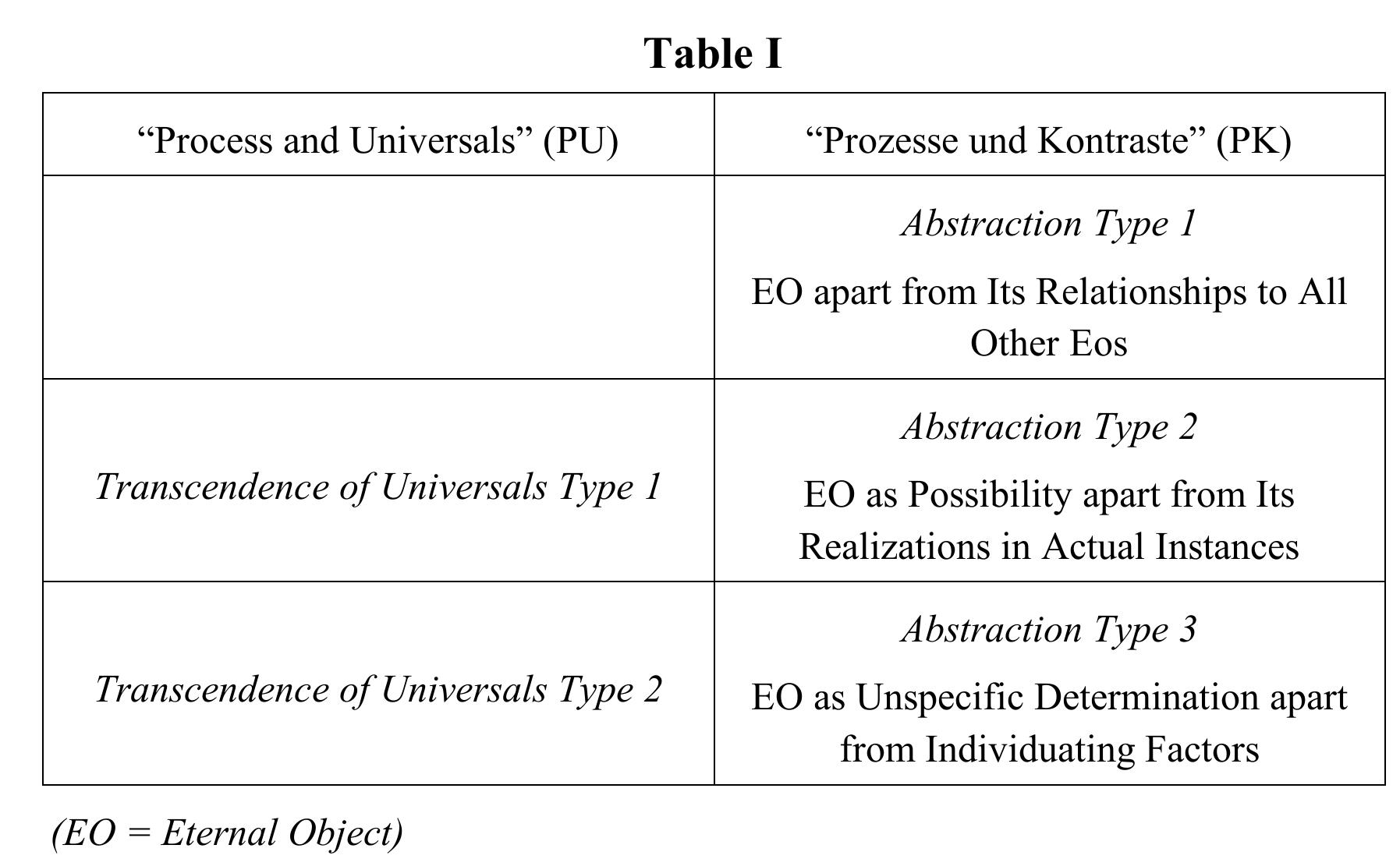
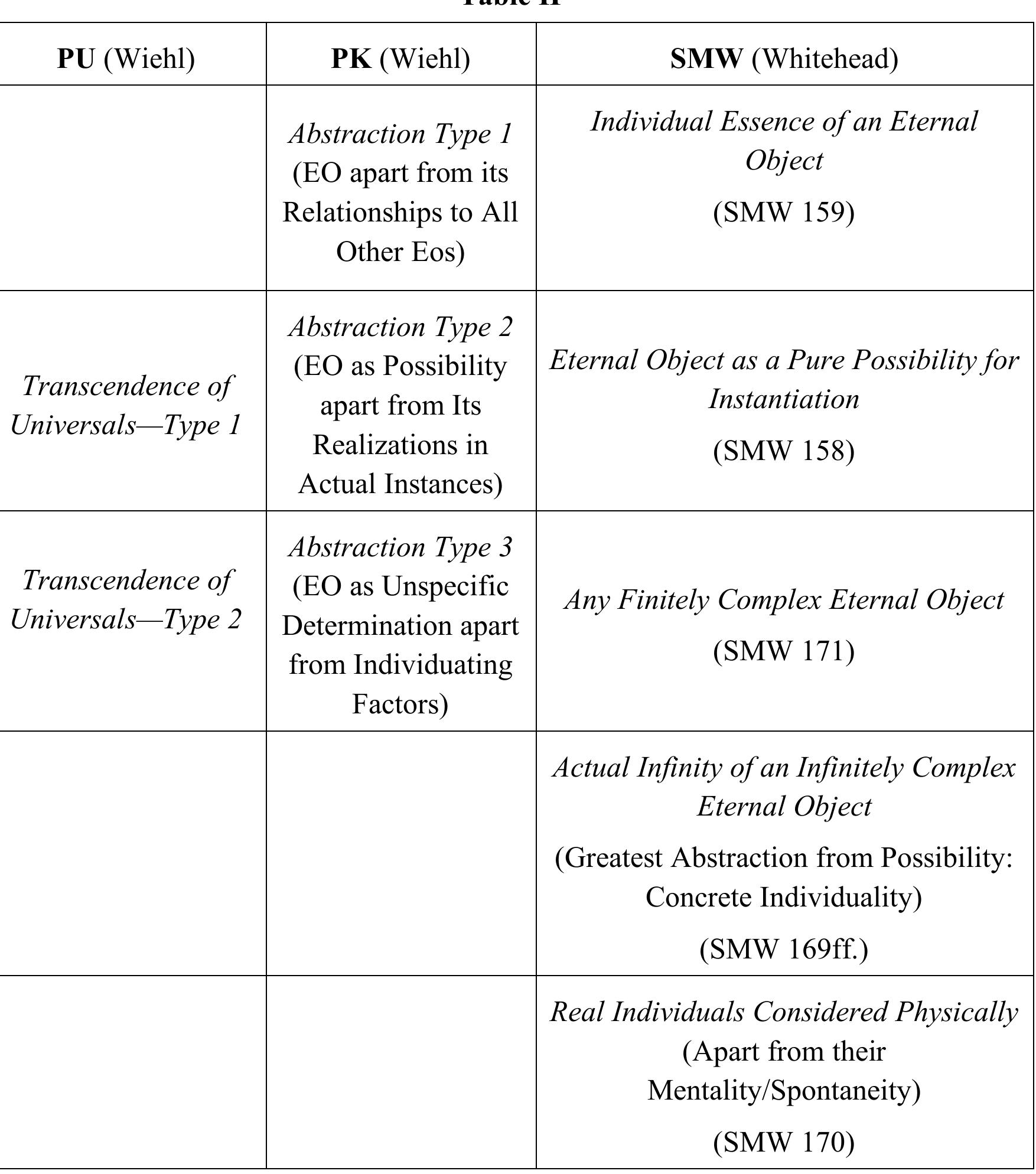
34 Reiner Wiehl
transcendence seems to correspond to the kind of universality or
abstractness he describes on pp. 169ff. These seem to correspond in turn to
the second and third types of abstractness the author distinguishes on p. 73
of “Prozesse und Kontraste.” The gist appears to be that universals are
transcendent (or abstract) in the first sense of transcendence because they
can be multiply instantiated. Each universal (or complex description
consisting of universals) will thus transcend any particular instance the way
the possible transcends the actual (since it is always capable of multiple
instantiation). Accordingly, a more detailed description of something is not
any less abstract, in this sense of abstract, than a less detailed description.
In this sense the whole hierarchy of concepts is abstract, from its first to its
last member. But a complex description employing universals is
transcendent in the second sense of transcendence when it falls short of a
complete description of the qualitative specificity of an individual, and the
more it falls short the more abstract it is. In this sense it can be said that a
more detailed description is less abstract. But no description will ever
achieve full concretion. According to Whitehead “it is impossible to
complete the description of an actual occasion by means of concepts”
(Science and the Modern World, op. cit., pp. 169ff.). Accordingly, no
matter how detailed, no description employing concepts alone will ever be
sufficiently nuanced to be able to pick out an actual individual uniquely,
and it will thus be transcendent in the second sense.
X. The traditional controversy over the nature and status of universals
was concerned exclusively with the predicables of genus and species (that
is, terms or concepts classified as the genus or species of something). It is
the second sense of transcendence that is relevant to this debate because it
is in this second sense that the genus transcends the species and the species
transcends the individual.
XI. Professor Wiehl appears to assume here that classification in terms of
genus and species applies only to things in the sense of stable entities
sustaining a manifold of enduring properties. Since classification is based
on similarity and difference, whatever is classified must sustain such
comparative relations. This certainly implies a manifold of properties. For
example, an item classified must have minimally one different property of
similarity and one different property of dissimilarity to other items in the
classification for each level of its remove from the highest genus. Does this
mean the ultimate items must be enduring things? It is not immediatly clear
why this has to be case.
XII. The reader is advised to consult the index of the corrected edition of
Process and Reality for passages relevant to the concepts of “depth”
(“narrowness”) and “width.” Especially important in this regard are pp.
Process Philosophy and the Problem of Universals 35
105, 110-115, 163-166, 279-280, 317-319. Professor Wiehl has rightly seen
that for Whitehead intensity of feeling depends on depth of relevance and
width of contrast. Width and depth are thus the parameters of the quality
space of enjoyment and satisfaction. Wiehl is also right to see the two-
dimensionality (ibid., p. 166) of this quality space as the critical bridge to
the four-dimensionality exhibited by the extensive continuum in our cosmic
epoch (ibid., pp. 163-166, 91-93, 317-319). Whitehead emphasizes that the
“relationships of metrical geometry” are not intrinsic to the extensive
continuum (ibid., p. 66). “In its full generality beyond that of the present
epoch, it does not involve shapes, dimensions, or measurability” (ibid.). It
includes only “the various allied relationships of whole to part, and of
overlapping so as to possess common parts, and of contact, and of other
relationships derived from these primary relationships” (ibid.).
XIII. For Whitehead there are as many universes as there are occasions
since each occasion is the concrescence of the entire universe from a
unique perspective.
XIV. The idea of a non-metrical “distance” between concepts is
something Prof. Wiehl’s developed in his unpublished doctoral dissertation
Der Begriff in den Anschauungsformen der Mittelbarkeit und
Unmittelbarkeit, nebst einem Anhang über die Kategorien in Whiteheads
“Process and Reality” (1961).
XV. The author may have the following argument in mind. It is possible
to describe motion in ways that do not involve motion, e.g.,
mathematically. The formula expressing change of position in a coordinate
system is a static representation of motion. A similar situation is to be
found in Minkowski space, where motion is represented as a world-line in a
four-dimensional space. Conversely, it is always possible to represent a
body at rest as being in motion in a different coordinate system. This
relativity levels the difference between stasis and kinēsis, being and
becoming. These insights based on metrical considerations can be
generalized. We can perhaps imagine some kind of purely topological
transformations according to which rest is the transformation of motion and
vice versa. Motion and rest become different kinds of projection in a
topology indifferent to either. This kind of topology seems to be what the
author has in mind. Furthermore, he analogizes this event-topology in
which the differences between motion and rest are dissolved into
descriptive transformations to a purely conceptual topology of Ideas, a kind
of description space. Internal relations define both kinds of topological
manifolds (the event-topology and the Idea-topology), and the relation of
(non-metrical!) proximity and distance is the common form of both
topologies. However, the manifolds have only topological properties
36 Reiner Wiehl
(including the aforementioned proximity and distance). They have no
metrical properties. (Professor Wiehl does not explain in this paper how it
is possible to think of proximity and distance non-metrically.) The author
suggests that the topological manifold of events cannot enjoy real motion
or real becoming without taking on a specific metric and that this can
happen only if a third kind of internal relatedness enters the scene, an
internal relation between an event in the event manifold and the manifold
of Ideas. This is what Whitehead called “conceptual prehension” or
mentality. It allows an event to have an inner or intrinsic reality that is not
relative to a description. The interpretation is, to say the least, uncertain and
speculative.
XVI. In stark opposition to the ontology of things, what Professor Wiehl
calls process philosophy in the narrow sense seems to have its raison d’etre
in the infinite distance or difference between the ultimate particular events
and the Ideas in terms of which they can be described. What Professor
Wiehl calls the “primal relationship” between events and ideas is the
mutual involvement of totally disparate things (the word “thing” is used
here out of grammatical necessity and does not signify thing in the strong
sense). For process philosophy, therefore, “participation” itself must be
understood as a radical kind of event that cannot be further explained. By
contrast, the thing ontology has it easy. Things provide an ultimate and
stable point d’appui for a finite number of essential attributes, ensuring that
the distance between lowest subject and highest predicate in a chain of
descriptions or definitions is finite and manageable. Indeed, one of the
things that Aristotle tries to prove (Posterior Analytics A 19-23) is that if
there is an ultimate subject, then there must be a highest predicate that can
be reached through a finite number of definitional steps, and, vice versa, if
there is a highest predicate, then there must be an ultimate subject. The
sequence Aristotle envisions is: [ultimate subject] isdefinition a [proximate
difference] + [proximate genus]; [proximate genus] isdefinition [next up
difference] + [next up genus]; [next up genus] isdefinition … {finite number of
intervening definitions} … [category]. If the ultimate subject (an ultimate
subject is defined as something that is not itself said “of” a subject) is
present “in” a subject , the category will be among the attributive ones
(quality, quantity, relation, etc.); if the ultimate subject is not “in” a subject,
the category will be substance.
XVII. The important contrast here is between a Leibnizian and an
Aristotelian theory of individuation. The author is affirming, contrary to
Leibniz, the position Whitehead seems to be stressing in Process and
Reality (but see the translator’s contribution to this volume for important
caveats), namely that no complication of universals will ever be adequate
Process Philosophy and the Problem of Universals 37
to individuating an actual event. What will be missing is precisely the
haecceitas of the individual. According to Professor Wiehl’s interpretation
of Whitehead, only subjectivity can provide this haecceitas. This does
seem to be Whitehead’s view in Process and Reality—or at least one
important element in it. It may or may not be his view in Science and the
Modern World, where individuality is discussed in terms of an infinite
abstractive hierarchy. If the infinite abstractive hierarchy is supposed to be
a sufficient condition of individuality, then we can say that Science and the
Modern World shares with Leibniz’s view the idea that concepts or
universals do define the individuality of a thing, but it undercuts this view
at the same time by denying that any finite set of universals can adequately
define its individuality. On this interpretation the difference between
Process and Reality and Science and the Modern World would then be: in
Science and the Modern World Whitehead believes that no finite
complication of universals will define an individual, while in Process and
Reality he believes that even an infinite complication of universals is not
sufficient, although it may be necessary. On the other hand, if Science and
the Modern World proposes the infinite abstractive hierarchy only as a
necessary condition of individuality, then there does not seem to be any
necessary conflict between Science and the Modern World and Process and
Reality. However, for reasons that cannot be elaborated here, I develop a
third, more complicated line of interpretation in my contribution to this
volume: in both Science and the Modern World and Process and Reality
the infinite abstractive hierarchy is in one sense only a necessary condition
and in another a sufficient condition of individuality. As an abstract
essence it is only a possible synthesis of universals and thus only a
necessary condition of individuation; as a real essence it is the actually
achieved togetherness of these same universals and thus a sufficient
condition. We cannot make any sense of the difference between possible
and actually achieved, however, without referencing the haecceitas of the
(partially) self-referential subjective becoming that achieves the synthesis.
XVIII. Process philosophy in the narrow sense must take universals
seriously because according to its ontology there are no pre-given things
from which universals could possibly be abstracted in a nominalistic
(conceptualistic) fashion.
XIX. The description in terms of properties is inadequate precisely
because it abstracts from the interiority of events, their private intensity of
feeling, which constitutes their subjectivity. The inadequacy of description
by properties is bound up with Whitehead’s and Wiehl’s rejection of the
Leibnizian theory of individuation. Real individuality eludes the specificity
38 Reiner Wiehl
that can be achieved with genus+differentia descriptions. Real
individuation occurs in the “quality space” of width and depth.
XX. This difficult passage can perhaps be interpreted as follows. What
counts as abstract is one of two things. It can be (1) any unseparated part of
something concrete considered in isolation from the rest of that concretum
(a part by coordinate division of the extensive continuum) or (2) the
content (or subjective result) of a mental act of abstraction holding
something in view that is not a part emerging by coordinate division of
anything concrete and is therefore not “objectively present” in the
extensive continuum. Rather, it will be a part that emerges by some form of
genetic division. Of course, the mental act of abstraction may itself be
something concrete and thus have coordinate parts that are “objectively
present.” Once the act takes its inevitable place in public (objective) time,
for example, its successive phases will constitute coordinate parts of the
time it takes up. But abstractions that are not extensive partitions of the
concrete are strictly mental. They derive from an abstractive activity.
Professor Wiehl’s example is the idea of a thing without subjectivity (a
vacuous actuality), which is in no way “objectively present.” It is not a
coordinate part of the extension of anything concrete, but rather the
isolation and reification of a genetic condition of concretion, namely,
localization in the extensive continuum. Coordinate and genetic division
are used here exclusively in Whitehead’s technical sense of the terms.
XXI. Universals have been underdetermined in the sense of concealing an
ambiguity, ambivalence, or equivocation vis-à-vis the two possible
meanings: general concepts of classification abstracted from and related
externally to the properties of supposedly pre-given things or primordial
Ideas to which ultimate and unique events of happening are themselves
internally related.
XXII. The reference appears to be: “[T]he endeavour to understand
eternal objects in complete abstraction from the actual world results in
reducing them to mere undifferentiated nonentities […] The general
relationships of eternal objects to each other, relationships of diversity and
of pattern, are their relationships in God’s conceptual realization. Apart
from this realization, there is mere isolation indistinguishable from
nonentity” (Process and Reality, op. cit., p. 257).
Abstraction and Individuation in
Whitehead and Wiehl: A
Comparative Historical Approach
Anderson Weekes
In the early twentieth century, Alfred North Whitehead (to the chagrin of
many) conceived a philosophical cosmology in the grand tradition of
western metaphysics.∗ He believed there was a need for such a cosmology,
properly updated to incorporate important scientific developments such as
quantum theory and relativity theory. He was unembarrassed to take as
models for this project the likes of Plato, Aristotle, Spinoza, and Bergson.
The topics were traditional; the theorems were not. Actuality and
potentiality, being and becoming, subjects and objects, universals and
particulars, internal and external relations—these familiar tropes of
classical philosophy found expression in a natural philosophy clearly
indebted to projective geometry, special relativity, universal algebra and
mathematical logic. This paper looks at one of the most ancient and
abstruse of perennial philosophical topics, the career of which intersects
with every great metaphysical system: the principle of individuation.
Whitehead’s contribution to this subject is examined in light of the tradition
he emulates. We want to know what Whitehead’s theory of individuation
is, but this will be unilluminating if we don’t know what issues motivate
philosophers to take one position or another on a question so abstract. What
are the basic positions that have been taken in the traditional debate? Why
were they taken? What should be the parameters of an inclusive taxonomy
∗ In this paper, reference is made to the following editions of Whitehead’s works by
means of the following standard abbreviations: AI: Adventures of Ideas (New York
1967); CN: Concept of Nature (Cambridge 1978); PNK: An Enquiry Concerning the
Principles of Natural Knowledge (New York 1982); PR: Process and Reality. An Essay
in Cosmology, corrected edition, edited by D. R. Griffin and D. Sherburne (New York
1978); S: Symbolism. Its Meaning and Effect (New York 1985); SMW: Science and the
Modern World (New York 1967).
40 Anderson Weekes
of theories of individuation? Where would Whitehead fit in such a scheme?
These are the guiding questions that receive at least partial answers here.
The first part sets the stage by laying out the necessary analytic
vocabulary. I do this by tracking the many different meanings of
abstractness (or universality) that Whitehead distinguishes. Since
abstractness and individuality are correlative counter-notions, each kind of
abstractness delineates individuality somewhat differently. These fine
delineations will prove very useful in keeping track of the traditionally
debated theoretical alternatives. Since these distinctions have been a focus
of Reiner Wiehl’s interpretations of Whitehead, I take as my point of
departure his paper “Process Philosophy and the Problem of Universals”
(PU). I begin with a central, but difficult passage in Professor Wiehl’s
essay concerning the different senses in which universals can be said to
“transcend” particulars, relying for guidance on an earlier essay of his,
“Prozesse und Kontraste” (PK), and on the chapter on abstraction in SMW.
While my interpretation of Professor Wiehl’s difficult paper must remain
tentative, the clarification he facilitates of Whitehead’s analytic apparatus
in SMW is more secure. In part two I examine the contrasting theories that
have dominated the philosophical tradition regarding the relationship of
intuition and thought, which sheds light on the question of individuation.
Part three turns to individuation proper, offering a taxonomy of traditional
positions. Finally, in part four, I examine Whitehead’s own treatment of
individuation in CN, SMW and PR in order to establish the precise points
of agreement and disagreement with the traditional positions delineated in
parts two and three.
A brief word need to be said about my method of presentation, which
follows the order of discovery, dwelling on the structure of the problems in
order then to explore alternative solutions (mainly by retracing the dialectic
of evolving arguments and counter-arguments in the history of philosophy).
This method finds its justification in the nature of the problems considered.
Abstract philosophical problems are entirely discursive phenomena and
their existence depends on an argument or set of arguments for their
existence, giving their specific discursive genesis a primacy that no
solution, however satisfying it may seem, can ever annul.
I note in advance that the argument in each part of this paper reveals the
same two positions as fundamental alternatives. Since the language
required for explicitness and clarity about such an abstract problem is of
necessity somewhat cumbersome, it will be helpful to fix the relevant
terminology at the outset. The basic question is whether individuality is to
be understood as a unique extreme of specificity or as a singularity
somehow beyond or more than specificity. By specificity is meant the kind
Abstraction and Individuation in Whitehead and Wiehl 41
of identity that can be specified without recourse to any indexical (token-
reflexive) acts of reference, that is, by a description that presupposes
acquaintance with universals alone. (Whether we can be acquainted with
universals without having been previously acquainted with particulars is
immaterial. The question is whether, once we are acquainted with
universals, we can successfully pick out an individual using universals
alone. If so, then in such a case individuality coincides with unique
specificity.)
The identification of individuality with unique specificity is sometimes
called “essentialism” because it envisions the individual as being nothing
more than a unique complex or intersection of universals (“essences”).1
Each individual will therefore differ in some perfectly definable way from
every other individual. All individuals, in other words, will differ in specie
(in type) from one another. In this case, to be individual rather than
universal (or concrete rather than abstract) means being the last or most
specific species (one of the infimae species) of a given genus, which would
be comparable to being the last and most complex member (the vertex) of
what Whitehead calls an abstractive hierarchy. Contrariwise, if a
description employing universals alone fails to pick out an individual, then
by implication individuality is something more than extreme specificity.
The question naturally arises what this something more is. How can what is
already typologically unique be further individuated into numerically
distinct instances? Since the answer to this question obviously cannot
consist in specifying what transcends specificity, we should not be surprised
that the question elicits abstruse and exceedingly subtle responses. The
difference between the two positions becomes especially complicated when
essentialism abandons the traditional Aristotelian idea that the complexity
of a thing’s essence is necessarily finite. In that case there is no “last” term
in the specification of the essence. The distinction between singularity and
infinite specificity is more elusive than the distinction between singularity
and unique finite specificity, as the discussion of Whitehead’s theory of
individuation in part four will show.2
42 Anderson Weekes
1. The Abstractness and Transcendence
of Universals
The core insight of Professor Wiehl’s paper has to do with the meaning of
the traditional concept of universals. This concept suffers from a
fundamental ambiguity. Even process philosophy, he believes, is not
immune to this failing. It inherits the failure of the philosophical tradition
to distinguish unequivocally between two very different ways that
something can be said to transcend particulars and hence to be abstract or
universal. This is stated, but not altogether explained, in his paper when he
refers at the close of part one to the “ambiguity of traditional process
philosophy,” which, he says, “has to do with the meaning of
transcendence.” Since “universals,” “abstractions,” and “eternal objects”
are roughly co-extensive notions (in Whitehead and Wiehl), all defined by
the same relation of “transcendence,”3 these terms will presumably all
suffer from the same ambiguity. Bearing this in mind, we can begin to
unpack Professor Wiehl’s meaning simply by collating texts in Whitehead
and in Professor Wiehl’s earlier writings bearing on the ambiguity of any
of these rubrics.
In PU Professor Wiehl states, somewhat enigmatically:
One of the two meanings of transcendence construes it in reference to the
totality of a given hierarchy of concepts and value-determinations. The other
meaning arises from the primal relationship […] that the hierarchy of
concepts and values enters into with things or events. It involves the
transcendence of a part of the hierarchy—in the extreme case, the
transcendence of the highest or of the lowest in the hierarchy—vis-à-vis the
being for which the hierarchy functions as a predicative order.
Happily, we can turn to an earlier essay for some elucidation here. In PK
Professor Wiehl distinguished three ways that Whitehead’s eternal objects
can be said to be abstract.4 First, eternal objects are abstract insofar as each
one can be considered apart from its relationships with all other eternal
objects. Secondly, they are abstract insofar as they are possibilities for
realization considered apart from the actual givenness of a real thing.
Thirdly, they are abstract insofar as they are unspecific determinations
considered apart from individuating factors (such as, for example, generic
predicates). I suggest that the two meanings of transcendence distinguished
in the quotation above correspond to the second and third meanings of
abstractness noted in PK:
Abstraction and Individuation in Whitehead and Wiehl 43
Table I
“Process and Universals” (PU) “Prozesse und Kontraste” (PK)
Abstraction Type 1
EO apart from Its Relationships to All
Other Eos
Abstraction Type 2
Transcendence of Universals Type 1 EO as Possibility apart from Its
Realizations in Actual Instances
Abstraction Type 3
Transcendence of Universals Type 2 EO as Unspecific Determination apart
from Individuating Factors
(EO = Eternal Object)
Let’s pursue the triad from PK for the moment. Since these distinctions
are meant to gloss Whitehead’s discussion of abstraction in chapter ten of
SMW, it makes sense for us to seek their basis in this critical text.
Professor Wiehl’s first kind of abstraction, I suggest, corresponds to what
Whitehead calls the “individual essence” of the eternal object, which
Whitehead contrasts with its “relational essence.”5 According to its
individual essence, the eternal object “is what it is […] considered in
respect to its uniqueness,”6 while the relational essence involves “its
reference to other eternal objects.”7 The individual essence abstracts from
the eternal object’s relations to other eternal objects, and this abstraction is
justified because “eternal objects are devoid of real togetherness: they
remain within their ‘isolation’.”8
The second type of abstractness seems to correspond to what Whitehead
has to say about eternal objects as “entities which transcend [the]
immediate occasion [of cognition] in that they have analogous or different
connections with other occasions of experience.”9 As possibilities for
realization, eternal objects are capable of multiple instantiation. Any
instance of an eternal object thus transcends its particular instance as
something identically instantiated elsewhere or inherently capable of such
multiple instantiation. It is by way of this inherent possibility for
instantiation that unrealized eternal objects (whether completely unrealized
or just unrealized in a given case) are, according to Whitehead, able to
become relevant to occasions that do actually exist.10
These first two types of abstractness form a necessary couplet defined by
contrast. Whitehead proposes a relational ontology according to which
44 Anderson Weekes
relations are constitutive of what things are. Therefore, nothing can be
concrete apart from its relations. Since there are two kinds of relations,
external and internal, and eternal objects possess both of them, there will
evidently be at least two ways for an eternal object to be abstract,
depending on which type of relation is abstracted from. Eternal objects
have internal relation with other eternal objects (e.g., red is not blue and
wouldn’t be red any more if it were, so its difference from anything not-red
is an internal relation; red and blue are both colors and couldn’t be red and
blue without having this much in common with one another, so their
generic similarity is an internal relation). And, eternal objects have external
relations with the actual entities that instantiate them (it makes no
difference to red whether anything is red right now, so its being
instantiated is an external relation as far as red is concerned). The eternal
object apart from its internal relations yields abstraction in sense one; the
eternal object apart from its external relations is abstraction in sense two.
The possibility of these two kinds of abstraction guarantee that eternal
objects have a definite identity that is not context dependent (does not vary
in relation to other eternal objects or depend on their concrete realization).
The third type of abstractness seems to correspond to what Whitehead
means when he says that the distinguishing characteristic of the mental is
the “abruptness” of “a finite complex concept.”11 This is one of
Whitehead’s most original contributions to philosophy and requires some
careful elucidation. Along the way we will distinguish yet two more senses
of “abstract,” giving us a total of no less than five.
First of all, to understand what Whitehead has in mind when he describes
“abruptness” as a kind of abstraction, we must examine an important
distinction he makes between two diametrically opposed measures of
abstraction. He employs this distinction to construct a new oppositional
couplet, in which abstraction as abruptness is one of the contrasted terms.
Just as senses one and two are terms of a necessary couplet whose
respective meanings are illuminated by their contrast, so too with
abruptness and its opposite. In order to understand abruptness, then, we
will have to look at the kind of abstraction with which it is paired by
contrast. These latter two meanings of abstraction will become senses three
and four in our tally.
The diametrically opposed measures of abstraction Whitehead
distinguishes are “abstraction from actuality” and “abstraction from
possibility.”12 Whitehead stresses that “some confusion of thought has been
caused” because they run in “opposite direction[s].”13 Let’s take as an
example the description “a round red rubber ball.” This description is more
concrete than “a round rubber ball,” which again is more concrete than “a
Abstraction and Individuation in Whitehead and Wiehl 45
round ball.” The more complex description is less abstract because it more
closely approximates the plenary detail of the actual concrete individual.
But by the same token it is able to apply to fewer things. It does not just
apply to fewer things in fact. Rather, it is capable of applying to fewer
things. In this latter respect, therefore, it can also be said to be more
abstract in a well defined sense: through greater specificity it abstracts
more from the scope of possibility and concentrates on a narrower scope of
potential realization. Since a description achieves greater specificity
through greater complexity, complexity is a measure of abstraction from
possibility, while simplicity is a measure of abstraction from actuality. This
same insight is expressed in ordinary logic books by saying that the
extension and intension (or “content”) of a class-concept bear an inverse
relation to one another. Whitehead puts it this way:
[W]ith a high grade of complexity we gain in approach to the full
concreteness of [an actual occasion], and with a low grade we lose in this
approach. Accordingly the simple eternal objects represent the extreme of
abstraction from an actual occasion; whereas simple eternal objects
represent the minimum of abstraction from the realm of possibility. It will, I
think, be found that, when a high degree of abstraction is spoken of,
abstraction from the realm of possibility is what is usually meant—in other
words, an elaborate logical construction.14
Returning to Wiehl’s definitions, it should be obvious that abstractness in
his senses (1) and (3) are both kinds of abstraction from actuality. It should
also be obvious that abstractness in Wiehl’s sense (1), that is, the simple
eternal objects in their isolation, will coincide with the greatest abstraction
from actuality, even if this is not the hallmark by which sense one is
defined. (It is defined by the isolation of eternal objects from one another.)
It is abstraction in sense three that is defined by the hallmark of abstraction
from actuality. But note that it is defined by abstraction from actuality as
such, which means any degree of abstraction from actuality. This
establishes a clear conceptual distinction between senses one and three,
even if the extension of A1 is wholly included in that of A3:
A1 = Abstraction of Eternal Object from Its Relations to All Other Eternal
Objects (implying greatest abstraction from actuality);
A3 = Any Degree of Abstraction from Actuality (implying abstraction of
eternal object from its relations to at least some of the other eternal
objects).15
We have also established a clear distinction between senses one and two
(abstraction from internal versus abstraction from external relations). But
we wanted most to understand the difference between senses two and three.
Remember that our goal is to understand the difference between the two
kinds of transcendence broached in PU and that my hypothesis is they
46 Anderson Weekes
correspond to abstraction in senses two and three in PK, which is a more
manageable text because its bearing on Whitehead’s own distinctions is
more transparent. However, establishing the conceptual distinction between
senses two and three is not as straightforward as the other distinctions. Isn’t
abstraction in sense two defined as abstraction from actuality just as much
as sense three?
In order to understand the difference between senses two and three we
must understand what it means for sense three to be defined by the concept
of abruptness, and this, as noted, requires us to examine the concept
Whitehead contrasts with abruptness, which is the concept of the extremity
of abstraction from possibility. Abruptness is abstraction in sense three, and
the extreme of abstraction from possibility is the fourth sense of
abstractness that we must consider. Once we understand how senses three
and four form an oppositional couplet, we will be positioned to come back
to sense two (the abstraction of eternal objects from their external relations)
and see how it differs from abruptness. As an oppositional couplet, sense
three versus sense four may seem lopsided since the one term is abstraction
from actuality (of any degree), while the other is specifically the extreme of
complete abstraction from possibility. Sense one versus sense four might
seem to be a more balanced couplet (because they are contraries: extreme
abstraction from actuality versus extreme abstraction from possibility), but
we will see that it is three and four that form the appropriate contrast. This
begins to make sense as soon as we realize that they are in fact
contradictories. For extremity of abstraction from possibility means no
abstraction from actuality and thus turns out to be another name for
concreteness, so the contrast in question is some (any) abstraction from
actuality versus no abstraction from actuality, which simply means non-
concrete versus concrete (or, as we shall shortly see, finite versus infinite
abstractive hierarchy of eternal objects).
Whitehead’s description of what I am subjoining to Wiehl’s list as sense
(4) is logically precise. First Whitehead defines the notion of an
“abstractive hierarchy of concepts (or eternal objects) based upon a set g of
simple eternal objects.”16 G can be a finite or an infinite set of simple
eternal objects. The abstractive hierarchy is a set of combinations of those
simple eternal objects, and these combinations can be finite or infinite.
Where, for example, the combinations are an open set defined by recursive
operations, the abstractive hierarchy will be infinite, regardless of whether
the base is finite or infinite, and where the combinations are finite,
Whitehead defines the hierarchy as finite, again regardless of whether the
base is finite or infinite. He then tells us what the extremity of abstraction
Abstraction and Individuation in Whitehead and Wiehl 47
from possibility is; that is, he tells us what individuality means for the
philosophy of organism:
In any actual occasion a, there will be a group g of simple eternal objects
which are ingredient in that group in the most concrete mode. This complete
ingredience in an occasion, so as to yield the most complete fusion of
individual essence with other eternal objects in the formation of the
individual emergent occasion, is evidently of its own kind and cannot be
defined in terms of anything else. But it has a peculiar characteristic which
necessarily attaches to it. This characteristic is that there is an infinite
abstractive hierarchy based upon g which is such that all its members are
equally involved in this complete inclusion of a [understand a subjective
genitive: “involved in this complete inclusion of (them by) a].17
The significance of this does not become clear until Whitehead adds: “The
existence of such an infinite abstractive hierarchy is what is meant by the
statement that it is impossible to complete the description of an actual
occasion by means of concepts.”18 An actual individual is something no
finite description can capture: no finitely employed inventory of concepts,
no finite set of combinations, no finite iteration of their combinations. It is
infinitely complex or infinitely nuanced (depending on how you look at it).
This is abstraction in sense four: extreme of abstraction from possibility,
i.e., actual concrete individuality.19 Simply by negating this concept of
extremity of abstraction from possibility we arrive at a perfectly well-
defined sense of abstractness from actuality: any finite description, no
matter how complex, will fall short of actual individuality and so be
abstract.20 This is our sense three, abruptness, which we can now explain.
Since the description or analysis of any concrete individual is always finite,
at some point it is discontinuous. It breaks off abruptly with a
determination or characteristic that is not further qualified in the
description, even though that quality in the individual is in fact still more
nuanced, indeed, infinitely more nuanced, than the description allows.
One of Whitehead’s boldest and most ingenious claims is that finite
abstractive hierarchies are not artifacts of our descriptions, but rather exist
independently of consciousness. Although they do play an important role as
the content of all conscious mentation, they are also factors in the
constitution of things that do not think and need not be thought about.
Things that fall short of actual individuality exist and play a critical role in
the make-up of what is fully actual and individual, whether or not it is a
conscious or even a living type of individual. And this yields us our fifth
sense of abstractness, for if the abstract “really exists” and contributes to
the concreteness of things, then any ontology limiting itself to what is
concrete in the more conventional sense is ipso facto abstract.21 Such an
ontology would fail on its own terms to be an ontology of the concrete if
the concrete is itself actually informed by a constitutive relevance of the
48 Anderson Weekes
abstract. For example, a description of a human being that ignored values
and goals would obviously be far more abstract than one that took them
into account. This constitutive relevance of the abstract is what Whitehead
calls mentality. But he means by mentality something relevant to the
constitution of all beings, not just conscious ones. Mentality, in other
words, is broader than consciousness, and whether it is conscious or not, it
presupposes rather than generates its abstract objects, which are finitely
complex sets of eternal objects. It is best to take this provocative
proposition in two steps: first, the Platonistic claim that thought
presupposes rather than generates its abstract objects; second, the
peculiarly Whiteheadian claim that these objects contribute to the
specificity of more than just conscious thinking.
(1) Whitehead’s belief in the ontological autonomy of abstractions in
senses one, two, and three has obvious affinities with the so-called
Platonism of such nineteenth century thinkers as Bolzano, Lotze, Frege,
and Meinong, who were all agreed that non-actual or incompletely
individuated things can and do have some kind of being.22 In fact,
Meinong’s non-existent objects offer a particularly good example of the
abruptness of a finitely complex set of eternal objects. The golden
mountain has exactly two properties: it is golden and it is a mountain. It
makes no sense to ask what the weather is like on the golden mountain
unless we stipulate that, too. But a real mountain will have properties we
have not stipulated, but can discover—infinitely many of them. Thus, on a
real mountain there will be weather, an average annual rainfall, a standard
deviation to the average annual rainfall, a change in the standard deviation
over periods of time, and so on and so on with qualifications and
refinements indefinitely. Thus, although every description of the mountain
is finite, it is a description of a real mountain only because the description
could be continued indefinitely. By contrast, whenever we think about
something unreal (or not yet real, like a goal), we are able to capture what
we mean by a description that stops satisfactorily with a finite amount of
detail. It is easy to see that everything we normally think of as physical
proffers material for an interminable description, while everything we
normally think of as mental, such as concepts, wishes, theories, fantasies,
or descriptions themselves, is (and must be) finite and abrupt in this way.
The idea that finitude of content characterizes the mental thus accords with
our experience. But the usual assumption is that this finitude of content is
an artifact of consciousness. What the logical Platonists of the nineteenth
century claimed was that these mental objects did not depend on thought,
but on the contrary that thought depended on the self-sufficiency of these
objects, which, even if they do not and indeed cannot exist in the most
eminent way, nevertheless have some kind of originary presence.
Abstraction and Individuation in Whitehead and Wiehl 49
(2) But for all of the thinkers mentioned, their ideal forms (or “non-
psychological concepts” or “pure objects”) tend to be conceived as purely
logical entities, and as such they are physically and metaphysically inert,
relevant only to cognition. Whitehead, on the other hand, wants to solve the
problem that Aristotle had already exposed in Plato’s original version of
the theory of forms: how can they ever be causes of anything if they are so
ethereal and derealized as to be inert cognita? Whitehead’s metaphysics of
process is meant to explain how finite abstractive hierarchies—independent
of their being excogitated by conscious subjects—affect the outcome of
events in nature. Whitehead believes it is the abruptness of finitely complex
eternal objects that allows for a discontinuity of otherwise deterministic
processes and explains how the irruption of something genuinely new into
the world is possible. The constitutive relevance of the abstract to the
concrete creates a leeway for unpredictable development.
Whitehead may be the only philosopher who has offered a purely logical
definition of the mental. “This breaking off from an actual illimitability is
what in any occasion marks off that which is termed mental from that
which belongs to the physical event to which the mental functioning is
referred.”23 Mentality is defined by the abruptness of a finite abstractive
hierarchy, which not only accords with our own experience of mentality,
but also gives us a general criterion for mentality that allows us to
generalize it to “inanimate” things without falling prey to animism and
anthropomorphism. Mentality is the discontinuity of natural processes that
makes room for spontaneity and novelty in the outcome. Table II
summarizes our results so far.
We can now understand the important conceptual differences between the
second and third types of abstractness and finally return to the two types of
transcendence (which I have suggested correspond respectively to the
second and third kinds of abstractness). Universals are transcendent in the
second sense of abstractness (first sense of transcendence) because they can
be multiply instantiated. Each universal thus transcends any particular
instance the way the possible transcends the actual. But universals are
transcendent in the third sense of abstractness (second sense of
transcendence) inasmuch as they fall short of a complete description of the
qualitative specificity of an individual, which in an important sense they
always do. For no matter how detailed, no description employing an
inventory of concepts finitely will ever be sufficiently nuanced to be able to
pick out an actual individual uniquely. The description will be applicable to
multiple individuals (and thus transcend them) not so much because of an
inherent possibility of multiple instantiation, but because it leaves out
50 Anderson Weekes
distinguishing nuances. It will therefore be transcendent in a sense clearly
distinct from the former.
Table II
PU (Wiehl) PK (Wiehl) SMW (Whitehead)
Abstraction Type 1 Individual Essence of an Eternal
(EO apart from its Object
Relationships to All (SMW 159)
Other Eos)
Abstraction Type 2
(EO as Possibility Eternal Object as a Pure Possibility for
Transcendence of Instantiation
apart from Its
Universals—Type 1
Realizations in (SMW 158)
Actual Instances)
Abstraction Type 3
Transcendence of (EO as Unspecific Any Finitely Complex Eternal Object
Universals—Type 2 Determination apart
from Individuating (SMW 171)
Factors)
Actual Infinity of an Infinitely Complex
Eternal Object
(Greatest Abstraction from Possibility:
Concrete Individuality)
(SMW 169ff.)
Real Individuals Considered Physically
(Apart from their
Mentality/Spontaneity)
(SMW 170)
It is important to see that these two kinds of transcendence can, but need
not, coincide. This will depend on one’s theory of individuation, which
brings us to the nerve of all these distinctions. The divisive question will
be: can something be abstract in sense two (capable of multiple
instantiation) without being abstract in sense three (an incomplete
description)? Depending on how she understands individuation, a
philosopher will have a different understanding of abstractness and
universality, and she will tend to privilege one or another of the
Abstraction and Individuation in Whitehead and Wiehl 51
discriminated senses of abstractness accordingly. But the converse is just as
true: commitment to the priority of one or the other senses of abstractness
will largely determine one’s theory of individuation.
1.1. Universality and the First Type of
Transcendence
Defining universality primarily in terms of the possibility of multiple
instantiation suggests that universals become instantiated by becoming the
attributes of a thing, which instantiates and thus individuates them. It is
crucially important to see that the thing individuates the type without
further specifying it, for any specification would ipso facto belong to the
type and be capable of multiple instantiation! This implies that what
universals lack is not (necessarily) adequate specificity, but (necessarily)
the indefinable quality Scotus called haecceitas.
Haecceitas is the quality of unique singularity that makes a thing capable
of being the ultimate referent of ostensive indication: this one as opposed to
that one, where both are identical in type. This possibility means that
individuality is somehow something more than extreme specificity of type.
Individuality must involve something sui generis and indefinable: a
discriminated singularity beyond anything that could be specified
employing nothing but abstract concepts and universal descriptors.
Consequently, if we restrict ourselves to understanding universality
according to the first type of transcendence, there would be no in-principle
reason why a complete description of an individual thing by a finite set of
universal predicates should be impossible. Since individuality in this case
would not depend on infinite nuance, the lack of infinite nuance implied by
the possibility of a complete but finite description would not be at odds
with the requirement that what exists be fully individuated. The description
would not lack adequate nuance, but only the primitive, indefinable quality
of the thing’s haecceitas that no description can capture. Furthermore, even
though it was a complete description of an individual, it would still be
capable of multiple instantiations: two individuals could be identical in all
respects and still be different individuals simply because they were
different things, differing only in virtue of their respective haecceitas. And
last but not least, on this theory of individuation there would be no in-
principle reason why even an infinite abstractive hierarchy must uniquely
identify an individual. Decoupling specificity from individuality not only
means that individuality does not depend on infinite nuance (as its
necessary and sufficient condition), but also that infinite nuance fails to
52 Anderson Weekes
entail individuality even in the manner of a sufficient (but not necessary)
condition. All this means is that an infinite abstractive hierarchy would in
and of itself still lack haecceitas. Consequently, there would be no reason
why the same infinite abstractive hierarchy could not be multiply
instantiated. Multiple individuals could have the same infinitely nuanced
specificity and would differ only numerically. Individuality would thus
involve a discriminated singularity beyond what could be specified even in
an infinite description. On this understanding of universality, something
can be abstract in sense two (capable of multiple instantiation) without
being abstract in sense three (incomplete), but not vice versa. Sense two
thus becomes the fundamental sense that will define what the
transcendence of universals essentially means: lack of haecceitas.
We saw that defining universality primarily in terms of the possibility of
multiple instantiation suggests that individuation happens when universals
become instantiated as attributes of a thing. Consequently, this view of
universality leads quite naturally to the idea that haecceitas is something
that belongs exclusively and inalienably to the thing-substrate. Other
interpretations of haecceitas are of course possible. Some will be
considered later in this paper: haecceitas as relative or absolute space-time
location, relative position in (or in relation to something in) the
immediately experienced intuitive manifold, indication by token-reflexive
reference. However, since these interpretations have a hard time expressing
what it is that does the instantiating in the token-type relationship, they are
intuitively less obvious than the thing-theory of individuation, for which a
“thing” is simply the requisite vehicle for instantiation. The interpretation
of individuation most readily suggested by the first kind of transcendence is
therefore the Aristotelian one, which associates individuation with an
ineffable thisness of things. Nevertheless, multiple instantiation of the same
type remains possible even if we decide to get rid of “things” and
reinterpret haecceitas as, say, relative or absolute space-time location or
token-reflexive indication within a field of immediate acquaintance.
Discussion of these more complicated options is reserved for subsequent
parts of this paper. But a general reservation about the singularity-beyond-
specificity view of individuation belongs here. A pre-requisite of this view
of individuation seems to be that we allow individuals instantiating the
same type to differ in “accidental” respects and count among the accidents
their relational properties inter se, such as their relative space-time
location. Otherwise we would indeed be unable to discriminate them and
thus unable to identify them (as being distinct but “the same”). This
consideration suggests that the various theories of haecceitas (unique
Abstraction and Individuation in Whitehead and Wiehl 53
thinghood, space-time locus, object of token-reflexive reference) are more
intimately connected than might have seemed at first glance.
1.2. Universality and the Second Kind of
Transcendence
Defining universality in terms of the shortfall of any finite description vis-
à-vis the richness of the individual suggests that a complete description, if it
could be achieved, would not lack individuality and would thus be ipso
facto incapable of multiple instantiation. But a complete description cannot,
on this telling, be achieved because individuality is the result of a synthesis
of universals that is infinitely complex or nuanced (an infinite abstractive
hierarchy). On this view of individuation, multiple identical individuals
would be impossible. All individuals would have to be different in specie
even though the difference could not be specified in any finite description.
Haecceitas as an indefinable formal addition to things would be
superfluous to their individuality. The individual would be unique precisely
and only because it is infinitely complex. It would differ in specie from
every other individual simply because there would be no other effective
principle of numerical individuation than specificity. On this understanding
of universality, nothing can be abstract in sense two without being abstract
in sense three. Indeed, it can be abstract in sense two only because it is
abstract in sense three. Sense three thus becomes the fundamental one that
defines what the transcendence of universals essentially means: lack of
complete specificity.
If this reading of the two kinds of transcendence is correct, then we are
finally in a position to understand one of the principal themes in Professor
Wiehl’s paper: how each meaning of transcendence is differently biased in
regard to the primacy of things and processes. Privileging the first meaning
of transcendence leads to a thing ontology and an Aristotelian theory of
individuation. On this account, formally identical individuals are possible:
two things can be the same in all specifics, and yet numerically distinct
simply because they are numerically distinct things. Privileging the second
meaning of transcendence leads away from a thing ontology to an
understanding of the individual as an unrepeatable singularity (an event)
and hence to a radical process ontology and a Leibnizian theory of
individuation. On this account, instantiation would not require a substrate,
such as things or “matter” or intuition or space-time. Instantiation would
coincide with the logical fact of extreme specificity. But by the same token,
instantiation would be incapable of adding to type-specification any further
54 Anderson Weekes
degree of individuation. Multiple identical individuals would therefore be
impossible. All individuals would be different in type.
Here is perhaps the place to interrogate the mischief-making Principle of
the Identity of Indiscernibles. Let’s bracket for a moment the question of
finite versus infinite descriptions and focus simply on the idea of multiple
individuals with identical descriptions. Surely the Principle of the Identity
of Indiscernibles holds in a very basic sense that if there were absolutely no
differences between two individuals then they would indeed be the same
individual. But if that were the last word on the matter, then the question
we are asking—can numerically distinct individuals be the same?—would
be senseless. The short answer would be: of course not, otherwise they
would not be numerically distinct. Now this short answer may seem to be
the very claim of the Principle of the Identity of Indiscernibles, but in fact it
is not. The short answer, because it takes itself to be a tautology and hence
self-evident, denies the meaningfulness of the question, which, it assumes,
is asking about the possibility of something impossible, the possibility,
namely, of a contradiction. But the Principle of the Identity of
Indiscernibles—while it also gives a negative answer to the question can
there be identical individuals?—is nevertheless giving a very different
answer than the short one, for it gives a negative answer to our question in
a context where the question itself is assumed to be meaningful. The
Principle of the Identity of Indiscernibles, in other words, does not take
itself to be trivially true, but to be a strong metaphysical claim, the falsity
of which is not logically impossible. An easy way to illustrate this
difference is to point out that the short answer has no consequences, while
Leibniz famously employed his principle to prove the unreality of space.
The Principle of the Identity of Indiscernibles is therefore a principle of
strong metaphysical consequence, and both its truth and its falsity have
important implications that would, in the case that obtains, constitute a
priori knowledge about the world. Thus, to understand the Principle of the
Identity of Indiscernibles, we must understand the conditions under which
it is meaningful to ask if two things can be the same. We already have what
we need to do this. I noted above that a pre-requisite of the singularity-
beyond-specificity view of individuation (such as the haecceitas theory)
seems to be that we allow “identical” individuals to differ in “accidental”
respects. Otherwise there could be no sense in asking if things that are
different (different enough to count) are “the same,” and nothing could be
considered the same as anything other than itself. This observation reveals
what we are looking for. There are specifically two assumptions that make
the sameness of discernibles a meaningful question and the Principle of the
Identity of Indiscernibles, as well as its denial, a matter of strong
Abstraction and Individuation in Whitehead and Wiehl 55
metaphysical consequence. First, the idea (or possibility) of multiple
instantiation depends on a distinction between accidental and essential
properties or at least between absolute and relative ones. If all predicates
were on the same footing, it would be impossible to see how we could ever
say two “distinct” items were the “same.” What we mean when we say this
is ostensibly that they differ only in “accidental” respects. And yet these
accidental differences seem to be essential to the possibility of a plurality
of “identical” instances! Perhaps, however, they are essential only for our
recognition of such individuals. This consideration points up the second
important assumption in play here. The idea (or possibility) of multiple
instantiation presupposes a certainty that accidental or relative predicates,
however necessary they may be for our a posteriori discrimination of
otherwise identical individuals, are unable to individuate them. If we
assume otherwise, the Principle of the Identity of Indiscernibles (or its
denial) ceases to be a principle of strong consequence that tells us
something a priori about all the individuals in the world (namely: that they
are/are not all different in specie; that they do/do not possess a singularity
beyond specificity) and reverts to being an undeniable tautology of no
philosophical value.
It is significant that endorsement of these two assumptions characterizes
the positions of both Aristotle and Leibniz, despite the fact that it leads
them to opposite conclusions about individuation. In both cases, however,
it leads to strong a priori conclusions about the nature of individuals.
Assuming the Principle of the Identity of Indiscernibles, Leibniz argues:
because space (i.e., relative predicates) cannot individuate things, their
relative difference in space (their presence at different locations)
presupposes that they are already differently individuated in their absolute
properties. In other words, the Principle of the Identity of Indiscernibles is
able to prove the unreality, superfluousness, or derivativeness of any
discriminating predicates over which it is not defined in the first place.
Leibniz’s conclusion is that all individuating differences (any differences
resulting in the possibility of discrimination) have to be essential or derived
from essential differences. Since spatial location is a relative difference, it
must be derived from absolute differences.24
Aristotle begins in a similar place, but because he employs a different
principle, he arrives at a different place than Leibniz. The principle
Aristotle assumes is the following: what is essential is precisely what things
of the same natural kind25 have in common. He thus argues: since (a)
accidents cannot individuate things and (b) what is essential is precisely
what things of the same natural kind have in common, something else,
which is sui generis, neither accidental nor essential, must be at work in
56 Anderson Weekes
individuation. For Aristotle, this is the actuality of the essence, which is not
a universal (a commonality) any more than it is an accidental singularity.
This theory is remarkable, for at the same time that it explains individuality
without recourse to accidental predicates, it allows individuals to be distinct
and yet essentially identical. In other words, demoting discriminating
predicates to the status of accidents incapable of individuating a thing and
incapable of derivation from what individuates it abrogates the identity of
indiscernibles in principle. Aristotle and Leibniz therefore agree (a) on a
distinction between relative and absolute predicates and (b) that relative
predicates cannot individuate anything. For Aristotle this means that the
Principle of the Identity of Indiscernibles is just not true. For Leibniz it
means that relative differences must be the external reflection of absolute
ones so that the validity of the Principle of the Identity of Indiscernibles is
preserved. An important variation on the arguments we are considering,
which forfeits any ability to draw a priori conclusions from the Principle of
the Identity of Indiscernibles, holds that individuals can be essentially the
same (like Aristotle and unlike Leibniz), but that accidents are after all
enough to individuate them inter se (contrary to both Aristotle and
Leibniz). This is a not uncommon position in the history of philosophy. It
appears to be the teaching of many Scholastics and of Aquinas in
particular.
Now let us go a step further and examine what happens if we abstain from
making such a predicate-type distinction as essential versus accidental or
absolute versus relative. For one thing, as noted above, the Principle of the
Identity of Indiscernibles becomes an insignificant tautology. All things
will be the same thing or differ in some predicate, end of story. But even if
we envision a world in which all predicates are of a homogenous type, we
can still draw an ideal contrast and ask if the predicates in this world are all
essential (or all like the ones we were calling essential) or all accidental (or
all like the ones we were calling accidental). The thesis “all differences
among individuals are accidental differences (i.e., all properties are
accidents; there are no “real” essences) should perhaps make us think of
Ockham and the Nominalists. The thesis “all differences among individuals
are essential differences” (i.e., there are no “accidents;” all properties are
essential to what a thing is) should perhaps make us think of the Stoics and
of Spinoza.
We can summarize our results by reviewing the different kinds of
abstractness and seeing how all but the last involve a kind of
transcendence. In sense (1) each eternal object is abstract insofar as it
transcends the others in its individual essence. In sense (2) each eternal
object is abstract by virtue of its inherent possibility for multiple
Abstraction and Individuation in Whitehead and Wiehl 57
instantiation. It thus transcends each and every actual instance. In sense (3)
any finite complex of eternal objects is abstract simply because it is finite:
everything fully concretely real is infinitely specific. The finitely complex
eternal object thus transcends individuals the same way the genus
transcends the species. In sense (4) the concrete is abstract insofar as it is
the extreme of abstraction from possibility. Since this coincides with an
infinite specificity, the adequate description of which would, if we only
could execute it, never break off at any last specification, it transcends any
description the way the infinite transcends the finite. In sense (5) the
physical is abstract if taken apart from the mental. The reflections that led
to this last conclusion can be recapitulated as follows. In and of itself, the
finite abstractive hierarchy lacks any concreteness. But it is nevertheless
relevant to the process by which things become concrete. As mentality, this
relevance becomes causally efficacious, exercising a force of innovation
discontinuous with what already exists. It thus contributes something to the
fullness of a thing’s concretion, and nothing can be considered fully
concrete in abstraction from the forms of abstractness that have informed
its coming to be. It is this kind of consideration that allows Whitehead to
see in materialism an entirely abstract doctrine.
2. Two Ways of Distinguishing Concepts
and Intuition
A distinction between different faculties (or modalities) of cognition in
terms of a fundamental polarity or positive/privative contrast is almost
universal in the history of philosophy. But how the contrast operates has
been understood in two very different ways. The following table of
contrasts associated with traditional theories of cognition will illustrate the
common ground, which evidently goes beyond a mere pattern of polar
contrasts to include a similarity in the content of what functions
contrastively. The table draws freely from the history of philosophy and is
not meant to be either exhaustive or systematic. A few examples from each
period suffice to indicate a large pattern of agreement. Consider the
following spectrum of oppositions that runs the gamut from Parmenides to
Frege:
Table III
doxa aletheia
aisthesis noesis
58 Anderson Weekes
katalepsis prolepsis/ennoia
species impressa species expressa
sensation intellection
perception understanding
intuition concept
sensibility understanding
receptivity spontaneity
intuition signification
object concept
Similarly, opposite qualifications attach to the respective modalities (or to
their activities or contents or objects). Here are a few of the familiar ones
(there is no ordered, one-to-one correspondence between the items in the
preceding and following lists; the correspondence is only between the
groups):
Table IV
visible invisible
unbounded bounded
relative absolute
fleeting remaining
non-intelligible intelligible
deceptive faithful
particular universal
concrete abstract
passive active
given made
confused distinct
sensuous (full) non-sensuous (empty)
immediate mediate
manifold one
non-discursive discursive
continuous (dense) discrete
analog digital
Abstraction and Individuation in Whitehead and Wiehl 59
To these catalogs we must add Whitehead’s contrast: infinite versus finite
abstractive hierarchy.
Now, however difficult it may be to agree on what the common
denominator is in each column, I doubt there will be any disagreement that
the terms have in each case been assigned to the appropriate side. The
members of each group have a strong family resemblance to one another,
despite the obvious fact that they do not line up in terms of relative value:
the true or more true or truth-conferring term of the contrast switches back
and forth for different pairs. I illustrate this by assigning each pair in Table
III to one or another philosopher or school closely associated with that
particular way of drawing the contrast and giving an asterisk to the term
privileged by that philosopher or school:
Table V
Parmenides doxa aletheia*
Plato/Aristoteles aisthesis noesis*
Ancients/
Stoics katalepsis* prolepsis/ennoia
Medievals
Neo-Platonists sensation intellection*
Scholastics species impressa species expressa*
Locke perception* understanding
Leibniz perception understanding*
intuition* concept
Moderns Kant/Neo-Kantians sensibility* understanding
receptivity* spontaneity
Husserl intuition* signification
Frege object* concept
There are many peculiarities and much to think about in this schema, but I
want to highlight only one thing. While a division of cognitive modalities
made by contrasting the immediate givenness of something concrete and
qualitatively dense with the remove of something intangible and counter-
operating from within remains constant throughout the history we are
looking at, what is considered to be the ultimate source of validation
migrates back and forth. The reason for this is rooted in a deeper
60 Anderson Weekes
disagreement about the way the terms of each couplet are opposed. The
critical question over which the philosophers divide is whether the two
modes of cognition know different objects or the same objects in different
ways. To say with Whitehead, for example, that concepts will never
capture the whole content of intuition implies that capturing the content of
intuition is what concepts try to do and that, in fact, they succeed at
capturing at least some of it. This establishes a definite idea of the relation
between concepts and intuition. It implies that concepts and intuition deal
with the same objects, but in different ways. Intuition contains the fullness
of the object. Concepts do not. Conception is an economical but
intrinsically deficient way to know something about the same object we do
or can intuit.
This view of the relationship between concept and intuition is the one
usually thought of as modern and explains why for most of the modern
figures listed the source of validation falls in the left-hand column. The
contrary view, that concept and intuition have different objects, is the view
usually thought of as ancient and, as we shall see, explains why for most of
the ancient and medieval figures listed the source of validation falls in the
right-hand column. Of course there are important exceptions to this rule on
both sides of the supposed ancient/modern split.
The view typically associated with Greek antiquity is that the aistheton
and the noeton are different kinds of objects. The intelligible and the
sensible constitute separate worlds. This is indeed the view of Parmenides,
Plato, the neo-Platonists, and—with important qualifications—Aristotle.
Different cognitive modalities, like aisthesis, doxa, dianoia, and noesis,
each have their own proper objects. This is the point of Plato’s divided line,
which is a graded classification of objects. The most noble kind of objects
top the line and the shabbiest kind anchor it. A separate cognitive modality
is required (and so postulated without further ado) for each class of objects.
Since these modalities differ in value depending on the value of their
respective objects, the divided line does indirectly become a graded
classification of cognitive modalities, but these are not valued as better and
worse apprehensions of the same things, but as the cognitive correlatives of
better and worse types of objects.
Of course there are ontological relations of dependency and derivation
among the different classes of objects. According to the divided line:
images depend on things; things depend on the mathemata; and the
mathemata depend on the forms. In general, the sensible world depends on
the intelligible world as an image upon its original. This fact can be
interpreted to mean that knowing one class of objects involves knowing
another class eminently or deficiently. This was a favorite tack of neo-
Abstraction and Individuation in Whitehead and Wiehl 61
Platonism—perceiving appearances is a deficient way of knowing the
being upon which they depend; having intellection of being is an eminent
way of knowing the appearances that depend on it. But this is only because
of the objective relationships that exist among the various classes of
objects. It is the interrelation of the objects, not the variable efficacy of
cognition that is responsible for the availability of an object in more and
less adequate ways. Strictly speaking, each mode of cognition has its
separate objects, which are not properly available to the other modes. What
Plato and Aristotle called “true opinion” offers a clear-cut example of this
situation. True opinion is not a deficient way of knowing something that
could have been proved; it is the proper way to know something contingent
that cannot be proved.26 To the classical Greek way of thinking typified by
Parmenides, Plato, and (with qualifications) Aristotle, to say nothing of its
neo-Platonic revival in late antiquity and the early Renaissance, it is the
being of the object that is eminent or deficient, not the way it is known.
Perception is inferior to intellection not because it is a deficient mode of
cognition, but because it targets a class of objects deficient in being.
Aristotle does not uphold this view in all respects. For Aristotle,
knowledge of separate substances and first principles is noetic in a way that
contrasts with aisthesis in terms of their respective objects. But in the all-
important case of composite substances it turns out that sense perception
and intellection are both directed at the same thing, just knowing it in
different ways. For if we were to say that the composite is only sensible
and cannot be known, that only the form is known, making primary and
secondary ousia separate objects, we would do violence to Aristotle’s
fundamental intent. However different, primary and secondary ousia are
also one and the same (in a way that we can recognize as peculiarly
Aristotelian even if it is exasperatingly difficult to elucidate). For one thing,
the form is not a separate and distinct model upon which the composite is
based, but its own being and essence. On the other hand, it is not an
accident that the form is the form of a composite. Such a form is,
accordingly, actual only insofar as it is actualizing the composite (which it
perforce is always doing). To grasp such a form is thus to know something
perceived, not something separate.
Granted that in the case of composites intellection and perception are both
directed at the same thing, the question of which mode is eminent and
which is deficient turns out to be frustratingly tricky. It may seem obvious
that thought is eminent because it grasps the essence, but the essence is
actual only insofar as it is actualizing the sensible individual. Parallel to
Aristotle’s systematic equivocations about the relative priority (as well as
the identity and difference) of primary and secondary ousia we therefore
62 Anderson Weekes
find an ambivalence about which mode of cognition is eminent and which
is deficient. On the one hand, since what sense-perception grasps are
accidents, not essences, it is obviously deficient. Accordingly, there are
many passages where Aristotle presents thought as the eminent mode of
cognition vis-à-vis composite substances.27 But insofar as thought grasps
only universals, it, too, is deficient. The real is actually individual and
concrete, and to know it means to grasp it in its actuality.28 Accordingly,
there are decisive passages where Aristotle clearly gives privilege to
aisthesis!29 Of course this should not be misconstrued as an incipient
nominalism. Aristotle never identified individuality with the sum of
contingent differences we could perceive between one thing and others. As
I will discuss in the next part, Aristotle always thought of individuality as
the unique tokening of the essence, which implies but does not depend on
the presence of sensible accidents. But this does make the token, not the
essence, the object of eminent cognition. In fact, what Aristotle appears to
envision is a situation where eminent cognition is flanked by opposing
deficiencies: sense-perception insofar as it only grasps accidents (aisthesis)
and thought insofar as it only grasps universals (dianoia), between which
we find noesis, a mode of cognition that grasps what is essential (like
dianoia), but at the same time targets the concrete (like aisthesis). What
marks Aristotle’s approach as fundamentally classical in its outlook is that
noesis (eminent cognition) is always more thought-like than perception-
like, whether its objects are separate or composite substances, while
aisthesis, even when it fronts for noesis as the eminent mode of cognition
vis-à-vis the sensible composite, is deficient in comparison with cognition
of separate substances: substances that are sensible are ipso facto less
knowable than those that are not. Hence, Plato’s graded ontology of beings
is indirectly preserved: the availability of some substances to a deficient
mode of cognition (whether we construe it as aisthesis or dianoia or both)
is the result of their own deficiency of being. Intimately connected with
this—its flip side—is Aristotle’s refusal to abandon the idea of secondary
ousia altogether. As long as secondary ousia is an essence rather than an
abstraction, it will be necessary to seek eminent cognition of the individual
in something ultimately thought-like.
As usual, it is the Stoics who seem to have been primarily responsible for
a break with classical attitudes. According to the Stoics, who were strict
materialists, there is no intelligible world, no such thing as separate
substances. Only sensible individuals are real, and they inhabit a world in
which the Principle of the Identity of Indiscernibles holds absolutely.
Consequently, true knowledge must be the grasp of an individual thing’s
unmistakable uniqueness. The Stoics are thereby compelled to make two
critical changes to the epistemology they inherited. First, because there are
Abstraction and Individuation in Whitehead and Wiehl 63
no separate intelligible objects, they universalize what for Aristotle was a
principle of limited validity: the notion that perception and thought can be
directed at the same object. Secondly, because there is no place for
essences in this scheme, they invert the order of importance classically
ascribed to thought and perception. Perception is the eminent mode
(always), while intellection is the deficient one (always). Intellection is the
deficient mode because for the Stoics it is nothing more than deficient
perception: sensible ideation that stops short of being able to pick out
something in the world uniquely. What Aristotle called an essence is
simply a description that applies equally to multiple individuals because it
fails to completely describe any of them. This inversion of the classical
order is reflected in the table above, where the Stoic katalepsis (the
“cognitive impression” that captures a thing in its unmistakable singularity)
falls on the same side as Parmenides’ doxa, and the ficta of their prolepseis
and ennoiai (i.e., general concepts and abstract notions) fall on the same
side as Parmenides’ truth. The Hellenistic perspective is a complete
reversal of the classical one:
Table VI
Sensible Intelligible
Parmenides, Plato Doxa Truth
Stoics, Epicureans Truth Fictions
The skeptical reader can verify that the Stoics’ katalepsis has been lodged
in the proper column of Table III by tracking its crucial properties, which
fall in the left-hand column of Table IV. The kataleptic impression is
sensuous, immediate, given (passively received), concrete, and particular,
even if it is not unbounded, deceptive, or confused.
The Stoic view that thought is a deficient grasp of the same object that is
fully available to perception takes hold in Hellenistic thinking, propounded
mostly by philosophers, but it becomes strikingly evident in the
epistemological ideas of the great practicing scientists of the Roman period,
Ptolemy30 and Galen.31 This is the view taken up again in the later
Renaissance, indebted as it was to the recovery of Hellenistic ideas.
Finally, Kant is the one who puts into a kind of canonical form the idea that
concepts are a finite and penurious way to designate indirectly what
intuition gives us immediately in inexhaustible plenitude. This idea
continues to play a crucial role into the twentieth century: in neo-
Kantianism and in Husserl’s phenomenology, for example.32 In fact, when
Whitehead says that it is impossible to complete the description of an
64 Anderson Weekes
actual individual by means of concepts, he reveals his extraordinary
proximity to his German contemporaries, Ernst Cassirer and Heinrich
Rickert, whose neo-Kantian philosophy revolved around the importance of
this insight.33
But just as views in antiquity were not homogenous, views in the modern
period are not either. Nevertheless, it was not until the extraordinary
developments of mathematics in the nineteenth century that the Stoic-
Kantian viewpoint encountered real peril. When mathematics moves
beyond Euclidean geometry and the theory of real numbers it becomes
impossible to see mathematical concepts as attenuated ways of knowing the
sensible world and a return to Platonism becomes hard to avoid. Many
accepted this; many did not. The theory of logic known as Intuitionism
appears to be a way of embracing the counter-intuitive advances of
mathematics without giving up the Stoic-Kantian view of thought as
beholden to intuition.
This discussion can now be harvested for its bearing on individuation. If
conceptual thought is merely a deficient approach to the intuitive object,
then we should expect to find individuals only in intuition. But if
conceptual thought has its own objects, there is no reason why we should
not be able to find individuals in the intelligible world as well. Another
possibility is the one that Leibniz explores: that intuition is merely a
deficient approach to an intelligible individual, whereby we should expect
to find individuals only in the intelligible world. That true individuality is
intelligible, not sensible, is of course the position of the classical Greek
philosophers, but they got there in a very different way. They thought that
sense perception knew an object deficient in true individuality, not that
sense perception was deficient in grasping the true individuality of its
object. But either way, the fact remains that if any individuals can be found
in the intelligible world, then there is no reason to think that what
individuates even a sensible individual is itself necessarily something
peculiar (or peculiarly available) to intuition. The two views of the relation
between concepts and intuition therefore imply two different views about
individuation, to which I now turn.
3. Peculiarities and Problems of the
Traditional Theories of Individuation
Traditionally, there have been two basic theories of individuation. One is
the theory we find in Aristotle’s account of composite (sensible)
Abstraction and Individuation in Whitehead and Wiehl 65
substances, in Duns Scotus, or in Kant: universals can never yield
individuality; individuality is a primitive and irreducible principle, unique
to and constitutive of each thing (like the thisness of Aristotle’s tode ti, or
Scotus’ haecceitas, or immediate givenness within the space-time manifold
of intuition). For convenience, I will call this the intuitionist theory of
individuation (not to be confused with the intuitionist theory of logic). The
other theory is the one we find in the Stoics, in Leibniz, in Aristotle’s
theory of separate substances, or in Scholastic angelology: all things differ
in specie; nothing differs in number only; individuals are simply the
infimae species (the last or most specific species), while universals are the
next up species and all the higher genera.34 For convenience I will call this
the logicist theory of individuation. (The placement of the Stoics in this
classification is peculiar: here I group them with logicists even though in
the previous section I identified them as intuitionists. How they can be
metaphysical logicists and epistemological intuitionists is something that
will concern us later.) I set the stage for comparing these two paradigms of
individuation by reviewing Plato’s theory of individuation in the Timaeus.
Then I look at the intuitionistic and the logicist theories in that order.
3.1. Plato’s Theory of Individuation in the
“Timaeus”
The first formal attempt at a theory of individuation is to be found in
Plato’s Timeaus. Plato postulated the forms to explain why things are
always of a certain sort such that the question what is it? always makes
sense, even if we can’t always answer it. But forms can’t provide an answer
to the other question so basic that it always makes sense to ask it: does such
a thing exist? In the Timeaus, Plato proposed the amorphous spatial matrix
he called the Receptacle as the basis for existence: a thing of such and such
a kind exists when the form of such a thing is realized in the medium of the
Receptacle. The Receptacle is simply postulated as something that makes
such tokening (instantiation) possible, just as the bronze is what makes it
possible for the sculptor to realize his design. Plato concedes the ad hoc
character of this postulate when he says that we arrive at the notion of the
Receptacle through a form of “bastard reasoning.” He knows, in other
words, that strictly speaking it would be a fallacy to argue: something such
as the Receptacle would explain the difference between tokens and their
types; since there is such a difference, the Receptacle must exist.
Nevertheless, he seems to regard the Receptacle as the only possible way to
explain the difference between tokens and their types, which makes his
bastard reasoning not a fallacy, but the first clear example of
66 Anderson Weekes
methodologically self-conscious transcendental argument in western
philosophy. The Receptacle is the condition of the possibility of existence
(that a thing is) as distinct from quiddity (what a thing is).
However, at the same time the Receptacle explains something else. It
explains numerical individuation: how there can be more than one thing of
a given type. An easier way to explain multiplicity would have been to say
that no two things are really identical. Such a position had already been
adopted by Anaxagoras and articulated very clearly by Diogenes of
Apollonia.35 But Plato is at pains to pursue another path. He denies the
Receptacle any character of its own so that it can realize the forms perfectly
without distortion. There is, consequently, nothing to stop it from realizing
the exact same form arbitrarily many times. The Receptacle has no effect
other than to allow for a token-type distinction and a multiplicity of tokens.
The principle Leibniz called the Identity of Indiscernibles has no validity in
the cosmology of the Timaeus. According to Timaeus’ “likely story,” what
we find at the most elemental level of physics is a limited variety of regular
geometrical shapes, each of which is identically instantiated countlessly
many times. Since the Receptacle exercises no resistance to the forms
realized in it, the elementary particles of air, earth, fire, and water are not
morphological approximations to, but perfect realizations of the regular
solids. They are, moreover, nothing but these geometrical shapes. They
have no other properties, and all their phenomenal properties are
supposedly reducible to geometrical ones. The fact, for example, that things
in our ordinary experience are subject to change and are always imperfect
realizations of “what they are” is deduced from the geometrical properties
of the elements, which ultimately are perfect and unchanging (the triangles,
namely, of which the solids are composed). It is a matter of simple
necessity that things composed of such elements will be unstable and
subject to motion, unrest, and corruption in mathematically determined
ways depending on the mode of composition. The pure receptivity of the
Receptacle is, in other words, conceptually designed for the purpose of
reducing everything without residue to form and the formal relations of
forms.
This reduction to form creates an air of paradox that is difficult to avoid
in any theory of individuation allowing for multiple identical individuals.
The individuals of the Timaeus are complexes of nothing but universals, so
what makes them existing individuals rather than unrealized forms? Clearly
the Receptacle contributes everything to this difference, and yet it is critical
that it contribute absolutely nothing! Anything positive it contributed to the
differentiation of identical individuals would ipso facto make them non-
identical and should really be counted as a formal difference. This
Abstraction and Individuation in Whitehead and Wiehl 67
generates the problem that Aristotle saw with Plato’s theory of
individuation. Even though he believes in the multiple instantiation of
something formally identical and postulated the Receptacle to explain this,
Plato has failed to say why anything is concrete. Neither the forms nor the
Receptacle are concrete, so where does the concretion of actual things
come from?
Of course the Timaeus does not contain Plato’s only reflections on
individuation. More commonly associated with Plato’s name is the idea
that the individual was an imperfect copy of an ideal original, an image
participating in (but never coinciding with) the form. This idea never sat
well with Aristotle. Aristotle understood the theory of participation to mean
that concrete individuals were less actual than the universals (forms) they
exemplified. He did not see how the forms could lack concreteness and yet
be actual or how concreteness could be explained as the attenuation of an
actuality that was not itself concrete. He thought Plato was engaged in the
impossible task of deriving the concrete from something not concrete, but
supposedly more primitive. Ironically, this is also how Aristotle was
understood by seventeenth century philosophers, who thought Aristotle’s
essence or substantial form was an abstraction, a hypostatized ens rationis,
that was somehow supposed to cause its possessor to be a concrete instance
of itself. Whitehead believes that Aristotle’s seventeenth century critics
rediscovered Aristotle’s own doctrine of the intrinsic concreteness of
actuality in their insistence on grounding philosophy in the concrete
experience of subjectivity.36
3.2. Intuitionistic Theories of Individuation
Aristotle thought there had to be more to a thing’s individuality than its
numerical distinctness or even its difference from all other things. Relative
position, for example, is enough to discriminate otherwise identical things.
But how could the concreteness of something depend on relative and
accidental properties? Moreover, essential properties and intrinsic
differences, in and of themselves, don’t help us out of this problem either.
A particular shade of red is essentially different from all other colors, but
that does not make it an individual thing. And, finally, two patches of the
same color aren’t different because you can count them; you can count
them because they are different. Aristotle’s conclusion was that
concreteness is something primitive and inexplicable. Duns Scotus,
however much he may diverge from Aristotle’s theory of individuation
(and this continues to be a subject of debate), agrees with Aristotle on the
one cardinal point, which is stressed by Whitehead as well: individuality
68 Anderson Weekes
must be primitive. It cannot come from any prior principle. It cannot be
constituted. Nothing that is not already individual could give rise to
individuality. For Scotus this means that haecceitas is a “formal” part of
every individual thing.37 For Aristotle it means that a this cannot come into
being absolutely; it cannot be generated from antecedents that are not
already in possession of thisness. The application of this principle to
biology results in Aristotle’s doctrine of the eternity of the species realized
in the cyclical becoming of its individuals: a this comes only from a this of
like type—a horse produces a horse; a man produces a man.
To some, the insistence on concreteness may seem question begging.
Perhaps nothing really is concrete in this sense Aristotle was so fond of. So
let’s return to the Receptacle and ask how it makes even numerical
distinction possible, regardless of the question of concreteness. The only
feature that seems to belong intrinsically to the Receptacle is its expanse as
a spatial matrix. Accordingly, we could try to explain numerical
individuation as a function of differential location in this matrix. This is
indeed a very common recourse taken in the history of philosophy, but the
result is to burden space with the whole mystery we were trying to explain
in the first place: if contentless space is itself without qualities,
undifferentiated, and everywhere the same, what makes two places
different?
One reaction to this challenge is to concede the argument and, like
Leibniz, base the differentiation of space on the differentiation of its
content. On this account it would be impossible for there to be any two
completely identical things. Similarly, exactly one and the same quality
could never be extended in space. Extension in space would only be
possible as a function of continuous qualitative difference. Another
reaction to this challenge is defiance. Kant makes the strongest showing
here. He believes that purely numerical individuation is a brute fact that can
be easily documented and that this brute fact has unique metaphysical
importance. For it proves that space, precisely because we cannot specify
the nature of its peculiar contribution to experience conceptually, is
something metaphysically primitive, something that cannot be derived from
its content or from any specifications employing universals. This is the
context in which Kant’s paradox of incongruent counterparts must be
evaluated: it documents the alleged brute fact by generating a
mathematically irrefutable counterexample to Leibniz’ Principle of the
Identity of Indiscernibles. Simply by reversing the plus and minus signs,
the equation for a clockwise conical spiral becomes the equation for a
counterclockwise conical spiral that is necessarily identical in all respects
to the clockwise spiral—except for the stubborn fact that the two spirals are
Abstraction and Individuation in Whitehead and Wiehl 69
distinct numerically. They are distinct for the obvious reason that they
cannot be brought to coincide—no more than you can put your left hand
into a right-hand glove, even though the two gloves are morphologically
identical.
It is a very curious fact that Kant deployed the paradox of incongruent
counterparts twice in his career: in the pre-critical period to prove the
reality of space and then in the critical period to prove its ideality! Perhaps
this means it proves neither. What it does prove is that the Leibnizian
theory of space is wrong: space is not the order of coexisting differentials.
It must be a principium individuationis sui generis. The metaphysical
reality and the transcendental ideality of space are both attempts to make
sense of its stubborn autonomy vis-à-vis thought and its machinery of
concepts and universals.
The aim of Kant’s argument from incongruent counterparts is the same as
the aim of his arguments about time and space in the “Transcendental
Aesthetic:” to prove that “to be” means to be unique in ways that defy
conceptual specification. A recent contribution to this very old debate has
been made by Michael Dummett.38 The lesson Dummett draws from
McTaggart’s refutation of time strikingly recalls Kant’s thesis. Dummett
shows that to be in time means to be individuated in ways that defy purely
conceptual specification. Reflections of this sort inevitably bring us back
into the proximity of something like the ineffable concreteness invoked by
Aristotle or Scotus.
3.3. Logicist Theories of Individuation
The other doctrine, which identifies individuality with specificity, is very
satisfying to the logically minded because it eliminates—at least in
principle—anything from the world that cannot be completely specified by
concepts, that is, anything that cannot be picked out uniquely by definition
or description alone. It envisions a world just like that of Stoics physics or
Leibniz’ monadology or Aristotle’s supra-lunar world of stellar intellects
where the Principle of the Identity of Indiscernibles holds absolutely.
Nothing can then be numerically distinct without being specifically
distinct. In principle, science should be able to proceed unencumbered by
the problem posed by individuals that are distinguished only indexically.
The fact that logicians have often had such an ideal of individuality-
reduced-to-specificity in mind, however vaguely, explains perhaps a fallacy
identified for the first time by Frege. It is not uncommon in the history of
logic to find conflated two very different logical relations: the subsumption
70 Anderson Weekes
of an object under a concept (the inclusion of a thing within the extension
of a class) and the subordination of one class-concept (e.g., a species) to a
higher class-concept (e.g., a genus). Predicating a concept of an individual
thing is very different from predicating a concept of a concept—unless, of
course, the individual is simply a most specific species. In that case it
coincides with the species, which becomes a class that has only a single
member, making the difference between the class and its unique member
easy to overlook and hard to pin down. What makes the token different
from the type it uniquely satisfies? This appears to be the same question
posed above: what makes the instance different from the form if the
Receptacle contributes nothing to what the instance is?
An important point needs to be highlighted. In the possible world we are
envisioning, where individuality reduces to greatest actual specificity, there
would be no logical, only a pragmatic need for proper names or for
demonstrative expressions such as this, that, here, there, now, then, I, you,
etc. What these words have in common is the ability to designate things
immediately, without identifying them by descriptive specification. It is a
way of designating things that is conceptually (“intensionally”)
unmediated. The unique importance of this kind of reference has been
emphasised numerous times in the history of philosophy. In his Logic, Mill
recognizes it as the function of proper names. In the first Critique, Kant
recognizes it as the function of intuition. In our own century this peculiar
function has captured the attention of both Continental and Anglo-
American philosophers. Russell assigned this function to “logically proper
names.” Husserl called it reference by “essentially occasional expressions,”
meaning all terms whose meaning depends on the context of utterance.
Analytic philosophers have called it “indexical” or “token-reflexive”
reference and developed a causal theory of meaning to account for it. From
Kant’s intuition to Russell’s logically proper naming, all these functions are
forms of token-reflexive cognition that presuppose the involvement and
participation of the subject in the world it knows. In the logicist world we
are imagining, where everything could be identified by its unique
description, immediate reference of this sort would be metaphysically
superfluous, however convenient it might be. If this function is
metaphysically superfluous, then “knowledge by acquaintance” (by which I
mean acquaintance with particulars) is necessarily a deficient mode of
knowing something that could be more properly known by description
alone.
The crucial questions thus become: is knowledge by acquaintance and
token-reflexive participation in the world something that science should
properly aim at replacing with a wholly objective knowledge by
Abstraction and Individuation in Whitehead and Wiehl 71
description? Is the only scientific function of acquaintance to provide us
with explananda, but never with explanantia?39 There are three possibilities
here.
(1) Positive answer. However difficult, it is in principle possible to
replace knowledge by acquaintance with knowledge by description that
relies on no acquaintance at all. The proper activity of science is to explain
the content of acquaintance without relying on acquaintance. (This is the
concept of science that Carnap expressly sought to justify in Der logische
Aufbau der Welt, §§ 13-17.) Acquaintance is therefore a kind of true belief
that science replaces with knowledge.
(2) Qualified negative answer. It is impossible to replace knowledge by
acquaintance entirely with knowledge by purely objective description, but
this impossibility stems only from our own cognitive limitations.
(3) Unqualified negative answer. It is impossible to replace knowledge by
acquaintance entirely with knowledge by purely objective description, and
this reflects something fundamental about the nature of the things we seek
to know.
(1) The idea that intuition is a deficient way of being apprised of
something that concepts alone can actually know should remind us of
Leibniz’s idea of perception as nothing more than confused intellection.
But what does it mean to say that science, under ideal circumstances, could
dispense with acquaintance? The idea of a wholly “objective” cognitive
methodology has played a powerful role in the history of philosophy and
science. But the requirements of such a method are not often followed to
their logical extreme, which is: it is possible to explain (or at least to
specify) any fact of acquaintance without presupposing any facts of
acquaintance. In other words, whatever we know by acquaintance we could
also (and more properly) know in a way that doesn’t depend on any
acquaintance with anything—including ourselves. Stated in this way, such
an idea may seem absurd. But it has lurked in more than one gifted mind. It
is behind Leibniz’s idea that everything that can be known a posteriori can
also be known a priori, i.e., every fact can ultimately be deduced from
truths of reason. And this is just what we would expect a committed
logicist to say. Nevertheless, Leibniz admits—almost grudgingly—that
much of what we know we will only know a posteriori. To God is reserved
the ability to know everything a priori. In the end his position appears to be
alternative two.
Leibniz’s commitment to this extreme idea of science is patent, and his
articulation of it is paradigmatic in its clarity and simplicity. But he is not
72 Anderson Weekes
alone. A little scrutiny finds the same idea behind a range of scientific
programs that seem on the surface to have little in common.
Echoes of Leibniz’s idea resound among the German Idealists, who have
long been ridiculed for allegedly thinking that from reason they could
deduce everything a priori—facts of experience, laws of nature, and even
their own place in the history of philosophy. While such criticism is often
poorly informed on particulars and cannot be taken at face value, it is not
without justification. It is true that Fichte, Schelling, and Hegel all
demanded that science proper make no presuppositions, least of all the
presupposition of positive empirical data. Science proper could therefore be
nothing other than a speculative philosophy that proceeded through a chain
of necessary deductions from an absolute first principle to the derivation of
particular truths. Just how far this deduction could go was the question that
generated controversy from the start. Already in 1801 Wilhelm Krug
mocked the project of deduction, which Schelling, in his System of
Transcendental Idealism, had proclaimed with characteristically inelegant
bravado:
Speaking as a physicist, Descartes said: give me matter and motion and I
will build the universe out of it for you. The transcendental philosopher
says: give me a Nature of opposite activities, of which one proceeds
infinitely and the other endeavors to intuit itself in this infinity, and out of
that I will make Intelligence along with the entire system of its
representations emerge for you.40
To understand the scope of this claim it is only necessary to know that
“system of representations” means the empirical world. And, to be sure, the
Idealists claimed to deduce natural phenomena (such as matter, magnetism,
organic life), as well as general laws of nature and the general course of
world history. However, on the grounds that contingency is one of the
things that is absolutely necessary, they were able to avoid the full burden
of deducing particular facts. Krug took them to task for this. He accused
them of false promises and defied them to deduce even one empirical
phenomenon, famously proposing his quill pen.41 In response, Schelling
and Hegel insisted that it is only the system of phenomena that is rational
and thus deducible.42 However, because the line between system and
positive fact was fluid, the limit case of exhaustive a priori deduction
always hovered over their program of Naturphilosophie, whether as an
impossible ideal or as a reductio ad absurdum.
Laplace’s determinism proved to be a less laughable project of deducing
particulars. Its great summary statement deserves to be quoted:
All events, even those which on account of their insignificance do not seem
to follow the great laws of nature, are a result of it just as necessarily as the
revolutions of the sun. […] We ought then to regard the present state of the
Abstraction and Individuation in Whitehead and Wiehl 73
universe as the effect of its anterior state and as the cause of the one which
is to follow. Given for one instant an intelligence which could comprehend
all the forces by which nature is animated and the respective situation of the
beings who compose it—an intelligence sufficiently vast to submit these
data to analysis—it would embrace in the same formula the movements of
the greatest bodies of the universe and those of the lightest atom; for it,
nothing would be uncertain and the future, as the past, would be present to
its eyes.43
Although Laplace is rightly held in much greater scientific esteem than the
likes of Schelling, they share a concept of science defined by the
impossible limit case of exhaustive deduction, as comparison of Laplace’s
summary statement with the following passage from the System of
Transcendental Idealism shows:
Thus, for example, sensation is an act of the ego, which, were it possible to
demonstrate all of its middle terms, would lead us to a deduction of all
qualities in nature, which is impossible.44
Laplace proposed what we now call a “covering-law” or “nomological-
deductive” model of scientific explanation: particular events are explained
by deducing them from antecedent events by means of general laws. Such a
model is implicit in Newton’s Principia, albeit not in the universalized
form that implies strict determinism. Explaining natural events by general
laws is in effect a way of deducing what is known by acquaintance from
what is known by description or, to put it differently, a way of reducing
acquaintance to description. Of course, while acquaintance is eliminated in
the covering laws, it crops up again in the specification of the boundary
conditions. In this context, we can see why Laplace’s revision of Newton’s
cosmology had unusual significance for philosophy. Because Newton’s
deistic universe needs occasional rewinding by God, even Laplace’s
imaginary intellect would be unable to deduce its history and future from
its present state. Periodic acquaintance with new and undeducible boundary
conditions would always be required. But Laplace (and, ironically, Kant in
his great pre-critical work on the “natural history” of the heavens) showed
how the boundary conditions themselves (all but the very first) could be
generated by the covering laws, thus bringing us one tantalizing step away
from a purely objective methodology. Needless to say, revisions in
cosmology do not usually have epistemological ramifications. In this case,
however, a concept of science that had previously been the fantasy of
speculative idealism was given universal legitimacy. What the example of
Laplace demonstrates is that the ideal of science disengaged from any
constitutive reliance on acquaintance is a more familiar figure than my
initial characterization may have led the reader to believe. It is well known
and often trusted under names such as determinism, materialism, or just
plain science.
74 Anderson Weekes
This idea continues to play an important role in contemporary discussions
of science. It seems entirely reasonable to suppose that the perspectivity
and subjectivity that characterize the empirical act of knowing are
contingencies of the act irrelevant to the nature of what is known—
presumably even in the case where it is ourselves we are seeking to know.
This leads to an ideal of knowledge that would wholly eliminate from its
content any residues of its contingent genesis. This is the implication of the
common idea that knowledge is objective (i.e., is knowledge in the strictest
sense) to the extent that it has eliminated or overcome subjectivity. The
problem with such an ideal is that no cognizance could be taken of the act
of cognition itself as a real psychological or psychophysical event
happening at some place and time, unless, of course, this fact were itself
arrived at in a purely objective way, rather than subjectively by self-
acquaintance. But self-cognizance by acquaintance is implicit in all
indexical language (as that in reference to which something is here or there,
now or then, etc.), making the elimination of this vestige of subjectivity
depend on the elimination of all indexical terms from scientific description.
This brings us right back to the logicist theme of explaining or describing
facts of acquaintance in a way that presupposes no facts of acquaintance,
for being objective (in this sense) simply means relying at no point on an
indexical anchor to execute a description of the world or the self it
contains. At one point in his Logical Investigations, Husserl, of all people,
imagines the possibility of such a scenario, invoking an “ideal” equivalence
between the actual momentary denotation of essentially occasional
expressions and corresponding absolute space-time coordinates!45 And
even (or especially) in his phenomenology, which germinates from ideas in
his Logical Investigations, Husserl shows a keen interest in freeing
consciousness from its psychological reality: transcendental consciousness
is prior to and independent of its tokening as this consciousness.
Phenomenology thus appears to be a science that does not in fact
presuppose the act of cognition as a real psychological or psychophysical
event happening at some place and time.
Because a purely objective description cannot take advantage of its own
perspective, Thomas Nagel has dubbed it “the view from nowhere.”46 It
would have to enter the world not only “from nowhere” but also from
“nowhen,” excluding not only indexical time words, but also any use of
tense (tense is essentially token-reflexive, establishing temporal position
relative to the time of enunciation). These constraints seem impossible to
meet and call into question either the possibility of objective knowledge or
the way we have been construing objectivity. However unreasonable this
interpretation of objectivity may seem once it is cast as an ideal of
description that relies on no acquaintance, not a few philosophers have
Abstraction and Individuation in Whitehead and Wiehl 75
invested in it in the name of reason. Husserl is perhaps the most explicit,
insisting in the Logical Investigations that the possibility of replacing
“subjective” with wholly “objective” expressions, while “factically”
impossible, is ideally and in principle demanded by the “unlimitedness of
objective reason” (Schrankenlosigkeit der objektiven Vernunft).47 Here
again, just as with Leibniz, Schelling, and Laplace, science is defined by an
idealized limit case whose impossibility is not denied. This makes all four
concepts of science edge away from alternative one, which they proclaim,
towards alternative two, which they concede.
Because the major transitions in his philosophical thinking present an
object lesson in the problem of “objective description,” Husserl’s example
deserves close examination. Making the rationality of the world depend on
absolute space and time is obviously something Husserl gave up with his
discovery of phenomenology, but it is in precisely this context that we can
appreciate the genius of his concept of phenomenology, for it turns out to
be another way to satisfy the same demands of “unlimited objective
reason.” It is actually a better way, since objectivity is now an ideal that is
supposed to be realizable rather than counter-factual in its normativity. The
trick is that the “phenomenological reduction” necessarily includes what
Husserl calls the “eidetic reduction”: the reduction of all individuals to their
corresponding types. Phenomenological description thus turns out to be
nothing less than the realization of the logicist concept of science: an
exhaustive description of the world that employs universals alone, never
relying on the token-reflexive indication of individuals. Just how
extraordinarily peculiar the resulting description is (the world as the
content of absolute consciousness) is probably a good measure of how
overextended the original demand for a “token-free” objectivity was. These
last reflections also point up a connection as unexpected as the one
suggested above between Schelling and Laplace. For Husserl’s
phenomenological reduction appears to have something in common with
the ether that contemporary physicists were seeking: transcendental
phenomenology and absolute location are both ways of eliminating token-
reflexivity from our description of the world. A further comparison is also
possible, for it is questionable whether absolute consciousness is any less
quixotic than the ether. Indeed, Husserl himself eventually came to
recognize not one but two fatal threats to his logicist interpretation of
phenomenology as a rigorous science: first, the temporality of
consciousness, which binds it to the critical index of the now, and,
secondly, the dependence of consciousness on the life-world, which binds
it—and every essence it discloses—to the factical givenness of its
particular historical milieu. It is bound, in other words, to the world that
can be identified only demonstratively as this one.
76 Anderson Weekes
The twentieth-century fascination with the ideal of purely objective
knowledge was of course not limited to Husserl. It was characteristic not
only of the Vienna circle and the early Wittgenstein, but also of much
analytic philosophy of science. Positivism and its analytic legacy were
actually more dogged proponents of the “unlimitedness of objective
reason” than phenomenology, since Husserl at long last gave up on it.
Doggedness notwithstanding, positivism and analytic philosophy both offer
case studies of the failure of “objective reason” as trenchant as the example
of phenomenology. Positivism runs almost parallel to phenomenology,
since in both cases attempts to realize the dream of purely objective
knowledge led conspicuously in the very opposite direction. Husserl was
led to the life-word as the ultimate foundation of all knowledge. Because
the life-world, being the presupposition of all objectifying knowledge, is
itself unobjectifiable, reason cannot take possession of it and must simply
acquiesce to its ultimacy, despite its lack of rationally desirable features
such as transparency or exact delineation (i.e., clarity and distinctness). It
was Husserl’s realization that meaning and essence depend on the life-
world, and not the other way around, that led him to his famous confession
that “the dream of philosophy as a rigorous science is dreamed out […]”48
In its search for objectivity the Vienna Circle also found itself mired in
subjectivity. For it was led to a doctrine according to which the most basic
scientific truths would all be of the sort “Here now red,” in other words:
token-reflexive reports of subjectively experienced sense data.49 Far from
eliminating acquaintance from science, this program ends up basing
everything on it. It was Karl Popper who recognized that this theory of
science contributed nothing to the objectivist program it cherished and was
in fact an extreme form of psychologism. Just as the nineteenth century
attempt to derive the laws of logic from the way human beings think
compromised the universal validity of logic, so, Popper argued, the attempt
to derive empirical statements of science from private perceptual
experiences compromises their objectivity.50 Since the gap between actual
cognitive experience and objective reason proved to be unbridgeable, we
should not be surprised at Popper’s astoundingly radical proposal for
salvaging the latter: to treat “protocol sentences” not as records of
psychological events, but as intersubjective conventions.51 Unfortunately,
this leaves unanswered whether there might be better and worse
conventions of this sort and by what criteria—other than the psychological
ones we wanted to avoid—we might evaluate them.
As a final case study of the failure of objective reason I mention the
debates about meaning in analytic philosophy. What Putnam’s argument in
“The Meaning of ‘Meaning”52 comes down to is this: that there is a latent
Abstraction and Individuation in Whitehead and Wiehl 77
indexical component in all referring terms. The causal theory of meaning
implies that it is not only impossible to pick out an individual by
specification alone, but that it is even impossible to refer to a type by
specification alone. All type names are token-reflexive in that they
presuppose the types of things found in this world, with the latent
properties they have here rather than in some other possible word where
things look the same, but would have different latent properties. For when,
in the fullness of time, we uncovered the latent differences, we would
rightly insist that it was our types we had been referring to all along, even
though, ex hypothesi, it was impossible for us to specify our types so as to
discriminate them from their Doppelgänger. But that means that all along
we were referencing them indexically.
The upshot of this argument is that all terms are essentially occasional
expressions in Husserl’s sense: they refer to things of various descriptions
only insofar as such things are the ones found in this world. Remarkably,
this is the same conclusion Husserl had finally come to. Because they are
rooted in it, even essences presuppose the life-word, which cannot in turn
be reduced to an essence. Instead, it is an ultimate fact. In his Logical
Investigations Husserl had proposed a taxonomy of intentional acts
according to which only objectifying acts (acts that specify an object) can
be thetic or non-thetic (affirming or denying the existence of something).
This amounts to saying that we do not affirm the existence of anything we
cannot objectively describe. In conceding in the Krisis that the life-world is
necessarily given in the manner of a non-objectifying thesis, Husserl has in
fact conceded that the life-world is given causally and can be signified only
indexically. The rootedness of essences in the life-world thus means that
they cannot be purged of their intrinsic reference to something that can be
identified only token-reflexively, which is the very conclusion Putnam has
made famous.
(2) A qualified negative answer is given by those who do identify
individuality with specificity, but concede that the limitations of our
faculties and the complexity of the world render it such that we will always
have to rely on acquaintance in our scientific explanations. Because our
concepts never reach the requisite specificity, we fall back on intuition,
which gives us the power to discriminate things without actually
understanding their differences. Here we find, with varying degrees of
chagrin, most of the figures discussed already under alternative one:
Leibniz, Schelling, Laplace, and the Husserl of the Logical Investigations.
For all of them, the logicist ideal is indispensable as the norm for a real
knowledge that mostly falls short of it. It is the knowledge that an infinite
intellect actually has (Leibniz), or the knowledge that an infinite intellect
78 Anderson Weekes
would have if there were such a thing as an infinite intellect (Laplace), or
the knowledge that we would have if contingency weren’t necessary
(Schelling), or the knowledge that we would have if the demands of reason
were “factically” fulfilled. Our knowledge is knowledge in the truest sense
only to the extent that it measures up to this ideal, which it can sometimes
do qualitatively (some of what we know can be specified by description
alone and is certain a priori), but not quantitatively (most things we cannot
know a priori by description alone). The rest of what we know is not
knowledge stricto sensu, but a true belief in the modern sense, for the facts
we are thus acquainted with have a rational etiology, even if we cannot
know it.
We should note that Schelling’s counterfactual conditional “if
contingency weren’t necessary” is tantamount to “if individuality were
specificity,” which is therefore a concession that individuality is in fact not
specificity. This pushes Schelling’s metaphysics down under alternative
three, while keeping his concept of science attached to alternative one:
knowledge stricto sensu is specification. This implies that individuals are
indeed more than specificity, but by the same token cannot strictly
speaking be known, even though we can be acquainted with them—a
position he seems to share with Plato in the Timaeus. For Schelling,
acquaintance with individuals would therefore seem to be a form of true
belief more in the tradition of Plato and Aristotle—something that lacks a
rational etiology because it is true only “by accident.” As for Husserl’s
counterfactual conditional, “if the demands of reason were factically
fulfilled,” it is impossible to imagine what a world in which they were
fulfilled would have to look like. Husserl seems to be thinking of absolute
space-time coordinates as last differentiae, and thus as the ultimate part of
each thing’s specificity. How could these differentiae be known? Perhaps
they would be known to God if, as Newton speculated, absolute space were
His sensorium, but we would have to add absolute time as a sensorium as
well.
A qualified negative answer seems to come from the Stoics too, for they
also believe that description cannot replace acquaintance even though
individuality is simply unique specificity. But their rationale is unlike that
of Leibniz or the others just discussed. For Leibniz, acquaintance is
confused description, and it would be better to do without it if only we
could. God does know conceptually what we can only know by intuition.
Similarly for Laplace or Husserl in the Logical Investigations, we fall back
on acquaintance because the adequate description, while not a metaphysical
impossibility, is not available to us. For the Stoics, however, intuition is not
inferior to thought. On the contrary, their katalepsis is sensuous, not
Abstraction and Individuation in Whitehead and Wiehl 79
conceptual, and yet they decidedly believe in the identity of indiscernibles
and hence the logical character of all individuality. This puts them in the
curious position of identifying individuality with unique specificity while
believing that intuition is the eminent mode of cognition. This combination
of theses is possible only if intuition is a way of specifying (rather than
demonstratively indicating) an object. How can intuition be a mode of
specification?
The crux is their belief that sensuous intuition is not less, but more clear
than thought. This seems to have been suggested to them by the fact that
the finest qualitative discriminations are ineffable. From this they made a
remarkable inference. If what defines thought is the fact that it operates
exclusively with general concepts or universals, this is because thought is
simply specification that has stopped short of picking out an individual
uniquely. Description by concepts is incomplete specification because
complete specification is always ineffable intuition. Thus, while they agree
that it is impossible to replace acquaintance with description (even though
individuality is just unique specificity), this implies something about the
limitations of thought rather than about the limitations of our ability to have
thoughts. Only acquaintance succeeds in going all the way to the point of
capturing an individual in its unmistakable uniqueness. Their katalepsis is
therefore a kind of acquaintance. It is the highly nuanced acquaintance of
the skilled artisan or connoisseur, able to discriminate so finely that even
the most similar individuals are not confused. This is confirmed by an
amusing passage in Cicero’s Academica. In discussing Stoic doctrine,
Cicero illustrates the sort of wisdom that is supposed to define the Stoic
sage with the satirical example of a poultry keeper allegedly so practiced at
his trade that he could discriminate one egg from another: simply by
looking he could determine which hen had laid it!53
But even if katalepsis is a kind of acquaintance, it differs from all the
other kinds of acquaintance discussed in a fundamental respect. They all
assumed an essential indexical component. The Stoics’ katalepsis,
however, is not token reflexive. Even though its grasp of extreme nuance
presupposes the ineffability of tacit knowledge and the embodied skills of
discriminative competence that we normally associate with the token-
reflexivity of the first-person, performative attitude, it actually targets
something that is not context dependent and could in principle be picked
out of a cosmic line-up. The individual is discriminated by its qualitative
peculiarities alone. For the Stoics, katalepsis is simply discrimination that
has reached the most extreme possible degree of nuance and therefore
reveals the unique specificity of its object. Thus, their position has in
common with intuitionists the reliance on acquaintance at the same time
80 Anderson Weekes
that they remain committed logicists who deny that individuality is
anything more than specificity. This position is not impossible to fathom if
we bear in mind that all the qualia of perception can be construed as
universals. This allows the object of intuition (an individual) to be
construed in a logicist fashion as a unique combination of universals. Since
this is Whitehead’s way of understanding qualia, his infinite abstractive
hierarchy may be a modern equivalent to the Stoics’ “kataleptic
presentation” (the sensuous content of the act of katalepsis). Whether
Whitehead is thus committed to the same theory of individuality as the
Stoics will be discussed in part four or this paper.
(3) The wholly negative answer to this question is given by the
intuitionistic theories of individuation we considered first. If individuation
is more than specificity and identical individuals are possible, token-
reflexive acquaintance will be our only way to keep track of them. We saw
that this was the answer of Aristotle, Scotus, and Kant.
The following table summarizes the results of this section:
Table VII
Individividuality Is More Individiduality Is
Than Specificity Extreme Specificity
Individividuality Aristotle
Is Only Knowable Duns Scotus Stoics
By Intuition Kant
Individividuality Leibniz
Plato’s Timaeus (?),
Is Only Knowable
Schelling ca. 1800 Laplace
By Concepts
Husserl is omitted from the table because his placement is complicated by
conflicting commitments. His concept of reason requires him to take his
position as a metaphysical and epistemological logicist alongside Leibniz,
while his theory of evidence makes him, at the very least, an
epistemological intuitionist like the moderns (other than Leibniz) discussed
in the previous section. We have seen how the impossibility of reconciling
these two commitments compelled him at last to abandon one of them.
Abstraction and Individuation in Whitehead and Wiehl 81
4. Whitehead’s Theory of Individuation
We have seen that numerous senses of abstractness are to be found in
SMW. They differ from one another in philosophically important ways that
Professor Wiehl has delineated. We have also seen how privileging one of
the senses of abstractness over the others can bring us into alignment with
very different factions in the traditional debate about individuation. We
have reviewed that debate and discussed complications and peculiarities
famously associated with the major factions. It remains now for us to
determine Whitehead’s own allegiance in this debate. Because Whitehead
shares motives and concerns with both of the major factions we have
discussed, determining his own position is not as straightforward as it
might seem at first. Let’s begin with a schematic recapitulation of our
argument so far.
We sketched the history of the debate about individuation from two
analytic perspectives: epistemologically in part two and metaphysically in
part three. Epistemologically it appears as a dispute over the relative value
of intuition and intellection for securing knowledge of individuals.
Metaphysically it appears as a dispute over whether the principium
individuationis is some kind of conceptually unspecifiable singularity or
just a unique extreme of specificity. The following matrix combines the
analytic perspectives of the previous two parts:
Table VIII
Theories of Cognition vs. Intellection Eminent Intellection Deficient
Theories of Individuation & Intuition Deficient & Intuition Eminent
Intuitionistic Aristotle (re: composite
(Individuality Is Plato, Thomas Aquinas, substances), Duns Scotus,
Singularity Beyond Schelling ca. 1800 Nominalists, Locke, Kant,
Specificity) Neo-Kantians, [Husserl]
Parmenides, Aristotle
(re: separate substances),
Logicist (Individuality Is
Spinoza, Leibniz, Stoics
Specificity)
[Husserl], Positivism,
Determinism
Back in part one we proposed an interpretation of the two types of
transcendence/abstractness alluded to by Professor Wiehl in PU. Let’s
82 Anderson Weekes
recall the relevant two types and use our analytic matrix to sharpen the
contrast between them. In sense one of transcendence (hereafter: T1) all that
universals necessarily lack is haecceitas, not adequate specificity, and this
lack is enough to secure their potential for multiple instantiation. In sense
two of transcendence (hereafter: T2), to be universal means to fall short of
complete specificity and thereby be able to apply to a number of things that
are partly or generically, but not completely or specifically identical in
type. Haecceitas as something distinct from extreme specificity is crucial to
the theory of individuation implied by the former construal of universals
and superfluous to the one implied by the latter.
Giving precedence to T1 leads to what I have called intuitionistic theories
of individuation, such as we find in Aristotle, Scotus, or Kant, and typically
to the promotion of some kind of token-reflexive acquaintance as an
eminent mode of cognition giving us privileged access to individuals. This
token-reflexivity may, but need not be, recruited metaphysically to explain
the very nature of individuality. This metaphysical strategy was used by
Kant, but not, for example, by Aristotle. What Kant and Aristotle have in
common is the epistemological idea that token-reflexive acquaintance is
indispensable if we are to be cognizant of individuals that possess
individuality beyond specificity.
Despite its partial anticipation by Aristotle (in the case of composite
substances) and Scholastics such as Scotus (in one sense) and the
Nominalists (in another sense), this epistemological idea tends to be more
prominently associated with modern rather than ancient positions. For as
soon as we add that there are no other individuals than the ones that have to
be accessed by means of token-reflexive acquaintance, we arrive at a thesis
that is recognizably modern even if its roots are in Scholastic Nominalism:
that there are no “intelligible” individuals; the only individuals are the
sensible ones, and everything non-sensible is an “abstraction.” Sensuous
intuitability thus becomes a test of reality, and sense perception becomes an
eminent mode of cognition. Of course it is possible, like Plato, Aquinas, or
Schelling, to combine an intuitionistic theory of individuality with an
insistence on intellection as the eminent mode of cognition. What this
implies is that individuality, insofar as it evinces singularity beyond
specificity, is something accidental and metaphysically tawdry. It is, to be
sure, knowable by token-reflexive acquaintance, but this is “knowledge” in
a very weak sense and hardly worth having.
Giving precedence to T2 leads to what I have called logicist theories of
individuation and, exceptions such as the Stoics notwithstanding, usually
leads to the denigration of acquaintance as a deficient mode of approach to
individuals.54 This position is usually thought of as ancient because it sees
Abstraction and Individuation in Whitehead and Wiehl 83
true individuality as something revealed to thought rather than intuition.
The Greek word for something revealed to thought is noumenon. The fate
of this word in modern philosophy is a good measure of how far from
ancient ideas modern thinkers wanted to be. Nevertheless, logicians such as
Leibniz and many of the nineteenth century Platonizing philosophers of
logic were happy to rehabilitate intellection as an eminent mode of
cognition. Furthermore, logicist ideas seem to have played an unadmitted
or at least an underestimated role in modern conceptions of scientific
knowledge that posit an ideal of wholly objective (standpoint-independent)
or nomologically exhaustive (deterministic) content. Implicitly at least,
these conceptions identify individuality with specificity and make
intellection the eminent mode of cognition, but they remain essentially
modern in that they deny the existence of separate individuals that are
intelligible without also being (in principle) sensible. In other words, they
posit individuals that are wholly intelligible without being only intelligible.
This means that we can know by objective description every individual we
are acquainted with, but also, at least in principle, that we can be
acquainted with every individual we know by description. By contrast, the
Platonizing logicians of the nineteenth century are rehabilitating a
characteristically ancient idea when they posit, among others, individuals
that are intelligible only, intrinsically incapable of becoming the object of
intuitive acquaintance.
Although logicist theories of individuation typically promote intellection
as an eminent mode of cognition giving us privileged access to individuals,
it is possible, as the example of the Stoics proves, to combine a logicist
theory of individuation with an insistence on intuition as an eminent mode
of cognition. What this means is that the qualitative nuance of intuition
achieves a specificity that not only surpasses thought, but also suffices to
pick out an individual by its absolute properties alone, without any reliance
on relational properties connecting it with the act of intuition as something
happening at a given place and time.
How to go about situating Whitehead in our analytic schema? Let’s begin
with the simplest question: does he subscribe to the ancient or the modern
view of cognitive modes? The ancient view allows thought and intuition to
have separate objects and inevitably grants eminence to thought, while the
modern view makes thought a deficient way of knowing the same thing
that intuition knows eminently. There can be no doubt that Whitehead is in
one sense wholly modern: thought and intuition are two ways of knowing
the same individuals. But the situation is not as straightforward as it first
seems because thought and intuition, while knowing the same individuals,
do have separate objects (eternal objects versus actual occasions).
84 Anderson Weekes
Everything therefore hinges on how these separate objects are related to
one another so as to converge in the same individual. We will find that this
complication puts all the options, ancient and modern, back on the table,
and makes all our other questions extremely difficult to answer: which
mode of cognition is eminent and which is deficient and why? Is
individuality unique specificity or singularity beyond specificity? If we
follow Whitehead’s arguments one by one, we will find him migrating
from one position to another or even insisting on combining elements from
contrasting positions. Therefore, assuming Whitehead’s position is not
always vacillating (or simply incoherent), we will be able to discover its
unity only if we can also expose critical limitations in our analytic schema
as it now stands. So let’s pause here to say something about the genesis of
this matrix and its adequacy.
With the topic of the matrix being individuation, its two parameters are
epistemological position vis-à-vis individuation and metaphysical position
vis-à-vis individuation. These are the variables of our analysis. As an
inductive survey of well-known historical positions, the preceding two
sections strongly suggest that only two values are possible for each variable
and, in fact, the same two in each case: metaphysically one is either a
logicist or an intuitionist, and epistemologically one is either a logicist or
an intuitionist. Despite a tendency for the metaphysical and epistemological
perspectives to run parallel, it’s obvious from our historical survey that the
two parameters represent independent variables: one’s metaphysical
position on individuation tends to influence, but does not constrain, one’s
epistemological position on individuation, and vice versa. This yields our
matrix of four possibilities. If adequacy in the representation of possible
positions is wanted, a simpler matrix than this is not possible. But, based on
our historical survey, a more complex matrix does not seem possible either,
which suggests that it is a complete taxonomy of possible theories of
individuation. As an inductive conclusion based on limited samples, this
conclusion is tentative. If we look at the matrix as an inductive hypothesis,
then what I am doing in this section is testing the adequacy of the
hypothesis against a new slate of data, which confronts us in the form of
Whitehead’s remarks on individuation in a variety of contexts over a period
of roughly twenty years.
The argument will proceed dialectically. Mindful of their chronology, I
will examine several important texts concerning individuation in
Whitehead, considering different possible interpretations of each,
especially in light of the others and their possible interpretations. In the first
section I address the epistemological question (which mode of access to
individuals is eminent?) and in the second section the metaphysical one (is
Abstraction and Individuation in Whitehead and Wiehl 85
individuality unique specificity or singularity beyond specificity?). In each
section I begin with SMW, considering the implications of the theory of
individuation I extracted from the chapter on abstraction in the first part of
this paper. This gives us preliminary answers to our two questions. I
proceed in each section by comparing these results with Whitehead’s
pronouncements about individuation in other works, revisiting earlier
conclusions as necessary. The third section suggests how our analytic
schema needs to be revised if we are to find coherence in the many views
Whitehead seems to express. It will be useful to keep the chronology of the
relevant works in mind as we proceed: PNK, CN, SMW, S, PR, AI.
4.1. What is the Eminent Mode of Access to
Individuals for Whitehead?
4.1.1. Let us begin our discussion of this question by noting Whitehead’s
obvious deep sympathies with the intuition faction, which is evident in his
understanding of mentality as discussed in part one above. According to the
passages cited from SMW, thought will never grasp an individual because
thought operates with a finite number of universal qualifications, while the
individual involves an infinite complexity. Whitehead’s understanding of
mentality in SMW therefore implies that intellection cannot possibly be an
eminent mode of cognition. This much seems certain. But how does he
stand in regard to intuition? This is more difficult. For example, if, like
Kant, we understand intuition as a mental function of a peculiar sort
(characterized namely by immediacy), then we encounter the obvious
problem: for Whitehead, nothing “mental” reaches all the way to
individuality. How then do we ever become cognizant of individuals
according to Whitehead? If we do have truck with individuals, it would
have to be by way of an experience that was not mental! And this is indeed
Whitehead’s teaching, which can be documented in all of the works that
concern us here.
From PNK onwards, we find Whitehead advocating for a kind of non-
mental perception as the necessary basis of any possible knowledge of the
real world (the world populated by individuals rather than universals).
From SMW onwards, however, he begins to introduce a distinction that
necessitates a refinement in our question. For Whitehead comes to the
conclusion that such non-mental perception would have to be pre-cognitive
and pre-conscious. This is the “uncognitive apprehension” of SMW and the
“unconscious experience” of PR. Thus, in PR Whitehead adopts “the
principle […] that consciousness presupposes experience, and not
86 Anderson Weekes
experience consciousness.”55 The question we have thus far posed, What is
the eminent mode of cognitive access to individuals?, must therefore be
reformulated as What is the eminent mode of experiential access to
individuals? We will be able to return to the question of cognition or
conscious experience of individuals only at the end of this investigation. I
turn now to textual documentation of the eminence of what I am calling
“non-mental perception” in Whitehead.
In S and PR Whitehead is explicit that it is only through non-mental
perception that we can have any access to individual things other than
ourselves. This is clear in the first place from PR’s basic contrast between
physical and conceptual (mental) prehension. The former takes account of
individuals precisely because it is not mental; the latter fails to reach
individuals precisely because it is abstract and grasps only universals. But
the importance of non-mental perception is cast in stronger and sharper
relief by Whitehead’s more subtle distinction between two fundamentally
different modes of perception: perception in the mode of presentational
immediacy and perception in the mode of causal efficacy. Presentational
immediacy is a form of perception dominated by mentality, while causal
efficacy is a form of purely physical perception. Perception in the mode of
causal efficacy is purely physical not in the sense that mentality plays no
role in the way it comes to be (because mentality does play a role in the
“subjective form” of all perceptions), but because its objects are physical
individuals. The critical ingredients of mental perception are the universals
Whitehead calls “simple eternal objects,” by which he means qualia, which
function as its principal objects insofar as they become localized in a
geometrically structured object-space. The critical ingredient of physical
perception is the causal action to which the experient is subjected by
individual entities in its environment (this environment is not identical to
the geometrically structured object-space of presentational immediacy,
although by a process Whitehead calls symbolic reference the two can be
correlated). By another name, this causal action upon the subject is its
“prehension” of those agents as objects for it.56 Based on these distinctions
we can say that Whitehead’s candidate for eminent mode of experience—
one that grasps concrete individuals rather than abstractions—is perception
in the mode of causal efficacy (and his candidate for an eminent mode of
cognition is presumably what he calls consciousness of perception in the
mode of causal efficacy, as I discuss later). And this is well corroborated,
for Whitehead is, in fact, quite explicit that the philosophy of organism
transforms the traditional modern concept of intuition (which is the concept
of intuition as an eminent mode) into that of prehension.57
Abstraction and Individuation in Whitehead and Wiehl 87
Although Whitehead is nowhere as emphatic in advocating for the
eminence of non-mental perception as he is in S and PR, it is nevertheless
clear that he held a similar position much earlier. PNK and CN both
operate with a distinction—not identical with, but very similar to the
distinction between perception in the mode of causal efficacy and
perception in the mode of presentational immediacy—between sense-
awareness of events and sense-awareness of objects: the former is related
to individuals, the latter to the universals characterizing them. By making
such a distinction Whitehead is ostensibly restricting the role of universals
to a function that does not achieve individual reference. Taken as it stands,
this implies that reference to individuals is a function in which universals
(mentality) play no role. Although this conclusion will be soon qualified, it
is nonetheless clear that sense-awareness of events is distinguished by a
specifically non-mental moment.
Finally, we must consider whether the concept of an eminent, non-mental
form of perception, which is implied by Whitehead’s discussion of
mentality in SMW’s chapter on abstraction, can actually be found in any of
the other chapters. For the chapter on abstraction (along with the chapter on
God) is a late interpolation into that text and does not necessarily speak for
the rest of the work. In fact, the concept we are looking for plays a
prominent role in the all-important chapters III and IV, where Whitehead
begins to construct the conceptual apparatus that will become his
speculative philosophy. It must be conceded that a distinction between two
kinds of perception is not made systematically in SMW, but it seems to be
intimated in a passing contrast between “prehension” and the “ingression of
sense-objects.”58 In any case, however, a broader contrast, similar to PR’s
general contrast between physical and conceptual prehension, is patent. It is
after all in SMW that Whitehead first introduces the term “prehension,”59
which he does in order to create a contrast between a “cognitive” and an
“uncognitive” way of perceiving or taking account of another thing: i.e.,
“apprehension” versus “prehension.” Obviously modeled on Leibniz
“perception without apperception,” prehension is described as a natural
process of unifying remote data. It is what abrogates the traditionally
assumed constraint of “simple location,” effectively referring to individuals
at locations distant from its own place of occurrence. In short, SMW’s
“uncognitive apprehension” appears to be what I have already identified as
non-mental perception in PNK, CN, and PR.
Our provisional conclusion, then, is the following. For Whitehead,
intuition (properly reinterpreted as non-mental perception) is the eminent
mode of experience. This would situate Whitehead on the right-hand side
of our matrix, with the epistemological intuitionists, which brings us to our
88 Anderson Weekes
next question: is he to be placed in the upper quadrant, with Aristotle and
Kant, or in the lower quadrant, with the Stoics? I will examine
metaphysical criteria for making this determination shortly. Before doing
that, I want to examine epistemological criteria, which come down to this:
is experiential access to individuals the result of token-reflexive
acquaintance or exhaustive specification?
4.1.2. We can translate the present question into Whiteheadian language
in the following way. The virtue of non-mental perception is that it can
reach concrete individuals because it escapes the finite limitations of
mentality. But how does it escape these limitations? Does Whitehead’s
sense-awareness actually grasp the infinite complexity of the individual, or
does it circumvent the necessity of doing this with the trick of token-
reflexive acquaintance? As a token-reflexive subterfuge for getting to
where no thought can actually take us, effective sense-awareness would be
a way to short-circuit the infinite path otherwise prescribed by concepts.
But as an achievement of synthesis that is no longer mental precisely
because it implies a description that is (would have to be) infinite, effective
sense-awareness would be the realization of an actual infinity.
The latter possibility would have some surprising implications, which we
should pause briefly to mention seeing that we will need to return to them
later. It cannot be stressed too much that Whitehead thinks of the qualia of
sense perception as universals. It is in light of this doctrine that we must
consider the possibility that sense-awareness discloses individuals by
assimilating their infinite specificity rather than by token-reflexive
acquaintance. For this looks a lot like a roundabout rehabilitation of the
epistemological logicism we thought Whitehead flatly rejected. But what
Whitehead flatly rejects is actually something more specific. He denies
universals the capacity to specify an individual insofar as they are
functioning mentally. By itself, this does not preclude the possibility that
they can also function non-mentally (intuitively) and as such succeed at
picking individuals out by their unique specificity. (This second possibility
also opens the way to a third possible interpretation: that Whitehead thinks
intuition accesses individuals both by token-reflexive indication and by
infinite qualitative specification, but discussion of this must be deferred to
the very end of this paper.)
Granting a crucial role to token-reflexive acquaintance would push
Whitehead into the upper quadrant with Aristotle or Kant (or possibly into
the lower left quadrant with Leibniz, as I discuss below). Granting sense-
awareness the power to fully grasp the unique specificity of an individual
would push him into the lower quadrant with the Stoics. For even if the
Stoics did not stress the infinite character of an individual’s specificity,
Abstraction and Individuation in Whitehead and Wiehl 89
they affirmed the two cardinal theses defining the lower right quadrant of
our matrix. First, they endorsed the Principle of the Identity of
Indiscernibles, which means they identified individuality with unique
specificity. Secondly, while denying thought the capacity to reach all the
way to the uniqueness of an individual, they specifically granted this
capacity to intuition—at least in the ineffable extreme of discriminatory
competence (i.e., katalepsis). Crucially, the success of intuition was not
seen as the achievement of token-reflexive acquaintance with the
individual, but as the consummation of the same process of specification
thought was aiming at—in other words, as a kind of complete specification.
It seems obvious at first glance that Whitehead goes with the Stoics. For
there can be no doubt that SMW represents thought as failing to conquer
something that is simultaneously available to us: “it is impossible to
complete the description of an actual occasion by means of concepts”
means that finite description fails because the material actually given for
description is somehow infinite (in its complexity or nuance, as expressed
by the infinite abstractive hierarchy associated with it). This suggests that
sense-awareness actually grasps the infinite complexity of individuals and
constitutes the standard against which thought is seen to fail. But this
conclusion is problematic. Such an infinite complex of eternal objects
could only be the object of what PNK calls sense-awareness of objects, not
sense-awareness of events, and it is expressly with the latter alone that
Whitehead associates the grasp of individuals. This issue is complicated,
however, by the fact that sense-awareness of events and sense awareness of
objects are not really different acts of sense-awareness. Rather, they are
distinct, yet inseparable aspects of one and the same sense-awareness:
There is no apprehension of external events apart from recognitions of
sense-objects as related to them, and there is no recognition of sense-objects
except as in relation to external events.60
The organic philosophy does not hold that the “particular existents” are
prehended apart from universals; on the contrary, it holds that they are
prehended by the mediation of universals. In other words, each actuality is
prehended by means of some element of its own definiteness.61
Nevertheless, it appears that the contact with individuality is precisely
what PNK’s sense-awareness of objects and PR’s objectification via eternal
objects cannot contribute to the total complex act, and there does not seem
to be any reason to qualify this conclusion for the case of an infinitely
complex eternal object/object of sense-awareness:
[U]niversals are the only elements in the data describable by concepts,
because concepts are merely the analytic functioning of universals. But the
“exterior things,” although they are not expressible by concepts in respect to
their individual particularity, are no less data for feeling; so that the
90 Anderson Weekes
concrescent actuality arises from feeling their status of individual
particularity; and thus that particularity is included as an element from
which feelings originate, and which they concern.62
It seems, therefore, that we must grant the following two theses:
(1) The only thing capable of achieving reference to actual individuals is
what PNK calls “event-awareness” and PR calls “perception in the mode of
causal efficacy.”
(2) Reference to individuals cannot be achieved by means of an infinitely
complex sense-object/eternal object, because such an object would pertain
only to PNK’s sense-awareness of objects or PR’s objectification via
universals.
I add, as a third premise, the main thesis of my epistemological analysis
of the problem of individuation:
(3) Reference to individuals is achieved either by token-reflexive
acquaintance or by exhaustive specification.
If we grant these three premises, then, by exclusion, we are compelled to
conclude that, for Whitehead, reference to individuals must be achieved by
an essential token-reflexivity. This conclusion is evidently corroborated by
the opening arguments of CN, to which I now turn.
CN begins with reflections on what it means to know nature. In this
context Whitehead lays enormous stress on the fundamental and
indispensable role played by a purely indexical component in perception.
Any account of how nature can be known must begin, he says, with an
appeal to the inexplicable demonstrative power ingredient in sense-
awareness: “something perceived is perceived as an entity which is the
terminus of […] sense-awareness, something which for thought is beyond
the fact of that sense-awareness.” Thought, in other words, has to be about
something that is not thought; perception has to be of something that exists
independent of perception. Sounding like the later Franz Brentano,
Whitehead says: “All thought has to be about things.” To be thought,
thought must transcend itself and make contact with what is beyond
thought. But the possibility of self-transcendence is given to thought only
by sense-awareness, which is possible in turn only because sense-
awareness transcends itself. Whitehead thinks the key to this self-
transcendence is indexical or demonstrative reference (what might
nowadays be called the crucial causal element that distinguishes “wide”
content from “narrow” content), which is always embedded in sense-
awareness. Thought has a descriptive content that helps to conceptually
disambiguate an act of demonstrative reference, but cannot explain it or
substitute for it. That which thought is about is therefore not well indicated
Abstraction and Individuation in Whitehead and Wiehl 91
by a description of any sort (misdescription would otherwise be
impossible), but rather by a demonstrative phrase like the pronoun “it”
when employed in unambiguous contexts. However much the uniqueness
of reference depends on conceptual disambiguation, there remains an
indispensable achievement of causal reference that no amount of
conceptual specification could have achieved on its own. Similarly, sense-
awareness has a describable content, but is not reducible to this describable
content: misperception would otherwise be impossible. The indexical
moment is always fundamental. Consider the following two passages from
CN:
The “it’ […] presupposes that thought has seized on the entity as a bare
objective for consideration. […] The entity is so disclosed as a relatum in
the complex which is nature. It dawns on an observer because of its
relations; but it is an objective for thought in its own bare individuality.
Thought cannot proceed otherwise; namely, it cannot proceed without the
ideal bare “it” which is speculatively [roughly: successfully—meaning the
reference has been understood] demonstrated.63
No characteristic of nature which is immediately posited for knowledge by
sense-awareness can be explained. It is impenetrable by thought, in the
sense that its peculiar essential character which enters into experience by
sense-awareness is for thought merely the guardian of its individuality as a
bare entity. Thus for thought “red” is merely a definite entity, though for
awareness “red” has the content of its individuality. The transition from the
“red” of awareness to the “red” of thought is accompanied by a definite loss
of content […] This loss in the transition to thought is compensated by the
fact that thought is communicable whereas sense-awareness is
incommunicable.64
In the passages intervening between the above two quotations, Whitehead
systematically contrasts the role of demonstration,65 which is “impenetrable
to thought” with the role of description, which obviously employs
universals. From these comments it is easy to extract Whitehead’s position
regarding the relative importance of intuition and conception (thought), but
also regarding the mechanism by which intuition achieves what thought
cannot. By itself, no amount of description ever gets to real things, while
demonstration does. Even if demonstration always presupposes a certain
amount of description (which is to be expected if they are, as we
established above, inseparable), what demonstration finally achieves is
something for which no description (not even an infinite one) could
substitute: the demonstrative indication of something beyond the content of
experience, which nothing can vouchsafe except causal interaction with the
thing being experienced. Demonstration is not something infinitely more
nuanced than thought (a difference in quantity), but something wholly other
and “impenetrable” to it (a difference in quality).
92 Anderson Weekes
If this conclusion is correct, what are we to make of the discussion in
SMW’s chapter on abstraction, which seems clearly to imply that intuition
differs from thought precisely in that it discloses the infinite specificity of
individuals, while thought does not? I will come back to this problem of
reconciliation below.
4.1.3. Suppose we are (for the time being) satisfied with the conclusion
that Whitehead belongs with those who insist on token-reflexive
acquaintance as the only mode of access to individuals: we now face a third
and more difficult question. Why exactly is this demonstrative intuition
necessary? There are, after all, two possible reasons, each having very
different implications. Is demonstrative intuition necessary because,
although individuality is simply unique specificity, it is in each case an
infinite specificity, making it impossible for us, with our finite means, to
grasp an individual through its specificity? If so, the problem comes down
to this: experience is always finite, while individuality is infinite. Hence, a
finite trick for targeting individuals must be found, and this would be
token-reflexive acquaintance. Or, on the contrary, is demonstrative
intuition necessary because individuality involves a singularity beyond
specificity, beyond even infinite specificity? If so, the possibility of
“infinite experience” would not necessarily be excluded, but at the same
time it would never be sufficient for access to individuals.
In the former case, intuition would be the eminent mode of access only by
default. It would really be a remedial form of intentionality that succeeds at
targeting an individual by the effective but undignified means of
acquaintance, superior to thought only because thought, despite its
intrinsically more dignified means of specification by universals
descriptors, fails to achieve any reference at all when faced with the infinite
specificity of individuals. On this account, individuality would still be
unique specificity, as the Stoics or Leibniz believed, even if it could not be
known by specification. Accordingly, intuition would play the role
specifically ascribed to it by Leibniz, rather than the Stoics. It would have
the same value that, according to Leibniz, a posteriori knowledge has for
the finite mind. Empirical familiarity (a posteriori knowledge) offers to the
finite mind something it would otherwise not experience at all. But an
infinite mind knows a priori, without recourse to any empirical familiarity,
the same truths that a finite mind is only familiar with empirically.
Similarly, what token reflexive acquaintance would offer is fundamentally
more than what finite thought could ever yield us, but fundamentally
inferior to what infinite thought would yield if it were possible. The critical
point is that, given the assumed nature of individuality, specification rather
than acquaintance would be the ideal way to access it. It would only be the
Abstraction and Individuation in Whitehead and Wiehl 93
finitude of experience, not the nature of individuality itself that would keep
us from accessing it by specification.
In the latter case, however, where individuality is singularity beyond
specificity, intuition would be truly eminent because individuality would be
something as qualitatively different from specificity as demonstration is
from description, just as Aristotle or Kant believed. Here it is the very
nature of individuality that prevents us from accessing it by specification.
But here we have already crossed over to the metaphysical part of our
examination of Whitehead’s theory of individuation. So let’s return now to
the chapter on abstraction in SMW and, looking more closely at the theory
of the infinite abstractive hierarchy, see what it implies about the
principium individuationis.
4.2. What Constitutes Individuality for
Whitehead?
In SMW Whitehead associates individuality with a description of infinite
complexity. Limiting ourselves first to this text alone and leaving aside
anything we have just learned from other texts: in allegiance to which
faction should we construe Whitehead’s theory of individuation in SMW?
The answer to this question will depend on how we answer another
question, which we must consider first: is Whitehead proposing the infinite
abstractive hierarchy (hereafter: IAH) as a sufficient or just a necessary
condition of individuality? Because the answer to this question is far from
obvious, it will be instructive to consider both possibilities.
Suppose first that the IAH is intended as a sufficient condition of
individuation. In that case, it is evident that Whitehead would be proposing
an essentially Leibnizian theory of individuation. The significance of the
infinite abstractive hierarchy would be that all individuals do differ in
specie. Individuality would therefore be the same as specificity. Depending
on whether we thought of intuition as grasping this specificity or just
tracking it by way of the makeshift trick of token-reflexive acquaintance,
we could place Whitehead in either of the two lower quadrants—with the
Stoics or with Leibniz.
But we must note at once that there is a small but decisive qualification
we would have to make to this interpretation, and it would go a long way
towards mitigating the logicism of an otherwise very Leibnizian viewpoint.
Individuality would be infinite specificity (a point that Leibniz concedes
but does not stress as essential to the very nature of individuality). So
Whitehead, on this interpretation, would ingeniously get to have it both
94 Anderson Weekes
ways. All individuals would differ in specie only, which means their
differences would indeed be purely conceptual and reducible to purely
universal qualifications. But each individual would nevertheless be
infinitely nuanced or infinitely specific, which means that individuality
could never be reduced to any finite set of universal qualifications. In
principle, individuality would be something ineffable, something that
always transcends conceptual thinking because mentality is always finite.
From this perspective Whitehead’s theory of individuation would seem to
approximate more to the intuitionistic faction, which always emphasized
the impossibility of capturing the individual in concepts alone and
consequently the indispensability of something extra-logical, something
extra-conceptual (aisthesis, intuitio, Anschauung, or token-reflexive
reference) in becoming aware of or knowing an individual.
According to this interpretation of the IAH, we would have to say
Whitehead disagrees with the intuitionistic faction, insofar as he does not
believe that concepts (universals, eternal objects) are intrinsically incapable
of specifying an individual. On the contrary, eternal objects would be all
the forms of definiteness that things can have. As eternal objects
functioning in an infinite abstractive hierarchy, “concepts” would—on this
interpretation—constitute individuality. But Whitehead would agree with
the intuitionistic faction as soon as concepts are construed psychologically
as aspects of mentation. As such they are always, like everything mental,
irremediably finite: each one of them will be finite in complexity, just as
every composite description will be finite in its complexity (since the total
number of concepts employed for any characterization will also be limited).
As a function of mentation, then, universals will always be incapable of
sufficient acuity to seize an individual by its unique description. But what
is crucial here is that every individual would, at least in principle, have a
unique description: it would differ from all other individuals in ways that
did not depend on predicates relative to a token-reflexive anchor. So
individuality would be infinite specificity, which transcends thought, but
does not transcend specification by universals. On this interpretation,
Whitehead’s position would appear to come very close to that of the Stoics,
who endorsed the Principle of the Identity of Indiscernibles, but denied
thought the capacity to reach all the way to the uniqueness of an individual.
Before considering the alternative interpretation, let’s note that there is an
obvious problem with interpreting the IAH as a sufficient condition of
individuation: it appears to be flatly contradicted by PR. Consequently, it
seems we would have to assume Whitehead changed his position between
SMW and PR in order to preserve this interpretation of the IAH. The
testimony of PR is twofold, involving one of Whitehead’s many forensic
Abstraction and Individuation in Whitehead and Wiehl 95
principles as well as direct statements. Regarding forensics, we have to
consider the relevance of the pejorative “subjectivist principle,” which
Whitehead considers a fundamental fallacy: the idea that the datum in the
act of experience can be adequately analyzed purely in terms of universals.
Interpreting the IAH as a sufficient condition of individuality implies the
following questionable thesis: the datum in the act of experience can be
adequately analyzed in terms of an infinitely complex set of universals. The
question is whether the qualification “infinite” salvages the subjectivist
principle. Apparently it does not. Whitehead does think there is something
of value in the subjectivist principle that deserves to be salvaged: it has to
do with the way the most primary data for philosophy will always be facts
having the form my perception that S is P rather than of the logically more
straightforward form S is P. But in PR Whitehead salvages the subjectivist
principle through a reform that does not involve the infinite abstractive
hierarchy (although to be sure the role of the IAH in individuation, perhaps
as a necessary conditions, is not denied either), but rather involves the
insistence that the objective relata of experience are themselves particulars,
not universals. Proposed as a sufficient condition of individuation,
however, the IAH would suggest the contrary: that the relata of concrete
experience are not so much particulars as infinitely complex eternal
objects. This reminds us of the fundamental difference in roles between
“sense-awareness of objects” and “sense-awareness of events” in PNK and
CN. The IAH, since it has to do only with universals, seems relevant only
to sense-awareness of objects. No improvements to the objective correlate
of sense-awareness of objects (even making it infinite in complexity) can
achieve what sense-awareness of events achieves, and it is only by
recognizing the sui generis achievement of the latter that the valuable
element in the subjectivist principle can be salvaged.
As for direct statements, nothing could be more explicit than the
following:
[T]he “organic doctrine” demands a real essence in the sense of a complete
analysis of the relations, and inter-relations of the actual entities which are
formative of the actual entity in question, and an “abstract essence” in which
the specified actual entities are replaced by the notions of unspecified
entities in such a combination; this is the notion of an unspecified actual
entity. Thus, the real essence [of an actual entity] involves real
objectifications of specified actual entities; the abstract essence [of the same
actual entity] is a complex eternal object. There is nothing self-contradictory
in the thought of many actual entities with the same abstract essence; but
there can only be one actual entity with the same real essence. For the real
essence indicates “where” the entity is, that is to say, its status in the real
world; the abstract essence omits the particularity of the status.66
96 Anderson Weekes
Whitehead seems to be saying the same thing with the following briefer
declaration:
One actual entity has a status among other actual entities, not expressible
wholly in terms of contrasts between eternal objects.67
Individuality must be something beyond specificity, even infinite
specificity, if there is more to an entity than what can be specified by
contrasts of universals or, again, if there is no contradiction in the thought
of multiple individuals satisfying the exact same type, where the type is
specified by the complete ordered set of eternal objects characterizing it.
According to these passages in PR, individuation seems to involve
something beyond what eternal objects can specify, beyond what could be
said about an entity presumably even in an infinite description. It requires,
namely, the causal embeddedness of that entity in the real world. The
individual is such and such a type of entity in this particular set of relations
to other actual entities. This is consistent with the position we found
Whitehead advocating in CN: causal embeddedness is the anchor for the
token-reflexive acquaintance required for individuals to be recognizable. If
this is Whitehead’s position in PR, it explains the great stress he lays on
token-reflexivity:
It must be remembered that the phrase “actual world” is like “yesterday”
and “tomorrow,” in that it alters its meaning according to standpoint.68
Just as Descartes said, “this body is mine;” so he should have said, “this
actual world is mine. My process of “being myself” is my origination from
my possession of the world.69
Taken together, these last four passages from PR suggest that
individuation involves something unspecifiable that only token-reflexive
acquaintance can discriminate. We should briefly consider the possibility
that Whitehead thinks this token-reflexive element is only necessary for our
discrimination of individuals because we are unable to pursue the process
of conceptual specification to infinity. This would leave the door open to
the possibility that in PR Whitehead does think the IAH is a sufficient
condition of individuation, but not a sufficient condition of our ability to
discriminate individuals. It would, in other words, be a sufficient
metaphysical condition but not a sufficient epistemological condition of
individuation. This will indeed suffice for a reconciliation of SMW’s
emphasis on the infinite specificity of individuals with CN’s emphasis on
an exclusively token-reflexive access to them, but it will not suffice for a
reconciliation between SMW and PR. For in the longer passage from PR
quoted above Whitehead says quite clearly that there can be multiple
individuals of the same type, which implies that what SMW called the IAH
is not a sufficient condition of individuation. Therefore, if Whitehead did
Abstraction and Individuation in Whitehead and Wiehl 97
believe that the IAH was a sufficient condition of individuation in SMW,
he seems to adopt a new theory in PR. And if he does jettison the IAH as a
sufficient condition of individuation, then his silence in PR on its residual
status leaves its role in PR’s theory of individuation uncertain. Does
Whitehead abandon it entirely—because perhaps it is superfluous to his
new theory of individuation? Or does he think of it merely as demoted in
status so that it continues to play a role that is not insignificant, even if it is
diminished, and that can be inferred, even if it is not discussed—the role
perhaps of a merely necessary condition of individuation?
The other prima facie possibility is that in SMW Whitehead was
proposing the IAH as a necessary condition of individuation only. If this is
the case, there is not necessarily a conflict between SMW and PR.
Although not mentioned explicitly in PR, we can consistently think of the
IAH as continuing to play the same role it played in SMW.
Let’s distinguish these two interpretations of the IAH as the strong
interpretation (IAH is a sufficient condition of individuations) and the weak
interpretation (IAH is only a necessary condition of individuation). The
point we have arrived at so far is the following: the strong interpretation
requires us to hold that PR rejects the position of SMW, while the weak
interpretation allows us to view Whitehead’s development as cumulatively
consistent. But the strong interpretation also raises questions about
continuity between SMW and CN or PNK. For the earlier books are very
much like PR in stressing demonstrative indication rather than specification
in connection with individuals. Construing the IAH as a sufficient
condition of individuation seems to require us to hold that SMW deviates—
in emphasis if not in doctrine—from PNK and CN, while PR expressly
contradicts SMW and reaches back to the doctrine that SMW either
contradicted or at least refused to emphasize. This seems prima facie
implausible and militates against the strong interpretation. On the other
hand, there are, as I argue below, decisive considerations that militate
against the weak interpretation: there can in fact be no doubt that PR holds
every individual to be typologically unique, which means that multiple
individuals of the same type are actually impossible. This, of course, cries
out for reconciliation with the passages just cited from PR, where
Whitehead envisions the logical possibility of multiple identical instances
and seems to give emphasis to the token-reflexive singularity rather than
the infinite specificity of individuals. (This parallels the problem left
unresolved in the previous section: how to reconcile the implication of
SMW that intuition discloses the infinite specificity of individuals with the
clear statements of CN and PR that disclosure of individuals is token-
reflexive?)
98 Anderson Weekes
The interpretation I propose is therefore neither of those just given, but
one that is more complex. The problem is that we have still not taken
account of two distinctions that are crucial to Whitehead’s theory of
individuation. One is the distinction between real and abstract essence; the
other is the distinction between subjects and objects/superjects. Taking
proper account of these distinctions, I believe it is not only possible to
reconcile the ostensibly conflicting passages of PR with one another, but
also possible to reconcile a strong interpretation of the IAH with the
possibility of cumulative consistency. Thus, although it is obvious that
Whitehead, as he progresses from PNK and CN to SMW and finally to PR,
continues to develop a more and more complex and nuanced theory of
individuation, there is, I suggest, at least one consistent reading of the final
doctrine that offers a strong interpretation of the IAH and nevertheless does
not require us to hold that SMW rejects the position of PNK and CN or that
PR rejects the position of SMW.
There are two key elements to the proposed interpretation. One is that we
apply the distinction between real and abstract essence to the IAH itself.
We will then discover that the IAH as abstract essence is (in a special and
restricted sense) capable of multiple instantiations and thus only a
necessary condition of individuation, but as real essence is necessarily
unique and thus a sufficient condition. (By the same token, we will see that
only the abstract essence is externally related to its instances, while the real
essence must be internally related.) The implication of this state of affairs
is curious. Because the abstract IAH is infinitely specific without being
individual, it seems to follow that individuality is more than specificity. But
this means that the IAH as real essence, because it is individual, must be
something more than its own specificity. How does the IAH as real essence
succeed at becoming more than a function of universals so as to possess a
singularity beyond its own specificity?
Understanding how this could be requires us to look at the role of
subjectivity in producing the infinite specificity of the superject, which is
the second key element of the proposed interpretation. However, what we
will find is paradoxical: that the conditions for the emergence of new
individuals in the world are such that every individual is of necessity
specifically unique, which means that the infinite specificity of the IAH is,
after all, sufficient for individuation! This seems to suggest that any further
singularity is superfluous (if not non-existent). But if this is the case, then
in what does the difference between the real and the abstract essence
consist? Why is the same infinite specificity in the one case inadequate and
in the other adequate for individuation? I propose that the only difference is
the following: in the abstract essence the synthesis of eternal objects is not
Abstraction and Individuation in Whitehead and Wiehl 99
real but possible, while in the real essence alone is the synthesis real, the
product of becoming that is contingent, historically dated, and subjectively
motivated. This interpretation does have one somewhat unorthodox
implication for Whitehead scholarship, which is that complex eternal
objects are not eternal in the same way that simple ones are. It is only the
possibility of their synthesis, not their synthesis that is eternal. Let’s
reconsider our approach before we proceed to grounding the proposed
interpretation.
4.3. Does Whitehead’s Theory of Individuation
Fall in the Blind Spot of Our Analytic Matrix?
Before anything else, let’s take note of a possibility that our analytic
schema, while not prohibiting, nevertheless does not specifically envision.
To say, as I have, that for purposes of individuation haecceitas would be
superfluous to unique specificity (and vice versa) is not to say that they are
incompatible. There is nothing contradictory in the notion of an individual
whose individuality is overdetermined, possessing both unique specificity
and haecceitas. Whitehead in fact strongly supports both theories of
individuation—sometimes in the same book (e.g., PR). It is, of course,
possible that he is vacillating back and forth, but we should not reject out of
hand the possibility that he has reasons for wanting to combine both
theories. In fact, I shall make the following argument. Just as
phenomenology identifies what it calls a “genetic” fallacy—mistaking the
conditions of a thing’s coming-to-be for a description of what it is—
process philosophy identifies a complementary mistake, which we could
call a “descriptive” fallacy: forgetting that what things are is something
they have come to be. The descriptive fallacy results in the attempt to
understand what things are by means of a timeless description as though
they were wholly static phenomena (essences). The superfluousness of
haecceitas to unique specificity will turn out to be a finding of “pure
description.” Avoiding the descriptive fallacy means recognizing important
ways that unique specificity depends on haecceitas, and this, I propose,
motivates Whitehead’s embrace of both theories of individuation. I begin
by showing how our analytic matrix is limited by an implicit descriptive
bias.
So far we have considered the problem of individuation in terms of the
traditional token-type distinction, distinguishing a specificity theory of
individuation from a singularity theory of individuation based on the
answer to the question: can there be more than one token of the same type?
100 Anderson Weekes
If the answer to this question is yes, then there must be something more to
an individual’s singularity than its specificity. In looking for this “more,”
we broached a number of traditional possibilities, such as accidental or
relative predicates, space-time location or realization at different loci of the
Receptacle, a formal property of thisness (haecceitas) added to the essence,
or, as in Aristotle’s composite substances, the contingent actuality of the
type, which is ipso facto the singularity of an instance. But so far we have
throughout our investigation taken a static view of the token-type relation,
as if they were both given and we could compare them to decide what, if
anything, the token possesses that the type does not. This is indeed a very
common approach to the question. For example, the nineteenth century
Platonizing logicians we have already alluded to postulated three realms of
“being”: the first was the material realm of physical nature; the second was
the psychological realm of mental events; the third was the eternal realm of
universals and the complex universals we are calling “types.” The first
realm is in both space and time; the second is temporal only; and the third
realm is neither spatial nor temporal. The third realm in other words is
entirely static. Consequently, by taking a material or psychological
individual at an instant we can compare it with its static type and ask how
they differ. (A static view of the token-type relation can also be taken by
those who dismiss the third realm and see universals as mental entities:
they are comparing tokens given in intuition and taken at an instant with
their concepts of them as fixed in language or discursive analysis.) We
have drawn a clear distinction between Whitehead and those who take a
purely psychological view of concepts, but in the same breath we have
insinuated a static view of the token-type relation into Whitehead:
contrasting him with the psychological logicians by comparing him to the
Platonizing logicians who postulated the third realm. Whitehead seems to
invite this comparison by talking about “complex eternal objects” much the
same way he talks about simple eternal objects and by stressing that eternal
objects are related externally to their instances. But setting the problem up
in this way ignores some of Whitehead’s own caveats and in the end makes
it impossible to discover the difference between a thing’s abstract essence
and its real essence. Since it treats the abstract essence as nothing but a
hypostatized real essence, the abstract essence contains ipso facto
everything that the real essence contains, and we are thus sent looking in
strange places for what surplus the real essence might actually have over
the abstract one. Intimately bound up with this Platonizing view of types as
inhabiting a static, eternally pre-given realm of forms is an equally
Platonizing view of the realm of instantiation. If types are externally related
to their instances, then how many instances there are is a matter of
indifference to the type, and so to the instances as well. Thus, our tendency
Abstraction and Individuation in Whitehead and Wiehl 101
in this paper has been to think of tokens as inhabiting a kind of Platonic
Receptacle, where they stand in a loose array, mutually independent from
one another: they participate in forms but are not necessarily or essentially
related to one another. Whitehead’s position diverges from the one just
described in ways we need to examine.
The metaphysical scheme Whitehead advances in PR can be summarized
as follows. Each real individual in the universe has two aspects to its
existence. The primary or originative aspect is the process by which it
comes to be. This is a process by means of which an individual arises at a
discrete locus within the extensive continuum by absorbing, reconciling,
and concretizing the ambient causal influences converging at that locus
from all the antecedent individuals in the world. This process Whitehead
calls concrescence. It is driven by the goal of achieving complete
determinacy in relation to every possibility (yes, every possibility—hence
the constitutive relevance of eternal objects to this process!). As long as
this process is still underway, the entity in question is a subject. But once
this process has achieved its goal, its animating nisus, because satisfied,
expires, and what is left is something static, which Whitehead calls a
superject. (Between process and stasis there is a moment of consummated
self-enjoyment, the discussion of which I defer to the end of this paper.)
Development and impulsion belong to a subject seeking concretion; stasis
and permanence belong to it as a superject that has become concrete. Now
what we have done so far in this paper is to assume that our tokens are
superjects and to ask how they stand in comparison with their types. But by
ignoring the dynamic aspect of instantiation we exaggerated the aloofness
of the type. The relationship of the subject to the type is obviously more
fundamental and illuminating than the relationship of the superject to the
type, and we must consider this first, even if our ultimate goal is to
understand the individuality of superjects. With Whitehead’s metaphysical
scheme in mind, we must consider two fundamental issues: (1) what is the
status of the subject’s individuality prior to the perfected realization of the
infinitely nuanced superject it resolves into, and (2) what is the status of the
IAH prior to its realization in the superject, i.e., what is the relationship
between the IAH and the subject realizing it?
(1) If the subject is (at least for most of its career) an inchoate individual
that is seeking, but has not achieved, complete individuation, in what sense
can we even say that the subject is an individual? And if it is not an
individual, then what is it? Some kind of universal? Surely not some kind
of universal since a subject is the agent of its own becoming and only
individuals can be agents. The solution to this problem brings us to a theory
of individuation that appears so far to have been overlooked in this paper.
102 Anderson Weekes
Despite the many theories we have looked at, we have considered only one
type of individuation: individuation as the differential value distinguishing
separate things. But this is individuation as a kind of “being for another,” as
Hegel would call it, and it is Hegel to whom we owe the theoretical grasp
of a different kind of individuation: being-for-self. Self-reference
constitutes a unique form of individuation that does not depend on any
differential value. We can imagine twins who are identical in all respects,
including their personalities and experiences, but they would nevertheless
be distinct individuals—not because of any difference between them, but
quite on the contrary because of something they have in common. Each of
them instantiates the same relationship of immediate self-reference. Being
self-related makes something ipso facto different from everything else that
is self-related! That is the peculiar nature of selfhood. Each self is unique
because it is related to itself rather than another, even if every self has
exactly this property. That makes selfhood look a lot like haecceitas.
Distinct selves are different in a sui generis way that defies any attempt to
describe it or specify it conceptually with universals. In fact, self-reference
is the ultimate form of token-reflexivity and a precondition of all other
forms of token reflexivity: here and now have meaning only for something
that experiences itself as here and now, and nothing can experience itself as
anything if it does not experience itself.
From these observations we are entitled to conclude that self-reference as
a form of individuation has not been overlooked in the earlier pages of this
discussion, but rather made its appearance disguised as haecceitas
whenever this was understood as intrinsically involving some kind of token
reflexive acquaintance. It was not necessarily implied when haecceitas was
conceived as being metaphysically independent of an epistemological
anchor of this sort, which is how Aristotle or Scotus seem to understand it.
But whenever token-reflexive acquaintance was seen as essential to what
individuation is (and not just to knowing it), we were either dealing with or
presupposing self-reference as the anchor (or null-point) of possible
indication, where indication is functioning as a principium individuationis.
Because Whitehead’s subjects are to a significant extent self-referential,
aiming at their own concretion, they are individuals in this Hegelian sense.
This makes our picture of individuation in Whitehead more complex than
we first assumed. Let’s distinguish between differential individuation and
self-referential individuation terminologically as d-individuation and s-
individuation. Then we can say that subjects in Whitehead are—until the
very moment of their final consummation—necessarily not d-individuated,
but that they are s-individuated because they are the process of aiming at
their own d-individuation.
Abstraction and Individuation in Whitehead and Wiehl 103
Now let’s remind ourselves of our original question (can there be multiple
individuals of the same type?) using our newly refined language. It seems
that multiple subjects of the same type should be possible. For to begin
with, subjects are not necessarily d-individuated. Insofar as they are
subjects still becoming they have an underdetermined d-individuality,
which would thus allow for multiple instantiation the way abstraction in
sense three (from part one) does. Properly speaking, subjects still becoming
are s-individuated. (The importance of this will become clear later when we
discuss conscious experience.) But it belongs to the nature of s-
individuation to allow for multiple instantiation. There can be as many
things as you like that all say “I,” and despite being identical they will all
be successfully referring to something different. But what about d-
individuals (superjects)? Can there be d-individuals according to
Whitehead that are instances of the exact same type (namely, of the same
IAH)? If there can be, then the IAH is not a sufficient condition of
individuation; if there cannot be identical individuals, then the IAH is
sufficient.
(2) To answer this last question we need to clarify the relationship
between a subject and the IAH it ultimately realizes, for the question comes
down to this: can more than one subject realize the same type? Determining
this will help clarify what status the IAH can have “independent” of its
realization, that is, in its status as “abstract essence.” Let us note, first of
all, that two s-individuals cannot aim at the same IAH for the simple reason
that they cannot aim at the IAH at all: it cannot have the status of a mental
object. Mentality is always finite. Thus, while only mentality can drive or
motivate a synthesis, only a physical synthesis can be infinite. To know if
there can be two identical individuals thus requires us to look at the
conditions of physical synthesis, and we will see in fact that each physical
synthesis must be typologically unique. Whitehead thinks that each thing in
the universe is related internally to all other things that have, relative to it,
already come to be. Being a token means being somewhere, and being
somewhere means having a perspective on the universe that is unique to
that locus. Each thing constitutes its own individuality as a double function
of the singularity of the universe and its unique perspective on that one
universe. It is easy to see that under these circumstances no two things can
be completely identical in type. In order to be identical in type to
something else, an actual occasion would have to be identical with
something from which it is removed by some finite distance in space-time
and with which it does not share a perspective. What it is would therefore
have to be (at least in part) independent of its perspective on the universe,
which is to say that its relation to (at least some of) the rest of nature would
have to be external. Whitehead’s idea that the universe constitutes an
104 Anderson Weekes
organic whole of which all the parts are internally related precludes the
possibility of any two individuals being identical.70
These considerations are conclusive and force us to admit the IAH as a
sufficient condition of individuality in PR. Each individual is necessarily
associated with a unique IAH. The question we must now address is how to
reconcile this with Whitehead’s statements, also found in PR, about
multiple identical instances and token-reflexive individuality, which seem
to imply that individuality is more than specificity. The first thing to note is
that the token reflexivity broached in PR (and, by retrospective implication,
in CN) characterizes the individuality of subjects and the extrinsically
denominated individuality of things indicated within the token-reflexive
experience of subjects, not the intrinsic individuality of superjects, which
should exist independently of their being experienced. Infinite specificity is
associated only with the latter kind of individuality, the d-individuality of
superjects. There is therefore no contradiction in Whitehead’s ascribing an
individuating role to both specificity and token-reflexivity. The latter
individuates subjects, the former superjects. Secondly, Whitehead is clear
that it is the abstract essence, not the real essence, that can be multiply
instantiated. This means we are quite safe in letting infinite specificity be a
sufficient condition of real individuation, but this exacerbates the
remaining question: what does the abstract essence lack so as to fall short
of picking out an individual uniquely. Doesn’t it of necessity have the same
infinite specificity as the real essence?
I suspect that our mistake in approaching the problem of individuation in
Whitehead was to ask in the first place if the same IAH could have multiple
instances, as if the IAH had some being independent of its instances. And it
is true that Whitehead speaks of “complex eternal objects” as though they
existed eternally apart from their contingent instances. But this cannot be
quite right. The crucial point I want to stress is that eternal objects are, as
Whitehead himself insists, inherently abstract in sense one (from part one)
above: the simple eternal objects all remain in the “isolation” of their
disparate individual essences. Now what can this mean but that “complex
eternal object” is a sort of oxymoron? Can eternal objects really be
eternally pre-given in their manifold possible complexities? Isn’t it the
possibility of their combinations that is pre-given? Thus, Whitehead says,
“we are discussing possibility; so that every relationship which is possible
is thereby in the realm of possibility.”71 Whitehead’s simple eternal objects
must indeed have some kind of third-realm, Platonic-type being by virtue
of being the ultimate conditions of all possibility in a world where
possibility “actually” exists. But apart from this default being in the case of
simples, eternal objects don’t seem very much like denizens of the third
Abstraction and Individuation in Whitehead and Wiehl 105
realm. On the contrary, their composition into a complex seems to be
parasitic upon the actual occasions that realize such combinations, rather
than the occasions depending on the complex eternal objects.72
What I called in part one the relevance of the abstract to the concrete is
the relevance of a possible, not an actual complex of eternal objects. A
complex eternal object as such—not a possible one but one that enjoys the
real togetherness of its component—can exist only as realized in an
instance, which happens in one of only two ways: physically or mentally.
The IAH cannot exist as something mentally realized because mentality is
never infinite. The conclusion is that the IAH can only exist as something
physically realized in the superject. One important consequence that
follows from this is that the real essence is internally related to its
necessarily unique instance. And this is just what Whitehead seems to be
saying in the passages quoted above. But there is no reason why the
abstract essence—the possibility of a synthesis—need be internally related
to an instance. Indeed, it cannot be internally related since it remains
possible whether there is an instance or not. This allows us to see why there
is nothing contradictory in the idea of multiple individuals with the same
abstract essence, even though no two individuals can actually be identical
in type. For, as we noted before, if a type is externally related to its
instances, it will be a matter of indifference to the type how many instances
there are. There is consequently no logical reason why the abstract essence
could not have multiple identical individuals, even if one and the same
universe, because it is organically integrated and has the coherence of a
Gestalt, could not contain both of them. There is no reason, for example,
why the same IAH could not adequately correspond to one individual in
each of a multitude of possible universes.
5. Conclusion
I return now to the question how we are to classify Whitehead’s theory of
individuation. The first conclusion to draw from the foregoing analysis is
that Whitehead belongs, as we originally suspected, with those who think
of intuition as an eminent mode of experience. His logicist tendencies are
metaphysical, not epistemological. But in what does the eminence of
intuition consist? We queried earlier if intuition (the “sense-awareness” of
CN, the “perception in the mode of causal efficacy” of S, the “physical
prehensions” of PR) was to be understood as the realization of an actual
infinity. It is clear that thought is deficient because it tries to grasp the
individual through its specificity and cannot reach all the way to the
106 Anderson Weekes
individual’s infinite specificity. It is not clear, however, if intuition
transcends thought because it is the realization of the actual infinity thought
was aiming for, or only because it is token-reflexive.
To be sure, concrescence is the realization of an actual infinity. But at the
point where concrescence is consummated in an infinitely specific
individual, the occasion in question is no longer a subject and no longer has
any experience of other occasions at all. Must we, by contrast, say that as
long as an occasion is still a subject it experiences an intuition that
necessarily falls short of the infinite specificity of the world it is intuiting?
This would mean that intuition never grasps the individuality of its objects
by their unique specificity, but only by their causal relation to the act of
intuition. I think this is going to far, however, for Whitehead clearly
envisions a moment of consummated subjectivity, where the complete
(infinite) determinacy that subjectivity was seeking has been realized, but is
still being subjectively enjoyed. And, in fact, his description of this state is
his gloss on the meaning of “individuality” in his philosophy:
Individuality—The individual immediacy of an occasion is the final unity of
subjective form, which is the occasion as an absolute reality. This
immediacy is its moment of sheer individuality, bounded on either side by
essential relativity. The occasion arises from relevant objects, and perishes
into the status of an object for other occasions. But it enjoys its decisive
moment of absolute self-attainment as emotional unity.73
From this passage I think we are entitled to conclude that for every
occasion there is a moment of overlap, where it is still an s-individual, but
already a d-individual. This implies the overdetermined individuality I
previously suggested as an overlooked possibility in our analytic matrix.
Furthermore, it can be adequately expressed in the language of PNK,
supporting my contention of continuity in Whitehead’s theory of
individuation: at the same time that the individual is, as sense-awareness of
events, causally related to the real conditions of its own becoming (and so
refers to itself and its world token-reflexively), this same individual’s
sense-awareness of objects will, as an intuition of the same antecedent
world, be the realization of an actual infinity, describable only by an IAH.
In the moment of absolute self-enjoyment, sense-awareness of objects
therefore intuits the unique specificity (d-individuality) of the world and
constitutes the unique specificity (d-individuality) of the subject, while
sense-awareness of events intuits the token-reflexive singularity of the
world (its causal relation to the subject) and constitutes the token-reflexive
singularity (s-individuality) of the subject. This overdetermined
individuality puts Whitehead’s theory in both the upper and lower right
hand quadrants of our matrix.
Abstraction and Individuation in Whitehead and Wiehl 107
It bears stressing that individuality in the moment of absolute self-
enjoyment is overdetermined both epistemologically and metaphysically:
epistemologically, because the subject intuits the individuality of objects
both token-reflexively by their causal efficacy and typologically by their
unique specificity; metaphysically, because the subject constitutes its own
individuality as both a self-referential singularity and a unique specificity.
It remains for us to determine what the situation is before and after this
phase of overlap between the entity’s s-individuality and d-individuality.
But first we must come back to the difficult question we deferred when we
decided to talk about eminent experience of individuals as opposed to
eminent cognition of individuals. The infinitely nuanced intuition I have
just described is necessarily “unconscious.” So if we are really asking
about eminent cognition (i.e., conscious experience), we need to draw a
different conclusion. Consciousness is, after all, something “mental,” so
consciousness of perception in the mode of causal efficacy would,
presumably, not be any more able to access individuals by their specificity
than a description overtly using universals. We can be sure of this
conclusion not only on the grounds just adduced (that consciousness is
something mental), but also on the grounds that consciousness is
incompatible with the consummated d-individuation of the state Whitehead
calls absolute self-enjoyment. Whitehead says expressly that “[n]o actual
entity can be conscious of its own satisfaction; for such knowledge would
be a component in the process, and would thereby alter the satisfaction.”74
Since conscious experience can belong only to a pre-terminal phase of self-
realization, it can never be or be the experience of d-individuality.
Therefore, to the very extent that it is conscious, “consciousness of
perception in the mode of causal efficacy” will be unable to grasp
individuals by their unique specificity. Cognition will always have to fall
back on its token-reflexive involvement in the world it is experiencing.
These conclusions about the individuality of the subject and object of
conscious intuition can be generalized and apply to the individuality of the
subject and object of any experience prior to the moment of absolute self-
enjoyment. This answers the question of the nature of individuality prior to
absolute self-enjoyment: it is (and intuits) token-reflexive individuality
only.
The status of individuality after the moment of absolute self-enjoyment
comes down to this: is Whitehead a metaphysical intuitionist or a
metaphysical logicist about the individuality of the superject? This is the
main question that has been driving my whole analysis of Whitehead’s
theory of individuation. Although the outline of my answer has already
been given above, I propose to make one last indirect approach to this
108 Anderson Weekes
question by asking what is the eminent way of experiencing the superject’s
individuality. Specifically, is the token-reflexivity of conscious intuition,
which has just been elucidated, an eminent or a deficient mode of
experiencing individuals? For if it is deficient, then by implication the only
individuality intrinsically possessed by the superject must be the
typological individuality of unique specificity. But if it is eminent, then by
implication the superject must, in addition to its unique specificity, possess
an intrinsic haecceitas (an intrinsic non-typological individuality), for this
alone could be the object of a token-reflexive acquaintance functioning as
an eminent mode of access to individuality.
Let’s note that the token-reflexivity of conscious intuition is precisely
what Whitehead was describing in the extended passages quoted above
from CN. It looks in some respects like intuition as Leibniz understood it:
effective in putting us in relation to individuals by the trick of token-
reflexive acquaintance, but fundamentally lacking in clarity as to their
specificity. Whitehead’s concept of conscious intuition would therefore
seem to belong in the lower left quadrant, with Leibniz and others who
think of intuition as an indexical substitute for the clarity of an infinite
definition, although in Whitehead’s case it would be a substitute for
something quasi-Stoic: an infinitely specific intuition. But this assumes,
along with Leibniz, that the intuited individual possesses only unique
specificity so that knowing it by token-reflexive acquaintance is a deficient
way of accessing its individuality.
This seems to be a sensible conclusion. For the superject is, by definition,
no longer s-individuated. Therefore, it cannot derive a more-than-specific
singularity (a non-typological singularity) from self-reference. Where else
can it derive such singularity? Perhaps it is only in relation to other s-
individuals that it has any such singularity, that is, insofar as it is an object
of their experience standing in causal relation to them. But this is
singularity by extrinsic denomination and would obviously be a poor
substitute for experiencing its intrinsic individuality, guaranteeing that
conscious intuition is an essentially deficient mode of experiencing the
object’s individuality. If this is not Whitehead’s view, the problem is to see
how the non-typological singularity of an actual occasion can keep from
“evaporating” as it turns into the superject.
On the interpretation advanced in this paper, Whitehead is both a
metaphysical intuitionist and a metaphysical logicist not only regarding the
individuality of the subject, but also regarding the individuality of the
superject. In the case of the superject, however, this overdetermination is
extremely hard to pin down. It comes down to the peculiar way that the
superject both is and is not more than its specificity: the superject contains
Abstraction and Individuation in Whitehead and Wiehl 109
nothing more than its infinite description would contain, and yet it
possesses an individuality that even its infinite description would lack. The
reason is that the individual is the real togetherness of elements that are
otherwise eternally arrayed as possible to combine. It seems impossible to
say in what this reality consists except to defer the question by saying real
togetherness is togetherness that is causally embedded in the one real
world. Nevertheless, Whitehead’s unusual metaphysical scheme does give
us a little more explanatory traction than this. We said that every superject
has a unique abstract essence, but that its individuality is nevertheless not
just the uniqueness of its essence. It is the “reality” of that essence. We can
make some sense of this difference if we take into account the subjective s-
individuality from which real superjective d-individuality emerges. Real as
opposed to abstract (or merely possible) d-individuality is individuality that
results from a token-reflexive synthesis of the antecedently real universe,
whose individuals, in turn, must satisfy the same regressive definition.
There is, therefore, a critical difference between Whitehead’s position and
the one I am calling logicist, although at the same time he makes
concessions to logicism that none of the figures I have identified as
intuitionists would tolerate. The principal concession is that every superject
truly is a typological (as opposed to a merely token-reflexive) singularity.
The superject cannot help but be typologically unique because Whitehead’s
universe has the coherence of a Gestalt. The critical difference is that the
superject cannot help but be more than just an abstract typological
singularity because the genesis of the type has the non-typological
singularity of a (partially) self-referential synthesis. The d-individuality of
the superject inherits the non-typological singularity of its genesis precisely
insofar as it is an achieved, rather than a merely possible synthesis. The
non-typological individuality of the superject is therefore a residue of the s-
individuality of the subject from which it emerges. This non-typological
singularity is most obviously reflected in the fact that the individual’s
unique description is eternal (indifferent to place and time) while the real
togetherness of the elements in its unique description is something uniquely
associated with a single place and time.
The interpretation of Whitehead’s theory of individuation proposed here
has the virtue of accounting consistently for a great deal of seemingly
contradictory textual evidence. It might be objected that the interpretation
goes too far, proposing that Whitehead does not in later works reject any of
his own earlier positions on individuation. It is not, however, so
implausible that he should incorporate earlier positions into more complex
ones. There is also some, albeit limited, textual evidence that can be
adduced in support of a claim for coherence between the positions of SMW
110 Anderson Weekes
and PR. First, the distinction between the real and the abstract has
systematic value in both works, and we might reasonably expect the same
language to be associated with the same doctrine. On the interpretation
advanced here we can assert that PR’s distinction between the real and the
abstract essence corresponds exactly to SMW’s distinction between real
and abstract possibility. The abstract essence expresses an abstract
combinatorial possibility; the real essence expresses a synthesis constrained
by real possibility. Secondly, it is possible to find some adumbration in
SMW of PR’s emphasis on the crucial role of subjective activity in
constituting the reality of an essence:
In any actual occasion a, there will be a group g of simple eternal objects
which are ingredient in that group in the most concrete mode. This complete
ingredience in an occasion, so as to yield the most complete fusion of
individual essence with other eternal objects in the formation of the
individual emergent occasion, is evidently of its own kind and cannot be
defined in terms of anything else.75
This adumbration in SMW of PR’s concept of concrescence is consistent
with an interpretation that finds the same concept of reality operative in
both books. If “reality” is a togetherness of eternal objects that is itself not
eternal, but is rather the result of a self-referential activity of synthesis, then
we should expect Whitehead to associate reality with a process marked by
an indefinable haecceitas, just as he does in the passage quoted. And far
from excluding token-reflexivity from its analysis of intuitive experience,
which an isolated reading of the chapter on abstraction might suggest,
SMW makes its role explicit in the crucial chapter IV:
This unity of a prehension defines itself as a here and a now, and the things
so gathered into the grasped unity have essential reference to other places
and other times.76
This passage of SMW establishes continuity not only with the emphasis
on the token-reflexive aspect of experience in PR, but also with the
discussion of “demonstration” in CN. Thus, far from there being a
vacillation between two positions, it seems that in each work we have
examined Whitehead supports a dual theory of individuation that combines
the IAH with the token-reflexive fact of acquaintance.
An unorthodox consequence of the interpretation advanced here is that all
complex eternal objects are in a certain sense “created.” Only the
possibility of their combinations would be eternal and uncreated. However,
there is a small but growing minority of voices in process scholarship
arguing that Whitehead’s metaphysical scheme demands the creation of
“new” eternal objects.77 How their arguments compare to mine is a subject
for further research.
Abstraction and Individuation in Whitehead and Wiehl 111
Appendix: The Finitude of Mentality and
God’s Infinite Mind
Based on passages in SMW I have claimed that mentality is defined by
finite complexity (or “abruptness”), and I have assumed that this is also
Whitehead’s position in PR. But isn’t the equation of mentality with
finitude clearly contradicted by these passages from Part IV of PR, where
Whitehead is discussing God’s mentality?
One side of God’s nature is constituted by his conceptual experience. This
experience is the primordial fact in the world, limited by no actuality which
it presupposes. It is therefore infinite, devoid of all negative prehensions.78
Conceptual experience can be infinite, but it belongs to the nature of
physical experience that it is finite.79
A physical pole is in its own nature exclusive, bounded by contradiction: a
conceptual pole is in its own nature all-embracing, unbounded by
contradiction. The former derives its share of infinity from the infinity of
appetition; the latter derives its share of limitation from the exclusiveness of
enjoyment.80
God is the infinite ground of all mentality.81
I don’t think these passages stand in contradiction to the interpretation of
mentality I have based on SMW. God’s primordial nature is positively
related to an infinite number of eternal objects, but each one has an
“analytical character,” i.e., is finite and abrupt, whereas the actual occasion
realizes an infinitely complex eternal object (as does, I suppose, God’s
consequent nature) by subjecting the realm of possibility to a gradation of
relevance. “Gradation” is the opposite of abruptness. The infinitude of
conceptual experience is not one of depth, but of breadth, so to speak.
Conceptual experience can simultaneously entertain an indefinite number
of incompatible possibilities. But each one of them will be finite. Physical
experience, by contrast, cannot realize incompatible possibilities and is thus
necessarily limited (finite) in its range or compass. But the possibility it
does realize will be infinite in its specificity, which means that it will be
graduated rather than abrupt.
112 Anderson Weekes
Notes
1. W. H. Leue, “Process and Essence,” Philosophy and
Phenomenological Research 20.1, 1960, pp. 62-79.
2. It is perhaps not a coincidence that Aristotle, the philosopher most
insistent that the complexity of a thing’s essence is finite, is also the one
most emphatic in rejecting essentialism, while the philosopher most
emphatic in adopting essentialism, Leibniz, is the first to explicitly affirm
that the complexity of a thing’s essence is infinite.
3. As Whitehead explains: “These transcendent entities have been termed
‘universals.’ I prefer to use the term ‘eternal objects,’ in order to disengage
myself from presuppositions which cling to the former term owing to it
prolonged philosophical history. Eternal objects are thus, in their nature,
abstract. By ‘abstract’ I mean that what an eternal object is in itself—that is
to say, its essence—is comprehensible without reference to some one
particular occasion of experience. To be abstract is to transcend particular
concrete occasions of actual happening.” (Science and the Modern World,
op. cit., p. 159.)
4. R. Wiehl. “Prozesse und Kontraste. Überlegungen zur Ästhetik,”
Zeitwelten. Philosophisches Denken an den Rändern von Natur und
Geschichte (Frankfurt 1998), p. 73.
5. A. N. Whitehead, Science and the Modern World, op. cit., pp. 159ff.
6. Ibid.
7. Ibid.
8. Ibid., p. 169.
9. Ibid., p. 158.
10. The metaphysics of counterfactual relevance is something to which
Whitehead assigns the highest importance. An adequate metaphysics of
counterfactual relevance is, he feels, urgently needed in the modern world,
and his own turn to metaphysics in Science and the Modern World is
animated by this need.
11. A. N. Whitehead, Science and the Modern World, op. cit., p. 171.
12. Ibid., p. 167.
13. Ibid., p. 170.
14. Ibid.
Abstraction and Individuation in Whitehead and Wiehl 113
15. The following paragraphs will discuss what is tacitly implied here,
namely, that nothing can be concrete that is not related to every eternal
object. All this means is that a concretum is definite or decided in relation
to every possibility: every predicate is either truly affirmed or truly denied
in relation to it.
16. A. N. Whitehead, Science and the Modern World, op. cit., p. 169.
17. Ibid.
18. Ibid., pp. 169ff.
19. Ibid.
20. Ibid., p. 171.
21. “So far I have merely been considering an actual occasion in the side
of its full concreteness. It is this side of the occasion in virtue of which it is
an event in nature. But a natural event, in this sense of the term, is only an
abstraction from a complete actual occasion. A complete occasion includes
that which in cognitive experience takes the form of memory, anticipation,
imagination, and thought.” (Ibid.)
22. This assertion is subject to important qualifications that are discussed
at the very end of this paper.
23. A. N. Whitehead, Science and the Modern World, op. cit., p. 171.
24. G. W. Leibniz, New Essays on Human Understanding, translated and
edited by P. Remnant and J. Bennett (Cambridge 1981), pp. 229ff.
[=Philosophische Schriften (Berlin 1962), Vol. VI, p. 229ff.]
25. Things of the same natural kind are things in the world of becoming
with stable similarities: the stable similarity between two pieces of gold, for
example, or, more importantly, the similarities between the cycles of
periodic phenomena and between phenomena with the same periodic
cycles—think of biological reproduction or meteorological phenomena
evincing repeating closed cycles such as evaporation-precipitation. Not
only do two sloths of the same age have relatively stable similarities, but
any two sloths also evince a similar diachronic pattern or sequence of pairs
of similar properties, from the characteristics of being an infant sloth to the
characteristics of producing an infant sloth.
26. Aristotles, Analytica Posteriora, A 33 (89a2-6).
27. Ibid., A 2 (72a2-6), A 30-31 (87b19-88a18); Metaphysica A 2
(982a21-25).
28. Ibid., M 10 (1087a15-19); De Anima, B 5 (417a23-30).
114 Anderson Weekes
29. Ethica Nichomachea, Z 12 (1143b5-14), which should be taken
together with the two references in the preceding footnote and probably
with De Sensu et Sensibilia 6 (445b16-17) as well.
30. In his treatise “On the Kriterion and Hegemonikon” Ptolemy says in
express contradiction to neo-Platonic views he cannot have been unaware
of: “Hence it also follows that sense perception and thought deal with the
same objects, though not in the same way.” See P. Huby and G. Neal
(eds.), The Criterion of Truth. Essays written in honour of George Kerferd
together with a text and translation (with annotations) of Ptolemy’s “On
the Kriterion and Hegemonikon,” (Liverpool 1989), p. 197.
31. On the prominence of this doctrine in Galen and its Stoic roots, see M.
Frede’s “Stoics and Skeptics on Clear and Distinct Impressions,” Essays in
Ancient Philosophy (Minneapolis 1987), pp. 151-176, and the passages he
references, especially in Galen: “Cognitive [i.e., “kataleptic”] impressions
are not only clear, as opposed to obscure (amudros cf. Alexander of
Aphrodisias, De anima, 71.5ff.), they are also are distinct (ektypos; cf.
Diogenes Laertius, Lives of Eminent Philosophers VII 46), as opposed to
confused (sugkechumenos; cf. Sextus Empiricus, Adversus Mathematikos
VII [=Adversus Logikos I] 171). To see what their distinctness is supposed
to consist in, it will be useful to refer to a doctrine which is never explicitly
attributed to the Stoics but which we do find in Hellenistic dogmatic
medicine and of which we have some reason to believe that it is in part of
Stoic origin. According to this doctrine, the discriminatory power of the
senses far outruns the ability of the mind to conceptualize the object. Thus,
if under normal conditions we see an object clearly, its features are
represented in the impression in such detail that our concepts do not
capture them in all their detail. Hence, though a normal impression, as a
rational impression, has a propositional content, the way it represents the
subject of the proposition cannot be exhausted by any number of
propositions (cf. Galen’s De locis affectis, Opera omnia Caludii Galeni,
Vol. VIII, 86.12ff., 87.4, 117.6, 339.13, 355; De praesagitione ex pulsu,
Opera omnia, op. cit, Vol. IX, 366.10; De sanitate tuenda, Corpus
Medicorum Graecorum, Vol. V, Pt. 4, Fasc. 2 [Frede has Fasc. 1], p. 185,
16) [or in Kühn’s Opera, Vol. IV, 423.4]” (Frede 1987, 161). The ancient
sources cited are: (1) Alexander of Aphrodisias: De anima, Greek text in
Alexandri Aphrodisiensis, Praeter commentaria scripta minora. De Anima
Liber cum Mantissa, Consilio et Auctoritate Academiae Litterarum Regiae
Borussicae, Edidit Ivo Bruns 1887 (Berolinii Typis et Impensis Georgii
Reimer), 1-100; available in English as The De Anima of Alexander of
Aphrodisias: A Translation and Commentary by Athanasios P. Fotinis
(Washington 1980). (2) Diogenes Laertius: Lives of Eminent Philosophers,
Abstraction and Individuation in Whitehead and Wiehl 115
Greek text and English translation available in two volumes in the Loeb
Classical Library, edited and translated by R. D. Hicks 1972 (Cambridge
1972). (3) Sextus Empiricus: Adversus Logikos [=Adversus Mathematikos
VII-VIII] (Against the Logicians [=Against the Professors VII-VIII]),
Greek text and English translation available in the Loeb Classical Library,
Sextus Empiricus in Four Volumes, edited and translated by R. G. Bury
(Cambridge 1967), Vol. II. (4) Galen: De locis affectis, Greek text in K. G.
Kühn, Opera omnia Claudii Galeni, 22 Volumes (Hildesheim 2002), Vol.
VIII, pp. 1-452, available in English as Galen on the Affected Parts
translated by R. Siegel (Basle 1976); De praesagitione ex pulsu (On
Prognosis by the Pulse), Opera omnia, op. cit., Vol. IX, pp. 205-430; De
sanitate tuenda (On Hygiene) in Corpus medicorum Graecorum, Vol. V,
Pt. 4, Fasc. 2 (Leipzig and Berlin 1923), pp. 1-198, or in Kühn, Opera
omnia, op. cit., Vol. VI, pp. 1-452 available in English as A Translation of
Galen’s Hygiene, by Robert Montraville Green, with an introduction by H.
E. Sigerist (Springfield 1951).
32. Husserl’s intuitionism is balanced by an equally pronounced
commitment to a kind of Leibnizian logicism, as the next section will
reveal. Each stage in his development can be seen as a different way to
reconcile these two tendencies through different metaphysical or
epistemological qualifications.
33. H. Rickert, Kulturwissenschaft und Naturwissenschaft (Tübingen
1915), pp. 31ff.; E. Cassirer, Substance and Function & Einstein’s Theory
of Relativity, authorized translation by W. C. Swabey and M. C. Swabey
(New York 1953), Part II, passim, especially pp. 232ff. and 254
[=Substanzbegriff und Funktionsbegriff. Untersuchungen über die
Grundfragen der Erkenntniskritik (Berlin 1910), pp. 309ff. and 337].
34. Qualia are sometimes mistakenly added to the list of what things must
count as universals in a Leibnizian universe. But in fact, the Leibnizian
theory of individuation prohibits any two qualities from being identical,
making all qualia distinct particulars that can have only generic properties
in common. It is only on some variety of the intuitionist theory of
individuation that qualia can be universals.
35. Anaxagoras, fr. 12; Diogenes of Apollonia, fr. 5 in H. Diels and W.
Kranz, Die Fragmente der Vorsokratiker (Zürich/Hildesheim 1952), Vol II,
pp. 37ff. and 61ff.
36. A. N. Whitehead, Process and Reality, op. cit., pp. 40ff., 75, 80,
159ff.
37. From this perspective, the paramount “Realist” Scotus has more in
common with the Nominalists than, say, Thomas Aquinas: albeit for very
116 Anderson Weekes
different reasons, Scotus and the Nominalists both hold that the singular
individual is the true and proper locus of concretion, whereas Thomas
denies that sensible individuals possess a concreteness proper to their
singularity. Their distinction from others of they same type is something
accidental, making it inferior to and less knowable than their species, which
is the true locus of concretion. Thus, for Thomas, the “real” individuality of
a thing does coincide with its specificity. Far from being something
primitive, a thisness distinct from specificity is something specious. For the
Nominalists, of course, the sensible singular is the locus of true
individuality not because it has an inexplicable formal component that
confers individuality, but because the relative and accidental differences
distinguishing singulars from one another (including differences having to
do with their serving as the designata of acts of token-reflexive indication)
are all the individuality there is. To be sure, this implies a nominal
agreement with Thomas: there is no distinction between thisness and
specificity. But for Nominalists it is the idea of a specificity other than
accidental singularity that is specious. This makes the sensible singular a
true individual and intuition an eminent mode of cognition by default.
38. M. Dummett, Truth and Other Enigmas (Cambridge 1978), pp. 351-
357.
39. I leave aside the question of the origin of our knowledge of
universals. It does not matter for our purposes whether they are
encountered through a special kind of acquaintance (a direct acquaintance
with universals) or are derived by some kind of abstraction from our
acquaintance with particulars. In the latter case, acquaintance with
particulars would play an indispensable role in providing us with our stock
of universal concepts, but the validity of universals as explanatory tools
would not depend on this fact about their manner of genesis or discovery.
The independence of explanation-by-universals from acquaintance with
particulars would therefore be in no way compromised by this genetic
dependence of description on acquaintance for the acquisition of universal
concepts. If it turns out that explanation is unable to achieve independence
from acquaintance, it will have nothing to do with the conditions of
acquiring universal concepts. It will have to do with the impossibility of
explaining any particular fact without referencing some other particular fact
among the explanantia.
40. F. W. J. Schelling, Schriften von 1799-1801 (Darmstadt 1982), p. 427.
41. W. T. Krug, Briefe über den Neusten Idealismus: Eine Fortzsetzung
der Briefe über die Wissenschaftslehre (Leipzig 1801), p. 74; see also pp.
25ff., 29ff., 31ff.
Abstraction and Individuation in Whitehead and Wiehl 117
42. G. W. F. Hegel, Jenaer Kritische Schriften, edited by H. Buchner and
O. Pöggeler (Hamburg 1968), pp. 174-187.
43. P. S. Laplace, A Philosophical Essay on Probabilities, translated from
the Sixth French Edition by F. W. Truscott and F. L. Emory, with an
introduction by E. T. Bell (New York 1951), pp. 3ff. [=Essai philosophique
sur les Probabilités (Paris 1819), pp. 2ff.]. Let it be noted that, as a matter
of general principle, the deducibility of the future and the past from the
present state of the world was not a new thesis. As an alleged necessary
consequence of the principle of sufficient reason, it was already affirmed
by Christian Wolff a century earlier (e.g., in his Psychologia Rationalis
[1734], § 435). See C. Wolff, Gesammelte Werke, herausgegeben und
bearbeitet von J. École, J. E. Hofmann, M. Thomann, & H. W. Arndt
(Hildesheim 1972), Abteilung II: Band 6, pp. 353ff.
44. F. W. J. Schelling, Schriften, op. cit., pp. 398ff. Comparison of these
two passages also reveals an important difference between these two
otherwise very similar concepts of science. Determinism is concerned with
the deduction of events. For the deterministic paradigm, the defining
characteristic of science thus becomes the ability to make successful
predictions. For the Idealists, it was not events, but the classes of natural
phenomena, that is, the kinds of things that make up the natural world that
were to be deduced. In the one case nature is conceived as a diachrony of
interdependent events, in the other as a synchrony of interdependent types.
45. E. Husserl, Logische Untersuchungen, Vol. II, Part. I:
Untersuchungen zur Phänomenologie und Theorie der Erkenntnis, edited
by U. Panzer (Haag 1984), I § 28, p. 95.
46. T. Nagel, The View from Nowhere (New York 1989).
47. E. Husserl, Logische Untersuchungen, op. cit., I § 28, p. 95.
48. E. Husserl, Die Krisis der Europäischen Wissenschaften und die
Transzendentale Phänomenologie. Eine Einleitung in die
Phänomenologische Philosophie, edited by W. Biemel (Haag 1969), p.
508.
49. M. Schlick, “Über das Fundament der Erkenntnis,” Erkenntnis IV,
1934, pp. 96ff.
50. K. Popper, The Logic of Scientific Discovery (New York 1968), pp.
93-103 [=Logik der Forschung (Tübingen 1966), pp. 60-69].
51. Ibid., pp. 104-111 [= pp. 69-76].
52. H. Putnam, Mind, Language and Reality (Cambridge 1979), pp. 215-
271.
118 Anderson Weekes
53. Cicero, Academica, Latin text and English translation available in the
Loeb Classical Library, Cicero in Twenty-Eight Volumes, Vol. XIX, De
Natura Deorum & Academica, edited and translated by H. Rackham
(Cambridge 1979), II 57.
54. The Stoics would fully agree, however, in denigrating token-reflexive
acquaintance.
55. A. N. Whitehead, Process and Reality, op. cit., p. 53.
56. Whitehead is not a dualist, and the fact that he distinguishes between
something “mental” and something “physical” should not be
misunderstood. By radically reconceptualizing what “mental” and
“physical” mean, Whitehead thinks he can preserve a polarity that does not
imply incoherence.
57. A. N. Whitehead, Process and Reality, op. cit., pp. 49, 54ff., 113ff.
139, 151ff., 242.
58. A. N. Whitehead, Science and the Modern World, op. cit., p. 69.
59. Ibid., pp. 42, 69.
60. A. N. Whitehead, Principles, op. cit., p. 83
61. A. N. Whitehead, Process and Reality, op. cit., p. 152.
62. Ibid., p. 55.
63. A. N. Whitehead, Concept of Nature, op. cit., p. 8.
64. Ibid., p. 13.
65. In this context Whitehead uses “demonstration” in its etymological
sense, from de-monstrare: to point out, indicate, designate, show. It is a
question of ostension, not of proof, as when we employ a “demonstrative”
pronoun or adjective (this, that) to indicate something in our environment.
66. A. N. Whitehead, Process and Reality, op. cit., p. 60.
67. Ibid., p. 229.
68. Ibid., p. 65.
69. Ibid., p. 81.
70. Already in 1919 G. E. Moore determined that the Principle of the
Identity of Indiscernibles would necessarily hold in a world where all
relations were internal; see his “External and Internal Relations,”
Proceedings of the Aristotelian Society 20, pp. 40-62.
71. A. N. Whitehead, Science and the Modern World, op. cit., p. 164.
Abstraction and Individuation in Whitehead and Wiehl 119
72. I leave for future discussion how this interpretation needs to be
qualified in light of Whitehead’s theological speculations in Process and
Reality.
73. A. N. Whitehead, Adventures of Ideas, op. cit., p. 177.
74. A. N. Whitehead, Process and Reality, op. cit., p. 85.
75. A. N. Whitehead, Science and the Modern World, op. cit., p. 169
(emphasis added).
76. Ibid., p. 69.
77. M. Weber, Whitehead’s Pancreativism. The Basics
(Frankfurt/Lancaster 2006).
78. A. N. Whitehead, Process and Reality, op. cit., p. 345.
79. Ibid., p. 345.
80. Ibid., p. 348.
81. Ibid.