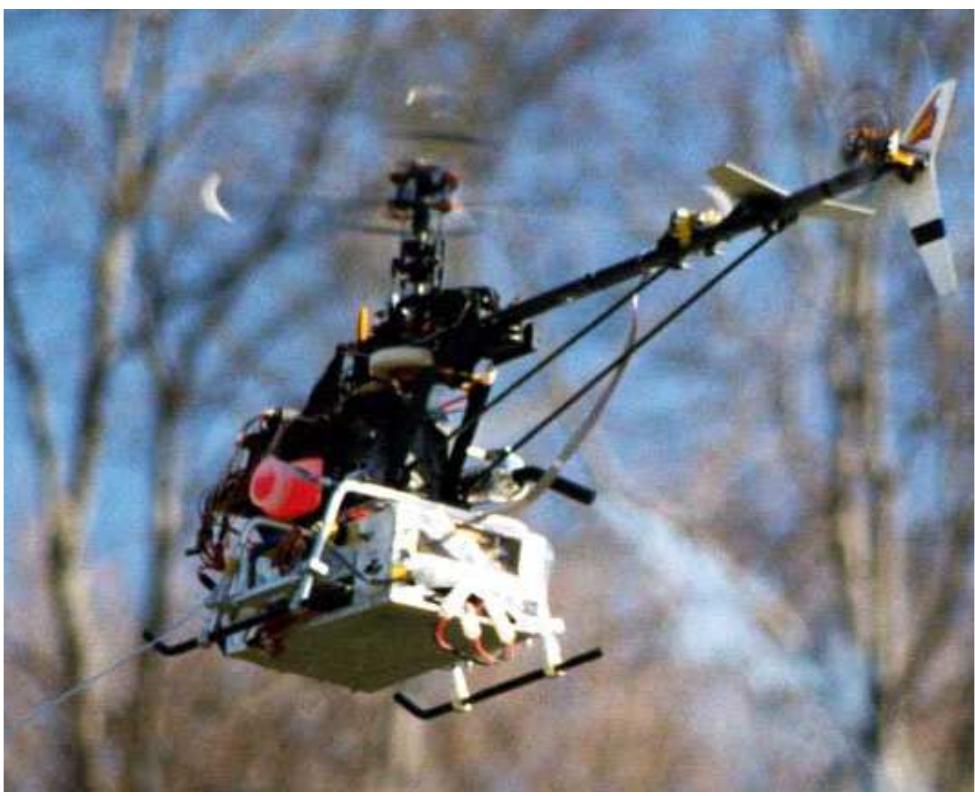
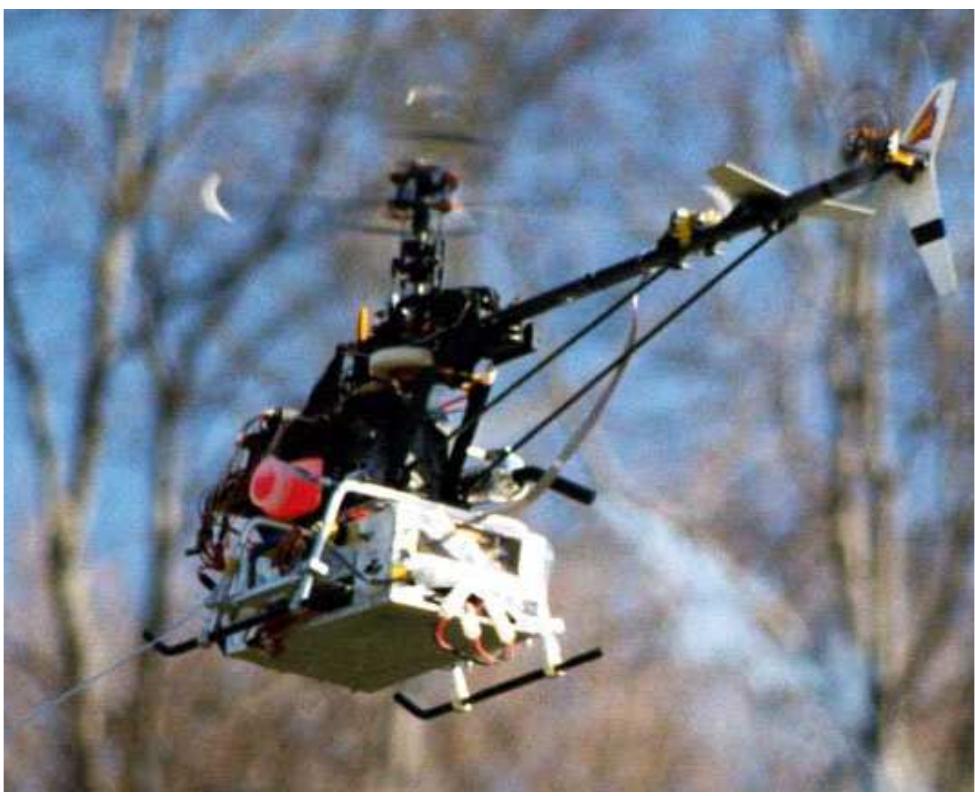
Figure 3 Instrumented X-Cell-90 helicopter in flight.
subdirectory_arrow_right Figure source:
Abstract: in Electrical Engineering from Stanford University. His research is in algorithms and architectures for adaptive signal processing and machine learning. He has ongoing projects in autonomous unmanned aerial vehicles, estimation and probabilistic inference, integrated navigation systems, time series prediction and modeling, and speech enhancement. He holds several patents in adaptive signal processing and has authored over 50 technical papers in the field.
... Read more Related topics:
State Estimation Position Estimation Extended Kalman Filter Navigation System Inertial Measurement Unit Sigma Point Kalman Filter Related Papers Abstract: The paper describes integration of Inertial Navigation System (INS) and Global Positioning System (GPS) navigation systems using new approaches for navigation information processing based on efficient SigmaPoint Kalman filtering and Particle filtering. The paper points out the inherent shortcomings in using the linearization techniques in standard Kalman filters (like Linearized Kalman filter or Extended Kalman filter) and presents, as an alternative, a family of improved derivativeless nonlinear filters. The integrated system was created in a simulation environment. An original contribution of the work consists in creation of models in the simulation environment to confirm the algorithms. The work results are represented in a chart and supported by statistical data to confirm the rightness of the algorithms developed. 1.0 INTRODUCTION Accurate and reliable navigation systems will have an important role for enhanced military capabilities in the coming years. The INS and GPS are wide...
... Read more
Abstract: A sigma-point Kalman filter is derived for integrating GPS measurements with inertial measurements from gyros and accelerometers to determine both the position and the attitude of a moving vehicle. Sigma-point filters use a carefully selected set of sample points to more accurately map the probability distribution than the linearization of the standard extended Kalman filter, leading to faster convergence from inaccurate initial conditions in position/attitude estimation problems. The filter formulation is based on standard inertial navigation equations. The global attitude parameterization is given by a quaternion, while a generalized three-dimensional attitude representation is used to define the local attitude error. A multiplicative quaternion-error approach is used to guarantees that quaternion normalization is maintained in the filter. Simulation results are shown to compare the performance of the sigma-point filter with a standard extended Kalman filter approach.
... Read more