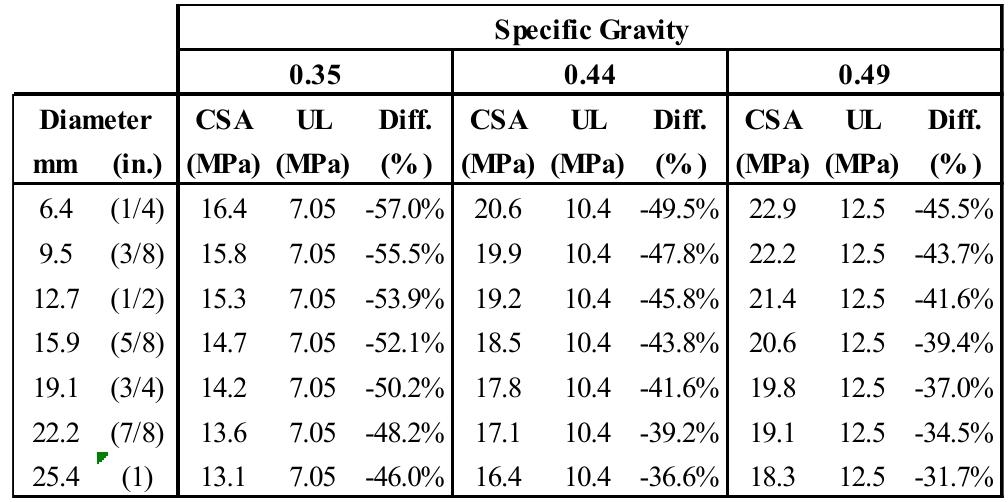
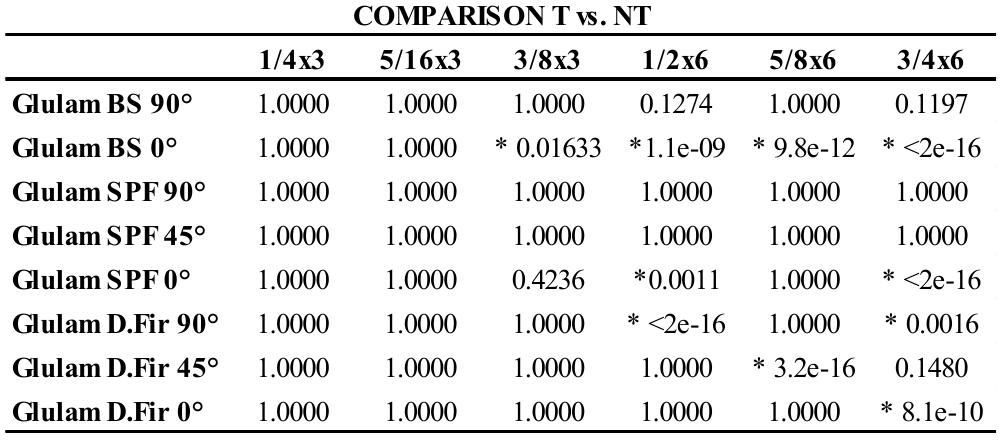
Table 7: Comparison between Equation (4) (CSA) and Equation (13) (UL) for 0° loading
subdirectory_arrow_right Figure source:
Abstract: The Canadian standard for engineering design in wood (CSA O86) adopted the European yield model for calculations of the lateral resistance of connections with dowel-type fasteners. This model takes into account the yielding resistance of the fastener, the assembly's geometry and the embedment strength of wood. The latter is considered a function of the relative density of wood and diameter of the fastener. The purpose of this study is to verify the significance of these variables as applied to the embedment strength for threaded dowel-type fasteners of diameters 6.4 mm and greater in Canadian glulam products. The importance of this research is justified by the growing interest in the use of large-diameter threaded fasteners in heavy timber and hybrid structures of high load-bearing capacity. Based on the results of 960 tests, a new design model for the embedment strength is proposed for potential implementation in CSA O86 standard and the impact of such a change is presented.
... Read more Related Papers Abstract: The purpose of this paper is to experimentally evaluate the embedding strength of dowel-type fasteners in Cross-Laminated Timber (CLT), observing the effect of lamellae orientation and the dowel diameters. Thereby, CLT specimenswith three layers of lamellaeand solid timber specimens were produced and tested under loads at 0º and 90º with the direction of the grain, considering five dowel diameters. The results showed that CLT embedding strength depends on the dowel diameter in the two investigated directions. The CLT embedding strength parallel to the grain was up to 8% lower than those for solid timber in the same direction, and up to 26% higher than the solid timber strength in the perpendicular direction. The analysis of variance (ANOVA) showed no significant difference between the mean values of the CLT and solid timber embedding strengths, except for the embedding strength perpendicular to the grain found for 16 mm dowel diameter. When comparing the results obtained experimentally with those determined analytically, the equation proposed by KENNEDY et al. (2014) led to a better agreement, for both the loads applied at 0º and 90º to the grain direction.
... Read more
Abstract: Embedment strength is a significant property in the dowel type connection in timber structure, i.e. cross-laminated timber (CLT). The CLT design properties are different from those of sawn timber (ST) and glued-laminated timber (GLT) because of the orthogonal structure, which may particularly have influence on the design of connections. The layup feature, i.e. the thickness ratio of transverse layer (TRTL) was considered as an effective factor on CLT embedment strength in this study, except for other factors, i.e. wood density, smooth dowel diameter, and loading angle. Approximate 660 embedment tests were performed according to ASTM D5764 half-hole test method. A few of existing design models for CLT embedment strength were evaluated using experimental data. It was found that different factors had different effect tendency and each factor had statistically significant impact on CLT embedment strength. The embedment strength and failure modes of CLT were obviously different from those of GLT due to the existence of transverse layer in CLT. The existing design equations should be improved. Based on the test results, a new design equation was proposed which had better prediction.
... Read more
Abstract: This work presents the results of three types of timber connections, in double-shear, with metal dowel-type fasteners, using the simplified equations from of Eurocode 5. All the design parameters were established and compared using three different properties of strength and density of the wood that represent the connecting members. A total of eighty-one connections were obtained, allowing for the determination of the number of fasteners needed for the applied tensile load. A large number and different types of connections allow the verification of the effect of the dowel parameters together with the wood characteristics. In all of the types of timber connections studied, the number of dowels increases with the applied tensile load, with lower dowel diameter, lower wood density, and strength. The design characteristic load-carrying capacity per shear plane and fastener also decreases with the previously considered parameters.
... Read more