




580 California St., Suite 400
San Francisco, CA, 94104
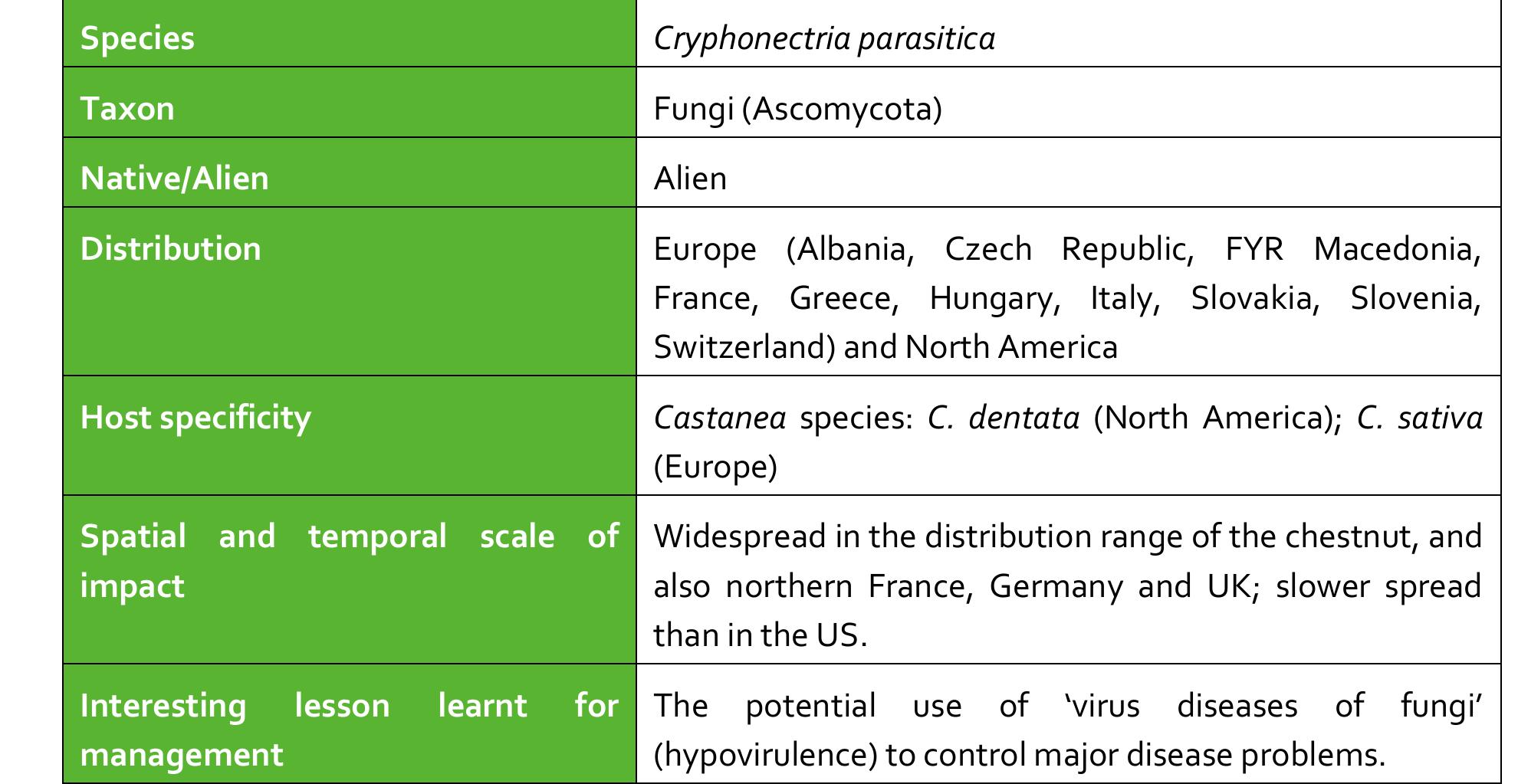
DESCRIPTION AND DAMAGE PATHWAY Before the turn between the 19" — 20" Centuries, the American chestnut (Castanea dentata) was arguably the most important broadleaved tree in the forests of the eastern USA, comprising some 25% of the individual trees present in these ecosystems which covered some 81 million hectares. Estimates suggest that over 4 billion chestnut trees were present in the eastern broadleaved forests at the end of the 19” Century. Some of the largest angiosperm trees ever recorded were chestnuts present in these forests. Moreover, the trees were heavily exploited. The fine, hard and durable timber was in great demand for all manner of applications, from carpentry to make furniture, to construction, to railway sleepers (Anon. 1995a). Chestnuts produced reliable seed crops each year and were gathered for sale by many people in the native range of C. dentata. The chestnuts were also an important food source for many wild animals.
Figure source:
Abstract: We thank all the experts and stakeholders who kindly provided feedback during the course of this study. DISCLAIMER: This report contains the research conducted by the project team and is not to be perceived as the opinion of the European Commission. Please cite this publication as: BIO Intelligence Service (2011), Disturbances of EU forests caused by biotic agents, Final Report prepared for European Commission (DG ENV) Photo credit: cover @ Vik Nanda Disturbances of EU forests caused by biotic agents | 3 Table of Contents LIST OF ACRONYMS CHAPTER 1: INTRODUCTION 1.1 Aim of this report 1.2 Managing forest ecosystems 1.3 State of EU forests 1.4 Disturbances in forest ecosystems 1.5 How to manage biotic risks 1.6 Structure of this report CHAPTER 2: PANORAMA OF THE CURRENT RISKS CAUSED BY BIOTIC AGENTS TO THE DELIVERY OF GOODS AND SERVICES 2.1 Key points 2.2 Trends in damage to EU forests caused by biotic agents 2.2.1 Biotic damages to EU forests 2.2.2 Types of biotic agents 2.2.3 Spatial and temporal scale of damages 2.2.4 Trends in biotic agents over the past fifty years 2.2.5 Influence of forest factors on biotic occurrence and damage 2.2.6 Drivers of changing biotic agents distribution 2.3 Impacts and trends for selected biotic agents 2.3.1 Ips typographus 2.3.2 Anoplophora chinensis 2.3.3 Thaumetopoea pityocampa 2.3.4 Bursaphelenchus xylophilus 2.3.5 Ash dieback 2.3.6 Chestnut Canker 2.3.7 Dutch elm disease 2.3.8 Phytophtora ramorum CHAPTER 3: TOWARDS ECOSYSTEM MANAGEMENT FOR ADAPTATION AND MITIGATION 149 3.1 Key points 3.2 Natural forest dynamics as a benchmark 3.2.1 Successional dynamics-six development stages Disturbances of EU forests caused by biotic agents | 5 5.5.2 Case study of the Swedish forest health monitoring system-a multi-dimensional system with an early warning function 5.5.3 Case study: the EWS for forest health threats in the US 5.6 Conclusions 5.6.1 Key characteristics for an efficient monitoring of forest biotic threats 5.6.2 What can the EU do to improve forest health monitoring?
