



580 California St., Suite 400
San Francisco, CA, 94104
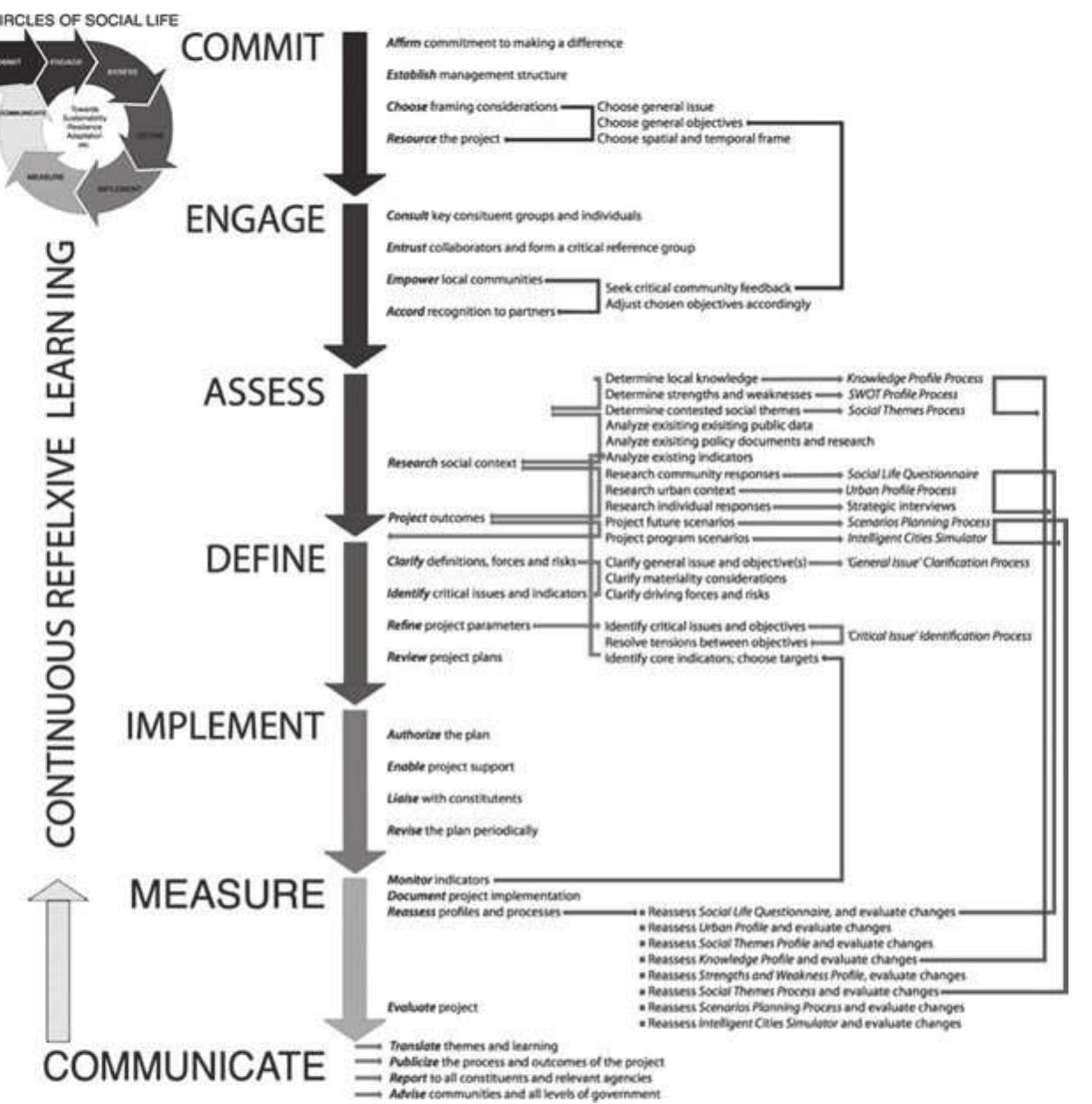
FIGURE 6.2 Elaborated Process Pathway for Sustainable Development - These stages can be elaborated into increasingly detailed phases. When laid ot n relation to the various phases, activities and tools through a process pathway tk ull method can be seen in one image. It is has a possible starting point and a logic et of steps, but it has no set end and no single, defined mandatory pathway. It is a terative process that once begun will ideally spiral through the circle of sustainab: levelopment a few times. Moving through the process can be fast or slow; it ca kip steps the first time and come back to them the second time around with mo: ntense focus; and it can either be done with minimal or maximum engagement, « omewhere in between. Other tools can be added to the process pathway, and wo1 ready done can be assessed in terms of the process pathway and incorporated int he mix.
Figure source:
Abstract: Urban Sustainability in Theory and Practice responds to the crises of sustainability in the world today by going back to basics. It makes four major contributions to thinking about and acting upon cities. It provides a means of reflexivity learning about urban sustainability in the process of working practically for positive social development and projected change. It challenges the usually taken-for-granted nature of sustainability practices while providing tools for modifying those practices. It emphasizes the necessity of a holistic and integrated understanding of urban life. Finally it rewrites existing dominant understandings of the social whole such as the triple-bottom line approach that reduces environmental questions to externalities and social questions to background issues. The book is a much-needed practical and conceptual guide for rethinking urban engagement.
