

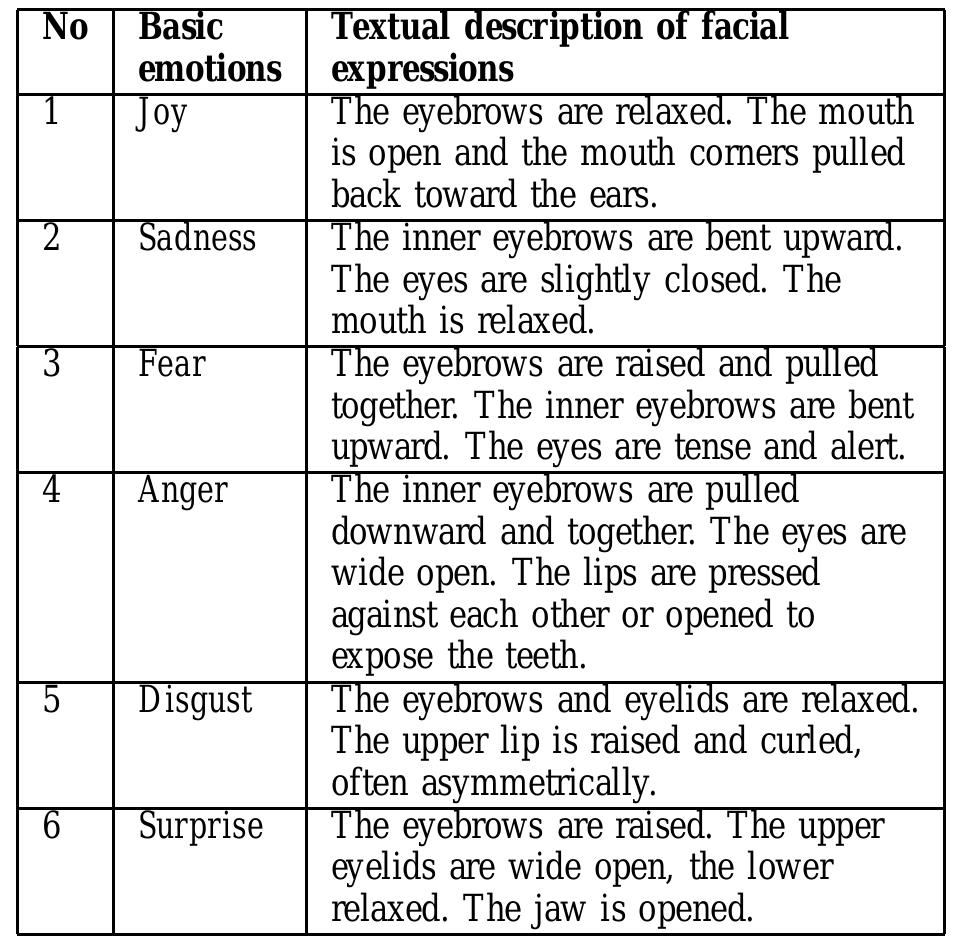
![Emotion generation in an algebraic model developed by 36] defined a set of parameters motivators. These motivators consist of keywords (mapped to emotional facial expressions, for example "happy” to smile”), hierarchical context to calculate coherence, user profile which associated with in- hibitor/amplifier affecting facial display and biological needs for example, blinking and wetting the lips). Motivators with their respective weights then were feed into a multiplexer to display a final facial expression. In our system, instead manual input of keywords, machine learning approach is employed to process the text. Fig. 3. Facial expression of neutral and basic emotions: sadness, joy, anger, fear, disgust, surprise (from left to right) [27].](https://figures.academia-assets.com/10107752/figure_003.jpg)


580 California St., Suite 400
San Francisco, CA, 94104
Emotion generation in an algebraic model developed by 36] defined a set of parameters motivators. These motivators consist of keywords (mapped to emotional facial expressions, for example "happy” to smile”), hierarchical context to calculate coherence, user profile which associated with in- hibitor/amplifier affecting facial display and biological needs for example, blinking and wetting the lips). Motivators with their respective weights then were feed into a multiplexer to display a final facial expression. In our system, instead manual input of keywords, machine learning approach is employed to process the text. Fig. 3. Facial expression of neutral and basic emotions: sadness, joy, anger, fear, disgust, surprise (from left to right) [27].
Figure source:
Abstract: A system consists of a text classifier and Fuzzy Inference System (FIS) to build a life-like virtual character capable of expressing emotion from a text input is proposed. The system classifies emotional content of sentence(s) from text input and expresses corresponding emotion by a facial expression. Text input is classified using the text classifier, while facial expression of the life-like character are controlled by FIS utilizing results from the text classifier. A number of text classifier methods are employed and their performances are evaluated using Leave-One-Out Cross Validation.
