

![It is interesting to know that the same relation 2u, + w= = s?/TBd — w1)] still holds. Thus the result 2) + w= = s*/[B( — W)] is valid at all times and inde- pendent of the influences from the spatial chemical gradient, as first shown in [11]. In order to apply the derived results, we also need to know the expression for the mean B, which is easily found to be](https://figures.academia-assets.com/31684326/figure_003.jpg)
![The above perturbative expressions are consistent with the more generalized result of Dickinson and coworkers [11,12], who also considered contributions from othe forms of taxis (e.g., haptotaxis, orthotaxis and tropotaxis) and kinesis. The use of th pseudo-equilibrium solution for the cell angu since the validity of the approximated Fickian ar density distribution is appropriat flux expression also requires the sam time scale. When ug = | (6 = 0), (47) reverts to w= = s?/[3Bo( — w1)], whicl is the commonly known expression for bacterial random motility in the absence o chemical gradients [28—30, 35]. On the other hand, when ug = —1 (09 = 2), (47 becomes w= = s°(1 + )/[3Bo(1 — Wi)] + O?) = s°/[3BU — Wi) + O€?) which is in agreement with our previous study for the single-phase tumbling fre quency [8,9]. For the case of small chemical gradients, the leading order of th random motility coefficient is O(1), but the locity is O(&), indicating that the bacterial ran dominant for small gradients. Since € denotes eading order of the chemotactic ve dom motility is always present and i the spatial chemoattractant gradient the transport flux j, retains the same form as in the Keller-Segel model [24,25].](https://figures.academia-assets.com/31684326/figure_004.jpg)


580 California St., Suite 400
San Francisco, CA, 94104
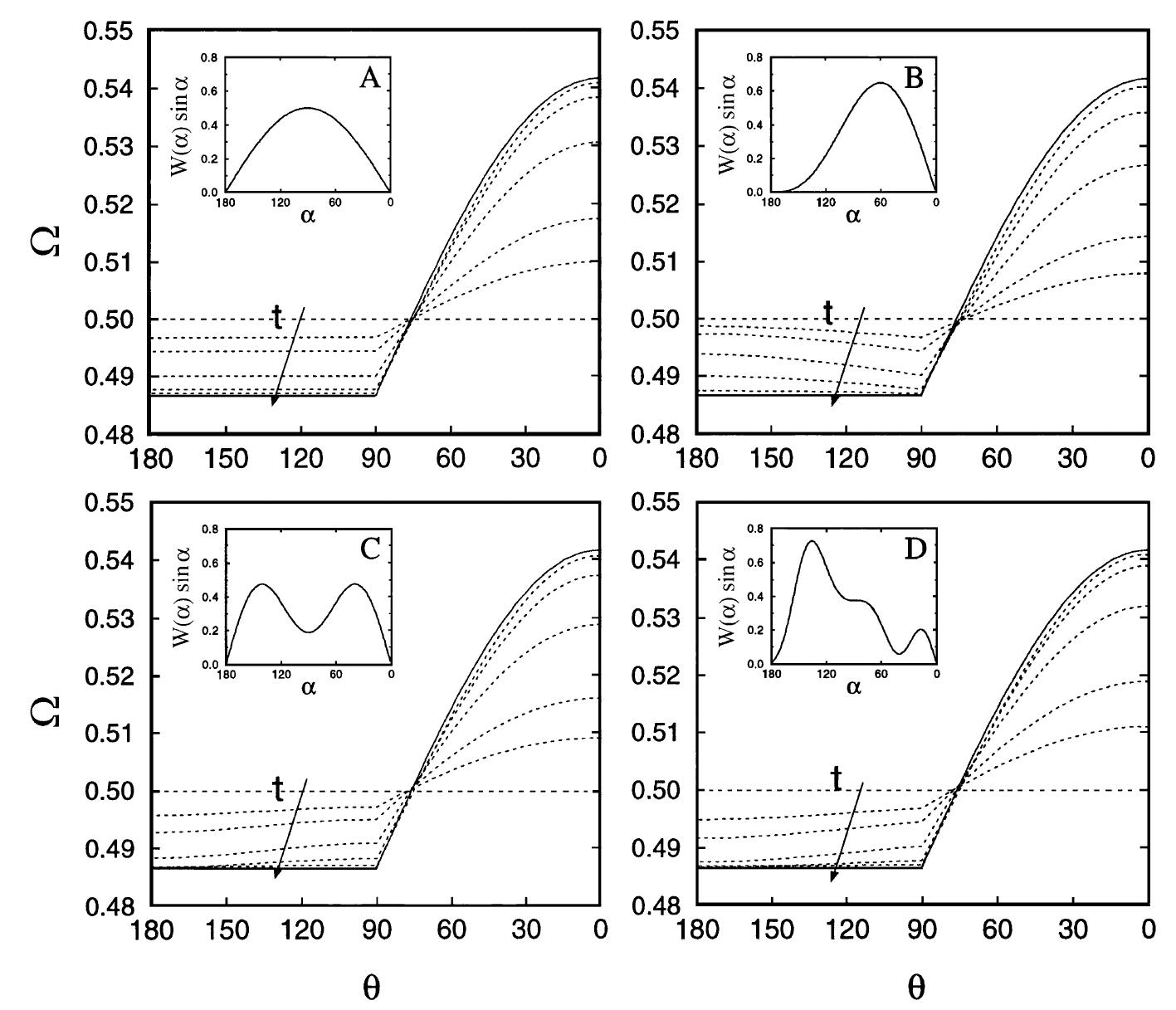
Fig. 2. Transient evolution of the cell angular orientation function for different W(q) at 0 = 90° and € = 0.1. To conform with the direction of the polar angle 9 drawn in Fig. 1, 0 starts from zero at the right to 180° at the left. Dashed lines are numerical solutions at tf = 0, 1, 2, 5, 10 and 20 seconds. Solid lines designate the equilibrium solution Q* predicted by (32). Insets show the distributions of W(q) sin(q@) versus a for each type of W(a@). Figure 2 displays the numerical solutions (dashed lines) for the transient distri- butions of (6, t) along the 0-axis. The solid lines indicate the theoretical profile at t > oo predicted by (32). It is clear that the transient curves, although behaving differently due to different W (@) during the transient state, all converge to the same
Figure source:
Abstract: Alt's three-dimensional cell balance equation characterizing the chemotactic bacteria was analyzed under the presence of one-dimensional spatial chemoattractant gradients. Our work differs from that of others who have developed rather general models for chemotaxis in the use of a non-smooth anisotropic tumbling frequency function that responds biphasically to the combined temporal and spatial chemoattractant gradients. General threedimensional expressions for the bacterial transport parameters were derived for chemotactic bacteria, followed by a perturbation analysis under the planar geometry. The bacterial random motility and chemotaxis were summarized by a motility tensor and a chemotactic velocity vector, respectively. The consequence of invoking the diffusion-approximation assumption and using intrinsic one-dimensional models with modified cellular swimming speeds was investigated by numerical simulations. Characterizing the bacterial random orientation after tumbles by a turn angle probability distribution function, we found that only the first-order angular moment of this turn angle probability distribution is important in influencing the bacterial long-term transport.
