16
On the Gradual Development of Polysynthesis in Nahuatl
Jason D. Haugen
16.1 Introduction
One of the widest-known and best-elaborated proposals for a macroparameter within the
Principles and Parameters approach to syntactic variation is Baker (1996, 2001)’s ‘Polysynthesis
Parameter’, which is very closely related to Jelinek (2002)’s ‘Pronominal Argument Parameter’.
In both of these proposals certain languages require some kind of marking for both
subject and object arguments on the main verb of a sentence. The macroparametric approach has
been criticized along several lines, not the least of which is that it seems to presuppose an abrupt
acquisition of the parameter in question, i.e. a ‘catastrophic’ change in grammar brought on by a
new generation of speakers (acquirers) of a given language; see, for example, Trask (2002). This
approach to parametric change is perceived to be inconsistent with other, more clearly-
established aspects of historical syntax, such as the gradual grammaticalization of case-markers
from adpositions.
Furthermore, the macroparametric view posits certain factors that correlate with the parameter
in question, but in most cases it has not been clearly established whether those correlations are
caused by or lead to the development of that parameter. In this paper I consider one well-known
polysynthetic Uto-Aztecan language, Nahuatl, in comparative and historical perspective.
Although Nahuatl is in fact polysynthetic by the criteria set forth by Baker, it is unusual in this
regard with respect to other Uto-Aztecan languages. Based on considerations from comparative
Uto-Aztecan morphosyntax I will show that the development of polysynthesis in this language
�was most likely gradual (i.e. stepwise) rather than catastrophic. However, the comparative Uto-
Aztecan evidence suggests that there were a series of stages in the development of full-blown
polysynthesis, and each of these could have been catastrophic if a single generation of speakers
made obligatory that which had previously been optional. The key factors in this gradual
development were the ordered grammaticalization of previously optional subject and object
clitics to obligatory pronominal affixes bound to the verb, and syntactic noun incorporation (NI).
This paper is structured as follows. In section 2 I discuss the notion of the ‘polysynthesis
parameter’, as presented by Baker (1996), and I make a distinction between subject and object
pronominal ‘polysynthesis’, as suggested and rejected by Baker (2001), using evidence from
Uto-Aztecan and elsewhere. In section 3 I give a brief overview of the structure of Nahuatl, and
in sections 4 and 5 I discuss the comparative Uto-Aztecan evidence for the gradual development
of subject and object pronominal affixes and syntactic noun incorporation, respectively. Section
6 offers my proposal for the various stages of grammaticalization involved in the transition from
Proto-Uto-Aztecan (PUA) to polysynthesis in Nahuatl, and section 7 concludes.
16.2 On the Polysynthesis Parameter
Baker (1996) establishes the ‘polysynthesis parameter’ as the setting of one single essential
quality that he terms the ‘Morphological Visibility Condition’, defined as follows:
(1) Morphological Visibility Condition (MVC) (Baker 1996: 486)
A phrase X is visible for θ-role assignment from a head Y only if it is coindexed with
a morpheme in the word containing Y via:
(i) an agreement relationship; or
(ii) a movement relationship.
�The MVC is intended to be a single property (i.e. a macroparameter) that explains a range of
attributes that follow from the setting of this parameter. These attributes are the following:
(2) Major characteristics of polysynthetic languages (Baker 1996: 498-9)
a. Syntactic noun incorporation (NI)
b. Object agreement is obligatory
c. Free pro-drop
d. Free word order
e. No NP reflexive
f. No true quantifiers
g. Obligatory wh-movement
h. N agrees with R argument
i. No true determiners
j. N agrees with possessor
k. Restricted morphocausative
l. NI or agreement in PP
m. CP arguments only if nominal
n. No infinitives
Using evidence from noun phrases (NPs) in Southeast Puebla Nahuatl, MacSwan (1998) argues
that two of the implicational relationships posited by Baker, (2)d and (2)f, do not hold up in that
language. In Baker’s (1996) theory NPs must be adjuncts, and this theoretical point is supposed
to explain both their optionality and their free word order. However, MacSwan claims that NPs
�are in argument positions in SE Puebla Nahuatl, and that evidence from weak cross-over effects
indicate that this variety also has true quantifiers. MacSwan concludes that:
the basic clause structure of Nahuatl, and perhaps that of other polysynthetic languages,
is not radically different from English, Spanish or other well-studied languages. For
this reason, while it may be useful for some purposes to refer to polysynthetic languages
informally as those languages which are characterized by rich agreement morphology
on the verb (sometimes called head-marking languages) plus productive NI, it does not
seem likely that polysynthetic languages exist as a formal typological class, contrary to
Baker’s proposals. (pp. 112-3)
Accepting MacSwan’s conclusion, I apply the term ‘polysynthetic’ to languages that exhibit
obligatory subject and object agreement plus syntactic NI, i.e. those languages which manifest
(2)a and (2)b, as well as an additional stipulation that there be subject agreement on the verb.
Baker himself has recently presented a similar definition of ‘polysynthesis’, as given in (3):
(3) Polysynthesis Parameter (Baker 2001: 111)
Verbs must include some expression of each of the main participants in the event
described by the verb (subject, object, and indirect object).
Baker also raises the possibility that this parameter might best be broken down into two separate
parameters, one requiring subject agreement and one requiring object agreement, as in (4) and
(5):
�(4) The Subject Polysynthesis Parameter (Baker 2001: 148)
The subject of a verb must be expressed in that verb (e.g. Mohawk, Chichewa, Slave).
(5) The Object Polysynthesis Parameter (Baker 2001: 149)
The object of a verb must be expressed inside that verb (e.g. Mohawk)
Baker (2001) presents Chichewa (Bantu) as a language that only has obligatory subject
agreement on its verbs, and in this language subject NPs are optional. Object NPs can be deleted
if there is object agreement, but if an object NP does appear without this agreement then it has to
appear immediately after the verb. With object agreement, the word order of both the subject
and object NPs is completely flexible. Other languages like this are attested, including Slave
(Northern Athabaskan), which has an SOV order when object agreement is not present. Such
languages as Chichewa and Slave would be ‘subject polysynthesis’ languages, given the
bifurcated parameter suggested in (4) and (5).
Baker rejects the partition in (4) and (5), however, because of the perceived lack of a language
with object agreement without subject agreement, a language that Baker calls ‘Reverse
Chichewa’. ‘Reverse Chichewa’ would be a language ‘in which the verb always agreed with the
object, so that the object could be omitted or put on either edge of the sentence. But the verb
would not have to agree with the subject, which would have to be present and in its usual
position before the main verb or tense auxiliary’ (Baker 2001: 147). However, it is supposedly
the case that no such language exists.
�To the contrary, though, at least one Uto-Aztecan language, Tohono O’odham (aka Papago)
shows this property, although it does have an obligatory subject agreement marker cliticized to
the second-position AUX element, as shown in the following data:1
(6) ’a:cim ’ ac g wisilo ø-ceposid (Zepeda 1983: 33)
1.PL.NOM. AUX DET calf 3.SG.OBJ.-branding
‘We are/were branding the calf’
(7) ’a:ñi ’añ g wipsilo ha-cecposid (Zepeda 1983: 33)
1.SG.NOM AUX DET calf.PL 3.PL.OBJ.-branding.PL
‘I am/was branding the calves’
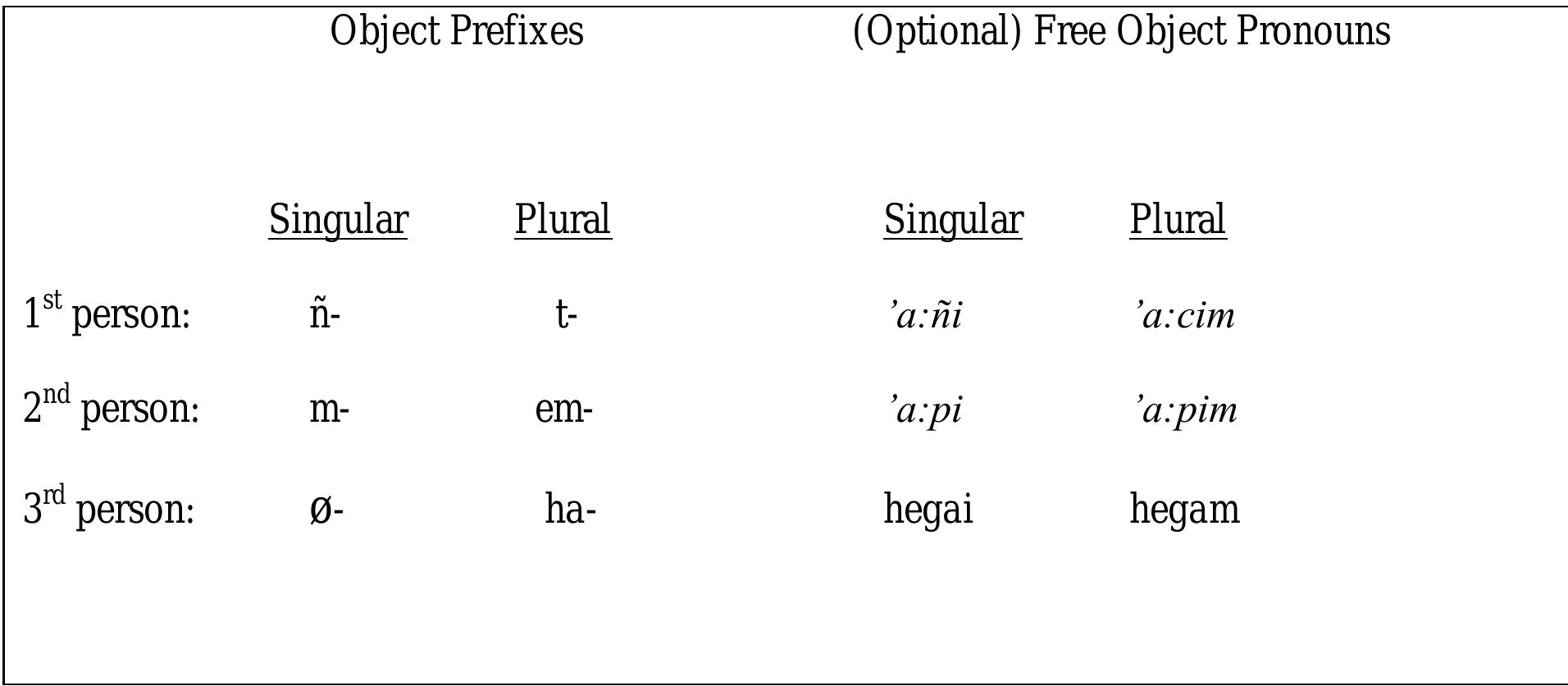
The full pronominal paradigms of O’odham are given in Table 1:
<<Insert Table 1 About Here>>
According to Steele (1977)’s diachronic account of the development of these pronominals and
auxiliaries, the Proto-Uto-Aztecan subject pronominal has fused with the tense/aspect AUX
element in exactly the position that Baker suggests that subjects should appear in a ‘Reverse
Chichewa’, ‘before the main verb or tense auxiliary’ (Baker 2001: 147). In addition to this
object agreement without (verbal) subject agreement in O’odham, other Uto-Aztecan languages
also demonstrate object-marking without subject agreement, for example in Hopi (a Northern
Uto-Aztecan isolate), with obligatory object agreement on what K. Hill (2003) calls ‘pronominal
�verbs’, as in (8), as well as in Yaqui (Taracahitic), where third person object agreement is
optional, as in (9):2
(8) Hopi
a. Tiyòoya paavay àa-pungyala (Hill and Black 1998: 881)
little.boy older.brother 3rd.SG.-keep.wanting.to.hang.around.with
‘The little boy wants to hang around with his older brother.’
b. Nu’ nuunukpàntuy amùu-piyna
1sg evil.ones-ACC 3rd.PL-make.leave
‘I made the bad guys go away.’
(9) Yaqui
a. Inepo Hose-ta (aa)-vicha-k (Maria Florez Leyva, p.c.)
1.SG Hose-ACC (3.SG.OBJ)-see-PERF
‘I saw Hose’
b. Huan Hose-ta into Maria-ta (am)-vicha-k
Huan Hose-ACC and Maria-ACC (3.PL.OBJ)-see-PERF
‘Huan saw Hose and Maria’
If we accept that O’odham is a language with (5) applied without (4), then we have reason to
suppose that Baker’s proposal in (4) and (5) is in fact necessary to differentiate Chichewa/Slave-
style languages from O’odham-style languages. Following Mithun (1991), I take it to be the
�case that the linear order of the agreement morphemes on the verb reflects the chronological
order in which these elements were grammaticalized, in addition to reflecting the synchronic
syntax of the language in question. Evidence in support of this view comes from languages that
have morphologized the agreement patterns in different orders. Nahuatl patterns with Mohawk
and most other polysynthetic languages in having its subject pronominals precede object
pronominals; see §3 below. In the Athabaskan languages, however, object pronominals precede
subject pronominals (Mithun 1991, Rice 2000).
We can even see variation in the order of subject and object pronominals within Uto-Aztecan
itself, since two Takic languages also have object-marking outside of subject-marking.
In Cahuilla, transitive verbs are obligatorily marked for subject and object. As (10) illustrates,
the object prefix precedes the subject prefix within the verb complex:
(10) Cahuilla
pe-n-téew-qal (Seiler 1977: 134 [156i])
3.SG.OBJ-1.SG.SUBJ-STEM.trans-SUFF.DURAT.
‘I see him’
The situation in Cupeño is slightly more complex. In this language the past tense is marked by
means of an obligatory subject prefix on the verb. The use of the third person plural prefix for
past tense is shown in (11)a, contrasted with (11)b, which has a future tense verb form and
therefore does not have a subject prefix:3
(11) Cupeño
a. túku=’ep pem-chíx (J. Hill 2003: 210 [6a])
yesterday=R 3.PL-die.PL
� ‘Yesterday they died’
b. tukumáy m=el=pe chíx (J. Hill 2003: 210 [6b])
tomorrow PL=3.PL.ABS=IRR die.PL
‘Tomorrow they will die’
Prefixal object clitics are optional for verbs in any tense. The use of the object clitic with a past
tense form is given in (12); note that the object clitic appears before the subject prefix in this
example:
(12) túkup=’ep ’i-ché’-max (J. Hill 2003: 211 [7])
yesterday-R 2.SG.OBJ-1.PL-give
‘yesterday we gave it to you’ (2 43 480)
This ordering of subject and object pronominals presents an interesting challenge to current
theories of morphosyntax; see J. Hill (2003) for a plausible analysis.
These examples from Cahuilla and Cupeño are quite interesting in that they clearly illustrate
different degrees of grammaticalization of subject and object pronominals in two relatively
closely related languages—both are within the Cupan group of the Takic sub-branch, which itself
is a sub-branch of a larger grouping, Northern Uto-Aztecan.
For our purposes here, I merely want to claim that the evidence suggests that subject agreement
has been grammaticalized for the past tense in Cupeño independently from object agreement.
Thus, to use Baker (2001)’s terminology, Cupeño has developed the ‘subject polysynthesis’
parameter for verbs in the past tense. Object prefixes are also possible in this language, although
�since they are not required no ‘object polysynthesis’ parameter has been set. Cahuilla, on the
other hand, seems to have developed obligatory ‘subject polysynthesis’ for verbs in all tenses,
and ‘object polysynthesis’ as well, although Cahuilla does not have syntactic noun incorporation
and is thus not a typical polysynthetic language as discussed by Baker (1996).
Crucially, this variation shows that there are two independent parameters for marking agreement
on a verb. In theory, a future generation of Cupeño speakers could possibly reanalyze the object
clitics as obligatory, and if this were to occur then the addition of the object polysynthesis
parameter to the subject polysynthesis parameter would yield something like Baker’s
polysynthesis parameter, but with a morpheme order opposite to that which we see in Nahuatl.
Having justified a distinction between subject and object polysynthesis, we now turn to a brief
discussion of the structure of Nahuatl (§3) before establishing the Uto-Aztecan bases for
Nahuatl’s polysynthetic characteristics in §4-5.
6.3 On the Structure of Nahuatl
Most varieties of Nahuatl, including Classical Nahuatl, are unambiguously polysynthetic in
Baker’s syntactic sense: verbs in this language must be inflected for both subject and object
agreement, and this inflection takes the form of prefixes.4 The relevant prefixes for Classical
Nahuatl are given in (13) and (14), respectively:5
(13) Classical Nahuatl Subject Prefixes (Newman 1967: 193)
Sg. Pl.
1st person: ni- ti-
2nd person: ti- am-
3rd person: ø- ø-
�(14) Classical Nahuatl Object Prefixes (Newman 1967: 193)
Sg. Pl.
1st person: nēch- tēch-
2nd person: mitz- amēch-
3rd person: k(i)- k(i)-
The reduced forms of the subject pronominals are obviously related to the independent pronouns,
at least in the first and second person:
(15) Classical Nahuatl Independent Pronouns (Steele 1977: 571 [15])
sg. pl.
1st person: newātl tewān(tin)
2nd person: tewātl amewān(tin)
3rd person: yewātl yewān(tin)
In addition to marking a verb with one of the direct object prefixes in (14), object-marking can
also occur via the incorporation of a nominal root which is ostensibly the direct object of the
verb. Merlan (1976) discusses the pragmatics behind such incorporation in Huauhtla Nahuatl
(HN). In general, noun incorporation is used to maintain topicality, i.e. definiteness in discourse.
As Merlan explains, ‘In contrast with complete pronominalization in HN, the nature of
incorporation is to permit preservation of the lexical properties of NP adjuncts previously
introduced, and thus definiteness of discourse reference is maintained’ (p. 185). In Merlan’s
terminology this applies only to ‘contextual’ or ‘discourse-determined’ NI; there are also cases
of what Merlan refers to as ‘lexical’ NI, which is the obligatory use of NI in certain
�constructions. This ‘lexical’ NI involves idiomatic meanings induced by noun incorporation. For
example, in (16), a literal interpretation occurs with a non-incorporating structure (16)a, but an
idiomatic reading is generated with NI, as in (16)b:
(16)a. ø-neč-maka-ø-k patli (Merlan 1976: 184)
3SG-1SG-GIVE-PAST-SG medicine
‘He gave me medicine’
b. ø-neč-pa-maka-ø-k (Merlan 1976: 184 [4])
3SG-1SG-medicine-GIVE-PAST-SG
‘He doctored me’ (lit. ‘He medicine-gave me’)
In addition to the incorporation of direct objects, unaccusative subjects and instruments may also
incorporate in Nahuatl, as in (17) and (18), respectively:
(17) tla-ā-weci-ø-ø (Merlan 1976: 183 [1])
INDEF-water-fall-PRES-SG
‘It is raining’
(18) Ya ø-ki-kočillo-teteki panci (Merlan 1976: 185 [10B])
he 3.SG.S-3.SG.OBJ-knife-cut bread
‘He cut the bread with a knife’
In this paper we will only concern ourselves with the incorporation of direct objects, which is
common across Uto-Aztecan (Haugen 2008, and §5 below). We now examine the Uto-Aztecan
�context for the crucial aspects of polysynthesis in Nahuatl: subject and object clitics and
agreement (§4) and noun incorporation (§5).
6.4 Subject and Object Agreement in Uto-Aztecan
Most Uto-Aztecan languages have subject and object clitics or affixes of some kind. As we saw
above, the order of subject and object affixes can vary, and I take this to be evidence of the
different chronological ordering of the morphological fusion of these affixes to the verb in the
languages in question. In the usual case, the object marker has grammaticalized first, and some
languages have set the ‘object polysynthesis parameter’ independently from ‘subject
polysynthesis’. Evidence for this comes from Tohono O’odham (Tepiman), where all transitive
verbs must be marked for the direct object (as in 6 and 7 above). Additionally, certain verbs in
Hopi require direct object pronominal marking (as in 8), and transitive verbs in Yaqui can
optionally be marked for the direct object (as in 9).
By hypothesis, PUA had similar patterns of optional pronominal object marking, and over time
Pre-Nahuatl (PN) gradually grammaticalized obligatory object agreement for all transitive verbs
that did not have overt noun incorporation, as is currently the case in O’odham. Thus, at some
point PN set the ‘object polysynthesis parameter’, and at this stage PN was like Tohono
O’odham in having obligatory object agreement. At this stage this parameter could be satisfied
by either the incorporation of a nominal root or a direct object pronominal into the verb. I assume
that at this stage subject agreement was not obligatory.
With respect to subject pronominals, most of the Uto-Aztecan languages have subject clitics or
affixes, and an examination of these morphemes shows that they are clearly cognate. Examples
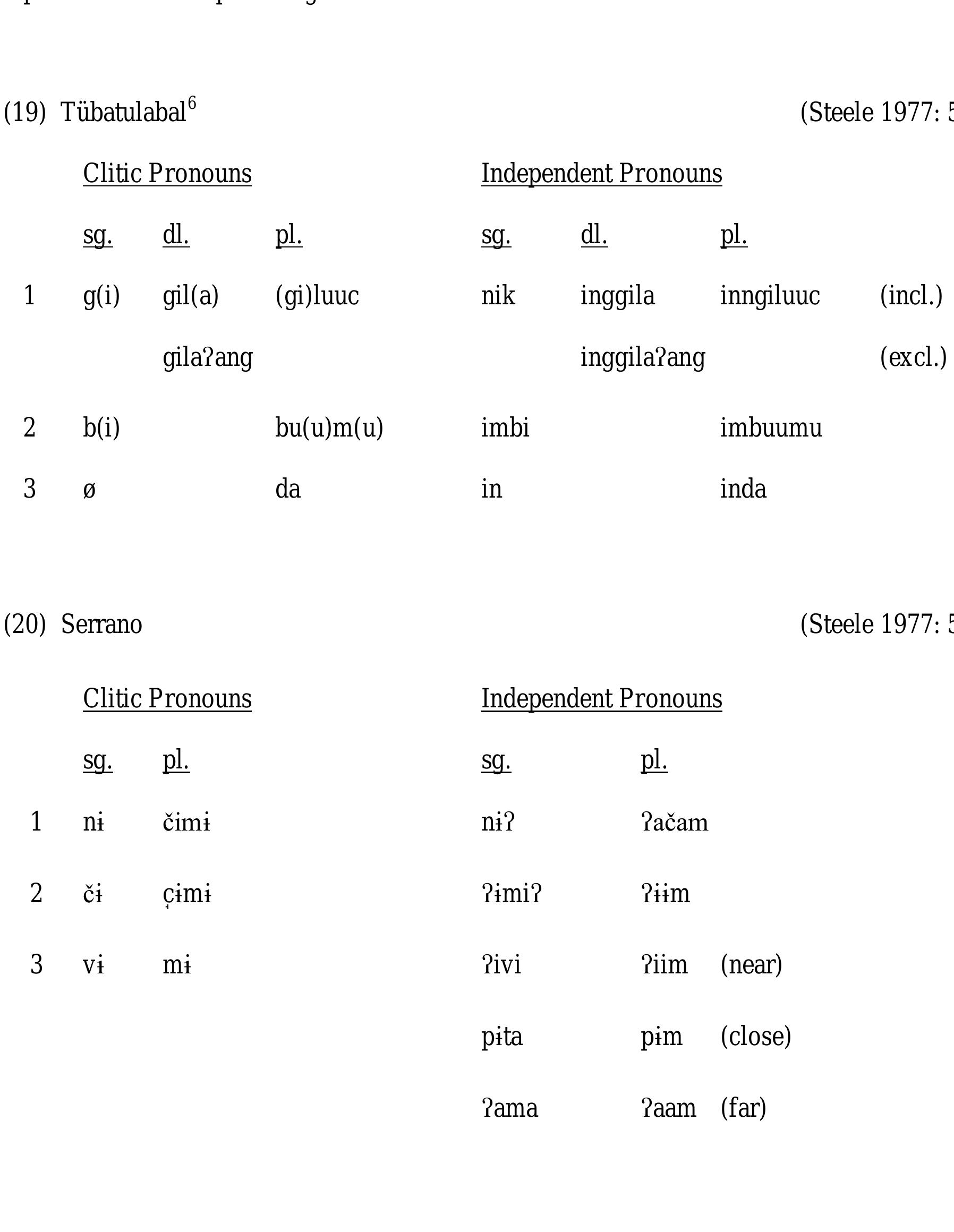
�from O’odham were given above in (Table 1), and from Nahuatl in (13). Some other
representative examples are given below:
(19) Tübatulabal6 (Steele 1977: 567 [4])
Clitic Pronouns Independent Pronouns
sg. dl. pl. sg. dl. pl.
1 g(i) gil(a) (gi)luuc nik inggila inngiluuc (incl.)
gilaang inggilaang (excl.)
2 b(i) bu(u)m(u) imbi imbuumu
3 ø da in inda
(20) Serrano (Steele 1977: 567 [5])
Clitic Pronouns Independent Pronouns
sg. pl. sg. pl.
1 n čim n ačam
2 č cm mi m
3 v m ivi iim (near)
pta pm (close)
ama aam (far)
�(21) Yaqui (Steele 1977: 569-70 [11])
Clitic Pronouns Independent Pronouns
sg. pl. sg. pl.
1 ne te, itom inepo itepo
2 e, en em, eme empo eme?e
3 ø ø aapo bempo
(22) Huichol (Steele 1977: 570-1 [14])
Clitic Pronouns Independent Pronouns
sg. pl. sg. pl.
1 ne te nee taame
2 pe ze eek zeeme
3 ø we/me iik iime (near)
mk mm (distant)
iya (general)
With respect to the distribution of these clitics within the sentence the Uto-Aztecan languages
differ: some languages have second position clitics, some have pre-verbal clitics or affixes, and
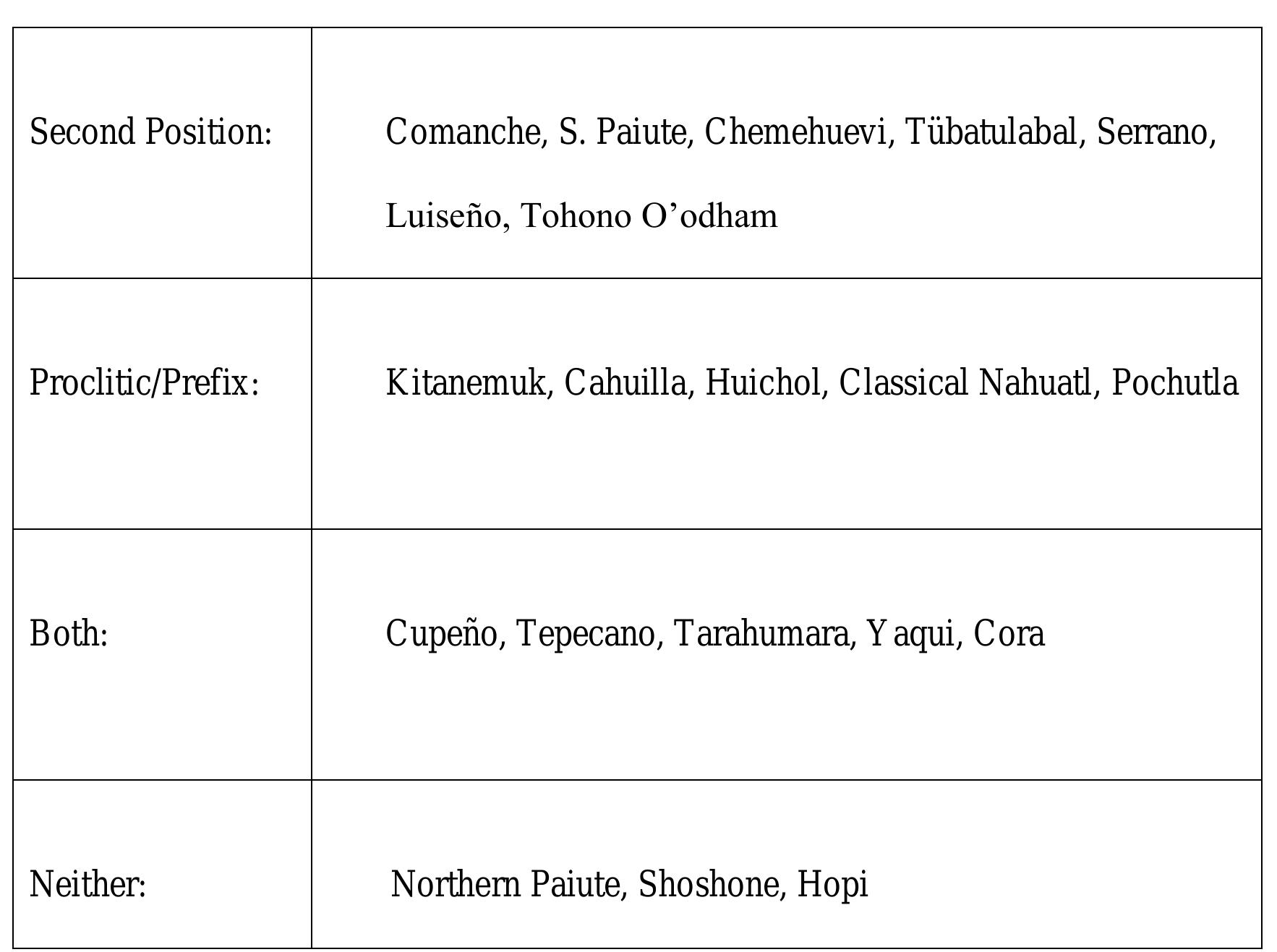
some have both. Steele (1977) presents the following table showing the distribution of subject
clitics across a representative sample of the Uto-Aztecan languages:
<<<Insert Table 2 About Here>>>
�Langacker (1977) reconstructs subject and object clitics for Proto-Uto-Aztecan (PUA), stating
that ‘it seems fairly clear that subject clitics, but not subject verb prefixes, can be reconstructed
for [PUA]’ (p. 126). He offers the following as speculative reconstructions, ‘offered mainly as a
basis for research and discussion’ (p. 126):
(23) PUA Subject Clitics (Langacker 1977: 126)
SG PL
1P *=n *=ta
2P *=’ *=’-m
3P *(=p) *=(p)-m
(24) PUA Independent Definite Pronouns (Langacker 1977: 124)
SG PL
1P *(i-)n *(i-)ta(-m)
2P *(-m) *’-m
3P-H *p *p-m
3P-NH *a *a-m
Based on the extant distribution of subject clitics in the family, it appears that subject clitics in
PUA could either be in second position or prefixed to the verb, and this property has been
retained in several languages, including Tarahumara:7
�(25) Tarahumara
čú mu šika ké mu nakí muhé ko ba (Steele 1977: 553 [30])
WH CP WH NEG CP want you emphatic emphatic
‘Why don’t you want it?’
Following Langacker (1977), Steele (1977), and much other work, I assume that the pronominal
prefixes of Nahuatl developed from these PUA clitics. If the suggestion that separating subject
polysynthesis and object polysynthesis is correct, then it is plausible that it was only after PN
already had obligatory object-marking (i.e. ‘object polysynthesis’, as in Tohono O’odham) that
these pre-verbal subject clitics were reanalyzed as obligatory subject agreement. It would have
been then that they ‘fused’ to (i.e. became morphologically a part of) the verbal complex. It was
with this reanalysis that PN then had obligatory subject agreement and thus the ‘subject
polysynthesis parameter’ had been set. In this way we can think of the setting of the
polysynthesis parameter, as defined in (3), as an ordered sequence of the independent setting of
separate sub-parameters, namely, (4) and (5).
In this section we have accounted for the gradual development of the weaker of Baker’s two
definitions of the polysynthesis parameter (cf. 3). In the next section we will consider the
stronger version, in which polysynthesis is also related to syntactic noun incorporation (cf. 2a).
5. Syntactic Noun Incorporation in Uto-Aztecan
In addition to obligatory object agreement (2b), the second critical element to Baker (1996)’s
definition of the polysynthesis parameter is syntactic noun incorporation (2a). Syntactic noun
incorporation is usually taken to be the type of noun incorporation that occurs when a noun-verb
�complex retains its transitivity, a key diagnostic for which is the presence of external elements
(determiners, adjectives, etc., often referred to as ‘stranded modifiers’) modifying any
incorporated nouns; this has been termed Classifier NI (Rosen 1989) or Type 4 / classificatory
NI (Mithun 1984). In some cases syntactic noun incorporation takes a full DP complement,
where the head noun of the complement NP is hyponymous with respect to the incorporated
noun. Examples of such syntactic NI are evident in Hopi, which allows for both ‘modifier
stranding’ (26) and hyponymous object arguments (27):
(26) Hopi
Naat itam pu-t qatsi-yese. (K. Hill 2003: 234 [98])
still we that.-acc life-sit(PL)
‘We are still living that life.’
(27) Pam tsiili-t nakwa-’y-ta-ngwu. (K. Hill 2003: 236 [112])
he chile-ACC feather.worn.on.head-POSS-DUR-HAB
‘He (the Hehey’a kachina) wears chili pepper (‘chile as a feather’) on his head.’
Syntactic NI can be contrasted with another kind of NI, that which creates an intransitive verb.
This type of NI is associated with compounding and has been referred to as compound NI (Rosen
1989), or ‘Type 1 NI’ in the typology of Mithun (1984).8 The Southern Uto-Aztecan language
Yaqui has some examples of intransitivizing NI, although this process is not productive in this
language:
�(28) Yaqui
a. aapo maso-ta peu-ta-k (Jelinek 1998: 213 [48])
3sg deer-ACC butcher-TRAN-PERF
‘He butchered a deer’
b. aapo maso-peu-te-n
3sg deer-butcher-INTR-PAST
‘He was deer butchering’
c. *aapo bwe’uu-k maso-peu-te-n
3sg big-ACC deer-butcher-INT-PAST
[*‘He was [big deer]-butchering’] or [*’He was deer-butchering a big one’]
Example (28)a shows the use of the verb peu- as a standard transitive verb, which is marked with
the transitivity suffix –ta, and in this sentence the direct object maaso ‘deer’ appears in object
position and takes accusative case (marked with the accusative case suffix –ta). In (28)b maaso
is incorporated into the verb, and thus is not marked with case. The intransitive verb that is
formed is marked with the intransitive verb marker –te. (28)c shows that the incorporated
nominal cannot be modified by adjectives, determiners, or the like (i.e. there is no ‘modifier-
stranding’).
It is unclear from the extant grammatical descriptions which of these two types of NI is currently
more general in Uto-Aztecan with respect to lexical verbs. Following Hale and Keyser (1993
and subsequent work), though, Haugen (2008) takes the position that denominal verbs involve
�obligatory incorporation of the head nominal in the verbal complement, by claiming that
denominal verb morphemes are bound affixes that are base-generated in v.9 Denominal verbs do
generally show the characteristics of syntactic NI across the Uto-Aztecan languages. For
example, ‘modifier-stranding’ seems to be typical of denominal verbs in all of the Uto-Aztecan
languages. Some representative examples are given below.
(29) Gosiute Shoshone (Miller 1996: 706)
N wahatti kahnikantn
I two-OBJ house-HAVE
‘I have two houses’
(30) Comanche (Charney 1993:205: [78])
[suRIse nknu tammati sonipIφai]
suti=-se n-knu tamma=-ti soni-=ph-pai
that.one-CNTR my-father’s.father a.lot-OBJ grass, hay-ABS-pai
‘My grandfather had hay (for horses)’
(31) Southern Paiute (Sapir 1930: 134)
wa·΄q·utcan qava·΄x·Α
two-OBJ-preterite-I horse-GET
‘I received two horses’
(32) Tohono O’odham (Saxton 1982: 141)
n-t wo ha’i kii-ki-t
� I-TNS FUT some RED-house-MAKE
‘I’m going to build some houses’
(33) Southeastern Tepehuan (Willett 1991: 64 [141])
day ma’n tu-sa’ua-h’iñ
only one OWN-blanket-1s
‘I have only one blanket’
(34) Western Tarahumara (Burgess 1984: 28)
bilé mahtá-ga-me
one metate-STAT-PRTC
‘I have one metate’
(35) Yaqui
'aapo hiva tu’ii-k te-tekil-e (Jelinek 2003: 207 [24])
3sg always good-ACC RED-job-ITER-IMP
‘He always has a good job’
Uto-Aztecan denominal verbs can also often take hyponymous arguments, thus instantiating
‘classificatory noun incorporation’:
(36) Tümpisa Shoshone (Dayley 1989: 91 [123])
Nümmü so’oppüh putish pungkupaimmippühantü
we(exc) many burro pet-HAVE-HAB-PAST
‘We used to have many burro pets’
�(37) Gosiute Shoshone (Miller 1996: 706)
Isapaipph sukka ponaiha taipai
Coyote that-OBJ Mouse- OBJ brother-HAVE
‘Coyote has Mouse for a younger brother’
(38) Cupeño (Jane H. Hill, p.c.)
túku=’ep ne-’ásh-lyu awá-l-i
yesterday=r 1s-pet-VB dog-NPN-O
‘Yesterday I had a dog’
(39) Yaqui
’uka ’ ili chu’u-ta ne=vuk-ek (Haugen 2004: 207 [13])
det.ACC little dog-ACC 1.sg=pet-PERF
‘That little dog is my pet’ (lit. ‘I pet-have that little dog.’)
Based on such evidence as that given above, Haugen (2008) reconstructs syntactic NI, including
modifier-stranding and hyponymous object arguments, for PUA.
The crucial point that I would like to make here is that, just as there are non-polysynthetic
languages with subject or object marking on their verbs, there are also non-polysynthetic
languages that have syntactic NI, e.g. the Northern Uto-Aztecan language Hopi. I conclude from
this discussion that the two key aspects of Baker (1996)’s definition of the polysynthesis
parameter (i.e. obligatory object-marking and syntactic NI) are independent variables, and thus
�this ‘macroparameter’ does not necessarily entail a catastrophic development. In the next section
I will propose a likely scenario for the step-wise development of the various stages that Pre-
Nahuatl must have gone through en route to full-blown polysynthesis, each of which themselves
could have involved the setting of a single parameter by a single generation of speakers. The
instructive aspect of the comparative Uto-Aztecan evidence is that each of these proposed stages
has independent attestation elsewhere in the family.
16.6 A Grammaticalization Cline for Polysynthesis in Nahuatl
I propose that the ‘polysynthesis parameter’ developed in Nahuatl in the following gradual
stages.
First, Pre-Nahuatl (PN) descended from a language, Proto-Uto-Aztecan (PUA), which had both
subject and object clitics, as argued in §4, as well as syntactic NI, as argued in §5. By
hypothesis, the subject clitics of PN could appear either in second position or pre-verbally, as I
have argued to have been the case for PUA, and as is still the case in many extant Uto-Aztecan
languages, e.g. Tarahumara. Presumably, object clitics were pre-verbal, as in Hopi, Yaqui, and
other Uto-Aztecan languages. We can refer to this initial period, inherited directly from PUA, as
Stage One.
Stage Two would have involved the setting of the object polysynthesis parameter to ‘on’, and
transitive verbs would have required either object agreement or noun incorporation. The ‘object
polysynthesis property’ is also attested in Tohono O’odham and other Tepiman languages. The
difference between the hypothetical PN Stage Two and Tepiman, however, is that, with the
exception of denominal verbs, the Tepiman languages do not have noun incorporation at all, but
all transitive verbs must agree with their objects. That is, the Tepiman languages are Pronominal
�Argument languages, in the terms of Jelinek (2001). It is my hypothesis that the loss of NI in
favor of obligatory object agreement in these languages was the result of the reanalysis of an
incorporated pronominal element as a general classifier, meaning something like ‘thing’ or ‘it’,
which eventuality lost its referentiality and became just a marker of agreement. At Stage 2 of PN
there would have been no requirement that verbs show agreement with their subjects, although
subject clitics could have optionally attached to the object-verb complex.
Subsequent to the fixing of the object polysynthesis parameter, the reanalysis of optional pre-
verbal subject clitics as obligatory subject agreement markers would have constituted Stage
Three of PN, which I assume led to Proto-Aztec, and this property has been retained in all of the
varieties of Nahuatl that descended from that common ancestor. It was at this stage that the
subject clitics ‘fused’ to the object-verb complex, and it was here that ‘full-blown polysynthesis’
occurred.
Each of the changes that occurred to bring about the subsequent stages could conceivably have
occurred in a single generation, thus each could have been a ‘catastrophic’ change brought about
by the setting of a single parameter. Each of these parameter-settings would have involved the
reanalysis of a grammatical option as an obligatory requirement in a particular individual’s
grammar. This view is supported by the synchronic optionality of subject and/or object
pronominal markers in various languages, a feature which I assume is conservative with respect
to those Uto-Aztecan languages that have obligatory agreement. In this way it can be argued that
the polysynthesis parameter itself did not arise, and could not plausibly have arisen, as a single
change, but was, rather, the eventual result of a gradual series of changes that occurred in distinct
stages.
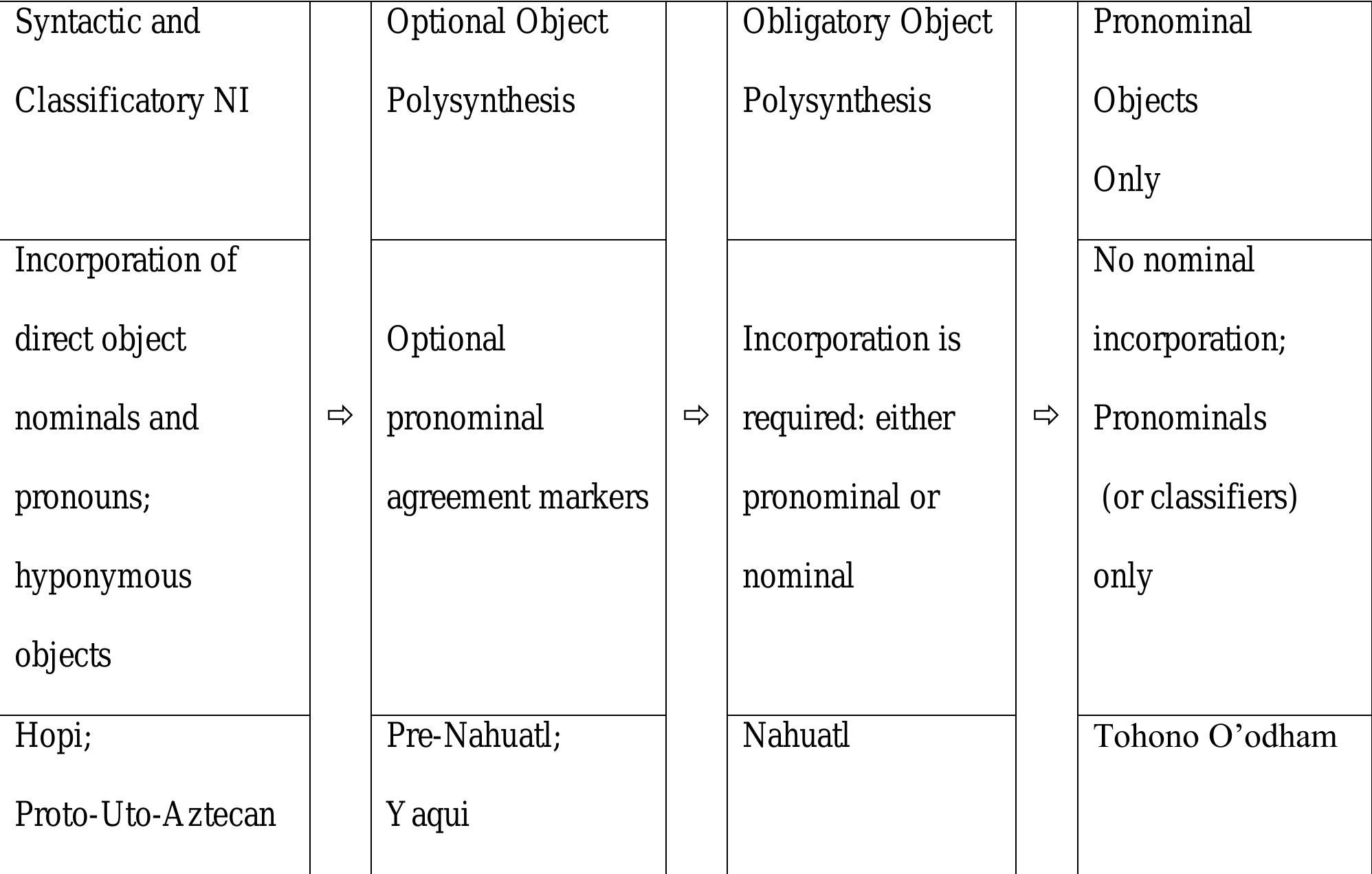
�The grammaticalization trajectory that I have proposed for the polysynthesis parameter in
Nahuatl is summarized below in Table 3.
<<<Insert Table 3 About Here>>>
A crucial aspect of my analysis is that subject agreement is completely independent of the object
incorporation referred to in Table 3. Although Nahuatl has developed obligatory subject
agreement, languages like Tohono O’odham (and other Tepiman languages) show us that this is
not a necessary development.
7. Conclusion
In this paper I have shown that multiple non-polysynthetic Uto-Aztecan languages display
properties that have been attributed to polysynthesis, and I have suggested that these properties
led to polysynthesis in Nahuatl, rather than the reverse. I have argued that polysynthesis
developed in a discrete series of stages, each of which has attestation elsewhere in the family.
The proposal made here is consistent with divergent work in both grammaticalization and more
formal approaches to language change. The gradualist approach links a gradual syntactic
change, the development of obligatory NI with the fixing of subject clitic placement, to the
abrupt change required by approaches to diachronic syntax focused on child language acquisition
(e.g. Lightfoot 1991). If this gradualist approach is correct for the polysynthesis parameter, then
it could probably also be applied to other proposed macroparameters as well. Thus, this line of
research suggests the need to search for potential ‘precursors’, in the form of retentions, in other
�languages and language families with no written record, in order to find (and reconstruct) likely
sources for the ‘grammaticalization’ of particular ‘macroparameters’.
Table 1. Tohono O’odham Object Prefixes and Free Object Pronouns (Zepeda 1983: 35)
Object Prefixes (Optional) Free Object Pronouns
Singular Plural Singular Plural
1st person: ñ- t- ’a:ñi ’a:cim
2nd person: m- em- ’a:pi ’a:pim
3rd person: ø- ha- hegai hegam
�Table 2. Subject clitics across Uto-Aztecan (Steele 1977: 541, 542-3 [II, III])
Second Position: Comanche, S. Paiute, Chemehuevi, Tübatulabal, Serrano,
Luiseño, Tohono O’odham
Proclitic/Prefix: Kitanemuk, Cahuilla, Huichol, Classical Nahuatl, Pochutla
Both: Cupeño, Tepecano, Tarahumara, Yaqui, Cora
Neither: Northern Paiute, Shoshone, Hopi
�Table 3. Grammaticalization trajectory of (object) polysynthesis
Syntactic and Optional Object Obligatory Object Pronominal
Classificatory NI Polysynthesis Polysynthesis Objects
Only
Incorporation of No nominal
direct object Optional Incorporation is incorporation;
nominals and pronominal required: either Pronominals
pronouns; agreement markers pronominal or (or classifiers)
hyponymous nominal only
objects
Hopi; Pre-Nahuatl; Nahuatl Tohono O’odham
Proto-Uto-Aztecan Yaqui
�1
Nivkh (aka Gilyak), a language isolate of Russia, may be another example of a ‘Reverse
Chichewa’. According to Mattissen (2003), ‘one undergoer is obligatorily marked on the verb,
either via dependent-head synthesis of the undergoer noun and the verb or via undergoer
prefixation’ (p. 203). Subjects (‘actors’) are only marked under certain conditions.
2
This optional agreement is only available for third person. Generally speaking, our
consultants disprefer the co-occurrence of object agreement with an overt NP in object position.
Such pronominals are obligatory, however, when the object NP is right-dislocated. In this
respect Yaqui seems to be like Chichewa, although it is unlike Chichewa in not having subject
agreement.
3
Subject pronominals are prefixed to the verb root only in the ‘zero class’. There are two
other large classes, the –in and –yax classes, wherein the subject pronominal appears between the
verb root and the suffixal thematic elements that are indicated in the names of the classes:
(i) yút-ne-n (ii)hét-pe-yax (Barragan 2003: 143
[5], [6])
raise-1.SG-IN crouch-3.SG-YAX
‘I raised’ ‘He crouched’
See J. Hill (2005) for details, and Barragan (2003) for a Distributed Morphology analysis
of these constructions where he proposes that the thematic affixes are located in v, and the
shifting of the subject is claimed to be the result of Local Dislocation at PF. These cases also
clearly have object-agreement external to subject-marking on the verb; see below.
�4
Some modern varieties of Nahuatl are losing some of Classical Nahuatl’s polysynthetic
characteristics and taking on a more analytic nature due to a long contact period with Spanish;
see Hill and Hill (1986) and Flores Farfán (2004) for further discussion of these varieties.
5
All Nahuatl orthography in this section, which has been collected from various sources
from different periods, has been standardized with respect to vowels: a macron indicates a long
vowel. In this usage I follow the practice of Andrews (2003).
6
In Tübatulabal, ‘independent subject pronouns are formed from the clitic pronouns with
the prefixation of –in; the first singular form is, however, irregular’ (Steele 1977: 567).
7
This claim contrasts with that of Steele (1977), who argues that pre-verbal clitics are
secondary developments from second position clitics in PUA; see Haugen (2007) for a critique
of this view.
8
An independent issue is the syntactic status of NI. Rosen (1989) gives an analysis where
both classifier and compound NI are lexical processes (i.e. occur ‘in the Lexicon’, prior to
syntax), whereas Baker (1995) argues that some languages have lexical NI and some have non-
lexical (i.e. purely syntactic) NI. For the purposes of this paper I remain agnostic on this issue.
9
Hale and Keyser reject their 1993 analysis of denominal verbs in Hale and Keyser
(2002), largely due to the ‘hyponymous object problem’: non-cognate nominals appearing in the
complement position in such constructions as I danced a jig or He wears a chili pepper (‘chile as
a feather’) on his head (see the Hopi example in (26)) seem to suggest that the incorporated
nominal could not have originated from that position. However, see Haugen (2008, 2009) for a
solution to this problem using the notion of Late Insertion of lexical material within the
framework of Distributed Morphology.
�


 Jason D Haugen