Prismatic
Security
Expanding
the
Copenhagen
School
to
the
Local
Level
by
Andrej Zwitter & Jaap de Wilde*
Department of International Relations and International Organization (IRIO)
University of Groningen**
Key words: Copenhagen School, securitization, human security, psychology of decision making,
methodology
This article expands the Copenhagen School framework for security analysis to
include local level security discourses. To this end, we elaborate the notion of
lenses, rather than sectors, to trace distinct discourses about existential threats.
These security discourses are overlapping, interrelated and synthesized by both
local actors and the analyst. This synthesizing practice results in what we call
prismatic security. We adapt a view on existential values that does not only build
on existing discourses but also on the discourse about basic needs, thereby
establishing thresholds for existential threats at the local level. We further
introduce an operational way of assessing security discourses on the local level,
based on empirical considerations and two mechanisms of securitization
processes: ‘abstraction & prognosis’ and ‘comparison & prognosis’.
After more than a decade of rethinking security studies, triggered by the end of the Cold War, some
of the dust has settled. In recent years, various authors produced overviews of the new field of
Security Studies. Various distinctions and similarities among different strands of security studies in
terms of conceptual and methodological considerations are put forward (Walt 1991; Krause &
Williams 1996; Terriff et al. 1999; Baldwin 2001; Paris, 2001; Buzan & Hansen 2009). They have
in common that they distinguish discourses on levels of analysis (‘global security’, ‘regional
security’, ‘state security’, and ‘human security’), and discourses on types of threats (‘military
security’, ‘environmental security’, ‘economic security’, etcetera). The varying positions in these
academic discourses are well summarized by Buzan & Hansen (2009: 221-224): Strategic Studies,
Peace Research, the Copenhagen School and Critical Security Studies.
In spite of these developments, security concerns at especially the local level are still
*
Jaap de Wilde is Professor of International Relations and World Politics and Andrej Zwitter is Assistant Professor
for International Political Economy at the University of Groningen. You can contact the authors at:
[email protected]
or
[email protected].
**
We like to thank the members of the VIEW-group (Tanja Aalberts, Erna Rijsdijk, Maarten Rothman, Jorg
Kustermans, Geoff Gordon and Wouter Werner) and the members and audience of the ISA Convention 2010 panel
“Fresh Ideas on Security and Peace” for their valuable comments on earlier drafts. We also wish to thank the
reviewers for their insightful and clarifying comments that greatly helped to improve the article.
insufficiently conceptualized and operationalized. Among these few studies interesting new insights
are provided by Salter (2008) and Hansen & Nissenbaum (2009); concerning criticism regarding
differences in cultural values concerning the local level a revealing article has been written by
Wilkinson (2007). The concept of securitization and desecuritization as developed by the
Copenhagen School is a constant subject of constructive theoretical discussions and critique (Floyd
2007, 2010; Hayes 2009; McDonald 2008; Mitzen 2006; Stritzel 2007; Taureck 2006; Williams
1998, 2003). However, concrete operationalization for measuring security on the local level is
needed as a basis for strategies for third party involvement. Assessment of local situations,
including their transnational contexts, and the complex interdependence of existential interests,
appears much harder than the broad brush security analyses at the global and world-regional levels
of analysis. If the objective is to make the Copenhagen School applicable to all areas of concern for
international politics, then it needs operationalization for the local level. It is on this level where
humanitarian and development aid needs empirical research in order to better understand the
complexities of humanitarian crises. There are some stimulating efforts in the field of human
security studies, in particular the attempt to establish a Human Security Index (HSI; Human
Security Centre, 2005). However, conceptually human security is a very weak and contestable
approach (De Wilde, 2008-b; Paris, 2001), which hinders proper operationalization. Also in
Development Studies a wide range of operationalizations exist, but in the end most of them turn out
to be quite state-centric (as is the case, e.g., with the Human Development Index [HDI], which also
forms a core in the HSI). Moreover, development needs are much wider than security needs. We
agree with the Copenhagen School that talking security only makes sense if the term refers to
existential values.
It is in line with the Copenhagen School that we like to develop a comprehensive approach
to analyse and work with local security complexes. Following Buzan’s notion of a security
complex, meant to establish critical environments to understand the dynamics of interstate security
policies (Buzan, 1991; Buzan & Wæver, 2003), we focus on the interdependence between various
security concerns in local settings, establishing local security complexes. In doing so, we need to
amend the original notion of sectors in the framework for security analysis that was developed in
Buzan, Wæver & De Wilde (1998). Moreover, the expansion of the Copenhagen School from
global, regional and national levels to the local level requires some alterations in order to make the
original framework applicable to the concerns of local groups and individuals. These alterations,
however, stay in line with the original conception of securitization theory and are mostly a further
elaboration on securitization processes and an expansion of the framework to the local level.
To this end we describe security discourses with the metaphor of a prism. Furthermore, we
elaborate on how local actors deconstruct social reality regarding security concerns. We introduce
two mechanisms that explain securitization processes (comparison & prognosis and abstraction &
prognosis), and elaborate on them on the basis of empirical observations and theories regarding the
psychology of decision-making. In conclusion this will lead to a framework on how to assess
security discourses on the local level and a way of visualizing these discourses along the metaphor
of a prism.
Security
Discourse
as
a
Prism
Often the metaphor of sectors for qualifying various security discourses is confusing. Buzan,
Wæver & De Wilde (1998) treat a sector as a lens and a value-based logic, rather than a well-
defined part of society. “Sectors serve to disaggregate a whole for purposes of analysis by selecting
some of its distinctive patterns of interaction.” (Buzan, Wæver & De Wilde, 1998: 8). They are
therefore not talking about, e.g., the military, the economy, or the environment as empirically
identifiable parts of society, but about the discourses and institutions that come into focus when
military, economic or environmental values are highlighted by the analyst. Security analysis
subsequently focuses on the perceived threats to these values, as uttered in speech acts (Ole
Wæver’s securitization theory).
A confusing factor in this approach is that some security discourses have become
institutionalized in society. Concerns about military security have led to a military sector in society
indeed. Concerns about market stability and competition have resulted in an economic sector,
characterized by, e.g., financial regimes, central banks, ministries of Finance, firms, unions etcetera.
Not each of the analytical sectors has such institutionalized counterparts in society, nor do all
sectors in society cover the analytical ones. The analytical sectors, therefore, are better labelled
lenses – as is also suggested at various places in Buzan, Wæver & De Wilde (1998: 168): “We see
sectors as a purely analytical device, as different lenses through which to see different views of the
same issues”. Hence, through an economic lens, the military – as a sector in society – is seen in
economic terms: how does their budget affect government spending and taxation?; is the army an
outlet for unemployed young men and women?; is there financial burden-sharing within alliances?;
etcetera. Through an environmental lens, the military sector in society may come in view in terms
of the environmental costs of warfare (ranging from nuclear winter to widely dispersed anti-
personnel mines obstructing normal use of the land) or because of the relief aid they can give in
response to natural hazards.
The advantage of this approach is that it focuses on security discourses rather than defining
fixed values and threats to them. Moreover, “the use of sectors confines the scope of inquiry to
more manageable proportions by reducing the number of variables in play” (Buzan, Wæver & De
Wilde, 1998: 8). The sector or lens is based on specific sets of values. Once these values are
established by the analyst (a troublesome and controversial phase in developing a framework for
analysis) they function as independent variables in the analysis of security discourses.1 The
disadvantage, however, is that the disaggregation does not tell how to reassemble the sectoral
analyses. Chapter 8 of Buzan, Wæver & De Wilde (1998), “How Sectors are Synthesized”, offers
two ways to deal with this: One way is to map out scores in a matrix. This is typically an activity
for the observing analyst, not for the actors involved. But it remains unclear how the observer must
deal with the interdependence of the issues at stake. The prismatic approach we offer here hopes to
contribute to a solution of this problem, while acknowledging the value of the second approach.
The other way offered to re-establish the whole picture is to trace overarching security
discourses: “... in the end, the actors themselves must make up their minds as to how the
securitization of different values adds up” (Buzan, et al., 1998: 166). We like to follow on to that
approach too, be it by including the analyst herself as one of the actors involved in the security
discourse. Positive about looking at cross-sectoral securitizations is that they help to better
understand the actors involved. But the method of aggregation is rather implicit: the dominant
discourse of the actor at stake does not necessarily reflect his way of matching sectoral concerns; it
may merely reflect his specific pre-occupations and biased world views. Here, institutionalization
does matter a lot: where you stand depends on where you sit. Our ambition in this article is to
elaborate a more explicit way in which sectoral discourses can be related to each other. To that end,
we present the image of a prism to combine the best of both matrix-mapping and cross-sectoral
discourses.2
Our selection of sectors deviates from the sectors defined by the Copenhagen School, due to
the bottom-up logic we apply. We do not see this as problematic because the Copenhagen School is
ambivalent about tracing sectors, acknowledging their temporary and epistemological character.
There are no theoretical objections within the logic of sectors to expand or limit their number.3 A
sector like the environmental sector could hardly be imagined before the 1970s. A sector like the
military one is internationally about territorial integrity, whereas at the sub-unit level it is also about
coercion, civil war and inner-city warfare. Hence, not only about the territorial integrity of the state
but also about the personal security of people; the protection from physical violence. This involves
military, police and intelligence, as well as gangs, war-lords, private security firms and domestic
violence. Personal security therefore provides a better lens than military security, when risks from
organized violence are at stake. Moreover, existential values at the group and individual levels do
1
One of the main concerns in the sector-chapters in Buzan, et al. (1998) is to trace and define clusters of existential
values that together form a coherent view on securitization processes. The circular aspect here is that the choice of
sectors is itself a reflection of the dominant security discourses in the academic and political fields.
2
In doing so, it is not our intention to qualify local security complexes as types of prismatic societies as developed by
Fred Riggs (1961).
3
In De Wilde, 1995, e.g., the military and the political sectors were merged into one military-political sector. Buzan &
Wæver (2003) find themselves differences in the relevance of various discourses in different regional security
complexes.
not always correspond with those at higher levels of analysis. A simple example is road safety. For
every individual and her intimates deadly accident is existential, whereas the USA and the EU each
take about 42,000 traffic casualties a year without declaring a state of emergency (or a global war
on cars). An individual has a different horizon of existential concerns than the group she belongs to.
Sometimes a collective interest even requires individual existential threats: sending out troops for a
humanitarian intervention puts the lives of the soldiers at risk for a higher purpose. In liberal
capitalist economic orders, individual risk is even seen as the root of success: job security is an
individual concern, and so is bankruptcy for firms, whereas it feeds the productive dynamics of
capitalism.
Instead of choosing the collective concerns of states (the international level) as a starting
point to sectorize security discourses, one can also start from below and take the local concerns of
people as the starting point. In following the Copenhagen School’s logic that only threats to the
vital or existential functions of an actor qualify as securitization, we take the discourse on basic
human needs as one starting point. That way we can narrow down the human security discourse,
which we embrace as a second starting point. In search of an acceptable operationalization of
sectors we opted for the sectoral division presented by the UNDP (1994), widely applied in human
security research: economic security, health security, food security, environmental security,
personal security, social security, and political security. These adjectives qualify seven clusters of
values that can be meaningful used as a starting-point for tracing distinct securitization processes.
Its arbitrariness is compensated by the fact that we problematise the role of the analyst.
Next we need to establish what constitutes the local. We are not looking at individuals as
such, although this can be taken as a starting point, but at individuals in relation to their societal
context. Individuals normally signify institutions (the priest, the king, the housewife, the child), and
their speech acts are valued correspondingly – as agents representing and reiterating a social
structure. The local is not defined in terms of (numbers of) individuals, but rather in terms of
societal contexts. This involves a combination of identity patterns, administrative practices,
geographical location and proximity, interaction capacity and (social-economic, social-political)
processes. In essence the local security complex does not differ from the international regional
security complexes (Buzan, Wæver & De Wilde, 1998: 201) ‘a set of units whose major processes
of securitization, desecuritization, or both are so interlinked that their security problems cannot
reasonably be analyzed or resolved apart from one another.’ Units at stake, however, are groups
and individuals rather than states and transnational corporations, even though these also play a role
in local security complexes. The subsequent scale and nature of local security complexes are subject
to interpretation. Obviously, humankind as such is a community of fate in face some securitizations.
But most global challenges manifest themselves differently over the world in local contexts (Buzan,
Wæver & De Wilde, 1998: 84-90).
Approaching security issues bottom-up can either begin arbitrarily with a choice of the
analyst or with an issue-specific functionalist logic: what is the minimum we need to consider to
deal with issue ‘X’? Here, e.g., a hazard can define the local security complex (e.g., concentric
circles around the epicentre of an earthquake). An alternative is to begin with a given referent object
and to establish its social context.4
It is within this context that we try to operationalize prismatic security for the use of
humanitarian studies and local humanitarian action. We look at security analysis and its component
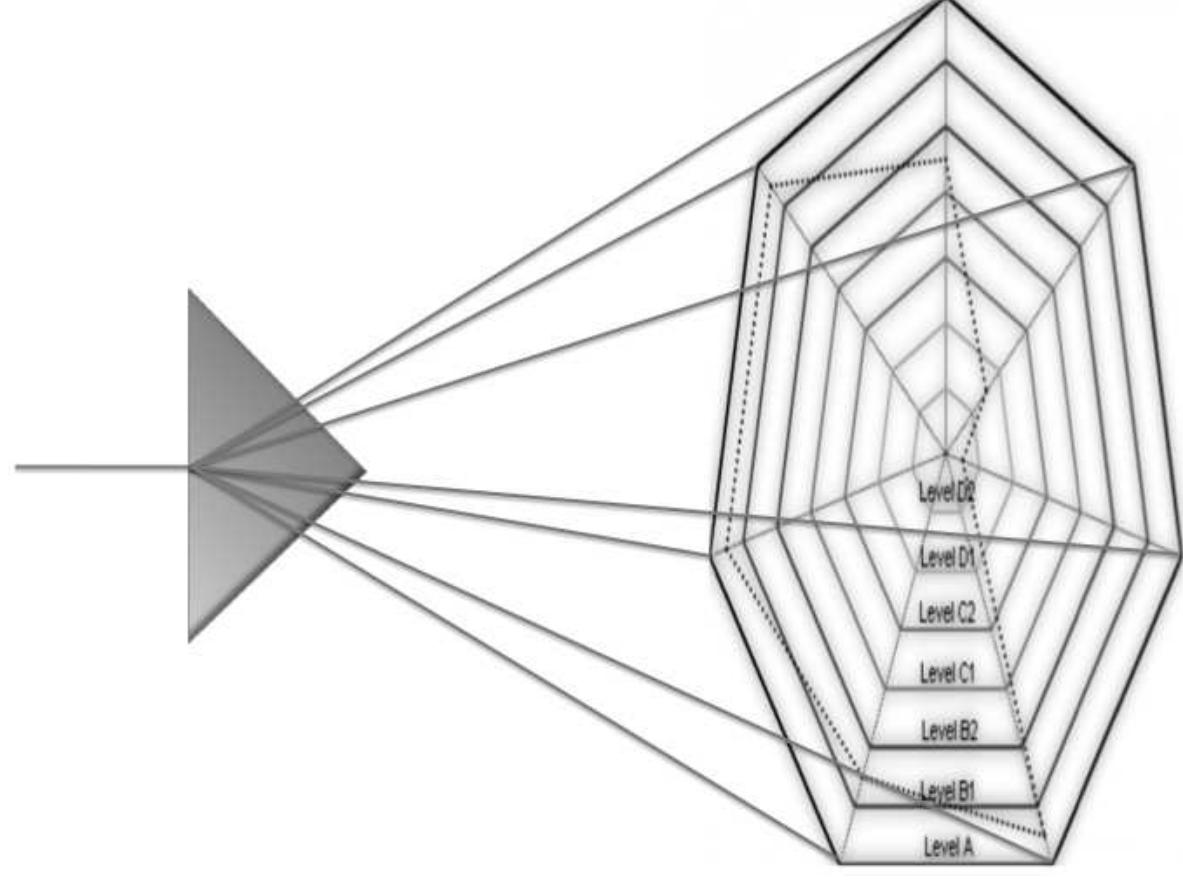
lenses in terms of a prism. A prism divides a white light beam into its spectrum of seven colours, as
the security analysis divides social life into various security discourses – which in case of the
UNDP approach happen to be seven value-clusters indeed.5 That does not mean that the security
aspects are separated from each other in practice but that they can be clustered in subsets of security
as much as the seven colours of light are subsets of the white light beam. That further means that
these clusters cannot be measured and addressed solely by themselves but only in combination with
other clusters. In the metaphor of the prism: 1) using less than seven colours of the white light
cannot lead to a white light beam; 2) shortcomings in any of the seven colours cannot lead to a
white light beam. The first points at an analytical shortcoming, the second at an empirical
shortcoming.
The prism approach implies that ‘white light’ is the ideal situation. No securitization occurs,
because neither analyst nor observed actors perceive any existential threats. We don’t expect to find
much white light in practice. The opposite is black. No light at all. Empirically probably impossible,
although concentration camps, death cells and torture chambers come very close. The metaphorical
approach is to place the prism in the selected case; break the light, and merge the results.
4
A useful approach for defining ‘the local’ in line with our argument is developed by Helen Clouclelis (1992),
combining mathematical, socioeconomic, behavioural and experiential space.
5
That there are seven security aspects in the human security approach as there are colours of light is of course
coincidental and does not reflect on its validity. It is thinkable that in future other discourses might surface as
happened before.
Figure 1: Security as Refracted Light
We can look, for example, at a state and break up its security concerns into various subsets, or we
can apply the prism to a village to assess the subsets of its security setting. Using a prism, we
cannot only deconstruct security into specific discourses; we can also reconstruct the whole in terms
of security, and give our reading of the complexity of interrelated social concerns, values and
interests.
3.
Deconstruction
of
Social
Reality
Regarding
Security
Due to the perceptive nature of threats not every aspect of security relevant to the individual and the
smaller groups she belongs to can easily be measured with quantitative and qualitative data. One
has to deal with the cultural settings that define insecurity in order to asses a situation. That leads to
a complicated problem: threats perceived by the analyst are not necessarily likewise perceived by a
local community. This might be because their cultural setting reflects different values or because
the knowledge necessary to perceive something as a threat is missing. In India and Nepal, for
example, the lowest cast, the Dalits, face life threatening social exclusion, extreme poverty and
atrocities.6 However, the traditional Hindu culture justifies their situation as a result of their karma.
Thus, traditional Hindus might not securitize the Dalits’ situation whereas the Dalits perceive a
threat to their security; an assumption that is supported by political organization of members of the
Dalits (e.g. International Dalit Solidarity Network (IDSN) and Dalit NGO Federation - a body of
175 Dalit NGOs of Nepal).
A more theoretical example would be the existence of an undiscovered disease or a
population living unwittingly in an area of radiological contamination. Both situations would not
result in a security discourse by the local population whereas the analyst based on a different
6
See, e.g., “UN report slams India for caste discrimination” http://www.cbc.ca/world/story/2007/03/02/india-
dalits.html.
cultural background or knowledgebase would consider them as threatening to the population.
Another factor that influences the research is that by researching such situations the analyst
changes its environment by pointing to what she perceives as threat. By interacting with the
reference group for her inquiry the analyst creates awareness among the researched group of a
possible threat. This awareness in turn is being interpreted by the reference group through their
cultural lens and either will be accepted, distorted or disregarded.
Adding to the problems with the perceptive nature of existential threats is the question of
establishing thresholds between basic needs on the one end and luxuries on the other, and between
acceptable risk and intolerable deprivation. It seems necessary to add thresholds to the security
discourse assessment that can be measured objectively, like numbers of deaths related to perceived
threats. One might assume that insecurity can be objectively measured by the amount of deceased
persons based on the key assumption that the more people die the higher the likelihood of a
situation to be prioritized as an existential threat. A simple example, however, proves this key
assumption wrong. In 2005, 41,600 people died in traffic accidents in the EU, while in the same
year 56 people died in Western Europe from terrorist attacks.7 While a major political discourse is
going on regarding terrorism, road safety is hardly securitized (although a policy issue). Numbers of
casualties do not represent what is perceived as threats that justify extraordinary measures. It seems
in this case that either we accept the road safety situation as unchangeable, self-inflicted, or not
threatening to the political system or justify it simply as a necessary risk to be taken given our
dependency on cars as means of mobility.8 Another explanation can be that threats related to
‘abnormalcy’ are securitized more than threats related to ‘normalcy’.9 Still another explanation can
be that potential securitizing actors have nothing or little to offer to counter the threat of traffic
death (it requires costly readjustment of the entire society), whereas securitizing terrorism opens
profitable new windows of opportunity.
We do not have the pretension that we can solve these methodological issues. The best
scholars can do, is to acknowledge their own impact on what they study by including themselves as
variable to their studies and by reflecting on their own bias of what they see as threats.
The discourse-based approach asks what securitizing actors put on the agenda. One would
think that when objectively basic needs are not met, this will be perceived as a threat and therefore
be reflected in the local security discourse. However, it happens that these issues are not mentioned
7
“Road traffic deaths and injuries”,
www.erso.eu/knowledge/content/09_postimpact/road_traffic_deaths_and_injuries.htm; Coolsaet & Van de Voorde
(2006).
8
See the revealing Appendix in Mueller (1989, 267-270): “War, Death, and the Automobile”.
9
As a consequence, the societal and political impact of terrorist attacks diminishes as their frequency grows. That the
Israelis have come to live with the omnipresent threat of suicide bombers is a telling example. Adjustment to street
violence in most megalopolises of the world illustrates this too.
at all. Take for example domestic violence: the mass of women in patriarchal societies do not tend
to express what the analyst will see as a human security problem, and what in international society
is defined as violations of human rights: rape, repression and forced labour. Possible explanations:
the women do not want to make themselves a target by bringing up violence as a topic of political
discussion, or they are kind-of hospitalized in their situation, or they don’t see an alternative.
Habituation, fear and uncertainty about alternative paths may outweigh the certainty of survival in
miserable circumstances. The status of insecurity assessed according to ‘objective’ indicators (as
set, e.g., by the UNDP) runs the risk of representing mainly the values relevant for the analyst. This
assessment is not necessarily relevant for the reference group, if they would be asked to comment
on that.
Another aspect, crucial in understanding the above example, is the need to differentiate
between existing miserable circumstances and the threat of ending up in such circumstances. Once
there, a security discourse is about escape (resistance, revolution, liberation), which is essentially
different from security discourses about prevention.
It means that we have to make use of indicators that allow the assessment of taboos, which
are reflected in actions rather than in words, and of the unidentified problems that will have an
impact on the group nevertheless, like, e.g., health. The spread of deadly disease, even though not
perceived as a threat because there is no knowledge about it, is still a threat to security as defined by
the analyst – who then becomes a securitizing actor herself. Securitization on the spot only occurs
when the potential securitizing actor believes in (emergency) measures that can turn the tides or
when she expects to profit from fears and measures raised by securitization, irrespective of their
problem solving ability. Especially in situations of apathy, passive compliance or taboos, the lack of
securitization can be explained by analyzing the position of the potential securitizing actors in
relation to what the analyst has securitized. Reversely, unrelated to threat or actual crisis,
institutionalized security concerns (armies, police, paramedics, fire brigades) keep reproducing the
securitizations that gave birth to them.
What individuals in their social environment identify as risk or threat is learned by direct or
indirect experience linked to expectation. This can take the form of comparison & prognosis or
abstraction & prognosis. We know about the threat that a rifle can pose because we are informed
about its purpose and use. The Incas did not know about the danger of muskets when Pizarro first
brought them to South-America. But Atahualpa learned quickly from his informant that it poses a
threat, though he himself did not experience it before he was captured. That means that one of his
informants directly or indirectly experienced the effect of muskets (comparison & prognosis) and
was able to communicate this threat to Atahualpa. He simply did or did not belief (abstraction &
prognosis).
The way abstraction & prognosis works, is well explained with the example of the nuclear
holocaust. During the Cold War the securitized threat was a nuclear holocaust. We never
experienced it, but imagined it (helped by Hollywood, peace research and Cold War game
theoretical modelling of scenarios). We were able to take what we learned and communicated about
the effects of nuclear warfare, abstracted it and imagined what would happen, if it was waged – the
power of imagination. Another issue-area where abstraction & prognosis figure strongly in
securitization processes is in environmental security (Buzan, Wæver & De Wilde, 1998; De Wilde,
2008-a): climate change, its origins, nature and consequences, is about the credibility of models that
predict future environmental catastrophes. (Other types of environmental threats, such as natural
hazards, industrial disasters, desertification, deforestation, depletion of resources and species, are in
the realm of comparison & prognosis.).
Essentially the discourse about what are the indicators for different aspects of security
concerns is a question of letting the analyst decide, by academic method/discourse, on the broadest
possible description of an aspect, and letting the reference group decide, by expression of
perception through their words and actions, which indicators have to be used. So the analyst will
expect certain aspects to be important beforehand. For example, given a monetary economy, money
is expected to be a relevant indicator at all levels. Actors without financial means cannot function
within it.
Empirical
and
Methodological
Considerations
Several examples have been mentioned of odd cases of securitization – odd from the perspective of
the analyst, such as the Dalits example, the Incas case, traffic accidents, terrorism, and nuclear
holocaust. In this section we like to present some of these cases in more detail, in order to
distinguish several typical securitization practices. This will further elaborate the mechanisms
mentioned above: abstraction & prognosis and comparison & prognosis. To the extent necessary
for measuring securitization by various means we will introduce key assumptions which will help to
establish different levels of security.
Security is about how actors relate to each other and to their natural environment in terms of
threats and vulnerabilities. Prismatic security is ‘white light’ in its brightest form: a status of a
reference group where no threats to its survival or to its key values are observable. The seven beams
show no distortions. There is no securitization at all; not by individuals, nor by the analyst – an
unlikely situation.
Key assumption 1: if indicators of risk, threat or deprivation pass a threshold acutely
affecting survival, then a security discourse in the area of these indicators is highly probable. (Put
simply: in such circumstances actors are expected to cry out for “Help!”)
The first key assumption is based on theories that attest basic needs as the impetus for
human behaviour (Maslow, 1943; Lasswell & Kaplan, 1950). It theorizes that when people are
threatened in their basic needs or values, this dominates their behaviour. Any acute threat to
survival would fall into this category. A maiore ad minor it means that the probability of the
emergence of a security discourse that justifies extraordinary measures regarding a specific aspect is
the more likely the more basic needs are affected. Key assumption 1 acts as the ‘objectively’ set
threshold applied by the analyst. A method that allows the measurement of basic needs enshrined in
human security has been developed by Owen (2002). He advocates measuring human security on
the basis of a body count related to different security sectors. Though observing our limits, a body
count can serve to support key assumption 1. Acute threats to survival seem to be a universally
applicable threshold where a securitization process is to be expected. We attest this threshold
universal applicability, which will serve as a point of departure for the operationalization of the
Copenhagen School’s framework for analysis.
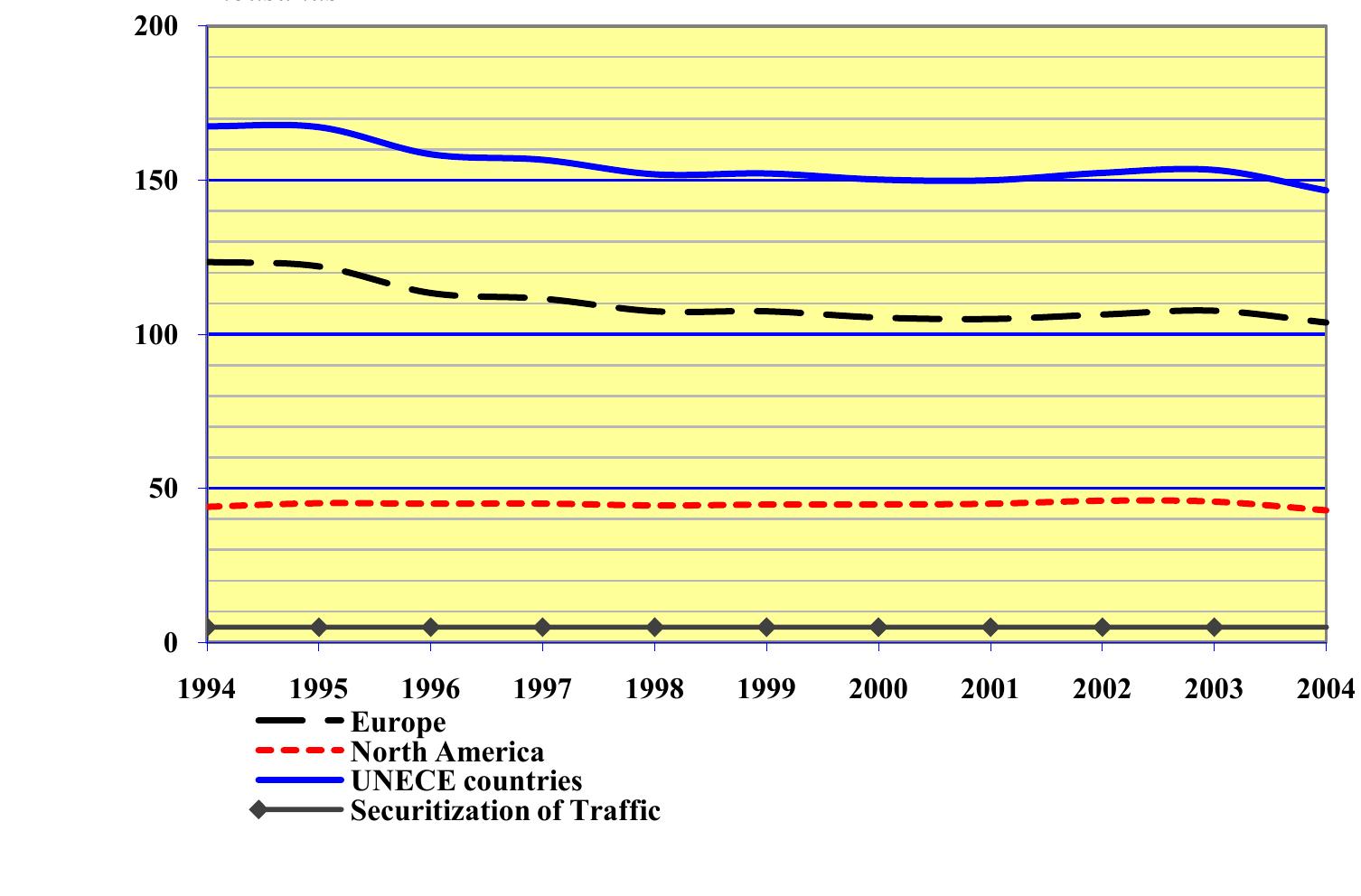
An astonishing phenomenon is that although traffic incidents cause on average 150,000
fatalities a year in 56 states covered by the United Nations Economic Commission for Europe
(UNECE, 2007), people tend to accept this as a mere fact and do not securitize this by demanding
extraordinary measures. It is dealt with as a concern for ordinary politics and legal regulations.
There is a tendency to individualize the casualties: 150,000 wrong decisions by individuals;
individual tragedies rather than structural violence within a social system. Terrorist attacks caused
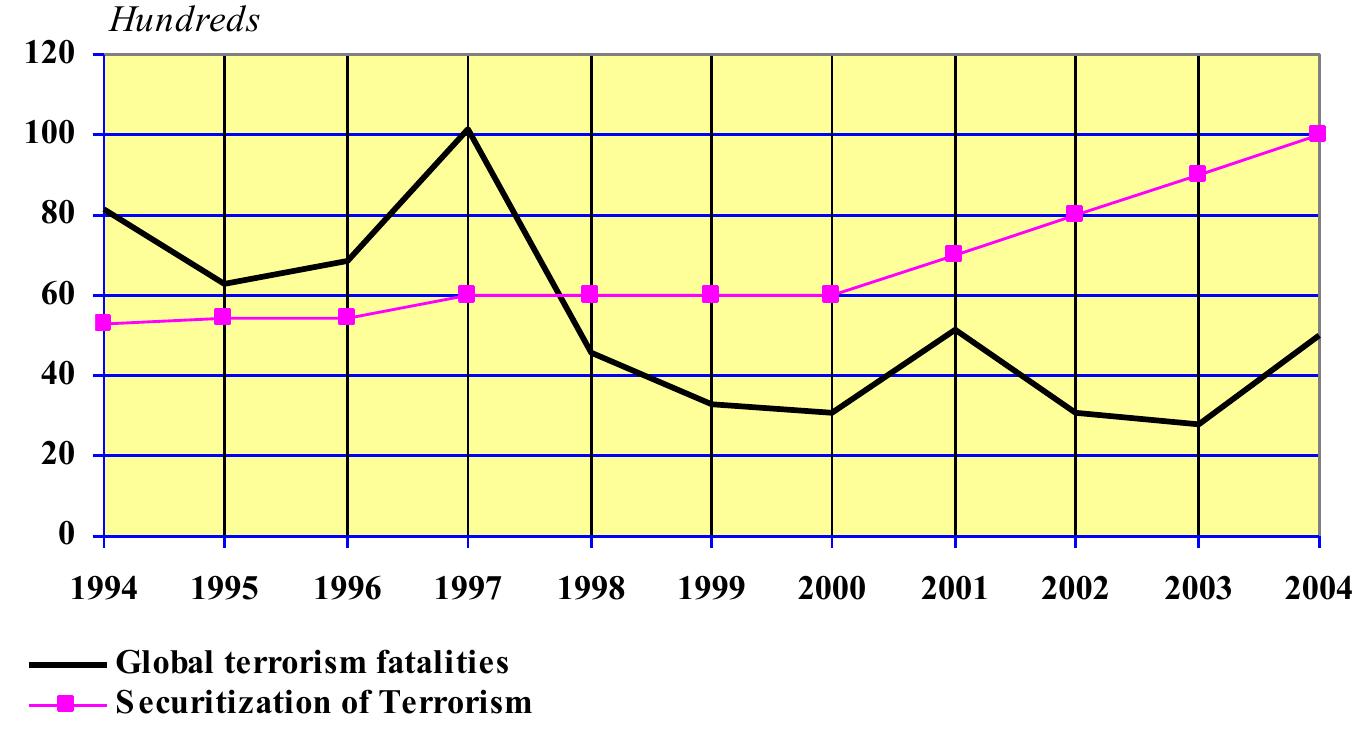
in the years 1994 to 2004 worldwide an average of about 5,312 fatalities per year. That is less than
5% of the numbers of persons killed annually in traffic accidents in UNECE countries alone.10
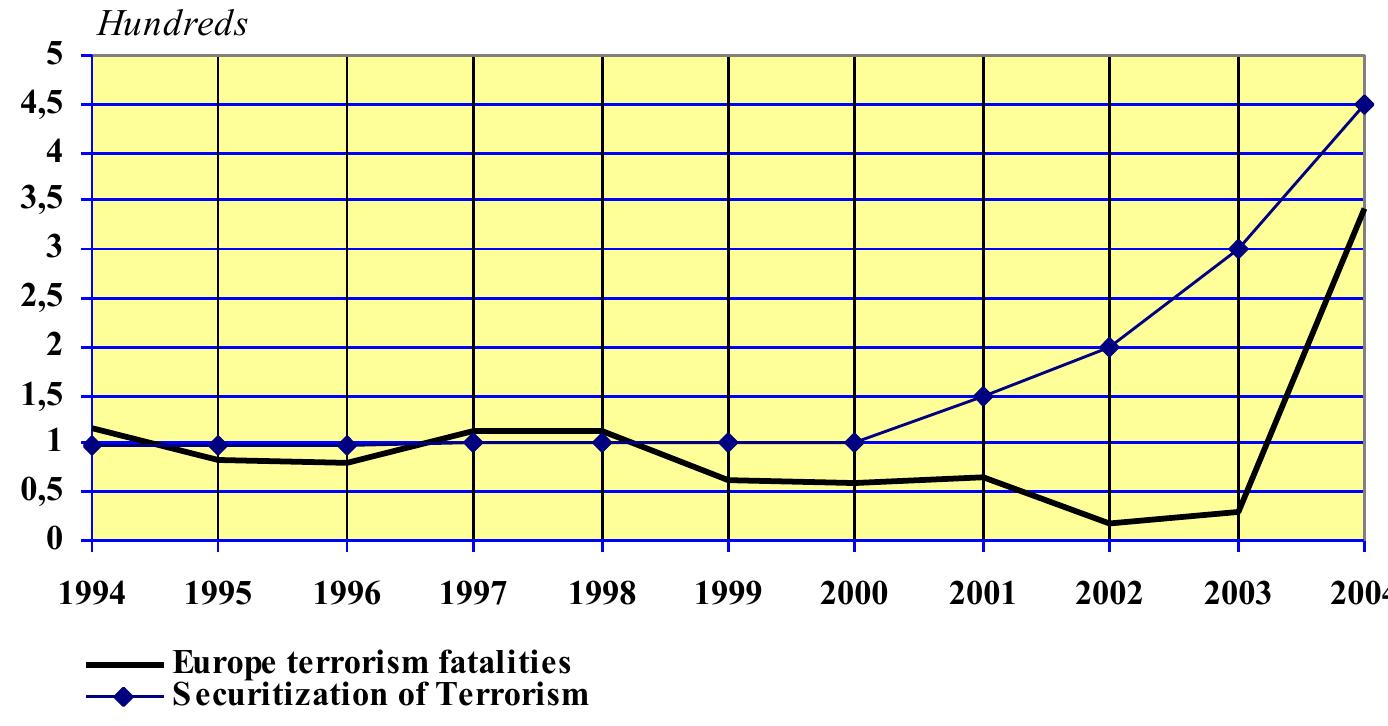
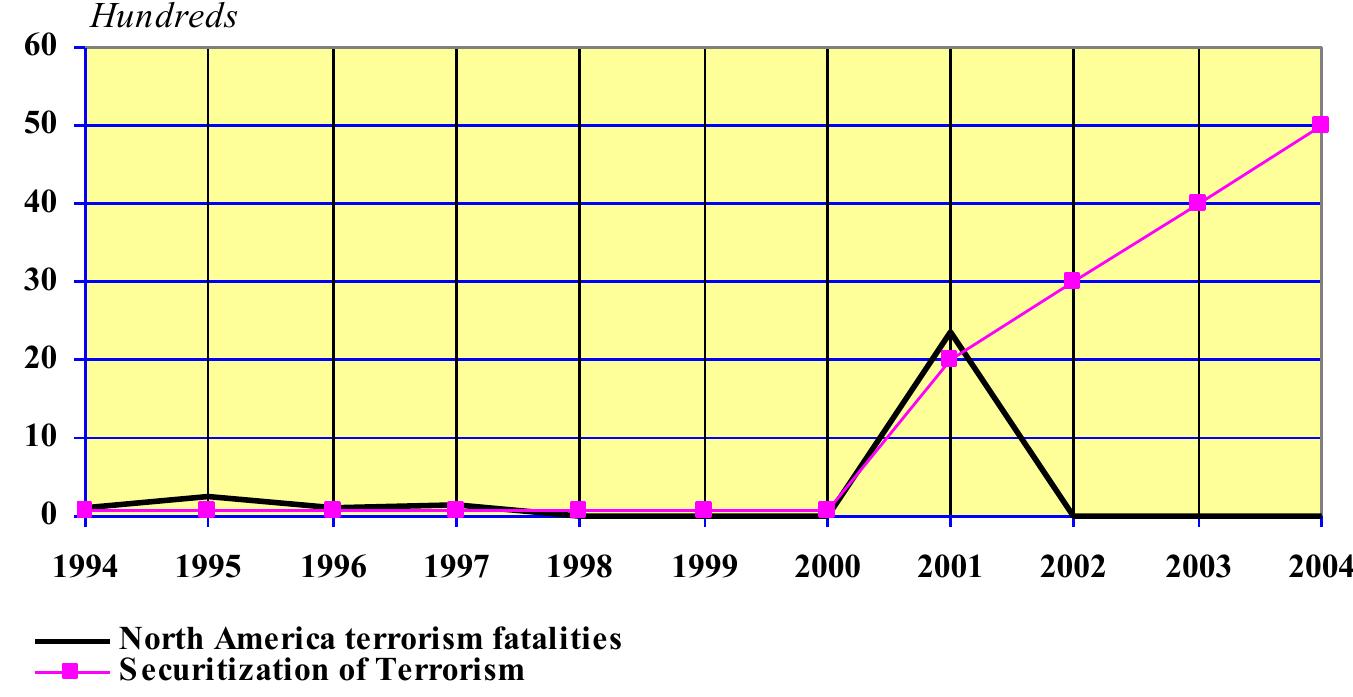
Nevertheless, it is a top priority in security discourses. The graphs on terrorism and traffic incidents
(Figures 2-5) illustrate this and add a hypothetical, value-based curve for observed securitization.
Thousands
200
150
100
50
0
1994 1995 1996 1997 1998 1999 2000 2001 2002 2003 2004
Europe
North America
UNECE countries
Securitization of Traffic
10
This average is based on the GTD 1.1 and 2 and the UNECE statistics.
Figure 2: Road Accidents & Estimated Securitization of Road Traffic, 1994-2004
Source: UNECE, Statistics of Road Traffic Accidents in Europe and North America, 2007 edition,
Number of terrorism fatalities
http://www.unece.org/trans/main/wp6/pdfdocs/Accident_2007.zip.
Hundreds
120
100
80
60
40
20
0
1994 1995 1996 1997 1998 1999 2000 2001 2002 2003 2004
Global terrorism fatalities
S ecuritization of Terrorism
Figure 3: Global Terrorist Fatalities & Estimated Securitization of Terrorism
Source: Global Terrorism Database
Number1.1ofand 2, http://www.start.umd.edu/start/data/GTD/
terrorism fatalities
Hundreds
60
50
40
30
20
10
0
1994 1995 1996 1997 1998 1999 2000 2001 2002 2003 2004
North America terrorism fatalities
S ecuritization of Terrorism
Figure 4: North American Terrorism Fatalities & Estimated Securitization of Terrorism
Source: Global TerrorismNumber
Database 1.1 and 2,
of terrorism http://www.start.umd.edu/start/data/GTD/
fatalities, 1994-2004
Hundreds
5
4,5
4
3,5
3
2,5
2
1,5
1
0,5
0
1994 1995 1996 1997 1998 1999 2000 2001 2002 2003 2004
Europe terrorism fatalities
S ecuritization of Terrorism
Figure 5: European Terrorism Fatalities & Estimated Securitization of Terrorism
Source – Global Terrorism Database 1.1 and 2, http://www.start.umd.edu/start/data/GTD/
In the case of terrorism we can observe a similar phenomenon of opposing securitization processes.
The Bush administration justified emergency measures such as torture and war as a means to fight
terrorism based on the securitization of the terrorist threat. This strong securitization process was
initiated by the events of September 11, 2001. Judging from this high-impact (low-probability)
event one could assume that a death-count provides valuable information on how strongly a threat is
securitized. However, when looking again at the road traffic fatalities, this seems to be doubtful.
The European securitization process regarding terrorism cannot be explained by the same
mechanism as the securitization process of the United States. It rather seems that diffusion of
security concerns of a dominant peer (the United States) to Europe lead to an increased
securitization of terrorism within Europe in the aftermath of the events of September 11, 2001 but
before the London and Madrid bombings occurred.11
Similarly, the world effectively experienced the power of the atomic bomb only twice in
history (Hiroshima and Nagasaki in 1945) but still the imagination of a nuclear holocaust worked
well during the Cold War, at least ever after the Cuban missile crisis (1961). Irrespective of the
nuclear arms race between the United States and the Soviet Union, the awareness of Mutually
Assured Destruction (MAD) appeared to set a rational limit to their willingness to escalate other
‘existential’ issues between them (Waltz, 1981). Moreover, the tone between the United States and
the Soviet Union changed after 1986, when a new disarmament process verbalized fear of the
possible environmental impact of nuclear war, helped by the theorized nuclear winter in 198312 and
the Chernobyl disaster in 1986.13
In the cases depicted by Figures 2-5 it is illustrated that singular events that had an impact
on threat perceptions and generated a securitization process (like Hiroshima, Chernobyl, 9/11), can
best be described as ‘abstraction & prognosis’. The incidents are considered to be a demonstration
of what could happen in abstract terms anywhere else (terrorists could launch such attacks as
experienced also against other targets, which might be more vital for the survival of a state; a
nuclear weapon could be used also against other targets) – abstraction. Subsequently, the actor
starts to develop a hypothetical prognosis where she multiplies the experienced example (a drastic
increase in terrorists employing means that target a huge number of persons; a nuclear holocaust) –
prognosis.
Multiple low impact events, related to factors such as the increase of pollution, population
11
Diffusion in this regard means the socially mediated spread of ideas among a population or among actors. In this
case the institutions facilitating this process are of course the media and also the UN Security Council with
Resolution 1373 (2001).
12
The discourse politically particularly unfolded around an article Carl Sagan (1983) in the journal of foreign
relations.
13
This incident lead to two international Conventions in the same year: Convention on Early Notification of a Nuclear
Accident; Convention on Assistance in the Case of a Nuclear Accident or Radiological Emergency.
and industrial output, are dealt with differently. A steadily increasing curve of low impact events of
environmental scarcity and degradation leads to a much lower threat perception based on the
prognosis that the curve would simply continue its path. Intervention is therefore always possible
and not a security priority. Projections of a neo-Malthusian kind try to alter the discourse by
changing the securitization curve from comparison & prognosis to abstraction & prognosis. Studies,
such as supported by the Club of Rome (Meadows et al., 2004), aim to change a politicization
process to a securitization process by projecting future (Armageddon-like) events and by shifting
the only possible emergency measures to a point near the present.
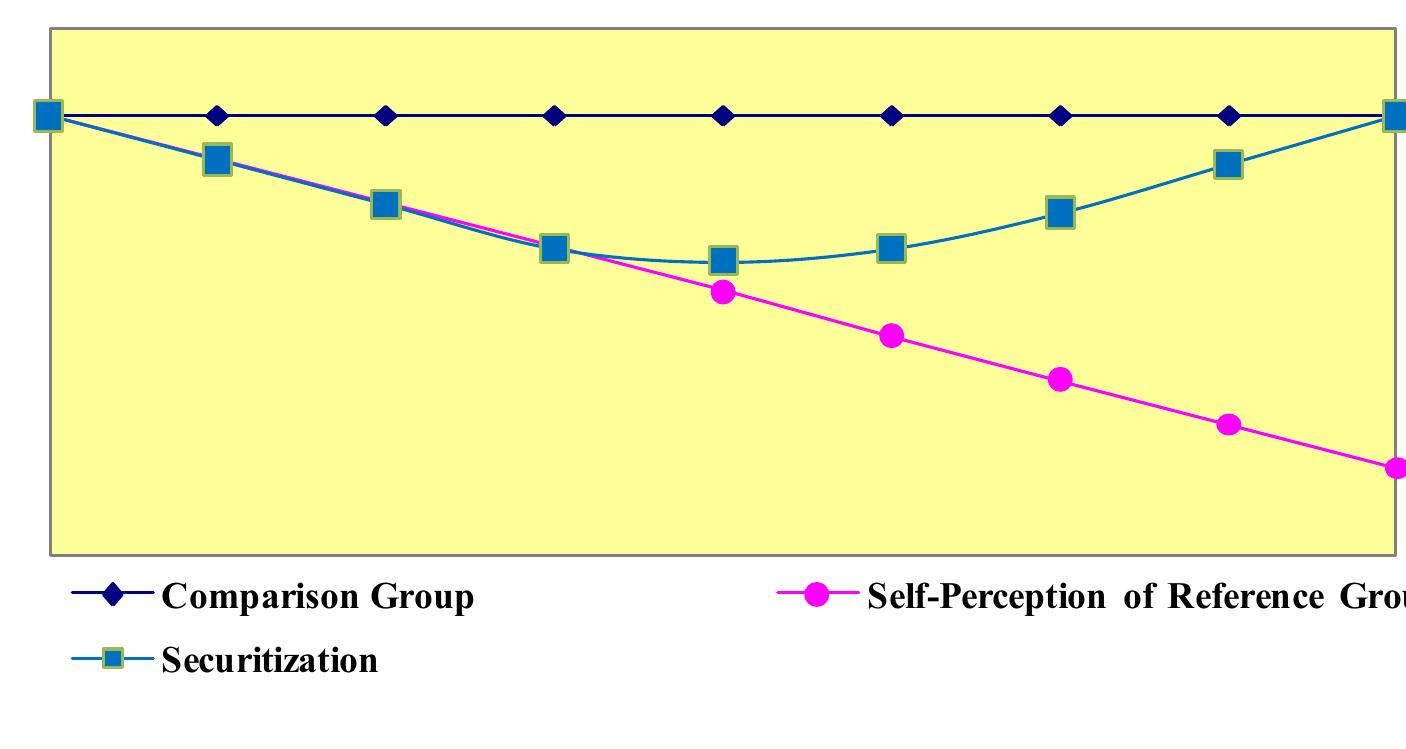
Key assumption 2a: comparison of the reference group with another group, with itself in an
earlier (idealized) point of time, or with an abstract standard, influences the perception of possible
change in future, and thus affects the incentives for securitization. This is a comparison of
circumstances and expected scenarios for change – comparison & prognosis (conducted by the
analyst and/or by actors in the reference group).
Above the threshold of survival and basic needs, empirical measurements will have to resort
to the concept of relative deprivation between a reference group and a comparison group with
relevancy to the reference group. The concept of relative deprivation is used to explain the tendency
for political violence conducted by an actor depending on how extreme this disparity of capabilities
and expectations in the area of her basic needs is perceived (Gurr, 1971: 24-27; Stewart, 2008: 3-
23). This comparison group can either be a group that is in geographic relation to the reference
group (‘why can’t we have what they have?’); or it can be a historical comparison group (‘we did
better in the past, let’s restore it’). This means that the reference group compares itself with itself at
an earlier point in history or with another closely related group experiencing better circumstances.14
The higher the disparity between the situations of comparison, the higher the likelihood of a
security discourse, even if there is no or little evidence of the factors described in key assumption 1.
This approach allows us to expect a securitization process on the basis of data, like income or crime
rates or living standards in general.
14
This follows Weber’s definition of social action that can be geared towards the past, present or future in contrast to
reactive action that is geared towards the present (1978: 22-24).
Comparison and Prognosis
Comparison Group Self-Perception of Reference Group
Securitization
Figure 6: Comparison and Prognosis
The higher the difference between reference group and comparison group, the higher the tendency for securitization
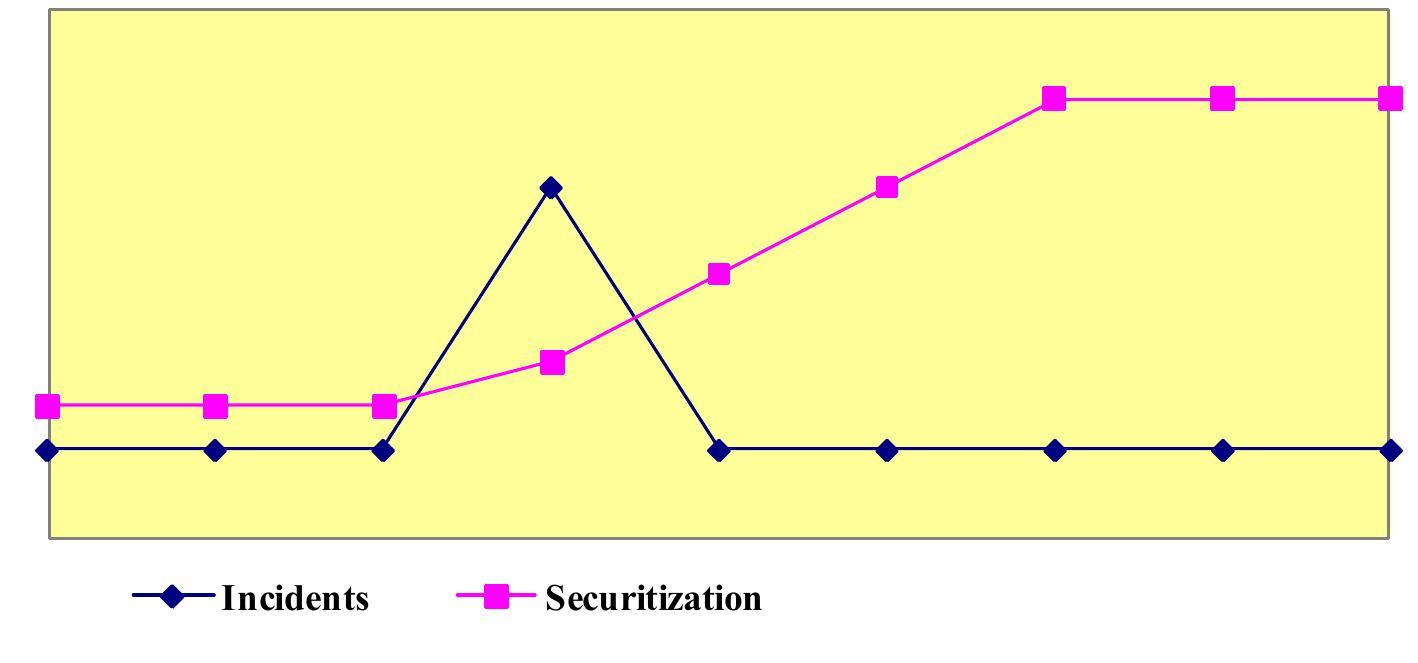
Key assumption 2b: comparison of the reference group with exceptional experiences by others or
with imagined hazards influences the perception of the future, and thus the incentives for
securitization. Let’s call it the Hollywood-factor: abstraction & prognosis.
Key assumption 2b reflects on a similar process of an intersubjective construction of
security issues as does 2a. However, the underlying mechanisms are different. The abstraction &
prognosis is purely based on a hypothetical vision of the future. The concept of relative deprivation
is not applicable in Key assumption 2b as the perceived threat does not follow the projection of a
trend into the future. Instead, indicators of relevancy for observing the securitization process can
only be found in the securitization process itself, namely discourse (e.g., political statements on
terrorism as threat) or actions (e.g., the nuclear arms race). In that case quantitative indicators for
Key assumption 1 show no or only small indication of threats to the respective aspect of survival,
whereas other indicators that measure actions and discourse point to a rather strong threat
perception.
Abstraction and Prognosis
Incidents Securitization
Figure 7: Abstraction and Prognosis
Both observations – abstraction & prognosis and comparison & prognosis – are similar in
projecting a threat into the future as hypothetically possible and theoretically likely. This leads the
actor to a conviction that something abnormal is happening of which she thinks it should be and can
be avoided. If the ‘can be’ is missing in the conviction, apathy or surrender is more likely than
securitization. Following this logic, in the traffic deaths example securitization will occur: (a) if
there are one or more accidents with a much higher amount of casualties as we are used to or in
sensational circumstances (abstraction & prognosis); or (b) if the amount of traffic related fatalities
shows a clear increase (comparison & prognosis).
A factor involved in abstraction and prognosis might be the Peak-End rule (Fredrickson &
Kahneman 1993). It explains why a slow increase of casualties due to the accelerating effect of
climate change on natural disasters (comparison & prognosis) tends to lead to a less steep
securitization process than abstraction and prognosis. Peak experiences, such as 9/11 or Hiroshima
and Nagasaki, are felt more strongly than slow changes (e.g. climate change). This seems to be so,
even if the final outcome of slow changes might be the same or worse than the result of peak
experiences. Abstraction and prognosis can then lead to an overweighting of the probability of
events with high impact (in the case of terrorism the high-impact/low-probability event of 9/11 lead
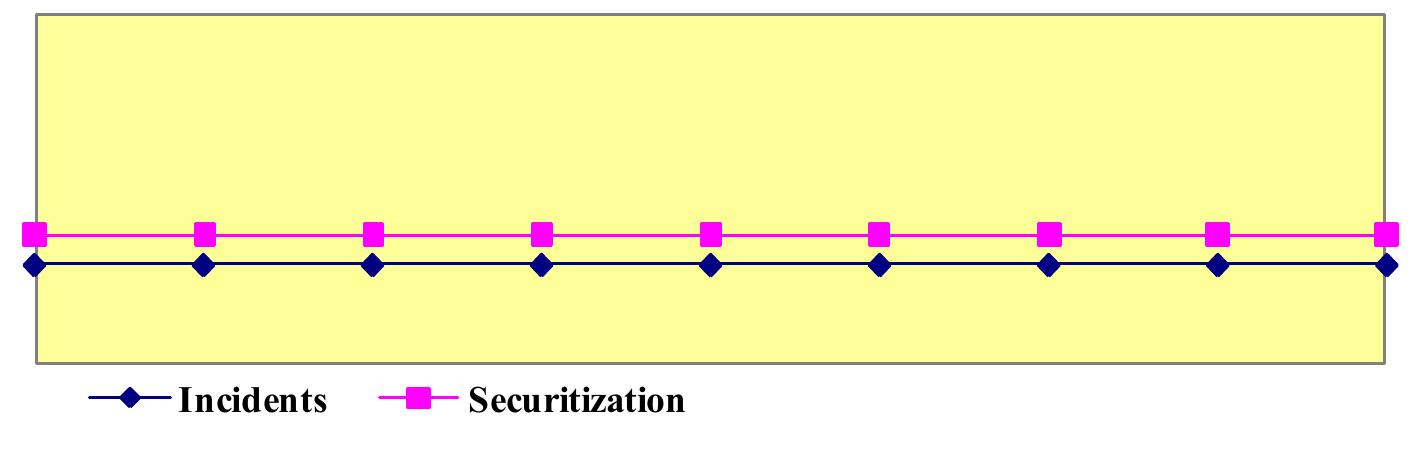
to massive securitization). In another study Kahneman, et al. (1993) discovered a cognitive error of
judgements: humans tend to neglect situations with a continuous duration of pain. The ‘duration
neglect’, as it is called, might explain why car accidents, which happen on a daily basis, are not as
strongly securitized as terrorism occurring only incidentally in Europe and the United States.
Comparison & prognosis, therefore, has a less strong effect on securitization (see also Taleb, 2008:
76-79). The mechanism of duration neglect leads to no or unsuccessful securitization (Figure 8).
The Peak-End rule distinguishes between low securitization as a result of comparison & prognosis
and high securitization in casesDuration
of abstraction and prognosis.
Neglect and Securitization
Incidents Securitization
Figure 8: Duration Neglect and (No) Securitization
The indicators for measuring relative deprivation regarding key assumptions 2a and 2b are
essentially established by the analyst, based on assessments of norms in and outside the reference
group. A recurring standard research question will be, if securitizations in the field reflect and
match the analyst’s expectations.15 That means, e.g., that if there is no evidence of a securitized
15
Compare the Copenhagen School’s insight in the notion of overlay: Overlay dampens local conflict dynamics,
which implies that we don’t see the security discourses played out as we, as analysts, would expect them to play out.
threat, this has to be contrasted with indicators about threats to basic needs. A disagreement
between the outcomes of both assessments can point to a threat perception within the reference
group that is not verbalized (because of fear, taboo or social compliance), to misperceptions within
the reference group, or to misperceptions of the analyst. In the latter case the analyst may have
misjudged the existential thresholds of the indicators.
Key assumptions 2a and 2b reflect process dependent variables that vary in their impact
based on speed of development from one situation to the other and the extent of change experienced
and/or expected. Coming back to the road safety example, road safety is not securitized as terrorism
is, simply because it follows a different expectancy curve. In the case of terrorism it appears that not
the empirical evidence (frequency, body count etc.) but rather the discourse about terrorism defines
the expectancy. The discourse reflects and causes fear. Although, in Western Europe the likelihood
of being killed in a traffic accident is much higher than being killed by a terrorist, the expectancy of
and fear from an upwards trend for terrorism is much higher than for traffic accidents. Therefore,
the need of a policy change appears to be much higher. This definition and the key assumptions
allow for a triangulation of methods that identify the threshold of (un)acceptable risks and threats or
deprivations assessed by (1) the analyst, and (2) the (other) actors involved.
The problem with measuring perceptions is that people do not always verbalize what they
perceive as threats, either because it is a taboo or the verbalization as such could increase the threat.
The operational path that follows from this starts with researching what the reference group sees as
important indicators in regard to the different aspects of security based on their values and by
analyzing the respective actions that indicate certain values by observing which indicators are
prioritized over others. Assume, e.g., that we look at a group for whom money is important to
define their economic security. The indicator money is countable, but the threshold defining
minimum existential amounts involves a wide range of societal concerns, and variations in time and
space. To ask the group members about how important money for them is, constitutes one but not
the only way to determine the threshold. We can also identify it by observing their financial
behaviour, including the sacrifices made to make money. Identifying the indicators by looking at
where economic, societal, political, etcetera actions are pointing at means to assess the values by the
actions they cause. The security discourse is either based on one of the three key assumptions
observed, or the analyst looks instead at actions that point to securitized issues. This might be
necessary where a discourse is expected but not detectable. That means that every status of security
is measurable either by occurrence or absence of factors and processes described in key
assumptions 1, 2a, and 2b.
In cases where there are words but no deeds, the necessity of securing an aspect seems not to
reach the perceived urgency as in the previous case (see for an illustration the analysis of
environmental securitizations: environmental policies by governments hardly if ever match the
alarming reports that inspire them (Buzan, Wæver & De Wilde, 1998: Ch. 4; De Wilde, 2008-a).
Where also acute threats to the survival, as defined by the analyst, are measurable, the urgency is
likely to be highest and deeds are to be expected.
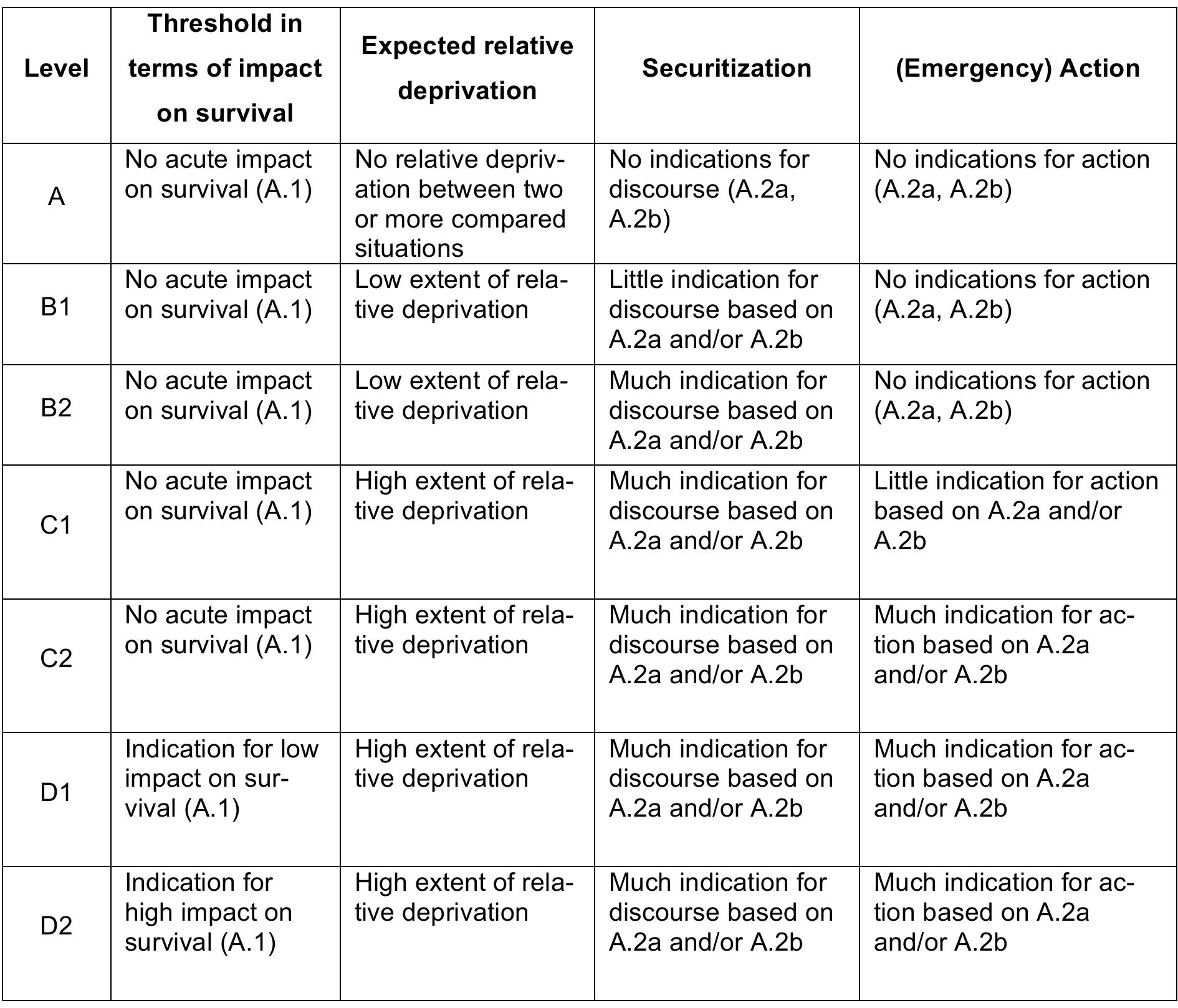
This leads us to three levels of securitization (or perceived threat levels) – B, C & D – and
one level (A) of security defined by the absence of words and deeds. The three key assumptions
thereby stand in relation to each other regarding the level of securitization to be assigned. We
distinguish between the following levels:
• A - Security: a status where no indicators (deaths, discourse or actions) are measurable.
• B - Latent Threat: a status where no or little acute threat to basic needs is measurable in
terms of key assumption 1, but discourse based on key assumption 2a and/or 2b is
measurable, or an equivalent of relative deprivation regarding key assumption 2a is
measurable; a missing verbalization of a threat can point at (x) social acceptance, (y)
missing knowledge about the threat or (z) a taboo.
• C - Manifest Threat: a status where no or only little acute threat to basic needs are
measurable in terms of key assumption 1, but action based on key assumption 2a and/or 2b
is measurable, or an equivalent of indicators for relative deprivation regarding key
assumption 2a is present.
• D - Acute Threat: a status where deprivation of basic needs is measurable in terms of Key
assumption 1; discourses and/or actions have to be present.
The first relevant step is to analyse the values the reference group emphasizes. This is important to
know when assessing qualitative and quantitative indicators for the measurement of relative
deprivation. The second necessary step is the assessment of the indicators for the security aspects
according to the key assumptions, including the associated concepts. The next step is to translate
quantitative data as well as qualitative data into a grid that allows an assessment of security by
making use of the prism (see Table 1).
Each aspect of security can be assessed in regard to its level. Sublevels are possible as well.
We can distinguish for the levels B, C and D between few and many indicators for action or
discourse, or high or low extent of relative deprivation in regard to key assumption 2a for levels B
and C. Key assumption 1 in Level D can be divided between high and low likelihood of lethality.
Relative deprivation thereby becomes a testable variable. If the research shows a relative
deprivation in a certain case, the analyst would expect a securitization process in this area.
However, if he finds that there is no such process in words or actions measureable it points to a
discrepancy between the values attributed by the analyst and the values attributed by the reference
group. Similarly we expect key assumption 1 to be a testable variable for level D. If there is no
securitization process, in other words people just die without taking any actions, one has to assume
that there is missing knowledge about the cause and that either the comparison between this group
and another group or their current situation in comparison with an earlier situation reveals no
relative deprivation and discrepancy. This leads to the following matrix (A1, A2a and A2b stand for
the key assumptions):
Threshold in
Expected relative
Level terms of impact Securitization (Emergency) Action
deprivation
on survival
No acute impact No relative depriv- No indications for No indications for action
A on survival (A.1) ation between two discourse (A.2a, (A.2a, A.2b)
or more compared A.2b)
situations
No acute impact Low extent of rela- Little indication for No indications for action
B1 on survival (A.1) tive deprivation discourse based on (A.2a, A.2b)
A.2a and/or A.2b
No acute impact Low extent of rela- Much indication for No indications for action
B2 on survival (A.1) tive deprivation discourse based on (A.2a, A.2b)
A.2a and/or A.2b
No acute impact High extent of rela- Much indication for Little indication for action
on survival (A.1) tive deprivation discourse based on based on A.2a and/or
C1
A.2a and/or A.2b A.2b
No acute impact High extent of rela- Much indication for Much indication for ac-
on survival (A.1) tive deprivation discourse based on tion based on A.2a
C2
A.2a and/or A.2b and/or A.2b
Indication for low High extent of rela- Much indication for Much indication for ac-
impact on sur- tive deprivation discourse based on tion based on A.2a
D1
vival (A.1) A.2a and/or A.2b and/or A.2b
Indication for High extent of rela- Much indication for Much indication for ac-
high impact on tive deprivation discourse based on tion based on A.2a
D2
survival (A.1) A.2a and/or A.2b and/or A.2b
Table 1: Prismatic Security Matrix
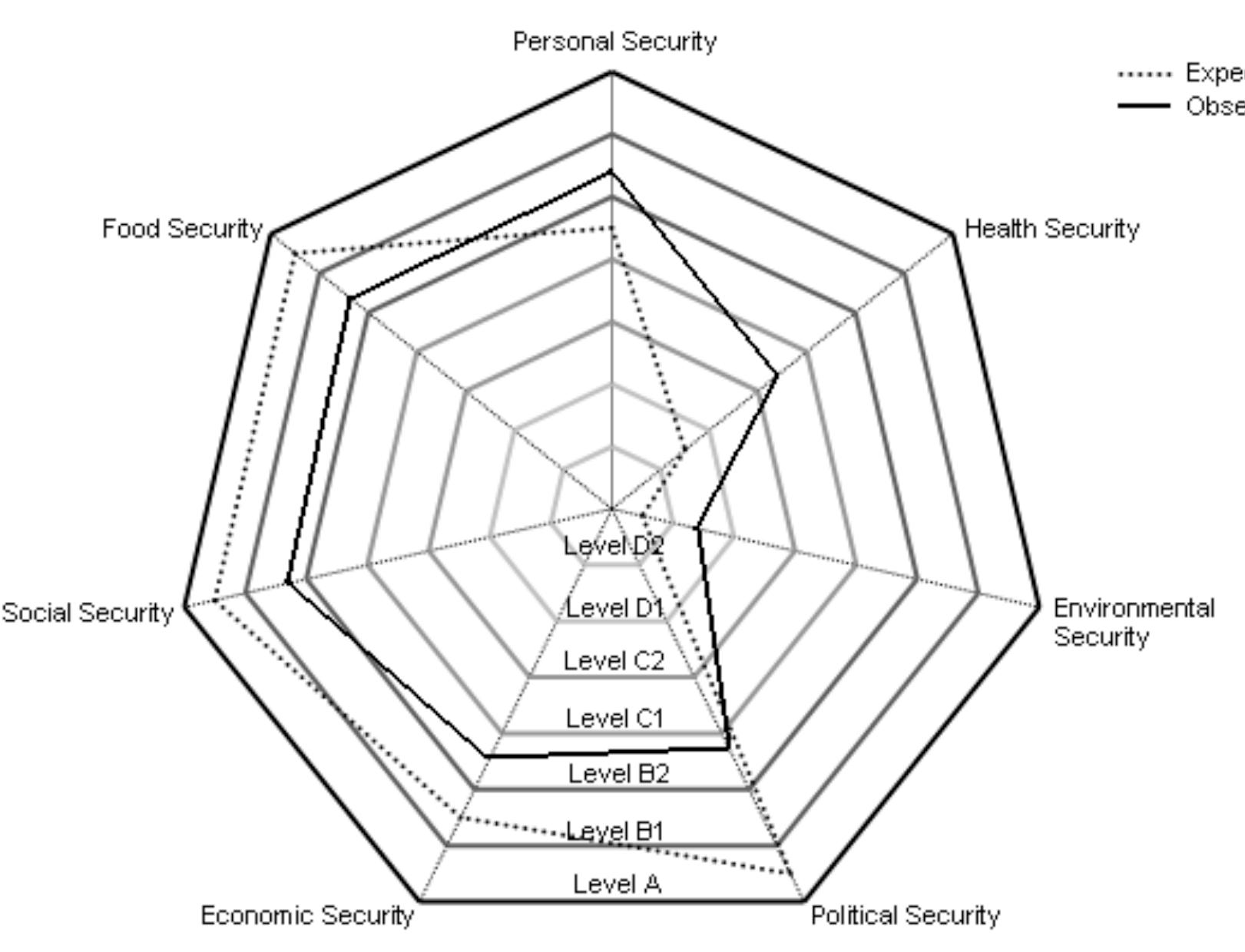
This matrix (table 1) leads us to the visualization of prismatic security. The idea to see security as a
prism takes concrete form in the operational structure of prismatic security and its visualization.
Each lens will represent one aspect of prismatic security. In order to visualize the overall state of
security the measurement of each aspect relevant to human survival has to be assessed. Therefore,
the gathered data based on the indicators for each aspect needs to be translated to the security
statuses of the prismatic security matrix. The outcome for each aspect is entered into a spreadsheet,
which can be easily visualized as a radar graph symbolizing the refracted white light (see Figure 9).
Projecting the observed discourse and emergency action on the graph in juxtaposition with the
relative deprivation that the researcher expects might shed light on the analyst’s own bias. It would
thus reflect on what he securitizes and which indicators she deems important.
Figure 9: Prismatic Security of Observed versus Expected Securitization
Conclusion
In this article we have shown how the Copenhagen School can be expanded to the local level. We
have suggested defining local security complexes along the lines established in regional security
complex theory. The theory provides the criteria, and the reading of their scores determines the
scale and location of the local security complexes, as well as the actors involved. The kind of lenses
required for charging local security discourses differs from the original framework for analysis, due
to the peculiarities of including individuals and small groups. We accepted the presently dominant
security perspectives of the UNDP, be it with two provisions. First, in order to preserve the
threshold that threats must have existential characteristics for the securitizing actors, we added the
basic needs discourse as a benchmark. Secondly, the criteria provided by UNDP, or by any other
analyst, can be wrong or lead to misleading conclusions in face of the actual (lack of)
securitizations in a given local context. Hence, it is crucial to treat the analyst not as a neutral third
party, but as one of the local actors: the analyst is involved – the more so, if she is working for a
humanitarian organisation that intends to improve the situation.
A final observation is simple but vital to the operationalization of securitization theory. It is
based on the idea that when threats are perceived acutely affecting our survival, then we tend to
accept or at least take existential risks in other value-clusters to overcome the threat. An example is
the hungry but poor person who steals bread for his survival, risking arrest. Assuming she had the
money, she would buy the food she needs. The values which she perceives are threatened justify
extraordinary measures and risks in other issue areas. It is like people jumping from the sixth floor
of a burning building. Various situations of self-defence and self-help in cases of emergencies can
be mentioned as examples. But also self-sacrifice to change the tides (like suicide-bombers) or to
provide others the option of escape (women and children first) show how existential concerns can
override each other. Tracing and deconstructing the discourse of the actors involved may reveal
how securitization processes make some existential values take priority over others. The distortion
between expected and observed behaviour may well have its roots in how some concerns and the
local values that underlie them override others.
To improve the chances of a successful analysis we have introduced two new explanations
of securitizing moves: ‘abstraction and prognosis’ and ‘comparison and prognosis’. From further
research we hope that this allows us to profit from psychological and psychiatric research of threat
perceptions. That is an obvious interdisciplinary direction when individuals and small groups are
central to an analysis.
References
Abler, Ronald F., Melvin G. Marcus & Judy M. Olson, Eds. (1992), Geography’s Inner Worlds: Pervasive
Themes in Contemporary American Geography, New Brunswick, NJ: Rutgers University Press.
Baldwin, David, 2001. ‘The concept of security’, Review of International Studies 23(01): 5–26.
Buzan, Barry, 1991. People, States and Fear: An Agenda for International Security Studies in the Post-Cold
War Era. New York, etc.: Harvester Wheatsheaf.
Buzan, Barry and Ole Wæver, 2003. Regions and Powers: The Structure of International Security.
Cambridge: Cambridge University Press.
Buzan, Barry, Ole Wæver and Jaap de Wilde, 1998. Security: A new Framework for Analysis. Boulder, Col.:
Lynne-Rienner Publishers.
Buzan, Barry and Hansen, Lene, 2009. The Evolution of International Security Studies. Cambridge:
Cambridge University Press.
Couclelis, Helen (1992), “Location, Place, Region, and Space”, in Abler, et al., pp. 215-233.
Coolsaet, Rick and Teun Van de Voorde, 2006. The Evolution of Terrorism in 2005, A Statistical Assessment.
University of Ghent, Belgium: Department of Political Science.
Den Boer, Monica & Jaap de Wilde, Eds. (2008), The Viability of Human Security, Amsterdam: Amsterdam
University Press.
De Wilde, Jaap, 1995. ‘Security Levelled Out: The Dominance of the Local and the Regional’ in Dunay, Pál,
Gábor Kardos and Andrew Williams, eds., New Forms of Security: Views from Central, Eastern and
Western Europe. Aldershot: Dartmouth (85–102).
De Wilde, Jaap, 2008-a. ‘Environmental Security Deconstructed’, in Hans Günter Brauch, John Grin, Czeslaw
Mesjasz, Navnita Chadha Behera, Béchir Chourou, Ursula Oswald Spring, P. H. Liotta, and Patricia
Kameri-Mbote, eds., Globalisation and Environmental Challenges, Vol. 1. AFESS-Press (595–602).
De Wilde, Jaap, 2008-b, “Speaking or Doing Human Security?” in: Den Boer & De Wilde, 2008, pp. 225-
254.Floyd, Rita, 2007. ‘Towards a Consequentialist Evaluation of Security: Bringing Together the
Copenhagen and the Welsh Schools of Security Studies’, Review of International Studies 33(2): 327–
350.
Floyd, Rita, 2007. ‘Towards a Consequentialist Evaluation of Security: Bringing Together the Copenhagen and
the Welsh Schools of Security Studies’, Review of International Studies 33(2): 327–350.
Floyd, Rita, 2010. Security and the Environment: Securitisation Theory and US Environmental Security
Policy, Cambridge: Cambridge University Press.
Fredrickson, Barbara L., and Daniel Kahneman. 1993. “Duration Neglect in Retrospective Evaluations of
Affective Episodes”, Journal of Personality and Social Psychology 65(1): 45-55.
Gurr, Ted Robert, 1971. Why men rebel. Princeton: Princeton University Press.
Hansen, Lene and Helen Nissenbaum, 2009. ‘Digital Disaster, Cyber Security, and the Copenhagen School’,
International Studies Quarterly 53(4): 1155–1175.
Hayes, Jarrod, 2009. ‘Identity and Securitization in the Democratic Peace: The United States and the Divergence
of Response to India and Iran's Nuclear Programs’, International Studies Quarterly 53(4): 977–999.
Human Security Centre, 2005. Human Security Report 2005. New York/Oxford: Oxford University Press.
Kahneman, Daniel, Barbara L. Fredrickson, Charles A. Schreiber, and Donald A. Redelmeier, 1993. ‘When
More Pain Is Preferred to Less: Adding a Better End’, Psychological Science 4(6): 401–405.
Krause, Keith, and Michael C. Williams, 1996. ‘Broadening the Agenda of Security Studies: Politics and
Methods’, Mershon International Studies Review 40(2): 229–254.
Lasswell, Harold D., and Abraham Kaplan, 1950. Power and society: A framework for political inquiry. New
Haven: Yale University Press.
Maslow, Abraham, 1943. ‘A Theory of Human Motivation’, Classics in the History of Psychology.
http://psychclassics.yorku.ca/Maslow/motivation.htm.
McDonald, Matt, 2008. ‘Securitization and the Construction of Security’, European Journal of International
Relations 14(4): 563–587.
Meadows, Donella, Dennis Meadows and Jorgen Randers, 2004. Limits to Growth: The 30 Year Global
Update. Chelsea: Green Publishing Company.
Mitzen, Jennifer, 2006. ‘Ontological Security in World Politics: State Identity and the Security Dilemma’,
European Journal of International Relations 12(3): 341–370.
Mueller, John, 1990. Retreat from doomsday: The obsolescence of major war, New York: Basic Books.
Owen, Taylor, 2002. ‘Body Count: Rationale and Methodologies for Measuring Human Security’, Human
Security Bulletin 1(3). http://www.taylorowen.com/Articles/2002_Body%20Count.pdf.
Paris, Roland, 2001. ‘Human Security: Paradigm Shift or Hot Air?’, International Security 26(2): 87–102.
Riggs, Fred W., 1961. ‘International Relations as a Prismatic System’, World Politics 14(1): 144–181.
Sagan, Carl, 1983. ‘Nuclear War and Climatic Catastrophe: Some Policy Implications’, Foreign Affairs
62(2): 257–292.
Salter, Mark B., 2008. ‘Securitization and Desecuritization: A Dramaturgical Analysis of the Canadian Air
Transport Security Authority’, Journal of International Relations and Development, 11(4): 321-349.
Stewart, Frances, 2008. Horizontal Inequalities and Conflict - Understanding Group Violence in Multiethnic
Societies. London: Palgrave.
Stritzel, Holger, 2007. ‘Towards a Theory of Securitization: Copenhagen and Beyond’, European Journal of
International Relations 13(3): 357–383.
Taleb, Nassim N., 2008. The Black Swan. London: Penguin.
Taureck, Rita, 2006. ‘Securitization Theory and Securitization Studies’, Journal of International Relations &
Development 9(1): 53–61.
Terriff, Terry, Stuart Croft, Lucy James, and Patrick M. Morgan, 1999. Security Studies Today.
Cambridge/Oxford: Wiley-Blackwell.
United Nations Development Programme – UNDP, 1994. Human Development Report 1994: New Dimensions
of Human Security. New York/Oxford: Oxford University Press.
Walt, Stephen M., 1991. ‘The Renaissance of Security Studies’, International Studies Quarterly 35(2): 211–239.
Waltz, Kenneth, 1981. ‘The Spread of Nuclear Weapons: More May Be Better’, Adelphi Paper 171.
Weber, Max, 1978. Economy and Society. Berkeley: University of California Press.
Wilkinson, Claire, 2007. ‘The Copenhagen School on Tour in Kyrgyzstan: Is Securitization Theory Useable
Outside Europe?’, Security Dialogue 38(1): 5–25.
Williams, Michael C., 1998. ‘Identity and the Politics of Security’, European Journal of International Relations
4(2): 204–225.
Williams, Michael C., 2003. ‘Words, Images, Enemies: Securitization and International Politics’, International
Studies Quarterly 47(4): 511–531.
Data sources:
Global Terrorism Database 1.1 and 2, http://www.start.umd.edu/start/data/GTD/
UNECE, Statistics of Road Traffic Accidents in Europe and North America, 2007 edition,
http://www.unece.org/trans/main/wp6/pdfdocs/Accident_2007.zip.
All websites retrieved on 26 March 2010.