Please, cite as:
Visconti, Luca M. (forthcoming), “Communicating Luxury Brands through
Stories,” in Felicitas Morhart, Sandor Czellar, and Keith Wilcox (ed.), Research
Handbook on Luxury Branding, Cheltenham, UK: Edward Elgar Publishing.
Chapter 13:
Communicating Luxury Brands through Stories <a>
Luca M. Visconti
�Introduction <b>
Storytelling as a practice is as ancient as mankind: ‘there is not, there has never
been anywhere, any people without narrative; all classes, all human groups, have their
stories, and very often those stories are enjoyed by men of different and even opposite
cultural backgrounds […]. Like life itself, it is there, international, transhistorical,
transcultural.’ (Barthes, 1966/1975: 237). The pervasiveness and longitudinal
relevance of stories, which Barthes highlights, find a biological and evolutionary
explanation in the fact that human beings memorize through stories (Boyd, 2009;
Bruner, 1986; Schank, 1999). Among other reasons, the narrative basis of human
memorization would derive from the massive episodic nature of the information we
store and retrieve (Woodside, 2010), which is particularly compatible with a story-
format. As Gottschall (2012: 87) says ‘the mind is a storyteller’. Cultural anthropologists
themselves demonstrate that stories are relevant to understand and transmit class
dynamics, ethnicity, gender, ideology, power, and many other aspects of social life
(Quinn, 2005). In sum, stories are biologically and culturally intertwined with human
history and nature.
Far from being new, in the luxury industry stories have flourished over the last
two decades. At the origin of the trend, one could identify the increasing attention for
customer experience (Atwal and Williams, 2009), which stories expand through
narrative transportation (Gerrig, 1993); the fragmentation and multiplication of
customer touchpoints (Heine and Berghaus, 2014), which fragment and multiply the
narrative moments; the digitalization, with its massive quest for branded contents (Holt,
2016); and, the increasing need to conquer customer attention in an era of
advertisments that are easy to select out (for example, by means of on-demand media
�contents). Luxury brands would benefit from stories in many ways. They may
strengthen positive brand associations, improve customer experience (for example,
through entertainment and escapism; Atwal and Williams, 2009), and lead to higher
willingness to pay (Lundqvist et al., 2013). They can expand luxury brands’ symbolic
meanings, and thus help customers to look behind luxury products (Seo and
Buchanan-Oliver, 2015) or beyond brands’ commercial intentions (Wentzel et al.,
2010). Within online contexts, they could gain from luxury bloggers’ capacity of
developing self-brand quasi-mythical associations (Kretz and de Valck, 2010) and from
brands’ ability of stimulating the co-construction of richer brand images (Üçok Hughes
et al., 2016).
Literature on brand storytelling is not specific to luxury brands, yet research in
the luxury domain does exist. Among others, scholars have investigated the role of
storytelling in museum-goers’ (Joy and Sherry, 2003) and luxury shoppers’ emplaced
experience (Dion and Arnould, 2011; Holmqvist et al., 2017); narrative transportation
effects associated to fashion advertising (Phillips and McQuarrie, 2010); the
sacralization of luxury brands through storytelling (Dion and Borraz, 2015; Twitchell,
2004; 2012; Visconti and Di Giuli, 2014); the digitalization of luxury brand storytelling
(Kretz & de Valk, 2010; Üçok Hughes et al., 2016); and, consumer self-brand
narratives in the automotive (Schembri et al., 2010), fashion (Marion and Nairn, 2011;
Thompson and Haytko, 1997), or tourism market (Ourahmoune, 2016; Pera, 2017). All
these works, however, use luxury brands as just an empirical context for data collection
and provide theoretical contributions extensible beyond the luxury domain. Stories
have in fact similar psychological and socio-cultural effects (Grayson, 1997) - what
Barthes (1966/1975) names the international, transhistorical and transcultural power
of stories - regardless of the nature of the brand being involved. The chapter thus
�reviews and systematizes literature on brand storytelling at large, but contextualizes it
to luxury brands.
Defining (luxury) stories <b>
The notion of (luxury) story remains elusive (Grayson, 1997; Van Laer et al.,
2014) and depends on the etic versus emic (Berry, 1989) view that is held. An etic
view, which largely dominates consumer and psychological research, is theory-driven
and implies defining stories from scholars’ perspective. At the dawn of narrative
research, Stein (1982) could already count more than twenty different definitions,
which revealed researchers’ lack of agreement on what is a story. Illustratively, a story
is an account of facts transitioning from an original state to a concluding stage (Bennett
and Royle, 2004), a definition that reflects Stein’s (1982: 497) idea of stories as ‘state-
event-state changes’. In simpler terms, there is no story without a sequence of
interconnected events leading characters from an initial to a final condition. In search
for a more stable basis to define stories, narrative scholars have looked into specific
features that stories (should) have and that (would) make them distinguishable from
other types of texts. Following the trace of structural linguistics and narratology (for
example, Barthes, 1953/1967; 1966/1975; Bakhtin, 1934/1981; Genette, 1980; Propp,
1928/1968), (luxury) stories are then specific texts including (1) identifiable characters,
(2) an imaginable plot, (3) a turning point (that is, a climax), and (4) a precise outcome
or key learning (Banerjee and Greene, 2012; Green and Brock, 2000; Phillips and Mc-
Quarrie, 2010; Stern, 1994a; van Laer et al., 2014; 2019). For example, most of
CHANEL stories juxtapose a female, self-centered character—which is the translation
of the founder’s spirit—to a man, who typically tries to limit or dominate her. Following
�a series of tensions and confrontations, which bring these stories to their climax, the
woman is liberated, either accepting her solitude or outperforming the man.
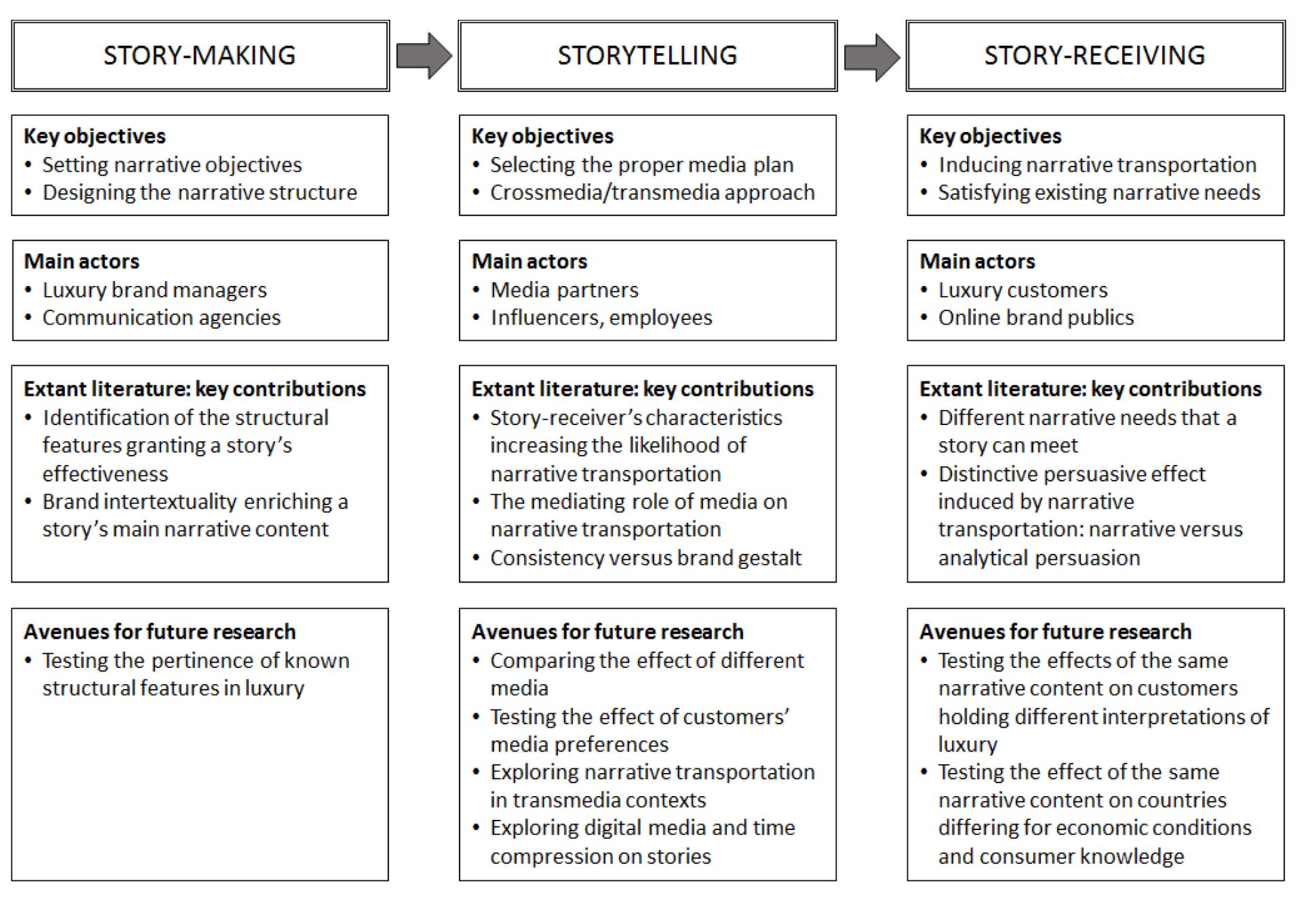
Figure 13.1. The Tripartite Model of Luxury Brand Storytelling
An emic view of stories would instead be field-driven and favor story-receivers’
viewpoint (here, luxury customers’ perspective). The scant works dealing with
receivers’ lived experience with stories (for example, Levy, 1998; 2006) also fail to
question how consumers of stories define them. Van Laer et al. (2018) explicitly raise
the question and show that receivers define stories in terms of genres more than
structurally. To them, stories do not only comprise texts such as books, films or fairy
tales, but also documentaries, narrative paintings (for example, religious or epic
paintings), songs, and even mathematics (Levy, 1998). This proves that story-
receivers are more inclusive than scholars in the way they think of stories. Additionally,
�story-receivers tend to consider stories on the basis of the effect they exert on them.
Stories would then be only those texts capable of transporting them into their narrative
world (Gerrig, 1993). Narrative transportation depends on receivers’ empathy with the
characters of a story, their capacity of fantasizing (that is, mental imagery), and the
fact of experiencing suspended reality (Escalas et al., 2004; Green and Brock, 2000).
In order to make the etic/emic view explicit, and in line with van Laer et al. (2018), I
refer here to ‘story’ as the story-as-produced (that is, the luxury brand’s perspective)
and to ‘narrative’ as the story-as-consumed (that is, the luxury customers’ perspective).
While the practice of telling and consuming stories largely exceeds the branding
or the marketing field (for example, Boje, 1991; 1995; Gabriel, 2000; Gottschall, 2012;
Ochs and Capps, 2009; Swap et al., 2001), this chapter specifically deals with the rich
literature on narrative transportation and (luxury) brand storytelling. My aim is not only
to provide the reader with a systematic review on this topic, but also to propose a
comprehensive framework organizing this literature (see Figure 13.1). Narrative theory
is highly multidisciplinary (Grayson, 1997), which augments the complexity of
navigating it. It also privileges focused research (for example, studies investigating
distinct antecedents, moderators, and consequences of narrative transportation),
which advance understanding of narrative theory but make it even more fragmented.
The simple yet comprehensive framework, which this chapter provides, acknowledges
that stories involve two main types of actors, the storyteller and the story-receiver,
whose interaction can be temporally plotted (preparation, communication, and
consumption of the story). Three different stages can be then distinguished: (1) story-
making, which consists in the design of a story (Visconti and van Laer, 2016); (2)
storytelling, which consists in the communicational provision of the story from the
storyteller to the story-receiver (Escalas, 1998); and, (3) story-receiving, which is the
�interpretation of said story by its audience—hence, its permutation into a narrative—
together with the possible transformative effects the story exerts on the receiver
(Gerrig, 1993; Levy, 2006; Van Laer, Feiereisen, and Visconti 2019). In doing so, the
chapter targets two audiences, scholars and professionals. As Holt (2016) recently
pointed out, empirical evidence suggests that corporate brands have not proven very
effective in their digital storytelling, if we consider that only three of them have entered
the YouTube Top 500 ranking. This, he argues, turns out into billions of dollars of
wasted branding investments.
Luxury brand story-making <b>
Scholars and luxury brand managers are constantly confronted with the
question: “What makes a story a well-told story?” (Ruiz Collantes and Oliva Rota, 2015;
Vincent, 2002). The literature on (luxury) brand story-making has addressed two main
aspects that help provide an answer: (1) the structural features qualifying a branded
text as a story; and, (2) brand intertextuality (Bakhtin 1934/1981; Volosinov
1929/1986), which implies linking one story to other existing texts, with effect of
enriching the focal story.
Structural features <c>
Structuralism (Bakhtin, 1934/1981; Barthes, 1953/1967; 1966/1975; Genette,
1980; Greimas, 1986; Propp, 1928/1968) has largely marked narrative theory, also
within consumer research (Escalas, 1998; Mick, 1987; Stern, 1994b; 1995; Stern et
al., 1998; Van Laer et al., 2014). This stream of studies posits that narrative structure
�is linked to narrative transportation (Gerrig, 1993), and thus ultimately to what makes
(luxury) stories effective, that is, narrative persuasion (Escalas, 2007). Therefore,
identifying the ‘grammar’ of stories would be key to granting the success of luxury
brand storytelling. As Ruiz Collantes and Oliva Rota (2015: 98) nevertheless notice, ‘it
may seem that it is easy to understand what makes a good story, but there is nothing
more difficult than actually creating one.’
An example helps illustrate the point. Between 2011 and 2013, and then back
again from 2016 to 2017, Chanel (2011) has advertised the Coco Mademoiselle
fragrance by means of a story titled It’s a Man’s World. Keira Knightly interprets the
role of a model constantly threatened by men, who deploys the brand as a shield to
protect her independence. The story starts with the woman’s awakening in her Parisian
apartement. She is alone, safe, and confident. As soon as she leaves the protection of
her nest, she mounts on her bike and takes on the solitude of the city. We see her
surrounded by a group of bikers—all men—willing to race. She escapes and gets to
work, where a male photographer commanding a multitude of obedient women is
waiting for her. The photographer orders to leave him alone with Keira, professionally
starts the photo shooting session, and rapidly begings to unprofessionally flirt with her.
Taking advantage of a moment of distraction, she escapes and victoriously mounts on
her bike again. This story confronts the viewer with characters that are clearly
contrasted (black for men versus white/beige for the woman, a men’s gang versus the
isolated woman), a heroine that is constantly pressured to feel unsecure, and the brand
that is proposed as the way out of her troubles (in the last scene, when she mounts on
her bike, she puts the fragrance on her heart, thus creating a symbolic armor). The
soundtrack (Joss Stone’s song It’s a Man’s World) seals the key learning, Chanel’s
promise of defending women’s equal opportunities and freedom. Between 2014 and
�2015, the brand circulated another story, She’s Not There (Chanel, 2014). In this
episode we see Keira Knightly flirting with a man in various situations (a club, a boat
on the river Seine) and sending conflicting messages to him (it is hard to say if she is
flirting with the man or avoiding him). In the final scence, she even launches the
perfume to the man and thus symbolically disempowers herself, in sharp opposition to
the first episode. These two stories share the same brand/product, testimonial, and
emplacement (Paris), yet dramatically differ in terms of narrative structure. Should we
take Chanel’s decision to move back to the first story as an indicator of the different
impact the two campaigns had on their receivers, we could then conclude that the
second story proved less successful. Why?
Structuralism provides an explanation. Researchers in the field have recurrently
addressed four features leading to well-told stories: (1) identifiable characters, (2) an
imaginable plot, (3) a turning point (that is, climax), and (4) an outcome. First,
identifiable characters are clearly pinpointed personas (Küntay, 2002), whose life
experience is placed at the center of the story. In Chanel’s first episode, Keira Knightly
is clearly threatened by men, which makes us empathize with her, whereas in the
second episode she plays with men ambiguously, thus weakening our capacity to think
and feel alike. Research shows that identifiable characters stimulate receivers’
empathy (Escalas and Stern, 2003), and thus help engross the audience and transport
it into a story’s narrative world. Elaborating upon Feldman et al. (2014), van Laer et al.
(2019) suggest that identifiability is achieved when characters’ thoughts (that is,
landscape of cognitive consciousness), feelings (that is, landscape of affective
consciousness), and behavioral motivations are made understandable. In doing so,
receivers can vicariously live the storied experience (Slater and Rouner, 2002). In
2016, Penhaligon’s (2016; 2017), one of the most exclusive brands in the fragrance
�market, launched a new line of perfumes titled Portraits. The first four fragrances
carried the names of four members of an aristocratic British family (the two parents,
their daughter, and their son-in-law), which were then extended to two more
characters/fragrances (the father’s lover and their illegitimate daughter). In the moment
I write, the family counts 14 members, each of them with a clearly carved personality,
family role, and metaphoric association with an animal that conveys additional
information about his/her appearance and lifestyle.
Second, the imaginable plot is a sequence of events that involve characters in
a temporally and spatially contextualized setting (Escalas, 1998; Papadatos, 2006).
Thompson (1997) highlights that a plot has to combine narrative movement (that is,
the temporal flow of the events that provide the direction of a story) and narrative
framing (that is, the symbolic and thematic parallels interconnecting the various events
of a story, which facilitate meaning production). Back to Chanel stories, the first
episode clearly follows a temporal flow (awakening, preparing for work, goint to work,
and work), while the second episode shows two disconnected moments (a party, a
boat trip), which contradict both narrative movement and framing. If making a plot
imaginable is actually necessary to augment narrative transportation (Green et al.,
2008), concatenation of events alone does not suffice to obtain an imaginable plot
(Shankar et al., 2001). Research also shows that a plot’s genre (Bilandzic and
Busselle, 2008) and realism (that is, reference to events that happened; Van Laer et
al., 2014) have no effect on narrative transportation. Differently, receivers’ familiarity
with a story genre (Bilandzic and Busselle, 2008) and verisimilitude (that is,
lifelikeness; Bruner, 1986: 11) positively affect narrative transportation (Green, 2004).
Paco Rabanne’s (2013) successful launch of Invictus helps familiarity by reproducing
the well-known myth of the Greek Olympus. It also favors verisimilitude by incarnating
�the brand in a famous rugby footballer (Nick Youngquest) and by staging the eternal
“men-hunting-women” situation. Similarly, Mercedes Benz’s 2014 Super Bowl
advertisement introduces the new line of Mercedes cars by creating an implicit
reference to Christ’s nativity—an especially familiar story. The film shows former
Mercedes cars traversing the globe and gathering overnight around this profane
“sacred family” of new cars, which are sheltered in a contemporary hut.
Third, climax is necessary to stimulate narrative transportation. Aristotle
(335BC/1998) was the first to theorize that a story has to provide a crescendo, that is,
a balance-imbalance-balance frame (Ruiz Collantes and Oliva Rota, 2015). Luxury
brands often disregard this principle when they simply stage aspirational or hedonic
atmospheres that do not imply a dramatic peak. In Chanel’s introductory example, the
first episode is punctuaded with unexpected conflicts that the heroine proves capable
to overcome, whereas the second episode simply nurtures ambiguity. Another
remarkable illustration comes from Louis Vuitton’s (2013) multi-millionaire film
L’Invitation au Voyage – Venice, which displays an opulent Venetian masked ball
where complications and resolutions are just missing. Adweek (Nudd, 2013)
harangued the story as simply “inscrutable” and “exquisite nonsense.” Differently,
Guerlain’s (2013) film The Legend of Shalimar achieves its climax when it alludes to
the separation of a man (emperor Shah Jahan) from his beloved wife (Mumtaz Mahal),
who passed away in 1631. Emperor’s reaction to his wife’s premature death was to
commission the Taj Mahal (1632-1653), a mausoleum that ever since has represented
men’s ability of overcoming mundane death and remaining true to eternal love. Beyond
external challenges leading to climax, luxury brands recurrently use mimetic desire
(Girard, 1977) to induce it. Mimetic desire implies that a person’s desire is in fact arising
from the imitation of what others desire, which turns them into rivals competing for the
�same object (here, the same luxury brand/product). Iconic luxury products—a classic
example being Hermès’ Kelly or Birking bags—and limited editions—think of
Supreme’s intentional manipulation of customer frustration through systematic use of
product scarcity—exemplify the case. This complication can be described as ‘a battle
for prestige’ (Belk et al., 2003: 329), where luxury consumers are engaged in an
ambivalent confrontation suspended between mimesis and distinction (Bourdieu,
1984).
Fourth, since good stories are always built on ‘the struggle to attain, defend or
regain harmon’ (Fog et al., 2005: 33), they should also convey a clear key learning.
The first episode of Chanel’s opening example provides evidence for what the brand
strives for: liberating women from men’s oppression. The outcome of a story helps
understand why the characters willingly fought to solve the complication(s) in the plot,
that is, what they fought for. In luxury branding this is crucial, since a story’s outcome
should reflect the contract a brand has established with its clients (Kapferer, 2012).
Referencing Chanel again, its N°5 has set a long-lasting contract with its public, that
of an independent, self-sufficient woman, who may love a man but will never depend
on him. Abruptly, the brand came out with the film The One that I Want (Chanel, 2015),
where the N°5 woman (for the occasion, super model Gisele Bündchen) is married to
a man, has a daughter, and decides to quit everything to run (burst into tears) after
(another?) man. All of a sudden, the outcome of that story negated decades of
otherwise consistent storytelling. Differently from Chanel, a luxury brand can
purposefully decide to change its contract, and to consequently modify the key
learning deducible from its stories. For example, this may happen when said brand is
undertaking repositioning. In 2016, Kenzo World campaign (Kenzo, 2016) inflamed the
market. Following a long sequence of “women-on-the-verge-of-a-nervous-
�breakdown”-like events, the protagonist (Margaret Qualley) pauses before jumping into
a gigantic eye made of flowers. Since flowers have long constituted Kenzo’s world, we
can read her gesture as the brand’s intention of moving ahead from its original
universe. From this story, we learn that the brand is departing from its historic contract
(that of safeguarding customers’ spiritual equilibrium) to embrace a novel contract (that
of boosting spiritual energy). Relying upon structural affect theory, Hoeken and van
Vliet (2000) show that when and how the outcome is presented to an audience
determine its specific affective responses. They argue that curiosity, suspense, and
surprise are obtained respectively by postponing, anticipating, or altering the outcome
of the story.
Brand intertextuality <c>
Scholars have also investigated ways to make a (brand) story richer and more
resonant. The principle of intertextuality implies the possibility of establishing dialogues
between readers and other readers, and between texts and other texts (Allen, 2011;
Cutchins, 2017). For example, the abovementioned case of Guerlain’s (2013)
Shalimar campaign is a self-standing text that references the Taj Mahal’s story (that
is, another text). Similarly, Mercedes (2014) linked the story introducing its new line of
cars by referencing Jesus’ nativity. The idea of intertextuality is usually attributed to
Volosinov (1929/1986) and Bakhtin (1934/1981). Volosinov first theorized that the
study of a language cannot be separated from its use. Bakhtin advocated narrative
polyphony and heteroglossia, which abet the inclusion of multiple viewpoints within the
same text. In his view, a text is never closed, yet derives from a diversity of voices—
those of the author, the characters, and other voices evoked by means of links and
interrelationships with other texts.
� Elaborating upon them, Kristeva (1980) coined the term intertextuality to posit
that the meaning of a text is shaped by links with pre-existing texts. In doing so, she
broke the binary relationship between the author and the reader of a text (typical of
structuralism), to instead argue that their confrontation occurs in the midst of many
more texts that are also relevant for meaning construction. Fog et al. (2005)
recommend serial stories, since they help strengthen brand intertextual references.
Prada (2013a; 2013b; 2013c) used this approach to accompany the launch of Prada
Candy. The brand had Wes Anderson and Roman Coppola shooting three episodes
that involve the same girl (Léa Seydoux) simultaneously dating two friends. The
meaning of each episode is enriched by references to the other episodes. Similarly,
luxury brands can use intertextuality when they connect their story to other famous
stories. Chanel N°5’s 2006 film starring Nicole Kidman is the branded remake of Baz
Luhrmann’s movie Moulin Rouge—Luhrmann actually shot both the movie and the
Chanel film— which in turn is the adaptation of Giacomo Puccini’s opera La Bohème.
Intertextuality also helps overcome a structural problem in brand storytelling.
When luxury brands use television to convey their stories, they have just a handful of
seconds to build up identifiable characters, structure the plot, reach a climax, and
communicate a clear learning. By means of intertextual links to other stories, they can
fill in the narrative gaps that time limits impose (Visconti and Van Laer, 2016).
Luxury brand storytelling <b>
This chapter employs the term storytelling restrictively to just refer to the
moment in which a story is eventually conveyed to its designated receivers. With
reference to this stage, scholars have mainly addressed three aspects: (1) story-
�receivers’ characteristics that are likely to increase narrative transportation; (2) the
moderating role of media on narrative transportation; and, (3) brand gestalt (Diamond
et al., 2009), which examines the moderating effect that the number of storytellers has
on narrative transportation (Van Laer, Feiereisen, and Visconti 2019).
Story-receivers’ characteristics <c>
This body of works satisfies both theoretical and managerial needs, since it
provides illumination on which audiences are more likely to be transported and are,
thus, best to target. Scholars’ attention has particularly addressed familiarity with a
story genre (Green, 2004), and story-receivers’ demographic (age, education, and sex)
and personality traits (typically, transportability; Dal Cin et al., 2004). First, familiarity
relates to the extent to which a story-receiver is already knowledgeable about the topic
or genre of a story (Green, 2004). Research proves that familiarity facilitates narrative
transportation (Bilandzic and Busselle, 2008). This effect may be due to the fact that
familiarity augments a receiver’s ability of fantasizing (Slater et al., 2006) and of
understanding a story content. Since transportation implies a receiver’s capacity of
interpreting the content of a story, some cultural capital (Bourdieu, 1986/2011) would
then be needed. Notably, scholars have been particularly interested in exploring story
genres (for example, Genette, 1979/1992; Levy, 2006; Stern, 1995), yet genre per se
has no effect on narrative transportation (Bilandzic and Busselle, 2008). For example,
viewers that are more familiar with Louis Cartier’s artistic work would be better off in
decoding the myriad of intertextual references embedded in the film L’Odyssée de
Cartier (Cartier, 2012). They would more easily fantasize about Wallis Simpson’s,
Duchess of Windsor, passion for Cartier panther, Louis Cartier’s invention of ‘tutti frutti’
�jewels, or the special watch he designed for the famous Brazilian aviator Alberto
Santos Dumont.
Second, with reference to demographic traits, age is the only non-concluding
variable (Van Laer et al., 2014). Some scholars have argued that younger receivers
would be more transportable due to their lower real-world understanding, lower ability
in assessing verisimilitude (Diekman and Murnen, 2004), and lower skepticism (Eagle,
2007). However, other scholars observe that older receivers may be familiar with more
story genres due to superior life experience and to higher education (Mar et al., 2006).
Education has in fact a positive effect on narrative transportation. Explanations are
linked to the fact that higher educated people are more likely to be better in inference
making (Mar et al., 2006) and to be familiar with more story genres. Finally, sex and
its cultural expressions (that is, gender; Visconti et al., 2018) impact narrative
transportation. Women are more transportable than men, and this depends on a variety
of reasons: women read more than men, and are thus familiar with more genres (Mar
et al., 2006; Stern, 1993); they are better in empathizing (Ang and Couling, 1985; Argo
et al., 2008); and, they are less distrustful of storytellers than men (Stern, 1992).
Third, personality also matters. Familiarity is specific to one (or more) story
genre(s). Transportability is instead a chronic propensity to be transported, regardless
of a story’s genre (Dal Cin et al., 2004). It thus helps narrative transportation beyond
familiarity (Mazzocco et al., 2010), and this occurs since more transportable people
are also better in empathizing (Davis, 1983) and imagining (Betts, 1909).
Media <c>
Guerlain’s relaunch of Shalimar (Guerlain, 2013) unexpectedly used television
to first air the 5'45'' film. For the first time in its history, Chanel N°5’s The One that I
�Want campaign (Chanel, 2015) was revealed on the brand’s YouTube chain, in the
attempt of connecting the N°5 to a younger audience. Prada’s The Therapy (Prada,
2012) and Castello Cavalcanti (Prada, 2013d) were shot just for digital diffusion. These
few examples show that luxury brand managers look cautiously to the effect that
different media may exert on a story and its receivers. To date, however, no study has
holistically explored the effect of different types of media on narrative transportation
(Van Laer et al., 2014).
Scholars have instead investigated media individually. For example, research
has inspected storytelling diffused through advertising (Phillips and McQuarrie, 2010;
Scott, 1994), social media (Kozinets et al., 2010; Van Laer and De Ruyter, 2010),
points of sale (Borghini et al., 2009; Diamond et al., 2009; Sherry et al., 2001), and
television (Ang and Couling, 1985; Perracchio, 1993). While these works are valuable,
future research can fruitfully address the specificities of media channels on a story’s
reception. Comparisons across media channels also depend on media classification.
At least, media can be distinguished in terms of mechanisms of control (earned versus
owned versus paid media; Hanna et al., 2011; Lovett and Staelin, 2016), direction and
number of interactions (mono-directional versus bi-directional versus multi-directional
media; Bezjian-Avery et al., 1998), and story modality (auditory reception versus visual
reception; Van Laer et al., 2014).
Brand gestalt <c>
The multiplication of touchpoints that luxury brands may use to reach out to their
customers as well as the appearance of social media to propagate customers’ voice
have dramatically increased the number of possible storytellers participating in the
storytelling of a brand. When multiple storytellers act jointly, storytelling becomes
�gestaltic (Diamond et al., 2009; Visconti and Di Giuli, 2014). This implies that luxury
customers are placed in the midst of multiple narrative contents, which would provide
them with a sort of holistic, stereophonic narrative experience. To accompany the
launch of its new fragrance L’Eau N°5 (Chanel, 2016), Chanel purposefully designed
a gestaltic storytelling. The brand combined a pre-launch TV film, various short stories
accessible on the website, a brand manifesto (diffused both digitally and on traditional
media), and many additional storytelling activities on the points of sale and through
public relations. Not all of these stories used Lily-Rose Depp, the testimonial of the
campaign, as a character, with the effect of making the storytelling even more
differentiated and layered.
The effect of engaging multiple storytellers on narrative transportation is
controversial. First, researchers from a socio-psychological tradition are keen on
concluding that brand gestalt may facilitate contradictions since, by mutiplying
narrative contents, it would increase risks of information distorsion. Rice et al. (2012)
demonstrate that the presence of multiple endorsers for the same brand would have a
positive effect on brand attitudes only for high involvement customers—which goal-
hierarchy theorists expect to encounter in luxury (Tsai, 2005)—and when the
congruence between the brand and said endorsers is high. When these preconditions
are unmet, multiple brand endorsers rather play a negative effect on brand attitudes.
Works considering story consistency as key tend to see stories as logical flows of
arguments. Yet, other scholars note that this does not correspond to the very nature
of stories (Escalas, 2007), which are not explicitly persuasive and invite receivers to
suspend their disbelief (Ferri, 2007; Schaper, 1978).
Second, researchers from a cultural and interpretive tradition look at brand
gestalt as a means to make storytelling more complex and compelling (Diamond et al.,
�2009; Visconti and Di Giuli, 2014). Booker (2004) first observed that richer master plots
provide more powerful stories. Similarly, Brown and Patterson (2010) unveil the
narrative richness of “Harry Potter”, which derives from both the construction of its plot
and the use of multiple narrative sources (that is, storytellers: books, films, author’s
interviews, and so on).
Third, researchers in the social media field also support a positive effect of
gestaltic storytelling on narrative transportation. This stream of studies observe that
brand managers have to simply accept that in the digital era they cannot fully control
their brand contents (Hennig-Thurau et al., 2013), since we have entered an open-
source branding era (Fournier and Avery, 2011). On top, interactive storytelling among
various co-creative storytellers helps renew brand meanings (Gensler et al., 2013),
increases perceived source expertise (Hautz et al., 2014), and strengthens the impact
of storytelling on receivers (Hennig-Thurau et al., 2013). In a recent meta-analysis of
this varied body of works, Van Laer, Feiereisen, and Visconti (2019) demonstrate that
user-generated brand stories increase narrative transportation and narrative
persuasion.
Luxury brand story-reception <b>
That a message is exposed to receivers’ active interpretation is established
wisdom. Story-receivers have to adapt the storytelling to their cognitions, needs, past
experience, and personality in order to make the text ‘habitable’ (De Certeau, 1984;
Fishbein and Yzer, 2003). Scholarly research on the story-reception stage has mostly
addressed two aspects: (1) receivers’ needs for narrative; and, (2) the effects of
narrative transportation on story-receivers.
�Need for narrative <c>
In this context, need for narrative is defined as the specific need(s) that story
consumption helps a luxury customer to satisfy. Levy (1998; 2006) highlights a plethora
of needs that stories would meet. By holding an etic perspective (Berry, 1989), he
argues that stories are not only inescapable (people cannot avoid consuming and
telling stories), but also useful to satisfy cognitive needs (for example, transmitting
information, testing reality, receiving orientation in life), to grant hedonism (for example,
stimulating fantasy and granting positive emotions), and to fulfill social functions (for
example, creating social memory). Focusing on the key learning that a story delivers,
he then distinguishes among ‘family myths’ (that is, stories that provide understanding
of collective identity), ‘edification stories’ (that is, stories that support a person’s
achievement of his/her identity project; Arnould and Thompson, 2005), and ‘foundation
stories’ (that is, stories that offer transcendent meaning and a religious interpretation
of the world). In luxury, customers typically expect entertainment and escapism from
stories, which allow them to move behind the product (Atwal & Williams, 2009).
Relying upon a videography of Eurostar travelers,Van Laer et al. (2018) provide
an emic review (Berry, 1989) of story-receivers’ needs by asking people what benefits
they derive from the enjoyment of stories. They identify five main categories of needs,
going from (1) a refinement of receivers’ understanding of both the inner and (2) the
external world to (3) the possibility of investigating the world beyond mundane
experience (that is, vicariously living others’ lives); and (4) from escapism (that is, the
possibility of breaking out from daily life; Tuan, 1998) to (5) a therapeutic use of stories
to look after a suffering self. Cacharel is a classic example of a luxury brand flanking
adolescents along their transition from childhood to adulthood, and from friendship to
�first love. Its storytelling repeatedly portrays fresh, innocent girls starting their
exploration of life. In one of these stories (Cacharel, 2016) for the fragrance Amor
Amor—which would sound as Two Times Love—we are confronted with a tripartite
plot. The film starts with a group of teenagers walking into a forest and crossing a river.
Friendship, curiosity, and sheltered athmospheres dominate. Quite rapidly, the group
splits to leave just a boy and a girl alone, fronting a waterfall. Overcoming hesitation,
the girl grabs the boy’s hand and jumps into the waterfall with him. Dunked with water,
their thin bodies are revealed and their joy turns into attraction. In the final part of the
story, we see them in a sun-drenched, arid land. Fresheness has turned into heat,
hesitatation into certitude (that of first love!), surprise into awareness. In sum, Cacharel
accompanies young luxury customers into the exploration of the inner and outer world.
More attuned to existential suffering, Chanel stories, and in particular those of the N°5,
are often centered on a misfortunate woman, who endlessly overcomes challenges
and struggles to remain true to herself. This type of plot is likely to appeal to the many
women who also feel lonely and constantly constrained by the world around them.
Effects of narrative transportation <c>
Narrative research is highly centered on narrative transportation, which Gerrig
(1993: 1) first defined as a story-receiver’s experience of ‘disappearing’ in the world of
the story. The author posits that narrative transportation occurs when receivers
‘perform’ the narrative (Gerrig, 1993: 12-13), that is, when they feel part of the story.
He also observes that narrative transportation is paradoxical, since a receiver is
contextually passive (he/she is transported) and active (he/she performs the narrative),
and that it engenders the receiver’s temporary inability of acting in both worlds (that is,
the real and the fictional). Scholars demonstrate that narrative transportation occurs
�when (1) story-receivers develop empathy with the characters of a story (not with the
story plot), (2) when they are good in fantasizing, and (3) when they experience
suspended reality (Escalas et al., 2004; Green and Brock, 2000).
To date, the Transportation-Imagery Model (TIM; Green and Brock, 2002) and
the Extended Transportation-Imagery Model (ETIM; Van Laer et al., 2014) offer the
completest review of the key variables affecting narrative transportation. The TIM first
provided a comprehensive explanation of the mechanisms behind narrative
persuasion. In doing so, it proved that the determinants and effects of narrative
persuasion—a type of persuasion obtained through narrative transportation (Gerrig,
1993) and suspension of disbelief (Ferri, 2007; Schaper, 1978)— differ from those of
analytical persuasion—a type of persuasion obtained through rational scrutiny of the
message, whose effects have to be potentially relevant for its receiver (Van Laer et al.,
2014) in order to arise his/her involvement (Chaiken, 1980). Building upon this model,
the ETIM brings together, and empirically tests, all known antecedents and
consequences of narrative transportation, thus extending the original model. These
models provide luxury brand managers with theoretical and practical guidance in
distinguishing the aims of traditional advertising, which is meant to persuade
analytically, from those of storytelling, which instead may persuade narratively.
Analytical and narrative persuasion do not just differ in terms of determinants
but also in terms of effects. Transported story-receivers return changed from the story
(Gerrig, 1993; Phillips and McQuarrie, 2010). Notably, the change consists in the
persuasion of the receiver, which has particularly long-lasting effects (Green et al.,
2004), the so-called ‘sleeper effect’ (Appel and Richter, 2007). This consists in the fact
that the change in receivers’ attitudes and intentions due to transportation increases
over time, instead of declining—a condition that is typical of analytical persuasion. In
�sum, narrative persuasion emerges from receivers’ transportation into the narrative
world and, due to suspension of disbelief, is not negatively affected by the weak (story)
arguments (Escalas, 2007). It is also ‘more unintentionally affective than intentionally
cognitive in nature’ (Van Laer et al., 2014: 800) and longer lasting.
Implications for luxury brand storytelling are of outmost importance. First, if a
brand aims at persuading an audience via narrative transportation, the story content
should not be overtly rational. As said, narrative transportation suspends rational
scrutiny of the story plot. Research proves that narrative transportation and narrative
persuasion are lowered when the commercial intents of the brand story are overt
(Wentzel et al., 2010). This would shift receivers’ narrative way of consuming the story
to the analytical assessment of its content. This insight conflicts with what several
luxury brands actually do, when they tell stories about the intrinsic quality of their
products, their refined craftsmanship and savoir-faire, and the superior duration of their
goods that would transform the cost a customer supports into a form of quasi-
investment. Just think of Patek Philippe’s claim ‘You never actually own a Patek
Philippe. You merely look after it for the next generation’ or of De Beers’ notorious pay-
off ‘A diamond is forever’.
Second, and in line with the former point, luxury brands elaborating self-
centered stories are more likely to reveal their commercial intents, and to thus
engender lower narrative persuasion (Wentzel et al., 2010). Two opposite strategies
can be contrasted: (1) a denotative strategy (Stern, 2006), which implies to embrace
stories about the brand itself (for example, about its founder, heritage, iconic products,
testimonials, and universe), versus (2) a connotative strategy (Stern, 2006), which
would attenuate the link between the story plot and the brand (for example, by simply
sponsoring stories appealing to the luxury brand’s customers, but disjunct from the
�brand itself). A clear illustration comes from Chanel versus Prada, which have pursued
a denotative and a connotative storytelling strategy, respectively. On the one hand,
Chanel has multiplied stories about Coco Chanel, from produts carrying her name (for
example, Coco, Coco Mademoiselle, Gabrielle) or testifying to her obsessions (for
example, Beige, Boy, Jersey) to narrative contents drawn from the founder’s life
events—at this regard, the website inside.chanel.com is emblematic, with its constantly
increasing collection of films about the splendor and myths of the brand. Within the
luxury panorama, the brand is also one of the sole to systematically metamorphize its
famous testimonials into its founder (for an illustration, refer to Chanel, 2006; 2015).
On the other hand, Prada is a spirited storyteller, yet seldom tells stories about itself.
The brand rather sponsors films, usually directed by legendary filmmakers (for
example, Roman Coppola, Roman Polanski, Wes Anderson; Prada 2012; 2013a;
2013d;), where the link with the brand is indirectly granted just by the stories’ key
learnings, which point to the brand contract. This approach weaves bonds between
Prada and additional narrative worlds (Visconti and Di Giuli, 2014), which result into a
diffracted narrative of the brand. In sum, a connotative strategy makes a luxury brand’s
commercial intents less overt and narrative persuasion more likely to occur.
Third, the proved longer-lasting effects of narrative persuasion (Appel and
Richter, 2007) constitute an incentive for luxury brands’ communication investments.
Ceteris paribus, the same communication budget can grant a higher return on the
investment when narrative persuasion is achieved, since the flow of financial returns
will be maintained for a longer period of time.
Directions for future research <b>
� I identify three promising directions for future research in the field of luxury brand
storytelling. First, one could question to what extent current narrative theory applies to
luxury brands. In the introduction to this chapter I observe that literature on brand
storytelling is not specific to luxury. Studies explicitly dealing with luxury brand
storytelling are to date either documenting the use of brand storytelling in luxury
industries (for example, Kretz and de Valk, 2010; Marion & Nairn, 2011; Phillips and
McQuarrie, 2010; Schembri et al., 2010; Üçok Hughes et al., 2016)—to thus expand
its validity to the luxury context—or exploring its role in the pursuit of objectives that
are distinctive of luxury brands (for example, brand sacralization; Dion and Borraz,
2015; Twitchell, 2004; 2012; Visconti and Di Giuli, 2014). In line with narrative
structuralism (Barthes, 1966/1975), I call for more work to assess any possible
difference in the narrative structure of luxury brand stories. Luxury products and brands
do have peculiar traits (Kapferer and Bastien, 2009), starting from the different
response of customer behavior to price increases. As such, the narrative structure of
luxury brand stories may also be distinctive.
Second, an extension of the first research stream would entail to consider
implications for luxury brand storytelling arising from today’s changes in the notion of
luxury or from differences in countries confronted with luxury. On the one hand, luxury
has undertaken profound transformations, moving from a strictly elitist definition—that
heralded by American sociologist Thorstein Veblen—to an extensive definition,
recently addressed as ‘new luxury’. New luxury would represent the democratization
of traditional luxury as much as the radicalization of extreme luxury, as testified by the
advent of ‘masstige, opuluxe, premium, ultra-premium, trading up, hyperluxury, real or
true luxury, and so on’ (Kapferer and Bastien, 2009: 311). On the other hand, luxury
has reached out to relatively new geo-cultural markets, including China, India, South
�America, and Africa in prospect. Compared to Western markets, these markets differ
not only in terms of economic stage and growth, but also in terms of how they interpret
luxury and in the amount of customer knowledge they have in the field (Bellaiche et
al., 2010; Chaper 6). For example, in China (Zhan and He, 2012) luxury customers
present three distinctive psychological traits (that is, value consciousness,
susceptibility to normative influence, and need for uniqueness), whose effect on
consumption behavior is moderated by the depth of consumer knowledge.
Illustratively, Chinese customers with higher luxury knowledge are less attracted by
best-known (Western) luxury brands, since they would grant lower uniqueness. In sum,
researchers need to assess the impact of reported differences—in terms of conflicting
visions of luxury and distinct geo-cultural sites approaching luxury—on the structuring
and effects of luxury brand stories.
Third, in line with Van Laer et al. (2014: 810), I also believe that ‘there is ample
room to investigate medium as an additional moderator of the relationship between
storyteller antecedents and narrative transportation.’ To date, narrative research offers
a wide range of studies addressing different kinds of media (for example,
advertisements, brand biographies, online communities, salespeople, television
programs), yet a comparative study contrasting the distinct effects of said media on
narrative transportation is overdue. Researchers could also investigate another story-
receiver’s antecedent, that is, media preferences. As Green (2008: 50) notes,
‘matching media type to individuals’ preferences may be an effective means of
promoting transportation.’ Focus on individual media preferences could also help
address generational differences in the consumption of luxury stories, since cross-
generational differences in media preferences have been reported (Bennett et al.,
2006). Last, the fragmentation and multiplication of customer touchpoints in luxury
�(Heine and Berghaus, 2014) has opened the way to two alternative media strategies
in brand storytelling (Veglis, 2012): (1) a crossmedia versus (2) a transmedia strategy.
A crossmedia approach implies to post the same content—in this case, a story—in
multiple media (that is, across different touchpoints). Narrative contents may be
marginally adapted to reflect the technical specificities of the different media, yet
remain largely similar. Within a transmedia approach, instead, different narrative
contents are produced for different media/touchpoints. ‘The expected result is intense
loyalty, long-term engagement and a desire to share the experience’ (Veglis, 2012:
315). The abovementioned narrative campaign that accompanied the launch of L’Eau
N°5 (Chanel, 2016) would be an example of a transmedia strategy. While a crossmedia
perspective is in line with extant narrative theory, a transmedia perpective challenges
it due to the alteration and fragmentation of the same narrative content across varied
media. Researchers may be willing to test narrative theory within this rising field. Last,
digital media are pressuring the duration of narrative contents, since online users are
not likely to consume long video formats. The coexistence of time compression and
maintainance of a story’s structural elements is thus another promising research field,
which holds strong managerial relevance.
By articulating luxury brands’ narrative efforts along three stages (that is, story-
making, storytelling, and story-receiving) and by reviewing key literature in the field,
this chapter contributes to make luxury scholars and luxury brand managers more
conscious about the mechanisms and stakes in this booming field of brand
communication.
�� References <b>
Allen, Graham (2011), Intertextuality (second edition). Abingdon, UK: Routledge.
Ang, Ien, and Della Couling (1985), Watching Dallas: Soap Opera and the Melodramatic
Imagination. London, UK: Methuen.
Appel, Markus, and Tobias Richter (2007), ‘Persuasive Effects of Fictional Narratives
Increase over Time’, Media Psychology, 10 (1), 113—34.
Argo, Jennifer J., Rui Juliet Zhu, and Darren W. Dahl (2008), ‘Fact or Fiction: An
Investigation of Empathy Differences in Response to Emotional Melodramatic
Entertainment’, Journal of Consumer Research, 34 (5), 614—23.
Aristotle (335BC/1998), Poetics, Translated by Kenneth McLeish. London, UK: Nick Hern.
Arnould, Eric J. and Craig J. Thompson (2005), ‘Consumer Culture Theory (CCT): Twenty
Years of Research’, Journal of Consumer Research, 31 (4), 868—82.
Atwal, Glyn and Alistair Williams (2009), ‘Luxury Brand Marketing: The Experience Is
Everything!’, Journal of Brand Management, 16 (5), 338—46.
Bakhtin, Mikhail M. (1934/1981), The Dialogic Imagination: Four Essays [original title,
Voprosy LiteraturyiI Estetiki]. Austin, TX: University of Texas Press.
Banerjee, Smita C., and Kathryn Greene (2012), ‘I Quit’versus ‘I’m Sorry I Used’: A
Preliminary Investigation of Variations in Narrative Ending and Transportation’,
Psychology & Health, 27 (11), 1308—22.
Barthes, Roland (1953/1967), Writing Degree Zero [original title, Le Degré Zéro de
l’Ecriture]. New York, NY: Hill and Wang.
29
�Barthes, Roland (1966/1975), ‘An Introduction to the Structural Analysis of Narrative’, New
Literary History, 6 (2), 237—72.
Belk, Russell W., Guliz Ger, and Søren Askegaard (2003), ‘The Fire of Desire: A Multisited
Inquiry into Consumer Passion’, Journal of Consumer Research, 30 (3), 326—51.
Bellaiche, Jean—Marc, Antonella Mei—Pochtler, and Dorit Hanisch (2010), ‘The New
World of Luxury: Caught between Growing Momentum and Lasting Change’,
Boston Consulting Group, accessed on 25 Febraury 2019, at
https://www.bcg.com/documents/file67444.pdf
Bennett, Andrew, and Nicholas Royle (2004), An Introduction to Literature, Criticism and
Theory. Harlow, UK: Pearson.
Bennett, Gregg, Michael Sagas, and Windy Dees (2006), ‘Media Preferences of Action
Sports Consumers: Differences between Generation X and Y’, Sport Marketing
Quarterly, 15 (1), 40—49.
Berry, John W. (1989), “Imposed Etics—Emics—Derived Etics: The Operationalization of
a Compelling Idea,” International Journal of Psychology, 24 (6), 721—35.
Betts, George Herbert (1909), The Distribution and Functions of Mental Imagery. New
York, NY: Columbia University.
Bezjian—Avery, Alexa, Bobby Calder, and Dawn Iacobucci (1998), ‘New Media
Interactive Advertising vs. Traditional Advertising’, Journal of Advertising
Research, 38 (August), 23—32.
Bilandzic, Helena, and Rick W. Busselle (2008), ‘Transportation and Transportability in
the Cultivation of Genre—Consistent Attitudes and Estimates’, Journal of
Communication, 58 (3), 508—29.
30
�Boje, David M. (1991), ‘The Storytelling Organization: A Study of Story Performance in an
Office—Supply Firm’, Administrative Science Quarterly, 36 (1), 106—26.
Boje, David M. (1995), ‘Stories of the Storytelling Organization: A Postmodern Analysis of
Disney as "Tamara—Land"’,Academy of Management Journal, 38 (4), 997—1035.
Booker, Christopher (2004), The Seven Basic Plots: Why We Tell Stories. London, UK:
Continuum.
Borghini, Stefania, Nina Diamond, Robert V. Kozinets, Mary Ann McGrath, Albert M.
Muñiz, and John F. Jr. Sherry, (2009), ‘Why Are Themed Brandstores so Powerful?
Retail Brand Ideology at American Girl Place’, Journal of Retailing, 85 (3), 363—
75.
Bourdieu, Pierre (1984), Distinction: A Social Critique of the Judgement of Taste.
Cambridge, MA: Harvard University Press.
Bourdieu, Pierre (1986/2011), ‘The Forms of Capital’, in Cultural Theory: An Anthology,
Imre Szeman and Timothy Kaposy, eds. Malden, MA: Wiley, 81—93.
Boyd, Brian (2009), On the Origin of Stories: Evolution, Cognition, and Fiction. Cambridge,
MA: Belknap Press of Harvard University.
Brown, Stephen, and Anthony Patterson (2010), ‘Selling Stories: Harry Potter and the
Marketing Plot’, Psychology & Marketing, 27 (6), 541—56.
Bruner, Jerome S. (1986), Actual Minds, Possible Worlds. Cambridge, MA: Harvard.
Cacharel (2016), Amor Amor, accessed on 2 March 2019, at
https://vimeo.com/153584372
Cartier (2012), L’Odyssée de Cartier, accessed on 3 March 2019, at
https://vimeo.com/37968321
31
�Chaiken, Shelly (1980), ‘Heuristic versus Systematic Information Processing and the Use
of Source versus Message Cues in Persuasion’, Journal of Personality and Social
Psychology, 39 (5), 752—66.
CHANEL (2006), Moulin Rouge, accessed on 3 March 2019, at
https://vimeo.com/62233097
CHANEL (2011), It’s a Man’s World, accessed on 3 March 2019, at
https://vimeo.com/21437948
CHANEL (2014), She’s Not There, accessed on 3 March 2019, at
https://www.youtube.com/watch?v=_ZAZD3ylG6Y
CHANEL (2015), The One that I Want, accessed on 3 March 2019, at
https://vimeo.com/109013805
CHANEL (2016), L’Eau – Manifesto, accessed on 3 March 2019, at
https://vimeo.com/194664125
Cutchins, Dennis (2017), ‘Bakhtin, Intertextuality, and Adaptation’, in The Oxford
Handbook of Adaptation Studies, Thomas Leitch, ed. Oxford, UK: Oxford
Handbooks, 71—86.
Dal Cin, Sonya, Mark P. Zanna, and Geoffrey T. Fong (2004), ‘Narrative Persuasion and
Overcoming Resistance’, in Resistance and Persuasion, Eric S. Knowles and Jay
A. Linn eds. Mahwah, NJ: Erlbaum, 175—91.
Davis, Mark H. (1983), ‘Measuring Individual Differences in Empathy: Evidence for a
Multidimensional Approach’, Journal of Personality and Social Psychology, 44 (1),
113—26.
32
�De Certeau, Michel (1984), The Practice of Everyday Life, trans. Steven Rendall.
Berkeley, CA: University of California Press.
Diamond, Nina, John F. Sherry Jr., Albert M. Muñiz, Mary Ann McGrath, Robert V.
Kozinets, and Stefania Borghini (2009), ‘American Girl and the Brand Gestalt:
Closing the Loop on Sociocultural Branding Research’, Journal of Marketing, 73
(3), 118—34.
Diekman, Amanda and Sarah Murnen (2004), ‘Learning to Be Little Women and Little
Men: The Inequitable Gender Equality of Nonsexist Children’s Literature’, Sex
Roles, 50 (5), 373—85.
Dion, Delphine and Stéphane Borraz (2015), ‘Managing Heritage Brands: A Study of the
Sacralization of Heritage Stores in the Luxury Industry’, Journal of Retailing and
Consumer Services, 22, 77—84.
Dion, Delphine, and Eric Arnould (2011), ‘Retail Luxury Strategy: Assembling Charisma
through Art and Magic’, Journal of Retailing, 87 (4), 502—20.
Eagle, Lynne (2007), ‘Commercial Media Literacy’, Journal of Advertising, 36 (2), 101—
10.
Escalas, Jennifer E. (1998), ‘Advertising Narratives. What Are They and How Do They
Work?’, in Representing Consumers: Voices, Views, and Visions, Barbara B. Stern,
ed. London, UK: Routledge, 267—89.
Escalas, Jennifer E. (2007), ‘Self—Referencing and Persuasion: Narrative Transportation
versus Analytical Elaboration’, Journal of Consumer Research, 33 (4), 421—29.
33
�Escalas, Jennifer E., and Barbara B. Stern (2003), ‘Sympathy and Empathy: Emotional
Responses to Advertising Dramas’, Journal of Consumer Research, 29 (4), 566—
78.
Escalas, Jennifer E., Marian C. Moore, and Julie E. Britton (2004), ‘Fishing for Feelings?
Hooking Viewers Helps!’, Journal of Consumer Psychology, 14 (1–2), 105–14.
Feldman, Carol F., Jerome S. Bruner, Bobbie Renderer, and Sally Spitzer (2014),
‘Narrative Comprehension’, in Narrative Thought and Narrative Language, Britton
K. Britton and Anthony D. Pellegrini, eds. New York, NY: Taylor & Francis, 1—78.
Ferri, Anthony J. (2007), Willing Suspension of Disbelief: Poetic Faith in Film. Lanham,
MD: Lexington Books.
Fishbein, Martin, and Marco C. Yzer (2003), ‘Using Theory to Design Effective Health
Behavior Interventions’, Communication Theory, 13 (2), 164—83.
Fog, Klaus, Christian Budtz, and Baris Yakavoylu (2005), Storytelling: Branding in
Practice. Berlin: Springer.
Fournier, Susan, and Jill Avery (2011), ‘The Uninvited Brand’, Business Horizons, 54 (3),
193—207.
Gabriel, Yiannis (2000), Storytelling in Organizations: Facts, Fictions, and Fantasies.
Oxford, UK: OUP.
Genette, Gérard (1979/1992), The Architext: An Introduction. Berkeley, CA: University of
California.
Genette, Gérard (1980), Narrative Discourse: An Essay in Method, trans. J. E. Lewin.
Ithaca, NY: Cornell.
34
�Gensler, Sonja, Franziska Völckner, Yuping Liu—Thompkins, and Caroline Wiertz (2013),
‘Managing Brands in the Social Media Environment’, Journal of Interactive
Marketing, 27 (4), 242—56.
Gerrig, Richard J. (1993), Experiencing Narrative Worlds: On the Psychological Activities
of Rreading. New Haven, CT: Yale University Press.
Girard, René (1977), Violence and the Sacred, trans. Patrick Gregory, Baltimore, MD,
USA: John Hopkins University Press.
Gottschall, Jonathan (2012), The Storytelling Animal: How Stories Make Us Human. New
York, NY: Houghton Mifflin Harcourt.
Grayson, Kent (1997), ‘Narrative Theory and Consumer Research: Theoretical and
Methodological Perspectives’, Merrie Brucks and Deborah J. MacInnis, eds. Provo,
UT: Association for Consumer Research, in NA — Advances in Consumer
Research, 24, 67—70.
Green, Melanie C. (2004), ‘Transportation into Narrative Worlds: The Role of Prior
Knowledge and Perceived Realism’, Discourse Processes, 38 (2), 247—66.
Green, Melanie C. (2008), ‘Research Challenges in Narrative Persuasion’, Information
Design Journal, 16 (1), 47—52.
Green, Melanie C. and Timothy C. Brock (2000), ‘The Role of Transportation in the
Persuasiveness of Public Narratives’, Journal of Personality and Social
Psychology, 79 (5), 701—21.
Green, Melanie C., and Timothy C. Brock (2002), ‘In the Mind’s Eye: Transportation—
Imagery Model of Narrative Persuasion’, in Narrative Impact: Social and Cognitive
35
� Foundations, Melanie C. Green, Jeffrey J. Strange, and Timothy C. Brock, eds.
Mahwah, NJ, USA: Lawrence Erlbaum, 315—341.
Green, Melanie C., Jennifer Garst, and Timothy C. Brock (2004), ‘The Power of Fiction:
Determinants and Boundaries’, in The Psychology of Entertainment Media: Blurring
the Lines between Entertainment and Persuasion, L. J. Shrum, ed. Mahwah, NJ:
Erlbaum, 161—76.
Green, Melanie C., Sheryl Kass, Jana Carrey, Benjamin Herzig, Ryan Feeney, and John
Sabini (2008), ‘Transportation across Media: Repeated Exposure to Print and Film’,
Media Psychology, 11 (4), 512—39.
Greimas, Algirdas J. (1986), Sémantique Structurale: Recherche de Méthode. Paris,
France: Presses Universitaires de France.
Guerlain (2013), The Legend of Shalimar, accessed on 3 March 2019, at
https://vimeo.com/122966974
Hanna, Richard, Andrew Rohm, Victoria L. and Crittenden (2011), ‘We’re All Connected:
The Power of the Social Media Ecosystem’, Business Horizons, 54 (3), 265—73.
Hautz, Julia, Johann Füller, Katja Hutter, and Carina Thürridl (2014), ‘Let Users Generate
Your Video Ads? The Impact of Video Source and Quality on Consumers’
Perceptions and Intended Behaviors’, Journal of Interactive Marketing, 28 (1), 1—
15.
Heine, Klaus, and Benjamin Berghaus (2014), ‘Luxury Goes Digital: How to Tackle the
Digital Luxury Brand–Consumer Touchpoints’, Journal of Global Fashion
Marketing, 5 (3), 223—34.
36
�Hennig—Thurau, Thorsten, Charles F. Hofacker, and Björn Bloching (2013), ‘Marketing
the Pinball Way: Understanding How Social Media Change the Generation of Value
for Consumers and Companies’, Journal of Interactive Marketing, 27 (4), 237—41.
Hoeken, Hans, and Mario van Vliet (2000), ‘Suspense, Curiosity, and Surprise: How
Discourse Structure Influences the Affective and Cognitive Processing of a Story’,
Poetics, 27 (4), 277—86.
Holmqvist, Jonas, Luca M. Visconti, L.M., Blandine Guais, Christian Grönroos, and
Aurelie Kessous (2017), ‘Towards an Understanding of Service Facilitation and
Value Creation in Service Contexts’, QUIS 15 Symposium, Porto, 12—15 June.
Holt, Douglas B. (2016), ‘Branding in the Age of Social Media’, Harvard Business Review,
94 (3), 40—50.
Joy, Annamma, and John F. Sherry Jr. (2003), ‘Speaking of Art as Embodied Imagination:
A Multisensory Approach to Understanding Aesthetic Experience’, Journal of
Consumer Research, 30 (2), 259—82.
Kapferer, Jean Noël (2012), The New Strategic Brand Management: Advanced Insights
and Strategic Thinking. London, UK: Kogan Page Publishers.
Kapferer, Jean Noël, and Vincent Bastien (2009), ‘The Specificity of Luxury Management:
Turning Marketing Upside Down’, Journal of Brand Management, 16 (5—6), 311—
22.
Kenzo (2016), Kenzo World – The New Fragrance, accessed on 1 March 2019, at
https://vimeo.com/180668935
37
�Kozinets, Robert, Kristine de Valck, Andrea C. Wojnicki, and Sarah J. Wilner (2010),
‘Networked Narratives: Understanding Word—Of—Mouth Marketing in Online
Communities’, Journal of Marketing, 74 (2), 71—89.
Kretz, Gachoucha, and Kristine de Valck (2010), ‘"Pixelize Me!’: Digital Storytelling and
the Creation of Archetypal Myths through Explicit and Implicit Self—Brand
Association in Fashion and Luxury Blogs’, in Research in Consumer Behavior, Vol.
12, Russell W. Belk, ed. Bingley, UK: Emerald Group Publishing Limited, 313–29.
Kristeva, Julia (1980), Desire in Language: A Semiotic Approach to Literature and Art.
New York, NY: Columbia University Press.
Küntay, Aylin C. (2002), ‘Development of the Expression of Indefiniteness: Presenting
New Referents in Turkish Picture—Series Stories’, Discourse Processes, 33 (1),
77—101.
Levy, Sidney J. (1998), ‘The Enjoyment of Reading Books’, Journal of Marketing, 62 (4),
99—101.
Levy, Sidney J. (2006), ‘The Consumption of Stories’, in Handbook of Qualitative
Research Methods in Marketing, Russell W. Belk, ed. Aldershot, UK: Edward Elgar
Publishing, 453—64.
Louis Vuitton (2013), L’Invitation au Voyage: Venice, accessed on 3 March 2019, at
https://vimeo.com/151385577
Lovett, Mitchell J., and Richard Staelin (2016), ‘The Role of Paid, Earned, and Owned
Media in Building Entertainment Brands: Reminding, Informing, and Enhancing
Enjoyment’, Marketing Science, 35 (1), 142—57.
38
�Lundqvist, Anna , Veronica Liljander, Johanna Gummerus, and Allard van Riel (2013),
‘The Impact of Storytelling on the Consumer Brand Experience: The Case of a
Firm—Originated Story’, Journal of Brand Management, 20 (4), 283—97.
Mar, Raymond A., Keith Oatley, Jacob Hirsh, Jennifer dela Paz, and Jordan B. Peterson
(2006), ‘Bookworms Versus Nerds: Exposure to Fiction Versus Non—Fiction,
Divergent Associations with Social Ability, and the Simulation of Fictional Social
Worlds’, Journal of Research in Personality, 40 (5), 694—712.
Marion, Gilles, and Agnes Nairn (2011), ‘"We Make the Shoes, You Make the Story"
Teenage Girls’ Experiences of Fashion: Bricolage, Tactics and Narrative Identity’,
Consumption, Markets & Culture, 14 (1), 29—56.
Mazzocco, Philip J., Melanie C. Green, Jo A. Sasota, and Norman W. Jones (2010), ‘This
Story Is Not for Everyone: Transportability and Narrative Persuasion’, Social
Psychological and Personality Science, 1 (4), 361—68.
Mercedes (2014), Super Bowl Commercial, accessed on 1 March 2019, at
https://vimeo.com/198537964
Mick, Glen D. (1987), ‘Toward a Semiotic of Advertising Story Grammars’, in Marketing
and Semiotics: New Directions in the Study of Signs for Sale, Jean Umiker—
Sebeok, ed. Berlin, Germany: Mouton de Gruyter, 249—78.
Nudd, Tim (2013), ‘Ad of the Day: David Bowie Serenades Arizona Muse for Louis
Vuitton’, Adweek, accessed on 3 March 2019, at http://www.adweek.com/brand—
marketing/ad—day—david—bowie—serenades—arizona—muse—louis—
vuitton—153798/#/
39
�Ochs, Elinor, and Lisa Capps (2009), Living Narrative: Creating Lives in Everyday
Storytelling. Cambridge, MA: Harvard University Press.
Ourahmoune, Nacima (2016), ‘Narrativity, Temporality, and Consumer—identity
Transformation through Tourism’, Journal of Business Research, 69 (1), 255—63.
Paco Rabanne (2013), Invictus, accessed on 3 March 2019, at
https://vimeo.com/69975702
Papadatos, Caroline (2006), ‘The Art of Storytelling: How Loyalty Marketers Can Build
Emotional Connections to Their Brands’, Journal of Consumer Marketing, 23 (7),
382—84.
Penhaligon’s (2016), Portraits, accessed on 28 February 2019, at
https://vimeo.com/231059316
Penhaligon’s (2017), New Portraits, accessed on 28 February 2019, at
https://vimeo.com/237531006
Pera, Rebecca (2017), ‘Empowering the New Traveller: Storytelling as a Co—Creative
Behaviour in Tourism’, Current Issues in Tourism, 20 (4), 331—38.
Peracchio, Laura A. (1993), ‘Young Children’s Processing of a Televised Narrative: Is a
Picture Really Worth a Thousand Words?’, Journal of Consumer Research, 20 (2),
281—93.
Phillips, Barbara J., and Edward F. McQuarrie (2010), ‘Narrative and Persuasion in
Fashion Advertising’, Journal of Consumer Research, 37 (3), 368—92.
Prada (2012), The Therapy, accessed on 3 March 2019, at https://vimeo.com/42704980
Prada (2013a), Prada Candy: First Episode, accessed on 3 March 2019, at
https://vimeo.com/71349556
40
�Prada (2013b), Prada Candy: Second Episode, accessed on 3 March 2019, at
https://vimeo.com/62846279
Prada (2013c), Prada Candy: Third Episode, accessed on 3 March 2019, at
https://vimeo.com/101897319
Prada (2013d), Castello Cavalcanti, accessed on 3 March 2019, at
https://vimeo.com/79558158
Propp, Vladimir (1928/1968), Morphology of the Folk Tale, trans. Laurence Scott. Austin,
TX: University of Texas Press.
Quinn, Naomi (ed.) (2005), Finding Culture in Talk: A Collection of Methods. New York,
NY: Palgrave Macmillan.
Rice, Dan Hamilton, Katie Kelting, Richard J. Lutz (2012), ‘Multiple Endorsers and Multiple
Endorsements: The Influence of Message Repetition, Source Congruence and
Involvement on Brand Attitudes’, Journal of Consumer Psychology, 22, 249—59.
Ruiz Collantes, Xavier, and Mercé Oliva Rota (2015), ‘Narrativity Approaches to
Branding’, in Handbook of Brand Semiotics, George Rossolatos, ed. Kassel,
Germany: Kassel University Press, 89—150.
Schank, Roger C. (1999), Dynamic Memory Revisited. Cambridge, UK: Cambridge
University Press.
Schaper, Eva (1978), ‘Fiction and the Suspension of Disbelief’, British Journal of
Aesthetics, 18 (1), 31—44.
Schembri, Sharon, Bill Merrilees, and Stine Kristiansen (2010), ‘Brand Consumption and
Narrative of the Self’, Psychology & Marketing, 27 (6), 623—37.
41
�Scott, Linda M. (1994), ‘Images in Advertising: The Need for a Theory of Visual Rhetoric’,
Journal of Consumer Research, 21 (2), 252—73.
Seo, Yuri, and Margo Buchanan—Oliver (2015), ‘Luxury Branding: The Industry, Trends,
and Future Conceptualisations’, Asia Pacific Journal of Marketing and Logistics, 27
(1), 82—98.
Shankar, Avi, Richard Elliott, and Christina Goulding (2001), ‘Understanding
Consumption: Contributions from a Narrative Perspective’, Journal of Marketing
Management, 17 (3—4), 429—53.
Sherry, John F. Jr., Robert V. Kozinets, Diana Storm, Adam Duhachek, Krittinee
Nuttavuthisit, and Bénet DeBerry—Spence (2001), ‘Being in the Zone: Staging
Retail Theater at ESPN Zone Chicago’, Journal of Contemporary Ethnography, 30
(4), 465—510.
Slater, Michael D., and Donna Rouner (2002), ‘Entertainment—Education and Elaboration
Likelihood: Understanding the Processing of Narrative Persuasion’,
Communication Theory 12 (2):117—244.
Slater, Michael D., Donna Rouner, D. and Marilee Long (2006), ‘Television Dramas and
Support for Controversial Public Policies: Effects and Mechanisms’, Journal of
Communication, 56 (2), 235—52.
Stein, Nancy L. (1982), ‘The Definition of a Story’, Journal of Pragmatics, 6, 487—507.
Stern, Barbara B. (1992), ‘Feminist Literary Theory and Advertising Research: A New
"Reading" of the Text and the Consumer’, Journal of Current Issues & Research in
Advertising, 14 (1), 9—21.
42
�Stern, Barbara B. (1993), ‘Feminist Literary Criticism and the Deconstruction of Ads: A
Postmodern View of Advertising and Consumer Responses’, Journal of Consumer
Research, 19 (4), 556—66.
Stern, Barbara B. (1994a), ‘Authenticity and the Textual Persona: Postmodern Paradoxes
in Advertising Narrative’, International Journal of Research in Marketing, 11 (4),
387—400.
Stern, Barbara B. (1994b), ‘Classical and Vignette Television Advertising Dramas:
Structural Models, Formal Analysis, and Consumer Effects’, Journal of Consumer
Research, 20 (4), 601—15.
Stern, Barbara B. (1995), ‘Consumer Myths: Frye’s Taxonomy and the Structural Analysis
of Consumption Text’, Journal of Consumer Research, 22 (2), 165—85.
Stern, Barbara B. (2006), ‘What Does Brand Mean? Historical—Analysis Method and
Construct Definition’, Journal of the Academy of Marketing Science, 34 (2), 216—
23.
Stern, Barbara B., Craig J. Thompson, and Eric J. Arnould (1998), ‘Narrative Analysis of
a Marketing Relationship: The Consumer’s Perspective’, Psychology & Marketing,
15 (3), 195—214.
Swap, Walter, Dorothy Leonard, and Lisa A. Mimi Shields (2001), ‘Using Mentoring and
Storytelling to Transfer Knowledge in the Workplace’, Journal of Management
Information Systems, 18 (1), 95—114.
Thompson, Craig J. (1997), ‘Interpreting Consumers: A Hermeneutical Framework for
Deriving Marketing Insights from the Texts of Consumers’ Consumption Stories’,
Journal of Marketing Research, 34 (4), 438—55.
43
�Thompson, Craig J., and Diana L. Haytko (1997), ‘Speaking of Fashion: Consumers’ Uses
of Fashion Discourses and the Appropriation of Countervailing Cultural Meanings’,
Journal of Consumer Research, 24 (1), 15—42.
Tsai, Shu—pei (2005), ‘Impact of Personal Orientation on Luxury—Brand Purchase
Value: An International Investigation’, International Journal of Market Research, 47
(4), 427—52.
Tuan, Yi—Fu (1998), Escapism, Baltimore, MD: Johns Hopkins University.
Twitchell, James B. (2004), ‘An English Teacher Looks at Branding’, Journal of Consumer
Research, 31 (2), 484—89.
Twitchell, James B. (2012), Living It Up: Our Love Affair with Luxury, New York, NY:
Columbia University Press.
Üçok Hughes, Mine, Wendy K. Bendoni, and Ekin Pehlivan (2016), ‘Storygiving as a Co—
creation Tool for Luxury Brands in the Age of the Internet: A Love Story by Tiffany
and Thousands of Lovers’, Journal of Product & Brand Management, 25 (4), 357—
64.
Van Laer, Tom and Ko De Ruyter (2010), ‘In Stories We Trust: How Narrative Apologies
Provide Cover for Competitive Vulnerability After Integrity—violating Blog Posts’,
International Journal of Research in Marketing, 27 (2), 64—174.
Van Laer, Tom, Jennifer E. Escalas, Stephan Ludwig, and Ellis Van Den Hende (2019),
‘What Happens in Vegas Stays on TripAdvisor? A Theory and Technique to
Understand Narrativity in Consumer Reviews’, Journal of Consumer Research, 46
(2), 267—285.
44
�Van Laer, Tom, Ko De Ruyter, Luca M. Visconti, and Martin Wetzels (2014), ‘The
Extended Transportation—Imagery Model: A Meta—Analysis of the Antecedents
and Consequences of Consumers’ Narrative Transportation’, Journal of Consumer
Research, 40 (5), 797—817.
Van Laer, Tom, Luca M. Visconti, and Stephanie Feiereisen (2018), ‘Need for Narrative’,
Journal of Marketing Management, 34 (5—6), 484—96.
Van Laer, Tom, Stephanie Feiereisen, and Luca M. Visconti (2019), ‘Storytelling in the
Digital Era: A Meta—Analysis of Relevant Moderators of the Narrative
Transportation Effect’, Journal of Business Research, 96, 135—46.
Veglis, Andreas (2012), ‘From Cross Media to Transmedia Reporting in Newspaper
Articles’, Publishing Research Quarterly, 28 (4), 313—24.
Vincent, Laurence (2002), Legendary Brands: Unleashing the Power of Storytelling to
Create a Winning Market Strategy, Chicago, IL: Dearborn Trade Publishing.
Visconti, Luca M., and Alberta Di Giuli (2014), ‘Principles and Levels of Mediterranean
Connectivity: Evidence from Prada’s “Made in Worlds” Brand Strategy’, Journal of
Consumer Behaviour, 13 (3), 164—75.
Visconti, Luca M., and Tom van Laer (2016), ‘Brand Story—Making and Digital
Conversations’, in Advances in Consumer Research, Vol. 44, Page Moreau and
Stefano Puntoni, eds. Duluth, MN: Association for Consumer Research, 103—07.
Visconti, Luca M., Pauline Maclaran, and Shona Bettany (2018), ‘Gender(s),
Consumption, and Markets’, in Consumer Culture Theory, Eric Arnould and Craig
J. Thompson, eds. Thousand Oaks, CA: Sage, 180—205.
45
�Volosinov, Valentin N. (1929/1986), Marxism and the Philosophy of Language,
Cambridge, MA: Harvard University Press.
Wentzel, Daniel, Torsten Tomczak, and Andreas Herrmann (2010), ‘The Moderating
Effect of Manipulative Intent and Cognitive Resources on the Evaluation of
Narrative Ads’, Psychology & Marketing, 27 (5), 510—30.
Woodside, Arch G. (2010), ‘Brand—Consumer Storytelling Theory and Research:
Introduction to a Psychology & Marketing Special Issue’, Psychology & Marketing,
27 (6), 531—40.
Zhan, Lingjing, and Yanqun He (2012), ‘Understanding Luxury Consumption in China:
Consumer Perceptions of Best—Known Brands’, Journal of Business Research,
65 (10), 1452—60.
46
�


 Luca M. Visconti