Academia.eduAcademia.edu

Outline

Music during lectures: Will students learn better?

format_quote

6 citations

https://doi.org/10.1016/J.LINDIF.2011.10.004

Abstract

We investigated the influence of music during learning on the academic performance of undergraduate students, and more particularly the influence of affects induced by music. Altogether 249 students were involved in the study, divided into a control group and an experimental group. Both groups attended the same videotaped lecture, with the addition of classical music for the experimental group. Just after the lecture, both groups had to fill out a multiple choice questionnaire (MCQ) aimed to assess their learning during the lecture. The MCQ score of the experimental group was significantly higher than that of the control group. Affect just before the exam predicted significantly the MCQ-score, however music accounted for an additional part of variance. The effect of music on academic performance is not only about affects, and further research should investigate the underlying mechanisms resulting from a change in the perception of the learning environment.

Key takeaways
sparkles

AI

  1. Music exposure during lectures significantly improved MCQ scores (experimental group: M = 14.5 vs control group: M = 12.2).
  2. The study involved 249 undergraduate students divided into control and experimental groups for accurate comparisons.
  3. Positive affect (PA) at T2 positively predicts academic performance, while negative affect (NA) negatively impacts it.
  4. Music accounted for an additional 5% variance in MCQ scores beyond affect changes, indicating other influencing mechanisms.
  5. Further research is necessary to explore the long-term effects of music on student motivation and learning.
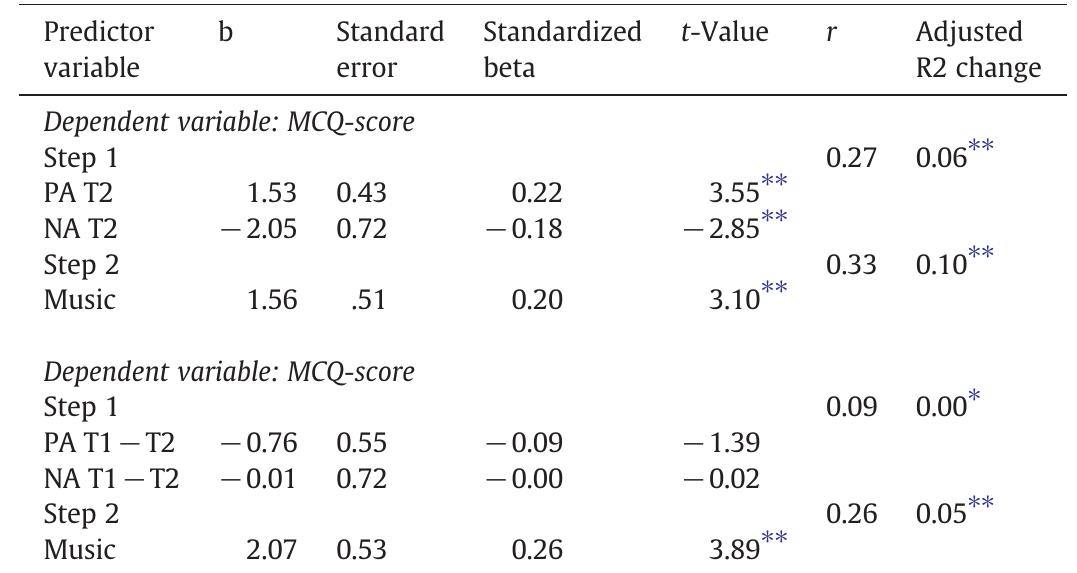
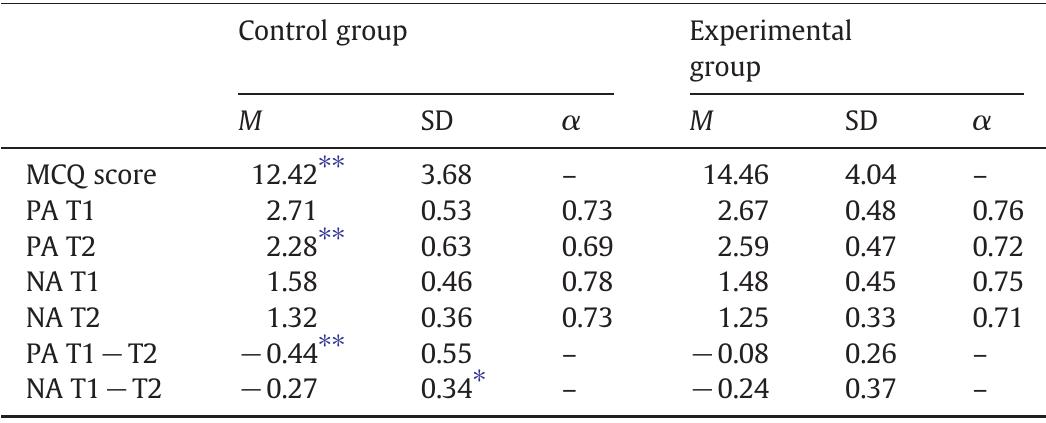
LEAIND-00587; No of Pages 5 Learning and Individual Differences xxx (2011) xxx–xxx Contents lists available at SciVerse ScienceDirect Learning and Individual Differences journal homepage: www.elsevier.com/locate/lindif Music during lectures: Will students learn better? Fabrice Dosseville a,⁎, Sylvain Laborde a, b, Nicolas Scelles a a Université de Caen Basse-Normandie, EA4260, France b German Sport University Köln, Institute of Psychology, Germany a r t i c l e i n f o a b s t r a c t Article history: We investigated the influence of music during learning on the academic performance of undergraduate stu- Received 9 July 2010 dents, and more particularly the influence of affects induced by music. Altogether 249 students were involved Received in revised form 7 October 2011 in the study, divided into a control group and an experimental group. Both groups attended the same video- Accepted 21 October 2011 taped lecture, with the addition of classical music for the experimental group. Just after the lecture, both Available online xxxx groups had to fill out a multiple choice questionnaire (MCQ) aimed to assess their learning during the lecture. Keywords: The MCQ score of the experimental group was significantly higher than that of the control group. Affect just Academic performance before the exam predicted significantly the MCQ-score, however music accounted for an additional part of Affective states variance. The effect of music on academic performance is not only about affects, and further research should Learning environment investigate the underlying mechanisms resulting from a change in the perception of the learning Multiple choice questionnaire environment. © 2011 Published by Elsevier Inc. 1. Introduction interactions between students and teachers (Frenzel, Pekrun, & Goetz, 2007). Doubtless, the learning environment is a key element Professors, readers, and lecturers hope that the lessons they teach of motivational, cognitive, and emotional outcomes (Karabenick, will help students prepare for future jobs by developing their compe- 2004; Ludtke, Robitzsch, Trautwein, & Kunter, 2009; Vermetten, tencies. While several new educational methods have been intro- Vermunt, & Lodewijks, 2002). Most of the studies that have assessed duced to improve students' academic performance, such as clickers, the influence of learning environments have done so via observers', e-lectures, and podcasts (Evans, 2008; Mayer et al., 2009; teachers' or students' reports and their associations with the students' Stephenson, Brown, & Griffin, 2008), traditional and PowerPoint lec- achievement or motivation. Only a few researchers have studied the tures are still an important and common approach to teaching stu- impact of different learning environments on academic performance dents in higher education (see Savoy, Proctor, & Salvendy, 2009). directly (Besançon & Lubart, 2008; Govender, 2009). The affect trig- Despite lacking interactivity between teacher and students, requiring gered by changing the characteristics of the learning environment the continuous attention of students (Bloom, 1953; Smith, 2001), and could influence learning outcomes in a critical manner. being unpopular among students and educational advisers, lectures are still used in university courses because they bear some advan- 1.2. Affective states tages over other methods (see Charlton, 2006). We assumed that changing the learning context or environment during lectures Many researchers have shown that academic performance can be would be a way to improve students' academic performance. In this influenced by students' affective states or motivational and cognitive study, we sought to change the learning environment through processes (Lewis, Huebner, Reschly, & Valois, 2009; Olafson & Ferraro, music, suggested to elicit affective states, in order to improve learning 2001; Pekrun, Goetz, Titz, & Perry, 2002; Pekrun, Elliot, & Maier, outcomes. 2009). Existing research on the affective contributors to achievement has often been confined to the effect of anxiety on academic perfor- 1.1. Learning environment mance (Musch & Broder, 1999; Schutz & Pekrun, 2007). Students' anxiety during exams might be influenced by their cognitive abilities. Learning environments can be conceptualized in terms of observ- For instance, students with higher cognitive abilities have been found able characteristics, such as school buildings, the layout of a class- to experience more positive affect when taking an exam (Goetz, room, or the materials used for instruction, or in terms of observed Preckel, Pekrun, & Hall, 2007). In turn, positive moods have been found to produce more creativity than neutral or negative moods in ⁎ Corresponding author at: Université de Caen Basse-Normandie, EA 4260, 2, boule- a recent meta-analysis (Baas, De Dreu, & Nijstad, 2008). Moreover, vard du Maréchal Juin, F14032 Caen, France. positive emotions in educational contexts might be associated with E-mail address: [email protected] (F. Dosseville). academic engagement (Reschly, Huebner, Appleton, & Antaramian, 1041-6080/$ – see front matter © 2011 Published by Elsevier Inc. doi:10.1016/j.lindif.2011.10.004 Please cite this article as: Dosseville, F., et al., Music during lectures: Will students learn better?, Learning and Individual Differences (2011), doi:10.1016/j.lindif.2011.10.004 2 F. Dosseville et al. / Learning and Individual Differences xxx (2011) xxx–xxx 2008). Yet there is a lack of empirical evidence concerning the effects topic of the lecture was an aspect of sport psychology (specifically, of positive affect induction in connection with learning and academic “Expertise in Athletes”) and had never been viewed by the students performance in universities. In addition, some research has shown before. that changing the learning environment could trigger an experience with a positive affect and in turn increase motivation among students 2.2.2. Multiple-choice questionnaire (Susskind, 2005), although no impact was found on course perfor- A multiple-choice questionnaire (MCQ) was created from the lec- mance (Susskind, 2008). Given these preliminary findings, the influ- ture material. We followed Holsgrove (1992) to write appropriate ence of positive affect on academic performance seems to be a questions: (a) use correct grammar, (b) avoid negative stems, (c) promising research area, one that has not yet been fully investigated. avoid overly complicated questions, (d) avoid ambiguity, and (e) do not use trick questions. Altogether there were 25 questions with a 1.3. Music and learning performance set of five answers, of which one was correct. Alternate forms of the test were created to prevent copying (Houston, 1983). A simple way to elicit these affective states is through music (Juslin & Vastfjall, 2008; Scherer & Zentner, 2001). A well-known 2.2.3. Music yet controversial effect in the literature is the Mozart effect The music chosen to elicit a positive affect was classical music (Chabris, 1999; Rauscher, Shaw, & Ky, 1993). In the former research without lyrics so that understanding the lecture would not be dis- (Rauscher, Shaw, & Ky, 1993), the authors found that listening to Mo- turbed. No information was given to the students about the presence zart improved spatial abilities. However, further replications showed of music. Six pieces of music were selected from a set of music that that although listening to music did improve some cognitive abilities, had already been used to elicit positive affect (Eich, Ng, Macaulay, this was not specific to Mozart's music. Three hypotheses can explain Percy, & Grebneva, 2007): (a) A Little Night Music, Allegro (Mozart; this effect: the neurological, the arousal, and the preference hypothe- 6:26); (b) Concerto for Four Violins in D Major (Vivaldi; 7:27); (c) sis (Jones, West, & Estell, 2006; Pietschnig, Voracek, & Formann, The Blue Danube (André Rieu; 6:55); (d) Nutcracker (Tchaikovsky; 2010). In summary, previous research showed that music can affect 6:04); (e) Brandenburg Concertos No. 3, Allegro Moderato (Bach; arousal and mood, influencing performance on specific cognitive 5:30); and (f) Ninth Symphony, Ode to Joy (Beethoven; 6:54). The tasks, such as those requiring spatial–temporal abilities (Husain, volume of the lecture was the same in both the experimental and Thompson, & Schellenberg, 2002; Jausovec, Jausovec, & Gerlic, 2006; control conditions. In the experimental condition, the volume of the Thompson, Schellenberg, & Husain, 2001). However, to the best of music was lower than the one of the lecture. our knowledge, the influence of music on more complex cognitive tasks, such as learning during a lecture and then taking an exam 2.2.4. Affect measure that involves memory, reasoning, and comprehension, has never To measure affect, we chose an approach used by Watson, Clark, been examined. and Tellegen (1988) that categorizes discrete emotions into higher- Therefore, our aim with this study was to investigate how listen- order dimensions on the basis of their overlapping properties. These ing to music during learning influences the affective states of under- authors developed the Positive and Negative Affect Schedule graduate students and their performance. We hypothesized that the (PANAS, French version by Gaudreau, Sanchez, & Blondin, 2006), a main effect of music on academic performance would be through af- questionnaire containing 10 items to assess positive affect (PA; e.g., fect elicitation. More precisely, we hypothesized that learning with active, enthusiastic) and 10 items to assess negative affect (NA; e.g., music would result in better exam performance due to the elicitation upset, guilty). The students had to rate to what degree they currently of positive affect, and to the reduction of negative affect. felt each emotion on a Likert scale of 1 (very little) to 5 (very much). 2. Method 2.3. Procedure 2.1. Participants Both groups attended the same multimedia presentation, with the addition that the experimental group was exposed to music. Affective The sample included 249 first- and second-year undergraduate state was assessed with the PANAS before (Time 1, T1) and after sport sciences students who were all enrolled in an introductory (Time 2, T2) the lecture. Before the lecture, students were told to con- sport psychology course and received course credit for participating centrate, and that they would have to take an exam based on the lec- in this study. The students were assigned to two groups that were ture afterwards. They were not allowed to take notes. Immediately equal on academic performance. The mean examination score of the after the lecture, they had to fill out the PANAS and then the MCQ first semester was used as a criterion variable to assign participants within 15 min. To control for researcher effects, which are frequent to the two groups, as it represents students' overall academic perfor- in the music and learning literature (Hetland, 2000), the authors mance in similar exam conditions. The two groups were the control were not present during the experiment. Moreover, the teachers group (n = 120; 25 females and 95 males; Mage = 19.4 years, age who supervised the students were blind to the hypotheses. range 18–23 years, Mexamination score = 10.20, SDexamination score = 2.47) and the experimental group (n = 129; 34 females and 95 2.4. Data analysis males; Mage = 19.8 years, age range 18–23 years, Mexamination score = 10.23, SDexamination score = 2.48). A t-test revealed that there was no First, to check for affect induction, we ran a t-test to compare base- significant difference between the mean examination score of both line affect between the experimental and the control group, for both groups (t = −0.135, p > 0.05). PA and NA. Second, to check for the development of affect and for the influence of the experimental condition, we ran a 2 × 2 repeated 2.2. Material measures multivariate analysis of variance (MANOVA), with one between-groups factor (two conditions: control group and experi- 2.2.1. Multimedia presentation mental group), one within-group factor (two assessment times: T1 A 1-h lecture was video-recorded and combined with synchro- and T2), and two dependent variables (PA and NA). Third, we ran a nized slides. The first author was the course instructor and gave the t-test to compare the MCQ score of the two groups. Finally, we tested lecture. The students had already received some video-based lectures the influence of affect on academic performance through hierarchical during the first semester and were familiar with the procedure. The regression analyses, with two models. In both models we used as Please cite this article as: Dosseville, F., et al., Music during lectures: Will students learn better?, Learning and Individual Differences (2011), doi:10.1016/j.lindif.2011.10.004 F. Dosseville et al. / Learning and Individual Differences xxx (2011) xxx–xxx 3 Table 1 Table 3 Descriptive statistics. Hierarchical regression analyses with MCQ-score as dependent variable. Control group Experimental Predictor b Standard Standardized t-Value r Adjusted group variable error beta R2 change M SD α M SD α Dependent variable: MCQ-score Step 1 0.27 0.06⁎⁎ MCQ score 12.42⁎⁎ 3.68 – 14.46 4.04 – PA T2 1.53 0.43 0.22 3.55⁎⁎ PA T1 2.71 0.53 0.73 2.67 0.48 0.76 NA T2 − 2.05 0.72 − 0.18 − 2.85⁎⁎ PA T2 2.28⁎⁎ 0.63 0.69 2.59 0.47 0.72 Step 2 0.33 0.10⁎⁎ NA T1 1.58 0.46 0.78 1.48 0.45 0.75 Music 1.56 .51 0.20 3.10⁎⁎ NA T2 1.32 0.36 0.73 1.25 0.33 0.71 PA T1 − T2 − 0.44⁎⁎ 0.55 – − 0.08 0.26 – Dependent variable: MCQ-score NA T1 − T2 − 0.27 0.34⁎ – − 0.24 0.37 – Step 1 0.09 0.00⁎ MCQ = multiple choice questionnaire; PA = positive affect; NA = negative affect; PA T1 − T2 − 0.76 0.55 − 0.09 − 1.39 T1 = Time 1 (before lecture); T2 = Time 2 (after lecture). α: internal consistency. NA T1 − T2 − 0.01 0.72 − 0.00 − 0.02 Mean differences were calculated with t-tests. Step 2 0.26 0.05⁎⁎ ⁎ p b 0.05. Music 2.07 0.53 0.26 3.89⁎⁎ ⁎⁎ p b 0.01. PA = positive affect; NA = negative affect; T1 = Time 1 (before lecture); T2 = Time 2 (after lecture). dependent variable the MCQ-score. In the first hierarchical regres- ⁎ p b 0.05. ⁎⁎ p b 0.01. sion, we entered as predictors at step 1 PA and NA at T2, and at step 2 the experimental condition, coded 1 for the control condition, and 2 for the music condition. In the second hierarchical regression anal- 3.3. Affect as a predictor of academic performance ysis, we entered as predictors at step 1 PA and NA change between T1 and T2. The change values were calculated according to the following Hierarchical regression analyses are presented in Table 3. The first formula: PAT1 − T2 = PAT1 − PAT2; and NAT1 − T2 = NAT1 − NAT2. At hierarchical regression showed that PA and NA at T2 explain signifi- step 2 we entered the experimental condition. cantly 6% of MCQ-score variance. More precisely, PAT2 was found to predict positively the MCQ-score (β = 0.22), while NAT2 was found 3. Results to predict negatively the MCQ-score (β = −0.18). Moreover, music was found to explain 4% of additional variance for the MCQ-score Descriptive statistics are shown in Table 1. Correlations between (β = 0.20). The overall model accounts for 10% of MCQ-score full study variables are shown in Table 2. Results are now presented variance. according to affect induction, MCQ score, and predictive power of af- The second hierarchical regression showed that the change in af- fect for academic outcome. fect does not predict any MCQ-score variance, however the music ex- plains significantly 5% of the MCQ-score (β = −0.26). The overall 3.1. Affect induction model accounts for 5% of MCQ-score variance. The baseline affect of the two groups did not differ, neither for PA 4. Discussion (t = 0.705, p > 0.05) nor for NA (t = − 1.724, p > 0.05). The 2 × 2 re- peated measures MANOVA revealed a main effect of assessment We sought to examine the influence of affect elicitation through time on PA and NA: they both decreased between T1 and T2; for PA, music during a lecture on academic performance. We now discuss F(1, 247) = 90.783, p b 0.001, ηp² = 0.27 and for NA, F(1, 247) = the findings as they relate to the literature. 125.421, p b 0.001, ηp² = 0.34. Further, we found a significant interac- tion effect between assessment time and condition for PA, F(1, 247) = 4.1. Affect induction 42.630, p b 0.001, ηp² = 0.15, where PA decreased more in the control group than in the experimental group; no such effect was found for Attending a lecture is not a particularly enjoyable task for stu- NA. dents, and in this study, we observed that a decrease in PA was much more significant in the control group than in the experimental 3.2. MCQ score group. We believe that music played a role in maintaining PA during the lecture (Juslin, Lijestrom, Vastfjall, Barradas, & Silva, 2008; Juslin The MCQ score for the experimental group (M = 14.5) was signif- & Vastfjall, 2008) and because the musical pieces were specifically se- icantly higher than that for the control group (M = 12.2), with lected to elicit PA in people (Eich et al., 2007). However, no other t = 4.171, p b 0.001, d = 0.53. sound condition was included in the design, such as preferred Table 2 Correlations between full study variables. MCQ-score Exp. cond. PAT1 NAT1 PAT2 NAT2 PA change NA change MCQ-score – Exp. cond. 0.26⁎⁎ – PA T1 0.15⁎ − 0.05 − NA T1 − 0.12 − 0.11 0.13⁎ – PA T2 0.20⁎⁎ 0.27⁎⁎ 0.64⁎⁎ 0.11 – NA T2 − 0.16⁎ − 0.10 0.10 0.64⁎⁎ 0.10 – PA change − 0.09 − 0.38⁎⁎ 0.30⁎⁎ 0.00 − 0.54⁎⁎ 0.00 – NA change 0.00 − 0.04 0.06 0.67⁎⁎ 0.05 − 0.14⁎ 0.00 – PA = positive affect; NA = negative affect; T1 = Time 1 (before lecture); T2 = Time 2 (after lecture). Exp. cond.: experimental condition; PA change: PAT1 − PAT2; and NA change: NAT1 − NAT2. ⁎ p b 0.05. ⁎⁎ p b 0.01. Please cite this article as: Dosseville, F., et al., Music during lectures: Will students learn better?, Learning and Individual Differences (2011), doi:10.1016/j.lindif.2011.10.004 4 F. Dosseville et al. / Learning and Individual Differences xxx (2011) xxx–xxx music, another musical genre, or white noise. Consequently, further of emotions in further research might lend support to the argument research should include these conditions to determine the real influ- that arousal provoked by music has an influence on learning abilities ence of classical music on academic learning. (Jones et al., 2006). Music could have induced a change in the students' perception of Interestingly, in both regression models music was found to ac- the learning environment (Hardré, Crowson, DeBacker, & White, count significantly for an additional part of the MCQ-score variance. 2007; Nijhuis, Segers, & Gijselaers, 2008), making it more attractive, This means that affects elicited by music are not the only responsible which could have resulted in increased motivation (Susskind, 2005) mechanisms for the increase of academic performance. Further re- and in turn increased academic performance (Steinmayr & Spinath, search should therefore aim to determine the other mechanisms trig- 2009). To clarify whether motivation was involved in this process, gered by music which may have an influence on academic this variable should be controlled in further studies (Schwinger, performance. Steinmayr, & Spinath, 2009), using an academic motivation scale Finally, we have to consider that individual differences may influ- (Vallerand et al., 1992), for example. Moreover, further research ence affect during exams, as proposed recently by Laborde, Dosseville, should be conducted to see whether using music during lectures on and Scelles (2010). In this study, the authors found that students pos- a long-term basis still triggers the same effects. Finally, students' ap- sessing higher trait emotional intelligence had better academic per- praisal of the situation should be taken into account. It is possible formance, and they hypothesized that these students would manage that the strength of engagement, through the intensity of attraction, their stress better during an exam, a hypothesis which was recently could influence the motivational forces at stake (Higgins, 2006; supported by findings with physiological data (i.e., heart rate variabil- Reschly et al., 2008). Engagement strength might differ according to ity; Laborde, Brüll, Weber, & Anders, 2011). music preference, a concept that has been studied by Jones et al. (2006). Further research should look into the influence of music pref- 5. Conclusion erence on academic learning. This study provided valuable insight into the influence of the 4.2. MCQ score learning environment on academic outcome, and specifically, the in- fluence of classical music on MCQ performance following a lecture. The MCQ score for the experimental group was significantly Even if the underlying mechanisms of the influence of music on learn- higher than that for the control group. This means that music could ing during a lecture remain unclear, the necessity for more research have played a role in the academic outcome. In the past, music was about the role of affect and motivation in the academic environment found to influence cognitive tasks (Husain et al., 2002) and learning is apparent. This experimental study provided a good example of a (Jausovec et al., 2006) directly, but these studies were focused on cost-effective way to enhance learning during lectures, which re- very specific abilities (i.e., spatial abilities). In contrast, this study mains the principal way of teaching at universities in many countries. lasted for the duration of a 1-h lecture and involved a large range of Finally, when wondering whether the effects of the classical music cognitive abilities. It is possible that music, provoking a change in heard during the lecture also lasted through the exam, it could be the learning environment (Modell, DeMiero, & Rose, 2009), helpful to refer to a famous music critic who stated: “Mozart has influenced the students' motivation to remain focused during the the privilege of a genius: when we hear a piece of Mozart, the follow- lecture, which led to better performance on the MCQ. However, and ing silence still belongs to him.” this constitutes a limitation of our study, we did not examine the students' motivation. This finding could also be explained by the References potential activating effect of music (Pietschnig et al., 2010; Steele, Armitage, C. J. (2008). Cognitive and affective predictors of academic achievement in school- 2000; Thompson et al., 2001), which could have in turn improved children. British Journal of Psychology, 99, 57–74, doi:10.1348/000712607x181313. the cognitive functioning. In addition, it should be noticed that the Baas, M., De Dreu, C. K. W., & Nijstad, B. A. (2008). A meta-analysis of 25 years of mood- MCQ-score might have been influenced by prior knowledge, even if creativity research: Hedonic tone, activation, or regulatory focus? Psychological Bulletin, 134(6), 779–806, doi:10.1037/a0012815. the students had not studied the topic of the lecture before at univer- Besançon, M., & Lubart, T. (2008). Differences in the development of creative compe- sity, which was not assessed beforehand. Finally, a last limitation re- tencies in children schooled in diverse learning environment. Learning & Individual garding the MCQ-test is its unknown validity. Differences, 18, 381–389, doi:10.1016/j.lindif.2007.11.009. Bloom, B. S. (1953). Thought processes in lectures and discussions. Journal of General Education, 7, 160–169. 4.3. Affect as a predictor of academic performance Chabris, C. F. (1999, Aug.26). Prelude or requiem for the ‘Mozart effect’? Nature, 400 (6747), 826–827, doi:10.1038/23608 author reply 827–828. The first hierarchical regression analysis revealed that affect at T2 Charlton, B. G. (2006). Lectures are such an effective teaching method because they ex- ploit evolved human psychology to improve learning. Medical Hypotheses, 67(6), (i.e., just before taking the exam) predicted significantly the MCQ- 1261–1265, doi:10.1016/j.mehy.2006.08.001. score, positively for PA, and negatively for NA. The influence of affect Eich, E., Ng, J. T. W., Macaulay, D., Percy, A. D., & Grebneva, I. (2007). Combining music could be related to achievement goals (Pekrun et al., 2009) and might with thought to change mood. In J. A. Coan, & J. J. B. Allen (Eds.), Handbook of emo- tion elicitation and assessment (pp. 124–136). New York, NY, US: Oxford University be used to sustain motivation (Armitage, 2008). However, further re- Press. search should look into the role of affect in more detail linking it with Evans, C. (2008). The effectiveness of m-learning in the form of podcast revision lec- appraisal (Higgins, 2006), for example, to see whether exams are ap- tures in higher education. Computers & Education, 50(2), 491–498, doi: 10.1016/j.compedu.2007.09.016. praised as a challenge or a threat by students (Giacobbi, Tuccitto, & Frenzel, A. C., Pekrun, R., & Goetz, T. (2007). Perceived learning environment and stu- Frye, 2007). This could lead to the development of new methods to dents' emotional experiences: A multilevel analysis of mathematics classrooms. foster students' positive affect and to help them appraise events in a Learning & Instruction, 17(5), 478–493, doi:10.1016/j.learninstruc.2007.09.001. Gaudreau, P., Sanchez, X., & Blondin, J. P. (2006). Positive and negative affective states positive way through manipulation of the learning environment. in a performance-related setting: Testing the factorial structure of the PANAS The second hierarchical regression analyses showed that a change across two samples of French–Canadian participants. European Journal of Psycho- in affect before and after the lecture, for both PA and NA, did not pre- logical Assessment, 22, 240–249, doi:10.1027/1015-5759.22.4.240. Giacobbi, J. P. R., Tuccitto, D. E., & Frye, N. (2007). Exercise, affect, and university stu- dict the MCQ score. This means that if affect did influence academic dents' appraisals of academic events prior to the final examination period. Psychol- performance, it was not due to the change in affect induced by ogy of Sport & Exercise, 8(2), 261–274, doi:10.1016/j.psychsport.2006.04.001. music during the lecture. However, we have to keep in mind that Goetz, T., Preckel, F., Pekrun, R., & Hall, N. C. (2007). Emotional experiences during test only the subjective component of emotions was assessed here, yet taking: Does cognitive ability make a difference? Learning and Individual Differ- ences, 17(1), 3–16, doi:10.1016/j.lindif.2006.12.002. emotions can be identified by several components, such as the phys- Govender, I. (2009). The learning context: Influence on learning to program. Computers iological one (Scherer, 2005). Studying the physiological component & Education, 53(4), 1218–1230, doi:10.1016/j.compedu.2009.06.005. Please cite this article as: Dosseville, F., et al., Music during lectures: Will students learn better?, Learning and Individual Differences (2011), doi:10.1016/j.lindif.2011.10.004 F. Dosseville et al. / Learning and Individual Differences xxx (2011) xxx–xxx 5 Hardré, P. L., Crowson, H. M., DeBacker, T., & White, D. (2007). A multitheory study of Pekrun, R., Elliot, A. J., & Maier, M. A. (2009). Achievement goals and achievement emo- high school students' beliefs, perceptions, goals and academic motivation. Journal tions: Testing a model of their joint relations with academic performance. Journal of Experimental Education, 75(4), 247–269. of Educational Psychology, 101(1), 115–135, doi:10.1037/a0013383. Hetland, L. (2000). Listening to music enhances spatial-temporal reasoning: Evidence Pekrun, R., Goetz, T., Titz, W., & Perry, R. P. (2002). Academic emotions in students' self- for the “Mozart Effect.”. Journal of Aesthetic Education, 34(3), 105–148. regulated learning and achievement: A program of qualitative and quantitative re- Higgins, E. T. (2006, July). Value from hedonic experience and engagement. Psychological search. Educational Psychologist, 37(2), 91–105, doi:10.1207/S15326985EP3702_4. Review, 113(3), 439–460, doi:10.1037/0033-295x.113.3.439. Pietschnig, J., Voracek, M., & Formann, A. K. (2010). Mozart effect-Shmozart effect: A Holsgrove, G. J. (1992). Guide to postgraduate exams: Multiple-choice questions. British meta-analysis. Intelligence, 38(3), 314–323, doi:10.1016/j.intell.2010.03.001. Journal of Hospital Medicine, 48(11), 757–761. Rauscher, F. H., Shaw, G. L., & Ky, K. N. (1993, Oct 14). Music and spatial task perfor- Houston, J. P. (1983). Alternate test forms as a means of reducing multiple-choice answer mance. Nature, 365(6447), 611, doi:10.1038/365611a0. copying in the classroom. Journal of Educational Psychology, 75(4), 572–575, doi: Reschly, A. L., Huebner, E. S., Appleton, J. J., & Antaramian, S. (2008). Engagement as 10.1037/0022-0663.75.4.572. flourishing: The contribution of positive emotions and coping to adolescents' en- Husain, G., Thompson, W. F., & Schellenberg, E. G. (2002). Effects of musical tempo and gagement at school and with learning. Psychology in the Schools, 45(5), 419–431, mode on arousal, mood, and spatial abilities. Music Perception, 20(2), 151–171. doi:10.1002/pits.20306. Jausovec, N., Jausovec, K., & Gerlic, I. (2006). The influence of Mozart's music on brain Savoy, A., Proctor, R. W., & Salvendy, G. (2009). Information retention from PowerPoint activity in the process of learning. Clinical Neurophysiology, 117(12), 2703–2714, (TM) and traditional lectures. Computers & Education, 52(4), 858–867, doi: doi:10.1016/j.clinph.2006.08.010. 10.1016/j.compedu.2008.12.005. Jones, M. H., West, S. D., & Estell, D. B. (2006). The Mozart effect: Arousal, preference, Scherer, K. R. (2005, December 1). What are emotions? And how can they be measured? and spatial performance. Psychology of Aesthetics, Creativity, and the Arts(S(1)), Social Science Information, 44(4), 695–729, doi:10.1177/0539018405058216. 26–32, doi:10.1037/1931-3896.s.1.26. Scherer, K. R., & Zentner, M. R. (2001). Emotional effects of music: Production rules. Juslin, P. N., Lijestrom, S., Vastfjall, D., Barradas, G., & Silva, A. (2008). An Experience In N. Juslin, & A. Sloboda (Eds.), Music and emotion: Theory and research. Oxford: sampling study of emotional reactions to music: Listener, music, and situation. Oxford University Press. Emotion, 8(5), 668–683, doi:10.1037/a0013505. Schutz, P. A., & Pekrun, R. (2007). Emotion in Education. San Diego, CA: Academic Press. Juslin, P. N., & Vastfjall, D. (2008). Emotional responses to music: The need to consider Schwinger, M., Steinmayr, R., & Spinath, B. (2009). How do motivational regulation underlying mechanisms. Behavioral and Brain Sciences, 31(5), 559–621, doi: strategies affect achievement: Mediated by effort management and moderated 10.1017/s0140525x08005293. by intelligence. Learning & Individual Differences, 19(4), 621–627, doi: Karabenick, S. A. (2004). Perceived achievement goal structure and college student 10.1016/j.lindif.2009.08.006. help seeking. Journal of Educational Psychology, 96(3), 569–581. Smith, B. (2001). Just give us the right answer. In H. Edwards, B. Smith, & G. Webb Laborde, S., Brüll, A., Weber, J., & Anders, L. S. (2011). Trait emotional intelligence in (Eds.), Lecturing. Case studies, experience and practice (pp. 123–129). London: sports: A protective role against stress through heart rate variability? Personality Kogan Page Limited. & Individual Differences, 51(1), 23–27, doi:10.1016/j.paid.2011.03.003. Steele, K. M. (2000). Arousal and mood factors in the “Mozart effect”. Perceptual & Laborde, S., Dosseville, F., & Scelles, N. (2010). Trait emotional intelligence and preference Motor Skills, 91, 188–190. for intuition and deliberation: Respective influence on academic performance. Per- Steinmayr, R., & Spinath, B. (2009). The importance of motivation as a predictor of sonality and Individual Differences, 49(7), 784–788, doi:10.1016/j.paid.2010.06.031. school achievement. Learning & Individual Differences, 19(1), 80–90, doi: Lewis, A. D., Huebner, E. S., Reschly, A. L., & Valois, R. F. (2009, October 1). The incre- 10.1016/j.lindif.2008.05.004. mental validity of positive emotions in predicting school functioning. Journal of Stephenson, J. E., Brown, C., & Griffin, D. K. (2008). Electronic delivery of lectures in the Psychoeducational Assessment, 27(5), 397–408, doi:10.1177/0734282908330571. university environment: An empirical comparison of three delivery styles. Com- Ludtke, O., Robitzsch, A., Trautwein, U., & Kunter, M. (2009). Assessing the impact of puters & Education, 50(3), 640–651, doi:10.1016/j.compedu.2006.08.007. learning environments: How to use student ratings of classroom or school charac- Susskind, J. E. (2005, Sept.). PowerPoint's power in the classroom: enhancing students' teristics in multilevel modeling. Contemporary Educational Psychology, 34(2), self-efficacy and attitudes. Computers & Education, 45(2), 203–215, doi: 120–131, doi:10.1016/j.cedpsych.2008.12.001. 10.1016/j.compedu.2004.07.005. Mayer, R. E., Stull, A., DeLeeuw, K., Almeroth, K., Bimber, B., Chun, D., et al. (2009). Susskind, J. E. (2008). Limits of PowerPoint's power: Enhancing students' self-efficacy Clickers in college classrooms: Fostering learning with questioning methods in and attitudes but not their behavior. Computers & Education, 50(4), 1228–1239, large lecture classes. Contemporary Educational Psychology, 34(1), 51–57, doi: doi:10.1016/j.compedu.2006.12.001. 10.1016/j.cedpsych.2008.04.002. Thompson, W. F., Schellenberg, E. G., & Husain, G. (2001). Arousal, mood, and the Modell, H. I., DeMiero, F. G., & Rose, L. (2009). In pursuit of a holistic learning environ- Mozart effect. Psychological Science, 12(3), 248–251. ment: The impact of music in the medical physiology classroom. Advances in Phys- Vallerand, R. J., Pelletier, L. G., Blais, M. R., Briere, N. M., Senecal, C., & Vallieres, E. F. iology Education, 33(1), 37–45, doi:10.1152/advan.90149.2008. (1992). The academic motivation scale — a measure of intrinsic, extrinsic, and Musch, J., & Broder, A. (1999). Test anxiety versus academic skills: A comparison of two amotivation in education. Educational & Psychological Measurement, 52(4), alternative models for predicting performance in a statistics exam. British Journal of 1003–1017. Educational Psychology, 69, 105–116. Vermetten, Y. J., Vermunt, J. D., & Lodewijks, H. G. (2002). Powerful learning environ- Nijhuis, J., Segers, M., & Gijselaers, W. (2008). The extent of variability in learning strat- ments? How university students differ in their response to instructional measures. egies and students' perceptions of the learning environment. Learning & Instruc- Learning & Instruction, 12(3), 263–284. tion, 18(2), 121–134, doi:10.1016/j.learninstruc.2007.01.009. Watson, D., Clark, L. A., & Tellegen, A. (1988). Development and validation of brief Olafson, K. M., & Ferraro, F. R. (2001). Effects of emotional state on lexical decision per- measures of positive and negative affect: The PANAS scales. Journal of Personality formance. Brain & Cognition, 45(1), 15–20, doi:10.1006/brcg.2000.1248. & Social Psychology, 54(6), 1063–1070, doi:10.1037/0022-3514.54.6.1063. Please cite this article as: Dosseville, F., et al., Music during lectures: Will students learn better?, Learning and Individual Differences (2011), doi:10.1016/j.lindif.2011.10.004

References (53)

  1. Armitage, C. J. (2008). Cognitive and affective predictors of academic achievement in school- children. British Journal of Psychology, 99, 57-74, doi:10.1348/000712607x181313.
  2. Baas, M., De Dreu, C. K. W., & Nijstad, B. A. (2008). A meta-analysis of 25 years of mood- creativity research: Hedonic tone, activation, or regulatory focus? Psychological Bulletin, 134(6), 779-806, doi:10.1037/a0012815.
  3. Besançon, M., & Lubart, T. (2008). Differences in the development of creative compe- tencies in children schooled in diverse learning environment. Learning & Individual Differences, 18, 381-389, doi:10.1016/j.lindif.2007.11.009.
  4. Bloom, B. S. (1953). Thought processes in lectures and discussions. Journal of General Education, 7, 160-169.
  5. Chabris, C. F. (1999, Aug.26). Prelude or requiem for the 'Mozart effect'? Nature, 400 (6747), 826-827, doi:10.1038/23608 author reply 827-828.
  6. Charlton, B. G. (2006). Lectures are such an effective teaching method because they ex- ploit evolved human psychology to improve learning. Medical Hypotheses, 67(6), 1261-1265, doi:10.1016/j.mehy.2006.08.001.
  7. Eich, E., Ng, J. T. W., Macaulay, D., Percy, A. D., & Grebneva, I. (2007). Combining music with thought to change mood. In J. A. Coan, & J. J. B. Allen (Eds.), Handbook of emo- tion elicitation and assessment (pp. 124-136). New York, NY, US: Oxford University Press.
  8. Evans, C. (2008). The effectiveness of m-learning in the form of podcast revision lec- tures in higher education. Computers & Education, 50(2), 491-498, doi: 10.1016/j.compedu.2007.09.016.
  9. Frenzel, A. C., Pekrun, R., & Goetz, T. (2007). Perceived learning environment and stu- dents' emotional experiences: A multilevel analysis of mathematics classrooms. Learning & Instruction, 17(5), 478-493, doi:10.1016/j.learninstruc.2007.09.001.
  10. Gaudreau, P., Sanchez, X., & Blondin, J. P. (2006). Positive and negative affective states in a performance-related setting: Testing the factorial structure of the PANAS across two samples of French-Canadian participants. European Journal of Psycho- logical Assessment, 22, 240-249, doi:10.1027/1015-5759.22.4.240.
  11. Giacobbi, J. P. R., Tuccitto, D. E., & Frye, N. (2007). Exercise, affect, and university stu- dents' appraisals of academic events prior to the final examination period. Psychol- ogy of Sport & Exercise, 8(2), 261-274, doi:10.1016/j.psychsport.2006.04.001.
  12. Goetz, T., Preckel, F., Pekrun, R., & Hall, N. C. (2007). Emotional experiences during test taking: Does cognitive ability make a difference? Learning and Individual Differ- ences, 17(1), 3-16, doi:10.1016/j.lindif.2006.12.002.
  13. Govender, I. (2009). The learning context: Influence on learning to program. Computers & Education, 53(4), 1218-1230, doi:10.1016/j.compedu.2009.06.005.
  14. Hardré, P. L., Crowson, H. M., DeBacker, T., & White, D. (2007). A multitheory study of high school students' beliefs, perceptions, goals and academic motivation. Journal of Experimental Education, 75(4), 247-269.
  15. Hetland, L. (2000). Listening to music enhances spatial-temporal reasoning: Evidence for the "Mozart Effect.". Journal of Aesthetic Education, 34(3), 105-148.
  16. Higgins, E. T. (2006, July). Value from hedonic experience and engagement. Psychological Review, 113(3), 439-460, doi:10.1037/0033-295x.113.3.439.
  17. Holsgrove, G. J. (1992). Guide to postgraduate exams: Multiple-choice questions. British Journal of Hospital Medicine, 48(11), 757-761.
  18. Houston, J. P. (1983). Alternate test forms as a means of reducing multiple-choice answer copying in the classroom. Journal of Educational Psychology, 75(4), 572-575, doi: 10.1037/0022-0663.75.4.572.
  19. Husain, G., Thompson, W. F., & Schellenberg, E. G. (2002). Effects of musical tempo and mode on arousal, mood, and spatial abilities. Music Perception, 20(2), 151-171.
  20. Jausovec, N., Jausovec, K., & Gerlic, I. (2006). The influence of Mozart's music on brain activity in the process of learning. Clinical Neurophysiology, 117(12), 2703-2714, doi:10.1016/j.clinph.2006.08.010.
  21. Jones, M. H., West, S. D., & Estell, D. B. (2006). The Mozart effect: Arousal, preference, and spatial performance. Psychology of Aesthetics, Creativity, and the Arts(S(1)), 26-32, doi:10.1037/1931-3896.s.1.26.
  22. Juslin, P. N., Lijestrom, S., Vastfjall, D., Barradas, G., & Silva, A. (2008). An Experience sampling study of emotional reactions to music: Listener, music, and situation. Emotion, 8(5), 668-683, doi:10.1037/a0013505.
  23. Juslin, P. N., & Vastfjall, D. (2008). Emotional responses to music: The need to consider underlying mechanisms. Behavioral and Brain Sciences, 31(5), 559-621, doi: 10.1017/s0140525x08005293.
  24. Karabenick, S. A. (2004). Perceived achievement goal structure and college student help seeking. Journal of Educational Psychology, 96(3), 569-581.
  25. Laborde, S., Brüll, A., Weber, J., & Anders, L. S. (2011). Trait emotional intelligence in sports: A protective role against stress through heart rate variability? Personality & Individual Differences, 51(1), 23-27, doi:10.1016/j.paid.2011.03.003.
  26. Laborde, S., Dosseville, F., & Scelles, N. (2010). Trait emotional intelligence and preference for intuition and deliberation: Respective influence on academic performance. Per- sonality and Individual Differences, 49(7), 784-788, doi:10.1016/j.paid.2010.06.031.
  27. Lewis, A. D., Huebner, E. S., Reschly, A. L., & Valois, R. F. (2009, October 1). The incre- mental validity of positive emotions in predicting school functioning. Journal of Psychoeducational Assessment, 27(5), 397-408, doi:10.1177/0734282908330571.
  28. Ludtke, O., Robitzsch, A., Trautwein, U., & Kunter, M. (2009). Assessing the impact of learning environments: How to use student ratings of classroom or school charac- teristics in multilevel modeling. Contemporary Educational Psychology, 34(2), 120-131, doi:10.1016/j.cedpsych.2008.12.001.
  29. Mayer, R. E., Stull, A., DeLeeuw, K., Almeroth, K., Bimber, B., Chun, D., et al. (2009). Clickers in college classrooms: Fostering learning with questioning methods in large lecture classes. Contemporary Educational Psychology, 34(1), 51-57, doi: 10.1016/j.cedpsych.2008.04.002.
  30. Modell, H. I., DeMiero, F. G., & Rose, L. (2009). In pursuit of a holistic learning environ- ment: The impact of music in the medical physiology classroom. Advances in Phys- iology Education, 33(1), 37-45, doi:10.1152/advan.90149.2008.
  31. Musch, J., & Broder, A. (1999). Test anxiety versus academic skills: A comparison of two alternative models for predicting performance in a statistics exam. British Journal of Educational Psychology, 69, 105-116.
  32. Nijhuis, J., Segers, M., & Gijselaers, W. (2008). The extent of variability in learning strat- egies and students' perceptions of the learning environment. Learning & Instruc- tion, 18(2), 121-134, doi:10.1016/j.learninstruc.2007.01.009.
  33. Olafson, K. M., & Ferraro, F. R. (2001). Effects of emotional state on lexical decision per- formance. Brain & Cognition, 45(1), 15-20, doi:10.1006/brcg.2000.1248.
  34. Pekrun, R., Elliot, A. J., & Maier, M. A. (2009). Achievement goals and achievement emo- tions: Testing a model of their joint relations with academic performance. Journal of Educational Psychology, 101(1), 115-135, doi:10.1037/a0013383.
  35. Pekrun, R., Goetz, T., Titz, W., & Perry, R. P. (2002). Academic emotions in students' self- regulated learning and achievement: A program of qualitative and quantitative re- search. Educational Psychologist, 37(2), 91-105, doi:10.1207/S15326985EP3702_4.
  36. Pietschnig, J., Voracek, M., & Formann, A. K. (2010). Mozart effect-Shmozart effect: A meta-analysis. Intelligence, 38(3), 314-323, doi:10.1016/j.intell.2010.03.001.
  37. Rauscher, F. H., Shaw, G. L., & Ky, K. N. (1993, Oct 14). Music and spatial task perfor- mance. Nature, 365(6447), 611, doi:10.1038/365611a0.
  38. Reschly, A. L., Huebner, E. S., Appleton, J. J., & Antaramian, S. (2008). Engagement as flourishing: The contribution of positive emotions and coping to adolescents' en- gagement at school and with learning. Psychology in the Schools, 45(5), 419-431, doi:10.1002/pits.20306.
  39. Savoy, A., Proctor, R. W., & Salvendy, G. (2009). Information retention from PowerPoint (TM) and traditional lectures. Computers & Education, 52(4), 858-867, doi: 10.1016/j.compedu.2008.12.005.
  40. Scherer, K. R. (2005, December 1). What are emotions? And how can they be measured? Social Science Information, 44(4), 695-729, doi:10.1177/0539018405058216.
  41. Scherer, K. R., & Zentner, M. R. (2001). Emotional effects of music: Production rules. In N. Juslin, & A. Sloboda (Eds.), Music and emotion: Theory and research. Oxford: Oxford University Press.
  42. Schutz, P. A., & Pekrun, R. (2007). Emotion in Education. San Diego, CA: Academic Press.
  43. Schwinger, M., Steinmayr, R., & Spinath, B. (2009). How do motivational regulation strategies affect achievement: Mediated by effort management and moderated by intelligence. Learning & Individual Differences, 19(4), 621-627, doi: 10.1016/j.lindif.2009.08.006.
  44. Smith, B. (2001). Just give us the right answer. In H. Edwards, B. Smith, & G. Webb (Eds.), Lecturing. Case studies, experience and practice (pp. 123-129). London: Kogan Page Limited.
  45. Steele, K. M. (2000). Arousal and mood factors in the "Mozart effect". Perceptual & Motor Skills, 91, 188-190.
  46. Steinmayr, R., & Spinath, B. (2009). The importance of motivation as a predictor of school achievement. Learning & Individual Differences, 19(1), 80-90, doi: 10.1016/j.lindif.2008.05.004.
  47. Stephenson, J. E., Brown, C., & Griffin, D. K. (2008). Electronic delivery of lectures in the university environment: An empirical comparison of three delivery styles. Com- puters & Education, 50(3), 640-651, doi:10.1016/j.compedu.2006.08.007.
  48. Susskind, J. E. (2005, Sept.). PowerPoint's power in the classroom: enhancing students' self-efficacy and attitudes. Computers & Education, 45(2), 203-215, doi: 10.1016/j.compedu.2004.07.005.
  49. Susskind, J. E. (2008). Limits of PowerPoint's power: Enhancing students' self-efficacy and attitudes but not their behavior. Computers & Education, 50(4), 1228-1239, doi:10.1016/j.compedu.2006.12.001.
  50. Thompson, W. F., Schellenberg, E. G., & Husain, G. (2001). Arousal, mood, and the Mozart effect. Psychological Science, 12(3), 248-251.
  51. Vallerand, R. J., Pelletier, L. G., Blais, M. R., Briere, N. M., Senecal, C., & Vallieres, E. F. (1992). The academic motivation scale -a measure of intrinsic, extrinsic, and amotivation in education. Educational & Psychological Measurement, 52(4), 1003-1017.
  52. Vermetten, Y. J., Vermunt, J. D., & Lodewijks, H. G. (2002). Powerful learning environ- ments? How university students differ in their response to instructional measures. Learning & Instruction, 12(3), 263-284.
  53. Watson, D., Clark, L. A., & Tellegen, A. (1988). Development and validation of brief measures of positive and negative affect: The PANAS scales. Journal of Personality & Social Psychology, 54(6), 1063-1070, doi:10.1037/0022-3514.54.6.1063.

FAQs

sparkles

AI

What impact does music during lectures have on academic performance?add

The study reveals that students exposed to music during lectures scored an average of 14.5 on the MCQ, significantly higher than the control group's 12.2, indicating a positive influence on academic performance.

How was affect measured in relation to music exposure?add

Affective states were measured using the Positive and Negative Affect Schedule (PANAS), assessing emotions before and after the lecture. Results indicated a decrease in positive affect, with the experimental group maintaining higher levels than the control group.

What methodological approach was used in this study?add

The study utilized a randomized control trial design with 249 undergraduate participants assigned to music and control conditions during a multimedia lecture. Data were analyzed using t-tests and MANOVA to evaluate differences in affect and academic performance.

How does positive affect relate to learning outcomes in this research?add

Positive affect during the lecture was found to positively predict MCQ scores, explaining 6% of the variance. Additionally, music exposure added 4% to the variance, suggesting a significant relationship between affect and academic performance.

What are suggestions for future research based on the findings?add

Future studies should investigate different sound conditions and individual preferences to understand the broader impact of audio environments on learning. Exploring the physiological components of affect may also elucidate the mechanisms behind music's influence on academic performance.

About the author
German Sport University Cologne, Post-Doc
Papers
144
Followers
760
View all papers from Sylvain Labordearrow_forward