6
Genderlithics: Women's Roles in Stone
Tool Production
Joan M. Gero
The most traditional technology of all, in every society, is the social
technology of the dfuision of labor uthicb leaaes won an utith tbe most
labor-intensiae responsibilities of child and food. prodwction, and which
defines her role as one tbat does not require tools. . .. \(/hat is most urgently
needed is to begin to define women as tool-makers and tool-users - which
they have always been.
E. Boulding, "Women, Peripheries and Food Production" (1978)
Introduction: Did Vomen Make Stone Tools?
Stone tool production, the bashing of rock against rock, is a male
province by all accounts. "The most visible activity in the archaeological
record is stone tool fabrication. an exclusivelv male endeavor" (Thomas
1983t 439). Or from a National Science Foundation reviewer,
I would hardly have the temerity, in these enlighrened rimes, ro deny that
there has been androcentrism in the reconstruction of the past (and in the
recruitment of those chosen to do that reconstruction). Yet I remain
unconvinced that there is any significant misunderstanding as to the fact
that most prehistoric lithic production (unarguably the marerial with
which we must work for the 6rst million years or so) was produced by
males. No doubt women made bags and baskets and cloths of numerous
sorts for just as long . . . [and] in most cuhures, past and presenr, ceramics
were and are made by women. No doubt also there are some
historically documented reversals of these tradirional sex roles, but . . .
certainly there is no indication of a technological breakthrough that would
require a seriously revisionist archaeology . , . (Anonymous, 1988)
This paper challenges the assumption that males alone are responsible
for producing the stone tools that comprise so much of the archaeological
163
� t64 J. M. Grno Gn^roERr-rtHrcs 165
record for extended periods of prehistory.My critique, involving no
up in how Man-the-Toolmaker demonstrates his human-ness. Tools are
technological breakrhrough that allows sex to be assigned ro artif"acts,
the standard by which Mankind can be measured. "Tools provide a
attempts a seriously revisionist archaeology with another kind of thermometer for measuring intellectual heat" (Laughlin 1968: 318), as
breakthrough: a theoretical perspectiue thii recognizes gender as a
though making tools is what man does and, once made, these tools have
dynamic and critical consrruct in social life and onelhrt provides entry
completed their function: to bear testimony to man's abilities. Today's
into studying thc organization of prehistoric social labor. It will be a lithii analysis has not completely outgrown these beginnings but still
signrficant ourcome of this study to show that engendering tool focuses on the production and final forms of elaborately finished tools,
production does more than map femaies onto the prehistoric rec"ord; it
with only secondary regard to the range of economic and cultural goals
also.provides a framework for reconstructing gendei relations as they are
accomplished by tools. The most primary distinctions in lithic analysis
mediated by material culture.
are still made between the end-products of the manufacturing sequence'
The logic of this paper proceeds as follows. I begin by examining the
"tools", and the by-products of manufacture' cores and debitage, so that
current use and loading of the rerm "stone tool", rurning then to
the production sequence rather than use-applications still predominates
question why males are so widely assumed to be the producirs of this
in tool analysis. These distinctions are underscored by further classifactory
broad category of material culture and offering, finally, arguments for
groupings: artifacts that were obviously used but that had not been
women's participation in srone tool production. In the second half of the
iubfected in the productive stages to being made into a standardized
piq... I inspect a sequence of changes in stone tool technology from the shape are referred to not as "tools" but as 'utilized flakes", or even more
hrshlands of Peru to identify women's roles in tool production and to
emphatically as "unretouched flakes", with the emphasis retained on the
intcrpret thcir significance.
amount of production - or lack of it. Tools, it is clear, is a term retained
for categories of elaborated retouched artifacts with formal structure,
\What is a Stone Tool? Vhere Did This Definition Come although the question is clearly begged: when does one "use a tool" and
From? when does one "utilize a flake"?
In fact, of course, "utilized flakes" are tools, although in the literature,
The study of stone tools, the material remains most closely associated
"tools" are still frequently comprised of only standardized, classifiable,
with evolving hominids, speaks directly to the validation of being reproduced forms of worked stone. Thus, Hayden writes that among the
human. It is not coincidental that the eirly studies of srone tool, anj
Australian aborigines he was surprised to confront "the unbelievable
tooi-makers (Holmes 1897; wilson 1899) occurred in the heady flush of
lack, or rarity, of what the archaeologist calls 'tools'. At first I saw
newly accepted evolutionary theory (Kehoe 1987); while ethnologists
Aborigines usiqg only unretouched primary flakes for shaving and
analyzed conremporary savages and barbarians for evidence of"the
scraping wood, and unmodified blocks of stone for chopping wood.
succcssive ages and srages through which humanity had evolved and
None of these would have been recognized archaeologically as 'tools"'
progressed, archaeologists unearthed direct evidence of brutish early
(Hayden 1977: 179). Or again, Binford and Binford carcgorize Middle
man from the material record (Kehoe (1,987:3), Spearheads and axei,
Paleolithic artifacts in five general classes: Levallois flakes, non-Levallois
weapons and implements fashioned out of stone, were identified as the
flakes, cores, waste flakes, and utilized flakes, and then they exclwde the
essence of man's rude beginnings, savage, indeed, as beginnings must be,
final category of utilized flakes from their graphed results "because they
but also full of the clever p.omiie that makes rhem appr"opriatJ hallmarks
are not diagnostic and because their quantity is such that they tend to
of human ability. Accompanying this early artention io rhe forms of distort the graph" (Binford and Binford 1,966:263-4).
stone tools were the related arrempts ro undersrand their technology of
As Hayden suggests, part of the conventional loading of the term
manufacture, and different tool lorms were frequently replicatJi in
"tool" towards elaborated and retouched forms derives from the real
expcrimental undertakings during the late nineteenth and'early twentieth
difficulty that archaeologists have had in recognizing unretouched flakes
cen.tury (Hester and Heizer 1923; Johnson 1978), to identify rhe narure
that may have been used as tools. In lithic studies expressly designed to
and capacity of early man. (And note please: "man" is noi a semanric
detect artifact use, the term "tool" (or tool-edge) is applied much more
gencralization - such tools were scen, without doubt, as the products of
generally to any stone that exhibits evidence of having been used, and a
malc labor.)
much broader, more inclusive range of artifact forms is coyered by the
The definition of whar constirures a tool, then, is intimately wrapped
"tool" term. In functional analvsis. and especiallv in use-wear studies
� 166 J. M. GEno GnNoBnutrucs 167
where microscopic analysis of an artifact's edge may reveal evidence of virtually no published literature by women as flint knappers: knapping is
how tt was used, the identifying criteria are rurned around and wse publicly male territory.
defi-nes tool-ness, clarifying the Jistinction between unused flakes and Not only do only male archaeologists make stone tools, but the tools
tools. experimentally reproduced by modern (male) flint knappers duplicate
But micro.scopic use-wear evidence is the exception and is relatively the narrow definition of tools as highly formalized, elaborately
recent,
1n{ il general the flake vs. tool distinctibn upholds the larger retouched and morphologically standardized. As noted by Johnson
archaeological paradigm; lithic studies are most frequenily undertakerito (1978:355), the single most frequently replicated artifact is the projectile
erect a simple classification system that can be used as an adjunct to other point, especially the fluted point. After the point come other technically
spatio-temporal approaches, another tool, as it were, to sort culture demanding tool forms such as Egyptian predynastic flint knives,
groups on the basis of material culture correlates, to ..measure prismatic blades, Levallois cores, polished celts and axes, all technologic-
intellectual heat", to erect a culture history of ,,man,,. Tools are ally difficult and requiring a long sequence of manufacturing steps and,
identified on the basis of their typological 'characteristics and their usually, a high quality raw material. The male gender-loading on tool
redundant features in order to partiti,cn prehistoric time inro knowable, production is maintained by modern males reproducing only the
comprehensible units. In so doing, lithic analysis has ignored large conventionally circumscribed range of tools by which Man-the-Tool-
bodies of data consisting of ad boc or expediently producel flake toois, maker is evaluated. and measured.
the non-classifiable, noi formally redunda.,t tooli that lack elaborate It is also exclusively male archaeologists who experimentally use
retouch' Adopting a broader definition of "rools" not only refines one of replicated, standardized tools in modern, analogical activities (in contrast
archaeology's central tenets but proves fundamental 'to a feminist to research such as Tringham et a\.1.974, orJuel Jensen 1982, which test
analysis of tool use in prehisrory. fresh flake edges for micro-wear). Note too that the modern man-made
tools are used in highly selected activities to recreate ancient man/"real
man". Fastened into reconstructed haftings, attached to spears, arrows,
Vhy is Making Stone Tools Perceived as a Male Activity? darts, and shafts, these experimental testing programs have in common
an overwhelming emphasis on tool use in exaggeratedly "male"
activities, especially hunting (Flenniken and Raymond 1986), butchering
If males, making elaborated tools have been linked to the progress of (Elliott and Anderson 1974; Hester et al. 1976; Odell 1980), spear
mankind, other biases in modern lithic analysis also reinfoice the throwing (Odell and Cowan 1986; Spencer 1.974), and the particularly
equation of tools with male makers and users. Lithic studies have served popular combined."research" endeavor of throwing projectiles into, and
as a venue for male and female archaeologists alike, and indeed, a carving up, modern analogs to big game (Butler 1980; Frison 1989;
relatively large number of women archaeolog"ists have built reputations Huckell 1982; Park 1978; Rippercau 1979; Stanford 1979), as well as
on, and made significant contribudons to, ih. study of ancient lithic felling trees (Coutts 1.977; White t977) and making bows or arrows
techno,logres (e.g Juel Jensen 1982, 1988 ;Johnson 1977 Knudson 1923, (Miller 1979; Whire 1,977). This research often oversteps the fine line
;
1979;Leudtke 1979; Montet-white 1974;Moss 1983, 19g6; purdv 1925. dividing imaginative science from popular ideas of the past, filled with
1981; Torrence 1983, i,989; Tringham et al. 1974). But studies rugged men doing primal things - and the media coverage responds
undertaken by women are nor representative of the range of interests in accordingly; shooting arrows into newly killed and (importantly!) still
lithics, and entire areas of modern lithic studies inchide virtually no warm boar strung up in wooden frames (Fischer et al. 1984) illustrates a
women,investigators. Most notably perhaps, flint knapping, #here particularly lurid design in which only males participate. (In contrast to
archaeologists replicate iithic prod,-,ction techniques, is'exclisiuely a males' programs, women's experimental lithic studies focus on such
male arena (e.g Bonnichsen l9l7; Bordes 196g; Bradiev 19751 Brvan things as nutting (Spears 1975), leatherworking (Adams 1988), grain
1 960 ; Callah an 1 97 9
; Clarke 1982 ; Crabtr ee 7967, 197 2 ; Flenniken 1 98 t, harvesting (Korobkova 1 98 1 ), and woodworking (Price-Begger|y 1,97 6),
1984; Kelterborn 1984; Madsen 1984: Neill 1952: Newcomer all of which are done with unelaborated and non-standardized stone
1971; Sheets and M$o 1972; Sollberger 1969; Titmus 19g4; Tsirk tools.) If male archaeologists are replicating anachronistic stone techno-
1974; \(/itth o{t 1967; Young and Bonnichsen 19g4). While many women
logies for purposes other than reiterating an elemental association of males
archaeologists have lea.neJ to knap (e.g. personal experience), there is with stone tool production and use. their reenactments nevertheless
� 168 J. M. Grno GpNrpnr-ttnrcs L69
project and kecp alivc, as male, rhe reduction of nature through priority to technoenvironmental factors to account for cultural change
stonc. and human evolution (Meg Conkey, personal communication; Gero
A final area of lithic studies rhar consistently underrepresents both forthcoming).
fcmale investisators and female tool-makers/useis is the ethnoarchaeolo-
gical observation of "stone age" peopies. Based on males' ethnographic
observations, it is again almost invariably males who are observed Considerations for'Vomen as Likely Stone Tool Producers
producing and using sione tools (Holmes 1897; Miller 1979;Vhite 1967,
1969, 1977) in a narrow range of male-related productive tasks. Etirno- In contrast to the male-dominated areas of lithic studies that focus on
nralcs are recorded or filmed making projectile points, fashioning arrow (some) tool forms and on how (some) tools are made, a very different
shaft.s, fclling trces, grinding axes. line of investigation asks how tasks were carried out with stone tools'
. Ethnographically observed tool-making women occasionally figure
lnto tltcsc sccnarios as secondary players. For example, Richard Gould's
And it is femile investigators who, in disproportionate numbers, have
worked from a functional perspective to study how tools were used, at
stucly of Ausrralian Aborigines nores rhar both males and females pick the level of microwear analysis (e.g. Adams 1988; Bienenfeld t9a5; Juel
up ancl use sharp flakes foi butchering and other domestic asks (1977:
Jensen 1982, 1988; Lewenstein 1981, 1987 ;Mansure-Franchomme 1983;
164). But evcn after pointing this out, Gould reverrs to a study entirely Moss 1983, 1986; Olausson 1980; Price-Beggerly 1'976; Sale 1986;
dcvotcd to males, and it ii still only males and male tasks that are Unger-Hamilton 1984), macrowear analysis (e.g. Cantwell 1979 ; Knudson
sysrcmerically observcd : 1973; Stafford 1977), or assemblage composition (e.g. Arundale 1980;
Gero 1983a, 1983b).t In doing so, women study the flake tools, the
. ' . approxir.nately 20 of these flake knives are used by one person each "non-standardized", "non-curated", "expedient" tools that are in almost
ye'ar. Of
coursc, women use these as much as men, and I might add here all regards held to be inferior, based on contemporary values attached to
thilt wornen somerimes rake a hand in the final Gnishing of wooden bowls time lnd form and ranking, and on the male-biased standards for tools
too. Thus I arn being arbitrary in referring to use of stone tools as male that pervade lithic studies. If women's work has been observed cross-
tasks, and I think it best to say so. (Gould 1977:166)
culturally to be devalued, in archaeology it is put to the study of the
devalued "utilized flakes".
Bur the recognition of female tool_makers and users is thereafter I now wish to examine the proposition that women in prehistory made
ignored, and daia is tabulated as "Toral amounrs of lithic raw material stone tools. I will argue that women, at the very least, made many of the
ncedcd pcr man pcr year" (Gould 1977: 166, emphasis mine), although flake tools on,which modern female archaeologists focus their studies
wc ltave been told that women use flake knives as mucb as men! and which mbdern female archaeologists replicate in experimental
The point here is nor accusarory but expository; male bias is procedures. In the course of this argument I believe we will recognize
systen)atically imposed on archaeological inrerprerarions of tool manu- much potential for women making a wider range of tools as well.
flcture and use, as consrructs of archaeological interpretation interact Let us .start with the simplest assumptions: females comprised
with modern gender ideology. Modern, *.it.rn males generally make approximately half of all prehistoric populations, and these women
tools and womcn don't. It is sometimes even postulated that only males carried out productive activities at prehistoric sites. We suspect'
are strong enough to make stone tools (but see Geis l98Z). Modern moreover, that women were especially visible and active in household
gc'dcr ideology is uncierwritten by maie archaeologists undertaking contexts where they played significant roles in household production
Itthtc studres that illustrate males making and using stone tools, and household management (Moore 1988: 32). Almost ironically,
eppropriatinc. this productivc arena as male for as far back as humaniry women can be expected to be most visible and active precisely in the
crn bc cxtcndcd. The restrictive and self-fulfilling definition of stone contexts that archaeologists are most likely to excavate: on house floors,
tools as formal, standardized tools central to male activities leads to an at base camps and in village sites where women would congregate to
anthropological overstatemcnt about the importance attached to weapons, carry out their work. Prehistoric women are probably disproportionately
extractive tools, and hunting paraphernalia. The "maleness" of "rbols" represented in densely concentrated areas of household refuse, and
-
derived in this fashion ties back to control over rhe techno-eco/ ar-haeological materials from the central areas of base-camp or house-
environment, as parr of the sarne logical system that tacitly accords floor excavations are at least likelv to be associated with women's work.
� 170 J. M. Geno GrNornr-rrrucs l/ I
As women work in association with such living areas, they need tools 1988), and it is this richness in gender sysrems that makes gender a
for the tasks they carry our. Although the kindi of tools women need dynamic variable in social and productive relations.
would clearly vary from culture to Cultu.e and from task to task, it is To avoid an argument that would simply assign men ro some tasks and
inconceivablc that they sat and waited for a flake to be produced, or that women to others, we can better examine some of the common
they set out each time to borrow one. \(omen clearly required ready constraints on tool production for their gender implications; I will here
access to efficient working edges in their routine work, and they must consider four: scheduling, access to appropriare raw materials, biological
have manufactured them ai n.id.d. Since the user of a tool is in the best strength and, finally, the symbolic significance of production.
positiorr- to judge its adequacy, it makes sense thar women produced
many of their own tools, and indeed it would be most inefficient for
them to rely on men for these needs. Scheduling
F.inally, women are both srrong and smart enough to produce stone
tools. The ethnographic, ethnohisroric, and e*p"ri-entil archaeology Judith Brown argues ('1970:1Q77) that women's child-care responsibilities
Itterature amply illustrates (or implies)thar women make tools, although tend to restrict women to "repetitive, interruptible, non-dangerous tasks
the unspectacular, rourine narure of such acriviry mitigates against its that do not require extensive excursions", thus setting trp unirrersal task
being recorded as a distinctive undertaking: "[\Women] undertake all the restrictions for nursing mothers or for women with children three years
work except that alone of the grand chase" (Jesuit Relations 3: 101), of age or younger. Such universal prescriptions are widely debated and in
although we also know that *o-en in some conrexrs hunt as well (cf. fact rejected today, especially in reference to generalizations such as
Estioko-Griffin and Griffin 1981). The ethnohistorical observations of "women's roles" or "women's experiences" (see Coward 1983); certainly
stone-using societies illustrate that women both make and use stone women in many societies share responsibilities for child care with other
tools; in addition to flake rools and core tools made by Australian household members or other household units. Even if one were to acceDr
aboriginal women (Gould 1977 :,t66;Hamilton l98O: 7 ; Hayden 1.977: Brown's argumenr, this hardly eliminates women's participation from
183, 185; Tindaie 1972: 246), Tiwi women made axes (Goodale 1971t stone tool production. Producing expedient tools requires only a single
155) and, in at least one instance, a companion to the Lewis and Clark
blow to a core and virtually no time at all. Even working formalizid
expedition reporting seeing "squaws chipping flakes into small arrow tools is not time consuming: an "average sized" projectile point is
points, holding the "flake iri their left hand, gt"asped between a piece of finished by a practised knapper in about 30 minutes (Flolmes tgtg: ltl
bent leather, and chipping off small flakes by pressure, using a and
,328). If flying debitage is considered dangerous around young
small pointed bone in ihe right hand for that purpose" (Holmes 1919: children, special tool preparation areas are easily arranged at a shori
316).
remove from the house floor, and young children can alwiys congregare
Like men's tools, the kinds of tools made by women would be elsewhere. There is every reason to believe thar women in many srone-
determined by a range of hisrorical, marerial, economic, social, political, using contexts could regularly have found time and space to produce
and symbolic factors; to generalize further about women's tools would
tools,-and that tool production would have been localized within camps
be to redute the categorli,,*orn"n', to one so broad and homogenized
or villages or, many times, even within structures.
that it would be meaningless. We musr be wary of reducing and
sirnplifying the variations on qender divisions manifest in different
societies, and even within siiele societies, as they relate to the Access to lithic raw rnaterials
production of technoloeical artificts. It is obvious that the division of "Accessing" or "gaining access to" lithic raw materials frames the
productive activities by gender varies enormously from group ro group, problem of procuring srone. in terms of obstacles, restrictions, and
that what is exclusively hales' work in one serting is females' work in constraints; one gains_access despite such barriers as distance, knowledge
another, and that women's control over a soecific task in one context of sources, claims of ownership, paymenrs, rransport, divisibility 6f
tells us little about that work falling ro women in all comparable what's been acquired. In contrast, the idea of "conirol over" lithic raw
contexts. In addition, feminist scholarship has contributed important materials renders such constraints invisible and suggesrs an immediate
insights into how gender inreracrs with age classes and status rankings as correspondence berween wanting stone and having it. Clearly, who
relattonships that organize productive activities (Gailey 1987; Moore "accesses" stone and who "controls" stone provides a semantic loading
�1,72 J. M. GEno GnNornlIrnlcs 173
that is easily genderized in modern categories; women are allowed to course it is the flake tools of local materials that represent a vast majority
access souries of stone while men conttol the flows of lithic material' of tools in the archaeological record.
In fact, of course, the matter of attributing gender to stone Procure-
ment is difficult in anv case. and the amount of women's control over Biological urrrgrl,
appropriate raw lithic materials is difficult to reconstruct and probably
highly variable. Ethnographic reports of stone-using people have often Already alluded to, the issue of strength is addressed here because it is
been interpreted to illustrate a Dattern of male control oYer exotic stone. raised so regularly in discussions of sex roles, and because it lurks as an
Gould, for instance, reports tfLat among the Australian aborigines, implicit objection to women's participation in stone tool production. Sex
differences in upper body strength, significant in modern populations
quarries occur at or near sacred sites - that is, totemic "dreaming" places. even when normalized for lean body mass (Fausto-Sterling 1985:21'7,
People lmen - J.G.] who believe themselves to be descended patrilineally but see Lowe 1983), could be thought to have ramifications in tool
from the particular-totemic being at one of these sites will make special
trips to the quarry to secure stone there. A man places a high value on -production.
In fact, upper body strength is not an issue in making tools, where
stone from a'site of his dreamtime lotem Because of his patriLineal
technique rather than force is determinate (John Clark, personal
relationship to the site, a man sees the stone as part of his own being - a
fact which motivates him to carry the stone to other, distant sites
communication). Moreover, differential upper body strength gives us no
(1977 : 164, emphasis mine) reason ro exDeq an activitv like tool production should fall either to
males or to females; we don't expect the division of sex roles to follow
This spiritual justification for why men and not women control the our own cultural categories of either rational efficiency or fairness.
'Women
rare, imported, traded, or quarried stone materials is paralleled in other in fact are often found carrying out heavier labor tasks than
Australian contexrs to rationalize male control over foreign interactions males, as in the transport of heavy goods to market locations or
and exchanges: "Among the Yankuntjara people that I worked with, it gathering and transporting firewood. \We can't even assume that stone
appeared that there was a prohibition against women using crypto- tool manufacturing will always be divided by gender rather than by age
crystalline rocks. . . . A similar prohibition was recorded in Central or class or ability. Divisions or labor not only vary in all these
Australia by Spencer and Gillen 1i1t2,373,376)' (Hayden 1977: 183). dimensions but also in the degree of task specialization, that is, in how
A third obsirvation focuses on the acquisition of grindstones in the production sequences are divided up into specified tasks. A more
western zones of the Australian desert regions where stone rePresents a meaningful question might ask, what stages of stone tool production
scarce resource: "Men travelled to the known sources of stone, utilizing could be divided between males and females in the course of producing
kinship ties with people in these areas. [The grindstones] were then specific tool types and, even more importantly perhaps, as played out in
handed over to their wives..." (Hamilton 1980:8). soecific
- socio-historic contexts.
But other Australian accounts clearly report that while men flake the The issue of upper body strength might be significant only in very
stone at quarry sites, it is women's work to carry it away (Jones and specific ar.eas of lithic production: in quarrying raw stone from bedrock
Vhite 1988: 61 and 83). Thus, women clearly do partake in long-distance sources, in breaking apart large cobbles or large blocks of quarried stone
trade for "exotic" roc'k and certainly could have controlled such stone to produce primary flakes, and in some pressure-flaking techniques,
once it arrived "back home".2 \fle also know that quarry sites were often especially using an indirect punch. Female disadvantage in these'areas
visited by larger residential groups, presumably of both sexes, and that could be significant eloug_h for them regularly to fall. to men. This
camps were established over longer time periods where huge quantities presents more interesting alternatives for how gender might have been
of flakes and partially reduced bifaces were removed (e.g. references to played out in stone tool production: under what circumstances would
tipi circles associated-with quartzite quarries of eastern Wyoming, or the females and males have separate charge of distinct production spheres
evidence for habitations at Flint Ridge, Ohio, in Holmes 1'919t 178 and (for what rypes of tools? in which quarrying contexts?), and under what
211). These reconstructions surely allow ample access for women to circumstances would gender tasks be specialized and complementary,
highly-sought, high-quality stone. Finally, the ethnographic glimpses of towards a shared production goal?
male-dominated i.rdi foi dista.rt stone materials fail to address the
question of control over local stone sources for tool production, and of
�174 J. M. GEno
GsNopnrrtrucs 175
prehistory, there is no reason to exclude women's roles as producers of
The social aalwe of tool prodwction hnely finished tools. \We have ample evidence of other wealth items and
ltis in the realm of meaning, or social value, that women's ParticiPation highiy decorated items that women were charged with producing.
can and Schneider (1983: 106-9), for instance, discusses Plains Indian women
in tool production -urt ult]-otely be considered' That women making and dressing the ritual Sun Dance Dolls among the Crow, or
do maki stone tools has already been shown. The questions of where and
when women make tools, the kinds of tools they make, and the task- doing the quillwork on high-status Pawnee shirts; Blackfeet women
specialized jobs they perform within tool production, are more complex decoiate tipis with paintings of war and huntinB; and Gros Ventre
matters and will uoty in different socio-historic contexts. Recognizing women made beaded moccassins. Gailey depicts Tongan chiefly women
that social value is always attached to specific labor tasks and that males' as the makers of all holoa, valuables or wealth objects: "IWomen-made]
labor is generally more'highly valued t-hat females" brings us directly to valuables were always superior to things made by men . . Chiefly
'how vromen's production of valuables validated other chiefly persons' status
the quesiion of g.,rJ..'systems work: how do males control the
labor that is more toii"llv uaiued, and how do these gender roles in throughout life" (Gailey 1987: 97). In societies where female-male
production activities .o-. in,o being? Is some labor valued principally relationships are characterized by reciprocity and complementarity
because it is performed by males? And how do we account for the rather than by hierarchy and dominance, and where women are known
apparent invisibility of women's labor? Finally, what social value would to have held positions of power and respect, there is no reason to believe
accompany the production of different classes of stone tools? that women did not produce elaborate worked stone tools'
Flaki tools bf definition lack the investment of energy that we today, This brings us to the final query: are projectile points in a category by
using a modein value system, accord greater symbolic. and social themselves? Do men have to have made the arrow heads? \fle have
importance, \Where women regularly perform undervalued work, it is already noted one ethnographic example of women chipping arrow
relitively simple today to ,rro*.irt. thi production of flake tools with points, suggesting that the partitioning of labor is not determined sole-ly
women, with'base-coiop op"rutions, wiih local materials, with simple by -hat iils thai is being made. Instead, the division of labor will be
production sequences. D.uoid of social meaning, the common, expedient conditioned by the context of social relations' and by the social and
;'ucilized flake"
naturally falls within a larger class of productive symbolic valui placed on what is made. The projectile point in and of
activities that women are not only allowed to perform but that are often itself has no universal meaning. It can represent the cunning and danger
associated by modern gender ideology with their lot. We find it easy to of the hunt, where hunters are highly esteemed and where projectile
believe that women we".e allo*ed tJdo, perhaps were only allowed do, points speak to control over the means of production, in meat as well as
"meaningless" work, work without toii"l ualue, such as flake tool in rton.. In such cases, projectile points miy indeed provide a means of
Proouctlon, reproducing the male stitus as hunter and may be made by men. But this
But thesc value loadings on stone tools can be questioned for is not all caies. In other contexts, especially agricultural societies, small-
prcl-ristoric tirnes. Tcrrns like an "inaestment of energy" smack so thickly game hunting is divested of these meanings and is conducted as an
bf n-rodcrn values that we are forced to question the assumption that incillary, secbndary subsistence enterprise. Projectile points in these
tools with more retouch automatically carried greater social status or context; convey neither cunning nor danger, dominance nor male
irnportance than effective, reliable (throw-away? "expedient"?) flake status . . . nor would projectile points have to have been made by men'
tools. Are we sure that elaborately worked bifaces were necessarily more What then do we know? Unilateral male control over lithic production,
highly valued? Or does this "investrnent of energy" only today produce from flake to point, has crumbled in light of sociological, historical,
the expectation that formal "tools" were high class and made by men? experimental, and ethnographic evidence. lWomen can be suspected of
Most central to this issue, would women have made elaborately -iki.rg as many stone tools as men, and of leaving even more tools than
retouched tools? men do in recoverable concentrations where archaeologists usually dig.
Everything we have considered up to this point suggests. that they Indeed, in hindsight it is illogical that the medium of stone should, by
could have aid probably did. It certainly can be argued that the implicit itself, have been ihought to have deterministic power over the sex of
ranking (based on ".n.igy investments't) of projectile points at.the to.p, those who would work it. Gender systems, deeply embedded in social
other bifaciallv oroducJ tool, in the middle, and flake tools at the relations of complementarity and/or hierarchy, cooperation and/or
bottom, is o .et..rt construct. Moreover, even if this value system held in dominance, override any particula;r artif.act medium.
�176 J. M. GEno
There are no compelling biological, historical, sociological, ethno-
graphnic, ethnohistoiical, 6r .*p.ii-.n,tl reasons why wo.men could
ioil-,ou.'-ude - and good r.uron to think they probably did.make- all
kinds of stone rools, in all kinds of lithic materials, for a variety of uses
and contexts. On the other hand, direct gender attribution of individual
tools remains problematic; women, like men, can't easily be.sought at
the level of ind'iuidu"l tool producers. Thus, for purposes of elucidating
thc bare minimum level of female participation in stone tool production,
I suggest we look at lithic assemblages that are (1) from dwelling or
habiiJtion areas where, because of occupation over many days,.weeks or
monrhs, we are -ort likely to find euidence of maintenance tasks related
to food, clothing, child-rearin gi Q) made of. locally. available raw
materials, ,o ,uold argumenrs io'. o,- against differential male/female
mobility; and (3) of .;"rpedi.nt" flake iools, leaving aside the highly
retoucfied toolswhich, fro- our cultural PersPective' conform to formal
standards of tool morphology and are gtunt.i high social value. It is at
this most minimal *^lvtil"l and co-ntextual level, which probably
constitutes 90 percent tf ,h. archaeological record of stone tool
manufactur", thrt we will surely "see" *Jmen. The remainder of this
paper examines a particul.r coniext of stone tool production, and use in
it-r" hight""ds of Pe.u, arguing that the work of women can be detected
in thiJlithic tradition, ani thui the meaning of gender can be approached
by thcse means.
Stone Tools at Huaricoto, Peru
Context of studY
The lithic assemblages used in this study were excavated from the site of
Huaricoro, a fo.,1iatiue period t.-pi. with associated occupational
components located in the Callej6n d^e Huaylas intermontane valley of
nor,k."nt.ni highland peru.3 The data have previously been analyzed to
messages of soctal status
assess the potential of stone tools for carrying-Here,-
and gtoup identity (Gero 1,983a, 1989). changes .in lithic
t..hn6logy. will be r.ui"*ed to see how an explicitly gendered analysis
retocuses the lnterpretatlon,
The site of Huaiicoto is located ar2740 m on a small promontory on
the easrern side of the Rio Sanra, a north flowing river that is bounded by
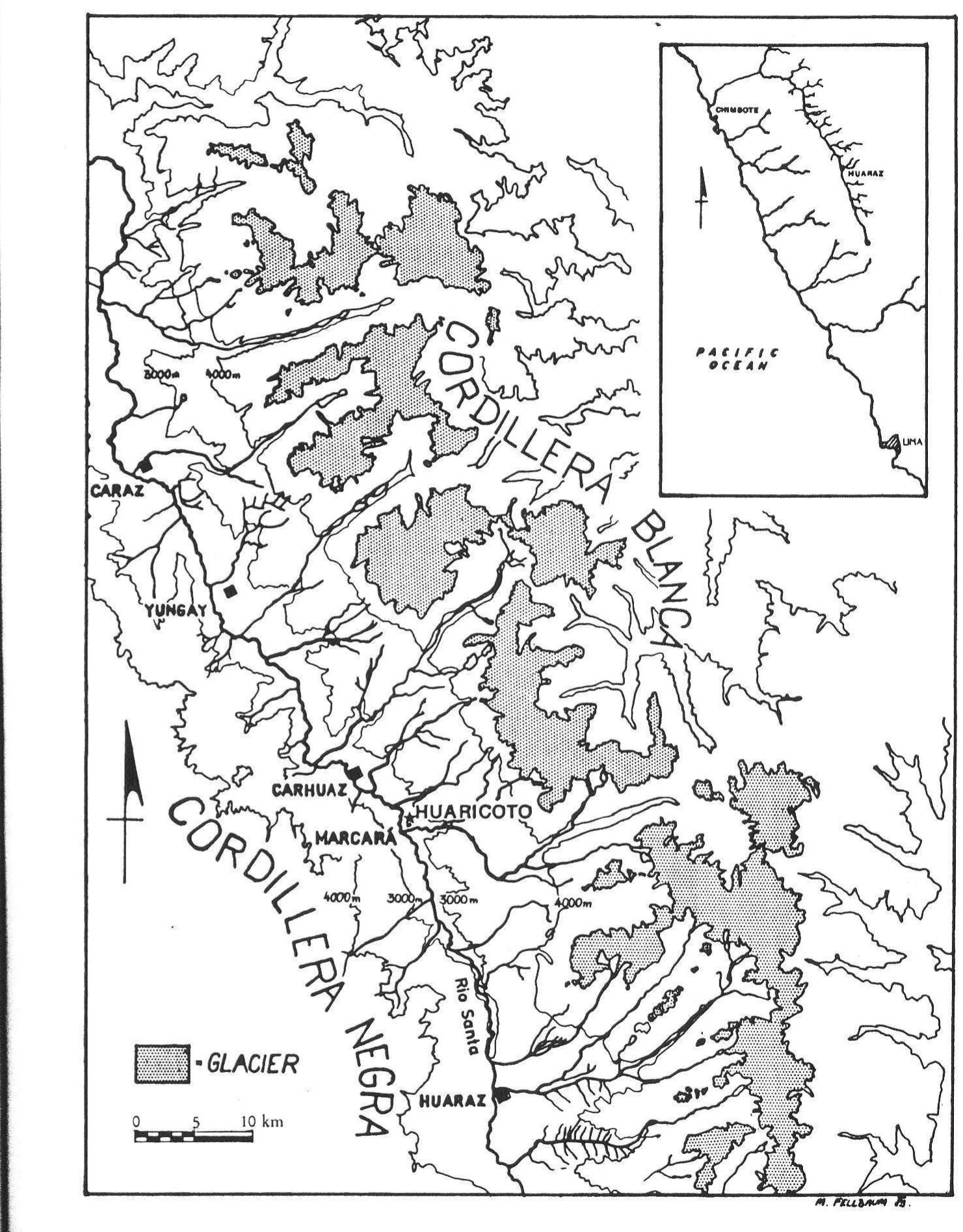
two parallel but contrastive mountain chains (fi$rre 6.1)' Both C.ordilleras
Figure 6.1 Callej6n de Huaylas region showing location of qite of Huaricoto.
exhibit extensive post-glacial change, but outwash and erosional deposits
are considerably more ironoun..i on the eastern, Cordillera Blanca side
of the Callej6n, a function of its higher, sreeper slopes. Rapid glacial
� GeNor,nurnrcs
178 J. M. Gnno
depositing, materials
melting has further contributed to these Processes'
derived from the Cordiliera Blanca on the valley
floor where they
accumulate in ,.rro..r""*"r"g ;rallel to the
mouths of .the rivers
of unsorted sands and
emptying upper glacial lakes' lt is.on such a tt"utt
gravels that Huaricoto is situated'
years' from the late
Occupation of the site spans approximately 2500
preceramic period ;;;i;ffi"B' th'ough
:n:,1:Y"lntermediate
and Salazar-Burger 1980)'
period/Middle Horizon nO 600 (Burger
"i
The earliest i.o.1, hu"u. .tp*ta it"'ioni"l"platform
covered with
'
yellow clay and .onrrrr.,Jd with several carefully PttPll*' Burger
sunken'
1 985).
itrf _ti.,.a'....-oni"l ;.;;;-l* (B;;g., and salazar-Burgeran unoccupied
and Salazar-Bur*.. i*;;" i.*tittt trtit stage as by mobile
ceremonial zone that was visited and used only ititettittently
hunters and gatherers. not
BC
The introdu.,iott oi ceramics at the site at about 1700 -does
Rather' a
changes'
seen to accompany ;d;;l;;;;
of .nlrrg.-.r,t-,
series
'i"lt 'otio-cultural
,ft. i.-plt area through regular construction
"i
and filling of ..r.*o.rirf -i"iii"l aPP€ars 'o" to"iin"t
h..,'h'
p"iiod, *nd u"iY j:tn: o-T:t^t;
-out
of the
4N
p re ceramic l.u. roieil,n;
l, th
(pt
have been traced
t.rru.", th"t b,..tttrerr.i ,h. growing temple mound large,elliptical areas 9)
around the northern perimeter of the t.rnpl., and. were
defined by the frigf-r dresred boulders ('huancas') 5'
"r".ri;r'oi'l*
constructed during ,il..1;;;6it'ul" ph"t" setting
aPart an open plaza
otir., ,it,i.l on the other
area in front of ,h. ;;;;i;'"nJ a.nni"g "re"r
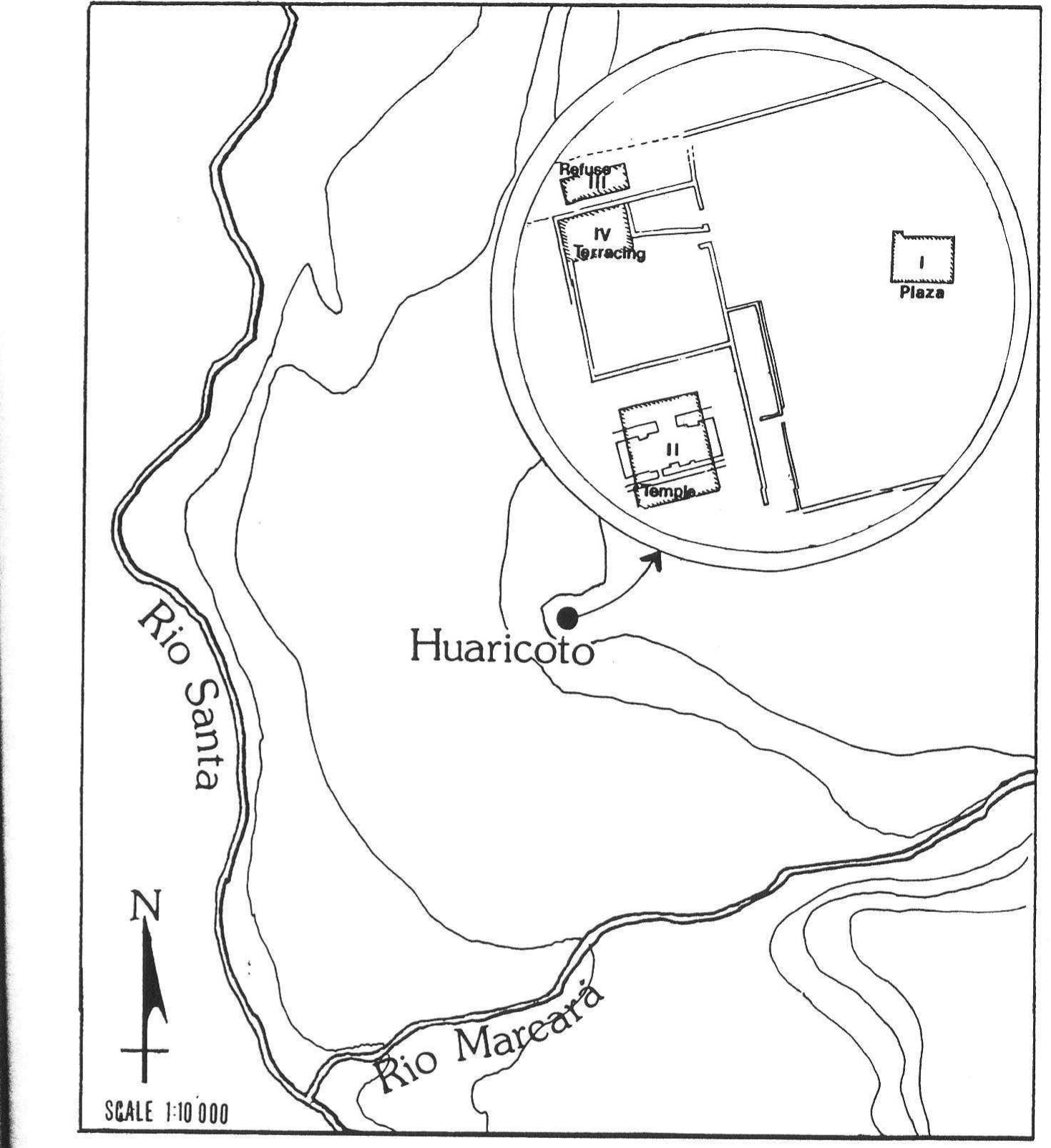
sidc of the main ,t.r.,ui. as well (figure 6'2)'
Because excavations at Huaricoto were largely
directed to defining the
components are
te.rple and ceremo;i;i";; of the site' the"residential
peri-od (EIP)'
less well und.rr,ooi. Si"trt"g lrr the Early Intermediate
howevdr, l"rg. of iiddtn accumulation are aPParent in the
"rno.t,-tt, sector, conCentrations of
northernmost excavation
"p"'"nting-dense now reaches its
domestic refuse fr";';l; ;;;t;iv t*p"nata ulllugt-thtt
maximum exrenr frrp i.u.lop*.nt"of " ptt*"t""' "ill?g:
"i'i;;:ifiir
settlement associated with an older, strictly ceremontal area ls Paraucrcq
Figure 6.2 Huaricoto, showing distinct excavarion secrors (inset courtesy of
at other highland sites. . r t,.^^ t^.,- excavatlon R. Burger).
Lithic materials from Huaricoto were collected from four 1989)' The
se*ors (figure 5.2), *'hi.h;;detail.d elsewhere (Gero1983a, chipped and ground slate bifaces are noted throughout secror II levels,
four site sectors ..;;;;;;A untq"^lly to the total lithic
assemblage as
mostly in a disfunctional broken or exhausted state, accompanied by a
well as to the ,.pr.;;;;;; oitith ct'lt"'al period' Sector,I' the open
thin scatter of barely modified flake tools. Sector IV, representedby a
plaza east of the ,.;;i.' ;"nned the t"iiit oit"p'tion
of the site w-ith
two Preceramlc series of
particularly ir,..r"rri,lg q.,u,,' materials coming {rom .supporting-terraces north of the temple, apparently dates only
temnle to the middle period of Huaricoto's occuparion: thi-two lower rerraces
ceremonial t ."r,t, ir,'itttJl"*;; lt"ti'' IIIthe
Sttto' central
111 are Initial period, and there is one uppir Early Horizon terrace. Of
the EIP srrata correspondrng
yielded u lo* d",",ritf oiii.i-,i., and_lacked
for this time' special interest, the lowest rerrace of sector IV contained a well-defined
to the residential ;.G";t"" i"""a.ir.*here at the site
�180 J. M. Grno
GnxoBRlrturcs 1B1
lithic workshop area, apparently corresponding to-the produc.tion of evaluate the Huaricoto lithic assemblage for the accessibility of the stone
bifaccs ...ou...d f.om i.,itiai p..iod occ,rpationi at Huaricoto. Fin_ally, materials represented at the site.
Sector III, the deep refuse u*n on the extreme northern edge of the As tabulaied in figure 6.3, "local" materials are readily .accessible from
tcmple mound, daies predominantly to the last .(EIP) period of site river cobbles o, s.,rfa.e outcroppings close at hand: sandstones, qua\tz-
occupation. This sectJr contained ,h. gr"ut.rt density of artifactual ites, granites, and metamorphoied sedimentary rocks..The_se-probably
an over- *erei"ke., from the nearby riverbeds of the Rio Santa, just 500 m below
-ut.rinl in its midden strata, with few projectile points andwhile and to the west of the site promontory, or from the Rio Marcar| flowing
whelming proportion of expediently produced fljke tools, the
lowesr l""u.ls i"u.aled a preceramic .ornpon.n, of carefully prepared 50Om southeast of the site.
hearths and a few tools. iool frequencies by cultural periods for the
entire site are given in table 6.1. Flakes Proj. Pts. Flakes Proj. Pts.
Table G.l Size and structure of the Huaricoto lithic assemblage based on
1014 arttiacts
Bifaces and
Flake rcols Projectile Points
636 (e6%) 26 (4%)
Early Intermediate Period (n = 622)
L,arly Horizon (n : 74) s7 (77%) 17 (23%)
Initial Period (n : 247) 221(8e%) 26 (11%)
Preceramic Period (n = 31) 27 (87%) 4 (13%)
TOTALS 941 73 n=28 n=4 n=221 11=26 n = 5/ n = lt n=636 n=26
Preceramic Initial Period Early Horizon Early Intermedhte
Inspection of the Huaricoto stone tools focuses on the three dimenstons [--r-.rM"*i,1" Nl -So**t'utro'ru^*at @-xruazax
of litiric assemblages identified earlier as areas in which gender roles
appear to rnteracr wrth lithic production and use' Again, while"none of Figure 6.3 Artifacts grouped in categories of relative rareness of raw material.
,i.,"r" ."p..rents a simple ,o.r"rpo.tdence of archaeological artifact with
sex, each area has gender implications: "somewhat local" materials include volcanic stonep (tuffs, rhyolites,
and andesites) derived from at least approximately 5 km away and from
1 Litbic ra.w materials. Gender can obviously be used as a category to the other side of the Rio Santa (Wilson et al. 1967: 44-6). In addition,
limit control over different types of workable stone' this group includes materials that occur in the Cordillera Blanca but are
2 Degree of preparatio, of tooliorms' Gender has already been shown *o.i diffi.ult to obtain than the "local" materials because they are
,o L. *ith"'eneigy investments" in tool Production' derived from lower geological beds and outcrop less frequently:
"rro.i"ted
although we suspect this is lar:gely a modern association, Minimally, rhyolites and tuffs, shale, slate, and caliz.
ce.t"i'ly contributed'extensively to fl ake tool production. Finally, "rare" materials were imported from outside the Callej6n de
-o-.,i h"u.
Huaylas or, minimally, were unevenly and sparsely available within the
3 Context of tool preporotion and use, Gender has spatial implications,
with certain .on,.i,, and ranges of tool applications at least loosely wider local region; these include obsidian, quartz crystals, and high-
suggesting female work areas. oualitv chert. Chert sources can only be identified in the Marofron
drrir,rg. at significant remove (Vilson et al. 1967:26-7), while Burger
and Aiaro 1illz| report that Callejon obsidian was imported from
Litbic raw materials in Huancavelica, several hundred miles to the south.
Quispisisa
'The
If we take the view that women enjoyed access to abundant local lithic data in figure 6.3 indicate first, that although rare stone was used
materials rather than depending on'imported quarried materials, we can more often to produce bifaces than flake tools (12"/o compared to 2o/o),
� 182 J. M. GEno
GrworRurHrcs
no cultural component at Huaricoto exhibits a significantly high 183
prop.ortion of rare materials, with the possible exceprion of the Huaricoto is simply that, rnore tools are made
expediently, and tools are
made rnore expediently.
unrcliably small prcceramic biface sample.
On the other hand, the pattern of using somewhat local marerials for
complex tools, and local materials for expedienr tools, is apparent for all Context of tool preparation and wse
culturalperiods; bifaces made of local materials show up is only 4"/" up
The contextualization of Huaricoto lithics resrs
ro 25"/" of each biface sample, while the flake rools of local materials are on recognizing the
overarching change in site function from
ncvcr represented by less than 60"/" and reach as high as 89"/" of. the flake tlre pr.*r".*.)iJriv'Horiro.,
occupations when the site was dominated
tool assemblages. As well, somewhat local and ,arJmaterials accounr for ui irr ..r.r*ili'1rp..rr,
the larer EIp occupation associa,;J-;ld'" -r;i[g."i"irr"r;." ,o
between 82"/" and96% of allthe biface samples, while the same materials
residential functions. All.time-transgr.rriu.
onfy account for between 7lu/o and 4e"/" oT the flake tools.
lighr of this contextual shift. o ----. trends must be interpreted"ra
in
A third trend somewhat obscured in the grouped data of figure 6.3 is
the strong. tendency towards the adoption of a-single local material, a Projectile points and bifaces are overrepresented
in the earlier strata
rnetamorphosed sedimenrary rock here called "metashale", as the rh. .,..r"-o'i"f;;;;r," of temple andplaza(Table
and, significantly, in
standard material for flake tools. During earlier periods of site 6'1)' Most of these were recovered in a much
,educed'or-brok..r,
expended state althou.g} a number of unbrok"n
occupatior.r, metashale rcpresented only 35"/" to 4eu/" of the flake tool po;"rr-r..oi.r"d fro-
ceremoniallv prepared hearths exhibit ui.ruar
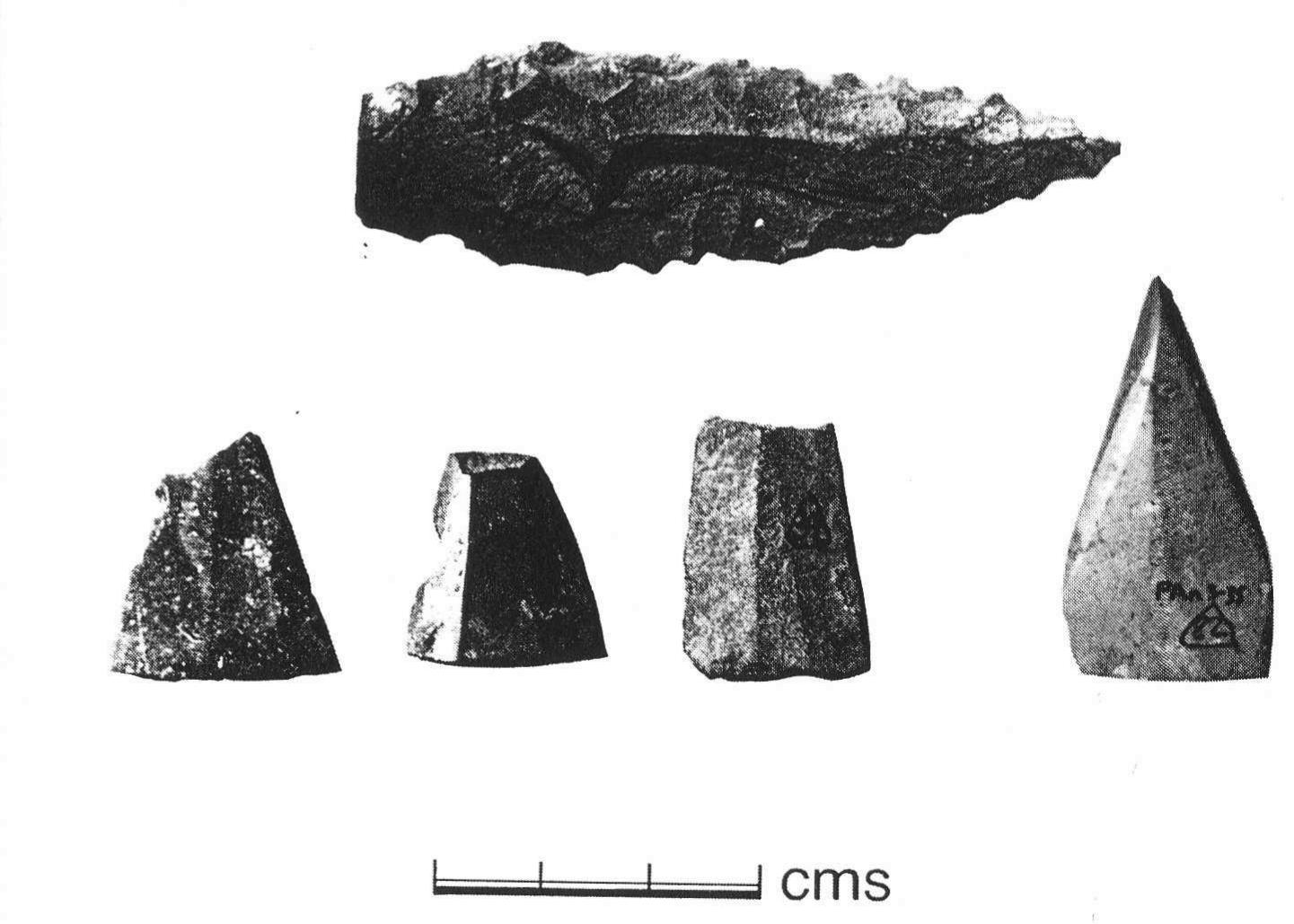
traterial while in tl-re last F,lP period. metashale dominated the flake tool ty n J ;r;-;r';rtih;ure 6.4).
rtssernblagc with a r"pr.r"ntrii on of 62"/o. \We return to interpret these uiltrg. conrexr, flake toolassemblages replace bifaces
ljT_,lr:.rEfn
appear to be produced on-site more and
finclings aftcr loohing at thc othcr lithic dimensions. often than b"efore; ,rr. or
cortex remaining on debitage flakes (see "-oun.
Gero 19s3a);r;;;d;;'a crude
Dcgrec of tool prcparation
Tool p.reparation ar Huaricoto can be assessed initially by a separarion of
"cxpcdient" flake tools from the carefully worked'bifaces ih"t o..u.
tlrroughout the sequence. Table 6.1 showed that bifaces comprise
bctwccn 4{ht and 23"1, of thc total assemblage for any period, and that
wlrilc.thc.Early Horizon rcprcscnration of bifaces is unexpectedly high,
it is the _dramarically low fie qucncy of bifaces in the EIP that ir -ort
noticcable. \ilThcrcasj in earlier periods. bifaces comprised letween 23o/o
to ll"/u of thc assemblages, in thc EIP only a.i" of rhe lirhics are
rcpresenred by bifaces.
Not only do bifaces almost disappear in the later, more residential EIP
sample, but even rhe flake tools exhibit less preparation. Measuring rhe
Pcrcentage of flake tools with cortex remaining on the surface shows an
increase of residual correx in the ErP:57u/o of fluk. tools retain some
cortex., compared to measures of 43"/o,49"h, and 63"/, tn the three earlier
Pcnoos.
Finally, the amount of retouch per flake tool was calculated for a sub-
sct of tl-re Huaricoto materials ."n be simply summarized (cf. Gero
"nd trend demonsrrares that tools from
1983a: 139): a slight but consisrent
later oc'cupational periods show less retouch, measured both by shaping
eltd thrnnlng flake scars, than tools from the earlier periods. A fair
L----l_-t____r CmS
summary of the amount of investment in tool preparation over rime ar
Figure 6.4 Projectile points recovered from
ceremonial contexts of Huaricoro.
�184 J. M. Geno
GrNonRlrrHIcs 185
r-ncasurc of rivcr cobble material that was worked (or reworked) at the examples of dedicatory and apparently unutilized (or underutilized)
site rathcr than at rhe river or quarry location. The fact that, after the projectile points recovered from ceremonial hearths in the early
unrcpresentativc prcceramic samplc, proportions of debitage with cortex Huaricoto temple suggest that the projectile point was also offered up, in
rise steadily and ieach a f.ull25'/" of all debitage in the EIP, suggests that addition to or as a substitute for ceremonial meat. In the earlier
more tools are bcing produced, or reworked, on site than_ earlier, a occupations at Huaricoto, we can speculate that we are observing rituals
finding that fits comforiably with the EIP rise in frequency of expedient in which meat played an important role, with males possibly providing
tools and with the ,"plocement of the ceremonial area with a village this highly valued food, and probably actually hunting it, in an economy
cconomy. that lacked domesticated animals until late in the Early Horizon.
It may be, too, that men manufactured the Huaricoto bifaces
recovered from the early ceremonial and dedicatory contexts; the
' Gender shifts in tool prodwction and use at Huaricoto narrowly restricted conditions that associate men with the production of
To re capitulate, the major trends that accompany the shift from projectile points (e.g. when such tools carry the social meanings of, and
ceremonialcenter to village settlement include: (1) a consistent pairing of reflect directly on the prestige of hunting and meat production) could
flake tools with local ri* materials, while bifaces are made of less apply in this circumstance. 'Women, however, are likely to be directly
accessible rnaterials; (2) both bifacially prepared tools and flake tools of associated with the use of these tools in the Huaricoto temple context
the later EIP occupaiion manifest lesi ietouch and more cortex on tool and most probably participated in the rituals in the preparing, cooking,
surfaces (less toolpreparation)than in earlier periods;and (3)a dramatic and serving of the ceremonially important meat.
itrcrcasc in flakc tciols^(and the virtual disappearancc of bifaces), together It also can be seen that the conditions suggesting women's participation
with thc homoscnization of local raw materials, characterizes the EIP in stone tool production and use increase with time, especially in
villase (non-tcmple) phase. How are gender systems operating to conjunction with the appearance of a residential settlement at Huaricoto
procluce thcsc data? after the Early Horizon. When flake tools replace bifaces and become
It is questionablc whethcr the lower proportions of bifacial tools in more expedient in their production, and when local raw materials
latcr phascs is because the prece.ramic, period and Early Horizon increase in representation, it is not necessarily because a new economic
.Initial base is creating new uses for stone tools. Rather, the demands on stone
ccononrles were so much more intensely focused on hunting or even on
meat-eating. In fact, camelid domestication most likely dates to the late tools as sacred and prestigious have changed with the cessation of the
EH, and meat preparation and consumption would probably-have temple complex, and social meanings attached to ritual hunting
increased in the E,IPlBurke 1990). The change in the ratio of lithic forms paraphernalia have shifted.
and raw materials follows more closely from the shift from a ceremonial In the village context, stone tools fulfill a much broader range of
to a residential context. \We recognize that the carefully finished biface of functions than in the temple area, with less focus specifically on meat
cxotic material in the restricted context of the ceremonial center is preparation and less social loading on tool morphology. Conditions are
e quiaalem to the flake tool in the residential setting, and the flake tool
created that concentrate women's secular work in household production
performs many of the same actions unceremoniously that bifaces and management, and in the process, encourage the making and using of
perform in a ritualistic setting: cutting, scraping, sawing, skinning' and expedient flake tools produced from abundant local raw materials. The
whittling (Ahler 1970: 88-981. nif"..i recovered from restricted, sacred precise activities carried out at Huaricoto by EIP women using flake
contcxts may have been constrained by more formal, standardized tools is still not well defined; the quality of locally available lithic
morphological definitions and by the value of exotic raw materials from materials precludes fine-grained microwear analysis and we are left with
which they werc made, to contribute to the legitimation of a restricted gross functional interpretations: working wood, defleshing cactus,
and sacred contcxt: the Huaricoto preceramic and Initial period temple. butchering and skinning animals, perhaps leather work. In general, the
The high proportions of expended projectile points from the early flake tools show little tendency toward task specialization, and the same
ritual conte"h it Huaricoto probably refer to meat consumption (or tool proves to have been used in a wide variety of work actions (Gero
offerings) at ccremonial feaitr; there is ample evidence for meat 1983a:152-61).
preparation in Huaricoto's ritually prepared, ash-filled hearths that are Vhile males may also be making and using flake tools, male status is
full of splintered bone and tiny flake spalls. At the same time, the no longer linked to lithic production but is tied up in newly defined
� 186 J. M. Grno GrNornlrrnrcs 187
prestigc goocls in othcr media, some of which are probably commissioned 2 Note that the associational chains that build up and give value to tools as
(c.g. tl-re claborated Rccuay ceramics of the IllP (Gero l99O)) and/or standardized, curared, and elaborately retouched, also include tools of'
nrade by womcn (c.g. fancy rextiles). Males are increasingly involved in "exotic" (vs. "common") materials, all associated with male production and
actlvttlcs that accompanv earlv state formation and that take males into use. Note how different rhese values sound when "exotic" materials are
widcr, socio-politicai rphc.cs but whose definition lies ourside the called "low density" materials and "common" materials are "high density".
Dound.s ol thls lnqulrv. In whose terms do we rationalize the high- and low-value rerms placed on
Our unde rst.,,ding, of gcndcr rclations as rhey operated in Huaricoto stone tool dichotomies?
tool prclduction are still very incornplete, and indeed, the question "Did J Research on the lithic materials of Huaricoro was carried our from 1978 to
wortlcn mrrkc srorrc rools?", ihhough'it c.ln now be answcrcd^affirmarively, 1980 with the generous help of a Fulbright-Hays pre-dissertation award,
administered by the Comisi6n para Intercambio Educativo entro los Estados
will hardly produce compelling insighrs into how gender sysrems Unidos y el Perf . A 1982 Sigma Xi Grant-in-Aid supported the computeri-
operatcd in Forrnativc Peru. To understand the constitution and zation of the flake tool data. The assemblages considered here are restricted
opcration of gende r sysrems, a focus
on a single material technology such ro lithics collected rn 1978 and 1979 .id o*. much to the generous
aslithics is neccisarily fruitful, and to i g..rt exrenr the argumenr cooperation of Dr Richard Burger, Lucy Salazar-Burger, and Abelardo
prcsented hcrc 'otis constraincd by an archaeological paradigm that would, Sandoval, projecr direcrors.
xt least. implicitly, assume a simple .o...rpond.nce berween one
prod.tretrvc proccss and one sex. To elucidate gender sysrems and
rclatlons' wc will nccd to rrace rhe convergence of many lines of material
REFERENCES
cviclc'cc. But wc havc l'rad ro pur such interests on hold until gender is
acccpteci as a consrirutivc clcment of all social relations and as a primary
Adams, Jenny L. (1988). "Use-\Wear Analysis on Manos and Hide Processing
nrcans. of siunifying rclationships of power (Scott 1986). As a new axis of
Stones." Journal of Field Archaeology 15:307-15.
lllvcs.ttgatlotr, scnclcr is only bcginning to ;rccumulate the analytic power Ahler, Stan (1970). Projectile Point Form and. Function at Rodgers Shelter,
to acidrcss (ancl change) cxi.sting archacological catcgories, to shift our Missouri. Missouri Archaeological Society Research Series No. 8.
spccillizccl focus frol.r sropes, shells, or sherds to nl"n and women. Arundale, Wendy H. (1980). "Funcrional Analysis of Three Unusual Assem-
blages from the Cape Dorset Area, Baffin Island." Arctic 33: 464-86,
Bienenfeld, Paula (1985). Preliminary Results from a Lithic Use-\l7ear Study of
the Swifterbanr Sites, S-51, S-4, and S-2. Helinium 25: 194-211.
ACKNO\(LEDGMENTS Binford, Lewis R. and S. Binford (1966). A Preliminary Analysis of Functional
Variability:in the Mousterian of Levallois Facies. American Antbropologist 68:
Many thanks to thc participants of "The vedge " conference for their wise and 238-95.
suPPortlve commenrs on this work, and to Meg Conkey for her careful, Bonnichsen, Robson (1977). Modek for Deriving Cultural Information from
insightful critiquc thar got to the hearr of alternative rrru.,rr... Liz tsrumfiel Stone Tools. Ottowa: Mercury Series Paper No. 60, National Museum of
ktndly.supplied rhe epigram. Man.'
John Clark, Alice Kehoe, and Morgan Maclachlan
offcred thoughtful .o,llm.n* along the way, and Kathy Bolln contributed Bordes, Francois (1968). The Old Stone Age. New York: Vorld University
dtltgcnt research, all of which I very nruch appreciate and rnuch (but not all) of Library.
which I usecl. Boulding, Elise (1978). "Vomen, Peripheries and Food Production." Consonium
for International Developmenr, "lnternarional Conference on \flomen and
Food," January 8-11,,1978. Vol. I, Tucson: University of Arizona, 22-44.
Bradley, B. A. (1975). "Lithic Reduction Sequences: A Glossary and Discussion."
NOTES ln Lithic Tecbnology: Making and [Jsing Stone Tools, E. Swanson, ed. The
Hague: Mouton, 5-13.
I It.r contrast to tl'rc loo'2,
san.rple of r'ales in flint knapping research, the ratio Brown, Judith (1920). "A Note on rhe Division of Labor by Sex." American
.f wonrcn to n involvecl in r,icrowear stuc'lies rpp."rr I be approximately Anthropologist 72: 1073-8,
I : I , compared'eto an overall ratio of I :5 rvomcn to-men e-ployJ m full-time Bryan, A. L. (1960). "Pressure Flaking: The Problem of Identification." Tebiwa
a,rcl-raeologists i. anthropology departnrenrs lisred in ' rhe AAA Guide 3: 29-30.
(Kranrer ancl Stark 19gg: 1l). Burger, Richard L. and Frank Asaro (1977). "Analisis de rasgos significativos en
�188 J. M. Grno GnNonnltrrucs 189
Ia obsicliana de los Andes centrales." Reaista del Museo Nacional (Lima) 43:
Gailey, Christine \fard (1982). Kinship to Kingsbip: Gender Hierarchy and State
28t-325. Formation in the Tongan Islands. Austin: University of Texas Press.
Burgcr, Richard L. and Lucy Salazar-Burger (i980). "Ritual and Geis, Maureen (1982). "Lithic Flake Production Analysis: Another Fly in the
Huaricoto." ArchacoloRy 33 : 26-32. Ointment." Paper presented at the 15th Annual Meeting of the Northeast
(1985). .The Early i..e-onirl Center of Huaricoto." In Early Ceremonial Anthropological Association, Amherst, MA.
in tbe indes, Christopher Donnan, ed. Vashington: Dumbarton Gero, Joan M. (1983a). "Material Culture and the Reproduction of Social
- Arihitecturc
Oaks Research Library and Collection, 111-38' Complexity: A Lithic Example from the Peruvian Formative." Unpublished
Burke, Itobin (1990)..Th. Llr-. Figurine in Andean Prehistory: Analysis of Ph.D. dissenation, Departmenr of Anthropology, University of Massachuserts.
Examples from the Callei6n de Huaylas, Peru." Unpublished MA Thesis, (1983b). "Srone Tools in Ceramic Conrexrs: Exploring the Unstructured."
Depaittnent of Anthropology, University of South Carolina. In Investigations of the Andean
- University Past, D. Sandweiss, ed. Ithaca: Cornell
Butlei, \flilliam B. (1980). "Penet."ring Elephant Hide with Wood Atlatl Darts," Latin American Studies Program, 38-50.
PLains Anthropologist 25 353-6.
(1989). "Stylistic Information in Stone Tools: How Vell do Lithics
Callahan, erlc (fzi;. .The Basics of Biface Knapping in the Eastern Fluted Measure Up?" In Time, Energy and Stone 7oo/s, Robin Torrence, ed.
- Cambridge: Cambridge University
Point Tradition: A Manual for Flintknappers and Lithic Analysrs." Archae- Press, 92-105.
oLogy of Eastern North America 7.
(1990). "?ottery, Power and Parties! ar Queyash, Peru." Arcbaeology,
Cantilell, Anne-Marie (1979). "The Functional Analysis of Scrapers: Problems, - March/April: 52-6.
(forthcoming). "Facts and Values in the Archaeological Eye." In Tbe
New Techniques and Cautions." Litbic Technology 8:5-11.
Clark, John E. (1982). "Manufacture of Mesoamerican Prismatic - Powers of Obseruatioz, S. Nelson and A. Kehoe, eds. American Anrhro-
Alterrrrtivc Techniqr.rc." Amcrican Antiquity 47 : 355-76. pological Association Publication No. 2.
Coutts, P.J.F. (1g7)). "Green Timber and Polynesian Adzes and Axes'" In Goodale, Jane C. (1971). Tiwi lViaes. Seattle: University of Vashington Press.
Stone ToLLs as'Cultural Markers, R. V. S. Wright, ed. Canberra: Australian Gould, Richard A. (1977). "Erhno-archaeology; Or, 'Where do Models Come
Institute of Aboriginal Studies, 67-82. From?" In Stone Tools as Cultural Marhers, R. V. S. Vright, ed. Canberra:
Coward, Rosalind lf lS:1. Patriarcbal Precedents. London: Routledge Er Kegan Australian Institure of Aboriginal Studies, 162-77.
Paul. Hamilton, Annette (1980). "Dual Social Systems: Technology, Labour and
'Women's
Crabtree, Don E. (1967). Notes on Experiments in Flintknapping: Tools Used Secret Rites in the Eastern Western Desert of Australian ." Oceania
for Making Flaked Stone Artifacts. Tebiwa 10: 60-73. 51: 4-19.
Introduction to Flinnuorking. Boise: Idaho State University Hayden, Brian (1977). Stone Tool Functions in the Vestern Deserr." In Stone
Tools as Cultural Markers, R. V. S. Wright, ed. Canberra: Ausrralian Institute
Museum Occasional Papers 28.
-(1972).-An
Elliott, \il. J. and R. Anderson (1974). "A Butchering Experiment with Flaked of Aboriginal,Studies, 1 /8-88.
Obsidian Tools." Archaeology in Montana 15: 1-10. Hester, Thomas R. and Robert F. Heizer (1973). Bibliography of Archaeology I:
trstioko-Griffin, Agnes and P.-Bion Griffin (1981). "'Woman the Hunter: The Experiments, Lithic Technology, and Petrography. Reading, Massachusitts:
Agta." ln Womin the Gatherer, Frances Dahlberg, ed. New Haven: Yale Addison-Vesley Module in Anthropology No. 29.
University Press, 121-51. Hes1er,.T.,
T . Spencer, C. Busby, and J. Bard (1976). "Butchering a Deer vrith
Fausto-steriing, Anne (1985). Myths of Gender. New York: Basic Books' obsidian Tools." uniaersity of california Archaeological Research Facility
.I
Lontnbuttons 43 : 33-75.
Fischer, Andeis, P. V. Hansen, and P. Rasmussen (1984). "Macro and Micro
wear Traces on Lithic Projectile Points." Journal of Danish Arcbaeology 3: Holmes, \f, H. (1897). "Srone implements of the Potomac-Chesapeake
19-46. Tidewater Province." ln l5th Annial Report of the Bureau of Etbnilogy,
Flenniken,J.Jeffrey(1981).Replicatit,eSystemsAnalysis:AModelAppliedto J. W. Powell, ed. Vashington; Government PrintingOffice, 13-152.
the Vein Quari Artifacts irom the Hoko River Srre. Washington State (1919). Handbooh of Aboiginal Amerian Antiquitbs: part L The Lithic
University Laboratory, Anthropology Report No. 59. - Indastnes. Washingron: Bureau of American Ethnology, Bullerin 50.
Huckell,,Bruce (1982)-'The Den'er Elephanr projeaf A Repon on Erpri-
(1984). "The Past, P..r.n, uld Fu,-ur. of Flitttknapping: An Anthropological
Perspective." Annual Review of Anthropology 13: 187-203. menr:rion rich Ttrusang Sperrs-" Pki,ri Anblc,ylog;* ZZiZtl-Z+-
-Flenniten, leszn Ra!-eas &n i&tt Mrzts' Tradi -ta rryuoa"t d dr lena
J. Jeffrey and Anan'Raymond (lSSe). "Morphological Projecdle
point Typoiogy: Replication Expirimenrarion and Technological Analysis." -U*;&,,sys a I a Frae, I 6I :- I ;g J, F;** p,a:= 6,r-d" Rd*;* of
r?s, {-*.c. -\er -V-,
-*l
American Antiquity 51: 603-14. a- cy ic C;awz .sri ar r t rrr**, l-, III:
Fris.rn. George C. t tgSSr.
*E-rperimental Use of Clovis Weaponlv and Tools on A.rG4 I&^ii-ieio-
Jud Jcn:,ea, HdIc *i9d.;- '-{ Priihm;rr llrrfr$s of Blade S.zpers trom
�190 j. M. Gnno GsNoBnr-rrnrcs t91
llingkloster, a Danish Late Mesolithic Site." Studia Praehistorica Belgica 2: Miller, Tom O., Jr (1979). "Stonework of the Xeti Indians of Brazil." In Litbic
323-7. Use-Wear Analysis, Brian Hayden, ed, New Yorkl Academic Press, 4Ol,-7.
"Functional Analysis of Prehistoric Flinr Tools by High-Power Montet-White, Anta ('t974). "The Significance of Variability in Archaic Point
Microscopy: A Review of West European Research." Journal of World Assemblages." Plains Anthropologist 19: 14-24.
-(1988).
Prchistory 2: 53-88. Moore, Henrietta (1988). Feminism and Antbropology. Cambridge: Polity Press.
Jolrnson, Lucy Lewis (1977). "A Technological Analysis of an Aguas Verdes Moss, Emily (1983). The Functional Analysis of Flint Implements. Pincevent and
Quarry-Workshop. "In Tbe Individual in Prehistory: Studies of Variability in Pont d'Ambon: Two Case Studies frorn the French Final Paleolithic. Oxford:
Stylc tn Prchistoric Tcchnologies, J. N. Hill and J. Gunn, eds. New York: BAR International Series No. 127.
Acaderric Press, 205*29. (1986). "Vhat Microwear Analysts Look At." In Owen, L. and G. Unrath,
"A History of Flint-knapping Experimentation, 1838-1976." ed. "Technological Aspects of Microwear Studies." Early Man Neus
- (Ttibingen) 9-11 : 9l*6.
Currcnt Anthropctlogy 19: 337-72.
-(1978)r
Jones, Rhys and Neville White (1988). "Point Blank: Stone Tool Manufacture at Neifl, Vilfred T, (1952). "The Manufacrure of Fiuted Points." Tbe Florida
the Ngilipitji Quarry, Arnhem Land, 1981." In Archaeology with Ethnography: Antbrop o logist Y (1 -2) : 9 - 16.
An Australian Perspcctive, Betty Meehan and Rhys Jones, eds. Canberra: Newcomer, Mark H. (1971). "Quantitative Experimenrs in Handaxe Manu-
Australian N;rtional University. 51-87. facture." World Archaeology 3(1): 85-93.
Kehoc, Alice (1987). "Points.',n..i Lin.r." Papcr presentcd at the Annual Meeting Odell, George H. (1980). "Burchering with Stone Tools: Some Experimental
of AAA, Chicago. Results." Lithic Technology 9: 39-48.
Kclterborn, Peter (1984). "Towards Iteplicating Egyptian Predynastic Flint Odell, George H. and F. Cowan (1986). "Experiments with Spears and Arrows
Knivcs." Journal of Archacological Science 1 1: 413-51. on Animal Targets." Journal of Field Arcbaeology 13:195-212.
Knuclson, Ruthrnn (1973). "Organiz.ational Variability in Late Paleo-lndian Olausson, Deborah Seitzer (19S0). "starting from Scratch: The History of Edge-
Asse Irblages." Unpublished Ph.D. dissertation, Washington Stare University. Wear Research from 1838-1978." Lithic Technology 9t 48-60.
(1979). "lnference and Imposition in Lithic Analysis." ln Lithic Use-ttear Park, Fdwards (1978). "The Ginsberg Caper: Hacking ir as in Stone Age.',
AnaLysis,13. Hayden, ed. New York: Academic Press, 269=8) . Smithsonian 9: 85-94.
-Korobkova, G. F. (1981). "Ancient Reaping Tools and Their Productivity in the
Price-Beggerly, Patricia (1976). "Edge Damage on Experimentally Used
Light of Experimental Tracewear Analysis." lnThe Bronze Age Civilizations Scrapers of Hawaiian Basalt." Litbic Technology 5:22-4.
of Central ,4sia, Philip L. Kohl, ed. Armonk, NY: M. E. Sharpe,325-49. Purdy, Barbara. A. (1975). "Fractures for the Archaeologisr." In Litbic
Kramer, Carol and Miriarn Stark (llaS). "The Status of Women in Archaeology." Te.cbnology: Mahing and [Jsing Stone Tools. Earl Swanson, ed. Chicago:
Anthropology Nezuslettcr, (American Anthropological Association) 29(9): l, Aldine.
t1-12. (1981). Fhrida's Prehistoric Stone Technology. Gainesville: University
Leudtke, Barbara (1979). "The Identificarion of Sources of Chert Artifacts." Presses of Florida.
Arnertcan Antiauittt 44: 744-57. -Rippeteau, Bruce (1979). "The Denver Elephant Project: A Personal
and Semi-
Laughlin, William (ii68). "Hunting: An Integrative Biobehavior System and its Preliminary Rep-orr." ln Megafauna Pancbers' Review, vol. 1, B. Rippeteau,
Evolutionary Importance." In Man the Hunter, Richard Lee and Irven ed. Denver: Office of the Colorado State Archaeologist, 1-8.
deVore, eds. Chicago: Aldine, 3A4-20. Sale, Irene'Levi (1985). "IJse \Vear and Post Depositional Surface Modification:
Lewenstein, Suzanne (1981). "Mesoamerican Obsidian Blades: An Experimental A Vord of Caution." Journal of Archaeological Science 13:229-44,
Approach to Functions." Journal of Field Archaeology 8: 125-88. Schneider, Mary Jane (19S3). "\flomen's \Vork: An Examination of Vomen's
(1982). Stone Tool Use at Cerros: The EthnoarchaeoLogical and Use-Wear Roles in Plain Indian Arts and Crafts." In Tbe Hidden Half: Studies of plains
Euidence. Austin: University of Texas Press. Indian Women, P. Albers and B. Medicine, eds. Lanham, MD: University
-Lowc, Marian (1983). "The Dialectic of Biology and Culture." In Woman's
Press of America, 101-21 .
l"tature: Rationalizations of Inequality,Marian Lowe and Ruth Hubbard, eds. Scott, Joan \fl. (1986). "Gender: A Useful Category of Historical Analysis.',
New York: Pergarnon, 39-62. American Historical Repiew 91 : 1053-75.
Madsen, Bo (198a). "Flint Axe Manufacture in the Neolithic: Experiments with Sheets, Payson D. and Guy Muro (1972). "Pressure Blades and Total Cutting
Grincling and Pc,lishing of Thin-l3utted Flint Axes." Journal of Danish Edge: An Experiment in Lirhic Technology." Science 175:632-4.
Archacology 3: 47-62. Sollberger, J. B. (1969). "The Basic Tool Kit Required ro Make and Notch Arrow
Mansure-Franchomme, Maria Estela (1983). "scanning Electron Microscopy of Shafts for Stone Points." Texas Archaeological Society Bulletin 40: 232-40.
Dry Hide Vorking Tools: The Role of Abrasives and Humidity in Microwear Spears, Carol S. (1975). "Hammers, Nuts and Jolts, Cobbles, Cobbles, Cobbles:
Polish Formation." Journal of ArchaeoLogical Science 1A 223-3Q. Experiments in Cobble Technologies in Search of Correlates." In Arkansas
�1g2 J' M. Grno
Gr'NornltrHtcs 193
young, David and Robson Bonnichsen 09s4). understanding Sto.ne Tools.
EastmanArchaeologicalProject,C.Baker,withcontriburionsbyC.Spears,
claassen and Ml Schiffer. Fayetteville: Arkansas Archaeological
Survey, o.o'no, University of Maine, Peopling of the American Process Series No. 1.
c.
83-1 10.
Experiments in the Manufacture and Use of a
"'Cr.o,' L. (1974). "Replicative
Spencer,
S.r;n .q,tl.tl.i' In Grrit Basin Atlatl Studies, T. R. Hester,
M.P.Mildner,andL.Spencer,eds'Ramona'CA;BallenaPressPublications
in Archaeology, Ethnology and History No 2' 37-60'
Macmillan'
Sp.n..., W. B.1nd f.1. Ciifg.i 0912)' Actoss Australla' London:
"Burin Manufacture and Utilization: An Experi-
Stafford, Barbara O. tigZil.
mental Study." Jowrnal of Field Arcbaeo.logy 4: 235-46'
Age Style." National
Stanford, Dennis (t9l9l. "iaruing up a 'Marimoth' Stone
Ct'ograPhic 155: l2 I .
T;,oma"s, bavicl H. (1983). Gatecliff Sbelrer. New
York: Anrhropological Papers
of the American Museum of Natural History 59' part l '
.^
Tindale,N.B'(1972)..,ThePitjandjara."]nHuntersandGatherersToday,
M. G. Bicchieii, ed. New York: Holt, Rinehart & Winston' 217-68'
lso*.
Titmus, Gene L. (1984). Aspects of Stone Tool Notching-" In Stone Tool
Analysis: Ersoyi i, Horo, of Crabtre.e,J' \ilo9d1' M' G' Plew^' and M' G'
Doi
Pru"'si., Albt,qu.rq,r.iUniuttsity of New Mexico Press' 243-63'
"dr.
Torrence, Robin (f 9S^i). 'iTi-" Budgeting and Hunter-Gatherer
Technology'"
ln Hunter-Gothrrr', Economy in Prehisto* A Ewropean Perspectiae'
C. n"il.y, ed. Cambridge: Cambridge University Press' 11-22'
(ed.) Time,'En,'gy o'i Ston' Tools' Cambridge: Cambridge
University Press.
-(1989)
1.ring1tu-,
'Rrrth, Glen., Cooper, George Barbara Voytek' and Anne
,Odell'
Wtit-nn (1974). "E*p.rirr,.n'ation ii the Formation o{ Ed.ge Damage: A
N.* App.ouch to Liti.,ic Analysis,,, lournal of Fiel.d.Arcbaeology^l:171-95.
Tsirk, Are'(1g74).,'Mechanical Basis oi Percussion Flaking: Some Comments'"
Arnerican AntiquitY 39: 128-30'
Unger-Hamilro.,,
- Ronluna (198a)' ."The Formation of Use-Wear Polish on
iiinr, Beyond .'-O.fori, vs. Abrasion' Controversy." Journal of Archae-
rt
ological Science 11: 91-8.
White, J. Peter (1967):.1'E h,,o-utthaeology in New Guinea:
Two Examples'"
Manbind 6(9): 4A9-14.
*- 1tStS1. )Typologi., for Some Prehistoric Flaked Stone Arti{acts of the
Australian N.* Culn.u Highlands." Arcbaeology and Pbysical Anthropology
of Oceania a(1): 18-a6. r -
Axes and Ani: Stone Took of tbe Duna' Forty-one
mrnute
documentary film.
-(1977).
\x/itthoft,;otrn 1rrez). "The Art of Flint chipping." Journal of the Archae-
ological Society of Maryland 3: 123-44'
- de
Vilson, John, L. n.y.r' indJ' Ga'ayar (1967)'.Ge2logia de.los Cuadrangulo.s
MolleLamba, Tayabambai H'oyiot, Pomabamba' Carhwaz y Huari' Lima:
Servicio de Geologia Mineria, Boletin i6'
,,Arrowpoints, Spearheads, and Knives of Prehistoric
wilson, Thomas (1g'gg).
ii-.r.. Report of the U.S. National Museum 1897,Part 1, 811-988.
� Copyright @ Basil Blackwell Ltd 1991
E,ngendering Archaeology Firsr published 1991
RePrinted 1992
Women and Prehisrory
Blackwell Publishers
108 Cowlev Road' Oxford' OX4 UF' UK
Edited by loan M. Gero Three Cambridge Center
and Margare t W. Conkey Cambridge' Massachusetts 02142' USA
for the quotation of shorr Passages
for thc purposes of
All rights vs5srued. Except rn
publication ma' be reproduced' stored
a
critictsm and revrew, nJ p'* of this
any io:T ol U'u-"nv *t*t' electronic'
mechanical'
retrieval system, or t'a"smiJted' in of the publisher'
otherwisi' wirhout piio' permission
photocopying, recorcltng or 'ht
ExceptintheUnitedStatesofAmerica,thisbookissoldsubiecttotheconditionthat
lent' re-sold' hired out' or othcrwrse
ir shall not, by way ot tt"Ji o' othtttitt'
be
cover other
circulared n'irhout rhe publisher's
prior consenr in any form of binding or
a simila, condition including this
rhan rhat in which i, o i",i'iiiiii';;i;-h;r; purchaser'
condition ftitg ltpc,tta on the subsequent
Data
Brittsb Library Cataloguing in Publication
ACll,cataloguerecordforthisbookisavailablefromtheBritishLib.rgry..-
Data
Library of Congress Cataloging rn Publication
and.nrelist11/editcd by
Engeridering archaeology: Y?T"n \W' Conkey
loin M' Gero-and Margaret
D. cm. (Social archaeologl')
- (pbK
lsBN 0-63i-16505-l - lsBN 0-631-17501-6 Philosophl''
)
l. Vomen. p"ftit"tit f iemini'm' J Archaeolosr'-
"i'
Gero' Joan M
4' Sexual al"i''on oi't'u;; - Hi;;";)' - Phiiosophv
Il' C";k;''Mo'go"t W'ight' 1944- ' lll' Series'
' GN799.\066E51 1991
305.4'09'01-dc2O 90-35i35
CIP
Garamond
Tvpescr in 10.5 on l2pt Stemple
'' bv Hopc Scrvices (Abingdon) Lto'
BLACI(WELL ' Prinred ln Great Britain bY
O{od UK & Canbtidsc USA
T. t' Pres Ltd, Padstos'' Cornwall
�


 Joan Gero