1
PHONETICS, ARTICULATORY
Xiaonong ZHU
The Hong Kong University of Science and Technology
In: James D. Wright (ed), International Encyclopedia of the Social & Behavioral Sciences,
2nd edition, Vol 18. Oxford: Elsevier. pp. 65–74.
Abstract. Articulatory phonetics is concerned with consonants and vowels (segments) as well
as tone and phonation types(phonationals).For more than a century, it has been deemed as an
applied discipline for practical purposes such as language teaching and description. In recent
years, articulatory or linguistic phonetics has developed quickly and general theories are
attempted to organize various concepts into a consistent system to account for phonetic
phenomena. This article introduces a syllable-centric phonetic theory, which treats tone and
phonation types as non-linear syllabic constituents, while consonants and vowels as linear
constituents. Phonetic typology is also explored in the article.
Keywords. Phonetics, articulatory, linguistic phonetics, syllable, segment, phonation, tone
1. Introduction
Phonetics, in its earliest sense, means articulatory phonetics. Although it has now
developed into a greater ‘phonetic science’, containingdozens41�inter-disciplines, itsbase or
core part is still articulatory phonetics.
‘Articulation’ has two meanings. In the narrower sense, it refers to the movements of
articulators in the oral tractthat produce ‘segments’ (vowels and consonants). In the broader
sense, it also includes ‘phonation’, the laryngeal orvocal folds activities, to
produce‘suprasegmentals’ (cf. ‘Suprasegmental’ in this volume)or ‘phonationals’ (register,
pitchand length). Since segments are the main subject to study in traditional phonetics and
suprasegmentals are merely secondary features, the two meanings do not create much
ambiguity.
In this article ‘articulation’ (and ‘articulator’ as well) is used in the narrower sense, as
opposed to ‘phonation’. However, ‘articulatoryphonetics’ is used in the broader sense,
covering the study of both articulation and phonation. It is concerned with the production of
speech sounds(cf. ‘Speech production’ in this volume): how the vocal cords modify the
airstream, when it passes through, to bring about different ‘voice qualities’ and how the
articulators further modify the airstream coming out of the glottis to form different ‘sound
qualities’.
The interest in the exploration of speech sounds started as early as two thousand years
ago in ancient India and ancientGreece, and later in ancient Arab. In ancient China, phonetics
awoke in the first century CE (fanqie spelling), continued progressing in the sixth century
(rhyming books) and flourished around the tenth century (classification of consonants and
rhyming tables).Modern phoneticsemerged in the late 19th century marked with a series of
� 2
academic events, one of which was the design and promulgationofa set of phonetic symbols,
theInternational Phonetic Alphabet (IPA), by the newly established International Phonetics
Association as a standardized representation of all the speech sounds in human languages.
For more than a century phonetics has been deemed as an applied discipline for such
practical purposes as language learning and teaching, dictionary making, language/dialect
description (cf. ‘Dialectology’ in this volume), speechpathology, singing and acting,
translation andspelling reforms(cf. ‘Writing systems’ in this volume). Its main task is to
describe and classify segments, with suprasegmentals as its subsidiary task.
Since the late 1970s articulatory phonetics has developed quickly in the studies of
consonants, vowels, phonation and general theories.
A great number of new consonants were found and identified, which resulted in a total of
five revisions of the IPA chart in a quarter of century (1978~2005). In the earlier half a
century only one revision was made in 1952.
The nature of vowels has been reconsidered. Vowels were previously defined with
respect to two physiological criteria: (a) they have a wide enough oral track for the outward
airstream so that no noise would be generated, and (b) they are described along three
physiological parameters: height (or mouth openness) and backness of the tongue position,
and lip rounding. These criteria have been replaced by two new ones. First, the vowel space is
defined by the acoustic dimensions of the first two formant frequencies. Second, the nature of
the vowel is understood with reference to its phonological status in a syllable.
A new subject, phonation modes, attracted extensive studies first in physiology and
acoustics, and later in linguistic phonetics. There are as many as two dozen phonation types in
terms of physiology (Catford, 1977; Laver, 1980). In linguistic phonetics, however, only six
were identified (Ladefoged and Maddieson, 1996). Recently, in the light of tonal typologyand
sound evolution, a phonological system of phonation types has been established (Zhu, 2011a),
which contains thirteen types, grouped into six major types. This finding has amended the
classification of consonants, brought about a new tonal model, restructured the syllable and
eventually reshaped the overall phonetic framework.
The most important change happening in phonetics is the change in theoretical
conception in recent years when ‘linguistic phonetics’ (Ladefoged, 1971) is becoming
matured. In his linguistic phoneticsLadefoged (2006) conceptualized an overall theoretical
framework, in which phonetics was absent. Zhu (2008, 2011a) attempted to refine the
framework by setting the syllable as the basic and pivot unit. These theoretical works
haveimproved the understanding of phonetics.
The remaining part of this article willaddress some theoretical issues in phonetics before
introducing criteria for segment description and classification, followed by a system of
phonation types and a set of parameters for tonal representation.
2. Theoretical considerations
2.1. Linguistic phonetics being phonology
‘Pure’ phonetics was largely separated from linguistics long ago. Phonologists, from
early years’ structuralists to the present generativists, include only phonology in linguistics
� 3
and regard phonetics as part of physics (e.g. Trubetzkoy, 1939; Anderson, 1980). As
‘functional phonetics’ (Martinet, 1949), ‘phonology begins where phonetics leaves off.’
(Sommerstein, 1977) (cf. ‘Non-linear phonology’ and ‘Phonology’ in this volume). Enormous
changes have taken place in the past few decades. Phonetics has now become such a large
field that it contains dozens of inter-disciplines. The phonetics that linguists pursue is what
Ladefoged called ‘linguistic phonetics’, an inter-discipline of phonetics and linguistics. It
developed from articulatory phonetics and remains the core part of the greater phonetic
science. As a phonetic discipline, it differs from other disciplines such as engineering
phonetics, forensic phonetics and pathological phonetics in that it is of linguistics, by
linguistics and for linguistics. When facing various linguistic disciplines, however, ‘linguistic
phonetics’ is not an appropriate term because there are no such terms as ‘linguistic syntax’ or
‘linguistic morphology’. In linguistics, ‘linguistic phonetics’ is just phonology, or the core part
of phonology. That is why basic phonetic concepts such as the consonant and vowel should
and can be defined with reference to their phonological roles in a syllable, in addition to their
articulatory and acoustic criteria and why phonology should and can be conducted based on
phonetics.
2.2. Basic framework
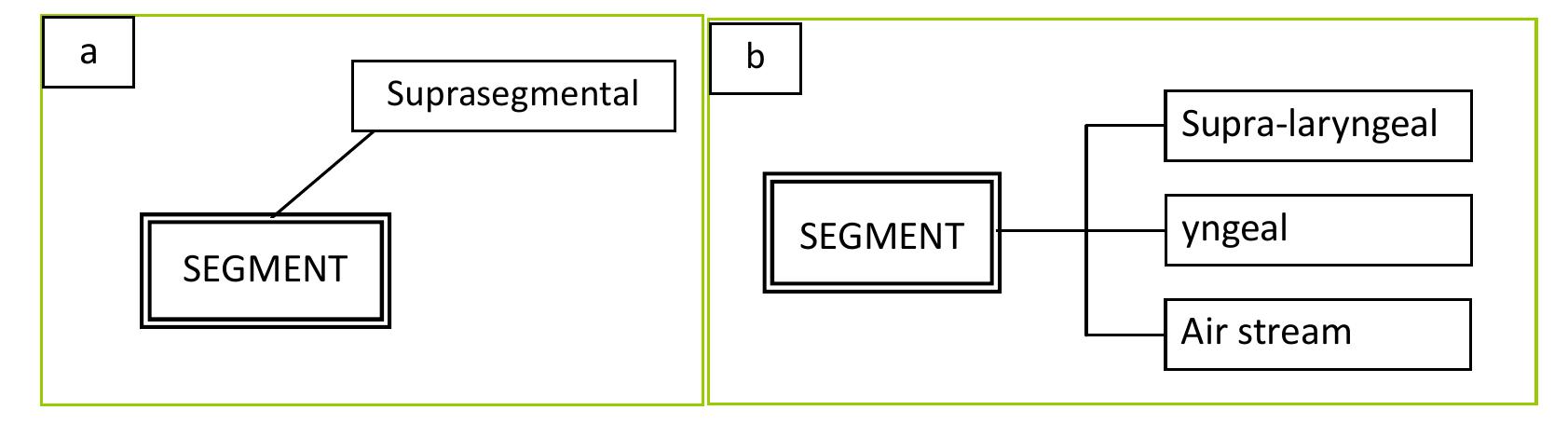
There is no explicit general phonetic framework before Ladefoged’s proposal. The
traditional consensus in phonetics is that the segment is the core subject to study, with
suprasegmentals (pitch and length) as secondary features, as schematically represented in
Fig.1a. Ladefoged’s framework (Fig.1b) is like a diagrammatic combination of the traditional
common view and the three processes of speech production (Catford 1977): initiation
(=airstream), phonation (=laryngeal) and articulation (=supra-laryngeal).
a b
Suprasegmental
Supra-laryngeal
SEGMENT yngeal
SEGMENT
Air stream
Figure 1. The segment-centric phonetic frameworks: a hypothetical traditional model (left) and
Ladefoged’s (2006) model (right).
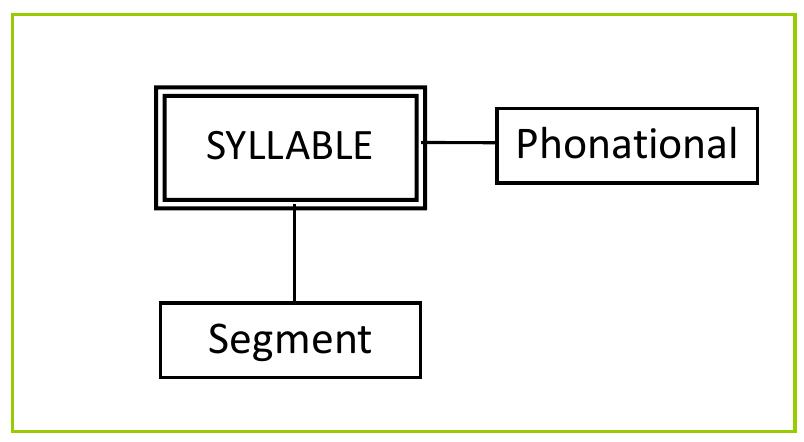
The segment-centric view has been the mainstream view in phonetics. Yet there is
another view held by British linguists (e.g., Abercrombie, 1967) which sets the syllable as the
basic unit. This is also a millennia-long tradition in Chinese phonetics/phonology. Following
this thread, a new linguistic phonetic framework has been developed (Fig.2).
� 4
SYLLABLE Phonational
Segment
Figure 2. The syllable-centric phonetic framework (Zhu, 2008, 2011).
A syllable has two kinds of components, the linear segments and the non-linear
phonationals. They can be phonologically organized to form linear onset and rime as well as
nonlinear register, length and pitch.
3. Segments
Segments include consonants and vowels, which, during production, involve (near-)
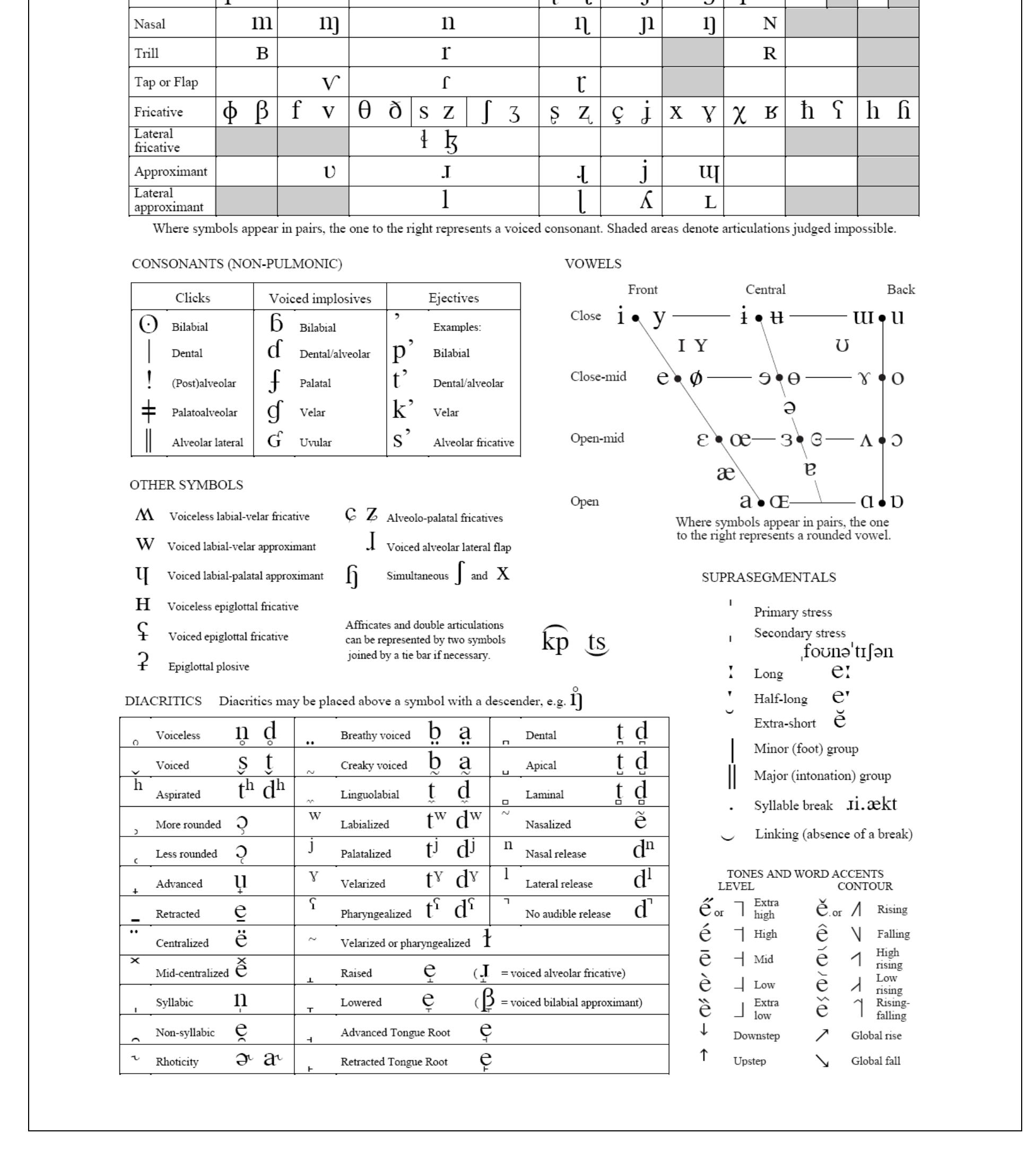
closing and opening of the vocal tract. The most widely used symbols for notating segments
are the IPA, which is presented below.
� 5
Figure 3. The IPA chart.
3.1. Consonants
‘Normal’ consonants are produced with an egressive airstream. They are arranged in the
pulmonic consonant table at the top of the IPA chart (Fig.3) along two dimensions: place and
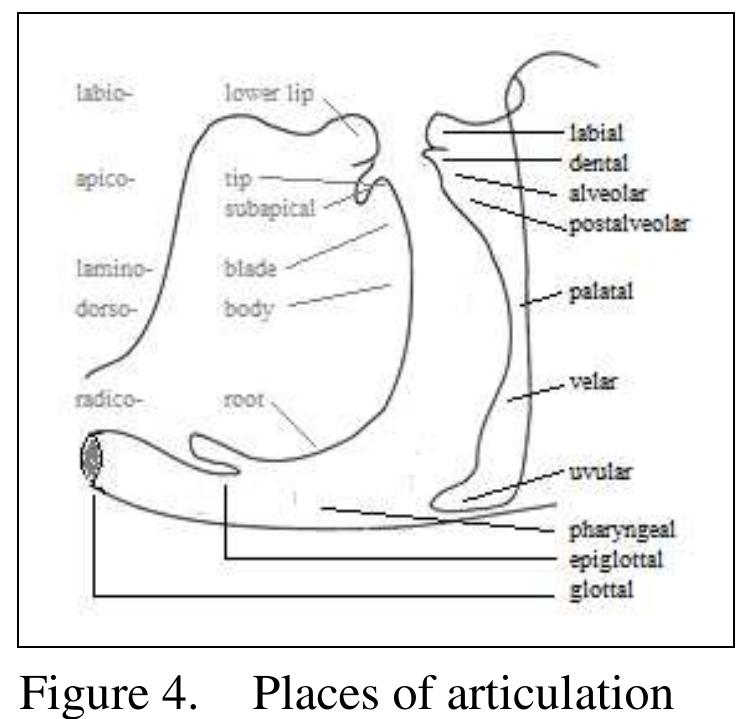
mannerof articulation. Places of articulation, also called articulatory targets or passive
articulators, refer to the locations in the upper and back areas in the vocal tract where active
� 6
articulators (the lower lip or the tongue) approach to form various kinds of constrictions to
impede airflow. Eleven places of articulation, e.g. bilabial, alveolar, etc., are established in the
table. They are listed on the right side of Fig.4 except one, retroflex, which refers to a type of
consonants involving an articulatory target somewhere between post-alveolar and palatal and
an active articulator of sub-apical or the tip of the tongue. Note that, according to Jacobson et
al (1952), the ‘glottal’ sounds are neither consonants nor vowels. Rather, they are phonation
types (cf. §4.1). Active articulators refer to the lower lip and various parts of the tongue,
whose terms are given in the middle of the figure. Along the left side are hyphenated terms of
active articulators, which, when combining with those for place, form terms of articulatory
gesture, e.g. bilabial (labio-labial), labio-dental, apical-alveolar, lamino-dental, etc.
Figure 4. Places of articulation
‘Manner of articulation’ refers to the methods of maneuvering airstream during
consonant production. Airstream can, when going through the vocal tract, be totally blocked
before being released (plosives or affricates) or near blocked (fricatives), make little noise
(central and lateral approximants), or go out of nostril (nasals) instead of mouth. There are
another two terms, ‘rhotic’and ‘liquid’, which are fairly common but not established on the
IPA chart. The former refers to seven r-sounds, which could be trills, taps/flapsor
approximants. The latter is a cover term for laterals and rhotics.
In the consonant table there is a third dimension, voicing, implied in the presence of
pairs of symbols for obstruents (plosives and fricatives) such as [p~b]and [s~z]. For example,
the symbol at the right, i.e., [b], indicates a voiced sound, and that at the left, [p], voiceless,
with thestatus of aspiration (and breath, creak as well) unspecified. This kind of presentation
results from the practical and convenience purpose of using the existing Latin alphabet, whose
basic function is to transcribe speech sounds in European languages. There are also voicing
contrasts occurring in sonorants such as [m~m], [n~n] and [l~l] in other languages but not
presented in the table due to the lack of Latin letters. Moreover, the contrast between
voiceless and voiced involves only two types of phonation modes; so far up to 13 phonation
types have been identified in linguistic phonetics. Itis, therefore, better to represent all the
contrastive phonation types separately (cf. §5).
In the newer versions (1989 onward) of the IPA a non-pulmonic consonant table is
included, which contains clicks, implosives and ejectives. The latter two can also be treated as
phonationals because their production and the phonological features that distinguish them
� 7
from other plosives at the same place of articulation involveglottis movements rather than
articulatorygesture.
Thereis also a list of ‘other symbols’ on the IPA chart which contains consonants with
double articulations of place/manner ([ , w, , ], etc.) and three rarely-seen epiglottal sounds
[ , , ]. Only the pair of pre-palatal or alveolo-palatal fricatives [ , ] is an exception.
Pre-palatals are commonly used in Asian languages such as Sinitic, Tibeto-Burman, Miao-Yao
and Tai-Kadai but rarely seen in European languages (with Polish as an exception).They were
previously placed in the consonant table (the 1978 version)next to the palato-alveolar [ , ]
(now ‘post-alveolars’). The two sets of sounds share a similar place of articulation and usually
do not contrast witheach other phonemically; these might be the reasons to remove the
pre-palatals out of the consonant tablein the later IPA versions. There is, however, an auditory
distinction between the two, and a constant articulatory difference is that [ ] is more
palatalized whereas [ ] is more labialized. Perceptually, to a Westerner’s ear, Mandarin’s [ ]
rather than [ ]sounds more like English [ ]. On the other hand, Mandarin speakers would say
[t t ] rather than [ ] when learning to speak the English word ‘church’. Even for
professional Chinese dialectologists, Cantonese obstruents at that place of articulation are
transcribed as [ , ], meaning they are distinguishable from Mandarin [ , ] and sound more
similar to those in English.
3.2. Vowels
Vowels are placed on a chart according to the positions of the tongue:high-low (or
close-open of the mouth) and front-back. When the high-front vowel [i] is being produced, the
blade of the tongue is forwarded to approach the alveolo-palatal region. When [u] is being
produced, the ‘bunched’ tongue is pulled back to get close to the velum. While almost all
languages in the world have these two high vowels and a low vowel /a/, some have both front
[a] and back [ ]. There is also a third dimension on the chart: paired symbols like [i~y] are
distinguished by the shapeof lips, with the symbol in the right indicating a rounded vowel.
The vowel chart defines a physiological quadrilateral space for vowels to reside in. This
physiological criterion for vowel description has been changed to an acoustic one. In the
newest edition of the Handbook of the IPA (1999), the vowel chart in a language is drawn
along acoustic parameters of the first two formants’ frequencies. For example, the front vowel
symbol [ ], physiologically defined as between [i] and [e], is placed ‘correctly’ in the Hindi
chart (p.102), but as low as [e] in the German chart (p.87) and even lower than [e] in the
American English chart (p.42). That is, a vowel has now its absolute values in terms of
formant frequencies, so the IPA phonetic notations share about the same nature as phonemic
representations.
In addition, new understanding of the nature of vowel arose that the vowel is not a solely
phonetic concept, but is defined with reference to phonology. This view is reflected in the IPA
Handbook (1999), in which vowels are defined as ‘sounds which occur at syllable centers,
and … involve a less extreme narrowing of the vocal tract than consonants’ (p.10). Or, more
straightforwardly, “the vowel is produced without apparent constriction along the oral tract
and serves as the syllabic component of nucleus” (Zhu, 2010:231).
3.3. Secondary features
Secondary features are represented by symbols in the ‘diacritic’ table and the lists of
� 8
suprasegmentals and tones in the lower part of the IPA chart. Most of the diacritics are used to
indicate minor adjustments of articulation. The two for ‘syllabic’ and ‘non-syllabic’ are
phonological notations. The remaining five in the top left corner of the table, voiceless, voiced,
aspirated, breathy voiced and creaky voiced, are symbols for phonation types, which are
better grouped with tones and suprasegmentals as phonationals.
4. Phonationals
4.1. A system of phonationals
Phonationals are divided into three groups: phonation types (cf. ‘phonation types’ in this
volume), major types and supra-phonationals, which are listed below.
Table 1. A classification of phonationals
Major type Type Notation Supra-phonational
I. Falsetto 1. Falsetto á L
II. Fortis 2. Pre-glottalization/implosive p/ length M
3. Final-glottalization/ejective a /k’ S
4. Voiceless (Unaspirated) p H/L
III. Clear I 5. Weak Aspiration p‘ pitch H/M/L
h
6. Aspirated p 4/3/2/1
7. Checked Creaky a
IV. Stiff 8. Creaky Voice a
9. Weak Stiff a
V. Clear II 10. Modal Voice b
11. Voiced Aspiration b ( )a
VI. Breathy 12. Slack Voice pa
13. Weak Slack pa
Traditional phonetics usually deals withthree COMMON phonationtypes: voiceless
unaspirated, voiceless aspirated and modal voice. Ladefoged considered three more (breathy
voice, creaky voice and glottal stop) and regarded all the six as properties of stop consonants.
Phonation types are actually equally realized on fricatives, sonorants, and even more on
nuclear vowels; they are properties of the syllable rather than of a single segment.
Supra-phonationals include length and pitch. Length is sub-categorized into Long, Mid
and Short, according to the tonal behaviors in Cantonese and other tone languages. Pitch will
be discussed in detail later.
4.2. Composition of phonational
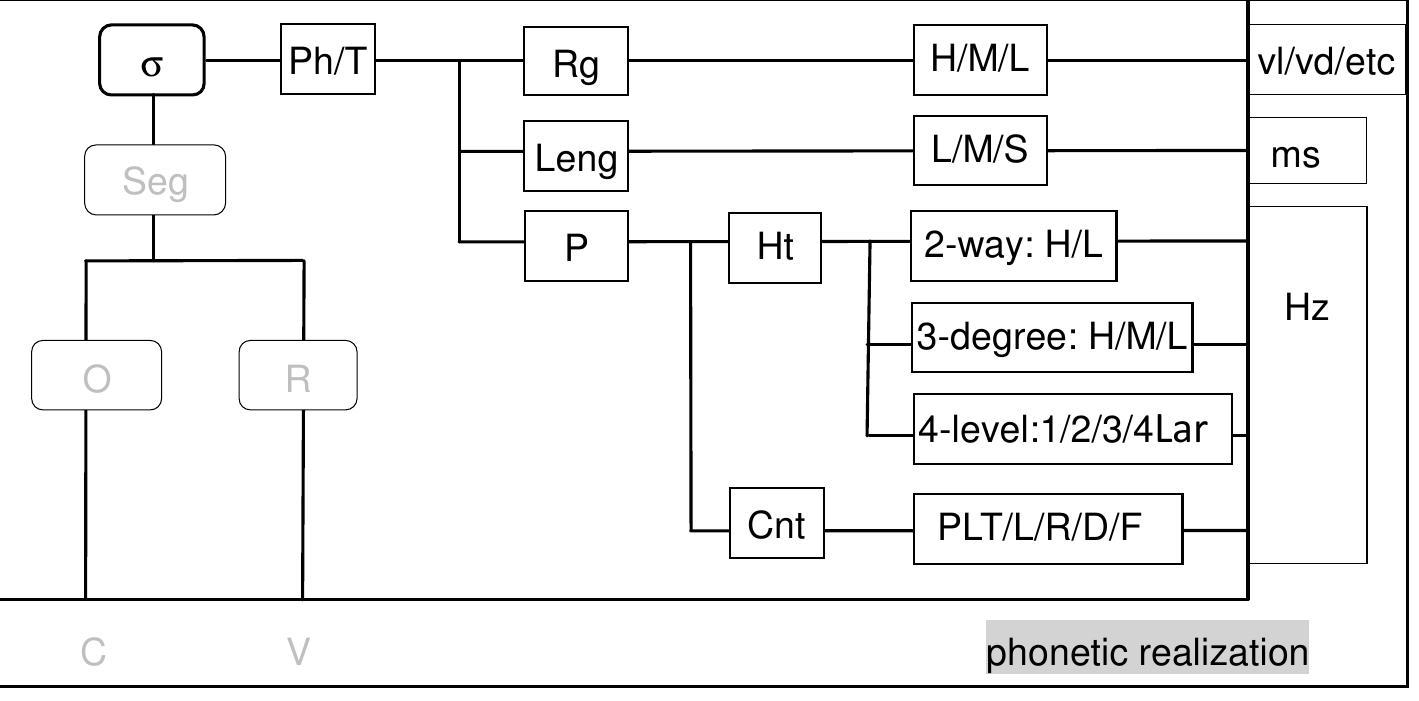
Phonational (‘Ph’ in Fig.5), as thefirst-level non-linearsyllabic constituent, can also
be named tone (T). Tone consists of three components: register (Rg), length (Leng), and
pitch(P); pitch is comprised of height (Ht) and contour (Cnt). Tone is, therefore, described
and represented along four parameters: register, length, height and contour. These
� 9
parameters can be sub-categorized. Register, length and height all show a tri-partition
contrast, i.e. register H, M and L, length Long, Mid and Short, and pitch heightin 2-way,
3-degree, and 4-level contrasts. Pitch contour can be categorized as level, rising, falling,
dipping, and the less known but rather frequent type pure low tone, a low tone without
CONTOURICITY specification (Zhu,2012b). These components are hierarchically structured
under the syllable as in Figure 5.
σ Ph/T Rg H/M/L vl/vd/etc
Leng L/M/S ms
Seg
P Ht 2-way: H/L
Hz
3-degree: H/M/L
O R
4-level:1/2/3/4Lar
Cnt PLT/L/R/D/F
C V phonetic realization
Figure 5. Structure of phonational or tone (adapted from Fig. 4, Zhu 2011a).
Phonologically, register, length and pitch are associatedwithphonational or tone.
Phonetically, “the tone features are sometimes relevant for the initial consonant, sometimes
for the nuclear vowel, and sometimes for the final consonants” (Wang, 1967). Pitch and
length areshown on rime,and registercan be on either onset or rime.
After the non-linear components have been defined, it is not important which
component, the Ph, P or Cnt, is called “tone”. Or, they could be called “tone1”, “tone2”,
and “tone3” respectively. In the syllable theory (Zhu, 2008), as shown in Fig.5, “tone”
equates to phonational, dominating all other non-linear components.
Pitch (cf. ‘pitch’ and ‘stress’ in this volume) can be contrastive by height only or by both
height and contour. The 2-way contrast in pitch height refers to stress and the accentual tone
in Japanese, the 3-degree one to the African register tone and 3-degree stress, and the 4-level
one to the Asian contour tone.
In non-tonal languages, laryngeal activities are less activeand therefore the
phonational tier could be saved in their linguistic-phonetic representations.�With regard to
a few COMMON phonationals�such as the two degrees of pitch (strong vs. weak), length
(long vs. short) and phonation (voiceless vs. voiced) in these languages, they can be
treated, for the sake of convenience, as secondary features of consonants (voicing) or
vowels,i.e. suprasegmentals�(stress and length). In tone languages, on the contrary, there
are more phonationals, usually LESS-COMMON,in the non-linear tier.
Contour tone is by and large in complementary distribution with stress. In a typical tone
language such as Cantonese there is no room for stress, because (a) the language is
monosyllabically morphemic and stress resides on polysyllabic words, and (b) pitch, the main
phonetic cue for stress in non-tonal languages, is fully utilized for the distinction of tone in
tone languages.
� 10
4.3. Registers realized as phonation types
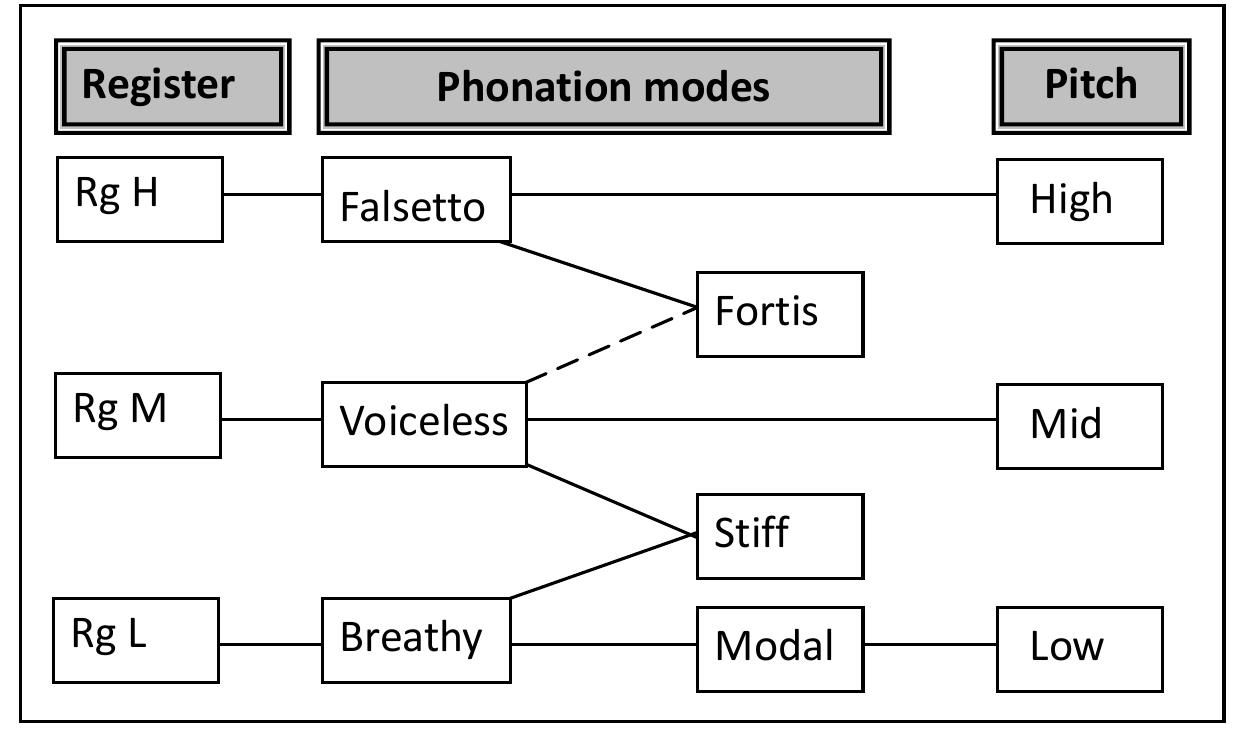
The six major types are arranged from top to bottom in Fig.6 roughly in accordance with
pitch height. By these phonation types three tonological registers (cf. ‘register’ in this volume)
are defined. Not every phonation type can identify a register. Essentially, only three types,
Falsetto, Voiceless, and Breathy Voice, if occurring in a tone language, can define an
independent register. Falsetto defines the highest H Register. Breathy Voice defines the lowest
L Register. Voiceless defines the commonest, default, M Register. Every tone language, every
language indeed, has this register.
Register Phonation modes Pitch
Rg H Falsetto High
Fortis
Rg M Voiceless Mid
Stiff
Rg L Breathy Modal Low
Figure 6. Three tonological registersdefined by six major phonation types
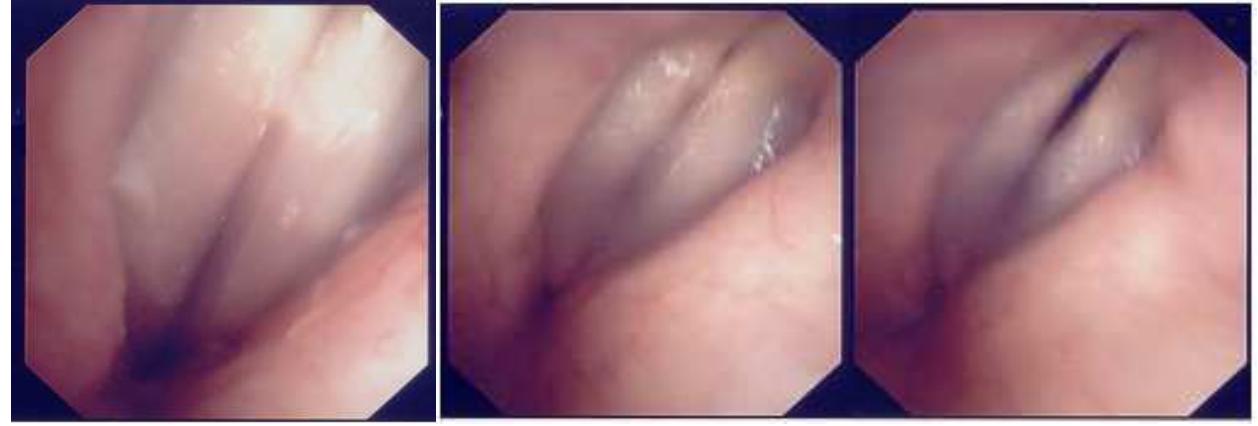
Figure 7 shows the statuses of vocal cords of three phonation types. The vocal cords in
the left panel, which is for a falsetto sound, are stretched tightly; they are longer, wider, and
thinner than the ones in the middle panel, which is for a modal voice. In the right panel is a
slack voice. The vocal cords in this panel do not close entirely. Airflow is continuously
leaking out through the aperture of the glottis even during the closing phase of vibration.
Slack voice is perceived as having a low pitch and noise on the vowel.
Figure 7. Sample photographs illustrating three laryngeal statuses: falsetto (left),modal voice
(middle) and slack voice (right).Cited in Zhu (2012a).
The Modal Voice usually does not occur in a tone language alone; it is ordinarily
accompanied by one or another non-clear voice. In the absence of a breathy voice (as in
Wu, Gan, Miao or Wa), or creaky voice (as in Thai, Hani or Lahu), Modal Voice alone is
unlikely to be able to define a tonological register.
Creaky Voice is the commonest among the members of Stiff Voice. It is associated
with the lowest human pitch, and will cause a ‘broken tone’ in terms of both acoustics and
� 11
perception. In addition to contrasting with other phonation types in non-tonal languages
like Mon-Khmer, creak is also found in hundreds of varieties of Chinese and other tonal
languages such as Vietnamese and Yi (Lolo). In most tonal cases, creak is a phonetic
realization of either M or L�Register, serving as an accompanying feature of a low tone.
Only in a few linguistic varieties is creak found to play a role of distinctive feature in
differentiating two otherwise identical tones (Mai, 2007; Zhu and Yang, 2010). In this case,
Stiff Voice alone defines an L Register.
The last one, Fortis Voice, is rather subtle in terms of physiological characteristics
and acoustic manifestations. Note that Fortis and Stiff Voice are different from the ‘stiff
voice’ suggested by Ladefoged and Maddieson (1996). In short, Fortis Voice is associated
with fortis/strong/long/tense voiceless consonants, e.g., Korean fortis stops and Wu
pre-glottalized consonants, which induce a higher pitch and larger intensity on the
following vowel than non-Fortis voiceless consonants do. Fortis Voice is usually a variant
of Falsetto or Voiceless, and seldom defines a register itself.
Phonation types are not consonants’ properties; they define registers, which constitute a
syllabic component. Two of them, Voiceless and Modal, are clear voices or COMMON
PHONATIONALS and acoustically realized on the initial consonant as well as on the nuclear
vowel (a higher pitch after a voiceless than after a model voiced consonant); three, Falsetto,
Slack and Stiff, are non-clear voices or LESS-COMMON PHONATIONALS and are realized on
vowels and occasionally on consonants. As forFortis Voice, two of its varieties, pre-and
final-glottalization, are COMMON PHONATIONALS, and the other two, implosive and ejective are
LESS-COMMON PHONATIONALS. That Register M is defined by Voiceless means Register M is a
property of the syllable thatbegins with an onsetin clear voice: either a voiceless obstruent, a
normal sonorant or zero onset in clear voice.
4.4. Multiregisters and Four-Level Tonal Model
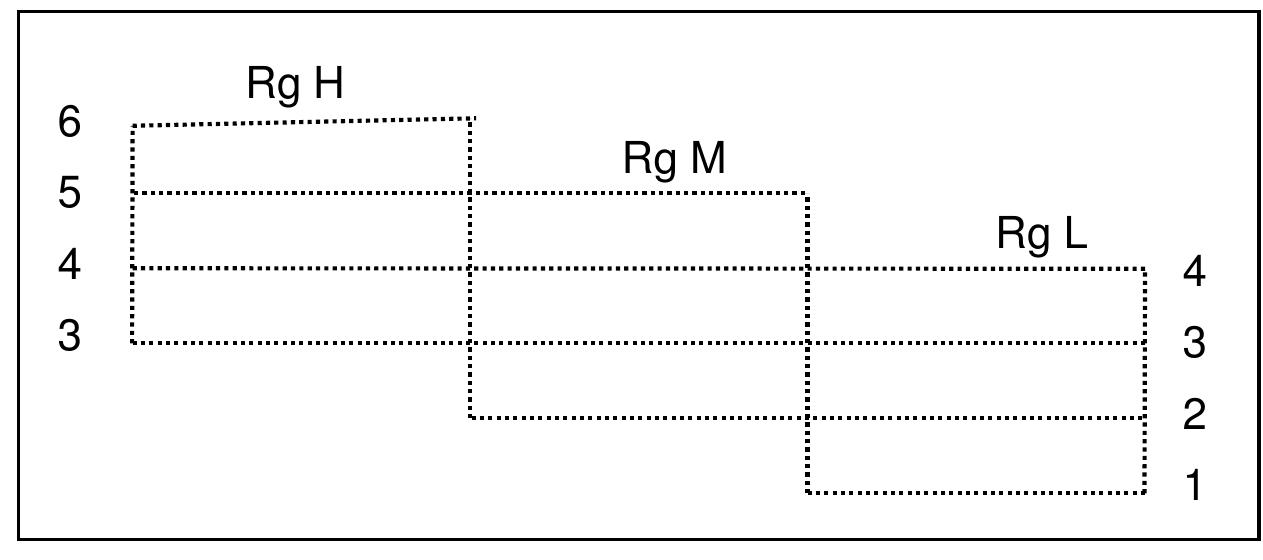
Based on the syllable model (Fig.5) and the mapping of phonation types onto registers
(Fig.6), a new tonal model, the Multi-Register and Four-Level Tonal Model is developed (Zhu,
2012a). Basically, it is suggested that (a) a language may have more than one type of
phonation which defines up to three tonological registers; (b) each register has its own pitch
range, which is divided into four levels; and (c) each register is one notch lower/higher in
pitch than an adjacent one. The following diagram shows a total of three registers and six
pitch levels:
Rg H
6
Rg M
5
Rg L
4 4
3 3
2
1
Figure 8. The Multi-Register and Four-Level tonal model
In this model the four Beijingese tones are all piled in RegisterM and numerically
� 12
transcribed as {55, 35, 22, 52}, and the nine Cantonese tones, six long and three short, reside
in RegisterM, too, and are transcribed as {55, 22, 35, 24, 44, 33, 55, 44, 33}. Of the five
Shanghaiese tones, three are in RegisterM and transcribed as {52, 34, 55} and two in
RegisterL: {14, 13}.
4.5. Phonationaltypology,
While data of segment distribution (Maddieson, 2005) have been accumulated to an
extent that typological studies can be carried out (cf. ‘Linguistic typology’ in this volume),
those of phonationals still lack.
Exploration of tone typology started as early as the 1970s (Cheng, 1973; Maddieson,
1978), based on impressionistically descriptive data. It did not flourish until recently when
sufficient amounts of acoustic data were accumulated and a phonational model proposed
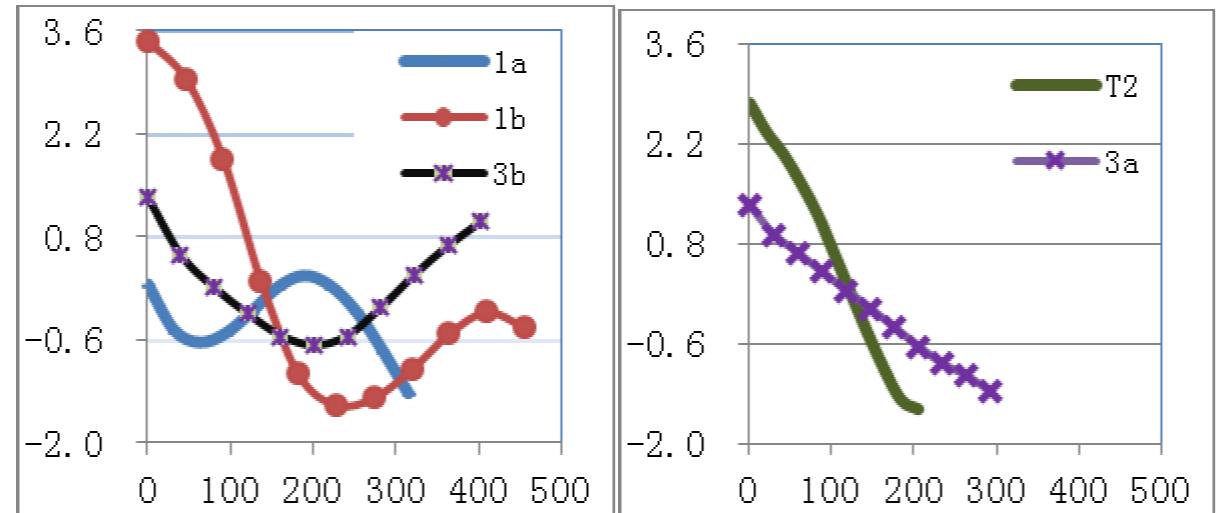
(Fig.5). There are five basic contour types: level, falling, rising, dipping and the pure low tone.
The falling tone has eleven sub-types (Zhu, 2012b), and the dipping tone, seven (Zhu, Yiand
Zhang, 2012). The level tone is the most distinctive one and may have up to six distinct
heights (Zhu, Shi and Wei, 2012). The falling tone is the most frequent type in tone languages.
A typological statement can be stated as “if there is a tone in a language, it tends to be a
falling one”, or in terms of implicational universal, “a level tone implies a falling tone”.
Below is a typical example from Chálíng Gan, which has five tones: three circumflex and two
falling but no level.
Figure 9. Five tones in Chálíng Gàn: three circumflex: a low dipping {324}, a double circumflex
{3232} anda back dipping {523} (left); and two falling: short {52} versus long {42} (right).
Cited in Zhu and Yi (2012).
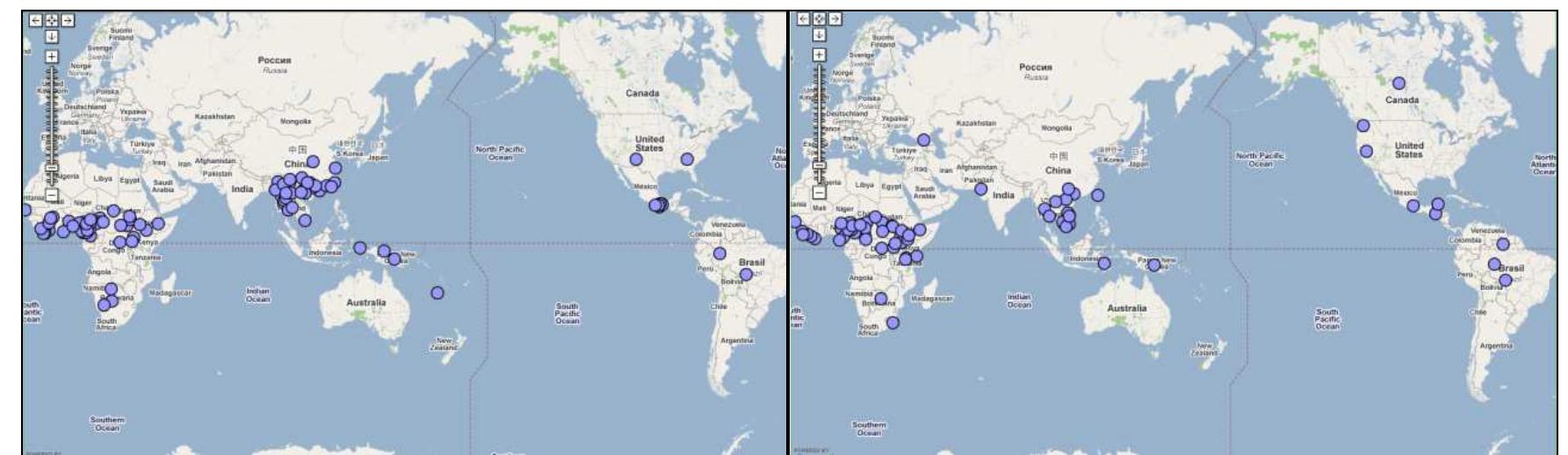
As a LESS-COMMONphonational, tone often does not occur in a language alone, rather
itco-occurs with other LESS-COMMONphonationals. The following maps show the geographical
coincidence between tones and implosives. Not accidentally breathy voice is also found in the
same areas and falsetto in East and Southeast Asia (Zhu, 2010). Geographical locations seem
to correlate with linguistic-phonetic patterns: the languages on warmer continents are more
phonation-active, while those in colder regions are more segment-prominent (larger segment
inventories and more complex phonotactics). A salient example is the Indic languages which
gained implosives and breathy voice after their migration from colder Europe to the warmer
sub-continent.
� 13
Figure 10. Geographical distributions of tone (left) and implosives (right). Cited in Zhu& Guan
(2011). The data are fromMaddieson 2005, while the finding of the correlation is mine.
4.6. Classification of some special segments
There are some special or strange consonants and vowels whose phonetic properties
arepreviously known to a certain extent but which are difficult to classify
linguistic-phonetically. They are now accountable in the phonational classification (Table 1).
Moreover, phonetic properties previously thought to belong to consonant, vowel, or tone
separately can be treated uniformly in light of the phonational system.
Three sets of voiceless stops.
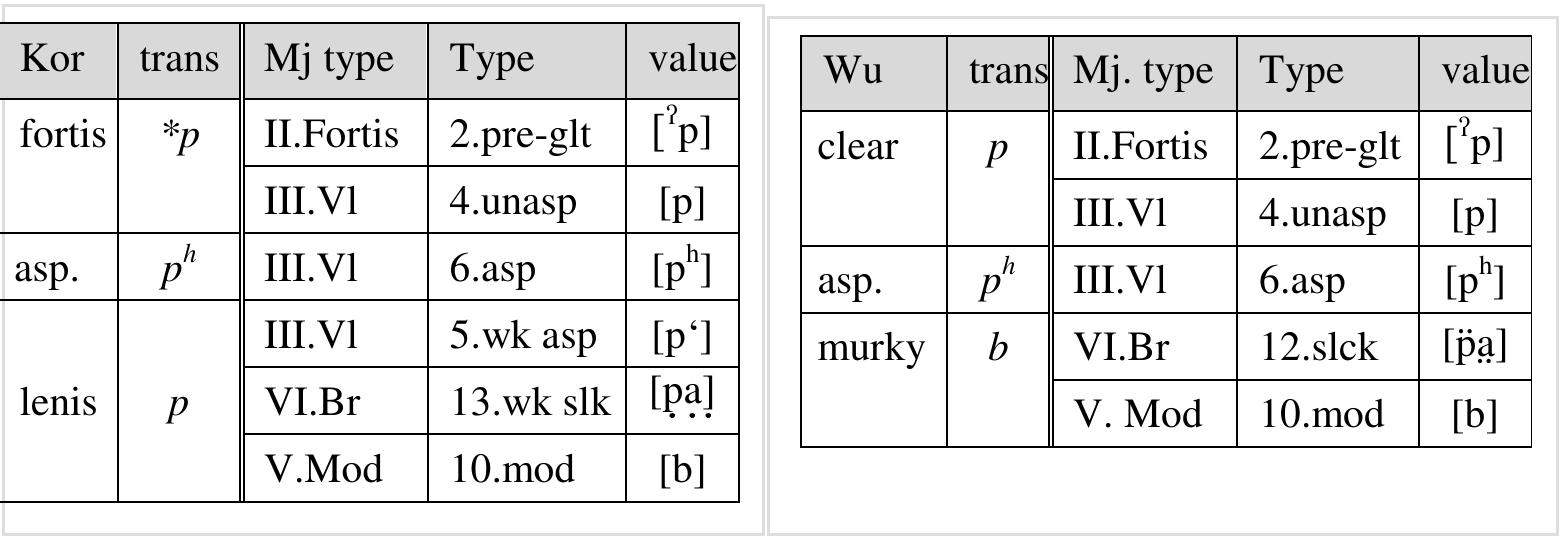
There are three sets of voiceless stopsin Korean, which have been a puzzle in phonetics
and phonology for decades. While the aspirated one is considered ‘normal’, the other two,
unaspirated sets can only be labeled as ‘fortis’ and ‘lenis’, transcribed as, say, *p and p (see
the first two columns in the left table below). While the lenis stops have a longer VOT (up to
60 ms) than the fortis ones (usually below 20 ms), the perceptual and acoustic properties of
the stops are mainly manifested on the nuclear vowels: weaker in intensity and lower in pitch
for the vowel after the lenis consonant than for the vowel after the fortis. The problem is how
to classify them phonologically or linguistic-phonetically. In terms of the phonational system,
they can be classified as different phonation types (Zhu, 2011b): the fortis consonant (the
onset of a Fortis syllable indeed) is of Type 2 Pre-glottalization (like that in French) with an
allophonic variant Unaspirated (Type 4), and the lenis consonant is of Type 5 Weak Aspiration
with two variants: Weak Slack (Type 13) and Modal Voice (Type 10).
Table 2. Tri-partition of phonation types in Korean (left) and Wu (right)
Kor trans Mj type Type value Wu trans Mj. type Type value
fortis *p II.Fortis 2.pre-glt p] clear p II.Fortis 2.pre-glt p]
III.Vl 4.unasp [p] III.Vl 4.unasp [p]
asp. ph III.Vl 6.asp [ph] asp. p h
III.Vl 6.asp [ph]
III.Vl 5.wk asp [p‘] murky b VI.Br 12.slck [pa]
lenis p VI.Br ✁✁✁
13.wk slk [pa] V. Mod 10.mod [b]
V.Mod 10.mod [b]
There are also three sets of stops in Wu Chinese (see the Wu table above): a normal
aspirated ph, a ‘clear’ p and a ‘murky’ or ‘voiced’ b, as termed in Chinese phonetics and
� 14
phonology. The murky set was eventually voiceless (Edkings 1868), but with ‘voiced
aspiration’ (Chao, 1928). In the phonational system the unaspirated p is classified as Type 2
Pre-glottalization with an allophone of Type 4 Unaspirated, and the murky b as Type 12 Slack
Voice with a variant of Type 10 Modal Voice. This is also true for the Miao language and
Xiang and Gan Chinese. Note that there is also a distinction between ‘clear’ and ‘murky’
sonorants in Wu, so they are not just properties of stops.
In fact they are not even (syllable-initial) consonants’ properties. The perceptual and
acousticproperties of these special sounds are mainly manifested on the rime rather than on
the onset. Moreover, there is a ‘clear’ and ‘murky’ distinction between syllables without initial
consonants. It is, therefore, reasonable to assign the phonetic features of these sounds to the
syllable rather than to a single segment.
Tense vs. lax vowels. The distinction between the tense and lax vowels in English
involves segment contrast, with a secondary contrast in length (and other physiological
factors that are not phonologically categorized, e.g. wall resistance), but the tense/lax
distinction in Austroasiatic and Tibeto-Burman languages involves phonation contrast.
In both Wa of Austroasiatic and Hani of Tibeto-Burman there are two sets of vowels,
labeled as ‘tense’ and ‘lax’. Their phonetic properties and phonological contrast, however, are
totally different. In Wa the tense vowels are in normal clear voice while the lax vowels in
slack voice. In Hani, on the contrary, it is the lax vowels that are in clear voice and the tense
vowels in creaky voice. So along the ‘tense/lax’ dimension, defined by the adductive tension
and medial compression at the glottis, there are at least three values rather than two. As the
Hani creaky voice also occurs on the initial consonant sometimes, and the Wa slack voice also
affects the initial consonant and makes it ‘murky’ or ‘lenis’, the phonation types occurring in
these languages are not just vowels’ properties, but syllables’.
There was a puzzle in Wa phonology that why the tense/lax vowel contrast only occurs
after an unaspirated consonant. After an aspirated consonant, there are only tense vowels. This
is just the case happening in Korean and Wu: the distinction between fortis/lenis or
clear/murky only occurs in unaspirated consonants. So the nature of the Wa vowels is the
same as that of the Korean and Wu consonants: they are all caused by (Weak) Slack Voice (or
Weak Aspiration) at the syllable level, but treated differently in different languages as vowels’
or consonants’ properties.
Moreover, the same slack voice can also be treated as a tonal propertyin tonal languages:
yang tones in Wu and even numbered tones in Miao. Since most of the Austroasiatic
languages are non-tonal, the slack voice is treated as vowels’ property. Wa is an Austroasiatic
language that has four newly emerging tones, three for native words and one for words
borrowed from Chinese.
In traditional phonetics and phonology, ‘fortis/lenis’ or ‘clear/murky’ are considered
consonant contrast, ‘tense/lax’ vowel contrast, and ‘yin/yang’ or ‘odd/even numbered’ tone
contrast with unrevealed phonetic properties. They can be treated uniformly now in the
system of phonation types.
5. Summary
Phonetics has expanded its territory quickly in the past few decades. Dozens of new
disciplines have emerged. By interacting with them, articulatoryphonetics has changed
� 15
enormously so that a split of the discipline took place. Half of itremains as articulatory
phonetics but is leaving from linguistics. It has become more technology-oriented, andmany
efforts have been made in articulatory modeling, which is more like engineering phonetics
than linguistic phonetics.
The other half remains in linguistics but is no longer pure articulatory; it resorts to more
parameters than articulatory parameter.This split is so significant for linguistics that it would
reshape linguistic articulatory phonetics, and affect such disciplines as phonology, typology,
dialectology and evolution studies. Thislinguistic articulatory phonetics is becoming more
theoretically-oriented. It is still part, maybe the core part, of the greater phonetic science, yet
differs from other phonetic disciplines in that it is of linguistics, by linguistics andfor
linguistics. So it is not ‘pure’ phonetics.In linguistic phonetics, physiological and acoustic
parameters are sought after, but they should be phonologically conceptualizable or
categorizable, or have linguistic implications for phonological evolution or typology.
Phonetics is to phonology what physics is to chemistry. In phonetics and physics, the
basic unit is the smallest analytical element, while in phonology or chemistry, the whole study
is established on a structural unit: syllable in phonology and molecule in chemistry. Had
chemistry not had its own basic, structural unit, it would not have been independent or
autonomous from physics. Phonetics overlapping with linguistics has given rise to the
linguistic, articulatory phonetics, which, as part of phonology, has the syllable as its basic
unit.
6. References
Abercrombie, David 1967. Elements of General Phonetic. Edinburgh University Press.
Anderson, Stephen R. 1981. “Why phonology isn’t ‘natural’.”Linguistic Inquiry 12:4, 493-539.
Catford, John C. 1977. Fundamental Problems in Phonetics. Edinburgh University Press.
Chao, Yuen Ren. 1928. Xiandai Wuyu de Yanjiu [Studies in the Modern Wu dialects]. Peiping: Hsinghua
College Press.
Cheng, Chin-chuan. 1973. “A quantitative study of Chinese Tones.” Journal of Chinese Linguistics, 1.1:
93-110.
Edkins, Joseph. 1868. A Grammar of Colloquial Chinese as exhibited in the Shanghai dialect. Shanghai:
Presbyterian Mission Press.
International Phonetics Association. 1999. Handbook of the International Phonetic Association. Cambridge
University Press.
Jakobson, Roman; Gunnar Fant and Morris Halle 1952. Preliminaries to Speech Analysis. Cambridge MA:
MIT Press.
Ladefoged, Peter.1971. Preliminaries to Linguistic Phonetics. The University of Chicago Press.
Ladefoged, Peter 2006. A Course in Phonetics, 5th edition. Boston: Thomson Wadsworth.
Ladefoged, Peter& Ian Maddieson 1996. The Sounds of the World’s Languages. Oxford: Blackwell.
Laver, John. 1980. The Phonetic Description of Voice Quality. Cambridge University Press.
Maddieson, Ian 1978. “Universals of tone.” In J. Greenberg (ed.) Universals of Human Languages.
335-365. Stanford University Press.
Maddieson, Ian. 2005. “Tone” and “Glottalized Consonants”. In Haspelmath et al (eds.) The World Atlas of
Mai, Yun. 2007.
✂✄☎✆✝✞✟✝✠✡☛☞✌✍✎✏✑
Language Structures. Oxford University Press.
“Phonetic analysis of the enteringtone in Badu
dialect of Hezhou, Guangxi.”Journal of Guilin Teachers’ College, 1: 1-7.
� 16
Martinet, A. 1949.Phonology as Functional Phonetics. Publications of the Philological Society XV.
Sommerstein, A.H. 1977. Modern phonology. Baltimore: University Park Press.
Trubetzkoy, Nikolai S. 1939. Principles of Phonology. English translation, 1969.
Wang, William S-Y. 1967. “Phonological features of tone.” International Journal of American Linguistics.
33. 93-105.
✎✒✓✎✒✔
✕✖✎✔✗
Zhu, Xiaonong. 2008. “Syllable and syllabics.” Oriental Linguistics 4: 142-164.
✖✘✖✎✔✓✎✙✔✚✛✜✢✣✤
Zhu, Xiaonong. 2010.
Zhu, Xiaonong. 2011a.
Phonetics: An Introduction. Beijing: Commercial Press.
“Linguistic phonetics and pan-chronic
✥✦✧★✩✪✫✬✭✮✧★ ✯ ✰✱✲✳✴✧★✵✶✷✸✹✺✻✼✽✻✬✾✿❀✦
phonology: A new theoretical framework.” Studies in Language and Linguistics31.1: 4-85.
Zhu, 2011b. —— ?
“Consonant types or something else: How to classify the three sets of stops in Korean and Wu in a
framework of phonation types?”Bulletin of Chinese Linguistics 5.2: 173-186
Zhu, Xiaonong. 2012a. “Multiregisters and Four Levels: A New Tonal Model”. Journal of Chinese
❁❂ ✌❃❄
Linguistics 40.1: 1-17.
Zhu, Xiaonong. 2012b. “A classification of falling tones.” Studies in Language and
❅❆❇❈❉❊❋●❍■❏❑▲
Linguistics2: 1-19.
Zhu, Xiaonong and GUAN Yingwei. 2010. “Four phonation types in
▼◆❖✻P◗❘✼✾❙P❚❯❘❱
Quanzhou dialects, Guangxi”. Dialect 4: 289-300.
Zhu, Xiaonong, SHI Defu and WEI Mingying. 2012. “Six level
tones in Yuliang Miao and the Three-Register and Six-Level Tonal Model”. Minority Languages of
❲❳☞❨❩❬❭❪❫
China, 4: 1-10.
Zhu, Xiaonong and YANG Jianfen. 2010. “Creaky voice as the feature [+low] in
Hebei dialects.”YuyanYanjiuJikan7: 134-147.
Zhu, Xiaonong and YI Li. 2012. “Double Circumflex and back dipping: Reports on two newly confirmed
types of contour tones”. Cahiers de Linguistique Asie Orientale. 41, 1: 81-106.
Zhu, Xiaonong, YI Li and ZHANG Ting. 2012. “Types of dipping tones”. Paper presented at The Third
International Symposium on Tonal Aspects of Languages. May 27-29, 2012, Nanjing, China.
�


 Xiaonong Zhu