ARTICLE IN PRESS
Building and Environment 42 (2007) 4093–4107
www.elsevier.com/locate/buildenv
Fractal geometry as the synthesis of Hindu cosmology in Kandariya
Mahadev temple, Khajuraho
Iasef Md Riana, Jin-Ho Parka,�, Hyung Uk Ahna, Dongkuk Changb
a
Department of Architecture, Inha University, South Korea
b
Department of Architecture, Chosun University, South Korea
Received 4 May 2006; received in revised form 21 July 2006; accepted 15 January 2007
Abstract
The underlying relationship between Hindu cosmology and fractal theory is manifested in Hindu temple where fractal geometry acts as
the language. This paper has analyzed the Kandariya Mahadev temple at Khajuraho as the paradigm of Hindu temples with regard to
fractal geometry and describes the syntheses of fractal features of the temple from the Hindu cosmology and philosophy.
r 2007 Elsevier Ltd. All rights reserved.
Keywords: Cosmic energy; Degree of details; Fractal dimension; Iteration; Self-similar repetitions; Vastu Purusha Mandala
1. Introduction Although employed in various fields for different roles,2
fractal geometry has been applied particularly, in archi-
The properties of self-similar repetitions, abundance of tecture as a language which translates the beauty of
textural details, and cascades of shape in architecture have complexity as well as the ideas of architects [6]. It also
been characterized by fractal geometry [1]. Coined by reflects the process of universe and its energy through the
Mandelbrot in 1970s, fractal theory has been widely buildings [7]. Hindu temple is one of the best examples of
applied for the analysis and synthesis of architectural and those fractal buildings which were constructed in the past,
urban designs [1–4, 17–20]. The term, ‘fractal,’ comes from far before than the birth of fractal theory and manifested
the Latin word ‘Fractus’ which means ‘broken’ or the religious cosmic visions [8].
‘irregular’ or ‘unsmooth’.1 This paper mainly deals with the fractal geometry
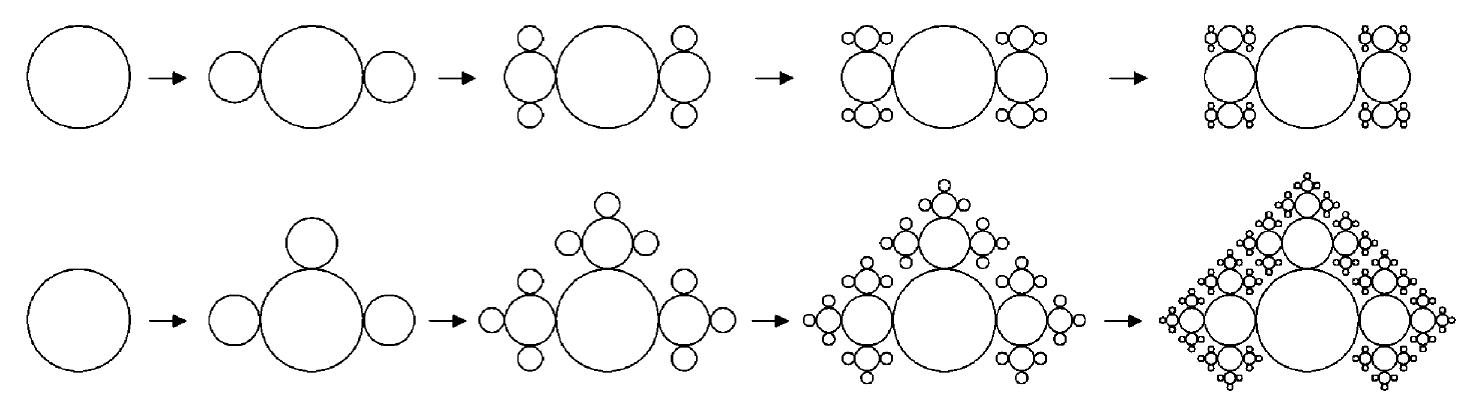
Mathematical property for the creation of fractal that performs the key role for transforming or mani-
geometry has been known as iteration. Different rules of festing the Hindu cosmology and philosophy into the
iteration create different fractal figures (Fig. 1). The divine diagrams (so-called vastu purusha mandala) and then
property of endlessness in the process of iteration makes to the structure. First, the Hindu cosmology and philoso-
fractal figure as the microcosm of infinity. Due to its never- phy has been briefly reviewed. And then, the divine
ending nature, fractal geometry cannot be possible to diagram of vastu purusha mandala and its application to
explain by Euclidian geometry, but be possible by compu- the temple structure has been introduced. Second, Kandar-
ter-generated programs and computational techniques such iya Mahadev Temple at Khajuraho has been briefly
as Shape Grammar [21]. In nature there are plenty of introduced for the further study. Third, a ‘box counting
fractal-like objects which are not true fractal, but up to method’ has been introduced for the analysis of the temple
certain range of scales they display fractal properties [5]. with regard to fractal geometry. Lastly, Kandariya
�Corresponding author.
1 2
Mandelbrot and frame. Geometry of self-contacting binary fractal C. Pickover. Fractal horizons: the future use of fractals. St. Martin’s
trees. The mathematical intelligencer, 1999. They defined fractal on the Press, New York, 1996. It points out the application of fractals and its role
basis of binary fractal tree as the recursively by symmetric binary in different major fields: Education, Art, Science, Music, Medicine,
branching. Mathematics, etc.
0360-1323/$ - see front matter r 2007 Elsevier Ltd. All rights reserved.
doi:10.1016/j.buildenv.2007.01.028
� ARTICLE IN PRESS
4094 I. Md Rian et al. / Building and Environment 42 (2007) 4093–4107
Fig. 1. Top: development of a fractal figure from a single circle by the iteration having some definite rule. Bottom: development of different fractal figure
from the same circle but by the iteration having different rule.
Mahadev temple has been analyzed with regard to fractal ocean8. During twisting, the ocean became churned and
geometry through the application of Hindu cosmology and gods found their elixir, and at the same time the every being
philosophy. in the universe was produced.
According to Hindu philosophy, the main goal of man’s
life is to achieve the ultimate liberation from the illusionary
2. A brief review of hindu cosmology and philosophy world where he suffers from his endless rebirth. Krishna
says in Bhagavad Gita,9 if man worships, devotes and
Hindus believe that the universe is created, destroyed, meditates to the manifested form of the wholeness of
and re-created in an endless repetitive series of cycles where infinity, and sees the truth of its manifestation; he will
Brahma is the creator, Vishnu is the sustainer and Shiva is surpass the confusion of the never-ending cycles of rebirth
the destroyer, and all of them are the trinity of in this physical world, and finally will assimilate with the
Parameshwar, the Supreme Being who is the manifested God. 10 Hindu calls it moksha.11 It brings the ultimate
form of the whole infinity3. He is the principal creator of peace and harmony in man’s life. But how one, from the
the universe. According to the myth, before each successive physical world, can practice to realize this ultimate truth of
series of the creation of universe, a lotus is grown from the the creation? Brihatsamhita12 and Sthapatyaveda13 give the
navel of Vishnu and then Brahma is born over it as the solution as the temple which should act as the microcosm
incarnation of the supreme God. Brahma starts creating the of the cosmos [9]. It should be the bridge for the man of
universe in a Brahma-day and destroys it in a Brahma-night physical world to the God of divine world [10].
and again creates the new universe next day. He repeats To connect the physical world with the divine world and
this process for 100 Brahma-years until his death. After his to reflect the truth of creation, the layout of cosmos was
death, Brahma is born again and starts the new cycle of copied graphically in the foundation of temple. Here, a
creation. A universe takes 4,320,000,000 years to be mythical incident was interwoven where a formless being
survived and same years to be destroyed. Hence, a universe covered the sky and was, immediately, arrested down to the
is the result of time that follows the cosmic order in which a earth by the creator Brahma and other gods. This super-
fraction of moment is the microcosm of biggest time unit. 4 natural fact was depicted graphically by vastu purusha
Another myth says that mount meru5 is the axis of the mandala, where vastu refers to physical environment,
cosmos. According to the Mahabharata, 6 gods twisted the purusha refers to energy, power or cosmic being, and
mount meru to find their most precious elixir, amrita 7 mandala is the diagram or chart. Central portion of the
which was lost during the terrible flood in the cosmic mandala represents the place of Brahma and other portions
symbolize the other gods according to their capability. By
3
Winthrop Sargeant and Chrostopher Chappel. Bhagavad Gita: an laying down this metaphysical diagram in the foundation,
interlinear translation from the sanskrit. State University of New York various supernatural forces are captured beneath the
Press, revised edition, 1987.
4
100 Brahma-years—death and rebirth // kalpa—1000 mahayugas //
temple whereas its centre is the source of cosmic energies.
mahayuga—4 yugas //yuga—10,000 divine years // divine year—360
8
sidereal years // life cycle—birth, death, rebirth //year—summer and According to Hindu cosmology, the space of cosmos is a kind of ocean
winter // day and night // breathing: inhale–exhale // bhavanga— which is full of milk.
9
consciousness wave ðmsÞ (refer to [9, p.7]). Bhagabat Gita is one of the most authentic Hindu scriptures in which
5
According to Hindu mythology mount meru is the center of universe there have own words’ of the Lord Krishna, a trinity of God.
10
where Brahma dwells along with other deities. Mythology says that it is Winthrop Sargeant and Chrostopher Chappel. Bhagavad Gita: an
450,000 km high and located in Jambudvipa, one of the continents on earth Interlinear Translation from the Sanskrit. State University of New York
in Hindu mythology. Pr, revised edition, 1987.
6 11
Mahabharata is the most ancient epic in India where the stories of ‘Moksha’ is a Sanskrit word which means ‘freedom’. In Hindu
Krishna, one of the trinity of Hindu gods, were included along with other scriptures moksha depicts the ultimate liberation from the cycles of rebirth
godly beings. in this physical world.
7 12
According to Hindu mythology amrita is an elixir which makes the Brihatsamhita is one the most authentic Hindu scriptures.
13
gods alive forever. If someone drinks this amrita, death never comes to Sthapatya Veda is the most ancient scriptures for the Indian tradition
him. of architecture.
� ARTICLE IN PRESS
I. Md Rian et al. / Building and Environment 42 (2007) 4093–4107 4095
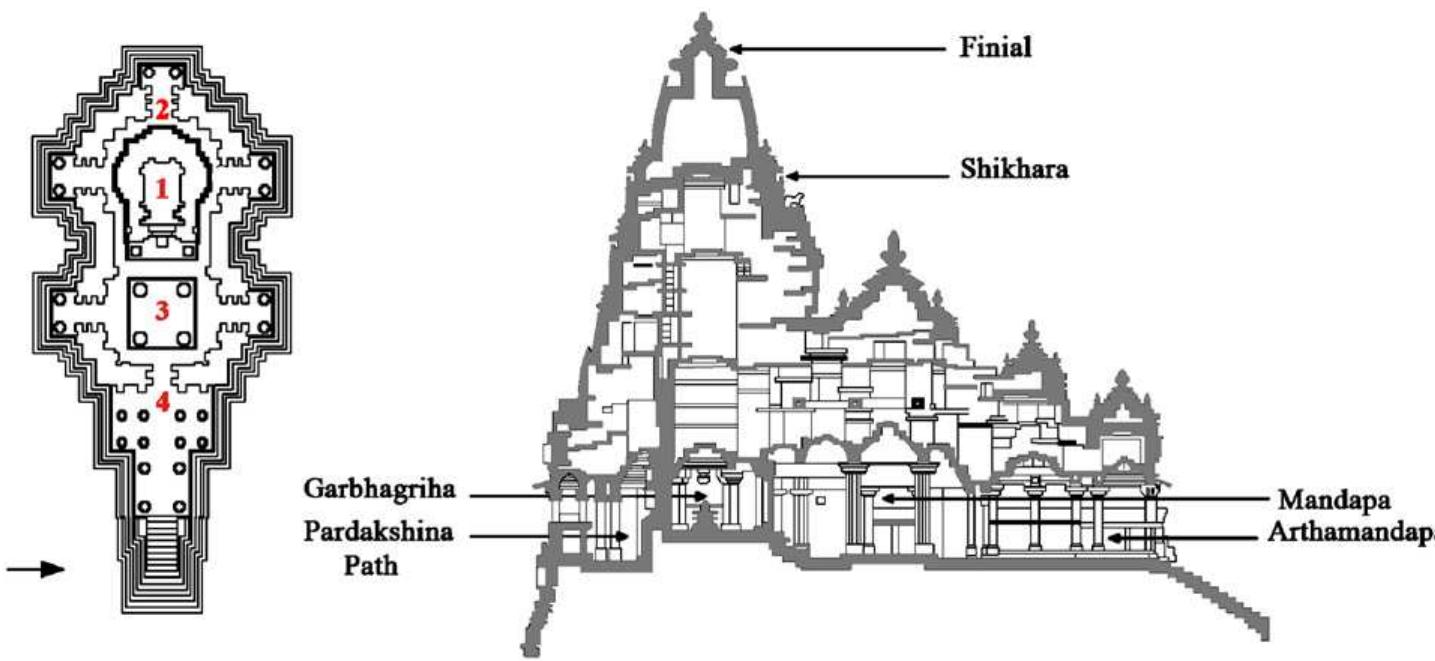
Fig. 2. Left: plan of Kandariya Mahadev temple (11th century): (1) Garbhagriha, (2) Pradakshinapth, (3) Mandapa, and (4) Arthamandapa. Right:
East–West section of Kandariya Mahadev temple.
The basic shape of the vastu purusha mandala is a square faced to the east to welcome the first rays of sun. The whole
which represents the earth [11]. Its four sides depict the structure consists of four major parts (Fig. 2):
four cardinal directions. It also symbolizes the order, the
completeness of endless life and the perfectness of life and
1. Grbhagriha, i.e., sanctuary where the main deity has
death [10]. According to Hindu philosophy, our mundane
been kept.
life is controlled by the number four—four castes, four
2. Pradakshina path, i.e., circumambulatory path having
stages of life, four great epochs or mahayugas, four heads
three sides balcony bringing ventilation and light to the
of Brahma, the four Vedas etc. [12].
interior.
There are various types of vastu purusha mandala, which
3. Mandapa, i.e., columned assembly hall having two sides
are nothing but the squares grids, produced from the basic
balcony.
shape; namely, a square which is known as sakala mandala.
4. Artha mandapa, i.e., entrance porch.
Each smaller square within the grid is called one pada. The
number of pada may vary from 1, 4, 9, 16, 25 and so on
1024, where it follows the geometric progression of 1, 2, 3, Kandariya Mahadev temple stands out from other
4, 5,y,32 of common ratio 2. The mandala having even temples of the region due to its grand scale with elaborated
numbers of pada in its grid known as yugma squares building design as a whole and ornamentation. The well-
mandala whereas the mandala, having odd numbers of pada controlled zigzag plan of the temple creates the vertical
known as ayugma squares mandala. Vastu purusha mandala visual rhythm, accentuated in the elevation through its
is also known as different distinctive names according to sharp recessions and projections, whereas the horizontal
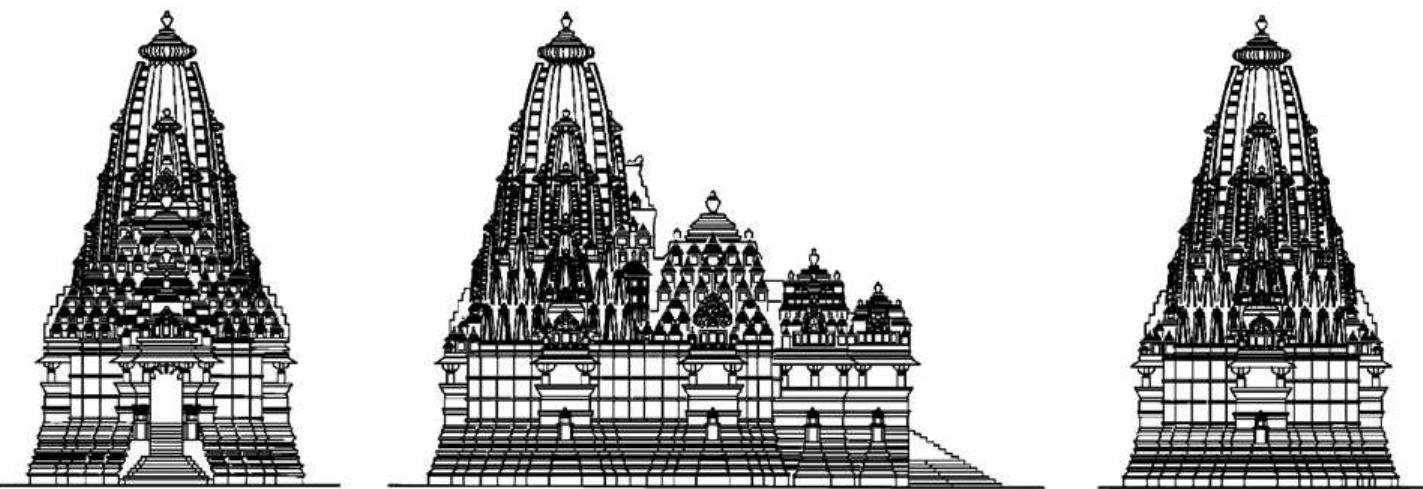
the numbers of pada within the grid. The mandala having friezes on the elevation create the horizontal rhythmic
1,4,9,16,25 and 36 numbers of pada within the grid are growth upward (Fig. 3).
known as sakala mandala, pechaka mandala, pitah mandala, The most distinctive part of the temple is its lofty curved
mahapitah mandala, manduka chandita mandala and para- towers above the sanctuary. It is known as shikhara.
masayika mandala, respectively14. Shikhara is crowned by an amalaka,15 a ribbed circular
motif, and a pot finial, known as the kalasha, a sacred pot
3. Kandariya Mahadev temple, Khajuraho, 1030 A.D. in which the most precious elixir amrita had been kept.
Here in the shikhara, the amalgamation of the form of lotus
Kandariya Mahadev temple at Khajuraho sets the bench- blossom and that of mountain has been frozen into the
mark of Hindu art in India. This temple was constructed in form of multiple recursive archetypes. Replicas of the
the middle of 11th century when Hindu temples had attained towers are the most distinctive character in the Kandariya
the highest point of matured design. During the period, all Mahadev temple.
kinds of Hindu art including sculpture, music and dance, Like exterior, interior of the Kandariya Mahadev temple
were intermingled in temple designs [22]. Kandariya is elaborated with ornamentation. At exterior it has more
Mahadev temple has height about 31 m. It is elevated above than 646 numbers of figures whereas 226 numbers of
a lofty plinth which makes the temple structure sanctity and figures were sculpted in interior. There is no boundary
monumental. The structure is 30.5 m long and 20 m wide, between interior and exterior in terms of ornamentation
and detailing.
14
For more information regarding vastu purusha mandala, its history
15
and application to the Indian traditional architecture in deep, see V. ‘Amalaka’ is a kind of fruit available in north part of India. According
Chakrabarti. Indian Architectural theory and practice; contemporary uses to Hindus amalaka is a sacred fruit. In most of the Hindu temples,
of vastu vidya. Routledge Curzon, 1999. amalaka was adopted as the finial on shikhara.
� ARTICLE IN PRESS
4096 I. Md Rian et al. / Building and Environment 42 (2007) 4093–4107
Fig. 3. Left: front elevation; middle: north elevation; and right: back elevation.
4. Fractal dimension and box counting method high textureness and abundance of details. Roughness of
the images having fractal dimensions 1.21–1.25 or the
In fractal geometry, fractal dimension is the quantity dimensions 1.81–1.86 are visually not so much distinguish-
which measures the fractalness of an object. For any fractal able by naked eyes. But naked eyes can easily distinguish
object fractal dimension is always non-integer, i.e., unlike the images having fractal dimensions 1.1, 1.2, 1.3,y, 1.8
integer-dimensional objects (zero-dimensional point, one and 1.9, separately.
dimensional line, two dimensional square and three To evaluate the fractal dimension of an image by ‘box
dimensional cube) fractal object is a fractional-dimensional counting method’, firstly a squares grid is overlaid on the
which may be in between one dimensional and two image where the size of each grid box, let ‘S’, determines
dimensional object, or in between two dimensional and the scale of the grid. Then the boxes, having any mark or
three dimensional object. For in between one-dimensional line of the image within the grid, are counted; let it is ‘N’.
and two-dimensional fractal object fractal dimension ‘D’ is After repeating the same process on the same image by
always more than 1 and less than 2 (i.e., 1oDo2Þ, whereas changing the box size, fractal dimension ‘D’ of that image
for in between two- and three-dimensional fractal object can be obtained by transforming the results of ‘S’ and ‘N’
the fractal dimension ‘D’ is always more than 2 and less into the log–log graph. The slope of the resulting line of the
than 3 (i.e., 2oDo3Þ. log–log graph determines the fractal dimension of the
There are various methods to evaluate the fractal image.
dimension, among which the ‘box counting method’ is There are various software that can directly calculate the
suitable for measuring the fractal dimension of the fractal dimension of an image by following the basic
elevation of buildings, mountains, trees or any objects process of ‘box counting method’. In this paper, the
which are not true fractal. Albeit, ‘self-similarity dimension software of ‘Box Counting Demonstration’17 has been
method’ is very common for calculating the fractal employed for counting the marked boxes. For the analyses,
dimension, but the method is only applicable for the true all parts of the temple have been taken as two-dimensional
mathematical fractals where self-similar structures are images by keeping the information about image sizes and
found at all zooming scales.16 their resolutions.
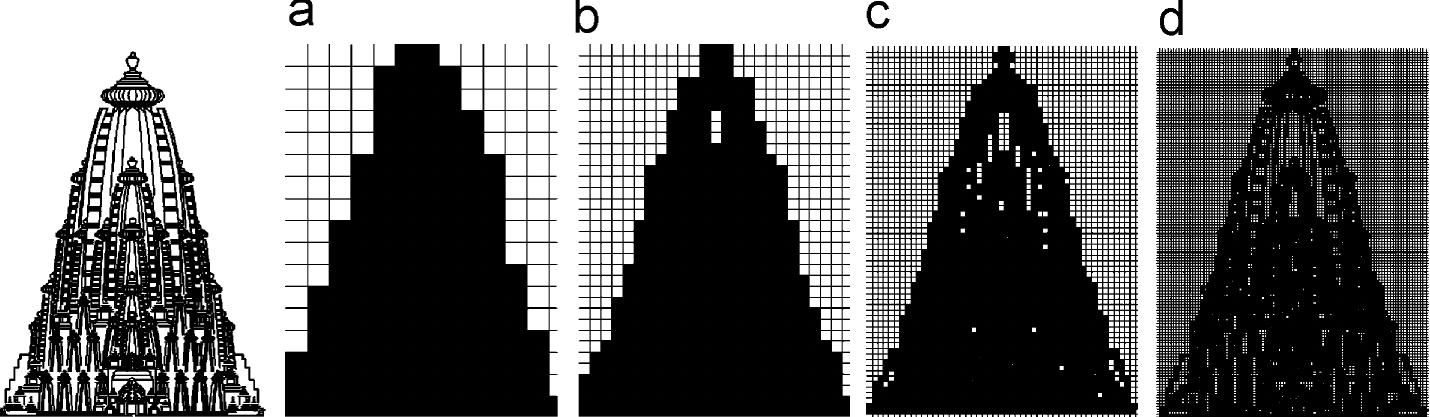
Fractal dimension calculated by ‘box counting method’ For example, by taking the box sizes or grid sizes 24, 12,
measures the fractalness of an image on the basis of 6 and 3 of a squares grid for a fractal image of 60 mm �
roughness or textureness or the amount of details. Images 43:5 mm with resolution 80 pixels/cm, marked boxes are
having fractal dimensions 1.1–1.5 indicate less roughness counted by the ‘Box-Counting Demonstration’ software
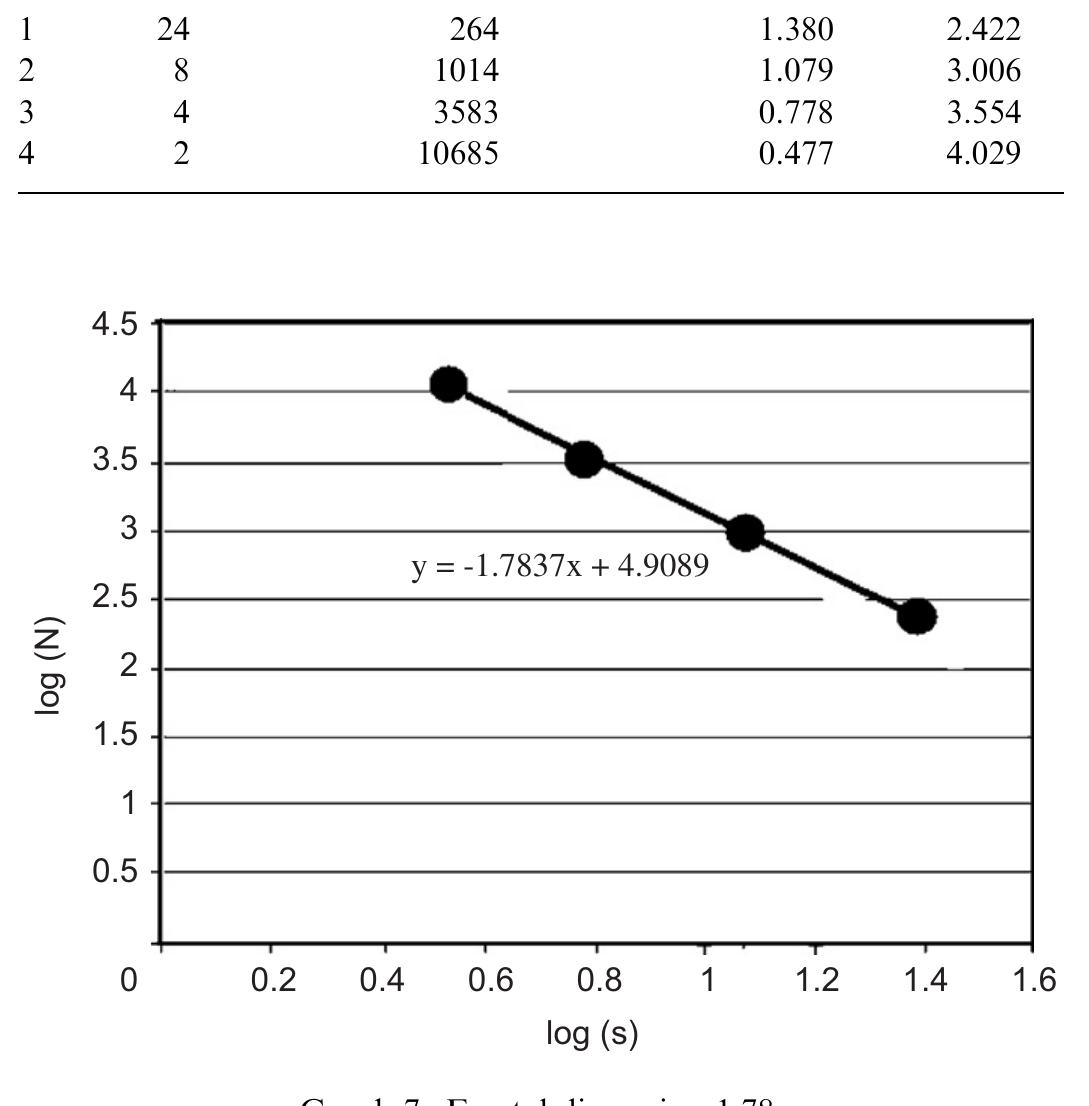
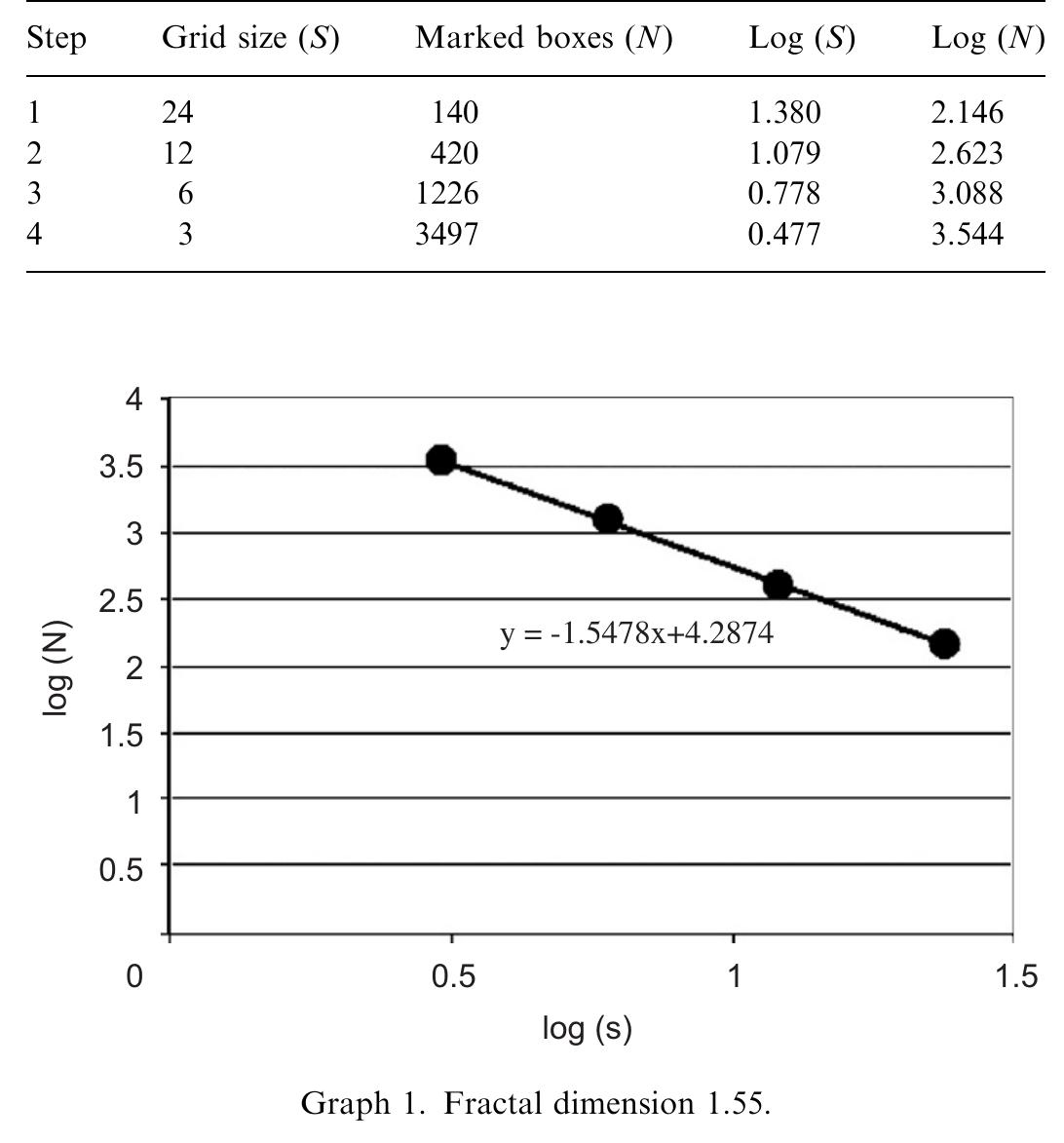
and details they have, whereas images having fractal (Fig. 4). Then by taking the log of grid sizes ðSÞ on the X -
dimension 1.6–1.9 but less than integer value 2, exhibit axis and log of marked boxes ðNÞ on the Y -axis following
results have been obtained as shown in Table 1 (Graph 1).
16
Slope of the resulting line in log–log graph shows the
Other well known methods include ‘measured dimension method’ or fractal dimension of the image is 1.55. The resulted points
‘structured walk method’ which is only applicable for the overlapping
curves, while the other methods (like box counting and self-similarity
lied on a smooth straight line in the graph indicate the
dimension methods) cannot include the part of overlapping curves. Self- uniformity of details of the image in different scales. Here
similarity dimension is believed to be the standard fractal dimension of a fractal dimension 1.55 confirms that the level of details of
pure fractal object and equivalent to Mandelbrot’s fractal dimension. But the fractal image is medium.
‘box counting method’ measures the fractal dimension of those objects
which are not true mathematical fractal. This method basically measures
the rate of roughness or detail-ness of an image, but not an object itself.
Accordingly, ‘box counting method’ is the suitable and preferable method
17
to calculate the fractal dimension of the images of buildings, mountains, The software of ‘Box-Counting Demonstration’ was developed by
trees or any objects which are not true fractal. Box counting dimension is Martin Nezadal, Institute of Physical and Applied Chemistry, Brno
also equivalent to Mandelbrot’s fractal dimension. For more details, refer University of Technology, Brno, Czech Republic for determining the
to Lorenz [13]. fractal dimension of an image through box counting method.
� ARTICLE IN PRESS
I. Md Rian et al. / Building and Environment 42 (2007) 4093–4107 4097
Fig. 4. Box counting operation of a fractal figure. Extreme left—fractal figure; (a) grid size 24; (b) grid size 12; (c) grid size 6; and (d) grid size 3.
Table 1 way. ‘Fig. 5’ shows the fractal characteristics of different
mandalas and their iterations from the sakala mandala.
Step Grid size ðSÞ Marked boxes ðNÞ Log ðSÞ Log ðNÞ
At the same time by laying down the diagram of mandala
1 24 140 1.380 2.146 in the foundation of temple, cosmic energies were grasped
2 12 420 1.079 2.623 beneath the structure. The center of mandala is the source
3 6 1226 0.778 3.088 of all energies which are radiated outwards to the physical
4 3 3497 0.477 3.544
world. The square shape of mandala significantly implies to
maintain the energy equilibrium. Arnheim [14], in his book,
‘Art and Visual Perception’, finely describes the hidden
4 ‘field of forces’ within the square where each side of the
3.5
square applies the force towards the center. Thus, the
center of square applies equal force towards its each side
3 (Fig. 6a).
2.5 Similarly, in the case of nine-square grid, each side of the
log (N)
y = -1.5478x+4.2874 nine-square grid applies the equal forces to the center
2
which is itself a square and to make a balance, this central
1.5 square also applies the equal and opposite force to each
1 side of the grid. Accordingly, within the nine-square grid
‘field of forces’ becomes higher, because, as Arnheim
0.5 described, within the grid each square itself has its own
‘field of forces’ (Fig. 6b). Thus, the increasing numbers of
0 0.5 1 1.5 squares in a mandala help the diagram to arrest the
log (s) (cosmic) energies more concretely where the ‘field of forces’
is increased in a fractal manner. These restored energies in
Graph 1. Fractal dimension 1.55.
the mandala radiate out to the physical world eternally
from the center (Fig. 6c).
5. Analysis of Kandariya Mahadev temple Although the mandala is primarily square, it may be
turned into different shapes for applying to the foundation
5.1. The foundation and floor plan of temple. But the final shape must evolve out of the
square, because of its essence in all Hindu architecture. As
In the foundation of any Hindu temple, cosmos is time goes the final shape of mandala was turning into
embodied by laying down the diagram of vastu purusha complex through some transitional stages. In these stages,
mandala on a selected ground. This divine diagram reflects plans of some earlier temples evidence that the fact of
the image of cosmos through its fractal qualities. In the radiating cosmic energy took the main role for amending
diagram, squares are repeated within a square and other the basic shape of mandala. Surprisingly, it is turned out in
squares within another square and so on. Each newly born some special cases that the process of amendment is
square perhaps depicts the birth of new universe in which nothing but the fractal iteration of mandala.
the centre of mandala is the source of creation of each To begin with, the evolutionary stages of temple plans
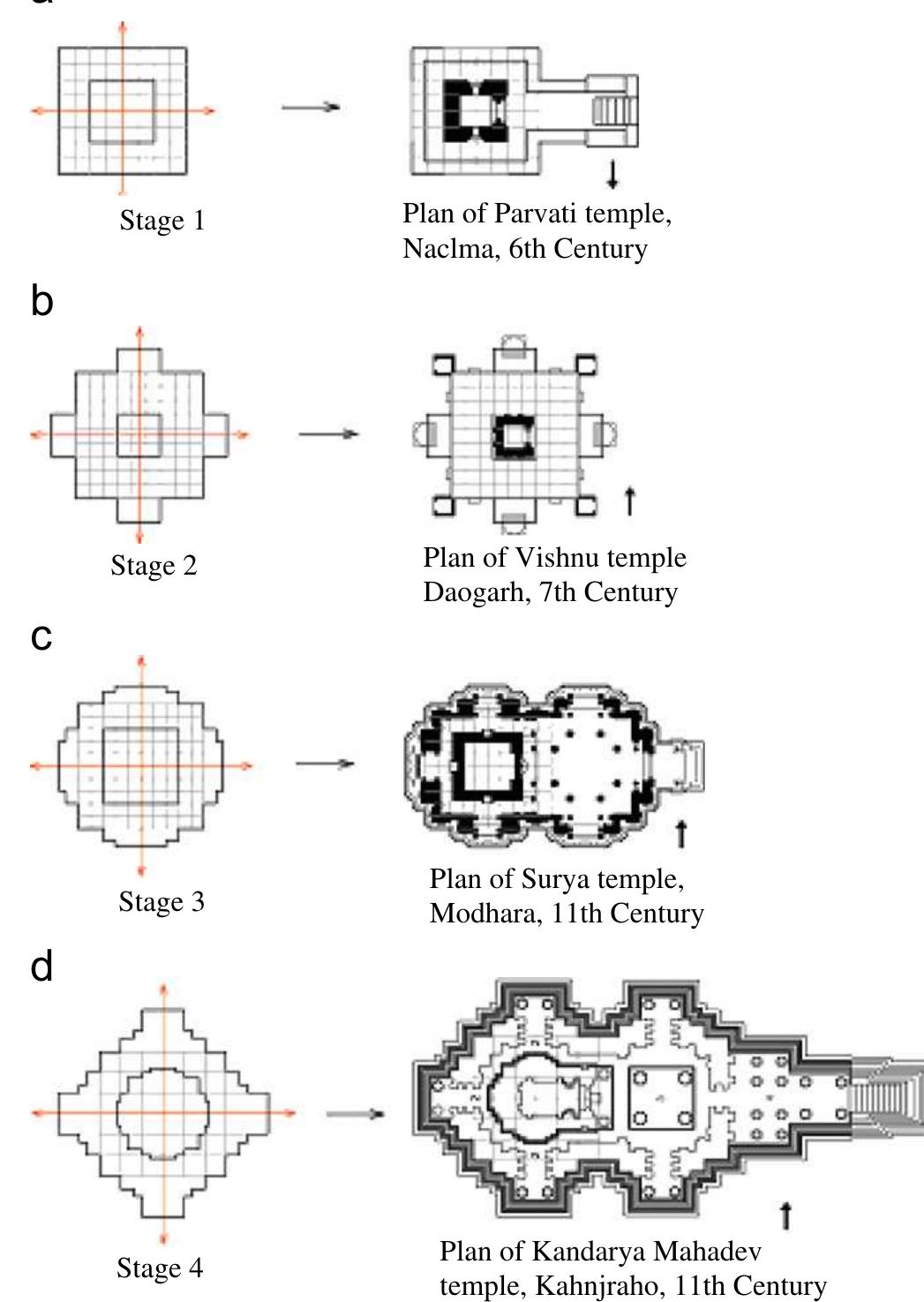
square, i.e., each universe. Apart from this, as the fractal are to be discussed. In the early ages, plans of Hindu
properties in vastu purusha mandala, each yugma mandala temple were nothing but the direct copy of vastu purusha
(even numbers of squares grid) is the result of fractal mandala. Parvati temple at Nachna, constructed in 6th
iteration of four-squares grid, i.e., pechaka mandala, century A.D., is one of those temples in which the grids of
whereas each ayugma mandala (odd numbers of squares mandala and its overall shape was directly applied to
grid) is the iteration of nine squares grid, i.e., pitah foundations, especially to the foundation of sanctuary
mandala. For example, pechaka mandala produces maha- (Fig. 7a). After then this square and grid plan of the temple
pitah mandala (16 squares grid), and manduka chandita was modified by bumping up each side outwards to the
mandala (64 squares grid), and pitah mandala produces four directions depicting the radiation of cosmic energies.
paramasayika mandala (81 squares grid) in an iterative This time, the shape of temple plan is the visual expression
� ARTICLE IN PRESS
4098 I. Md Rian et al. / Building and Environment 42 (2007) 4093–4107
Fig. 5. Fractal characteristics of different mandalas and their iterations from the sakala mandala.
a
Stage 1 Plan of Parvati temple,
Naclma, 6th Century
b
Fig. 6. (a) ‘Field of forces’ within the square ([4]; redrawn by the author);
(b) radiation of forces from 9-squares grid ([23]; redrawn by the author);
(c) radiation of forces from 81-squares grid.
Stage 2 Plan of Vishnu temple
of energy radiations whereas in the plan of Parvati temple Daogarh, 7th Century
it was only the symbolical expression. In the sixth century c
to the seventh century A.D. Hindu temples were usually
constructed on this modified plan by following the same
grids of mandala. Vishnu temple at Deogarh, constructed
in the late sixth century, is the example of this type of
temple (Fig. 7b).
Plan of Surya temple,
As time goes, the shape of Hindu temple plan became Stage 3 Modhara, 11th Century
more complex where each sides of the square of mandala
bumps up twice. By repeating the same process, i.e., by d
iterating, each side of the square of mandala attains a
fractal like pattern in which this time it expresses the
directions of radiating cosmic energies more clearly. This
pattern was employed on the plan of Surya temple at
Modhera in the 11th century (Fig. 7c). In this temple the
developed pattern was overlapped by the self-similar Stage 4
Plan of Kandarya Mahadev
pattern towards the east direction at the same axis leading temple, Kahnjraho, 11th Century
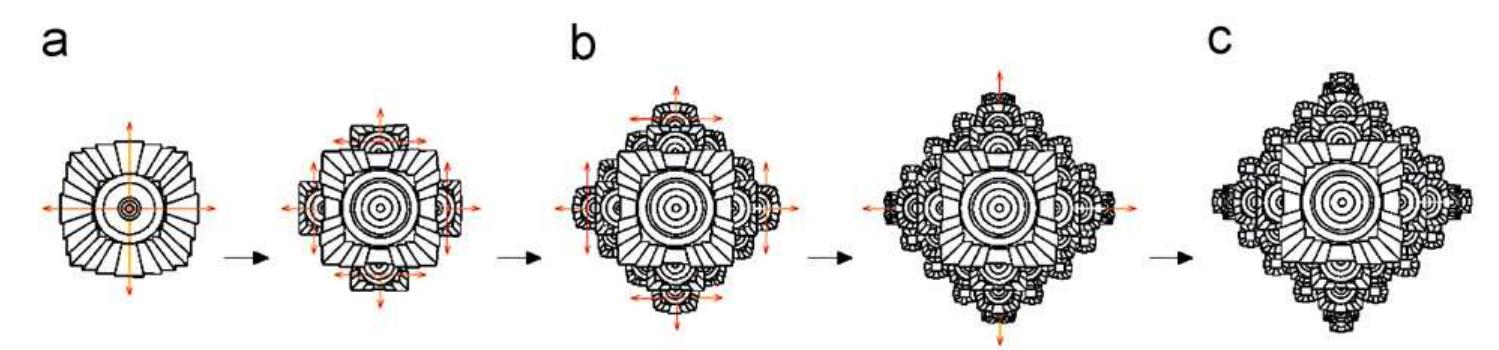
the entrance to the sanctuary and got the final outcome. Fig. 7. Evolution of the plan of Kandariya Mahadev temple from the
Lastly, during the 11th century, the plan of Hindu vastu purusha mandala through the above stages which is lead by the
temple had attained its final shape as the result of third radiation of cosmic energy. (a) Plan of Parvati temple, Nachna from
fractal iteration of mandala. This modified and matured simple square mandala; (b) plan of Vishnu temple, Deogarh from the first
iteration of mandala; (c) plan of Surya temple, Modhera from the second
plan was widely adopted in the North Indian temples; iteration of mandala; and (d) plan of Kandarya Mahadev temple,
among those Kandaraiya Mahadev temple at Kahjuraho is Khajuraho from the third iteration of mandala.
the most remarkable (Fig. 7d). Evolution of this temple
plan is the process of fractal iteration. Here the iteration
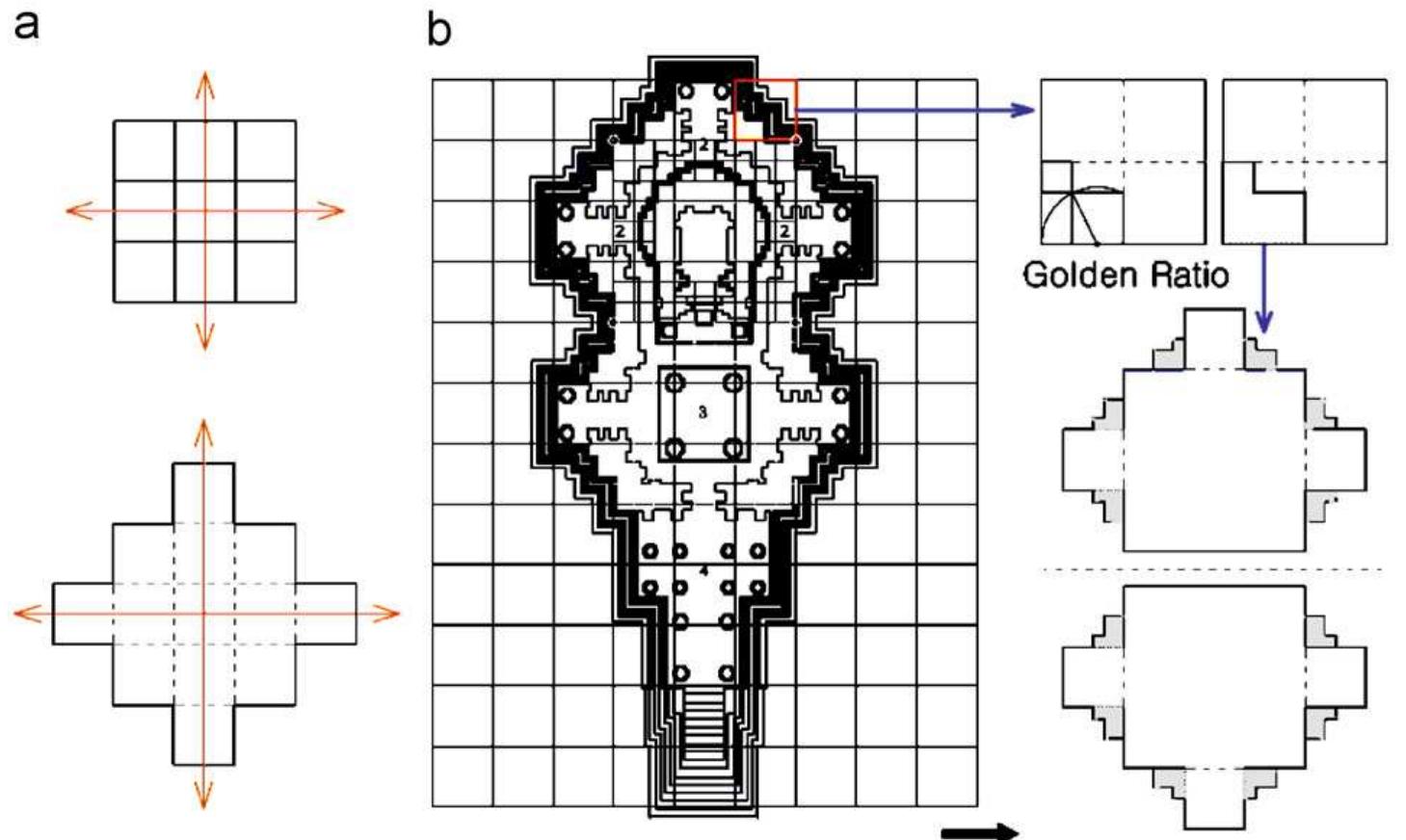
was lead by the cosmological events as well the symbolic Mahadev temple. In this geometric operation one smaller
geometries and sacred proportions. There are two hypoth- square within the grid of mandala, i.e., one pada has been
eses about the geometric operations of mandala to evolve taken as one unit. The outward energies generated from the
the final plan of Kandariya Mahadev temple. center of mandala have bumped up the middle of each side
According to the first hypothesis, pitah mandala, i.e., one unit along the four directions (Fig. 8a) as the first
nine-square grid is considered as the primary shape for the iteration. Then all the newly born outer corners have been
geometric operation to evolve the plan of Kandariya filled with meandering elements which are developed from
� ARTICLE IN PRESS
I. Md Rian et al. / Building and Environment 42 (2007) 4093–4107 4099
Fig. 8. (a) Top: 9-Squares mandala. Bottom: sides of a 9-squares mandala are bumped up 1 pada along the cardinal directions. (b) Left: plan of Kandariya
Mahadev temple. Right up: outer corner of ‘Fig. 8a-bottom’, i.e., 1 pada and development of a element having golden proportion with a quarter of the
pada. Right bottom: outer corner of ‘Fig. 8a-bottom’ filled by the newly born element from a pada in its three sides and overlapped with the self similar but
opposite pattern to get final fractal patterned plan of the temple.
the quarter of one pada. Each meandering element is the and irregular shape. Not only the outer plan but also the
combination of a golden rectangle and a square born from plan of central sanctuary is also the offset of outer plan,
the same rectangle. After filling the outer corners, it has got which makes whole the plan as fractal. For analyzing the
the fractal pattern which is overlapped with a self similar roughness of the plan of Kandariya Mahadev temple,
pattern, planned for the mandapa, along the axis of ‘Box-Counting Demonstration’ software has been em-
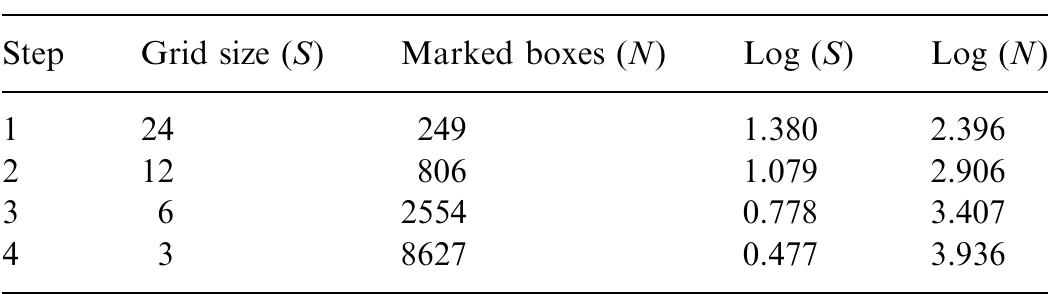
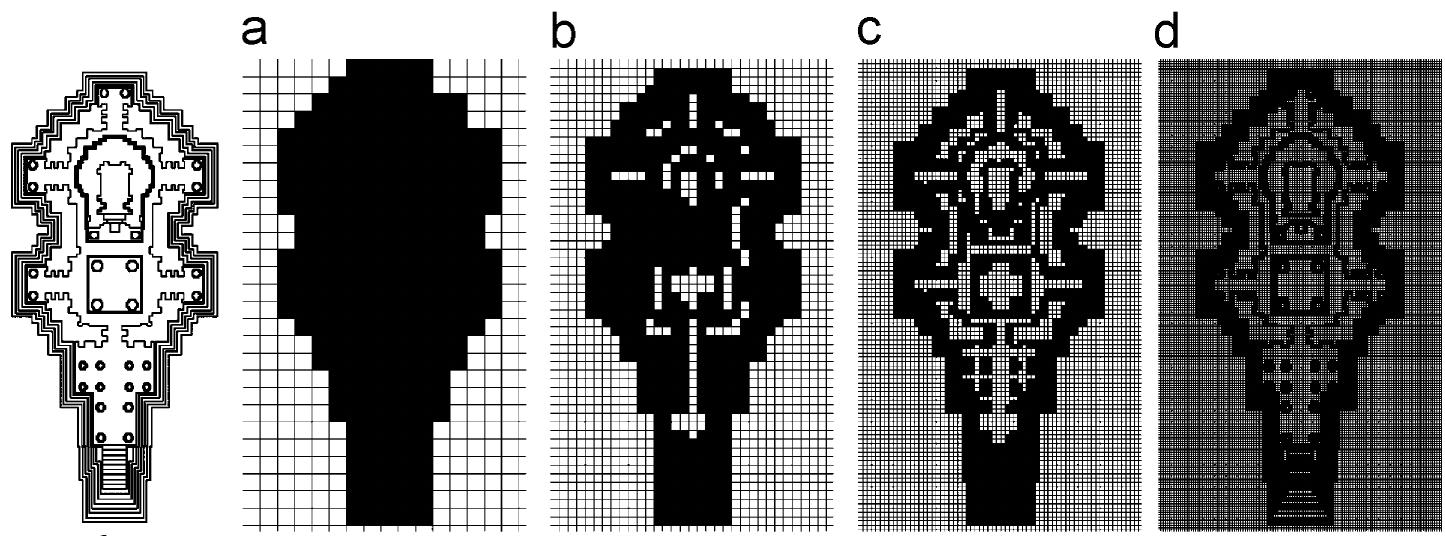
entrance to the sanctuary. Lastly, by projecting the ployed on the image of plan by taking its size 50 mm �
entrance part along the same axis, it has attained the final 70 mm having resolution 80 pixels/cm and grid sizes 24, 12,
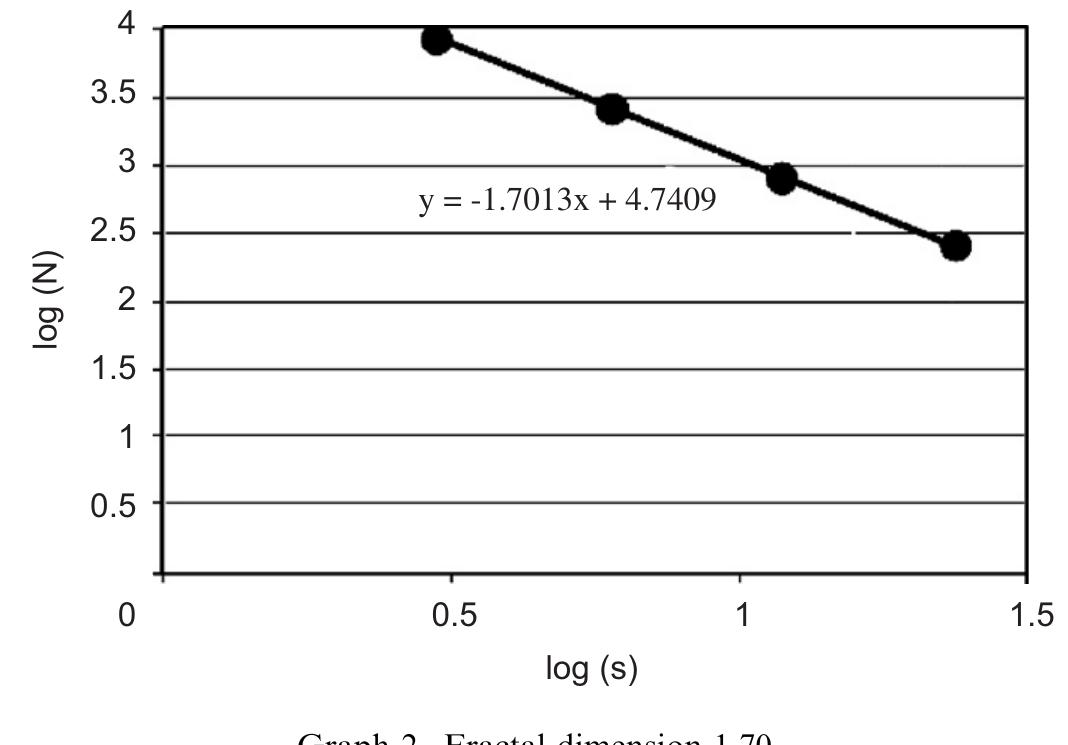
shape (Fig. 8b). 6 and 3 (Fig. 10). It gives the following results (Table 2
According to second hypothesis, the plan of Kandariya (Graph 2)):
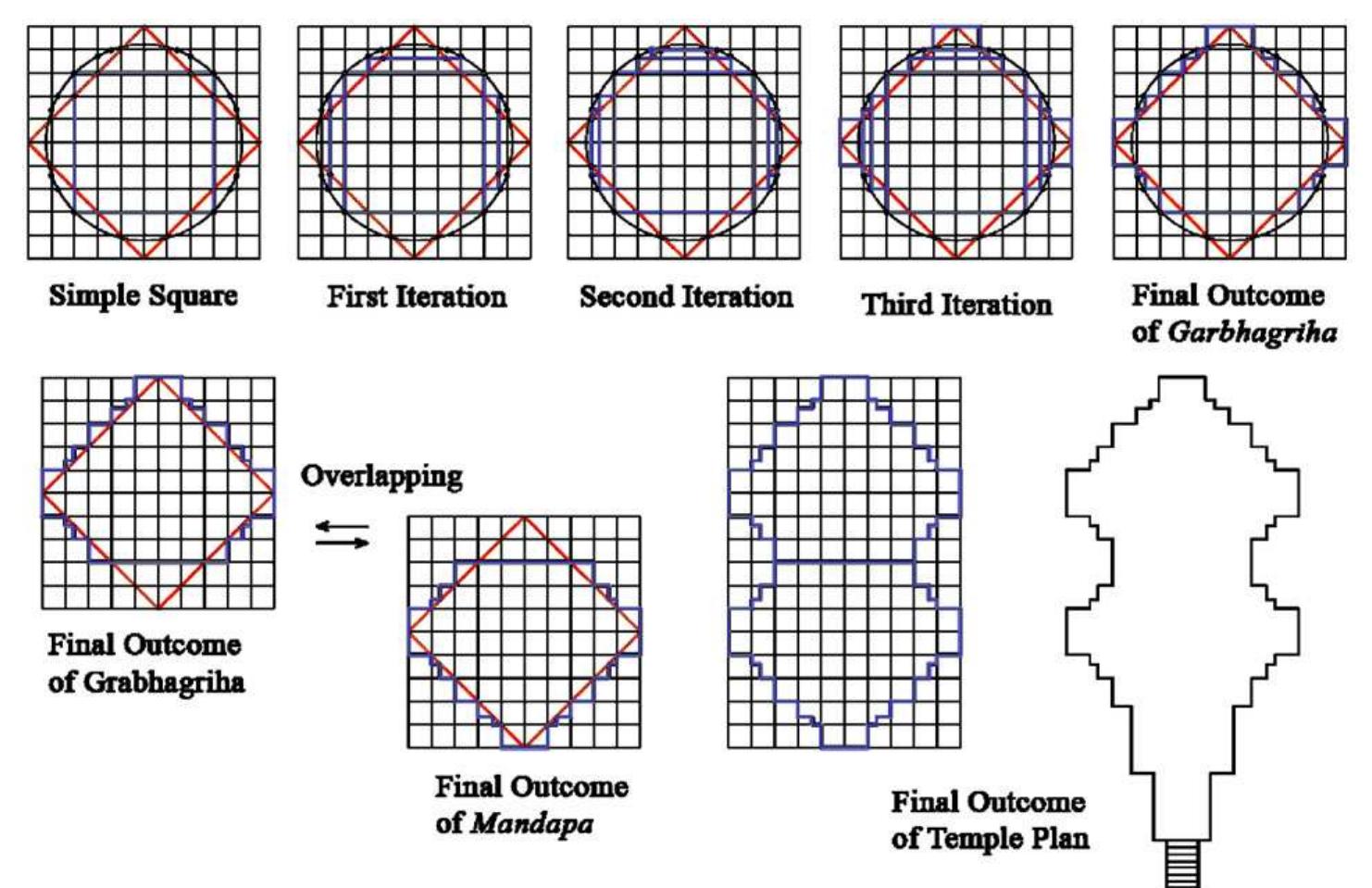
Mahadev temple is the result of third iteration of pitah From the slope, shown in Graph 2, it is obtained that it
mandala (36-squares grid). Here the pitah mandala is rest has fractal dimension 1.70 which depicts its high degree of
within the manduka chandita mandala (100-squares grid) on roughness or details. The smooth curve as a straight line in
the same grids. The iteration of each side is guided by the the graph describes the uniformity of its roughness. This
gridlines and a circle which touches the corners of pitah degree of roughness or details of plan has been accentuated
mandala. The circle depicts the endless cycles of times, the in the structure to make the whole structure complex and
wholeness and the consciousness due to its never-ending textured.
shape18. The sides of another square, placed diagonally by
touching its corners to the outer edges of the manduka
5.2. Elevation
chandita mandala, indicate the iteration points.
Each iteration starts from the intersection between a side
Hindu cosmology, manifested in the plan of Hindu temple
of the diagonal square and the last iterated line, and stops
two dimensionally, was also manifested in its elevation but
at the intersection between grid line and the circle. Finally,
three dimensionally and more symbolically. For the elevation
the iteration stops at the corners of the diagonal square
too, sthapati19 took the fractal as a medium to visualize the
(Fig. 9). The elongations of the last iterated forms depict
manifested form of cosmos and to make the pilgrims
the four cardinal directions. On the temple structure, these
meditating for spiritual journey. To apply the fractal as a
last projected parts are open verandas, symbolizes the
tool for constructing the temple, perhaps, sthapati did not
cardinal directions.
use any mathematical fractal theory or formulae, but he
This fractal operation of the plan of Kandariya
influenced by the nature where God himself create moun-
Mahadev temple makes it fractal in terms of roughness
tains, trees, leaves, etc. as the examples of fractal [5].
18 19
According to Kumar, ‘‘the circle is logically the perfect metaphor for In Brihatsamhita and Sthapatyaveda, architects of Hindu temples and
heaven since it is a perfect shape, without beginning or end, signifying residences were called as sthapati. It’s a Sanskrit term comes from the
timelessness and eternity, a characteristically divine attribute.’’ (see [12]). ancient Hindu scriptures.
� ARTICLE IN PRESS
4100 I. Md Rian et al. / Building and Environment 42 (2007) 4093–4107
Fig. 9. Geometric operation of mandalas and that of some symbolic geometry for the development of the plan of Kandariya Mahadev temple.
Fig. 10. Box counting operation of the plan of Kandariya Mahadev temple. Extreme left—plan; (a) grid size 24; (b) grid size 12; (c) grid size 6; and (d) grid
size 3.
4
Table 2
3.5
Step Grid size ðSÞ Marked boxes ðNÞ Log ðSÞ Log ðNÞ
3
1 24 249 1.380 2.396 y = -1.7013x + 4.7409
2 12 806 1.079 2.906 2.5
log (N)
3 6 2554 0.778 3.407
2
4 3 8627 0.477 3.936
1.5
In the structure of almost all Hindu temples, sthapati 1
took the mountain as a model of fractal object where self- 0.5
similar mounts are repeated and recurred, pointing towards
the sky. They made the rising towers, shikhara on the 0 0.5 1 1.5
temple structure by copying the form of mountain which
log (s)
dominates on the earth, and the replicas of soaring towers
on shikhara depict the series of repetitive universes [15]. Graph 2. Fractal dimension 1.70.
Even the literal meaning of shikhara is also mountain.
Besides, mythical mount meru was also the aim to adopt the Kandariya Mahadev temple, the mountain form of
form of a mountain in the structure of Hindu temples to shikhara has further significance which depicts the mount
manifest the cosmic events. Especially in the case of kailash where (according to Hindu beliefs) the Lord Shiva
� ARTICLE IN PRESS
I. Md Rian et al. / Building and Environment 42 (2007) 4093–4107 4101
Fig. 11. (a) Repetitions of towers and their elements in the shikhara; and (b) whole form of shikhara is repeated in a part within another part (marked by
red color). Repetitions of tower above the mandapas (marked by green color) create angle for upward eye movement to the summit of main shikhara.
dwells, because this temple was dedicated to the Lord system properly, then it can function in harmony with the
Shiva. Though the appearance of shikhara in all Hindu mathematical basis of the universe.21 Almost in every
temples are mountainous, but they are unique from each Hindu temple in North India, the rule of repetition of
other regarding the styles of repetition of towers, orna- towers is almost the same. On the shikhara above the
mentations on tower facades, tower slopes and their sanctuary of Kandariya Mahadev temple, the second larger
geometric structures. tower is just half in size of the main central tower and the
In the case of Kandariya Mahadev temple, the main shorter towers are one-third and one-fourth in size of the
tower above the sanctuary is repeated at its four sides and main tower. Placing of the smaller towers on the elevation
the same process of repetition is continued in each newly is such that the peaks of each smaller tower pointing
born smaller tower, and again this process repeated in the towards the summit of main central tower, makes the
last newly born smaller tower (Fig. 11a). At the same time impression of unity in infinity towards cosmic axis.
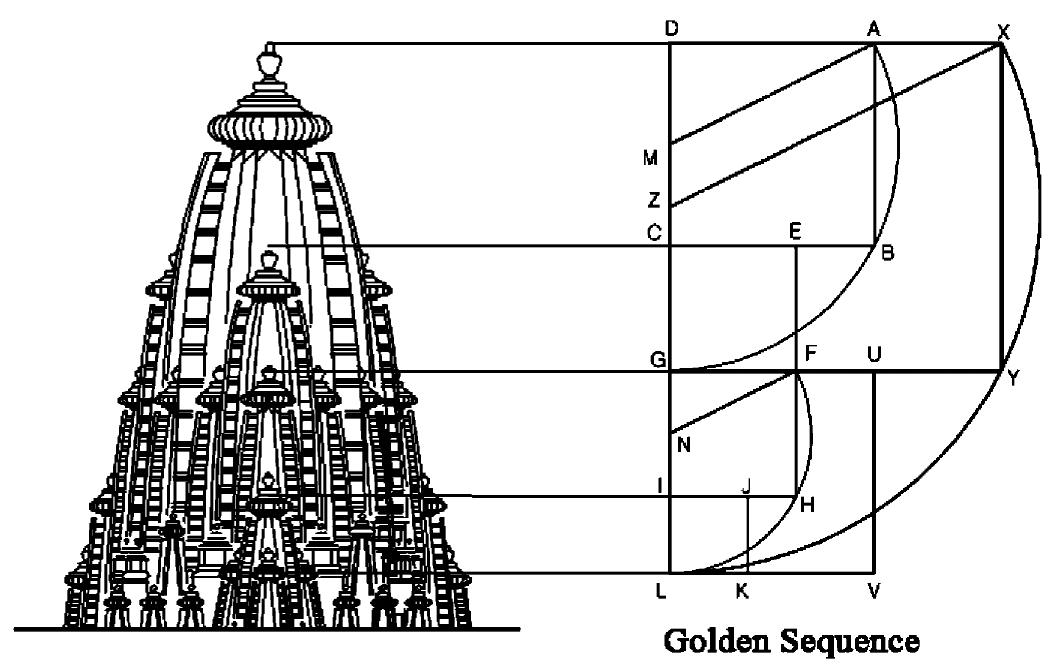
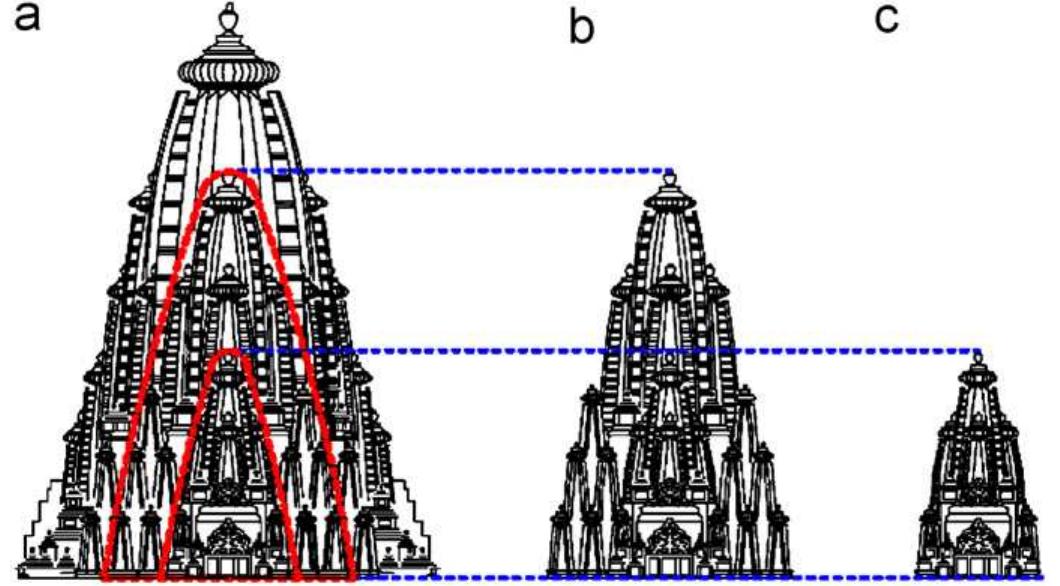
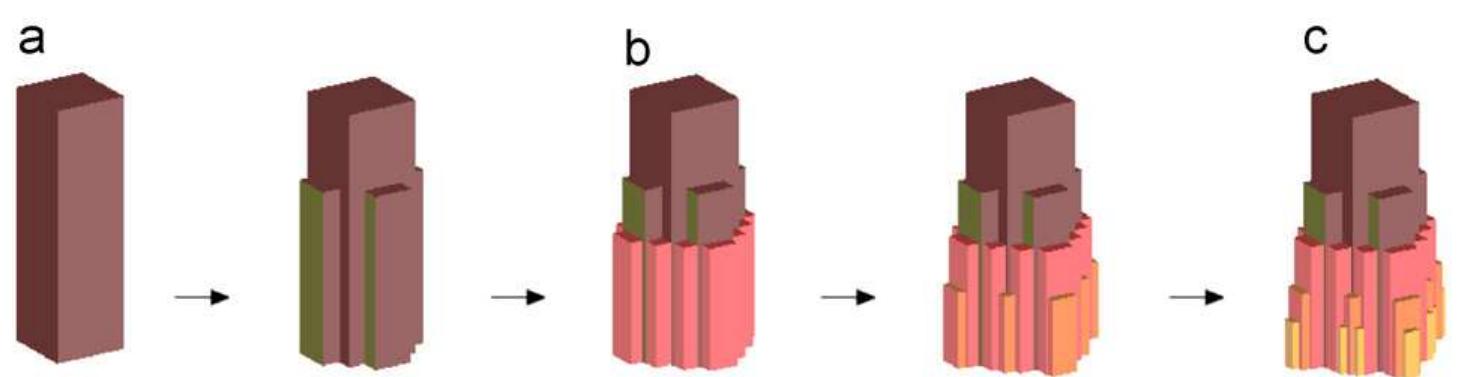
smaller towers are repeated on the body of main tower in It turns out that the stratification of the towers above the
which the whole tower attains such an arrangement where sanctuary follows the golden sequence as the basic rule for
one can easily feel the whole in a part within another part. arrangement. Let’s take the distance between two peaks of
Above the assembly hall, i.e., mandapa the main tower is main tower and second tower as a side of a square
repeated within its own body and at the same time its (ABCD). Then, an arc is drawn whose center is located at
whole body is repeated along the axis of mandapa to the M point and radius is MA (Fig. 12). The arc touches the
entrance. This arrangement of repetitive towers above the peak of third tower and intersects the extension of a line
mandapa (assembly hall) and arthamandapa (entrance DC at point G. Then, a square (EFGC) is drawn by taking
porch) is such that it makes to move up one’s eyes a line CG as a side. Now the square (EFGC) is copied as
automatically to the main tower above sanctuary and from FHIG whose side GI determines the distance between third
that travel up through the summit of finial to the axis of peak and fourth peak. Again a second arc is drawn from a
cosmos (Fig. 11b). This highest point of the shikhara above point O by taking the radius OF which touches the peak of
sanctuary is believed as the ultimate point of liberation fifth tower. It produces a new square (JKLI). Interestingly,
from the physical world. the peaks of alternative towers, i.e., the peaks of first, third
The beauty of shikhara lies behind the proportions of the and fifth towers also obey the golden ratio, where the
arrangement of replicas. In Hindu temples the repetitions distance between peaks of first and third towers determines
of the towers are not arbitrarily, but follow some rules and the square (XYGD) and that of third and fifth towers
proportions for the welfare of the society as well as the determines the square (UVLG).
universe.20 Its proportions have deep significance; because Another significance of such arrangement of smaller
if the temple is constructed according to the mathematical towers on the shikhara of Kandariya Mahadev temple is
the man’s perception for seeing the whole body of shikhara
20
According to Brihatsamhita Hindu temples must be perfect which will in its self-similar parts from any location of view (Fig. 13).
reflect the perfectness in this world as well as in spiritual world. R. J. This fractal property is also reflected from the degree of
Mehta found out that ‘‘There was the necessity for perfection but not details in each part of shikhara.
necessarily absolute perfect. The ancient texts lay down the mathematical One can experience the same level of details of the whole
concept of imperfection, that is, not a whole number but one where a small body of shikhara in its self-similar parts. To analyze the
fraction is left over on division [15]’’. Whereas Volwahsen points out, in
Hindu architecture the rules of proportion makes the structure well- consistency of details or roughness of whole shikhara and
balanced, architecturally pleasant and perfect within the mathematical
21
concept of imperfection (see [11]). Michell [10, p. 73].
� ARTICLE IN PRESS
4102 I. Md Rian et al. / Building and Environment 42 (2007) 4093–4107
that of its parts more concretely, ‘box counting method’
has been applied to the images of those parts for
calculating their fractal dimensions. For the experiment,
all three images are taken as the same size of 37 mm �
52 mm having the same resolution 80 pixel/cm. For the
experiment ‘Box Counting Demonstration’ software has
been employed for counting the marked boxes. By taking
the grid sizes 24, 12, 6 and 3, marked boxes has been
counted (Figs. 14–16). Then by applying the grid sizes and
their respective numbers of counted boxes in a log–log
graph the following results have been obtained (Tables 3–5
(Graphs 3–5)):
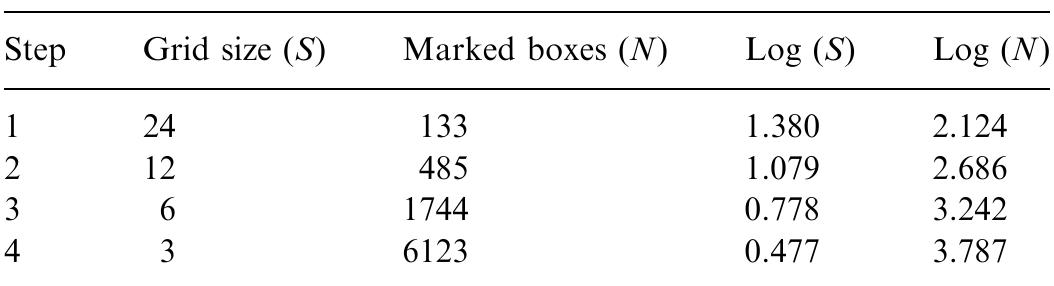
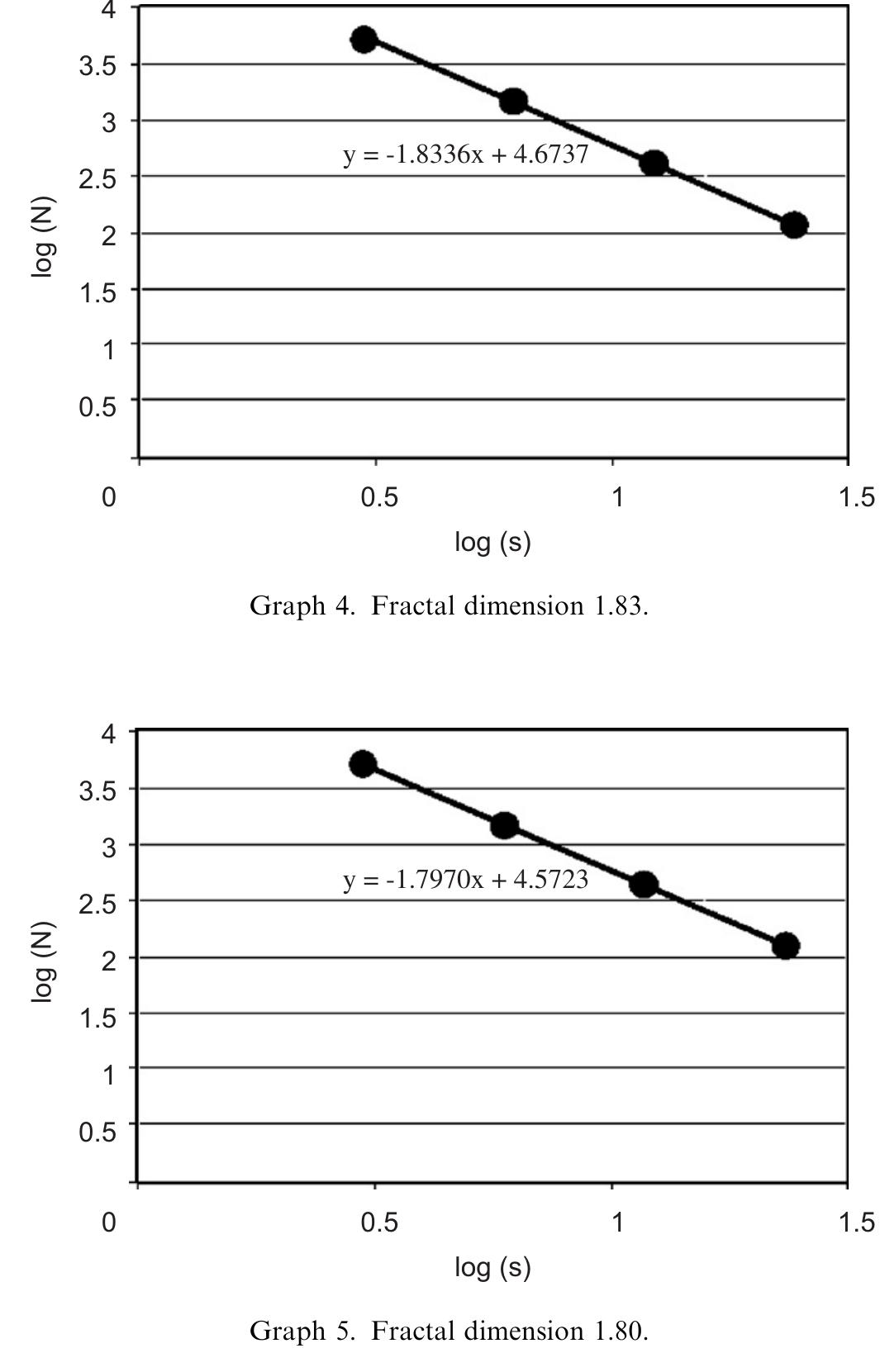
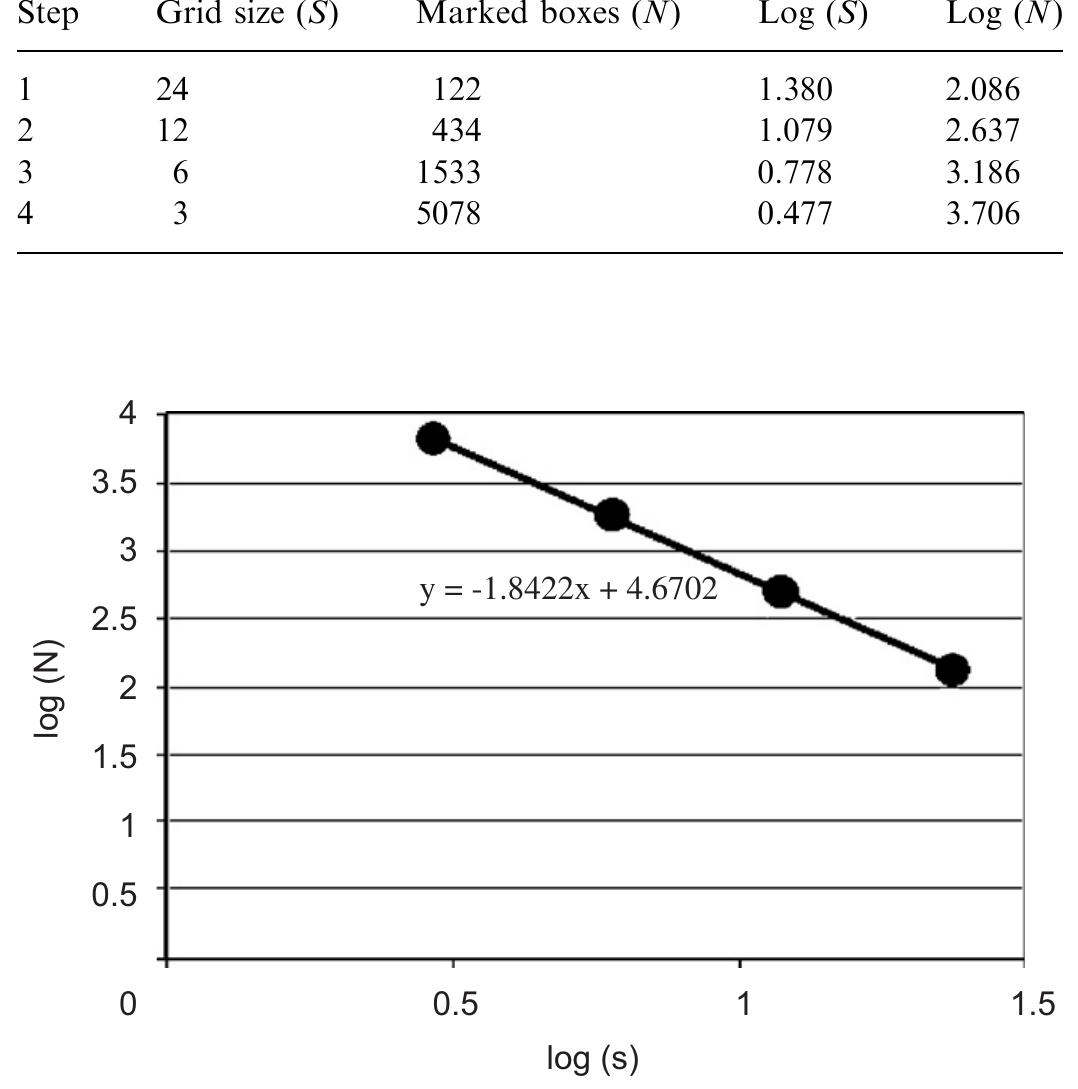
From resulted graphs of above three figures (Figs.
14–16), it is observed that the fractal dimensions of those
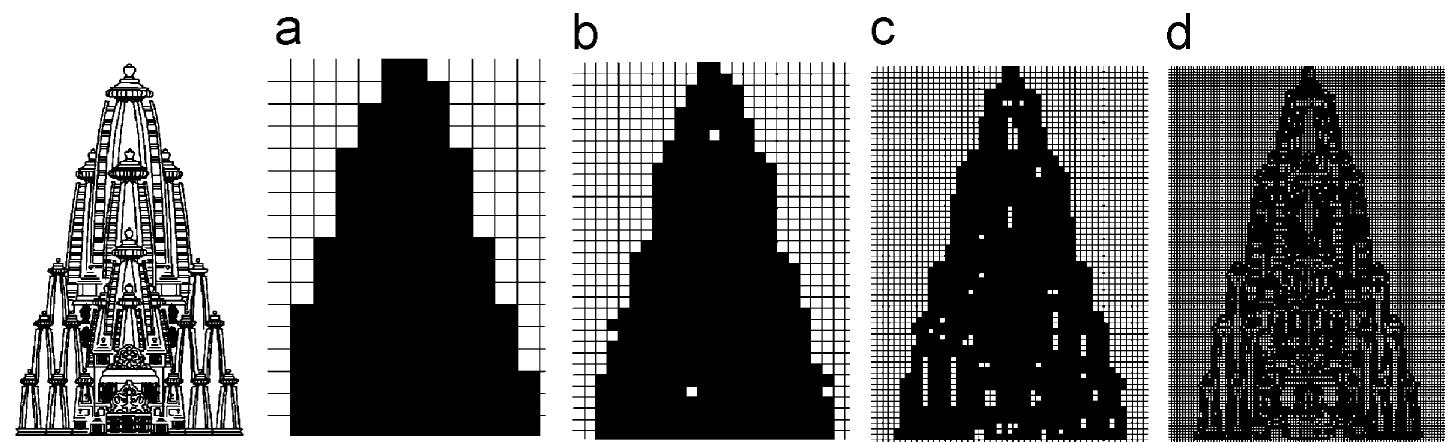
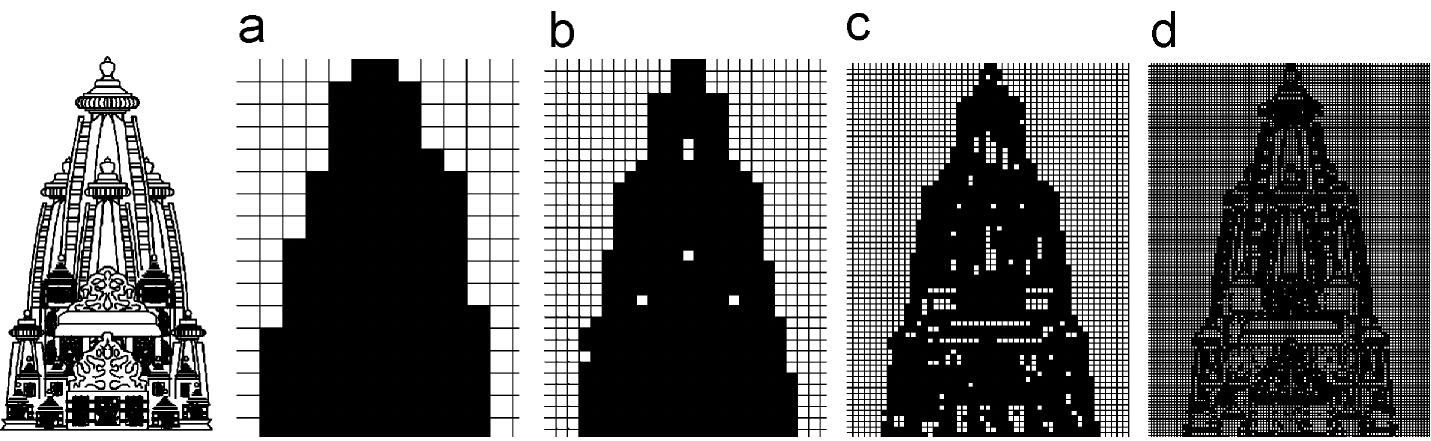
Fig. 12. Peaks of all self similar towers follow the rule golden sequence. three images are 1.84, 1.83 and 1.80, respectively which are
high fractal value and almost the same. As discussed
before, the level of details having these fractal dimensions
are not distinguishable in naked eyes and shows the high
level of details. Accordingly, it is concluded that the degree
of details of the whole body of shikhara and its self-similar
smaller parts are high and uniform. At the same time it is
observed from the graphs that in each case all the points
lies on a straight line, i.e., the resulted curve is a smooth
straight line in the graph which shows that in each part of
the shikhara degree of details is uniform. Therefore, it can
be said that from any viewpoint there is a consistency of
the richness of details in the whole body of shikhara.
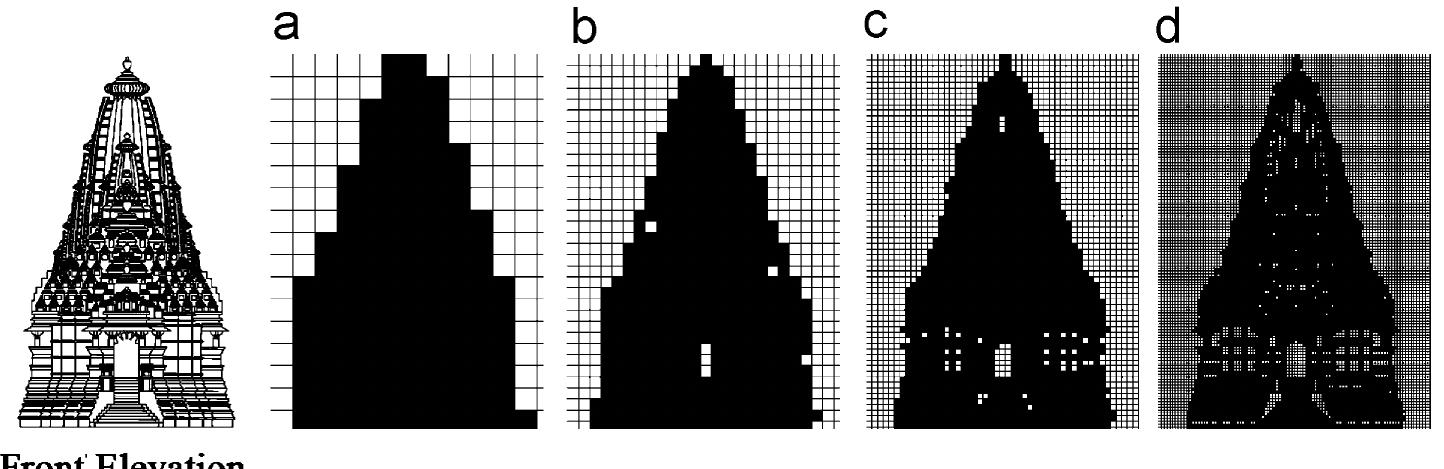
Now the same experiment has been done with the front
elevation by the same process. By employing the same
Fig. 13. Whole in a part in the shikhara: (a) whole body of shikhara above computer software (Box Counting Demonstration) on the
the sanctuary; (b) self similar part of the whole shikhara; and (c) self front elevation (Fig. 17) the following results are obtained
similar smaller part of the whole shikhara. shown in Table 6 (Graph 6).
Fig. 14. Box counting operation of the shikhara ‘Fig. 13a’. Extreme left—Shikhara, ‘Fig. 13a’; (a) grid size 24; (b) grid size 12; (c) grid size 6; and (d) grid
size 3.
Fig. 15. Box counting operation of the part of shikhara ‘Fig. 13b’. Extreme left—part of shikhara, ‘Fig. 13b’; (a) grid size 24; (b) grid size 12; (c) grid size 6;
(d) grid size 3.
� ARTICLE IN PRESS
I. Md Rian et al. / Building and Environment 42 (2007) 4093–4107 4103
Fig. 16. Box counting operation of the smaller part of shikhara ‘Fig. 13c’. Extreme left—Smaller part of shikhara, ‘Fig. 13c’; (a) grid size 24; (b) grid size
12; (c) grid size 6; and (d) grid size 3.
Table 3 4
Step Grid size ðSÞ Marked boxes ðNÞ Log ðSÞ Log ðNÞ 3.5
1 24 133 1.380 2.124 3
y = -1.8336x + 4.6737
2 12 485 1.079 2.686 2.5
3 6 1744 0.778 3.242
log (N)
4 3 6123 0.477 3.787 2
1.5
1
Table 4 0.5
Step Grid size ðSÞ Marked boxes ðNÞ Log ðSÞ Log ðNÞ
0 0.5 1 1.5
1 24 123 1.380 2.090 log (s)
2 12 443 1.079 2.646
3 6 1608 0.778 3.206 Graph 4. Fractal dimension 1.83.
4 3 5537 0.477 3.743
4
Table 5 3.5
Step Grid size ðSÞ Marked boxes ðNÞ Log ðSÞ Log ðNÞ 3
y = -1.7970x + 4.5723
1 24 122 1.380 2.086 2.5
log (N)
2 12 434 1.079 2.637 2
3 6 1533 0.778 3.186
4 3 5078 0.477 3.706 1.5
1
0.5
4
0 0.5 1 1.5
3.5
log (s)
3
y = -1.8422x + 4.6702 Graph 5. Fractal dimension 1.80.
2.5
log (N)
2
1.5
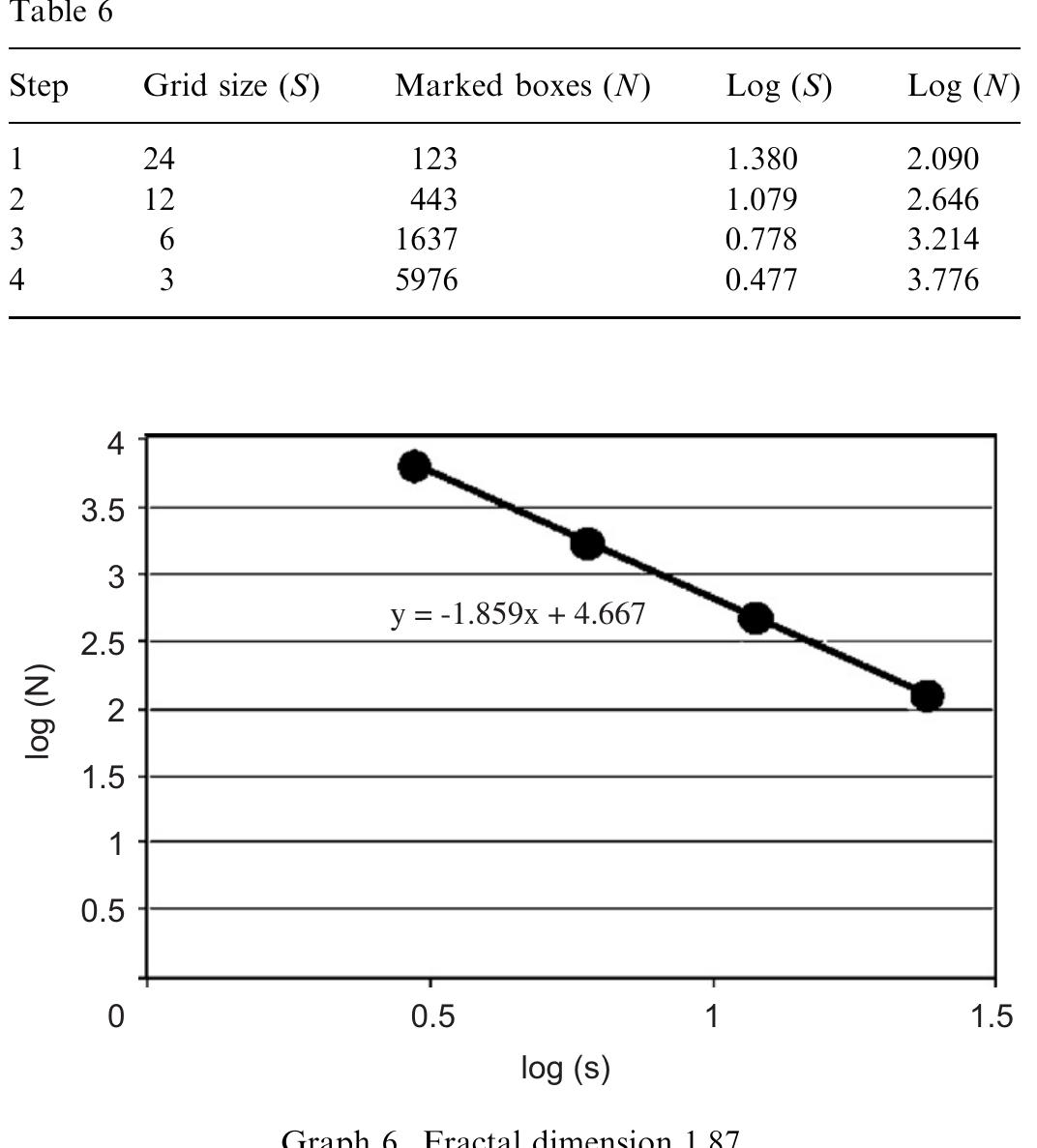
From the slope it is obtained that it has fractal
dimension 1.87 which is higher but near about similar to
1 that of whole shikhara (above sanctuary) and its self similar
0.5 parts within the shikhara (i.e., ‘a’, ‘b’ and ‘c’ in ‘Fig. 13’),
and its resulted smooth straight line in the graph describes
0 0.5 1 1.5
its uniformity of details. Thus it is observed that not only
from the distinctive part, shikhara, but also from the whole
log (s)
elevation one can experience the consistent degree of details
Graph 3. Fractal dimension 1.84. from anywhere outside.
� ARTICLE IN PRESS
4104 I. Md Rian et al. / Building and Environment 42 (2007) 4093–4107
Fig. 17. Box counting operation of the front elevation. Extreme left—front elevation; (a) grid size 24; (b) grid size 12; (c) grid size 6; and (d) grid size 3.
Table 6
Step Grid size ðSÞ Marked boxes ðNÞ Log ðSÞ Log ðNÞ
1 24 123 1.380 2.090
2 12 443 1.079 2.646
3 6 1637 0.778 3.214
4 3 5976 0.477 3.776
4
3.5
3
y = -1.859x + 4.667
2.5
log (N)
2
1.5
1
0.5
Fig. 18. Elevations and plans of: (a) Shikhara of Adinatha temple (900
AD); (b) Shikhara of Paraswanatha temple (950 AD); and (c) Shikhara of
0 0.5 1 1.5 Kandariya Mahadev temple (1050 AD).
log (s)
the same time this process is guided by the shape of
Graph 6. Fractal dimension 1.87.
foundation (Figs. 19 and 20).
5.3. Details
These unique fractal characters on the whole body of
shikhara above the sanctuary of Kandariya Mahadev The abundance of details in the temple of Kandariya
temple are born by the process of iteration from a single Mahadev not only makes the temple highly fractal in terms
central tower which is known as unipratiti. Shikhara of of roughness, but also displays the theme of godly beings
Adinatha temple (900 A.D.) as the unipratiti and the who are the important characters in Hindu cosmology and
shikhara of Paraswanatha temple (950 A.D.) as the result of philosophy. Numbers of figures displaying sexual gestures
third iteration of unipratiti are the evidences for production on the temple fabrics symbolizes the creation. In other
of the shikhara of Kandariya Mahadev temple. In this words, the smallest details of the temple carry the concept
process, self-similar smaller towers are generated along its of creation. Naked eyes go to the tiniest details up to some
four sides. Then again it produces smaller towers around its level, but the story or the images of the gods makes a
three sides outwards. It continues up to five steps and gets passage of spiritual journey for the ‘third eye’ (power of
the final form of whole shikhara as multipratiti (Fig. 18). imagination) to perceive further to the eternity. Though
Motifs of shikhara are the lotus petals. Shikhara is also the geometrically the details are not the exact repetitions of its
image of lotus blossom which symbolizes the creation as it parent body of the temple, but it repeats the same concept/
sprouts from Vishnu’s navel. It is the symbol of purity. The theme of the body.
budding of multipratiti shikhara as the iteration follows the Tiniest figures give the impression of paramanu (atom),
process of germination of lotus flower from its bud and at the smallest time unit, the consciousness which acts as the
� ARTICLE IN PRESS
I. Md Rian et al. / Building and Environment 42 (2007) 4093–4107 4105
Fig. 19. Plan of shikhara. Development of the multipratiti shikhara of Kandariya Mahadev temple from unipratiti by the process of iteration.
Fig. 20. Development of multipratiti shikhara as the multi square-prisms from a single square-prism by repeating the smaller scaled self-similar prism
outwards.
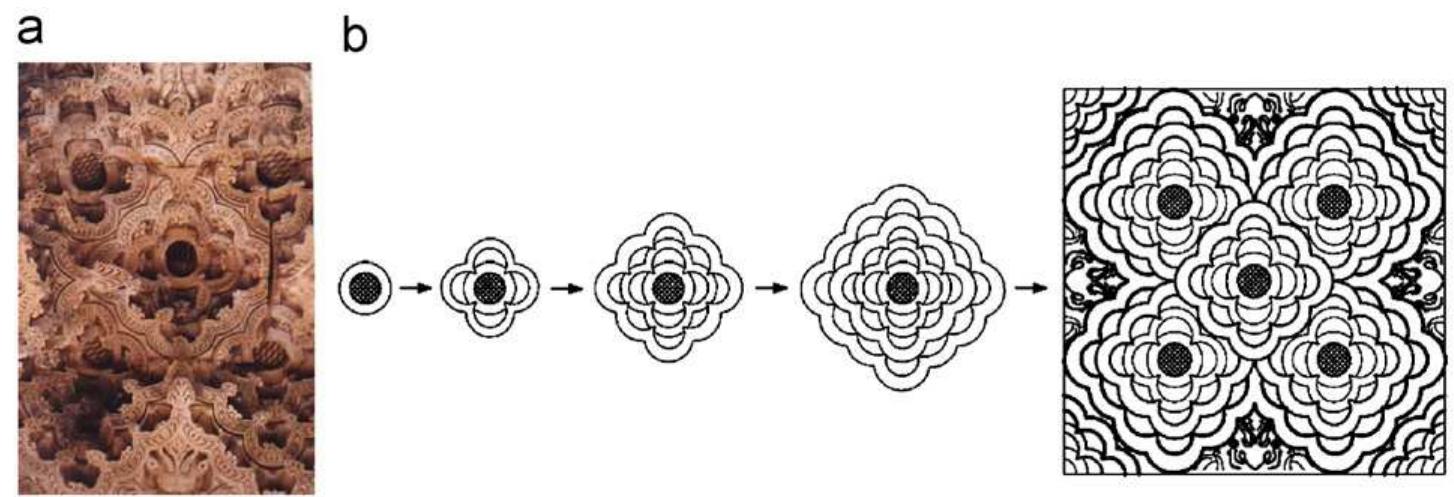
Fig. 21. (a) Ceiling of mandapa in Kandariya Mahadev temple (source: internet); and (b) development of the pattern of ceiling panel in Kandariya
Mahadev temple from a bud by the process of iteration.
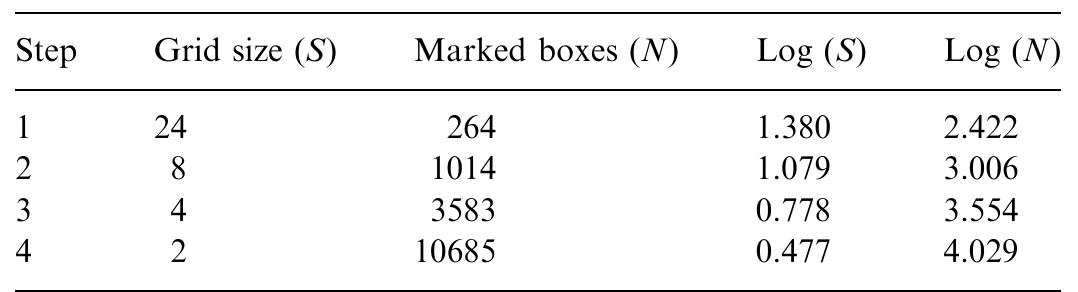
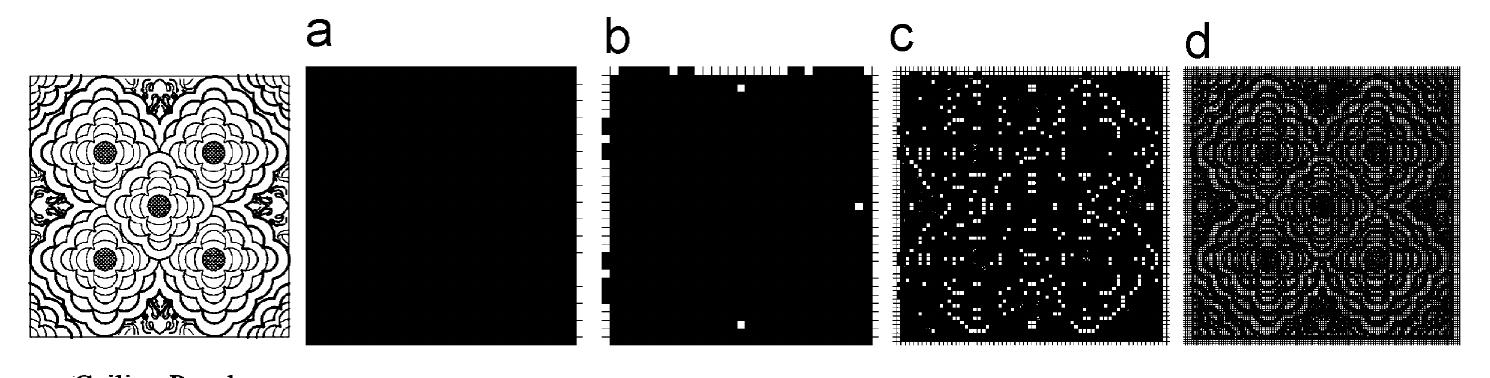
microcosm of the largest time unit, cosmos. Like the analyze the consistency of degree of details in the whole
exterior, the interior of Kandariya Mahadev temple is also structure, the ‘Box Counting Demonstration’ software has
full of figuristic and floral details in which figuristic details been employed. In this case, the image size of a part of
protects the sanctuary from demons and floral details ceiling details has been taken as 50 mm � 50 mm with the
depicts the cosmic events. On the ceiling of this temple, the resolution 80 pixels=cm (Fig. 22). By taking the grid sizes
floral pattern of panels is most noteworthy for depicting 16, 8, 4 and 2 the following results are obtained as shown in
the cosmos where, again, fractal takes the main role for Table 7 (Graph 7).
depiction. Here the combination of some ceiling panels From the slope it is obtained that it has fractal
makes the pattern such a way that it seems the flowers are dimension 1.78 depicting high degree of details and its
blossomed from buds recursively. From each bud four smooth curve as straight line depicts the uniformity of
petals are bloomed then from four petals eight petals are details in the panel.
generated and again from this eight petal-flower a 12 petal Fractal pattern of the plan of Kandariya Mahadev
bloom is born. Here the bloom depicts the creation of temple, replicas of detailed towers, and rhythmic growth of
universe from the lotus bud sprouting from the navel of horizontal friezes, create a harmony of fractal characters in
Vishnu. Each bloom from a single bud is stratified by the whole complex. High level of details in everywhere of
making the level difference. These differences of levels and the temple adds fractal flavor of roughness throughout the
concentric floral patterns make a passage for the spiritual structure.
journey to the unit ness of infinity and thus help the man to Fractal dimensions of the plan of Kandariya Mahadev
practice for getting the ultimate liberation (Fig. 21). temple, its elevation, parts of the elevation and smaller
The ceiling panels are also finely detailed which maintain details are ranging from 1.7 to 1.8, which confirms the high
the degree of skillful roughness in the whole complex. To fractal value of the whole temple complex from any view
� ARTICLE IN PRESS
4106 I. Md Rian et al. / Building and Environment 42 (2007) 4093–4107
Fig. 22. Box counting operation of the ceiling panel. Extreme left—ceiling panel; (a) grid size 24; (b) grid size 12; (c) grid size 6; and (d) grid size 3.
Table 7 temples evidence the deep relationship between the
fractal geometry and the deepest truth, which is being
Step Grid size ðSÞ Marked boxes ðNÞ Log ðSÞ Log ðNÞ
rediscovered in the contemporary architecture. Thus, the
1 24 264 1.380 2.422 ‘past’ present in the future and ‘future’ contained in the
2 8 1014 1.079 3.006 ‘past’ [16].
3 4 3583 0.778 3.554 Although, in modern architecture some buildings such as
4 2 10685 0.477 4.029
Frank Lloyd Wright’s prairie houses and Antonio Gaudi’s
buildings reflect the fractal characteristics with their gentle
and organic complexity, but their key element of complex-
4.5 ity were shaded by the trend of ‘‘simple and brute forms’’
4
of the modern architecture. However, temple architecture
was not strongly influenced by the modern architecture and
3.5 continues its strong and strict guidelines of design by
3 reflecting traditional fractal properties. Perhaps, Lotus
y = -1.7837x + 4.9089 temple (1986) in Delhi for the Baha’i communities is an
2.5
exception that sheds a new light of the possibility of using
log (N)
2 the fractal geometry wrapped by modern form, of course
1.5 by achieving its religious, philosophical and functional
requirements. After coining the term ‘fractal’ and setting
1
up some mathematical formulas, now it has a great
0.5 possibility to experiment about the refining of conventional
temple-form or searching for new form of complexity
0 0.2 0.4 0.6 0.8 1 1.2 1.4 1.6 related with Hindu cosmology with the consideration of
log (s) ritual guides.
The decline of using the fractal geometry in modern
Graph 7. Fractal dimension 1.78. architecture became soon eradicated by the strong affec-
tion towards the chaos and complexity in contemporary
point. Whereas the smooth curve in the log–log graph for architecture. For searching the new, complex, fractal and
each part of the temple confirms the uniformity of details in chaotic forms in the contemporary architecture, on the one
the temple structure from any point of view by naked eyes. hand, manual experiments of architectural elements with
To sum up, Hindu temple is not the abode of God but the fractal geometry are extensively practiced. On the other
the form of God and since it was strictly suggested to be the hand, by adopting the theories of folds, fractals, chaos,
microcosm of cosmos, all Hindu temples have the common complexity and algorithms, ‘computer architecture’ has
basic characteristics along with some unique features. been developed that translates the theories into the
These unique features of Hindu temples, exhibited fractal architecture [13].22 Accordingly, the fractal geometry not
properties and complex form, act as the signature of Hindu
art and architecture. This paper has presented Kandariya 22
Mahadev temple at Khajuraho as the icon of Hindu For example, by using the drafting tools, fractal geometry has been
applied manually for the plan of Zvi Hecker’s Galinski School of Berlin
temples. (1995). In the plan Zvi Hecker manifested sunflower by arranging the
Modern architecture lacks fractalness and complexity, classrooms as the repetition of bent triangular petals of various scales with
and carries the ‘‘simple and brute forms.’’ But Jencks [24] their spiraling ‘celestial construction’, reflecting the dynamic beauty of
believes that there has been a ‘paradigm shift’ in the Tornado and spiral rhythm. Besides, Lab Architects’ Federation Square at
contemporary architecture. According to him ‘‘fractals, Melbourn (2002) is another example where ‘computer architecture’
produced the elegancy and complexity of fractal on the facade by using
wave forms and the structure of the cosmos will be resonated the right-angled triangle as a single motif and the Pinwheel grid, thus
with the new buildings’’ which indicates the replication of enhancing the beauty of complexity in the architecture, and harmonizing
Hindu temples but in a different way. In this paper Hindu the building with the complex pattern of city fabric.
� ARTICLE IN PRESS
I. Md Rian et al. / Building and Environment 42 (2007) 4093–4107 4107
only analyzes the old buildings and the existed urban [11] Volwahsen A. Living architecture: Indian. London: Macdonald;
patterns and growth, but also helps to create a countless 1969.
[12] Kumar N. The Hindu temple—where man becomes God. The
unimaginable forms and patterns for finding new possibi-
cultured traveler, 2005; vol. 7; December.
lities of space as well as aesthetic in contemporary [13] Lorenz WE. Fractals and fractal architecture. Vienna, Vienna
architecture. University of Technology; 2003. hhttp://www.iemar.tuwien.ac.at/
modul23/Fractalsi.
Acknowledgment [14] Arnheim R. Art and visual perception. Los Angeles: University of
California Press; 1954.
[15] Mehta RJ. Masterpieces of Indian temples. Bombay: D.B. Tarapor-
This work was supported by an Inha University research evala Sons; 1974.
grant. [16] Elliot TS. Four quarters 1. Burnt Norton 1935.
[17] Ostwald MJ and Moore RJ. Fractal architecture: a critical
References evaluation of proposed architectural and scientific definitions.
In Kan WT, editor. Architectural science, informatics and
[1] Bovill C. Fractal geometry in architecture and design. Boston: design (shan-Ti: Chinese University in Hong Kong; 1996.
Birkha¨user; 1996. p. 137–48.
[2] March L. From sky-scraping to land-hugging. The Journal of the [18] Bangura AK. Review of African fractals: modern computing and
National University of Singapore, special issue The City (10) indigenous Design. Nexus Network Journal 2000; 2(4).
December, 1992. p. 12–9. [19] Salingaros NA. Ecology and the fractal mind in the new Architecture
[3] Ostwald M. Fractal architecture: late 20th century connections KHANEH Quarterly 2003; 4, 5.
between architecture and fractal geometry. Nexus Network Journal, [20] Frankhauser P. Comparing the morphology of urban patterns in
Winter 2001; 3(1). Europe — a fractal approach. Europoean Cities — insights on
[4] Batty M, Longley P. The fractal city. In: Mapelli EG, editor. AD, outskirts, Report COST Action 10 Urban Civil Engineering, vol 2,
Urban environments. New York: Wiley-Academy; 2001. structures. 2004. p. 79–105.
[5] Mandelbrot BB. The fractal geometry of nature. New York: W. H. [21] Stiny G, Gips J. Shape grammars and the generative specification of
Freeman and Company; 1982. painting and sculpture. IFIP Congress. Amsterdam: North Holland;
[6] Thomas D. Architecture and the urban environment: a vision for the 2nd ed. 1972.
new age, 1st ed. Architectural Press; June 2002. [22] Mehta RJ. Masterpieces of Indian sculpture. Stosius Inc/Advent
[7] Jencks C. The architecture of the jumping universe. New York: Books Division; June 1979.
Wiley; 1997. [23] Kalfazade N. Diagrammataic potency of the ‘‘Nine Square
[8] Jackson WJ. Heaven’s fractal net: retrieving lost visions in the Grid’’ in architectural design. Masters thesis. The Graduate
humanities. Indiana University Press; 2004. School of Natural and Applied Sciences, Middle East University,
[9] Steirlin H. Architecture of the world: India. Compagnie du Livre d’ June 2004.
Art, S.A.; 1996. [24] Jencks C. The new paradigm in architecture, (seventh edition of The
[10] Michell G. The Hindu temple: an introduction to its meaning and Language of Post-Modern Architecture). London, New Haven: Yale
forms. Chicago: University of Chicago Press; 1988. University Press; 2002.
�


 Iasef Md Rian




![Fig. 6. (a) ‘Field of forces’ within the square ((4]; redrawn by the author); (b) radiation of forces from 9-squares grid ((23]; redrawn by the author); (c) radiation of forces from 81-squares grid.](https://figures.academia-assets.com/34055232/figure_008.jpg)