Roma e le province del Danubio
Atti del I Convegno Internazionale
Ferrara - Cento, 15-17 Ottobre 2009
a cura di
Livio Zerbini
Rubbettino
II Convegno si e svolto sotto l'Alto Patronato della Presidenza della Repubblica Italiana
con il patrocinio dell'AIEGL, della Regione Emilia-Romagna,
della Provincia di Ferrara, del Comune di Cento
II volume e stato realizzato con il contributo del MIUR - PRIN 2008
Coordinamento redazionale: Sara Faccini
In copertina: Coronamento monumentale con acroteri e clipeo a ritratti, Brucla (Aiud)
© 2010 - Rubbettino Editore
88049 Soveria Mannelli - Viale Rosario Rubbettino, 10 - Tel. (0968) 6664201
www.rubbettino.it
The early urbanization ofNoricum and Pannonia
di Marjeta Sasel Kos
Universita di Lubiana
Aquileia and its hinterland
As is generally known, urbanization is an important feature of'Romaniza-
tion'1, which is closely related to the creation of a province with stable borders.
In the case ofNoricum and Pannonia, these borders were both external and in-
ternal, since their large sections along the Danube coincided with the frontiers
of the Empire. Both provinces also bordered on Italy and on each other, as well
as on other provinces, Noricum on Raetia, Pannonia on Dalmatia and Moesia2.
In addition, both provinces must have had well defined internal boundaries be-
tween various territories, public and private. The founding of a Latin colony at
Aquileia in 181 BC was of decisive significance for the Norican kingdom and
Pannonian regions, since this important Cisalpine emporium, which soon de-
veloped into a flourishing commercial and production city with a large agricul-
tural and stock breeding territory, was a starting point in establishing contacts
with hinterland regions across the Alps3. Wars, conquests, and the inevitable
spread of Roman influence went hand in hand. One main direction led towards
Virunum at Magdalensberg4, where a Roman emporium developed during the
proconsulship of Caesar, if not earlier5. The immigrants from Italy, who had
come to settle there - some on a permanent basis, some temporarily - were
mainly exploiting the famous Norican iron6, partly no doubt needed for Cae-
1 Alfoldy 2005; Bandelli 2009.
2 Alfoldy 1974 and Mocsy 1974 are still the basic reference books for these provinces. Also im-
portant are Noricum, 2002; Pannonia 1,2003; Pannonia II, 2004; Gassner, Jilek, Ladstatter 2002; Ban-
delli 2009a.
3 Cuscito (ed.), 2003.
4 Piccottini 2003; Dolenz 2008; for the name Virunum: Dobesch 1997.
5 See, for chronology, Bozic 2008,123 ff., with the relevant literature cited. See also Sedlmayer 2009.
6 Straube 1996; Dolenz 1998.
210
Marjeta Sasel Kos
sar's Gallic wars. Caesar's headquarters were then often at Aquileia7, and in the
second half of the first century BC the importance of the town-like agglomer-
ations at Concordia8, Forum Iulii9, and Iulium Carnicum10 greatly increased,
and other settlements in this part of Carnia also flourished.
Another important road crossed the Alps at Ocra Pass (Razdrto) below Mt.
Ocra (Nanos), where a small Roman road station has been discovered from the
end of the second century BC11. This road led to Nauportus, called a Tauriscan
settlement by Strabo (written in accusative as Pamporton and Nauponton)12, at
which, or, better, next to which a large vicus belonging to Aquileia was found-
ed, and it developed into a fortified Roman emporium13. It must have been so
well-urbanized that in the words of Tacitus it resembled a small town14. Nau-
portus was located on the navigable Nauportus River (the Ljubljanica) and rep-
resented an important reloading station on the way from Aquileia to Pannon-
ian-Celtic Segestica (next to Siscia, modern Sisak) at the confluence of the
Savus (the Sava) and Colapis (the Kolpa/Kupa) Rivers. At Nauportus the car-
goes were transferred from wagons to boats and conveyed to Segestica, from
where they were further transported on boats along the Savus to the Danubius
(Danube) at Singidunum and the Scordisci15. It has recently been shown that
the urbanization of Nauportus was quite remarkable: a large fortified area with
a forum, a sanctuary, and extensive storehouses, and a part of the settlement
that a generation later developed on the opposite side of the river16. The signif-
icance of the emporium was well reflected in the myth about the return of the
Argonauts from the Black Sea along the Danubius, Savus, and Nauportus17. Re-
cently, remains of the prehistoric Nauportus have been discovered, although
not from the Late Iron Age18.
The next significant station and emporium along the Nauportus River was
Emona. It, too, belonged to Italy, since the Nauportus-Emona basin was the key
area to protect the entrance to Italy, by securing or preventing passage through
7 Rossi 1981; Sasel Kos 2000.
8 Zaccaria 1995.
9 Vedaldi lasbez 2000.
10 Mainardis 2008.
11 Horvat, Bavdek 2009.
12 7. 5. 2 C 314; the name Nauportus may well have been a Latinized form of an epichoric
toponym.
13 Horvat 1990; Horvat, Music 2007.
14 Ann. 1. 20. 1; cf. Sasel Kos 1990.
15 Described and commented in the literature cited in the preceding footnotes.
15 Music, Horvat 2007.
17 Sasel Kos 2006.
18 Gaspari, Masaryk 2009.
The early urbanization ofNoricum and Pannonia
211
the most convenient pass leading from Illyricum to Italy at Postojna19. For this
reason it was also a good starting point for any military actions that were in-
tended to conquer Lower Illyricum (later Pannonia) and parts of Dalmatia, as,
for example, some areas inhabited by the Colapiani and Iapodes. Nauportus
and Emona were not only important temporary military posts during various
wars of conquest, they also played a significant role in Romanizing Noricum
and Pannonia, i.e. in spreading Roman cultural, economic, and political influ-
ence in provincial territories, where Roman civilization was in turn modified
by local cultures.
Noricum
The former regnum Noricum was possibly organized as a procuratorial
province during the reign of Caligula20, in whose name gold bars were pro-
duced at Virunum on Magdalensberg21, or, better, under Claudius22, but other
suggestions have also been advanced recently. Some claim that the province
had been founded under Tiberius, basing their opinion variously on literary,
epigraphic, and archaeological evidence23. An important argument in favour of
this thesis is the known passage in the Roman History of Velleius Paterculus,
in which he stated, referring to several wars Tiberius had successfully conduct-
ed under Augustus, that "Raetia, the Vindelici and the Norici, as well as Pannon-
ia and the Scordisci, had been annexed to the Roman Empire as new provinces by
Tiberius"24.
However, as has rightly been pointed out by Geza Alfoldy, perhaps unjus-
tified weight was attached to Velleius 'use of terminology, and the passage may
have been misunderstood by modern scholarship, since within a later context,
referring to Tiberius' preparations for the war against the kingdom of Marobo-
duus in AD 6, Velleius mentioned that the winter camp of the Roman army was
located at Carnuntum in the Norican kingdom25. Recently Herbert Grassl pro-
posed that Velleius 'first passage actually referred to the Augustan period and
19 Sasel Kos 2003.
20 Barrett 1989, 224.
21 Piccottini 1994: (aurum) C(aii) Caesaris Aug(usti) Germanici imp(eratoris) ex Noricfis
metallis).
22 Weber 1988, 611 ff.; Weber 2008.
23 Schaub 2001; Rollinger 2001, 281 ff.; cf. Sasel Kos 2005, 486 ff.
24 2.39.3: At Ti. Caesar, quam certam Hispanis parendi confessionem extorserat parens, Illy-
riis Delmatisque extorsit. Raetiam autem et Vindelicos ac Noricos Pannoniamque et Scordiscos no-
vas imperto nostro subiunxit provincias.
25 2.109.5; Alfoldy 1974, 62.
212
Marjeta Sasel Kos
the conquest of the Alpine peoples under Drusus and Tiberius in 15 BC26. A
small part of Noricum had partly been conquered at that time (the Ambisontes
at least, regardless of where exactly they had been settled, see infra), but most
of all the kingdom was then annexed to the Roman state. In the eyes of Velleius,
Noricum was a province, since the Latin word provincia has several mean-
ings27, one of which adequately corresponded to the actual position of Noricum
at that time.
It seems almost inevitable that the annexation of Noricum also included
those northern and western Pannonian regions around Savaria and Scarbantia
that had earlier been more or less dependent on the kingdom, or under strong
influence of the Norican king. As has been emphasized by Jeno Fitz, these ar-
eas were Celtic and in terms of ethnicity cannot be regarded as Pannonian2.
Alfoldy suggested that Noricum would have been at first governed or super-
vised by a praefectus, meaning that it would have been organized as a military
district in a similar way as Raetia and Vindelicia29. No doubt it was under pro-
tection of the Pannonian army. Indeed, a small vexillation of the Pannonian le-
gion VIII Augusta, which was stationed in Poetovio, was detached during the
Augustan period to Virunum at Magdalensberg30, where a part of the cohors
Montanorum prima also had a garrison; this unit had probably been recruited
in Noricum under Augustus31. Roman soldiers have been documented else-
where in Noricum at that time32.
Opinion prevails that Noricum became a province governed by a presidial
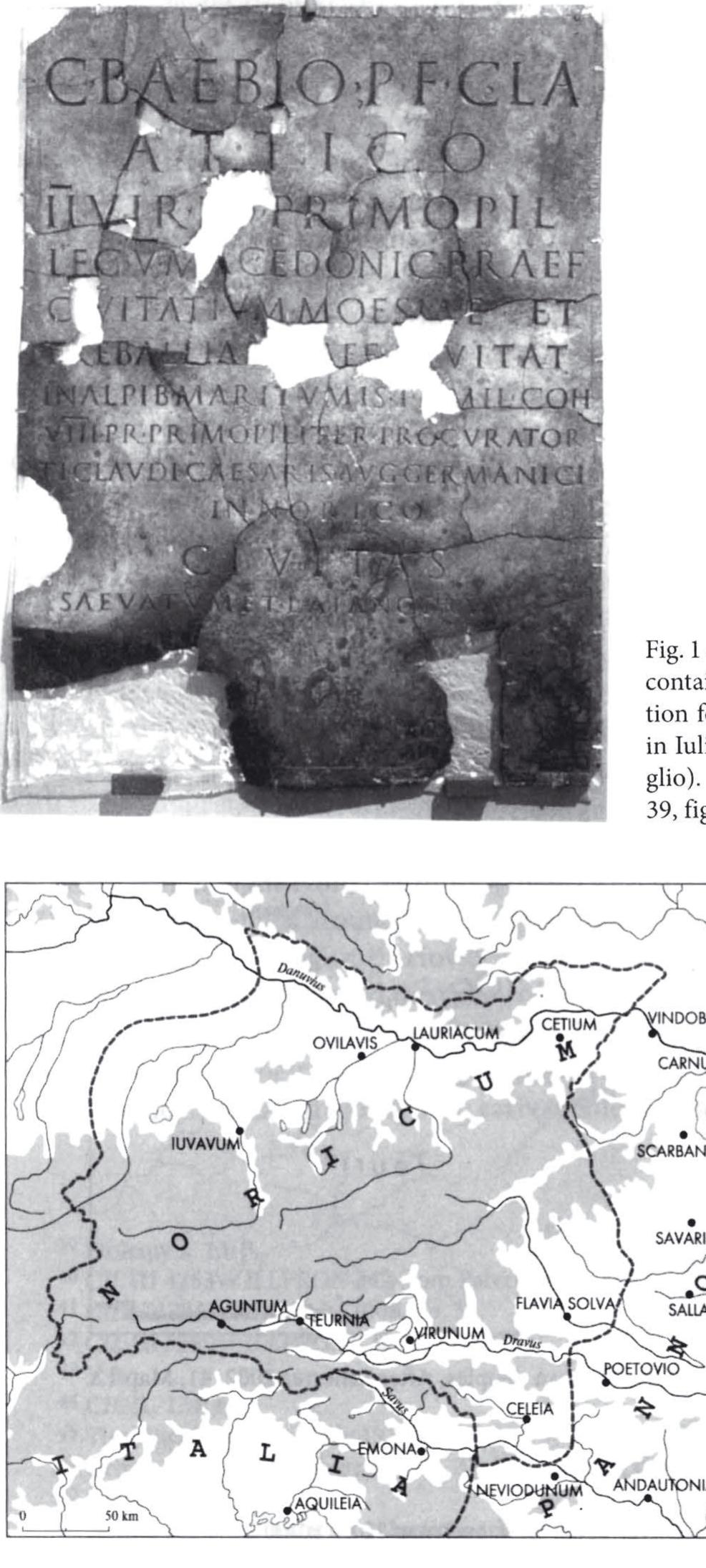
procurator at the latest under Claudius, when C. Baebius Atticus is attested as
a procurator (Fig. I)33. However, it is not quite certain whether he was a gover-
nor of the province or a financial procurator under Claudius, responsible for
the imperial patrimoniumu. In any case, five important Celtic oppida became
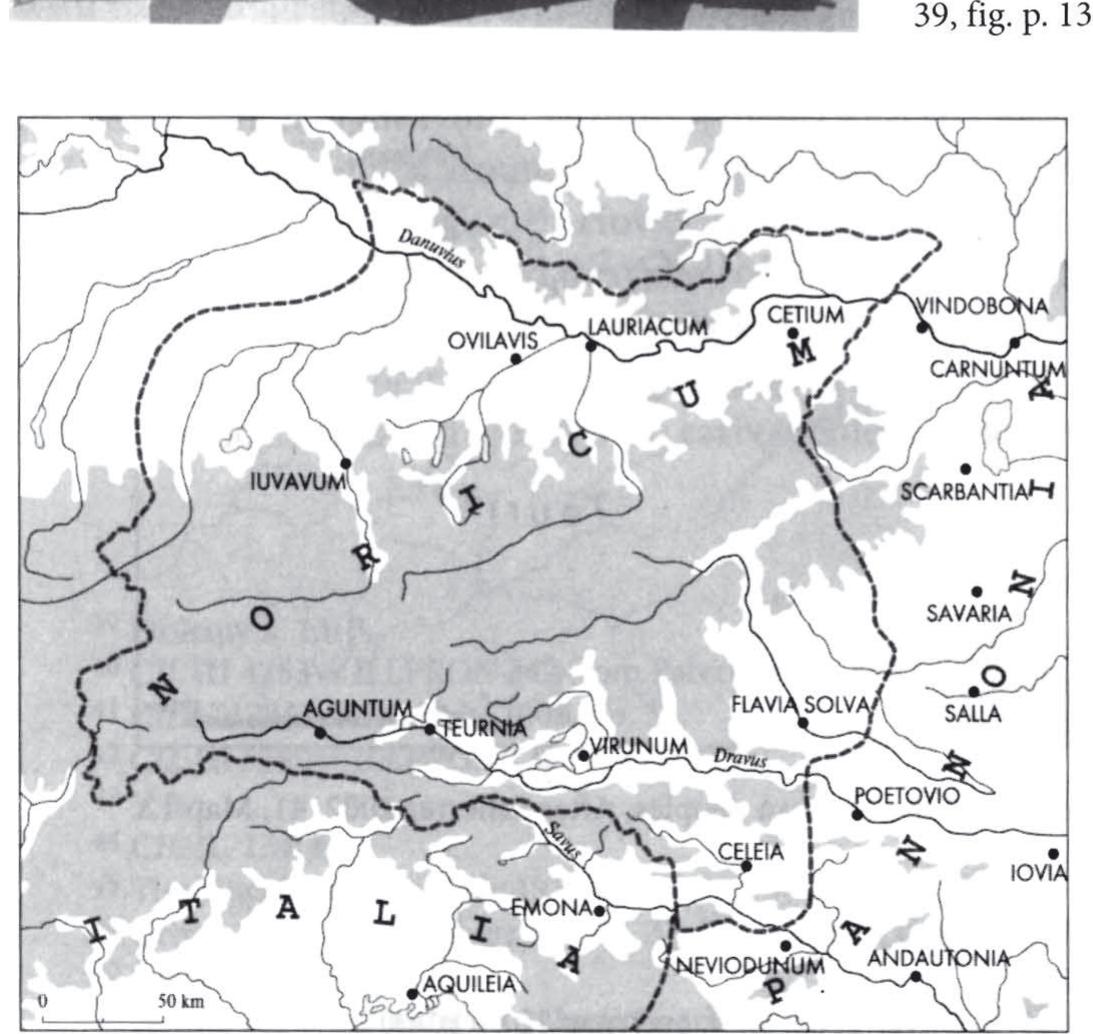
Roman municipia Claudia under Claudius: Celeia, Virunum, Teurnia, Agun-
tum, and Iuvavum (Fig. 2), enrolled in the voting tribe Claudia35. This makes
it clear that important administrative changes occurred in Noricum under this
26 Grafil 2008.
27 Wesch-Klein 2008, 5-7.
28 Pannonian: Mocsy 1979, 185; Celtic: Fitz 1993, 14; see also id., 1989-1990.
29 Alfoldy 1998, 13.
30 CIL III 4858 = ILS 2466.
31 CIL III 4847; Sasel 1986 (1992).
32 Alfoldy 1974, 64-66.
33 Alfoldy 1974, 62-63; 78-81; Sasel Kos 1997, 32-33; Weber 2008; for a different opinion,
see Scherrer 2002, 17.
34 Zaccaria 2001, 146-148; Mainardis 2008, 138-139.
35 Pliny, N. h. 3. 146; see on these towns Lazar 2002; Piccottini et al. 2002; Glaser 2002; Wal-
de 2002; Kovacsovics 2002. Briefly also Gassner, Jilek, in: Gassner, Jilek, Ladstatter 2002, 107 ff.
For the town magistrates and municipal administration in general, see Wedenig 1997.
The early urbanization ofNoricum and Pannonia
213
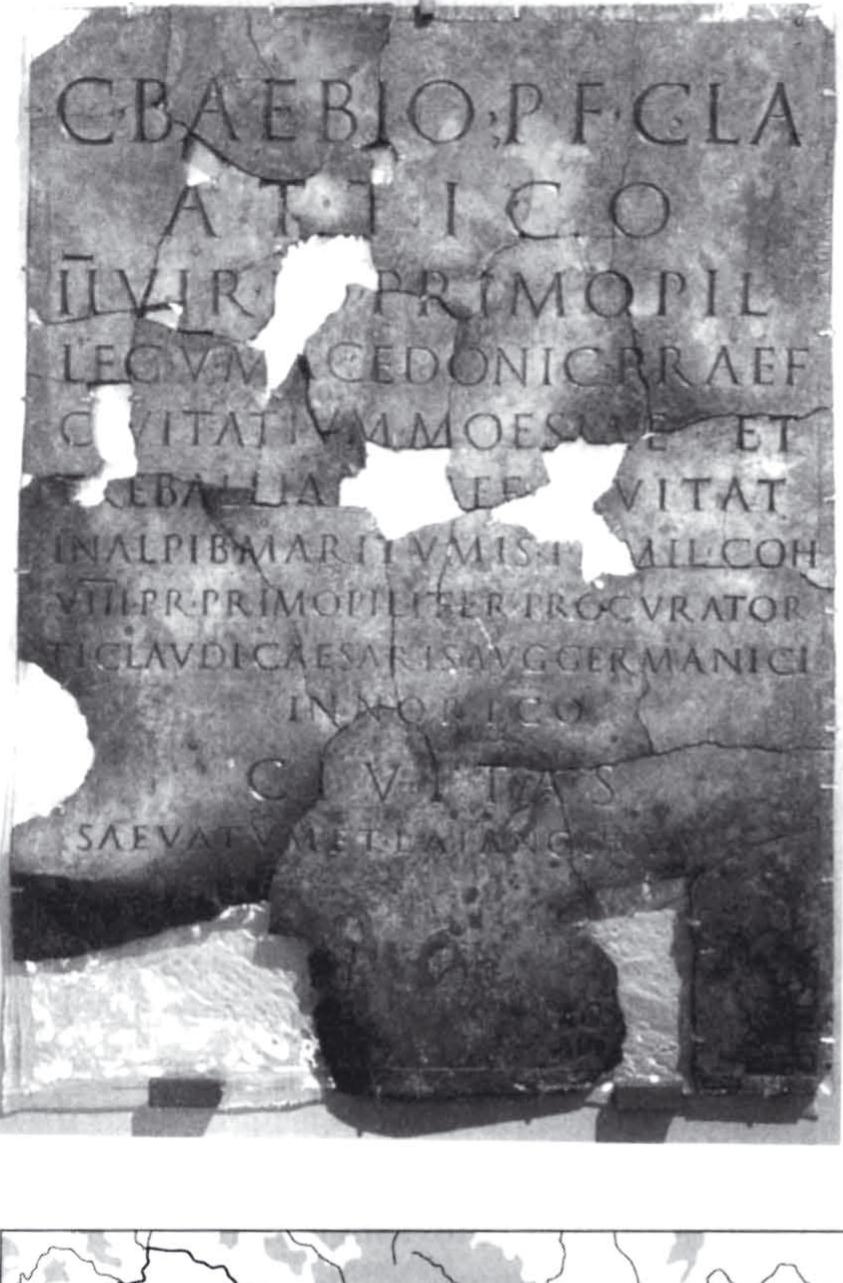
Fig. 1 - Fragment of a bronze tablet
containing the honorific inscrip-
tion for C. Baebius Atticus, found
in Iulium Carnicum (modern Zu-
glio). From Mainardis 2008, no.
39, fig. p. 136.
Fig. 2 - Towns in No-
ricum. From: Nori-
cum, 2002, pp. 8-9.
214
Marjeta Sasel Kos
emperor, plausibly suggesting that the administrative status of the former king-
dom had also been reorganized at the same time. The native Claudii are docu-
mented in those parts of southern Noricum that were hitherto poorly Roman-
ized, such as north of Zollfeld, in the upper Mur valley, and sporadically even
north of the Alps. Those native inhabitants who were not awarded Roman citi-
zenship or did not become cives possessing Latin rights (Latium minus) - and
these were no doubt the majority - were organized in civitates peregrinae, of
which nine are known by name: the Norici, Ambilini, Ambidravi, Uperaci, Sae-
vates, Laianci, Ambisontes, Elveti, Alauni. An interesting suggestion has been
put forward that eight Norican peoples, mentioned as dedicators in the inscrip-
tions erected at Virunum on Magdalensberg around 10/9 BC in honour of Au-
gustus' wife Livia, his daughter Iulia, and his granddaughter of the same name36,
would approximately coincide with the territories of the five Claudian municip-
ia37. These peoples would have been all those just mentioned except the Alauni.
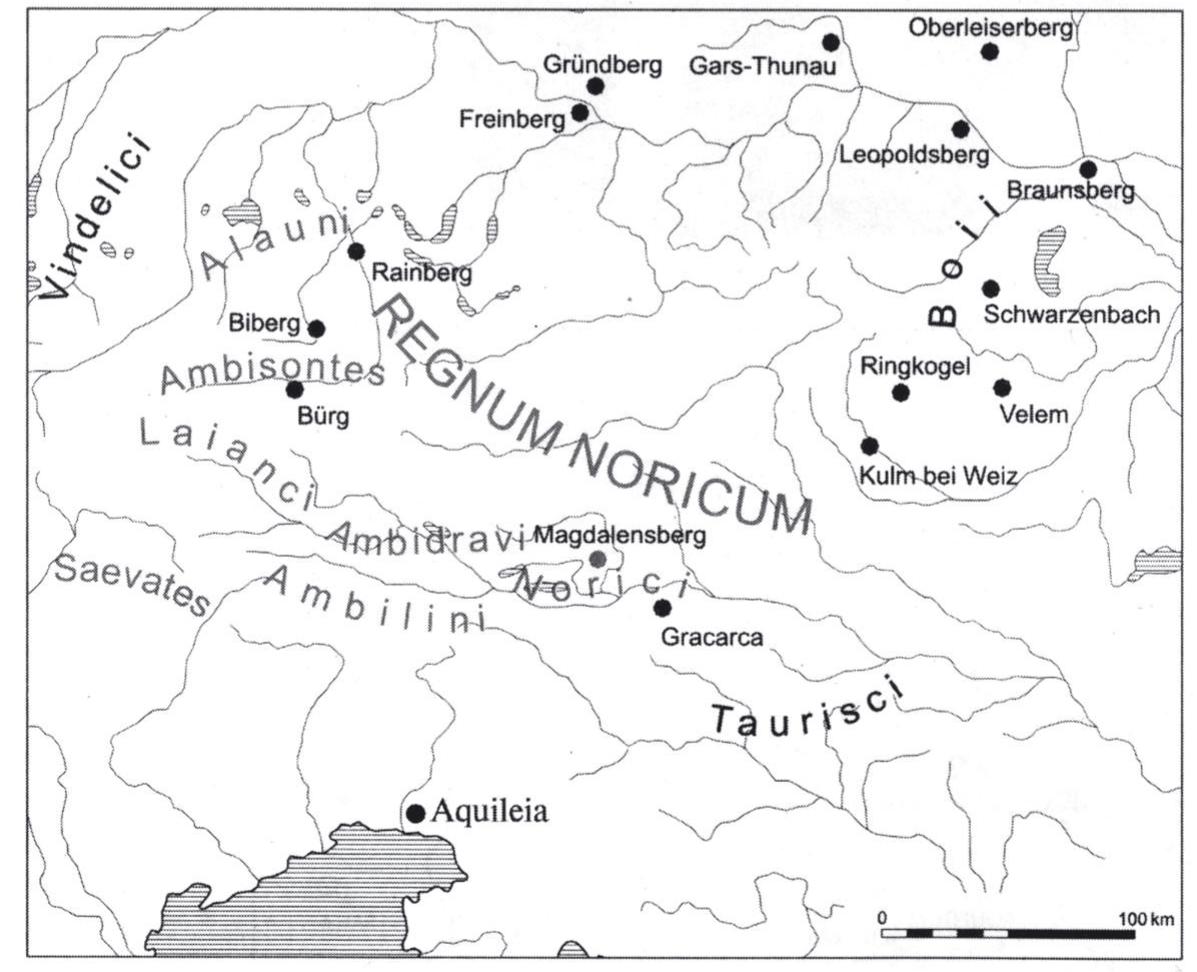
An attempt at locating the Norican peoples was made by Alfoldy and sup-
plemented by Peter Scherrer (Fig. 3)38. According to the latter, two civitates
Fig. 3 - (Hypothetic) location of the Norican peoples. After Scherrer 2002, 41, Map 12.
36 Sasel 1967 (1992); Piccottini 2005.
37 Scherrer 2002, 32 ff.
38 Alfoldy 1974, 66-69; Scherrer 2002, 32 ff. and map 12 on p. 41.
The early urbanization ofNoricum and Pannonia
215
would have been attributed to each municipium. Thus the Norici (settled be-
tween Santicum and Iuenna) and the Ambilini (dwelling in the Gail valley in
the region of Gurina, perhaps Ptolemy's Ilounon39) would have belonged to
Virunum. The Ambidravi would have been located along the Drava, with their
centre at Teurnia; as an argument in favour of this location, the funerary in-
scription of an auxiliary soldier from this area may be cited, whose name was
Ambidrabus40. Another people attributed to Teurnia would presumably have
been the Elveti, although there are no arguments for their location. The Laian-
ci and the Saevates south of them would have belonged to Aguntum; the name
'Saevates' is reflected in the toponym Sebatum (Saben) in southern Tirol. These
two peoples, who were indeed united in one civitas, had a bronze plate erected
to the procurator in Noricum, C. Baebius Atticus in his native Iulium Car-
nicum41. The Uperaci and the hypothesized Ambisavi would have belonged to
Celeia. However, a name Uperacus, which appears in a funerary inscription at
Solva42, would - in an analogous way to the mentioned Ambidrabus - rather
point to the location of the people in the region of Solva. It is not at all certain
that Upellis from the Tabula Peutingeriana43, the name of a settlement in the
territory of Celeia, along the road Celeia-Virunum (Stara vas pri Velenju),
could indeed be related to the Uperaci. On the other hand, the name Ambisavus
from Sevnica at the Sava River (the territory of Celeia)44, on the basis of which
the existence of the Ambisavi has been inferred45, would actually well accord
with their suggested location.
Austrian scholars locate the Ambisontes in the Salzach valley and Pinzgau in
the broad region of Iuvavum (Salzburg); these Norican people, as well as the Alau-
ni (living in the regions around the Chiemsee Lake), would have been attributed
to the territory of Iuvavum46. However, according to Jaroslav Sasel, the Am-
bisontes would have inhabited the valley of the Aesontius (the Soca/Isonzo), par-
ticularly around Kobarid, Most na Soci, and Idrija, where prehistoric settlement
is well attested47. Their location is controversial because in the region of the
Salzach, which was called Igonta in an early medieval source48, Norican settlement
39 Ptolemy 2. 13.3.
40 CIL III 4753 = ILLPRON 342 from Paternion.
41 CIL V 1838 = Mainardis 2008, no. 39.
42 CIL III 5390 = ILLPRON 1360 = RISt 213.
43 V 2.
44 CIL III 13406.
45 Thus ingeniously Alfoldy 1974, 60.
46 Urban 2000, 346 f.; Scherrer 2002, 32; Kovacsovics 2002, 166-167.
47 Sasell972 (1992).
48 Notitia Arnonis, in the introduction; see Sasel 1972, 140 (1992, 293).
216
Marjeta Sasel Kos
has also been well documented49. In 16 BC some Norici and Pannonians had in-
vaded Histria, but were repulsed by the proconsul of Illyricum, P. Silius Nerva50.
His military actions, also directed against certain peoples in the Alps, preceded the
Alpine campaigns of Drusus and Tiberius in 15 BC, no doubt contributing a great
deal towards their great success51. In the case Sasel's hypothesis is accepted, the in-
vading Norici may well have been the Ambisontes, which would make it under-
standable that they appeared on the Tropaeum Alpium at La Turbie as the only de-
feated Norican people.
In Scherrer's opinion the Aesontius valley and the surrounding area would
have been too far south from the centre of the Norican kingdom, and also too
small, so that a people living there could hardly have opposed the Roman
state52. However, both arguments can be countered. If Iulium Carnicum and
Upper Carniola had once been in the Norican kingdom, then why could not
the Kobarid - Most na Soci area? And if in fact Mt. Ocra represented the
boundary between Italy and Noricum, as is stated in Ptolemy53, then this area
actually was part of the kingdom. Strabo, too, noted that some of the Norici and
the Carni were settled as far to the southwest as the Adriatic and Aquileia54.
Most probably this was the region from where the Galli Transalpini descended
into the Aquileian plain in 186 BC to found a town55. And it should be added
that these Galli are usually regarded as having belonged to the Norican king-
dom56. And most of all, there, too, hoards and coins such as those coined in the
kingdom and among the Taurisci have been found in not negligible quanti-
ties57.
And the second argument: any place could resist Roman rule and revolt, or
even invade a neighbouring territory, if the need arose; thus for example Castel-
lum Larignum in Cisalpina revolted under Caesar. Needless to say, any such re-
bellion or incursion was instantly put down by the Romans. It may be conclud-
ed that the location of the Ambisontes still remains open, but the scale seems
to be tipping to the Soca/Isonzo valley. As has been seen, the location of some
of the Norican peoples is far from certain, and consequently also the thesis of
49 Moosleitner 2004; Hoglinger 2004; the latter interestingly noted that on the three hillfort
settlements, presented by him, no traces of destruction could be observed. Reinhold Wedenig
kindly drew my attention to these two articles.
50 Cassius Dio, 54.20.1-2.
51 Sasel Kos, 2005, 484-485.
52 Scherrer 2002, 32.
53 3. 1. 1.
54 4. 6. 9 C 206,
55 Sasel Kos 1997, 21 ff.; thus already Cassola 1979 (1994, 294-295).
56 Alfoldy 1974, 28 ff.; Dobesch 1980.
57 Kos, Zbona Trkman 2009.
The early urbanization ofNoricum and Pannonia
217
two peoples having been attributed to each of the Claudian municipia must re-
main hypothetical58.
Mention should be made of the pag(i) mag(istri), who are known from a
dedication to Maromogius, discovered in the sanctuary of Latobius at Burgstall
near St. Margarethen in Lavanttal in eastern Carinthia, within the territory of
Virunum59. These were chief magistrates of a group of hamlets composing a vil-
lage-like community, apagus, as opposed to the vicus, a village as a central set-
tlement. The institution of the pagi or vici magistri is most probably Roman; vi-
ci magistri are known from Iulium Carnicum, probably dating to the period of
Caesar, before Iulium Carnicum developed into a Roman city, and when it may
still have been close to Noricum. Magistri vici are also documented in Naupor-
tus, a village of Aquileia, probably from the same time. The sanctuary, howev-
er, and the settlement in the St. Margarethen area no doubt reflect a prehistoric
settlement pattern60.
An interesting case is Savaria, since this town, too, was a Claudian founda-
tion, a colonia Claudia; perhaps the town had at that time still been in Noricum
and was then transferred to Pannonia (see infra). Solva became a municipium
under Vespasian, while northern Noricum was not urbanized at all in the first
century AD. There, less intensive Romanization is well reflected also in the lack
of the so-called epigraphic habit61. Ovilavis and Cetium became autonomous
towns as late as under Hadrian {municipia Aelia), and the process of urbaniza-
tion came to an end under Caracalla, when the civil settlement outside the le-
gionary fortress of Lauriacum was raised to municipal rank, and Ovilavis be-
came a Roman colony62. With the constitutio Antoniniana under the same em-
peror the process of urbanization, as it had been conceived in the Augustan age,
partly came to an end throughout the Roman Empire.
Pannonia
It has long been erroneously believed that urbanization in Pannonia began
under Tiberius, who would have founded colonia Iulia Emona, whose inhabi-
tants were inscribed in the voting tribe Claudia63. However, the city can in all
respects, notably geographical, political, and administrative, be regarded as a
58 See also Wesch-Klein 2008, 252-253.
59 Weber 1985, 652-655; Piccottini et al. 2002, 112; Groh, Sedlmayer 2007.
60 See the preceding footnote.
61 Alf61dy2005,26-27.
62 See on these towns the contributions of Hudeczek 2002; Scherrer 2002; Miglbauer 2002;
Ubl 2002.
63 Saria 1938; cf. Sasel, Weiler 1963-1964 (1992). See Fitz 2003.
218
Marjeta Sasel Kos
border town between Italy on the one side and Noricum and Pannonia on the
other, and this specific position was emphasized by Ptolemy. According to him,
Emona was located "between Italy and Pannonia, below Noricum", or: "between
(that part of) Italy (which is situated) below Noricum, and Pannonia"M. That it
administratively belonged to Pannonia was soon doubted, and it has been hy-
pothesized that Emona had been part of Italy much earlier than the second cen-
tury AD, when this is actually confirmed in the sources65. Nonetheless, it has
generally been believed that the city belonged to Pannonia66. Recently, the pre-
viously expressed doubts proved thoroughly justified, when a boundary stone
between Aquileia and Emona was found in the Ljubljanica River (the Naupor-
tus) near Bevke, some 13 km to the southwest of Ljubljana, confirming that
Emona had belonged to the Tenth Italian Region already in the Augustan age,
and had most probably never been part of Illyricum or later Pannonia67. But re-
gardless of the discovery of the boundary stone, which offered undisputable
proof for this, enough arguments had earlier been collected in favour of Emona
having belonged to Italy from its existence as a Roman colony onwards, i.e. ear-
ly under Augustus or even soon after the battle at Actium in 31 BC68.
The urbanization of Pannonia (formerly Illyricum, and since the end of the
Pannonian-Dalmatian rebellion most probably called Lower Illyricum)69 had
not begun before Vespasian, who founded the first municipia and colonies. He
may have done this as a reward for political and logistic, and possibly even mil-
itary support of these communities in the course of his struggle for power70, al-
though in the case of Noricum and Pannonia this does not seem so obvious.
On the other hand, however, the fact that Vespasian founded colonies and
awarded municipal rights to the towns in Pannonia certainly represented the
first important phase of urbanization, which was ultimately expected to occur
after an interval of three generations had passed since the Augustan conquest71.
Whereas the urbanization of southern Noricum was carried out by Claudius
three generations after the annexation of the kingdom in 15 BC, this same
process correspondingly took place in Pannonia a generation later, counting
64 1.16; 2.14.5; 8.7.6 (ed. Nobbe). The cited sentence is from the last passage. The second
version of the translation is favoured by Grafil 1994, 519.
65 Thus already Th. Mommsen, CIL III, p. 483; Sasel 1968, 564-565; 573 (1992, 572-573;
577); id. 1989 (1992), where earlier literature is cited; Sasel Kos 2003.
66 See Sasel Kos 2003, with the literature cited.
67 Sasel Kos 2002a; ead. 2002b.
68 Sasel 1989 (1992); Sasel Kos 2003.
69 See, for slightly differing opinions, Nagy 1970; Sasel 1989 (1992); Fitzl996; Kovacs 2008.
70 Sasel 1983 (1992).
71 Sasel 1980 (1992).
The early urbanization ofNoricum and Pannonia
219
from AD 9, when Tiberius ended the great Pannonian-Dalmatian rebellion af-
ter four years of war. Whether or not the process would have been hastened by
the loyalty of these communities to the partes Flavianae is open to conjecture.
The Flavian towns in Pannonia had all grown out of the settlements along
the two main routes, the ancient Amber Route and the main road across II-
lyricum, connecting the Apennine with the Balkan peninsulas72. The first led
from the Baltic regions rich in amber across barbaricum to Carnuntum, Poet-
ovio, and Celeia to Emona, where it merged with the other route that ran par-
allel to the river route along the Danube, Sava, and Ljubljanica, and was linked
to the legend of the Argonauts. From Emona the road led further to Italy
through the geographically most convenient 'gate between the two peninsulas
(the Balkan and the Apennine) at Postojna. The Flavian towns along the so-
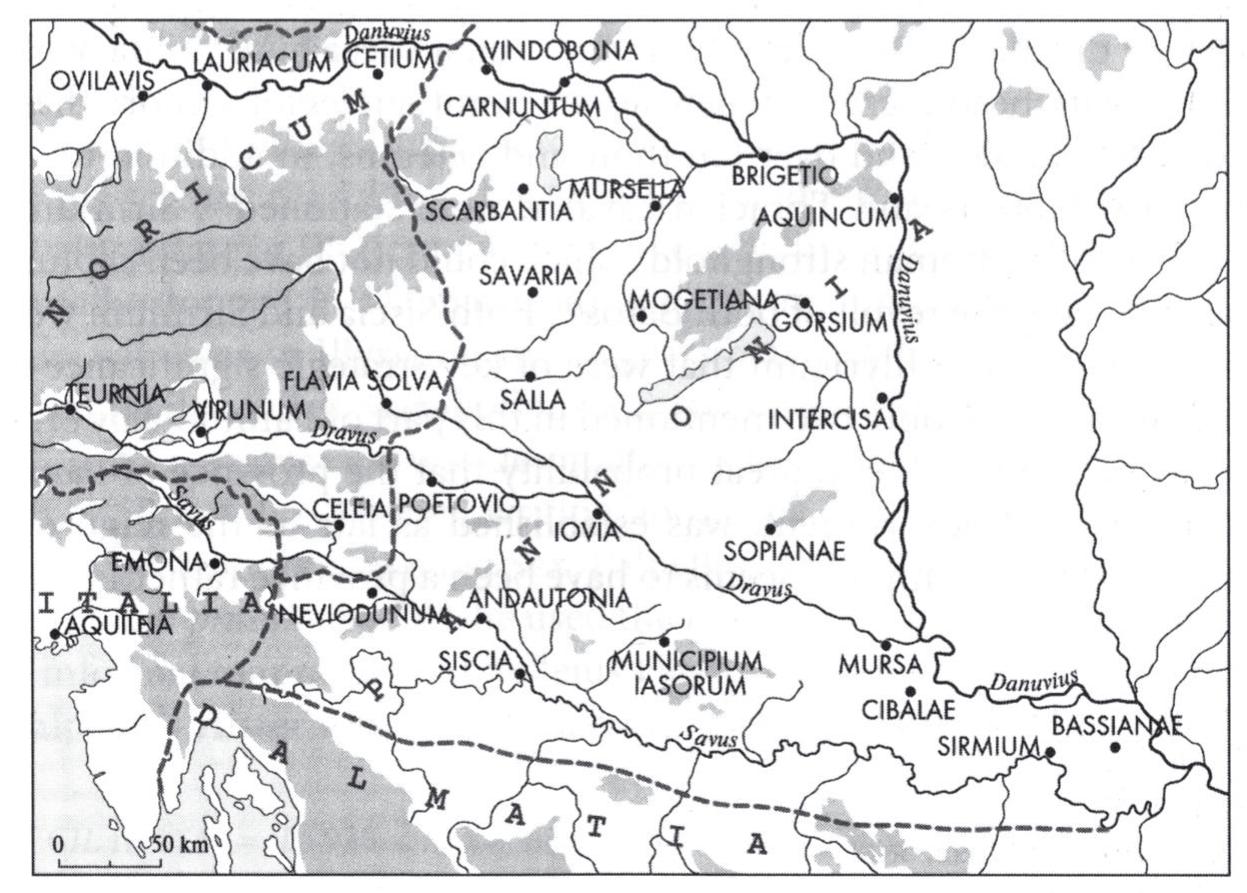
called route of the Argonauts were Neviodunum, Andautonia, Siscia, Sirmium,
their voting tribe having been Quirina. The first two were municipia, the oth-
er two colonies (Fig. 4). It should be noted, however, that Andautonia was in-
deed situated along the Sava River, but not on the same main road as Nevio-
dunum and Siscia; rather, it was located along the road connecting Siscia with
Poetovio73.
Fig. 4 - Towns in Pannonia. From: Pannonia I, 2003, pp. 8-9.
72 SaselKos 1997, 34 ff.
73 See on the town Sasel 1970 (1992); Nemeth-Ehrlich, Kusan Spalj 2003.
220
Marjeta Sasel Kos
Scarbantia, which was also a Flavian municipium, and whose inhabitants,
too, were inscribed in the same voting tribe, was situated along the Amber
Route. This town developed in a different way from the others, since it may
have belonged, like Savaria, to the Norican kingdom until Claudius74, or was at
least close to the kingdom and within its sphere of influence. Many Roman
colonists, mainly merchants and craftsmen from northern Italy, had settled in
the town before Claudius. Pliny the Elder called it oppidum Scarbantia Iulia, in
a passage in which he mentioned that Noricum extended as far as Pelso Lake
(Balaton), the deserted regions of the Boii, the colony of divus Claudius,
Savaria, and Scarbantia7.
Jeno Fitz hypothesized that the municipia Neviodunum and Andautonia
had developed out of former auxiliary camps76; in any case both towns must
have been most important as fluvial harbours, and in war-time also as ports for
the Roman navy. They must have played a significant role during the first phase
of Octavian's Illyrian Wars, directed against the Iapodes and Segestani. And
both were no less important during Tiberius' Pannonian war and the Pannon-
ian-Dalmatian rebellion77. On the other hand, there is evidence that military
camps preceded the foundations of colonia Flavia Siscia and colonia Flavia Sir-
mium. Octavian, after having captured Segesta/Siscia in 34 BC, left two and a
half legions there78, and the town was a military camp during Tiberius' Pan-
nonian war; during the great rebellion, however, it was a huge military base, as
well as Tiberius' headquarters, where at one point ten legions, more than sev-
enty cohorts, ten alae, and over ten thousand veterans, in addition to a great
number of volunteers and Thracian cavalry, were stationed79. Sirmium, too,
was a well fortified Roman stronghold, which could not have been captured by
the enemy during the revolt of both Batos80. Both Siscia and Sirmium were the
two early fortresses in Illyricum that were of key strategic significance to the
Romans, and also the only two mentioned in this part of Pannonia by Strabo81.
It may be supposed with great probability that the province of Pannonia,
based on civil self-government, was established as late as the reign of Ves-
pasian82. Until then Pannonia seems to have been a province rather in terms of
74 Differently Kovacs 2008, 238-239.
75 N. h. 3. 146.
76 Fitz 2003, 50.
77 Sasel 1970, 74 (1992, 581).
78 Sasel Kos 2005,441-442.
79 Veil. Pat. 2. 113. 1.
80 See now on the revolt Sasel Kos 2009.
81 7. 5. 2 C 314; see on these two towns, Lolic 2003; Mirkovic 2004.
82 Toth 1980; Sasel 1989, 57-60 (1992, 690-693); contra Fitz 1993, 126, basing his opinion
on incorrect premises; and recently also Kovacs 2008.
The early urbanization ofNoricum and Pannonia
221
a military district (Lower Illyricum), known in official texts under the name of
Illyricum, and placed under the command of a legatus exercitus. The division
into an upper and - consequently - a lower province is confirmed by a honorif-
ic inscription from Epidaurum, erected to the governor in the Dalmatian part
of Illyricum under Tiberius, P. Cornelius Dolabella83, while the denomination
'Dalmatia' and 'Pannonia' seems to have been informal. However, it was in use
ever since the end of the Pannonian-Dalmatian rebellion; this is well confirmed
by Velleius Paterculus, who acted as Tiberius' officer during this war. In the last
year of the uprising, in AD 9, when he mentioned the military successes of Ger-
manicus and C. Vibius Postumus in the Dalmatian part of Illyricum, he re-
ferred to Postumus as praepositus of Dalmatia84.
If only a few documents are cited in which the province is called Illyricum
after AD 9, it may be concluded that Illyricum was its official name, both in
cases when the entire province was meant, and also when only Dalmatia or
Pannonia were actually referred to. Only some years after the great rebellion
had been quelled, when Augustus composed the text commemorating his
deeds {res gestae), he claimed that he had subdued to the Roman rule, through
Tiberius Nero who was then his stepson and legate, certain Pannonian peoples
that had not been reached yet by a Roman army. In the course of the war against
the Pannonians, he "extended the frontier of Illyricum as far as the Danube"85.
By his words, "protulique fines Illyrici ad ripam fluminis Danuvii", probably the
course of the river near the confluence of the Sava and the Danube should be
understood, since the entire Pannonia had not yet been conquered.
In the senatus consultum about Cn. Calpurnius Piso pater, of December 10,
AD 20, his estate in Illyricum is mentioned; on his way back from Asia to Italy
he actually stopped in Dalmatia, hoping to come into personal contact with
Drusus, who was in Illyricum in the years between 17 and 20, on his second
mission after the fall of Maroboduus86. Some time during the reign of Claudius,
ca. 43-51 AD, a governor was designated as legatus Augusti pro praetore in Il-
lyricum87. But when Tacitus, writing about the Suebian king Vannius, men-
tioned that Claudius contacted Sex. Palpellius Hister, who governed Pannonia
("Pannoniam praesidebaf')^, he used the names Pannonia and Dalmatia in the
same informal manner as did Velleius Paterculus even for a much earlier peri-
od. Palpellius Hister was legatus exercitus in Lower Illyricum.
83 CIL III 1741 = ILS 938: civitates superioris provinciae Hillyrici. See Bojanovski 1988; Gla-
vicic 2008, 45-48, fig. 1 on p. 46.
84 Veil. Pat. 2. 116. 2.
85 Mon. Ancyr. 30; Toth 1977.
86 Caballos, Eck, Fernandez 1996, 130.
87 CIL X 5182 = ILS 972: leg. divi Claudi in Illyrico.
88 Ann. 12. 29. 2.
222
Marjeta Sasel Kos
It is also true that historians notoriously used contemporary terminology.
But perhaps the province of Pannonia, too, was organized at the same time as
Noricum, that is, under Claudius89. However, even as late as in a military diplo-
ma recently discovered in Vukovar (Cornacum), of July 2, AD 61, auxiliary
units are mentioned as having been stationed in Illyricum under L. Salvidienus
Salvianus Rufus, who was actually the governor in Pannonia90, and on other
diplomas from the same time the province is also named Illyricum91.
The first Roman municipal foundation was Savaria, which became a colony
under Claudius, no doubt at the same time when the Norican oppida became
the Claudian municipia. The town had almost certainly still belonged to
Noricum at the time when it was awarded colonial rights, as had very likely
some other settlements along the Amber Route. Since Carnuntum is known to
have still been in the Norican kingdom in AD 9, there would have been two
suitable occasions for the transfer of some Norican towns along the Amber
Route to Pannonia. This must have happened either under Claudius, when
Noricum was urbanized and probably also became a procuratorial province92,
or, less likely, under Vespasian, when southwestern Pannonia was urbanized93.
The former occasion seems in fact the only possible one, since military logic
played a role in the decision to make Noricum an inermis provincia, while the
legions were all stationed in Pannonia, including the legionary camp at Car-
nuntum, which was in Pannonia at the latest in AD 50. When mentioning the
regnum Vannianum in Suebia, Pliny the Elder referred to the legionary winter
camp at Carnuntum in Pannonia94. This section of the Amber Route was in
Pannonia and was supervised by the Pannonian army95. Thus Savaria may be
regarded as the oldest autonomous city in Pannonia, where mainly the veter-
ans of the legion XV Apollinaris were settled.
Under Traj an, Poetovio ceased to be a legionary fortress of the XIII Gemina and
became a colonia Ulpia; the legion was transferred to Vindobona96. The province
was divided into Upper and Lower Pannonia. Under Hadrian, Salla became a mu-
nicipium97, and Mursa a colony98, both having developed out of previous military
89 Fitz 2003, 48-49.
90 Dusanic 1998, 51 ff.; Reidinger 1956, 42 no. 10.
91 CIL XVI 2 and 4; it should be placed in AD 61 instead of 60, since it is of the same date
of issue as the diploma from Vukovar, cf. RMDIV, pp. 390-391.
92 Fitz 1993, 16-19; see lastly Scherrer 2003, 53.
93T6th 1980.
94 N. h. 4. 80-81.
95 Ubl 2008.
96 Horvat et al. 2003. See briefly on Pannonian urbanization also Sasel 1989 (1992) and Fitz
2003.
97 Redo 2003.
98 Filipovic 2004.
The early urbanization ofNoricum and Pannonia
223
camps, as was often the case in Pannonia. Carnuntum and Aquincum were also
Aelian foundations, which were formerly settlements of the Boii and Eravisci re-
spectively, and then became municipia". This is less likely for Brigetio, which was
most probably a municipium under Caracalla100. Carnuntum and Aquincum were
seats of the governor and they became colonies under Septimius Severus, whom
they supported during his struggle for imperial power. Mogetiana was a Hadrian -
ic municipium, while this is not so certain for Mursella and Cibalae101; however, the
latter was surely a colony under the Seven. The town of Aquae Balizae, which was
also called Municipium Iasorum, perhaps became a municipium under Hadrian102.
Some settlements in Pannonia became autonomous cities late under the Severan
dynasty, such as Bassianae, which became a colony under Caracalla103. There are
towns which were municipia, but cannot be located, as for example Faustinianum
and Volg(-), and towns whose status is not entirely certain, such as Vindobona104,
Sopianae, which was a very important town and early Christian centre in the late
Roman period105, civitas Iovia (Botivo), and Gorsium106. The late urbanization of
this part of Pannonia, particularly along the Danube, also meant its late 'Roman-
ization', which experienced the heyday of prosperity during the Severan dynasty107.
My sincere thanks are due to Reinhold Wedenig for having kindly read the text and
offered useful comments and suggestions.
Literature
Abbreviations
Noricum, 2002: M. Sasel Kos, P. Scherrer (eds.), The Autonomous Towns of
Noricum and Pannonia I Die autonomen Stadte in Noricum
und Pannonien. Noricum (Situla 40), Ljubljana 2002
Pannonia I, 2003: M. Sasel Kos, P. Scherrer et al. (eds.), The Autonomous
Towns in Noricum and Pannonia I Die autonomen Stadte in
99 Kandler et al. 2004; Zsidi 2004; in general on Hadrian and cities: Boatwright 2000.
100Borhyet al. 2004.
101 Nagy 2004 (Mogetiana); Szonyi 2004 (Mursella); Iskra-Janosic 2004 (Cibalae).
102 Schejbal 2004.
103 Milin 2004.
104 Mader 2004.
105 Karpati et al. 2004,270-271.
106 Gregl, Migotti 2004 (Iovia); Fitz 2004 (Gorsium).
107Alf61dy 2005, 27-31.
224
Marjeta Sasel Kos
Noricum und Pannonien - Pannonia I (Situla 41), Ljubljana
2003.
Pannonia II, 2004: M. Sasel Kos, P. Scherrer et al. (eds.), The Autonomous
Towns in Noricum and Pannonia I Die autonomen Stadte in
Noricum und Pannonien - Pannonia II (Situla 42), Ljubl-
jana 2004.
Sasel, Opera selecta]. Sasel, Opera selecta (Situla 30), Narodni muzej Slovenije,
Ljubljana 1992.
Alfoldy, G., Noricum, Routledge & Kegan Paul, London, Boston 1974.
Alfoldy, G., "Die Ostaipenlander im Altertum. Regionalgeschichte und eu-
ropaische Geschichte", in «Tyche» 13, 1998, pp. 1-18.
Alfoldy, G., Romanisation - Grundbegriff oder Fehlgrijf? Uberlegungen zum
gegenwartigen Stand der Erforschung von Integrationsprozessen im Romi-
schen Weltreich, in Z. Visy (ed.), Limes XIX. Proceedings of the XIXth Intern.
Congress of Roman Frontier Studies held in Pecs, Hungary, September 2003,
Pecs 2005, pp. 25-56.
Alfoldy, G., Die Anfange der epigraphischen Kultur der Rbmer an der Donau-
grenze im 1. Jahrhundert n. Chr., in M. Mirkovic (ed.), Romische Stadte und
Festungen an derDonau (Akten der regionalen Konfernz Beograd 16-19 Ok-
tober2003), Beograd 2005, pp. 23-38.
Bandelli, G., Aquileia da "fortezza contra i barbari" a "emporio degli Iliri", in F.
Crevatin (ed.), I luoghi della mediazione. Confini, scambi, saperi (Fonti e
studiperla storia della Venezia-Giulia, Studi 18), Trieste 2009, pp. 101-126.
Bandelli, G, Note sulla categoria di romanizzazione con riferimento alia Vene-
tia e aU'Histria, in G. Cuscito (ed.), Aspetti eproblemi della romanizzazio-
ne.. Venetia, Histria e arco alpino orientate (Antichita Altoadr. 68), Editreg
SAS, Trieste 2009, pp. 29-69 (a).
Barrett, A. A., Caligula. The Corruption of Power, Batsford, London 1989.
Boatwright, M.T., Hadrian and the Cities of the Roman Empire, Princeton Uni-
versity Press, Princeton 2000.
Bojanovski, I., Ad CIL III, 1741, Obod kod Cavtata (Epidaurum) [Ad CIL III, 1741,
Obod bei Cavtat (Epidaurum)], in Arheoloska istrazivanja u Dubrovniku i
Dubrovackom podrucju (Archaeological Researches in Dubrovnik and its Sur-
roundings) (Izdanja hrvatskog arheoloskog drustva 12), Zagreb 1988, pp. 101-
110.
Borhy et al., Ergebnisse der 1992-1998 durchgefuhrten Ausgrabungen (Munizip-
ium, Legionslager, Canabae, Grdberfelder), in: Pannonia II, 2004, pp. 231-
251.
Bozic, D., Late La Tene-Roman cemetery in Novo mesto. Ljubljanska cesta and
Okrajno glavarstvo - Studies on fibulae and on the relative chronology of the
The early urbanization ofNoricum and Pannonia
225
Late La Tene period I Poznolatensko-rimsko grobisce v Novem mestu. Ljub-
Ijanska cesta in Okrajno glavarstvo - Studije o fibulah in o relativni kro-
nologiji pozne latenske dobe (Katalogi in monografije 39), Narodni muzej
Slovenije, Ljubljana 2008.
Caballos, A., W. Eck, F. Fernandez, Elsenadoconsulto de Gneo Pison padre, Uni-
versidad de Sevilla, Sevilla 1996.
Cassola, E, Lepopolazionipreromane del Friuli nellefonti letterarie, in Antichita
Altoadr. 15 (1979), pp. 83-112 (= id., Scritti di storia antica - Istituzioni e
politica II: Roma [Antiqua 68], Napoli 1994, pp. 273-296).
Cuscito, G. (ed.), Aquileia dalle origini alia costituzione del ducato longobardo.
Storia - amministrazione - societd (Antichita Altoadriatiche 54), Editreg,
Trieste 2003.
Dobesch, G., "Zu Virunum als Namen der Stadt auf dem Magdalensberg und
zu einer Sage der kontinentalen Kelten", in «Carinthia» I 187, 1997, pp.
107-128.
Dolenz, H., Eisenfunde aus der Stadt auf dem Magdalensberg (Karntner Muse-
umsschriften 75 - Arch. Forschungen auf dem Magdalensberg 13), Verlag
des Landesmuseums fur Karnten, Klagenfurt 1998.
Dolenz, H., "Die Ausgrabungen auf dem Magdalensberggipfel im Jahre 2006",
in Rudolfinum 2006, 2008, pp. 61-72.
Dusanic, S., "An Early Diploma Militare", in «Starinar» 49, 1998, pp. 51-62.
Filipovic, S., Colonia Aelia Mursa, in Pannonia II, 2004, pp. 157-168.
Fitz, J., Die Verwaltung Pannoniens in der Romerzeit I, Encyclopedia Publish-
ers, Budapest 1993.
Fitz, J., "Noricum und Pannonien zur Zeit der romischen Okkupation", in
«R6m. Osterreich» 17-18, 1989-1990, pp. 79-86.
Fitz, J., "Anderungen in der Verwaltung Pannoniens", in «Specimina nova» 12,
1996 (1998), pp. 127-138.
Fitz, J., Die Stadte Pannoniens, in Pannonia I, 2003, pp. 47-52.
Fitz, J., Gorsium, in Pannonia II, 2004, pp. 197-207.
Gaspari, A., R. Masaryk, "Na sledi prazgodovinskega Navporta. Gradisce na
hribu Ticnica na Vrhniki (Tracing the prehistoric Nauportus. The hillfort
on Ticnica hill near Vrhnika)", in «Arheoloski vestnik» 60, 2009, pp. 195-
206.
Gassner, V., S. Jilek, S. Ladstatter, Am Rande des Reiches. Die Romer in Oster-
reich (Osterreichische Geschichte 15 v. Chr. - 378 n. Chr., ed. H. Wolfram),
Ueberreuter, Wien 2002.
Glaser, E, Teurnia, in Noricum, 2002, pp. 135-147 (Bibliographie: M. Huber).
Glavicic, M„ "Epigrafska bastina rimskodobnog Epidaura (The Epigraphic
Heritage of Roman Epidaurum)", in «Archaeologia Adriatica» 2,1, 2008,
pp. 43-62.
226
Marjeta Sasel Kos
Grafil, H., Die Grenzen der Provinz Noricum - Probleme der Quellenkunde in
der antiken Raumordnung, in Stuttgarter Kolloquium zur historischen Geo-
graphic des Altertums 4, 1990, eds. E. Olshausen, H. Sonnabend (Geo-
graphica Historica 7), Adolf M. Hakkert, Amsterdam 1994, pp. 517-524.
Grafsl, H., Der Prozess der Provinzialisierung im Ostalpen- und Donauraum im
Bild der neueren Forschung, in C. Franek et al. (eds.), Festschrift fiir Erwin
Pochmarski (Veroffentlichungen des Instituts fiir Archaologie der Karl-
Franzens-Universitat Graz 10), Phoibos, Graz 2008, pp. 343-348.
Gregl, Z., B. Migotti, Civitas Iovia (Botivo), in Pannonia II, 2004, pp. 131-143.
Groh, S., H. Sedlmayer, Der Kultplatz des Latobius Maromogius auf dem
Burgstall bei St. Margarethen im Lavanttal, in F. W. Leitner (ed.), Gotterwel-
ten, Tempel, Riten, Religionen in Noricum, Landesmuseum Karnten, Kla-
genfurt 2007, pp. 31-34.
Hoglinger, P., Zum Problem der spatlatenezeitlichen-fruhromischen Sied-
lungskontinuitat auf Hohensiedlungen des oberen Salzach- und Saalachtales
im Pinzgau, Land Salzburg, in C.-M. Hussen W. Irlinger, W. Zanier (eds.),
Spatlatenezeit undfruhe romische Kaiserzeit zwischen Alpenrand und Donau.
Akten des Kolloquiums in Ingolstadt am 11. und 12. Oktober 2001 (Kolloquien
zur Vor- und Friihgeschichte 8), Rudolf Habelt, Bonn 2004, pp. 187-198.
Horvat,}., Nauportus (Vrhnika) (Dela 1. razr. SAZU 33), Slovenska Akademija
znanosti in umetnosti, Ljubljana 1990.
Horvat,}., A. Bavdek, Okra. Vrata med Sredozemljem in Srednjo Evropo I Ocra.
The Gateway between the Mediterranean and Central Europe (Opera Insti-
tuti arch. Sloveniae 17), Zalozba ZRC, Ljubljana 2009.
Horvat, J., B. Music, Nauportus, a commercial settlement between the Adriat-
ic and the Danube, in M. Chiaba, P. Maggi, C. Magrini (eds.), Le Valli del
Natisone e dell'Isonzo tra Centroeuropa e Adriatico (Studi e Ricerche sulla
Gallia Cisalpina 20), Quasar, Roma 2007, pp. 165-174.
Hudeczek, E., Flavia Solva. Entwicklung und Topographie, in Noricum, 2002,
pp. 203-212.
Iskra- Janosic, I., Colonia Amelia Cibalae. Entwicklung der Stadt, in Pannonia II,
2004, pp. 169-195.
Kandler, M. et al, Carnuntum, in Pannonia II, 2004, pp. 11-66.
Karpati, G. et al., Sopianae, in Pannonia II, 2004, pp. 269-294.
Kos, P., B. Zbona Trkman, "A Hoard of Roman Republican and Norican coins
from the vicinity of Kobarid (Zakladna najdba rimskih republikanskih in
noriskih novcev iz okolice Kobarida)", in «Arheoloski vestnik» 60, 2009,
pp. 271-282.
Kovacs, P., Some Notes on the Division of Illyricum, in J. Piso (ed.), Die Romi-
schen Provinzen. Begriff und GriXndung, Editura Mega, Cluj-Napoca 2008,
pp. 237-248.
The early urbanization ofNoricum and Pannonia
227
Kovacsovics, W. K., Iuvavum, in Noricum, 2002, pp. 165-201.
Lazar, I., Celeia, in Noricum, 2002, pp. 71-101.
Lolic, T., Colonia Flavia Siscia, in Pannonia I, 2003, pp. 131-152.
Mader, I., Vindobona. Die zivile Siedlung, in Pannonia II, 2004, pp. 67-83.
Mainardis, E, Iulium Carnicum. Storia ed epigrafia (Antichita Altoadr., Mono-
grafie 4), Editreg, Trieste 2008.
Miglbauer, R., Ovilavis, in Noricum, 2002, pp. 245-256.
Milin, M., Bassianae, in Pannonia II, 2004, pp. 253-268.
Mirkovic, M., Sirmium, in Pannonia II, 2004, pp. 145-156.
Mocsy, A., Pannonia and Upper Moesia, Routledge & Kegan Paul, London,
Boston 1974.
Mocsy, A., "Illyricum eszaki hatara Claudius elott (Die Nordgrenze Illyricums
vor Claudius)", in «Arch. ert.» 106, 1979, pp. 177-186.
Moosleitner, E, Zur Kontinuitat von der Spatlatenezeit zur friihen rbmischen
Kaiserzeit im Salzburger Land, in Hussen C.-M., W. Irlinger, W. Zanier
(eds.), Spatlatenezeit undfriihe romische Kaiserzeit zwischen Alpenrand und
Donau. Akten des Kolloquiums in Ingolstadt am 11. und 12. Oktober 2001
(Kolloquien zur Vor- und Friihgeschichte 8), Rudolf Habelt, Bonn 2004,
pp. 175-186.
Music, B., J. Horvat, "Nauportus - an Early Roman trading post at Dolge njive
in Vrhnika. The results of geophysical prospecting using a variety of inde-
pendent methods", in «Arheoloski vestnik» 58, 2007, pp. 219-270.
Nagy, M., Mogetiana, in Pannonia II, 2004, pp. 75-83.
Nagy, T, Der Aufstand der pannonisch-dalmatinischen Volker und die Frage der
Zweiteilung Illyricums, in Adriatica praehistorica et antiqua - Miscellanea
Gregorio Novak dicata, Arheoloski institut Filozofskog fakulteta, Zagreb
1970, pp. 459-466.
Nemefh-Ehrlich, D., D. Kusan Spalj, Municipium Andautonia, in Pannonia I,
2003, pp. 107-129.
Piccottini, G., "Gold und Kristall am Magdalensberg", in «Germania» 72,1994,
pp. 467-477.
Piccottini, G. et al, Virunum, in Noricum, 2002, pp. 103-134.
Piccottini, G., Virunum Vancienne: le site du Magdalensberg, in M. Redde et al.
(eds.), La naissance de la ville dans VAntiquite, De Boccard, Paris 2003, pp.
171-194.
Piccottini, G., Zu den augusteischen Ehreninschriften vom Magdalensberg, in E
Beutler, W. Hameter (eds.), "Eine ganz normale Inschrift"... und ahnliches
zum Geburtstag von Ekkehard Weber (Althistorisch-Epigraphische Studien
Bd. 5), Osterreichische Gesellschaft fur Archaologie, Wien 2005, pp. 389-
402.
Redo, E, Municipium Aelium Salla, in Pannonia I, 2003, pp. 53-80.
228
Marjeta Sasel Kos
Reidinger, W., Die Statthalter des ungeteilten Pannonien und Oberpannoniens
von Augustus bis Diokletian (Antiquitas Reihe 1, Abh. z. alten Gesch. 2), R.
Habelt, Bonn 1956.
Rollinger, R., Raetiam autem Vindelicos ac Noricos Pannoniamque et Scordis-
cos novas imperio nostra subiunxit provincias. Oder: Warm wurde Raetien
(einschliefilich Noricums und Pannoniens) als romische Provinz ein-
gerichtet?, in R W. Haider, R. Rollinger (eds.), Althistorische Studien im
Spannungsfeld zwischen Universal- und Wissenschaftsgeschichte. Festschrift
fur Franz Hampl zum 90. Geburtstag am 8. Dezember 2000, Steiner Verlag,
Stuttgart 2001, pp. 267-315.
Rossi, R. R, Cesare tra la Gallia edAquileia, in Aquileia e I'Occidente (Antichita
Altoadr. 19), Arti grafiche friulane, Udine 1981, pp. 71-87.
Saria, B., Emona als Standlager der Legio XV. Apollinaris, in Laureae Aquincens-
es 1 (Diss. Pann. 2, 10), Pazmany Peter Tudomanyegyetem, Budapest 1938,
pp. 245-255.
Schaub, A., "Die formliche Provinzkonstitution Raetiens unter Tiberius nach dem
Zeugnis des Velleius Paterculus", in «Germania» 79/2, 2001, pp. 391-400.
Schejbal, B., Municipium Iasorum (Aquae Balissae), in Pannonia II, 2004, pp.
99-129.
Scherrer, P., Vom regnum Noricum zur romischen Provinz: Grundlagen und
Mechanismen der Urbanisierung, in Noricum, 2002, pp. 11-70.
Scherrer, P. et al., Cetium, in Noricum, 2002, pp. 213-244.
Scherrer, P., Savaria, in Pannonia I, 2003, pp. 53-80.
Sedlmayer, H., Die Fibeln vom Magdalensberg. Funde der Grabungsjahre 1948-
2002 und Altfunde des 19. Jahrhunderts, Verlag des Landesmuseums fur
Karnten, Klagenfurt 2009.
Szonyi, E., Mursella, in Pannonia II, 2004, pp. 85-98.
Sasel, J., "Huldigung norischer Stamme am Magdalensberg in Karnten. Ein
Klarungsversuch", in «Historia» 16, 1967, 70-74 (= id., Opera selecta, pp.
280-284).
Sasel, J., Emona, in RE Suppl. XI (1968), cc. 540-578 (= id., Opera selecta, pp.
559-579).
Sasel, J., Andautonia, in RE Suppl. XII (1970), cc. 71-75 (- id., Opera selecta, pp.
580-582).
Sasel, J., "Zur Erklarung der Inschrift am Tropaeum Alpium (Plin. n.h. 3, 136-
137. CIL V 7817)", in «2iva antika» 22, 1972, pp. 135-144 (= id., Opera se-
lecta, pp. 288-297).
Sasel, J., Dreigenerationen-Intervall, in W. Eck, H. Galsterer, H. Wolff (eds.),
Studien zur antiken Sozialgeschichte. Festschrift Friedrich Vittinghoff. Kol-
ner Historische Abhandlung 28, Bohlau, Koln, Wien 1980, pp. 357-363 (=
id., Opera selecta, pp. 316-322).
The early urbanization ofNoricum and Pannonia
229
Sasel, J., Lafondazione delle citta Flavie quale espressione di gratitudinepolitica,
in "La citta antica comefatto di cultura", Atti del Convegno di Como e Bel-
lagio 16/19 giugno 1979. Regione Lombardia, Como 1983, pp. 79-91 (= id.,
Opera selecta, pp. 332-344).
Sasel, J., Cohors I Montanorum, in Studien zu den Militargrenzen Roms III.
Forschungen und Berichte zur Vor- und Friihgeschichte in Baden-Wurt-
temberg 20, K. Theiss, Stuttgart 1986, pp. 782-786 (= id., Opera selecta, pp.
478-482).
Sasel, J., Die regionale Gliederung in Pannonien, in G. Gottlieb (ed.), Raumord-
nung im Rbmischen Reich. Zur regionalen Gliederung in den gallischen Prov-
inzen, in Rdtien, Noricum und Pannonien, E. Vogel, Munchen 1989, pp. 57-
73 (= id., Opera selecta, pp. 690-706).
Sasel, J., "Zur verwaltungstechnischen Zugehorigkeit Emonas", in «Acta Arch.
Acad. Sc. Hung.» 41, 1989, pp. 169-174 (= id., Opera selecta, pp. 707-714.
Sasel, J., I. Weiler, "Zur Augusteisch-Tiberischen Inschrift von Emona", in «Car-
nuntum Jahrbuch» 8,1963/64, pp. 40-42 (- id., Opera selecta, pp. 277-279).
Sasel Kos, M., Nauportus: Literary and Epigraphical Sources, in J. Horvat, Nau-
portus (Vrhnika) (Dela 1. razr. SAZU 33), Slovenska akademija znanosti in
umetnosti, Ljubljana 1990, pp. 143-159.
Sasel Kos, M., Caesar, Illyricum, and the Hinterland ofAquileia, in G. Urso (ed.),
L'ultimo Cesare. Scritti, Riforme, Progetti, Poteri, Congiure (Monografie /
Centra ricerche e documentazione sull'ant. class. 20), "L'Erma" di
Bretschneider, Roma 2000, 277-304.
Sasel Kos, M., "The boundary stone between Aquileia and Emona", in «Arhe-
oloski vestnik» 53, 2002, pp. 373-382.
Sasel Kos, M., "II confine nord-orientale dellTtalia romana. Riesame del prob-
lema alia luce di un nuovo documento epigrafico", in «Aquileia nostra» 73,
2002, pp. 245-260.
Sasel Kos, M., Emona was in Italy, not in Pannonia, in Pannonia I, 2003, pp. 11-
19.
Sasel Kos, M., Appian and Illyricum (Situla 43), Narodni muzej Slovenije, Ljubl-
jana 2005.
Sasel Kos, M., A Few Remarks Concerning the archaiologia of Nauportus and
Emona: The Argonauts, in M. Kokole et al. (eds.), Mediterranean Myths
from Classical Antiquity to the Eighteenth Century I Mediteranski miti od an-
tike do 18. stoletja, Zalozba ZRC, Ljubljana 2006, pp. 13-20.
Sasel Kos, M., Mit geballter Macht. Die augusteischen Militdroffensiven im Il-
lyricum, in H. Kenzler et al. (eds.), 2000 Jahre Varusschlacht. Imperium,
Haltern am See, Theiss, Stuttgart 2009, pp. 180-187.
Straube, H., Ferrum Noricum und die Stadt aufdem Magdalensberg, Springer,
Wien, New York 1996.
230
Marjeta Sasel Kos
Toth, E., "... protulique fines Illyrici ad ripam fluminis Danuvii.", in «Arheolos-
ki vestnik» 28, 1977, pp. 278-287.
Toth, E., "Die Entstehung der gemeinsamen Grenzen zwischen Pannonien und
Noricum", in «Arheoloski vestnik» 31, 1980, pp. 80-88.
Ubl, H., Lauriacum. Die zivilen Siedlungsraume, in Noricum, 2002, pp. 257-276.
Ubl, H., "Die Bernsteinstrafie als Verkehrsweg des romischen Heeres", in
«R6misches Osterreich» 31, 2008, pp. 127-140.
Vedaldi Iasbez, V., Cesare, Forum Iulii e il confine nord-orientale delVltalia, in
G. Urso (ed.), L'ultimo Cesare. Scritti, Riforme, Progetti, Poteri, Congiure
(Monografie / Centro ricerche e documentazione sull'ant. class. 20), "L'Er-
ma" di Bretschneider, Roma 2000, pp. 329-352.
Walde, E., Aguntum, in Noricum, 2002, pp. 149-163.
Weber, E., Drei Inschriften aus dem Bereich der Austria Romana, in E. Weber,
G. Dobesch (eds.), Romische Geschichte, Altertumskunde und Epigraphik.
Festschrift fur Artur Betz zur Vollendung seines 80. Lebensjahres (Archaolo-
gisch-epigraphische Studien 1), Wien 1985, pp. 649-658.
Weber, E., Noricum und die "Verleihung des Provinzialstatus", in H. Valen-
tinitsch (ed.), Recht und Geschichte. Festschrift Hermann Baltl zum 70.
Geburtstag, Graz 1988, pp. 611-617.
Weber, E., Die Anfdnge der Provinz Noricum, in J. Piso (ed.), Die Romischen
Provinzen. Begrijf und Grundung, Editura Mega, Cluj-Napoca 2008, pp.
225-235.
Wedenig, R., Epigraphische Quellen zur stddtischen Administration in Noricum
(Aus Forschung und Kunst 31), Geschichtsverein fur Karnten, Klagenfurt
1997.
Wesch-Klein, G., Provincia. Okkupation und Verwaltung der Provinzen des Im-
perium Romanum von der Inbesitznahme Siziliens bis auf Diokletian (An-
tike Kultur und Geschichte 10), Lit, Wien, Berlin 2008.
Zaccaria, C., Alle origini della storia di Concordia romana, in P. Croce Da Villa,
A. Mastrocinque (eds.), Concordia elaX Regio. Giornate di studio in onore
di Dario Bertolini (Atti del convegno Portogruaro 1994), Zielo Editore,
Padova 1995, pp. 175-186.
Zaccaria, C., Iulium Carnicum. Un centro alpino tra Italia eNorico (Isec. a.C. -
I sec. d.C), in G. Bandelli, E Fontana (eds.), Iulium Carnicum: centro alpino
tra Italia e Norico dalla protostoria all'eta imperiale. Atti del Convegno, Ar-
ta Terme - Cividale, 29-30 settembre 1995 (Studi e Ricerche sulla Gallia
Cisalpina 13), Quasar, Roma 2001, pp. 139-157.
Zsidi, P., Aquincum. Ergebnisse der topographischen und siedlungshistorischen
Forschungen in den Jahren 1969-1999, in Pannonia II, 2004, pp. 209-230.


 Marjeta Šašel Kos