Academia.eduAcademia.edu

Outline

Syllable-final and syllable-initial /s/ reduction in Cali, Colombia Brown & Brown 2012

https://doi.org/10.31819/9783954870196-006

Abstract
sparkles

AI

This study examines the phonological reduction of syllable-initial and syllable-final /s/ in Colombian Spanish, particularly in the Cali region. Although initial /s/ reduction is less documented compared to final /s/ reduction, evidence suggests that dialects in this region exhibit significant variability in their use of /s/. The research aims to fill the gap in existing literature by providing a comprehensive analysis of this phonetic phenomenon, contextualizing it within broader linguistic trends and exploring its implications for understanding regional dialects of Spanish.

Key takeaways
sparkles

AI

  1. The study analyzes 11,517 tokens of initial and final /s/ from 38 speakers in Cali, Colombia.
  2. Syllable-initial /s/ reduction is 12%, while syllable-final /s/ reduction is 36%.
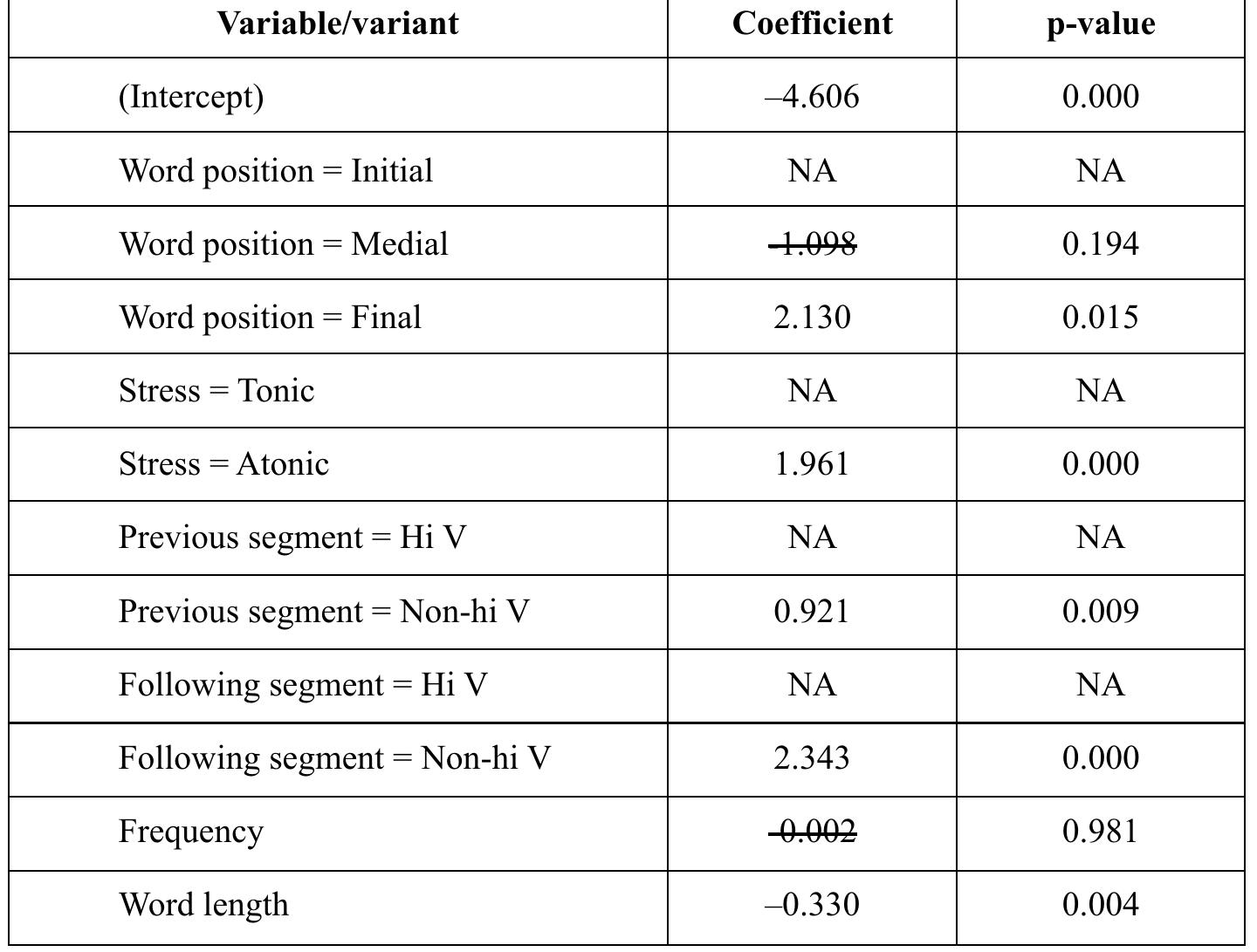
  3. Key linguistic factors include preceding segment, stress, word frequency, following segment, and word position.
  4. Initial and final /s/ reductions operate as separate phonological variables, not as extensions of each other.
  5. Future research should explore initial /s/ reduction in other Spanish dialects to address existing data gaps.
MURIEL/OROZCO 31/5/12 14:24 Página 1 R i ch ard J . F i l e-M u ri el R afael Oro zco (ed s . ) Colombia n Va r ie tie s of Spa nish MURIEL/OROZCO 31/5/12 14:24 Página 2 L IN GÜÍS T IC A IB ER OAMER IC ANA Vo l . 5 0 DIRECTORES: MARIO BARRA JOVER, Université Paris VIII IGNACIO BOSQUE MUÑOZ, Universidad Complutense de Madrid ANTONIO BRIZ GÓMEZ, Universitat de València GUIOMAR CIAPUSCIO, Universidad de Buenos Aires CONCEPCIÓN COMPANY COMPANY, Universidad Nacional Autónoma de México STEVEN DWORKIN, University of Michigan ROLF EBERENZ, Université de Lausanne MARÍA TERESA FUENTES MORÁN, Universidad de Salamanca DANIEL JACOB, Universität Freiburg JOHANNES KABATEK, Eberhard-Karls-Universität Tübingen EMMA MARTINELL, Universitat de Barcelona JOSÉ G. MORENO DE ALBA, Universidad Nacional Autónoma de México RALPH PENNY, University of London REINHOLD WERNER, Universität Augsburg MURIEL/OROZCO 31/5/12 14:24 Página 3 R i c h a r d J. F ile- Mur iel R a f a el Or ozco ( eds.) Colombian Varieties of Spanish Iberoamericana • Ve r v u e r t • 2012 MURIEL/OROZCO 31/5/12 14:24 Página 4 Library of Congress Cataloging-in-Publication Data Colombian varieties of Spanish / Richard J. File-Muriel, Rafael Orozco (eds.). p. cm. – (Lingüística iberoamericana; 50.) Includes bibliographical references and index. ISBN 978-1-936353-07-1 (pbk.) – ISBN 978-3-86527-685-8 – ISBN 978-1-936353-07-1 1. Spanish language–Variation–Latin America. 2. Spanish language–Spoken Spanish–Latin America. I. File-Muriel, Richard J. II. Orozco, Rafael, 1959 PC4074.7.C65 2012 467’.9861–dc23 2012009679 Reservados todos los derechos © Iberoamericana, 2012 Amor de Dios, 1 – E-28014 Madrid Tel.: +34 91 429 35 22 Fax: +34 91 429 53 97 [email protected] www.ibero-americana.net © Vervuert, 2012 Elisabethenstr. 3-9 – D-60594 Frankfurt am Main Tel.: +49 69 597 46 17 Fax: +49 69 597 87 43 [email protected] www.ibero-americana.net ISBN 978-84-8489-631-9 (Iberoamericana) ISBN 978-3-86527-685-8 (Vervuert) ISBN 978-1-936353-07-1 (Iberoamericana Vervuert Publishing Corp.) Depósito Legal: Diseño de la cubierta: Carlos Zamora Impreso en España Este libro está impreso integramente en papel ecológico blanqueado sin cloro MURIEL/OROZCO 31/5/12 14:24 Página 5 TA B L E O F C O N T E N T S Armin Schwegler PREFACE ....................................................................................................... 7 Rafael Orozco/Richard J. File-Muriel COLOMBIAN SPANISH AT THE TURN OF THE 21ST CENTURY ........................... 11 John M. Lipski THE “NEW” PALENQUERO: REVITALIZATION AND RE-CREOLIZATION ................ 21 José Alejandro Correa EL ESPAÑOL HABLADO EN EL PACÍFICO DE COLOMBIA: DOS RASGOS FONÉTI- COS DE PRESUNTO SUSTRATO AFRICANO ......................................................... 43 Catherine E. Travis/Timothy Jowan Curnow LOCATIONAL ADVERBS IN COLOMBIAN SPANISH CONVERSATION ..................... 67 Earl K. Brown/Esther L. Brown SYLLABLE-FINAL AND SYLLABLE-INITIAL /S/ REDUCTION IN CALI, COLOMBIA: ONE VARIABLE OR TWO? ............................................................................... 89 Catalina Méndez Vallejo ON THE SYNTAX OF THE FOCALIZING SER (‘TO BE’) STRUCTURE IN THE SPANISH OF BUCARAMANGA ....................................................................................... 107 Richard J. File-Muriel A LABORATORY APPROACH TO S-LENITION IN THE SPANISH OF BARRANQUILLA, COLOMBIA .................................................................................................... 127 Luz Marcela Hurtado Cubillos LA VARIABLE EXPRESIÓN DE LA IMPERSONALIDAD EN EL ESPAÑOL DE LOS COLOMBIANOS DE BOGOTÁ Y MIAMI ............................................................. 141 Scott Lamanna SECOND PERSON SINGULAR PRONOUN USE DURING CLOSED ROLE PLAYS BY COLOMBIANS IN THE NORTH CAROLINA PIEDMONT TRIAD ............................. 169 MURIEL/OROZCO 31/5/12 14:24 Página 6 Rafael Orozco THE EXPRESSION OF NOMINAL POSSESSION IN THE SPANISH OF COLOMBIANS IN NEW YORK CITY ...................................................................................... 205 REFERENCES ................................................................................................. 235 AUTHORS ...................................................................................................... 261 MURIEL/OROZCO 31/5/12 14:24 Página 89 SYLLABLE-FINAL AND SYLLABLE-INITIAL /S/ REDUCTION IN CALI, COLOMBIA: O N E VA R I A B L E O R T W O ? EARL K. BROWN/ESTHER L. BROWN 1. Introduction The variable aspiration and deletion of syllable- and word-final /s/, characteristic of multiple varieties of Spanish, is a well-studied phonological phenomenon. This reduction is illustrated in examples (1) and (2)1. (1) Para bu[h]car en el diccionario. ‘In order to search in the dictionary.’ [dic- cionario] (2) Yo tenía muchos amigo[Ø] de Gringolandia. ‘I had many friends from Gringoland.’ [install] This type of /s/ variation has been examined in several varieties of Colombian Spanish (Lafford 1986; Earl K. Brown 2009a; File-Muriel 2009). Within Colom- bian national boundaries, two macrozones have been identified, based largely upon different realizations of syllable- and word-final /s/: lowland (coastal) regions with rampant final /s/ reduction, and the more conservative /s/-retaining varieties of the interior highlands (Montes Giraldo 1982; Flórez 1973; 1978). Colombian Spanish has also been characterized, however, as being a variety that evidences reduction not only in syllable-final position, but in syllable-initial position as well (cf. Hualde 1991; Cuervo 1939; Flórez 1973). This type of reduction can be seen in examples (3) and (4), also taken from our corpus. (3) Me está doliendo la cabe[h]a horrible. ‘My head hurts horribly.’ [calima] (4) Le gusta la [Ø]ebolla. ‘S/he likes onions.’ [empanada] In fact, Lipski (1994: 209) notes that some varieties of Colombian Spanish are “unique in the Spanish-speaking world in reducing /s/ more frequently in syl- 1 The examples are taken from the corpus used in this study, with the title of the corpus file indicated in brackets. We thank Catherine Travis for her generosity in making this corpus available to us for this paper. MURIEL/OROZCO 31/5/12 14:24 Página 90 90 EARL K. BROWN/ESTHER L. BROWN lable-initial than in syllable-final position.” This phonological reduction has not gone unnoticed, but there has been a “scarcity of available studies, especially those of a comprehensive nature, on which to base … affirmations” regarding the nature and extension of this variable reductive process (Obaid 1973: 63). Although large-scale quantitative analyses have been conducted on other dialects (e.g. López Chávez 1977; Esther L. Brown/Torres Cacoullos 2002; Esther L. Brown 2005), very little is known about the linguistic factors that constrain vari- ation of initial /s/ in Colombia. Indeed, we would argue that it continues to be the case that initial /s/ reduction as an object of study has not received the attention it deserves (cf. Obaid 1973: 63) and very little is known about this linguistic vari- able in general. Through an analysis of 11,517 tokens of /s/ in the spoken Spanish of 38 speakers from Cali, Colombia, our study elucidates the linguistic factors that constrain the realizations of /s/ in all syllable and word positions in this variety. Furthermore, by examining four separate syllable and word positions, these data are uniquely able to address the question of whether initial /s/ reduction is a straight-forward extension of processes occurring in syllable-final position, as has been proposed (e.g. Méndez Dosuna 1987; 1996; Penny 2000), or whether weakening processes such as /s/ reduction can begin in syllable-initial position (e.g. Ferguson 1990; Mason 1994; Esther L. Brown/Torres Cacoullos 2002; Esther L. Brown 2005). 2. Background Despite being dialectally noted by many, and considered by some to be “the most interesting phonological phenomenon taking place in the Spanish language” (Obaid 1973: 63), initial /s/ reduction has generally been treated by researchers as sporadic (cf. López Scott 1983), and perhaps anomalous (cf. Hualde 1991: 56). In fact, it has been the case that “the dropping or aspiration of the /s/ phoneme in Spanish is generally regarded as occurring only in syllable-final and word-final positions….” (Resnick 1975: 13, emphasis ours). Certainly a survey of /s/ reduction studies would lead one to such a conclusion. Bibliographic indexes are replete with valuable studies of /s/ variation in syllable-final posi- tion. In stark contrast to this abundance of research is the paucity of available studies on /s/ realizations in syllable-initial position. Notwithstanding the lack of empirical analyses, there is documented mention of Colombian Spanish as a variety with frequent reduction of syllable- and word- initial /s/ (e.g. Resnick 1975: 13; Hualde 1991: 55-56; Lipski 1994: 209). As Flórez (1973: 83) notes: MURIEL/OROZCO 31/5/12 14:24 Página 91 SYLLABLE-FINAL AND SYLLABLE-INITIAL /S/ REDUCTION IN CALI 91 La s intervocálica, con articulación aspirada, débilmente faríngea, se oye hoy en diversas palabras del habla espontánea, rápida y descuidada de muchos colombianos en diversas regiones del país, incluyendo la ciudad de Bogotá y el discurso de locu- tores de radio y televisión. Algunos ejemplos del uso actual: nojotros, diejisiete, neje- sita, …sí jeñor, la jeñora, no jabemos, etc. Este fenómeno … creo que se está desar- rollando y extendiendo en Colombia. (emphasis ours) The extent to which initial /s/ reduction has developed or spread in Colom- bian Spanish is unknown owing to the lack of research on the subject. A primary goal of this investigation, therefore, is to quantify and describe the degree of phonological reduction of initial /s/ using quantitative variationist methodology. We will also identify the linguistic variables that significantly constrain, and hence promote and retard, /s/ reduction in this syllable position. A secondary goal of this analysis is to determine the source of this reduction. Many traditional accounts of aspiration of Spanish /s/ assert that /s/ weakening must begin in preconsonantal contexts (Terrell 1977a; 1979; Barrutia/Schwegler 1994: 216). Instances in which reduction occurs phrase-finally or prevocalically stem from analogical extensions of preconsonantal reductive processes. To account for these cases of prevocalic aspiration and deletion, the rule that gener- ates syllable-final /s/ reduction is said to generalize to include more conditioning environments (Terrell 1979) or is re-ordered to apply before resyllabification, and hence produces reduced allophones in a context otherwise unspecified (Har- ris 1983). Penny (2000: 149-150) describes a hierarchy of /s/ reduction in America that reflects a pattern of extension that emanates from phrase-final and syllable-final, preconsonantal contexts (word-medial, word-final) to later include prevocalic, word-final /s/ and lastly an extension to word-initial position. The hierarchy is reflected in the diffusion pattern proposed by Lipski (1999: 198-199), for example. According to this model, /s/ begins its weakening process in preconsonantal position (Stage 1) in either word-medial or word-final posi- tion. Generalizing from this position, the reduction may extend its phonetic con- text to include absolute final (Stage 2). Stage 3, in which word-final /s/ extends its phonetic context to include prevocalic position, is found in the “phonological- ly most advanced dialects” (Lipski 1999: 198). Once Stage 3 has been general- ized in a dialect, reduction may extend to word-initial (post-vocalic) position (Stage 4). Lastly, “the ultimate generalization would include word-internal /VsV/ combinations, and in some marginal varieties of Spanish, this extension is in its incipient phase” (Lipski 1999: 199). This cline has been tested in other initial /s/ reducing varieties (New Mexico; Chihuahua, Mexico) that are historically closely related. The possible causal MURIEL/OROZCO 31/5/12 14:24 Página 92 92 EARL K. BROWN/ESTHER L. BROWN TABLE 1 Proposed diachronic weakening pathway for /s/ [adapted from Lipski (1999)] Stage Phonological environment Examples 1 s > h / __C (word-medial, word-final) los mismos ‘the same ones’ 2 s > h / __# (phrase-final) cantas ‘2sg sing’ 3 s > h / __V(word-final, prevocalic) los amigos ‘friends’ 4 s > h / V#__ (word-initial, postvocalic) la semana ‘week’ 5 s > h / V__V (word-medial, intervocalic) veces ‘times’ relationship between final /s/ reduction and initial /s/ reduction, which was not sustained in previous analyses (Esther L. Brown/Torres Cacoullos 2002; Esther L. Brown 2005), has not been empirically tested outside of those varieties. In this current analysis, therefore, using variationist methodology and a usage-based approach, we will: 1. Quantify and describe the variable realizations and lexical extension of syllable-initial /s/ (word-initial, word-medial) in Cali, Colombia. 2. Quantify and describe the variable realizations and lexical extension of syllable-final /s/ (word-medial, word-final) in Cali, Colombia. 3. Identify the linguistic factor groups that significantly constrain realiza- tions of /s/ in syllable-initial and syllable-final positions. 4. Identify the magnitude and direction of effect of the linguistic factors that significantly constrain realizations of /s/ in syllable-initial and syllable- final positions. 5. Illustrate that syllable-initial /s/ reduction is a separate variable from syl- lable-final /s/ reduction in Cali, Colombia and, hence, need not be consid- ered exclusively an extension of final reduction. 3. Data and methods The data in this study come from spontaneous conversations between native speakers of Cali, Colombia (cf. Travis 2005). With relatively high levels of ini- tial /s/ reduction, this dialect lends itself well to a quantitative analysis of this phenomenon, as large numbers of tokens are necessary to detect patterns within otherwise apparently unsystematic variation. MURIEL/OROZCO 31/5/12 14:24 Página 93 SYLLABLE-FINAL AND SYLLABLE-INITIAL /S/ REDUCTION IN CALI 93 The recordings were made by a university student who recorded friends and family members whenever spontaneous conversations arose. Consequently, these conversations approximate the vernacular perhaps more than any other register, and are therefore essentially free of hypercorrection and irregular patterns of variation (cf. Tagliamonte 2006: 8). The corpus consists of the speech of 38 speakers, 14 men and 24 women, between the ages of 21 and 55 years. The majority of the speakers are considered middle-class Colombians, as many of them hold or are in the process of obtain- ing a university degree and many work in a related profession, such as university professor or high school teacher. Some exceptions include house cleaners and salespeople, who pertain to the working class. The larger number of female and well-educated speakers is undoubtedly the result of the fact that the research assistant is a female university student. All speakers live in Cali, and were either born there or moved there as children. The length of the conversations ranges from eight to forty minutes. The record- ings were made in places where the research assistant happened to be: at her home or that of a family member, in a car traveling, in her or a family member’s kitchen eating a meal, in the university cafeteria, in a restaurant, in the university library, and other places. The conversation topics vary greatly and cover those topics nor- mally discussed between friends and family members: family news, gossip about colleagues, jobs, current events, plans for the weekend or the upcoming holidays, car trouble, computer trouble, food, etc. The total number of words in the corpus is 105,248 (cf. Travis 2005: 13-16 for more information about the corpus used in this study, which is also used in Travis and Curnow, this volume). In order to analyze /s/ reduction in this corpus, a sequential set of tokens of /s/, starting from at least five minutes into each conversation, was coded impres- sionistically as either maintained or reduced. The choice to code the dependent variable by ear rather than instrumentally was based on the fact that “discrete variants, as the label implies, tend to be easily distinguished and their coding is typically a relatively straightforward process” (Milroy/Gordon 2003: 144). In short, if we heard sibilance, we coded the token as maintained, otherwise, it was coded as reduced. Tokens were passed over if there was so much background noise that the token could not be distinguished with confidence. A large number of tokens was analyzed in this study: N = 11,517 in 2,241 dif- ferent lexical types. The outlier behavior of entonces made necessary its exclu- sion because the entire last syllable of this word was usually deleted, as in /en- tón/, leaving neither a syllable-initial nor a word-final /s/ to analyze (N = 415). Concerning cases of outliers, Tagliamonte (2006: 91) asserts: “When the vari- able under investigation occurs in a context which is anomalous with respect to the variation of forms within it, these are typically removed from the analysis.” MURIEL/OROZCO 31/5/12 14:24 Página 94 94 EARL K. BROWN/ESTHER L. BROWN Research conducted on the reduction of /s/ in both syllable-initial and sylla- ble-final positions in multiple varieties of Spanish has shown that factors such as age, gender, speech style, level of education, and socioeconomic status correlate with varying degrees of reduction (Fontanella de Weinberg 1973a; López Chávez 1977; Cedergren 1978; López Scott 1983; Lafford 1986; Terrell 1986; Cid-Haz- ard 2003; López Morales 1989; Lipski 1986b; 1990; Dolores Brown 1993; Esther L. Brown 2000). We have no reason to presume that the Spanish of Cali, Colombia would lack such social and stylistic variation with regard to realiza- tions of /s/. Social and stylistic considerations were not the primary motivators in the selection of consultants for this corpus, however, and we therefore do not consider extralinguistic factors in this analysis. The seven independent variables analyzed in this study are: syllable-position (initial, final), word-position (initial, medial, final), the preceding and following phonological contexts, the prosodic stress of the syllable in which /s/ occurs (stressed, unstressed), the length of the word in segments, and the lexical fre- quency of the word in which /s/ occurs. In order to calculate lexical frequency, the number of occurrences of the indi- vidual words was calculated using the same corpus from which the words were extracted. This number was entered into the logistic regression models and thus, word frequency was measured as a gradient variable rather than a categorical one, as would be the case if the tokens were placed into groups based on their general frequency (e.g. high, mid, and low). One of the advantages of analyzing frequency as a gradient variable is that the researcher does not have to make the (oftentimes) arbitrary decision of where to place the dividing lines between the frequency groups (cf. File-Muriel 2010). Rather than the actual (or raw) number of occurrences, the natural logarithm of the number was entered into the logistic regressions. The reason for this deci- sion is that the highest-frequency word types invariably have frequencies sub- stantially higher than the rest of the tokens. This distribution gives the impres- sion that the increase in frequency among the lowest-frequency tokens is negligible. However, there may be significant differences between tokens with raw frequencies of, for example, one and fifty, but this information is overshad- owed by the huge differences when compared to the highest-frequency tokens, which have raw frequencies of 1,500. By taking the log of the raw frequencies the huge disparity between the highest-frequency tokens and the rest is assuaged. Gries (2009: 255) points out that word frequencies are usually skewed and that when there are outlier frequencies, “it makes sense ... to log the frequencies.” The following section provides a summary of the results of the quantitative and statistical analyses, as well as a discussion of the theoretical implications of these results. MURIEL/OROZCO 31/5/12 14:24 Página 95 SYLLABLE-FINAL AND SYLLABLE-INITIAL /S/ REDUCTION IN CALI 95 4. Results 4.1. SYLLABLE-INITIAL /S/ REDUCTION IN CALI, COLOMBIA (WORD-INITIAL AND WORD-MEDIAL) Overall, reduction in syllable-initial position is 12%. Reduction affects 14% of the lexical types in our data: of the 1,143 lexical types with a word-initial or syl- lable-initial, word-medial /s/, 158 different words show /s/ reduction. Among the most highly reducing lexical types are nosotros ‘we’ with 92% reduction (N = 38), necesito ‘1sg need’ with 68% reduction (N = 22), señora ‘woman’ with 63% reduction (N = 19), and se ‘3sg clitic pronoun’ at 37% (N = 437). The results of a series of stepwise binary logistic regressions performed with the statistics software R (R Development Core Team) reveal results which most often seem to concur with the findings of the few previous studies on ini- tial /s/ reduction in Spanish. Word- and syllable-initial /s/ is significantly condi- tioned by the following variables in these data: preceding segment, stress, word frequency, following segment, word position, and word length. See Table 2. The size of the conditioning effect is represented by the order in which the vari- ables are listed from top to bottom. The coefficients give the magnitude of effect of variants in comparison to the application value within each variable; the further away from zero, the stronger the effect of the variant on /s/ reduc- tion. The p-value reports the statistical significance of the difference between the conditioning effect of each variant and the application value. The coeffi- cients that are not statistically significant are struck-through. The coefficient and the p-value of the application values are listed as “NA” as a self-compari- son is not applicable. The two gradient variables, word frequency and word length, do not have a “% reduced” listed as there are no groupings (e.g. high versus low) within these variables. The R2 value measures the proportion of variation that is accounted for in the statistical model, with values ranging between zero and one in which more variation is accounted for as the R2 value increases towards one. As seen in the table, the variable with the strongest effect is the previous seg- ment. In comparison with a preceding pause, preceding non-high vowels (/a, e, o/) significantly condition word- and syllable-initial /s/ reduction. In this context, syllable-initial /s/ reduces at a rate of 18%. On the other hand, there is no signif- icant difference between the effect of a preceding pause and a preceding high vowel, nor between a pause and a consonant, and reduction is disfavored in this context (with reduction rates of 4% and 5% in these contexts). The fact that a preceding segment conditions word- and syllable-initial /s/ the most in these data concurs with previous studies of word- and syllable-initial /s/ in New Mexican MURIEL/OROZCO 31/5/12 14:24 Página 96 96 EARL K. BROWN/ESTHER L. BROWN TABLE 2 Distribution of word- and syllable-initial /s/ Preceding segment % reduced % data Coefficient p-value Pause 4 20 NA NA Consonant 4 14 0.078 0.750 High V 5 9 0.228 0.395 Non-high V 18 57 1.628 0.000 Prosodic stress Tonic 6 48 NA NA Atonic 17 52 0.812 0.000 Word frequency NA 100 0.246 0.000 Following segment High V 4 31 NA NA Non-high V 15 69 0.877 0.000 Word position Medial 11.5 54 NA NA Initial 12.3 46 0.719 0.000 Word length NA 100 0.109 0.000 N= 6,069 R2 = 0.178 df = 8 p= 0.000 MURIEL/OROZCO 31/5/12 14:24 Página 97 SYLLABLE-FINAL AND SYLLABLE-INITIAL /S/ REDUCTION IN CALI 97 Spanish (Esther L. Brown 2005) and in the Spanish of rural Chihuahua, Mexico (Esther L. Brown/Torres Cacoullos 2002; 2003). Prosodic stress also significantly conditions word- and syllable-initial /s/, with more reduction in unstressed syllables. When syllable-initial /s/ is realized in an unstressed syllable, the reduction rate is 17%, whereas initial /s/ in a stressed syllable reduces at a lower rate of 6%. This concurs with studies that demonstrate the influence of stress on the reduction versus maintenance of sounds in general. In fact, longer and larger articulatory gestures can be consid- ered part of the definition of stressed syllables (cf. Hualde 2005: 239; Beckman 1999). Thus, it is expected that /s/ in unstressed syllables will have shorter and smaller articulatory gestures and therefore will be perceived more often as reduced. The third most influential variable in the reduction of word- and syllable-ini- tial /s/ is the frequency of the word in which /s/ occurs. This sound is reduced more often as word frequency increases, as indicated by the fact that the coeffi- cient returned by the regression model is greater than zero (0.246). As previous- ly mentioned, this variable was entered into the regression model as a gradient variable, rather than as a categorical one. As such, the model returned a single coefficient and p-value for the variable itself rather than individual variants, as there are no individual variants in gradient variables. This result is in line with the many studies that have noted significant correlations between increased fre- quency and higher reduction (Bybee 2001; 2002; Pluymaekers/Ernestus/Baayen 2005; Raymond/Dautricourt/Hume 2006; Gahl 2008; Esther L. Brown/Torres Cacoullos 2002; Esther L. Brown/Torres Cacoullos 2003; Earl K. Brown 2009b; File-Muriel 2009). The following segment is the fourth significant variable. Similar to the influ- ence of the preceding segment, word- and syllable-initial /s/ is reduced more often when followed by a non-high vowel (15%) than by a high vowel (4%). The /s/ in Colombia typically has a predorsal articulation that can be alveolar (Montes Giraldo 1982: 37) or dental-alveolar (Flórez 1978: 211). Production of /s/ requires increased tongue height to create the friction necessary to articulate a sibilant. By definition, the high vowels /i/ and /u/ are also produced with an increased tongue height in the oral cavity and do not put pressure on the tongue to move away from the alveolar ridge. Articulation of a non-high vowel, howev- er, creates a more open space in the oral cavity due to the lower tongue height and hence increases the propensity towards a lax articulation of the sibilant, either as aspiration or deletion. Word position is the variable with the fifth strongest conditioning effect: /s/ is reduced more often in word-initial position than in word-medial position. This is the case even though the word that provides the largest number of tokens, and MURIEL/OROZCO 31/5/12 14:24 Página 98 98 EARL K. BROWN/ESTHER L. BROWN which has the highest frequency, sí, shows only 1% reduction while the rest of the words with word-initial /s/ have 17% reduction. The lexical item sí is most often used in utterance-initial position (post-pause), which is a phonological context that does not favor reduction. Further, the word-initial /s/ is followed by a high-vowel, is stressed, and is often articulated in isolation. All of these factors may contribute to the exceedingly low reduction-rate for sí, despite its excep- tionally high word frequency; it is the highest in our data, with a frequency of 1,774, which compares to frequencies of 975, 782, 397, and 317 (or 55%, 44%, 22%, and 18% as frequent as sí) for the next four most-frequent words: se, eso, así, si. Finally, word length significantly conditions word- and syllable-initial /s/, with increased reduction mirroring increased word length. This result seems to support Terrell’s (1979: 609) assertion about the influence of word length on word-final plural /s/ reduction. He argues that as word-final /s/ reduction increas- es, “the danger of misunderstanding increases and some effort (unconscious) is made to preserve the phonetic substance of monosyllabic words.” Our results show that reduction of syllable-initial /s/ in Cali, Colombia is sig- nificantly conditioned by lexical factors (frequency, word length, word position, stress) and extra-lexical or online contextual factors (phonological context). Reduction rates of initial /s/, at 12% overall, are not as high as other varieties of Spanish with initial /s/ reduction, such as New Mexico with 24% (Esther L. Brown 2005) or Chihuahua with 28% reduction (Esther L. Brown/Torres Cacoul- los 2003), but these results do suggest that, despite the geographic separation, syllable-initial /s/ reduction is constrained in nearly identical ways in these vari- eties of Spanish. 4.2. SYLLABLE- AND WORD-FINAL /S/ REDUCTION IN CALI, COLOMBIA The overall rate of reduction in syllable- and word-final position is 36%. Of the 1,098 lexical types with a word-final or word-medial, syllable-final /s/, 467 dif- ferent words show /s/ reduction in our data. These 467 words represent 43% of the lexical types. Among the most highly reducing lexical types are desde ‘from’, reduced 84% of the time (N = 19), mismo ‘same’ also reduced 84% of the time (N = 25), vas ‘2sg go’ with a reduction rate of 82% reduction (N = 22), nosotros ‘we’ with 81% reduction (N = 36), todos ‘all’ with 75% reduction (N = 48), and nos ‘1pl clitic pronoun’ with 70% reduction (N = 63). Most of the variables selected as having a significant influence in the reduc- tion of word-initial and syllable-initial, word-medial /s/ also make a significant contribution to the reduction of syllable- and word-final /s/. However, it is impor- MURIEL/OROZCO 31/5/12 14:24 Página 99 SYLLABLE-FINAL AND SYLLABLE-INITIAL /S/ REDUCTION IN CALI 99 tant to note the differences in hierarchies of significant variables between the two regressions. This difference in hierarchies suggests that /s/ is conditioned differently in the two syllable positions. The following variables significantly condition /s/ reduction in syllable- and word-final position: word position, following segment, prosodic stress, word frequency, and word length. See Table 3. Again, the magnitude of effect of each variable is represented by its position in the table, with the variables with the strongest effect at the top and the variables with the weakest effect on the bottom. The variable that most conditions syllable- and word-final /s/ reduction is the position that /s/ occupies within the word. /s/ is reduced more often in word-final position (43%) than in word-medial position (13%). This result is in line with many other studies of syllable- and word-final /s/ reduction (e.g. Earl K. Brown 2009b) that show increased rates of /s/ reduction in word-final position. The following segment is the second most influential factor group in condi- tioning realizations of /s/ in syllable-final position. In comparison with a follow- ing pause, all other segments (coronal and non-coronal consonants, and high and non-high vowels) favor reduction. The size of the conditioning effect is gauged by comparing the coefficients: the further away from zero, the stronger the effect. As seen in the table, of all the variants, a following non-high vowel favors /s/ reduction the most among the variants. This result differs from most other stud- ies of syllable- and word-final /s/ reduction, which show that a following conso- nant favors /s/ reduction more than other segments. The factor with the third strongest influence on /s/ reduction is syllabic stress. As expected, syllable- and word-final /s/ is reduced more often in atonic syllables than in tonic ones. /s/ in unstressed syllables reduces at a rate of 36%, while /s/ in stressed syllables has an overall reduction rate of 35%. While small, this differ- ence was selected as significant in the logistic regression. Again, this result con- curs with the findings of many other studies of reductive processes in phonology. The fourth variable to significantly condition syllable- and word-final /s/ reduction in these data is word frequency. As anticipated, /s/ is reduced more often in more frequent words, evidenced by the positive coefficient value. This result falls in line with previous research on the reductive nature of frequency (e.g. Hooper/Bybee 1976; Bybee/Scheibman 1999; Esther L. Brown 2004; File- Muriel 2009; Earl K. Brown 2009a). The fifth and final variable to condition syllable- and word-final /s/ reduction is word length: reduction increases as the word length increases. This finding matches the effect of word length on word- and syllable-initial /s/ reduction seen above in Table 2, and with other studies of syllable- and word-final /s/ reduction (Terrell 1979: 603). MURIEL/OROZCO 31/5/12 14:24 Página 100 100 EARL K. BROWN/ESTHER L. BROWN TABLE 3 Distribution of syllable- and word-final /s/ Word position % reduced % data Coefficient p-value Medial 13 26 NA NA Final 43 74 1.939 0.000 Following segment Pause 17 14 NA NA Consonant 36 68 1.610 0.000 High V 37 5 1.073 0.000 Non-high V 53 13 1.717 0.000 Stress Tonic 35 39 NA NA Atonic 36 61 0.237 0.001 Word frequency NA 100 0.066 0.000 Word length NA 100 0.062 0.004 Word length N= 5,448 R2 = 0.195 df = 9 p= 0.000 These findings suggest that syllable-final /s/ reduction in Cali, Colombia is constrained in ways that match previous research on the phenomenon. The lin- guistic factor groups that favor reduction in this study have also been found to favor reduction in other varieties. One notable exception is the finding regarding following phonological context. In Cali, Colombia, word-final /s/ reduction is favored even when the following word starts with a vowel. This contrasts sharply MURIEL/OROZCO 31/5/12 14:24 Página 101 SYLLABLE-FINAL AND SYLLABLE-INITIAL /S/ REDUCTION IN CALI 101 with studies that note higher rates of retention in prevocalic contexts. We will return to a discussion of this in the next section. The results presented thus far reveal the rates of /s/ reduction in all four sylla- ble and word positions2 in Cali, Colombia, and give us a complete picture of the extent of aspiration and deletion in this variety. A comparison of Tables 2 and 3 shows certain similarities between initial /s/ and final /s/ reduction. Perhaps not surprisingly, certain factor groups are shown to have similar effects on /s/ reduc- tion initially as well as finally. For example, prosodic stress has the same direc- tion of effect in both analyses: unstressed syllables favor reduction over stressed syllables. However, the comparison of results summarized in Tables 2 and 3 also reveals certain differences. For example, previous phonological environment is the most important conditioning factor group for initial /s/, but was not selected at all for final /s/. What can we infer from these results regarding the notion that initial /s/ reduction is an extension of final /s/ reduction in this variety of Span- ish? The following section outlines our attempts to address this question. 4.3. FINAL > INITIAL CONTINUUM If /s/ reduction were progressing down a cline as summarized in Table 1, we might expect rates of reduction to be highest in preconsonantal positions (stage 1), and to decrease successively in subsequent stages. Table 4 shows rates of reduction in Cali, Colombia for each of the phonological positions proposed in the cline. It can be noted that the rates of reduction do not appear to decrease with each purported stage in the cline, and hence do not appear to suggest a pathway of change. This cline also failed to be supported in New Mexico and Chihuahua, Mexi- co, two other dialects with initial /s/ reduction (Esther L. Brown/Torres Cacoul- los 2002; Esther L. Brown 2005). The results in Table 5 summarizing data from a variety of Spanish dialects that are not as closely related historically as the ones previously studied, provide further support of the notion that initial /s/ reduction need not proceed from final /s/ reduction. It has been proposed (Esther L. Brown/Torres Cacoullos 2003: 35) that “syl- lable initial /s/ reduction will occur in Spanish varieties where: (1) word-final /s/ reduction is greater before a pause and a vowel than before a consonant, and (2) overall final /s/ reduction rates are relatively low”. The Cali data partially sup- port the first (1) part of this assertion: reduction is high in word-final prevocalic 2 That is, (1) word-initial, (2) word-medial, syllable-initial, (3) word-medial, syllable- final, and (4) word-final. MURIEL/OROZCO 31/5/12 14:24 Página 102 102 EARL K. BROWN/ESTHER L. BROWN TABLE 4 Rates of /s/ reduction in Cali Colombian Spanish Stage Phonological environment Examples 1 s > h / __C (word-medial) 13% (1436) 2 s > h / __ #C (word-final, preconsonantal) 51% (2354) 2 s > h / __# (phrase-final) 17% (824) 3 s > h / __#V(word-final, prevocalic) 49% (1047) 4 s > h / V#__ (word-initial, post-vocalic) 23% (266/1142) (5) s > h / V__V (word-medial) 13% (370/2788) position (49%). Nevertheless, in Caleño Spanish, rates of reduction are not high in phrase-final position (17%). Prevocalic reduction rates do not exceed precon- sonantal reduction rates (51%) as would be expected; however, differences between these reduction rates are not significant. Indeed, a cross-dialectal comparison of reduction in seven varieties of Span- ish shows that dialects with noted initial /s/ reduction (Cali, Colombia, New Mexico, Chihuahua) all show no significant differences between word-final pre- consonantal /s/ reduction and word-final pre-vocalic /s/ reduction. These data are summarized in Table 5. This lack of significant difference contrasts with other /s/ reducing varieties such as Argentina, Cuba, Puerto Rico, and Venezuela, where, in word-final position, there are significant differences between pre-vocalic and pre-consonantal positions. Preconsonantal word-final /s/ reduces at a significant- ly higher rate than prevocalic word-final /s/ in these varieties. This suggests that there may be something special about the intervocalic phonological context in word-final position, and further that this lack of significant difference could potentially be used as a diagnostic to predict the existence of initial /s/ reduction in varieties of Spanish. Given the comparatively higher rates of prevocalic word-final /s/ reduction in initial /s/ reducing varieties, if there were a final > initial continuum, it seems likely the word-final, pre-vocalic position would be a key phonological context for the possible extension of reduction to word-initial position; a gateway of change, so to speak. One of the methodological weaknesses of the two regressions reported in Tables 2 and 3 is that the variables are not orthogonal: not every variant analyzed in one regression is analyzed in the other. For example, word-initial /s/ can only MURIEL/OROZCO 31/5/12 14:24 Página 103 SYLLABLE-FINAL AND SYLLABLE-INITIAL /S/ REDUCTION IN CALI 103 TABLE 5 Crossdialectal comparison of /s/ reduction in 4 word and phonological contexts in Spanish varieties with and without noted initial /s/ reduction3 Cali, New Chihuahua, Mérida, San Juan, Context Argentina Cuba Colombia Mexico Mexico Venezuela Puerto Rico ___C 13% (1436) 25% (1310) 22% (569) 88% (4150) 97% (1714) 90% (1675) 90% (1737) ___##C 51% (2354) 61% (1875) 42% (656) 89% (5475) 98% (3265) 97% (2769) 97% (2706) ___##V 49% (1047) 62% (962) 47% (221) 12% (2649) 82% (1500) 87% (1189) 91% (1176) ___// 17% (824) 44% (811) 54% (230) 22% (2407) 39% (1776) 58% (777) 82% (903) New Mexico data taken from Esther L. Brown (2005). Chihuahua data taken from Esther L. Brown/Torres Cacoullos (2002; 2003). Argentina and Cuba data taken from Terrell (1977b; 1978a; 1979), as summarized in Bybee (2001: 140). Venezuela and Puerto Rico data taken from Earl K. Brown (2009b). Differences in reduction rates word-finally __##C vs. __##V: Cali, Colombia p = 0.269, X2 = 1.22 not significant, New Mexico p = 0.4802, X2 = 0.498 not significant, Chihuahua, Mexico p = 0.1823, X2 = 1.78 not significant, Argentina p = 0.001, X2 = 4588.33, Cuba p = 0.001, X2 = 403.02, Mérida, Venezuela p = 0.001, X2 = 162.28, San Juan, Puerto Rico p = 0.001, X2 = 76.08 be followed by a vowel (e.g. señora) whereas word-medial, syllable-final /s/ is only followed by a consonant (hasta), and word-final /s/ can be followed by both vowels and consonants, as well as by pauses (los niños, los otros #). A similar situ- ation holds when analyzing the preceding segment. Word-final /s/ is only preceded by vowels (los niños), while word-initial /s/ can be preceded by vowels, conso- nants, and pauses (este señor, un señor, # señor). Given this distributional asymme- try, and considering the importance of word-final, prevocalic context revealed in the cross-dialectal comparison summarized in Table 5, we conducted a stepwise binary logistic regression using only the intervocalic data (N = 4,992), which includes VsV in word-initial, word-medial, and word-final contexts. The results of the statistical analysis are summarized in Table 6. If we were to find evidence of an extension process proceeding from final > initial, these tokens of /s/ would, in prin- ciple, be ones in which this pathway of change would be most evident. 3 These are varieties that have not been cited repeatedly in the literature as having notable initial /s/ reduction. It is possible that instances of variable /s/ aspiration occurs in initial posi- tion, particularly with specific lexical items, but that rates of reduction are not high enough to be noteworthy. MURIEL/OROZCO 31/5/12 14:24 Página 104 104 EARL K. BROWN/ESTHER L. BROWN TABLE 6 The conditioning effect of the main-effect variables4 on intervocalic /s/ reduction Variable/variant Coefficient p-value (Intercept) –4.606 0.000 Word position = Initial NA NA Word position = Medial -1.098 0.194 Word position = Final 2.130 0.015 Stress = Tonic NA NA Stress = Atonic 1.961 0.000 Previous segment = Hi V NA NA Previous segment = Non-hi V 0.921 0.009 Following segment = Hi V NA NA Following segment = Non-hi V 2.343 0.000 Frequency -0.002 0.981 Word length –0.330 0.004 As is made quite evident from this analysis of intervocalic tokens, the factor with the greatest conditioning effect, word position, makes apparent a significant difference (p = 0.015) between /s/ reduction in word-initial position (V#sV) and /s/ reduction in word-final position (Vs#V). Even when considered in identical phonological contexts, there is a significant difference between these two instances of reduction. Crucially, it is important to also note the lack of a signifi- cant difference (p = 0.194) between word-initial /s/ reduction and syllable-initial /s/ reduction in word-medial position (VsV). Thus, it appears that initial /s/ reduction (word-initial and word-medial) is one process that contrasts signifi- cantly with intervocalic /s/ reduction in word-final position. What might cause word-final /s/ to behave differently? One likely reason is the difference in its distribution across syllable-positions. While word-initial /s/ 4 The pairwise interactions between the main effects are not listed here even though they were entered into this model. MURIEL/OROZCO 31/5/12 14:24 Página 105 SYLLABLE-FINAL AND SYLLABLE-INITIAL /S/ REDUCTION IN CALI 105 is always in syllable-initial position, word-final /s/ occurs in syllable-initial posi- tion (because of resyllabification) only 24% of the time in these data (e.g. ‘vas a’ [bá-sa] vs. ‘vas con’ [bás-kon]). Thus, even when word-final /s/ is resyllabified into syllable-initial position when followed by a vowel, it remains lexically final and the cumulative experience in syllable-final position appears to influence its behavior. Overall, the results of our quantitative analyses summarized in sections 4.1- 4.3 suggest that in this variety of Spanish, initial /s/ reduction is not an extension of final /s/ reduction. The rates of reduction in different word and phonological contexts are not suggestive of a cline of development proceeding from final > initial (Table 1). Furthermore, the separate analyses of initial vs. final /s/ reduc- tion (Tables 2 & 3) show a different ranking of constraints, and consequently, magnitude of effect, for the linguistic factors. Lastly, when considering /s/ only in the intervocalic context shared across three word positions, we report no significant difference between word-initial and word-medial /s/ reduction, yet a sig- nificant difference between reduction in word-initial and word-final positions (Table 6). Together, these results suggest that the processes occurring in syllable-final position and those occurring in syllable-initial position are independent. These results are in line with the notion put forth by Bybee (2001: 86) that “it is proba- bly fair to say that the ‘same’ consonant almost never appears in both syllable- initial and syllable-final position without some modification.” It seems, there- fore, that when talking about aspiration and deletion in Cali, Colombia, we are talking about two variables, (s-) and (-s), as opposed to one. 5. Conclusions The previous discussion outlines the results of a large-scale quantitative analysis of /s/ reduction in all syllable and word positions (word-initial; syllable-initial, word-medial; syllable-final, word-medial; word-final) in Cali, Colombia. The results of the logistic regressions reveal the linguistic factor groups that signifi- cantly constrain both initial and final /s/, and the direction of effect for individual factors is determined (Tables 2 and 3). These results give us a better picture of the nature and extent of /s/ reduction in Cali, Colombia and address the paucity of empirical analyses of syllable-initial /s/ reduction. Future research is needed in other initial /s/ reducing varieties of Spanish (i.e. Honduras, Nicaragua, El Salvador) to address the dearth of empirical analyses on initial /s/ reduction. Individual analyses of initial /s/ tokens and final /s/ tokens revealed different orderings of factor groups (by magnitude of effect) and were suggestive of two MURIEL/OROZCO 31/5/12 14:24 Página 106 106 EARL K. BROWN/ESTHER L. BROWN separate variables (/s-/ and /-s/) as opposed to one (/s/). Also, quantitative analy- ses of reduction rates of /s/ tokens in different syllable positions and phonologi- cal contexts (Table 4) do not point to a unified process of /s/ reduction proceed- ing from preconsonantal contexts to ultimately include word-medial intervocalic contexts. Yet a comparison of rates of /s/ reduction in seven different dialects - those with initial /s/ reduction and those without noted initial /s/ reduction - does reveal an interesting difference between the two types of /s/ reducing varieties (Table 5). Those varieties with no noted word- and syllable-initial /s/ reduction (Cuba, Argentina, Venezuela, Puerto Rico) all present significant differences in rates of reduction in prevocalic contexts and preconsonantal contexts in word- final position. Conversely, initial /s/ reducing varieties (New Mexico, Chi- huahua, Cali) share the commonality of having no significant difference in reduction rates word-finally in prevocalic and preconsonantal contexts. To deter- mine if this commonality implicated intervocalic /s/ as a crucial component act- ing as a portal through which final /s/ could proceed to initial, we conducted an analysis of all intervocalic tokens of /s/ (Table 6). Results of this analysis clearly suggest that even in the shared intervocalic context, /s-/ and /-s/ are significantly different. The final > initial continuum reviewed in this work, therefore, does not seem to hold for the dialect under discussion here. Our data are taken from the Spanish of Cali, which, although classified as a highland variety (e.g. Montes Giraldo 1982), may, in fact, be better considered a transitional variety with influences from the nearby coastal regions. The ‘transi- tional’ nature of this variety may have implications for the analysis that were not identified in this work, and the applicability of the final > initial cline should be tested in future research on different varieties. Additionally, social variables were not included in this analysis. Phonological variation of /s/ has been shown to correlate significantly with social variables (e.g. Lafford 1986) that help eluci- date mechanisms of change, and as such, should be considered in subsequent works on Cali /s/ reduction. MURIEL/OROZCO 31/5/12 14:24 Página 235 REFERENCES ALARCOS LLORACH, Emilio (1973): Estudios de gramática funcional del español. Madrid: Gredos. ALBA, Orlando (1982): “Función del acento en el proceso de elisión de la /s/ en la Repú- blica Dominicana”, in: Alba, Orlando: El español del Caribe: ponencias del VI sim- posio de dialectología. Santiago: Universidad Católica Madre y Maestra, 17-26. — (2004): Cómo hablamos los dominicanos: Un enfoque sociolingüístico. Santo Domi- go: Grupo León Jimenes. ALBA DE DIEGO, Vidal/SÁNCHEZ LOBATO, Jesús (1980): “Tratamiento y juventud en la len- gua hablada: aspectos sociolingüísticos”, in: Boletín de la Real Academia Española 60, 95-127. ALBOR, Hugo R. (1986): “Uso e interpretación de ser en construcciones galicadas y en Él necesita es descansar”, in: Thesaurus XLI, 173-186. ALCINA FRANCH, Juan/BLECUA, José Manuel (2001/1975): Gramática española. Barcelo- na: Editorial Ariel. ALFARAZ, Gabriela (2002): “Miami Cuban Perceptions of Varieties of Spanish”, in: Long, Daniel/Preston, Dennis (eds.): Handbook of Perceptual Dialectology, vol. 2. Amster- dam/Philadelphia: John Benjamins, 1-11. AMASTAE, Jon/ELÍAS-OLIVARES, Lucía (eds.) (1982): Spanish in the United States: Soci- olinguistic Aspects. New York: Cambridge University Press. ARANGO CANO, Jesús (1994): El idioma español en Colombia desde la conquista hasta hoy. Armenia: Editorial QuinGráficas. ARRÁZOLA, Roberto (1970): Palenque, primer pueblo libre de América. Cartagena: Edi- ciones Hernández. Atlas lingüístico etnográfico de Colombia (ALEC) (1981-1983). Bogotá: Instituto Caro y Cuervo. 5 vols. BAAYEN, R. Harald (2001): Word Frequency Distributions. Dordrecht/Boston: Kluwer Academic. BAILEY, Raleigh (2005): “New Immigrant Communities in the North Carolina Piedmont . Triad: Integration Issues and Challenges”, in: Goz´dziak, Elz bieta M./Martin, Susan (eds.): Beyond the Gateway: Immigrants in a Changing America. Lanham: Lexington Books, 57-86. BARRUTIA, Richard/SCHWEGLER, Armin (1994): Fonética y fonología españolas. New York: Wiley. BARTENS, Angela (2002): “Another Short Note on Creoles in Contact with Non-Lexifi- er Prestige Languages”, in: Journal of Pidgin and Creole Languages 17, 2, 273- 278. — (2003): “A Contrastive Grammar Islander-Caribbean Standard English-Spanish”, in: Annales Academiae Scientiarum Fennicae/Suomalaisen Tiedeakatemian Toimituksia, Humaniora 327, 1-175. MURIEL/OROZCO 31/5/12 14:24 Página 236 236 REFERENCES — (2004): “Notas sobre el uso de las formas de tratamiento en el español colombiano actual“ <http://cvc.cervantes.es/obref/coloquio_paris/ponencias/bartens.htm> (Last consulted: 3 July 2010). — (2009): “A Comparison of the English-based Creoles of Nicaragua and San Andres and Old Providence,” in: Neuphilologische Mitteilungen 110, 3, 299-318. BATLLORI DILLET, Montse (1998): “La impersonalización en español medieval: recursos formales y Semánticos”, in: García, Claudio/González, Fabián/Mangado, Javier (eds.): Actas del IV CIHLE 1. Logroño: Universidad de la Rioja, 381-393. BAYLEY, Robert (2004): “The Quantitave Paradigm”, in: Chambers, J. K./Trudgill, Peter/Schilling-Estes, Natalie (eds.): The Handbook of Language Variation and Change. Malden: Blackwell Publishing, 117-141. BAYONA, Patricia (2006): “Sociolinguistic Competences in the Use of Colombian Pro- nouns of Address” <http://ling.uwo.ca/publications/CLA2006/Bayona.pdf> (Last consulted: 1 mayo 2008). BECKMAN, Jill N. (1999): Positional Faithfulness: An Optionality Theoretic Treatment of Phonological Asymmetries. New York: Garland. BELLACK, Alan/HERSEN, Michel/LAMPARSKI, Danuta (1979): “Role-play Tests for Assess- ing Social Skills: Are They Valid? Are They Useful?”, in: Journal of Consulting and Clinical Psychology 47, 2, 335-342. BELLETTI, Adriana (2004): “Aspects of the Low IP Area”, in: Rizzi, Luigi (ed.): The Structure of IP and CP: The Cartography of Syntactic Structures. New York: Oxford University Press, 16-51. BELLO, Andrés (1978): Gramática de la lengua castellana. Madrid: Edaf. BELLO, Andrés/CUERVO, Rufino J. (1941): Gramática de la lengua castellana. Buenos Aires: Ediciones Anaconda. BENTIVOGLIO, Paola/SEDANO, Mercedes (1993): “Investigación sociolingüística: sus métodos aplicados a una experiencia venezolana”, in: Boletín de Lingüística 8, 3-35. BERGEN, John (ed.) (1990): Spanish in the United States: Sociolinguistic Issues. Was- hington: Georgetown University Press. BICKERTON, Derek/ESCALANTE, Aquiles (1970): “Palenquero: A Spanish Based Creole of Northern Colombia”, In: Lingua 32, 254-267. BLAS ARROYO, José Luis (2007): “El contacto de lenguas como factor de retención en procesos de variación y cambio lingüístico: Datos sobre el español en una comunidad bilingüe peninsular”, in: Spanish in Context 4, 2, 263-291. — (1995): “Tú y usted: dos pronombres de cortesía en el español actual. datos de una comunidad peninsular”, in: Estudios de Lingüística de la Universidad de Alicante (ELUA) 10, 21-44. — (2008): “The Variable Expression of Future Tense in Peninsular Spanish: The Present (and Future) of Inflectional Forms in the Spanish spoken in a Bilingual Region”, in: Language Variation and Change 20, 1, 85-126. BLUST, Robert (2004): ì* t to k : An Austronesian Sound Change Revisitedî, in: Oceanic Linguistics 43, 365-410. BOERSMA, Paul/WEENINK, David (2010): “Praat: Doing Phonetics by Computer (version 5.1.43)” <http:// www.praat.org/> (Last consulted: 4 August 2010). MURIEL/OROZCO 31/5/12 14:24 Página 237 REFERENCES 237 BOOMERSHINE, Amanda/CURRIE HALL, Kathleen/HUME, Elizabeth/JOHNSON, Keith (2008): “The Impact of Allophony versus Contrast on Speech Perception”, in: Avery, Peter/ Dresher, Elan/ Rice, Keren (eds.): Contrast in Phonology: Perception and Acquisi- tion. New York: Mouton de Gruyter, 143-172. BORDEN, Gloria J./GAY, Thomas (1979): “Temporal Aspects of Articulatory Movements for /s/-stop Clusters”, in: Phonetica 36, 21-31. BOSQUE, Ignacio (1999): “On Focus vs. Wh-movement: The Case of Caribbean Spanish”, in: Sophia Linguistica 44-45, 1-32. BOSQUE, Ignacio/DEMONTE, Violeta (eds.) (1999): Gramática descriptiva de la lengua española. Madrid: Espasa Calpe. BOUCHER, Victor J. (1994): “Alphabet-Related Biases in Psycholinguistic Inquiries: Con- siderations for Direct Theories of Speech Production and Perception”, in: Journal of Phonetics 22, 1, 1-18. BROWN, Dolores (1975): “The Use of ‘Tú’ and ‘Usted’ with Parents by Some Mexican American Students”, in: Hispania 58, 1, 126-127. — (1993): “El polimorfismo de la /s/ explosiva en el noroeste de México”, in: Nueva Revista de Filología Hispánica 1, 159-176. BROWN, Earl K. (2009a): “The Relative Importance of Lexical Frequency in Syllable- and Word-Final /s/ Reduction in Cali, Colombia”, in: Collentine, Joseph/García, Maryellen/Lafford, Barbara/Marcos Marín, Francisco (eds.): Selected Proceedings of the 11th Hispanic Linguistics Symposium. Somerville: Cascadilla Proceedings Pro- ject, 165-178. — (2009b): A Usage-Based Account of Syllable- and Word-Final /s/ Reduction in Four Dialects of Spanish. LINCOM Studies in Romance Linguistics 62. München: Lincom Europa. BROWN, Esther L. (2000): “La reducción de la /s/ inicial en el habla de Chihuahua, Méxi- co”. Conference paper. 29th Meeting of the Linguistic Association of the Southwest (LASSO). Puebla. — (2004): The Reduction of Syllable Initial /s/ in the Spanish of New Mexico and South- ern Colorado: A Usage-Based Approach. Doctoral Dissertation. Albuquerque: Uni- versity of New Mexico. — (2005): “New Mexican Spanish: Insight into the Variable Reduction of ‘la ehe inihial’ (/s-/)”, in: Hispania 88, 813-824. — (2006): “The Effects of Discourse Context on Phonological Representation”. Confer- ence paper. Linguistic Society of America. Albuquerque. BROWN, Esther L./TORRES CACOULLOS, Rena (2002): “¿Qué le vamoh aher?: Taking the syllable out of Spanish /s/ reduction”, in: University of Pennsylvania Working Papers in Linguistics: Papers from NWAV 30. Philadelphia: University of Pennsylvania Press, 17-32. — (2003): “Spanish /s/: A different Story from Beginning (Initial) to End (Final)”, in: A Romance Perspective in Language Knowledge and Use. Selected Papers from the 31th Linguistic Symposium on Romance Languages (LSRL), Chicago. Amsterdam/ Philadelphia: John Benjamins, 22-38. MURIEL/OROZCO 31/5/12 14:24 Página 238 238 REFERENCES BROWN, Penelope/LEVINSON, Stephen (1987): Politeness: Some Universals in Language Usage. Cambridge: Cambridge University Press. BROWN, Roger/GILMAN, Albert (1960): “The Pronouns of Power and Solidarity”, in: Sebeok, Thomas (ed.): Style in Language. Cambridge: The M.I.T. Press, 253-276. BRUYNE, Jacques de (2004/1995): A Comprehensive Spanish Grammar. Malden: Black- well Publishing. BRZOZOWSKA-ZBURZYNSKA, Beata (2005): “Los marcadores de la deixis espacial en español y en frances”, in: Estudios de Lingüística Universidad de Alicante (ELUA) 19, 65-84. BUTT, John/BENJAMIN, Carmen (2004): A New Reference Grammar of Modern Spanish, Fourth Edition. New York: McGraw Hill. BYBEE, Joan (1985): Morphology: A Study of the Relation between Meaning and Form. Amsterdam/Philadelphia: John Benjamins. — (2000): “The Phonology of the Lexicon: Evidence from Lexical Diffusion”, in: Kem- mer, Suzanne/Barlow, Michael: Usage-Based Models of Language. Stanford: CSLI Publications, 65-85. — (2001): Phonology and Language Use. Cambridge: Cambridge University Press. — (2002): “Word Frequency and Context of Use in the Lexical Diffusion of Phonetical- ly Conditioned Sound Change”, in: Language Variation and Change 14, 261-290. — (2003): “Mechanisms of Change in Grammaticalization: The Role of Frequency”, in: Joseph, Brian D./Janda, Richard D. (eds.): Handbook of Historical Linguistics. Oxford: Blackwell Publishing, 602-623. — (2006): “From Usage to Grammar: The Mind’s Response to Repetition”, in: Lan- guage 82, 4, 711-733. BYBEE, Joan/PERKINS, Revere/PAGLIUCA, William (1994): The Evolution of Grammar: Tense, Aspect and Modality in the Languages of the World. Chicago: University of Chicago Press. BYBEE, Joan/SCHEIBMAN, Joanne (1999): “The Effect of Usage on Degree of Constituen- cy: The Reduction of don’t in American English”, in: Linguistics 37, 575-596. BYBEE, Joan/THOMPSON, Sandra A. (1997): “Three Frequency Effects in Syntax”, in: Berkeley Linguistics Society 23, 378-388. CAMACHO, José (2006): “In Situ focus in Caribbean Spanish: Towards a Unified Account of Focus”, in: Sagarra, Nuria/Toribio, Almeida Jacqueline (eds.): Selected Proceed- ings of the 9th Hispanic Linguistics Symposium. Somerville: Cascadilla Proceedings Project, 13-23. CANFIELD, D. Lincoln. (1988): El español de América. Barcelona: Editorial Crítica. CANTOR, Erik (2000): Ni aniquilados, ni vencidos. Los Emberá y la gente negra del Atra- to bajo el dominio español. Siglo XVII. Bogotá: Instituto Colombiano de Antropología e Historia. CARBONERO CANO, Pedro (1979): Deixis espacial y temporal en el sistema lingüístico. Sevilla: Universidad de Sevilla. CARRASCO, Félix (1986): “La indeterminación del sujeto y la práctica sociolingüística”, in: Moreno de Alba, José (ed.): Actas del II Congreso Internacional sobre el español de América. México: Universidad Autónoma de México, 390-397. MURIEL/OROZCO 31/5/12 14:24 Página 239 REFERENCES 239 CARRICABURO, Norma (1997): Las fórmulas de tratamiento en el español actual. Madrid: Arco Libros. CASHMAN, Holly (2007): “An Overview of Linguistic Politeness in the Spanish of the United States”, in: Placencia, María Elena/García, Carmen (eds.): Research on Polite- ness in the Spanish-Speaking World. Mahwah: Lawrence Erlbaum, 121-140. CÁSSERES ESTRADA, Solmery (2005): Diccionario lengua afro palenquero-español. Car- tagena de Indias: Ediciones Pluma de Mompox. CASTELLANOS, Isabel M. (1980): “Sociolinguistic Attitudes toward Caribbean Spanish”, in: Lenguaje 11, 73-91. CASTILLO MATHIEU, Nicolás del (1984): “Negro-African Vocabulary in San Basilio de Palenque”, in: Thesaurus 39, 80-169. CASTRO-MITCHELL, Amanda (2000): Pronominal Address in Honduran Spanish. München: Lincom Europa. CEDERGREN, Henrietta I. (1973): The Interplay of Social and Linguistic Factors in Panamá. Doctoral Dissertation. Ithaca: Cornell University. — (1978): “En torno a la -s final de sílaba en Panamá”, in: Corrientes actuales en la dia- lectología del Caribe hispánico. Río Piedras: Editorial Universitaria, 35-50. CHASTON, John (1987): Aspect Choice in Preterit and Imperfect Usage in the Speech of Mexican-American College Students in Texas: A Sociolinguistic Approach. Doctoral Dissertation. Austin: University of Texas at Austin. CHAUDENSON, Robert (2003): La créolisation: théorie, applications, implications. Paris: L’Harmattan. CHELA FLORES, Godsuno (1986): “Las teorías fonológicas y los dialectos del Caribe his- pánico”, in: Núñez Cedeño, Rafael/Páez, Iraset/Guitar, Jorge (eds.): Estudios sobre la fonología del español del Caribe. Caracas: Ediciones La Casa Bello, 21-30. CHOMSKY, Noam (2000): “Minimalist Inquiries: The Framework”, in: Martin, Roger/ Michaels, David/Uriagereka, Juan (eds.): Step by Step: Essays on Minimalist Syntax in Honor of Howard Lasnik. Cambridge: MIT Press, 89-155. CID-HAZARD, Susana Margarita (2003): “Variación de estilo en relación a la variable fonológica /s/ en el español de Santiago de Chile”, in: Southwest Journal of Linguis- tics 22, 13-43. CINQUE, Guglielmo (1999): Adverbs and Functional Heads: A Cross-Linguistic Perspec- tive. New York: Oxford University Press. COLMENARES, Germán (1991): Los esclavos en la Gobernación de Popayán 1680-1780. Tunja: Universidad Pedagógica y Tecnológica de Colombia. COMPANY COMPANY, Concepción (2008): “Gramaticalización, género discursivo y otras variables en la difusión del cambio sintáctico”, in: Kabatek, Johannes (ed.): Sintaxis histórica del español y cambio lingüístico. Madrid/Frankfurt: Iberoamericana/Ver- vuert, 17-51. CONTRERAS, Heles (1991): “On the Position of Subjects”, in: Syntax and Semantics: Per- spectives on Phrase Structure 25, 63-79. CORREA RAMIREZ, Amanda (1990): “On a Peculiarity of Rural Spanish”, in: Glotta 5, 2, 20-25. MURIEL/OROZCO 31/5/12 14:24 Página 240 240 REFERENCES COVARRUBIAS, Patricia (2002): Culture, Communication, and Cooperation. Interpersonal Relations and Pronominal Address in a Mexican Organization. Lanham: Rowman & Littlefield. CRIADO DE VAL, Manuel (1966): Gramática española y comentario de textos, tercera edi- ción. Madrid: Editorial Saeta. CUERVO, Rufino José. (1939): Apuntaciones críticas sobre el lenguaje bogotano con fre- cuente referencia al de los países de Hispano-América. Bogotá: Instituto Caro y Cuervo. CURNOW, Timothy Jowan/TRAVIS, Catherine E. (2004): “The Emphatic es Construction of Colombian Spanish”, in: Moskovsky, Christo (ed.): Selected Papers from the 2003 Conference of the Australian Linguistic Society, http://www.als.asn.au. — (2008): “Locational Adverbs in Non-Spatial Settings: The Case of ahí in Colombian Spanish Conversation”, in: Curnow, Timothy Jowan (ed.): Selected Papers from the 2007 Conference of the Australian Linguistic Society; http://www.als.asn.au. DAVIS, Martha Swearingen (1993): “The Anterior and Object Clitic Placement in Palen- quero”, in: Southwest Journal of Linguistics 12, 1-2. — (2000): “The Past Imperfect in Palenquero”, in: Studies in Language 24, 3, 565-581. DEMELLO, George (2000): "Tú impersonal en la habla culta", in: Nueva Revista de Filología Hispánica 48, 2, 359-372. DILLEY, Laura/SHATTUCK-HUFNAGEL, Stefanie/OSTENDORF, Mari (1995): “Glottalization of Word-Initial Vowels as a Function of Prosodic Structure”, in: Journal of Phonetics 24, 423-444. DONOHUE, Mark (2002): “Which Sounds Change: Descent and Borrowing in the Skou Family”, in: Oceanic Linguistics 41 (1), 171- 221. DUBOIS, John W./SCHUETZE-COBURN, Stephan/CUMMING, Susanna/PAOLINO, Danae (1993): “Outline of Discourse Transcription”, in: Edwards, Jane/Lampert, Martin (eds.): Talking Data: Transcription and Coding in Discourse. Hillsdale: Lawrence Erlbaum Associates, 45-89. DURÁN, Richard (ed.) (1981): Latino Language and Communicative Behavior. Norwood: Ablex. EBERENZ, Rolf (2004): “Cambios morfosintácticos en la Baja Edad Media”, in: Cano, Rafael (coord.): Historia de la lengua española. Barcelona: Ariel, 613-641. ECKERT, Penelope (1989): “The Whole Woman: Sex and Gender Differences in Varia- tion”, in: Language Variation and Change 1, 3, 245-267. EDMONDS, Joseph (1978). “The Verbal Complex V’ - V in French”, in: Linguistic Inquiry 9, 151-175. ELÍAS-OLIVARES, Lucía (ed.) (1983): Spanish in the U.S. Setting: Beyond the Southwest. Rosslyn: National Clearinghouse for Bilingual Education. ELÍAS-OLIVARES, Lucía/LEONE, Elizabeth/CISNEROS, René/GUTIÉRREZ, John (eds.) (1985): Spanish Language Use and Public Life in the USA. Berlin: Mouton. ENGSTRAND, Olle/KRULL, Diana (2001): “Segment and Syllable Reduction: Preliminary Observations”, in: Working Papers, Lund University, Department of Linguistics 49, 26-29. MURIEL/OROZCO 31/5/12 14:24 Página 241 REFERENCES 241 ERKER, Daniel (2010): “A Subsegmental Approach to Coda /s/ Weakening in Dominican Spanish”, in: The International Journal of the Sociology of Language 203, 9-26. ESCALANTE, Aquiles (1954): “Notas sobre el Palenque de San Basilio, una comunidad negra en Colombia”, in: Divulgaciones Etnológicas (Barranquilla) 3, 207-359. — (1979): El Palenque de San Basilio: una comunidad de negros cimarrones. Barran- quilla: Editorial Mejoras. — (1988). “Influencia bantú en la cultura popular de la costa atlántica colombiana”, in Desarrollo 87, 37-47. ESLING, John. (2005): “There is not Back Vowels: The Laryngeal Articulator Model”, in : Canadian Journal of Linguistics 50, 13- 44. ESLING, John/FRASER, Katherine/HARRIS, Jimmy (2005): “Glottal stop, Glottalized Reso- nants, and Pharyngeals: A Reinterpretation with Evidence from a Laryngoscopic Study of Nuuchahnulth (Nootka)”, in: Journal of Phonetics 33, 383- 410. FÉLIX-BRASDEFER, J. César (2007): “Natural Speech vs. Elicited Data: A Comparison of Natural and Role Play Requests in Mexican Spanish”, in: Spanish in Context 4, 2, 159-185. FERGUSON, Charles A. (1990): “From Esses to Atiches: Identifying Pathways of Diachronic Change”, in: Croft, William/Denning, Keith/Kemmer, Suzanne (eds.): Studies in Typology and Diachrony for Joseph H. Greenberg. Amsterdam/Philadel- phia: John Benjamins, 59-78. FERNÁNDEZ, Salvador (1951): Gramática española. Madrid: Revista de Occidente. FILE-MURIEL, Richard J. (2006): “Spanish Adjective Position: Differences between Writ- ten and Spoken Discourse”, in: Clements, J. Clancy/Yoon, Jiyoung: Functional Approaches to Spanish Syntax. New York: Palgrave MacMillan, 203-218. — (2007): The Role of Lexical Frequency and Phonetic Context in the Weakening of Syl- lable-Final Lexical /s/ in the Spanish of Barranquilla, Colombia. Doctoral Disserta- tion. Bloomington: Indiana University. — (2009): “The Role of Lexical Frequency in the Weakening of Syllable-Final Lexical /s/ in the Spanish of Barranquilla, Colombia”, in: Hispania 92, 348-360. — (2010): “Lexical Frequency as a Scalar Variable in Explaining Variation”, in: The Canadian Journal of Linguistics/La Revue canadienne de Linguistique 55, 1-25. FILE-MURIEL, Richard J./BROWN, Earl (2010): “The Gradient Nature of s-Lenition in Caleño Spanish”, in: Penn Working Papers in Linguistics: Selected Papers from NWAV 38 16, 2. Philadelphia: University of Pennsylvania Press, 45-55. — (2011): “The Gradient Nature of S-Lenition in Caleño Spanish” in Language Varia- tion and Change 23, 223-243. FILE-MURIEL, Richard J./DÍAZ-CAMPOS, Manuel (2003): “Grammatical Judgments and Phonetic Reality: A Study of Internal Constraints in Phonological Variation”. Confer- ence paper. 114th Meeting Acoustical Society of America. Austin. FISHMAN, Joshua/COOPER, Robert/MA, Roxana (eds.) (1971): Bilingualism in the Barrio. Bloomington: Indiana University. FISHMAN, Joshua/KELLER, Gary (eds.) (1982): Bilingual Education for Hispanic Students in the United States. New York: Teachers College, Columbia University. MURIEL/OROZCO 31/5/12 14:24 Página 242 242 REFERENCES FLEISCHMAN, Suzanne (2009/1982): The Future in Thought and Language: Diachronic Evidence from Romance. New York: Cambridge University Press. FLÓREZ, Luis (1950): “El habla del Chocó”, in: Thesaurus 6, 110-116 — (1951): La pronunciación del español en Bogotá. Bogotá: Instituto Caro y Cuervo — (1961): El atlas lingüístico-etnográfico de Colombia (ALEC). Nota informativa, in: Thesaurus: Boletín del Instituto Caro y Cuervo 16, 77-125. — (1973): Las “Apuntaciones Críticas” de Cuervo y el español eogotano cien años des- pués: pronunciación y fonética. Bogotá: Instituto Caro y Cuervo. — (1978): “Sobre algunas formas de pronunciar muchos colombianos el espanol”, in: Thesaurus: Boletin del Instituto Caro y Cuervo 33, 197-246. FONTANELLA DE WEINBERG, Maria Beatriz (1973a): “Comportamiento ante -s de hablan- tes femeninos y masculinos del español bonaerense”, in: Thesaurus 25, 12-22. — (1973b): “Comportamiento ante -s de hablantes femeninos y masculinos del español bonarense,” in: Romance Philology, 27, 50-58. FORREST, Karen/WEISMER, Gary/MILENKOVIC, Paul/DOUGALL, Ronald N. (1988): “Statis- tical Analysis of Word-Initial Voiceless Obstruents: Preliminary Data”, in: Journal of the Acoustical Society of America 84, 1, 115-123. FOUGHT, Carmen (2008): “On the Borderlands of Communities: Taking Linguistic Research to la Frontera”, plenary addresss. NWAV 37, Houston: 8 November 2008. FRIEDEMANN, Nina S. de/PATIÑO ROSSELLI, Carlos (1983): Lengua y sociedad en el Palen- que de San Basilio. Bogotá: Instituto Caro y Cuervo. GARCÍA GONZÁLEZ, Francisco (1996): “Se le(s)/lo(s)/la(s) impersonal”, in: Casado, Manuel (ed.): Scripta philologica in memoriam Manuel Taboada Cid. La Coruña: Universidade da Coruña, 387-405. GAHL, Susanne (2008): “Time and Thyme are not Homophones: The Effect of Lemma Frequency on Word Durations in Spontaneous Speech”, in: Language 84, 474-496. GEESLIN, Kimberly (2003): “A Comparison of Copula Choice: Native Spanish Speakers and Advanced Learners”, in: Language Learning 53, 4, 703-764. GEESLIN, Kimberly/GUIJARRO-FUENTES, Pedro (2007): “Linguistic and Social Predictors of Copula Use in Galician Spanish”, in: Potowski, Kim/Cameron, Richard (eds.): Spanish in Contact: Policy, Social and Linguistic Inquiries. Amsterdam/Philadelphia: John Benjamins, 253-274. GILI Y GAYA, Samuel (1964): Curso superior de sintaxis española. Barcelona: Bibliograf. GIVÓN, Talmy (1971): “Historical Syntax and Synchronic Morphology: An Archaeologis- t’s Field Trip”, in: Papers from the Seventh Regional Meeting of the Chicago Linguis- tic Society, April 16-18, 1971. Chicago: Chicago Linguistic Society, 394-415. GÓMEZ, Nora Lucia (1999). “Basic structures and phonological processes in Colombian Sign Language”, in: Lenguaje 27: 50-77. GÓMEZ TORREGO, Leonardo (1998): La impersonalidad gramatical: descripción y norma. Madrid: Arco Libros. GOOD, Jeff (2005): “Split Prosody and Creole Simplicity: The Case of Saramaccan”, in: Journal of Portuguese Linguistics 3, 11-30. GOROSCH, Max (1967): “Un sujeto indeterminado o general expresado por la segunda persona del singular: tú”, in: Revue Romane 1, 13-26. MURIEL/OROZCO 31/5/12 14:24 Página 243 REFERENCES 243 GRANDA, Germán de (1968): “La tipología “criolla” de dos hablas del área lingüística hispánica”, in: Thesaurus, 23, 193-205. — (1971): “Onomástica y procedencia africana de los esclavos negros en las minas del sur de la Gobernación de Popayán (siglo XVII)”, in: Revista española de Antropología Americana 4, 381-422. — (1977): Estudios sobre un área dialectal hispanoamericana de población negra. Las tierras bajas occidentales de Colombia. Bogotá: Instituto Caro y Cuervo. — (1978): Estudios lingüísticos hispánicos, afrohispánicos y criollos. Madrid: Gredos. — (1988): “Los esclavos del Chocó: su procedencia africana (siglo XVIII) y su posible incidencia lingüística en el español del área”, in: Thesaurus 43, 65-80. GREGORY, Michelle/RAYMOND, William/BELL, Alan/FOSLER-LUSSIER, Eric/JURAFSKY, Daniel (1999): “The Effects of Collocational Strength and Contextual Predictability in Lexical Production”, in: Papers from the Regional Meetings, Chicago Linguistic Society 35, 2, 151-166. GRIES, Stefan Th. (2009): Statistics for Linguistics with R: A Practical Introduction. Berlin: Mouton de Gruyter. GUITART, Jorge (1989): “On Spanish Cleft Sentences”, in: Studies in Romance Linguis- tics: Selected Papers from the 17th Linguistic Symposium on Romance Languages (LSRL) XVII, 129-154. GUTIÉRREZ, Manuel J. (1995): “On the Future of the Future Tense in the Spanish of the Southwest”, in: Silva-Corvalán, Carmen (ed.): Spanish in Four Continents: Studies in Language Contact and Bilingualism. Washington: Georgetown University Press, 214-223. GUTIÉRREZ AZOPARDO, Ildefonso (1980): Historia del negro en Colombia: ¿sumisión o rebeldía? Bogotá: Editorial Nueva América. GUTIÉRREZ-REXACH, Javier (2001): “Adverbial Weak Pronouns: Derivation and Interpre- tation”, in: Gutiérrez-Rexach, Javier/Silva-Villar, Luis (eds.): Current Issues in Span- ish Syntax and Semantics. Berlin: Mouton de Gruyter, 143-174. GUY, Gregory R. (2000): “A identidade lingüística da comunidade de fala: paralelismo interdialectal nos padrões de variação lingüística”, in: Organon 14, 28/29, 17-32. HAENSCH, Günther/WERNER, Reinhold (eds.) (1993): Nuevo diccionario de americanis- mos, vol. 1: Nuevo diccionario de colombianismos. Bogotá: Instituto Caro y Cuervo. HAMMOND, Robert (1982): “El fonema /s/ en el español jíbaro: cuestiones teóricas”, in: Alba, Orlando: El Español del Caribe: Ponencias del VI simposio de dialectología. Santiago: Universidad Católica Madre y Maestra, 157-169. HANSSEN, Federico (1913): Gramática histórica de la lengua castellana. Halle: Max Nie- meyer. HARRIS, James W. (1983): Syllable Structure and Stress in Spanish: A Nonlinear Analy- sis. Cambridge: MIT Press. HASPELMATH, Martin (1997): From Space to Time: Temporal Adverbials in the World’s Languages. München: Lincom Europa. HAWKINS, John A. (1994): A Performance Theory of Order and Constituency. Cam- bridge/New York: Cambridge University Press. MURIEL/OROZCO 31/5/12 14:24 Página 244 244 REFERENCES HENRÍQUEZ UREÑA, Pedro (1921): “Observaciones sobre el español en América”, in: Revista de Filología Española 8.357-90. HERNÁNDEZ, José Esteban (2002): “Accommodation in a Dialect Contact Situation”, in: Revista de Filología y Lingüística de la Universidad de Costa Rica 28, 2, 93-110. HERNANZ, María Luisa (1990): “En torno a los sujetos arbitrarios: La segunda persona del singular”, in: Demonte, Violeta/Garza, Beatriz (eds.): Estudios de lingüística de España y México. México: Instituto de Investigaciones Filológicas, 151-178. HIDALGO NAVARRO, Antonio (1996-97): “Sobre los mecanismos de impersonalización en la conversación coloquial: El tú impersonal”, in: Estudios de Lingüística Universidad de Alicante (ELUA) 11, 163-176. HOOPER, Joan Bybee (1976): “Word Frequency in Lexical Diffusion and the Source of Morphophonological Change”, in: Christie, William M. (ed.): Current Progress in Historical Linguistics. Amsterdam: North Holland, 96-105. HOPPER, Paul J./TRAUGOTT, Elizabeth Closs (1993): Grammaticalization. Cambridge: Cambridge University Press. HORVATH, Julia (1986): Focus in the Theory of Grammar and the Syntax of Hungarian. Dordrecht: Foris. HOSMER, David/LEMESHOW, Stanley (2000): Applied Logistic Regression. New York: Wiley. HOTTENROTH, Priska-Monika (1982): “The System of Local Deixis in Spanish”, in: Weis- senborn, Jürgen/Klein, Wolfgang (eds.): Here and There: Cross-Linguistic Studies on Deixis and Demonstration. Amsterdam/Philadelphia: John Benjamins, 133-153. HSU, Yu-Yin (2008): “The Sentence-Internal Topic and Focus in Chinese”, in: 20th North American Conference on Chinese linguistics (NACCL-20), Columbus: The Ohio State University. HUALDE, José Ignacio (1991): “Aspiration and Resyllabification in Chinato Spanish”, in: Probus 3, 55-76. — (2005): The Sounds of Spanish. New York: Cambridge University Press. HUALDE, José Ignacio/SCHWEGLER, Armin (2008): “Intonation in Palenquero”, in: Jour- nal of Pidgin and Creole Languages 23, 1-31. HURTADO, Luz Marcela (2001): La variable expresión del sujeto en el español de los colombianos y colombo-americanos residentes en el condado de Miami-Dade. Unpu- blished Doctoral Dissertation. Gainesville: University of Florida. — (2002): “El mantenimiento del español en Miami, Florida”, in: Litterae 11, 148-170. — (2005a): “El uso de tú, usted y uno en el español de los colombianos y colombo-ame- ricanos”, in: Ortiz López, Luis/Lacorte, Manel (eds.): Contactos y contextos lingüísti- cos: El español en los Estados Unidos y en contacto con otras lenguas. Madrid/ Frankfurt: Iberoamericana/Vervuert, 187-200. — (2005b): “Condicionamientos sintáctico-semánticos de la expresión del sujeto en el español colombiano”, in: Hispania 88, 2, 335-348. HURTADO IDÁRRAGA, Lucía (1994): Synchronic Variation in Colombian Speech: A Sociolin- guistic Analysis of the Usage of the Pronouns of Address tú, vos, and usted, in Medellín (Antioquia) and Manizales (Caldas). Masters Thesis. Arizona State University. MURIEL/OROZCO 31/5/12 14:24 Página 245 REFERENCES 245 HYMAN, Larry (2003): “Segmental Phonology”, in: Nurse, Derek/Philippson, Gerárd (eds.): The Bantu Languages. London: Routledge/Curzon; <linguistics.berkeley.edu/ ~hyman/Bantu_segmental. pdf > (Last consulted: 27 january 2009). ITKONEN, Esa (1991): Universal History of Linguistics: India, China, Arabia, Europe. Amsterdam/Philadelphia: John Benjamins. JACQUOT, André (1962): “Notes sur la phonologie du beembe”, in: Journal of African Languages 5, 232-242. J AMES , Deborah (1996): “Women, Men and Prestige Speech Forms: A Critical Review”, in: Bergvall, Victoria L./Bing, Janet M./Freed, Alice F. (eds.): Rethinking Language and Gender Research: Theory and Practice. London/New York: Long- man, 98-125. JARAMILLO, June (1990): “Domain Constraints on the Use of Tú and Usted”, in: Bergen, John (ed.): Spanish in the United States: Sociolinguistic Issues. Washington: George- town University Press, 14-22. — (1995): “Social Variation in Personal Address Etiquette”, in: Hispanic Linguistics 6/7, 191-224. — (1996): “Tú and Usted: Address Etiquette in the Mexican American Family”, in: His- panic Journal of Behavioral Sciences 18, 4, 522-532. JOHNSON, Keith (2004): “Massive Reduction in Conversational American English”, in: Proceedings of the 1st Session of the 10th International Symposium. Tokyo: The National Institute for Japanese Language, 29-54. KANY, Charles E. (1969): Sintaxis hispanoamericana. Madrid: Gredos. — (1975): American-Spanish Syntax (2nd ed.). Chicago: Chicago University Press. KASPER, Gabriele/DAHL, Merete (1991): “Research Methods in Interlanguage Pragmat- ics”, in: Studies in Second Language Acquisition 13, 2, 215-247. KATO, Mary A. (2008): “Clivadas sem operador no portugues brasileiro”. Conference paper. Sintaxe Gerativa do Português Brasileiro na Entrada do Século XXI: Minima- lismo e Interfaces. São Paulo. — (2009): “VP-Remnant Movement in Portuguese Focus Constructions”. Conference paper. 39th Linguistic Symposium on Romance Languages (LSRL). Tucson. KENISTON, Hayward (1937): The Syntax of Castilian Prose: The Sixteenth Century. Chicago: The University of Chicago Press. KLEE, Carol/LYNCH, Andrew (2009): El español en contacto con otras lenguas. Washing- ton: Georgetown University Press. KLEIN, Philip (1968): Modal Auxiliaries in Spanish. Doctoral Dissertation, Seattle: Uni- versity of Washington. KOHLER, Klaus (1998): “The Disappearance of Words in Connected Speech”, in: ZAS Working Papers in Linguistics 11, 21-34. — (1999): “Plosive-Related Glottalization Phenomena in Read and Spontaneous Speech - A stød in German?”; <http://www.ipds.uni-kiel.de/kjk/forschung/lautmuster.en. html> (Last consulted: 28 september 2008). KUTEVA, Tania and Bernd Heine (2008): “On the Explanatory Value of Grammaticaliza- tion. Linguistic Universals and Language Change”, in: Good, Jeff (ed.): Linguistic Universals and Language Change. New York: Oxford University Press, 215-230. MURIEL/OROZCO 31/5/12 14:24 Página 246 246 REFERENCES LABOV, William (1972): Sociolinguistic Patterns. Philadelphia: University of Pennsylva- nia Press. — (1990): “The Intersection of Sex and Social Class in the Course of Linguistic Change”, in: Language Variation and Change 2, 205-254 — (2001): Principles of Linguistic Change: Social Factors. Malden: Blackwell Publishing. — (2003): “Words Floating on the Surface of Sound Change”. Conference paper. NWAV 32. Philadelphia. LACORTE, Manel/LEEMAN, Jennifer (eds.) (2009): Español en Estados Unidos y otros con- textos de contacto: sociolingüística, ideología y pedagogía. Madrid/Frankfurt: Ibero- americana/Vervuert. LADEFOGED, Peter (1964): A Phonetic Study of West African Languages. Cambridge: Cambridge University Press. — (2001): A Course in Phonetics. Boston: Heinle & Heinle. — (2003): Phonetic Data Analysis: An Introduction to Fieldwork and Instrumental Tech- niques Malden: Blackwell Publishing. LAFFORD, Barbara (1986): “Valor diagnóstico-social del uso de ciertas variantes de /s/ en el español de Cartagena, Colombia”, in: Núñez Cedeño, Rafael/Páez, Iraset/Guitart, Jorge (eds.) Estudios sobre la fonología del español del Caribe. Caracas: La Casa de Bello, 53-75. LASTRA DE SUÁREZ, Yolanda (1972): “Los pronombres de tratamiento en la Ciudad de México”, in: Anuario de Letras 10, 213-217. LAUZEN, Martha/DOZIER, David (2002): “You Look Mahvelous: An Examination of Gen- der and Appearance Comments in the 1999-2000 Prime-Time Season”, in: Sex Roles 46, 11/12, 429-437. LENNES, Mietta/AHO, Eija/TOIVOLA, Minnaleena/WAHLBERG, Leena (2006): “On the Use of the Glottal Stop in Finnish Conversational Speech”, in: The Phonetics Symposium 2006, Publications of the Department of Speech Sciences, University of Helsinki, 53, 93-102. LEÓN REY, José Antonio (1983): “El breve diccionario de colombianismos”, in: López- Morales, Humberto/Molina, José Andrés de/Quilis, Antonio (eds.): Philologica His- paniensia in Honorem Manuel Alvar, I. Madrid: Gredos, 361-371. LEONETTI, Manuel (1999): “El artículo”, in: Bosque, Ignacio/Demonte, Violeta (eds.): Gra- mática descriptiva de la lengua española. Madrid: Espasa Calpe, 787-890. LEVINSON, Stephen (1983): Pragmatics. Cambridge: Cambridge University Press. LEWIS, Anthony M. (2001): Weakening of Intervocalic /p, t, k/ in Two Spanish Dialects: Toward the Quantification of Lenition Processes. Doctoral Dissertation. Chicago: University of Illinois. LINDAU, Mona (1980): “Phonetic Differences in Nigerian Languages”, in: UCLA Work- ing Papers in Phonetics, 51, 105-112. LIPSKI, John (1985a): “/s/ in Central American Spanish,” in: Hispania, 68, 143-149. — (1985b): “Black Spanish: The Last Frontier of Afro-America”, in: Crítica 2(1), 53-75. — (1986a): “El lenguaje de los negros congos del Panamá, estudio lingüístico”, in: Lexis 10 (1), 53-76. — (1986b): “Instability and Reduction of /s/ in the Spanish of Honduras”, in: Revista Canadiense de Estudios Hispánicos 11, 27-47. MURIEL/OROZCO 31/5/12 14:24 Página 247 REFERENCES 247 — (1987): “Language Contact Phenomena in Louisiana Isleño Spanish”, in: American Speech 62, 4, 320-331. — (1990): “Sabine River Spanish: A Neglected Chapter in Mexican-American Dialec- tology”, in: Bergen, J. (ed.): Spanish in the Unites States: Sociolinguistic issues. Washington: Georgetown University Press, 1-13. — (1994): Latin American Spanish. London/New York: Longman. — (1999a): “The Many Faces of Spanish /s/-Weakening: (Re)Alignment and Ambisyl- labicity”, in: Gutiérrez-Rexach, Javier/ Martínez-Gil, Fernando: Advances in Hispan- ic Linguistics: Papers from the 2nd Hispanic Linguistics Symposium. Somerville: Cascadilla Press, 198-213. — (1999b): “Evolución de los verbos copulativos en el español bozal”, in: Zimmer- mann, Klaus (ed.): Lenguas criollas de base lexical española y portuguesa. Madrid/ Frankfurt: Iberoamericana/Vervuert, 145-176. — (2000): “Back to Zero or Ahead to 2001?: Issues and Challenges in U. S. Spanish Research”, in: Roca, Ana (ed.): Research on Spanish in the United States: Linguistic Issues and Challenges. Somerville: Cascadilla Press, 1-41. — (2002): “Génesis y evolución de la cópula en los criollos afro-ibéricos”, in: Moñino, Yves/Schwegler, Armin (eds.): Palenque, Cartagena y Afro-Caribe: historia y len- gua. Tübingen: Niemeyer, 65-101. — (2005): A History of Afro-Hispanic Language: Five Centuries and Five Continents. Cambridge: Cambridge University Press. — (2007): “El cambio /R/ > [D] en el habla afrohispánica. ¿Un rasgo ‘congo’?”, in: Boletín de Lingüística 19 (27), 94- 114. — (2008a): Afro-Bolivian Spanish. Madrid/Frankfurt: Iberoamericana/Vervuert. — (2008b): Varieties of Spanish in the United States. Washington: Georgetown Univer- sity Press. — (2010): “Pitch Polarity in Palenquero: A Possible Locus of H Tone”, in: Colina, Sonia (ed.): Linguistic Studies in Romance Languages. Amsterdam/Philadelphia: John Ben- jamins, 111-127. — (2011): “El ‘nuevo’ palenquero y el español afroboliviano: ¿es reversible la descrio- llización?”, in: Ortiz López, Luis (ed.): Proceedings of the13th Hispanic Linguistic Symposium. Somerville: Cascadilla Proceedings Project, 1-16. LÓPEZ CHÁVEZ, Juan (1977): “El fonema /s/ en el habla de La Cruz, Sinaloa”, in: Nueva Revista de Filologia Hispánica 26, 332-340. LÓPEZ MORALES, Humberto (1989): Sociolingüística. Madrid: Gredos. — (2003): Los cubanos de Miami. Miami: Ediciones Universal. — (ed.) (2009): Enciclopedia del español en los Estados Unidos. Madrid: Instituto Cer- vantes/Santillana. LÓPEZ SCOTT, Alma (1983): A Sociolinguistic Analysis of /S/ Variation in Honduran Spanish. Doctoral Dissertation. Minneapolis: University of Minnesota. LORENZO, Emilio (1984): “Novedades sobre la segunda persona y la expresión imperso- nal”, in: Bernabé, A./Gangutia, E./Cuenca, L.A. de/López Facal, J. (eds.): ATHLON Satura Grammatica in honorem Francisci R. Adrados 1, 279-286. MURIEL/OROZCO 31/5/12 14:24 Página 248 248 REFERENCES — (1989): “Relación interpersonal y expresión impersonal”, in: Rodríguez González, F. et. al. (eds.): Comunicación y lenguaje juvenil. Madrid: Fundamentos, 217-230. LYNCH, Andrew (1999): The Subjunctive in Miami Cuban Spanish: Bilingualism, Con- tact, and Language Variability. Doctoral Dissertation. Minneapolis: University of Minnesota. — (2009): “Otras procedencias”, in: López Morales, Humberto (coord.): Enciclopedia del español en los Estados Unidos. Madrid: Instituto Cervantes, 382-389. LYONS, John (1977): Semantics. Cambridge: Cambridge University Press. MANN, Virginia A/REPP, Bruno H. (1980): “Influence of Vocalic Context on Perception of the S-[s] Distinction”, in: Perception and Psychophysics 28, 3, 213-228. MALDONADO, Ricardo (1999): “Espacios mentales y la interpretación del se impersonal”, in: Colombo, Fulvia (coord.): El centro de lingüística hispánica y la lengua española. México: Instituto de Investigaciones Filológicas, 205-227. MARCOS-MARÍN, Francisco (1992): “Corpus oral de referencia del español contemporá- neo. Universidad autónoma de Madrid”; http://www.lllf.uam.es/corpus/corpus_oral. html. MARÍN, Diego (1972): “El uso de “tú” y “usted” en el español actual”, in: Hispania 55, 4, 904-908. MÁRQUEZ REITER, Rosina (2000): Linguistic Politeness in Britain and Uruguay: A Con- trastive Study of Requests and Apologies. Amsterdam/Philadelphia: John Benjamins. MARTÍNEZ-CELDRÁN, Eugenio (1996): El sonido de la comunicación humana. Barcelona: Octaedro MARTÍNEZ-CELDRÁN, Eugenio/FERNÁNDEZ-PLANAS, Ana M./CARRERA-SABATÉ, Josefina (2003): “Castilian Spanish”, in: Journal of the International Phonetic Association 33 (2), 255-260. MASON, Keith William (1994): Comerse las eses: A Selective Bibliographic Survey of /s/ Aspiration and Deletion in Dialects of Spanish. Doctoral Dissertation. Ann Arbor: University of Michigan. MAYA, Luz A. (1998): “Demografía histórica de la trata por Cartagena 1533-1810”, in: Geografía Humana de Colombia. Tomo IV. Los Afrocolombianos. Bogotá: Instituto Colombiano de Cultura Hispánica. MCWHORTER, John H. (1995): “The Scarcity of Spanish-Based Creoles Explained,” in: Language in Society 24, 2, 213-244. — (1997): Towards a New Model of Creole Genesis. New York: Peter Lang. — (2000): Missing Spanish Creoles. USA: University of California Press. — (2005): Defining Creole. Oxford: Oxford University Press. MEDINA MORALES, Francisca (2010): “La metodología en los estudios sobre formas y fór- mulas de tratamiento en español”, in: Hummel, Martin/Kluge, Bettina/Vázquez Las- lop, María (eds.): Formas y fórmulas de tratamiento en el mundo hispánico. Méxi- co/Graz: El Colegio de México/Karl Franzens Universität, 21-56. MEGENNEY, William (1982): “Elementos subsaháricos en el español dominicano”, in: Orlando Alba (ed.): El español del Caribe. Santiago: Universidad Católica Madre y Maestra, 185-201. MURIEL/OROZCO 31/5/12 14:24 Página 249 REFERENCES 249 — (1986): El palenquero: un lenguaje post-criollo colombiano. Bogotá: Instituto Caro y Cuervo. — (1992): “El español de las Cumbes de Barlovento (Venezuela) y sus posibles ves- tigios Afronegroides: la filtración por la creolodización”, in: América Negra. 3, 54-67. MEJÍAS-BIKANDI, Errapel (1992): “The VP-Internal Subject Hypothesis and Spanish Sen- tence Structure”, in: Contemporary Research in Romance Linguistics. Papers from the 22nd Linguistic Symposium on Romance Languages (LSRL), 123, 275-289. MELLO, George de (2000): “Tú impersonal en el habla culta”, in: Nueva Revista de Filo- logía Hispánica 48, 2, 359-372. MÉNDEZ DOSUNA, Julián (1985): “La duración de S en los grupos SP, ST, SK: A propósi- to del orden regular de difusión en algunos cambios fonéticos”, in: Melena, José L. (ed.): Symbolae Ludovico Mitxelena Septuagenario Oblatae. Vitoria: Universidad del País Vasco, 647-655. — (1987): “La aspiracion de ‘s’ como proceso condicionado por el contexto de silabas”, in: Revista Espanola de Linguistica 17, 15-35. — (1996): “Can Weakening Processes Start in Initial Position?”, in: Hurch, Bernhard/ Rhodes, Richard (eds.): Natural Phonology: The State of the Art. New York: Mouton de Gruyter, 97-106. MÉNDEZ VALLEJO, Dunia Catalina (2009): Focalizing Ser (‘to be’) in Colombian Spanish. Unpublished Doctoral Dissertation. Bloomington: Indiana University. MENÉNDEZ PIDAL, Ramón (1968/1904): Manual de gramática histórica española, deci- motercera edición. Madrid: Espasa Calpe. MIKOLAJCZAK, Sylwia (2003): “Os tipos das construções com clivagem em portugués”, in: Studia Romanica Posnaniensia, 187-196. MILROY, Lesley (1987): Language and Social Networks. Oxford: Blackwell Publishing. MILROY, Lesley/GORDON, Matthew J. (2003): Sociolinguistics: Method and Interpreta- tion. Malden: Blackwell Publishing. MINNICK FOX, Michelle Annette (2006): Usage-Based Effects in Latin American Spanish Syllable-Final /s/ Lenition. Philadelphia: University of Pennsylvania. MIYAMOTO, Masami (1993): Lista contrastiva de frecuencias del vocabulario del español hablado y escrito de Colombia. Kobe: Universidad Municipal de Estudios Extranje- ros de Kobe. MIYOSHI, Junnosuke (1999): “Algunas reflexiones sobre acá y allá”, in: Samper, José Antonio/Troya, Magnolia (eds.): Actas del XI Congreso Internacional de la ALFAL. Las Palmas de Gran Canaria: Universidad de Las Palmas de Gran Canaria, 359-365. MOLHO, Maurice (1992): “La deixis española: lectura del significante”, in: Luna Traill, Elizabeth (ed.): Scripta philologica in honorem Juan M. Lope Blanch: a los 40 años de docencia en la UNAM y a los 65 años de vida. México: Universidad Autónoma de México, 203-217. MOLINA, Isabel (1993): “Las fórmulas de tratamiento de los jóvenes madrileños: estudio sociolingüístico”, in: Lingüística Española Actual 15, 2, 249-263. MOLINER, María (1984): Diccionario de uso del español. Madrid: Gredos. MURIEL/OROZCO 31/5/12 14:24 Página 250 250 REFERENCES MONTES GIRALDO, José Joaquín (1962): “Sobre el habla de San Basilio de Palenque (Bolívar, Colombia)”, in: Thesaurus 17, 446-450. — (1967): “Sobre el voseo en Colombia”, in: Thesaurus 22, 21-44. — (1974): “El habla del Chocó: notas breves”, in: Thesaurus 29, 409-428. — (1982): “El espanol de Colombia: Propuesta de clasificacion dialectal”, in: Thesaurus 37, 23-92. — (1985): Estudios sobre el español de Colombia. Bogotá: Instituto Caro y Cuervo. — (1992): “Historia del español en Colombia”, in: Hernández Alonso, César (coord.): Historia y presente del español de América. Valladolid: Junta de Castilia y León/ Pabecal, 501-517. — (1995): Dialectología general e hispanoamericana. Bogotá: Instituto Caro y Cuervo. — (1996): “Colombia”, in: Alvar, Manuel (dir.): Manual de dialectología hispánica. Barcelona: Ariel, 134-145. MONTES GIRALDO, José Joaquín/FIGUEROA LORZA, Jennie/MORA MONROY, Siervo/LOZA- NO RAMÍREZ, Mariano/RAMÍREZ CARO, Ricardo Aparicio/ESPEJO OLAYA, María Ber- narda/DUARTE HUERTAS, Gloria Esperanza (1997): El español hablado en Bogotá: relatos semilibres de informantes pertenecientes a tres estratos sociales. Bogotá: Ins- tituto Caro y Cuervo. MONTES GIRALDO, José Joaquín/FIGUEROA LORZA, Jennie/MORA MONROY, Siervo/LOZA- NO RAMÍREZ, Mariano/RAMÍREZ CARO, Ricardo Aparicio/ESPEJO OLAYA, María Ber- narda/DUARTE HUERTAS, Gloria Esperanza (1998): El español hablado en Bogotá: análisis previo de su estratificación social. Bogotá: Instituto Caro y Cuervo. MONTOYA, María C. (2010): Expression of Possession in Spanish in Contact with Eng- lish: A Sociolinguistic Study across two Generations in New York. Doctoral Disserta- tion. Albany: The State University of New York. MOÑINO, Yves (2002): “Las construcciones de genitivo en palenquero: ¿una semantaxis africana?”, in: Moñino, Yves/Schwegler, Armin (eds.): Palenque, Cartagena y Afro- Caribe: historia y lengua. Tübingen: Niemeyer, 227-248. MOÑINO, Yves/SCHWEGLER, Armin (eds.) (2002): Palenque, Cartagena y Afro-Caribe: Historia y lengua. Tübingen: Max Niemeyer Verlag. — (2003): “Lengua e identidad afro-americana: el caso del criollo de Palenque de San Basilio (Colombia)”, in: Alès, Catherine/Chiappino, Jean (eds.): Caminos cruzados: ensayos en antropología social, etnoecología y etnoeducación. Paris/Mérida: IRD- Éditions/Universidad de los Andes, GRIAL, 517-531. — (2007): “Convergencias lingüísticas iberocongolesas en Palenquero: ¿integrarse a la sociedad mayoritaria o distinguirse de ella?”, in: Mihatsch, Wiltrud/Sokol, Monika (eds.): Language contact and language change in the Caribbean and beyond/Len- guas en contacto y cambio lingüístico en el Caribe y más allá. Frankfurt: Peter Lang, 37-57. MORALES, Amparo (1995): “The Loss of the Spanish Impersonal Particle ‘se’ Among Bilinguals: A Descriptive Profile”, in: Silva-Corvalán, Carmen (ed.): Spanish in the Four Continents. Washington: Georgetown Universtiy Press, 148-162. MORENO F., Patricio (1985): “Deixis espacial en francés y español”, in: RLA: Revista de Lingüística Teórica y Aplicada 23, 157-162. MURIEL/OROZCO 31/5/12 14:24 Página 251 REFERENCES 251 MORTON, Thomas (2005): Sociolinguistic Variation and Language Change: In El Palenque de San Basilio (Colombia). Doctoral Dissertation. Philadelphia: University of Pennsylvania. MUFWENE, Salikoko (2001): The Ecology of Language Evolution. Cambridge: Cambridge University Press. MUÑIZ CACHÓN, Carmen (1998): Impersonalidad y despersonalización: Estudio contras- tivo. Oviedo: Universidad de Oviedo. NAVARRETE, María Cristina (2008): San Basilio de Palenque: memoria y tradición. Cali: Programa Editorial, Universidad del Valle. NILSSON, Kåre (1983): “En torno a los adverbios de lugar aquí, acá, etc. en castellano y sus formas correspondientes en catalán y portugués”, in: Actes de VIIIème Congrès des Romanistes Scandinaves, 257-268. NUÑEZ-CEDEÑO, Rafael (1982): “El español de Villa Mella, en desafío a las teorías fono- lógicas modernas”, in: Alba, Orlando (ed.): El español del Caribe. Santiago: Univer- sidad Católica Madre y Maestra, 223-236. OBAID, Antonio H. (1973): “The Vagaries of the Spanish ‘S’”, in: Hispania 56, 60-67. OCHOA FRANCO, José (1945): Consideraciones generales sobre costumbres y lenguaje palenqueros. Cartagena: Dirección de Educación Pública de Bolívar. OLIVEIRA, Marco Antônio de/BRAGA, Maria Luiza (1996): “On Focusing Sentences in Brazilian Portuguese”, in: Guy, Gregory R./Feagin, Crawford/Shiffrin, Deborah/ Baugh, John (eds.): Towards a Social Science of Language: Papers in Honor of William Labov. Amsterdam/Philadelphia: John Benjamins, 2, 207-221. ORDÓÑEZ, Francisco (1997): Word Order and Clause Structure in Spanish and other Romance Languages. Doctoral Dissertation. New York: The City University of New York. ORLOV, Ann/UEDA, Reed (1980): “Central and South Americans”, in: Thernstrom, Stephan (ed.): Harvard Encyclopedia of American Ethnic Groups. Cambridge: Har- vard University Press, 210-217. ORNSTEIN-GALICIA, Jacob/GREEN, George/BIXLER-MÁRQUEZ, Dennis (eds.) (1988): Research Issues and Problems in United States Spanish: Latin American and South- western Varieties. Brownsville: Pan American University at Brownsville. OROZCO, Rafael (2004): A Sociolinguistic Study of Colombian Spanish in Colombia and New York City. Doctoral Dissertation. New York: New York University/Ann Arbor: ProQuest. — (2005): “Distribution of Future Time Forms in Northern Colombian Spanish”, in: Eddington, David (ed.): Selected Proceedings of the 7th Hispanic Linguistics Sympo- sium. Somerville: Cascadilla Proceedings Project, 56-65. — (2007a): “The Impact of Linguistic Constrains on the Expression of Futurity in the Spanish of New York Colombians”, in: Potowski, Kim/ Cameron, Richard (eds.): Spanish in Contact: Policy, Social and Linguistic Inquiries. Amsterdam/Philadelphia: John Benjamins. 311-327. — (2007b): “Social Constraints on the Expression of Futurity in Spanish-Speaking Urban Communities”, in: Holmquist, Jonathan/Lorenzino, Augusto/Sayahi, Lotfi MURIEL/OROZCO 31/5/12 14:24 Página 252 252 REFERENCES (eds.): Selected Proceedings of the Third Workshop on Spanish Sociolinguistics. Somerville: Cascadilla, 103-112. — (2009a): “El castellano del Caribe colombiano a comienzos del siglo XXI”, in: Revis- ta Internacional de Lingüística Iberoamericana (RILI) 7, 2, 95-113. — (2009b): “La influencia de factores sociales en la expresión del posesivo”, in: Lin- güística 22, 25-60. — (2010a): “Variation in the Expression of Possession in Costeño Spanish”, in: Spanish in Context 7, 2, 194-220. — (2010b): “A Sociolinguistic Analysis of three Linguistic Variables in two Communi- ties: Barranquilla & New York”. Conference paper. Fifth International Workshop on Spanish Sociolinguistics. April 8, 2010: Raleigh. OROZCO, Rafael/GUY, Gregory (2008): “El uso variable de los pronombres sujetos: ¿Qué pasa en la costa Caribe colombiana?”, in: Westmoreland, Maurice/Thomas, Juan Antonio (eds.): Selected Proceedings of the Fourth Workshop on Spanish Sociolin- guistics. Somerville: Cascadilla, 70-80. ORTIZ LÓPEZ, Luis/LACORTE, Manel (eds.) (2005): Contactos y contextos lingüísticos: el español en los Estados Unidos y en contacto con otras lenguas. Madrid/Frankfurt: Iberoamericana/Vervuert. OTHEGUY, Ricardo/ZENTELLA, Ana Celia (2007): “Apuntes preliminares sobre el contacto lingüístico y dialectal en el uso pronominal del español en Nueva York”, in: Potows- ki, Kim/Cameron, Richard (eds.): Spanish in Contact: policy, social and linguistic inquiries. Amsterdam/Philadelphia: John Benjamins, 275-295. OTHEGUY, Ricardo/ZENTELLA, Ana Celia/LIVERT, David (2007): “Language and Dialect Contact in Spanish in New York: Toward the Formation of a Speech Community”, in: Language 83, 4, 770-802. PALACIOS, Azucena (2005): “Aspectos teóricos y metodológicos del contacto de lenguas: el sistema pronominal del español en áreas de contacto con lenguas amerindias”, in: Noll, Volker/Zimmermann, Klaus/Neumann-Holzschuh, Ingrid (eds.): El español en América: Aspectos teóricos, particularidades, contactos. Madrid/Frankfurt: Iberoa- mericana/Vervuert, 63-92. — (2007a): “¿Son compatibles los cambios inducidos por contacto y las tendencias internas al sistema?”, in: La Romania en interacción: entre historia, contacto y políti- ca. Ensayos en homenaje a Klaus Zimmermann. 263-283. — (2007b): “Cambios lingüísticos de ida y vuelta: los tiempos de pasado en la variedad emergente de los inmigrantes ecuatorianos en España”, in: Revista Internacional de Lingüística Iberoamericana (RILI) 5, 2, 109-125. PARKVALL, Mikael (2000): Out of Africa: African Influences in Atlantic Creoles. London: Battlebridge Publications. PASTIZZO, Matthew J./CARBONE Jr., Robert F. (2007): “Spoken Word Frequency Counts Based on 1.6 million Words in American English”, in: Behavior Research Methods 39, 4, 1025-1028. PATIÑO ROSSELLI, Carlos (1983): “El habla en El Palenque de San Basilio”, in: Friede- mann, Nina/Patiño Rosselli, Carlos: Lengua y sociedad en El Palenque de San Basi- lio. Bogotá: Instituto Caro y Cuervo, 85-287. MURIEL/OROZCO 31/5/12 14:24 Página 253 REFERENCES 253 — (1986): “On the Linguistic Question of San Andres and Providencia,” in: Glotta 1, 2, 8-12. — (1999): “Aspectos de la estructura del criollo Palenquero”, in: Zimmermann, Klaus: Lenguas criollas de base lexical española y portuguesa. Madrid/Frankfurt: Iberoame- ricana/Vervuert, 205-230. — (1991): Español, lenguas indígenas y lenguas criollas en Colombia. Presencia y des- tino: el español de América hacia el siglo XXI, vol. I, 145-207. Bogotá: Instituto Caro y Cuervo. — (2002): “History and Society in the Origin of Creole Languages”, in: Revista de Estu- dios Sociales 13, 109-115. PAVY, David (1967): “The Provenience of Colombian Negroes”, in: The Journal of Negro History 52 (1), 35-58. PENNY, Ralph (2000): Variation and Change in Spanish. New York: Cambridge Universi- ty Press. — (2002): A History of the Spanish Language, Second Edition. New York: Cambridge University Press. — (2008): Gramática histórica del español. Barcelona: Ariel. PÉREZ, Lisandro (1992): “Cuban Miami. Miami Now”, in: Grenier, Guillermo J./Stepick III, Alex (eds.): Immigration, Ethnicity and Social Change. Gainesville: University Press of Florida, 83-108. PFLEIDERER, Bettina (1998): Sprachtod und Revitalisierung der spanisch basierten Kreol- sprache Palenquero (Kolumbien). Berlin: Freie Universität Berlin. PICALLO, M. Carme/RIGAU, Gemma (1999): “El posesivo y las relaciones posesivas”, in: Bosque, Ignacio/Demonte, Violeta (eds.): Gramática descriptiva de la lengua espa- ñola. Madrid: Espasa Calpe, 973-1024. PIERREHUMBERT, Janet/TALKIN, David (1991): “Lenition of /h/ and Glottal Stop”, in: Docherty, Gerard/ Ladd, Robert (eds.): Papers in Laboratory Phonology II. Cam- bridge: Cambridge University Press. 90-117 PIÑEROS, Carlos-Eduardo (2003): “Accounting for the Instability of Palenquero Voiced Stops”, in: Lingua 113, 12, 1185-1222. PLACENCIA, María Elena (1997): “Address Forms in Ecuadorian Spanish”, in: Hispanic Linguistics 9, 165-202. PLUYMAEKERS, Mark/ERNESTUS, Mirjam/BAAYEN, R. Harald (2005): “Lexical Frequency and Acoustic Reduction in Spoken Dutch”, in: Journal of the Acoustical Society of America 118, 2561-2569. POPLACK, Shana (1979): Function and Process in a Variable Phonology. Doctoral Disser- tation. Philadelphia: University of Pennsylvania. PORCEL, Jorge (2003): Tense, Modality and Aspect in the Spanish Verb. (A Description of the Usage of Present Progressive, Simple and Periphrastic Future, and Preterite and Imperfect of the Indicative in the Miami Cuban Community). Doctoral Dissertation. Pittsburgh: University of Pittsburgh. POUPLIER, Marianne/GOLDSTEIN, Louis (2005): “Asymmetries in the Perception of Speech Production Errors”, in: Journal of Phonetics 33, 47-75. MURIEL/OROZCO 31/5/12 14:24 Página 254 254 REFERENCES QUESADA PACHECO, Miguel Ángel (2000): El Español de América. Cartago: Editorial Tecnológica de Costa Rica. — (ed.) (2010): El español hablado en América Central. Madrid/Frankfurt: Iberoameri- cana/Vervuert. R DEVELOPMENT CORE TEAM. R: A Language and Environment for Statistical Computing. Vienna: R Foundation for Statistical Computing; http://www.R-project.org. RAE, Real Academia Española (1973): Esbozo de una nueva gramática de la lengua española. Madrid: Espasa Calpe. RAMÍREZ, Dora (2003): “L1 regression in Spanish-English Bilinguals”, in: Sayahi, Lotfi (ed.): Selected proceedings of the First Workshop on Spanish Sociolinguistics. Somerville: Cascadilla Proceedings Project, 89-95. — (2007a): Language Attrition and Language Maintenance: The Case of Colombian Immigrants in New York State. Unpublished Doctoral Dissertation. Albany: State University of New York. — (2007b): “Subject Personal Pronouns and Impersonal Sentences in Adult Colombian Immigrants' Spanish”, in: Holmquist, Jonathan/Lorenzino, Augusto/Sayahi, Lotfi (eds.): Selected Proceedings of the Third Workshop on Spanish Sociolinguistics. Somerville: Cascadilla Proceedings Project, 122-128. RAYMOND, William D./DAUTRICOURT, Robin/HUME, Elizabeth (2006): “Word-Internal /t,d/ Deletion in Spontaneous Speech: Modeling the Effects of Extra-Linguistic, Lex- ical, and Phonological Factors”, in: Language Variation and Change 18, 55-97. REDI, Laura/SHATTUCK-HUFNAGEL, Stefanie (2001): “Variation in the Realization of Glot- talization in Normal Speakers”, in: Journal of Phonetics 29, 407- 429 REPP, Bruno H./WILLIAMS, David R. (1985): “Influence of Following Context on Percep- tion of the Voiced-Voiceless Distinction in Syllable-Final Stop Consonants”, in: Jour- nal of the Acoustical Society of America 78, 2, 445-457. RESNICK, Melvyn C. (1975): Phonological Variants and Dialect Identification in Latin American Spanish. The Hague: Mouton. REY, Alberto (1994a): “Social Correlates of the Usage of the Spanish You Subject Pro- nouns in Colombia”, in: Hispanic Journal 15, 2, 291-305. — (1994b): “The Usage of Usted in Three Societies: Colombia, Honduras, and Nicara- gua”, in: Language Quarterly 32, 193-204. REY CASTILLO, Marisol (2005): El uso de tú, ud, y sumercé como fórmulas de tratamiento en Funza, Cundinamarca. Masters Dissertation. Bogotá: Instituto Caro y Cuervo. RICHARDSON, Bill (1996): “Spanish Spatial Deictic Features: Indices of Entities, Location and Movement”, in: International Review of Applied Linguistics 34, 3, 215-231. RINCÓN, Luz Mary (2006): “Usted, the Pronominal Address of Familiarity in an Urban Community”, in: Hispanic Journal 27, 1, 11-22. ROCA, Ana (ed.) (2000): Research on Spanish in the United States: Linguistic Issues and Challenges. Somerville: Cascadilla Press. ROCA, Ana/COLOMBI, María Cecilia (eds.) (2003): Mi lengua: Spanish as a Heritage Lan- guage in the United States. Washington: Georgetown University Press. ROCA, Ana/LIPSKI, John (eds.) (1993): Spanish in the United States: Linguistic Contact and Diversity. Berlin: Mouton de Gruyter. MURIEL/OROZCO 31/5/12 14:24 Página 255 REFERENCES 255 RODRIGUEZ-CASTELLANO, Lorenzo/PALACIO, Adela (1948): “El habla de Cabra”, in: ROTP 4, 378-418. ROSSOMONDO, Amy (2002): “Pronominal Address Forms in Madrid”, in: Lee, James/Geeslin, Kimberly/Clements, J. Clancy (eds.): Structure, Meaning, and Acqui- sition in Spanish: Papers from the 4th Hispanic Linguistics Symposium. Somerville: Cascadilla Press, 115-129. RUIZ MORALES, Hildebrando (1987): “Desplazamiento semántico en las formas de trata- miento del español de Colombia”, in: López Morales, Humberto/Vaquero, María (eds.): Actas del I Congreso Internacional sobre el Español de América. San Juan: Academia Puertorriqueña de la Lengua Española, 765-775. SACKS, Norman P. (1954): “Aquí, acá, allí, and allá”, in: Hispania 37, 3, 263-266. — (1987): “An Analysis of Spanish Adverbs of Place Beyond the Rest / Motion Distinc- tion: Sound Symbolism, Relativity of Focus, and Correspondences to English there”, in: Morgan, Terrel/Lee, James F./Van Patten, Bill (eds.): Languages and Language Use: Studies in Spanish. Lanham: University Press of America, 289-315. SALCEDO RAMOS, Alberto/RODRÍGUEZ, Cynthia (2005): El oro y la oscuridad: la vida glo- riosa y trágica de Kid Pambelé. Bogotá: Debate. SALVÁ, Vicente (1830/1988): Gramática de la lengua castellana. Madrid: Arco Libros. SAMPER PADILLA, José Antonio (1990): Estudio sociolingüístico del español de Las Pal- mas de Gran Canaria. Santa Cruz de Tenerife: La Caja de Canarias. SCHMIDELY, Jack (1975): “Déictiques spatiaux de l’espagnol”, in: Sephiha, Haïm Vidal (ed.): Mélanges offerts a Charles Vincent Aubrun. Paris: Editions Hispaniques, 239-252. SCHREFFLER, Sandra (1994): “Second-Person Singular Pronoun Options in the Speech of Salvadorans in Houston, TX”, in: Southwest Journal of Linguistics 13, 1-2, 101-119. SCHUCHARDT, Hugo Ernst Mario (1885 [1972]): “On Sound Laws: Against the Neogram- marians”, in: Vennemann, Theo/Wilbur, Terence H. (eds.): Schuchardt, the Neogram- marians, and the Transformational Theory of Phonological Change. Frankfurt: Athenäum Verlag, 39-72. SCHWARTZ, Martin F. (1970): “Duration of /s/ in /s/-plosive blends”, in: Journal of the Acoustical Society of America 47, 1143-1144. SCHWEGLER, Armin (1989): “Notas etimológicas palenqueras: casariambe, túngananá, agü., monicongo, maricongo y otras voces africanas y pseudo-africanas”, in: Thesau- rus 44, 1-28. — (1990): Analyticity and Syntheticity: A Diachronic Perspective with Special Refer- ence to Romance Languages. Berlin/New York: Mouton de Gruyter. — (1991): “El habla cotidiana del Chocó (Colombia)”, in: América Negra 2:85-119. — (1996): “Chi ma nkongo”: lengua y rito ancestrales en El Palenque de San Basilio (Colombia). Madrid/Frankfurt: Iberoamericana/Vervuert. 2 vols. — (2002): “On the (African) Origins of Palenquero Subject Pronouns”, in: Diachronica 19(2), 273-332. — (2007a): “A Fresh Consensus in the Marking: Plural ma and Bare Nouns in Palen- quero”, in: Mihatsch, Wiltrud/Sokol, Monika (eds.): Language Contact and Lan- guage Change in the Caribbean and Beyond/Lenguas en contacto y cambio lingüísti- co en el Caribe y más allá. Frankfurt: Peter Lang, 59-75. MURIEL/OROZCO 31/5/12 14:24 Página 256 256 REFERENCES — (2007b): “Bare Nouns in Palenquero: A Fresh Consensus in the Making”, in: Bap- tista, Marlyse/Guéron, Jacqueline (eds.): Noun Phrases in Creole Languages: A Multi-Faceted Approach. Amsterdam/Philadelphia: John Benjamins, 205-222. — (2010): “State of the Discipline. Pidgin and Creole Studies: Their Interface with His- panic and Lusophone Linguistics”, in: Studies in Hispanic and Lusophone Linguistics 3, 431-481. — (2011a): “Palenque (Colombia): Multilingualism in an Extraordinary Social and His- torical Context”, in: Díaz-Campos, Manuel (ed.): The Handbook of Hispanic Soci- olinguistics. Malden: Wiley/Blackwell Publishing, 446-472. — (2011b): “Palenque(ro): The Search for its African Substrate”, in: Lefebvre, Claire (ed.): Creoles: Their Substrates, and Language Typology. Amsterdam/Philadelphia: John Benjamins, 225-249. — (forthcoming): “Sobre el origen africano de la lengua criolla de Palenque (Colom- bia)”, in: Maglia, Graciela/Schwegler, Armin (eds.): Palenque (Colombia): oralidad, identidad y resistencia. Un enfoque interdisciplinario. Bogotá: Instituto Caro y Cuer- vo/Universidad Javeriana SCHWEGLER, Armin/GREEN, Kate (2001): “Palenquero (Creole Spanish)”, in: Holm, John/Patrick, Peter (eds.): Comparative Creole Syntax. London: Battlebridge, 273-306. SCHWEGLER, Armin/KEMPFF, Juergen/AMEAL-GUERRA, Ana (2010). Fonética y fonología españolas. Hoboken: John Wiley & Sons, Inc. SCHWEGLER, Armin/MORTON, Thomas (2003): “Vernacular Spanish in a Microcosm: Kateyano in El Palenque de San Basilio (Colombia)”, in: Revista Internacional de Lingüística Iberoamericana (RILI) 1, 97-159. SCHWENTER, Scott (1993): “Diferenciación dialectal por medio de pronombres: una com- paración del uso de tú y usted en España y México”, in: Nueva Revista de Filología Hispánica 41, 1, 127-149. SEDANO, Mercedes (1988): “Yo vivo es en Caracas: Un cambio sintáctico”, in: Studies in Caribbean Spanish Dialectology. Washington: Georgetown University Press, 115-123. — (1990): Hendidas y otras construcciones con ser en el habla de Caracas. Caracas: Universidad Central de Venezuela. — (1994a): “Presencia o ausencia de relativo: Explicaciones funcionales”, in: Thesaurus 49, 3, 491-518. — (1994b): “Evaluation of Two Hypotheses about the Alternation between aquí and acá in a Corpus of Present-Day Spanish”, in: Language Variation and Change 6, 2, 223-237. — (1995a): “Los adverbios demostrativos en tres ciudades hispano hablantes”. Confe- rence paper. V Congreso Internacional del español de América, Burgos. — (1995b): “A la que yo escribí fue a María vs. Yo escribí fue a María: El uso de estas dos estructuras en el español de Caracas”, in: Boletín de Lingüística 9, 51-80. — (1996): “Las posibilidades de ahí como elemento central del sistema locativo”, in: Arjona, Marina (ed.): Actas del X Congreso Internacional de la ALFAL. México: Uni- versidad Nacional Autónoma de México, 103-108. — (1999a): “¿Ahí o allí? Un estudio sociolingüístico”, in: Serrano, María José (ed.): Estudios de la variación sintáctica. Madrid/Frankfurt: Iberoamericana/Vervuert, 51-63. MURIEL/OROZCO 31/5/12 14:24 Página 257 REFERENCES 257 — (1999b): “Los adverbios demostrativos y anafóricos en siete lenguas románicas”, in: Samper Padilla, José Antonio/Troya, Magnolia (eds.): Actas del XI Congreso Interna- cional de la ALFAL. Las Palmas de Gran Canaria: Universidad de Las Palmas de Gran Canaria, 433-446. — (2000): “Los adverbios demostrativos en diez ciudades hispanohablantes: resultados de una encuesta”, in: Carbonero Cano, Pedro/Casado Velarde, Manuel/Gómez Man- zano, Pilar (eds.): Lengua y discurso. Estudios dedicados al Profesor Vidal Lamíquiz. Madrid: Arco Libros, 805-826. — (2003a): “Más sobre seudohendidas y construcciones con verbo ser focalizador en el habla de Caracas”, in: Moreno Fernández, F. et al. (eds.): Lengua, variación y contex- to: Estudios dedicados a Humberto López Morales, Madrid: Arco Libros 2, 823-847. — (2003b): “Seudohendidas y oraciones con verbo ser focalizador en dos corpus del español hablado de Caracas”, in: Revista Internacional de Lingüística Iberoamerica- na (RILI), 1, 1, 175-204. SILBERT, Noah/DE JONG, Kenneth (2008): “Focus, Prosodic Context, and Phonological Feature Specification: Patterns of Variation in Fricative Production”, in: Journal of the Acoustical Society of America 123, 5, 2769-2779. SILVA-CORVALÁN, Carmen (1994): Language Contact and Change: Spanish in Los Ange- les. New York: Oxford University Press. — (ed.) (1995): Spanish in Four Continents: Studies in Language Contact and Bilin- gualism. Washington: Georgetown University Press. — (2004): “Spanish in the Southwest”, in: Finegan, Edward/Rickford, John (eds.): Lan- guage in the USA: Themes for the Twenty-first Century. Cambridge: Cambridge Uni- versity Press, 205-229. SIMARRA OBESO, Rutsely/MIRANDA REYES, Regina/PÉREZ TEJEDOR, Juana Pabla (2008): Lengua ri Palenge jende suto ta chitiá. Cartagena: Casa Editorial C. I. Organización Digital. SIMARRA REYES, Luís/TRIVIÑO DOVAL, Álvaro Enrique (2008): Gramática de la lengua palenquera: introducción para principiantes. Cartagena: Grafipapel. SOLÉ, Yolanda (1970): “Correlaciones socio-culturales del uso de tú/vos y usted en la Argentina, Perú y Puerto Rico”, in: Thesaurus 25, 2, 161-195. — (1978): “Sociocultural Determinants of Symmetrical and Asymmetrical Address Forms in Spanish”, in: Hispania 61, 4, 940-949. STEWART, Miranda (1999): The Spanish Language Today. London: Routledge. STURNER, Pamela (1995): “Colombian Americans”, in: Galens, Judy/Sheets, Anna/ Young, Robyn (eds.): Gale Encyclopedia of Multicultural America, V. 1. New York: Gale Research Inc., 326-338 TAGLIAMONTE, Sali (2006): Analysing Sociolinguistic Variation. New York: Cambridge University Press. TERRADO PABLO, Xavier (1990): “Sobre la forma de contenido de los adverbios de lugar. Cuestiones de diacronia”, in: Sintagma 2, 55-66. TERRELL, Tracy D. (1977a): “Universal Constraints on Variably Deleted Final Conso- nants: Evidence from Spanish”, in: The Canadian Journal of Linguistics/La Revue canadienne de Linguistique 22, 156-168. MURIEL/OROZCO 31/5/12 14:24 Página 258 258 REFERENCES — (1977b): “Constraints on the Aspiration and Deletion of Final /s/ in Cuban and Puerto Rican Spanish”, in: The Bilingual Review/La revista bilingüe 4, 35-51. — (1978a): “La aspiración y elisión de /s/ en el español porteño”, in: Anuario de Letras 16, 41-66.” — (1978b): “Sobre la aspiración y elisión de /s/ implosiva y final en el español de Puer- to Rico,” in: Nueva Revista de Filología Hispánica 27, 24-38. — (1979): “Final /s/ in Cuban Spanish”, in: Hispania 62, 599-612. — (1981): “Diachronic Reconstruction by Dialect Comparison of Variable Contraints: S-Aspiration and Deletion in Spanish”, in: Sankoff, David: Variation Ombibus. Car- bondale: Linguistic Research. — (1986): “La desaparición de /s/ posnuclear al nivel léxico en el habla dominicana”, in: Estudios sobre la fonología del español del Caribe. Caracas: Ediciones La Casa de Bello, 117-134. THOMASON, Sarah (2000): “Linguistic Areas and Language History”, in: Gilbers, Dicky/Nerbonne, John/Schaeken, Jos (eds.): Languages in Contact. Amsterdam: Rodopi, 311-327. — (2001): Language Contact: An Introduction. Washington: Georgetown University Press. THOMASON, Sarah/KAUFMAN, Terrence (1988): Language Contact, Creolization, and Genetic Linguistics. Berkeley: University of California Press. TORIBIO, Almeida Jaqueline (1992): “Proper Government in Spanish Subject Relativiza- tion”, in: Probus 4, 291-304. — (2002): “Focus on Clefts in Dominican Spanish”, in: Lee, James/Geeslin, Kimbery/ Clements, J. Clancy (eds.): Structure, Meaning, and Acquisition of Spanish, Somerville: Cascadilla Press, 130-146. TORRES, Lourdes (1991): “The Study of U.S. Spanish Varieties: Some Theoretical and Methodological Issues”, in: Klee, Carol/Ramos-García, Luis (eds.): Sociolinguistics of the Spanish-Speaking World: Iberia, Latin America, United States. Tempe: Bilin- gual Press/Editorial Bilingüe, 255-270. TOVAR, Lionel Antonio (2006): “Units of Linguistic Analysis in the Visual and Gestural Modality”, in: Lenguaje 34: 15-70. TRAUGOTT, Elizabeth Closs (2003): “Constructions in Grammaticalization”, in: Joseph, Brian D./Janda, Richard D. (eds.): Handbook of Historical Linguistics. Oxford: Blackwell Publishing, 624-647. TRAVIS, Catherine E. (2002): “La metalengua semántica natural: The Natural Semantic Metalanguage of Spanish”, in: Goddard, Cliff/Wierzbicka, Anna (eds.): Meaning and Universal Grammar: Theory and Empirical Findings. Volume I. Amsterdam/Phila- delphia: John Benjamins, 173-242. — (2005): Discourse Markers in Colombian Spanish: A Study in Polysemy. Berlin/New York: Mouton de Gruyter. UBER, Diane (1984): “The Pronouns of Address in the Spanish of Bogotá, Colombia”, in: The SECOL Review 8, 59-74. — (1985): “The Dual Function of Usted: Forms of Address in Bogotá, Colombia”, in: Hispania 68, 2, 388-392. MURIEL/OROZCO 31/5/12 14:24 Página 259 REFERENCES 259 — (1999): “Forms of Address in the Commercial Spanish of Five Latin American Cities”, in: Gutiérrez-Rexach, Javier/Martínez-Gil, Fernando (eds.): Advances in His- panic Linguistics: Papers from the 2nd Hispanic Linguistics Symposium. Somerville: Cascadilla Press, 110-118. — (2000): “Addressing Business in Puerto Rico: Tú vs. Usted”, in: Roca, Ana (ed.): Research on Spanish in the United States: Linguistic Issues and Challenges. Somerville: Cascadilla Press, 310-318. — (2011): “Forms of Address: The Effect of the Context”, in: Díaz-Campos, Manuel (ed.): The Handbook of Hispanic Sociolinguistics. Oxford: Blackwell Publishing, 244-262. US CENSUS BUREAU (2010): American Fact Finder. <http://factfinder2.census.gov> (Last consulted: 19 july 2011) VALDÉS, Guadalupe/LOZANO, Anthony/GARCÍA-MOYA, Rodolfo (eds.) (1981): Teaching Spanish to the Hispanic Bilingual: Issues, Aims, and Methods. New York: Teachers College, Columbia University. VALENTÍN-MÁRQUEZ, Wilfredo. (2006): “La occlusion glotal y la construcción lingüística de identidades sociales en Puerto Rico”, in: Sagarra, Nuria/Almeida, Jacqueline (eds.): Selected Proceedings of the 9th Hispanic Linguistics Symposium, 326-341 VAN NAERSEN, Margaret (1983): “Ignoring the Reality of the Future in Spanish”, in: Bai- ley, Kathleen/Long, Michael/Peck, Sabrina (eds.): Second Language Acquisition Studies. Rowley: Newbury House, 56-67. VELÁSQUEZ, Rogerio (1960): Breve historia del Chocó 1500-1852. Unpublished manus- cript. Bogotá: Instituto Colombiano de Antropología e Historia. VERA LUJÁN, Agustín (1990): Las construcciones pronominales pasivas e impersonales en español. Murcia: Universidad de Murcia. VIDA, Matilde (2004): Estudio sociofonológico del español hablado en la ciudad de Málaga. Alicante: Universidad de Alicante. VILA, María Rosa (1987): “La segunda persona gramatical en función no deíctica”, in: Revista Española de lingüística 17, 57-68. VILLA MEJÍA, Victor. (2001): Política idiomática en Colombia: visión sociolingüística. Medellín: Editorial Universidad de Antioquia. WEINREICH, Uriel (1967): Languages in Contact: Findings and Problems. London/The Hague/Paris: Mouton. WEST, Robert (1957): Las tierras bajas del Pacífico de Colombia. [Translated by Claudia Leal (2000)]. Bogotá: Instituto Colombiano de Antropología e Historia. WHERRITT, Irene/GARCÍA, Ofelia (eds.) (1989): US Spanish: The Language of Latinos. International Journal of the Sociology of Language 79. WIDDISON, Kirk A (1991): The Phonetic Basis for S-Aspiration in Spanish. Doctoral Dis- sertation. Berkeley: University of California. — (1994): “An investigation into the acoustic correlates of s-aspiration in Spanish,” in: Theoría 3, 113-118. — (1995): “Two models of Spanish s-aspiration”, in: Language Sciences 17, 4, 329-343. YANAGIDA, Yuko (1995): Focus projection and wh-head movement. Doctoral Disserta- tion. Ithaca: Cornell University. MURIEL/OROZCO 31/5/12 14:24 Página 260 260 REFERENCES YUAN, Yi (2001): “An Inquiry into Empirical Pragmatics Data-Gathering Methods: Writ- ten DCTs, Oral DCTs, Field Notes, and Natural Conversations”, in: Journal of Prag- matics 33, 2, 271-292. ZAGONA, Karen (2002): The Syntax of Spanish. Cambridge: Cambridge University Press. ZAMORA MUNNÉ, Juan C./GUITART, Jorge M. (1982): Dialectología Hispanoamericana: Teoría, Descripción, Historia. Salamanca: Ediciones Almar. ZENTELLA, Ana Celia (1990): “Lexical leveling in four New York City Spanish dialects: Linguistic and social factors”, in: Hispania 73, 4, 1094-1105. — (1997a): “Spanish in New York”, in: García Ofelia/Fishman, Joshua (eds.): The multi- lingual apple: Languages in New York City. New York: Mouton de Gruyter, 167-201. — (1997b): Growing up Bilingual: Puerto Rican Children in New York. Cambridge: Blackwell Publishers. — (2002): “Latin@ Languages and Identities”, in: Suárez-Orozco, Marcelo/Páez, Mariela (eds.): Latinos: Remaking America. Berkeley: University of California Press, 321-338. — (2004): “Spanish in the Northeast”, in: Finegan, Edward/Rickford, John (eds.): Lan- guage in the USA: Themes for the Twenty-first Century. Cambridge: Cambridge Uni- versity Press, 182-204. ZIPF, George Kingsley (1935): Selected studies of the principle of relative frequency in Language. Cambridge: Cambridge University Press.

References (371)

  1. BROWN, Penelope/LEVINSON, Stephen (1987): Politeness: Some Universals in Language Usage. Cambridge: Cambridge University Press.
  2. BROWN, Roger/GILMAN, Albert (1960): "The Pronouns of Power and Solidarity", in: Sebeok, Thomas (ed.): Style in Language. Cambridge: The M.I.T. Press, 253-276.
  3. BRUYNE, Jacques de (2004/1995): A Comprehensive Spanish Grammar. Malden: Black- well Publishing.
  4. BRZOZOWSKA-ZBURZYNSKA, Beata (2005): "Los marcadores de la deixis espacial en español y en frances", in: Estudios de Lingüística Universidad de Alicante (ELUA) 19, 65-84.
  5. BUTT, John/BENJAMIN, Carmen (2004): A New Reference Grammar of Modern Spanish, Fourth Edition. New York: McGraw Hill.
  6. BYBEE, Joan (1985): Morphology: A Study of the Relation between Meaning and Form. Amsterdam/Philadelphia: John Benjamins.
  7. -(2000): "The Phonology of the Lexicon: Evidence from Lexical Diffusion", in: Kem- mer, Suzanne/Barlow, Michael: Usage-Based Models of Language. Stanford: CSLI Publications, 65-85.
  8. -(2001): Phonology and Language Use. Cambridge: Cambridge University Press.
  9. -(2002): "Word Frequency and Context of Use in the Lexical Diffusion of Phonetical- ly Conditioned Sound Change", in: Language Variation and Change 14, 261-290.
  10. -(2003): "Mechanisms of Change in Grammaticalization: The Role of Frequency", in: Joseph, Brian D./Janda, Richard D. (eds.): Handbook of Historical Linguistics. Oxford: Blackwell Publishing, 602-623.
  11. -(2006): "From Usage to Grammar: The Mind's Response to Repetition", in: Lan- guage 82, 4, 711-733.
  12. BYBEE, Joan/PERKINS, Revere/PAGLIUCA, William (1994): The Evolution of Grammar: Tense, Aspect and Modality in the Languages of the World. Chicago: University of Chicago Press.
  13. BYBEE, Joan/SCHEIBMAN, Joanne (1999): "The Effect of Usage on Degree of Constituen- cy: The Reduction of don't in American English", in: Linguistics 37, 575-596.
  14. BYBEE, Joan/THOMPSON, Sandra A. (1997): "Three Frequency Effects in Syntax", in: Berkeley Linguistics Society 23, 378-388.
  15. CAMACHO, José (2006): "In Situ focus in Caribbean Spanish: Towards a Unified Account of Focus", in: Sagarra, Nuria/Toribio, Almeida Jacqueline (eds.): Selected Proceed- ings of the 9th Hispanic Linguistics Symposium. Somerville: Cascadilla Proceedings Project, 13-23.
  16. CANFIELD, D. Lincoln. (1988): El español de América. Barcelona: Editorial Crítica. CANTOR, Erik (2000): Ni aniquilados, ni vencidos. Los Emberá y la gente negra del Atra- to bajo el dominio español. Siglo XVII. Bogotá: Instituto Colombiano de Antropología e Historia.
  17. CARBONERO CANO, Pedro (1979): Deixis espacial y temporal en el sistema lingüístico. Sevilla: Universidad de Sevilla.
  18. CARRASCO, Félix (1986): "La indeterminación del sujeto y la práctica sociolingüística", in: Moreno de Alba, José (ed.): Actas del II Congreso Internacional sobre el español de América. México: Universidad Autónoma de México, 390-397.
  19. CARRICABURO, Norma (1997): Las fórmulas de tratamiento en el español actual. Madrid: Arco Libros.
  20. CASHMAN, Holly (2007): "An Overview of Linguistic Politeness in the Spanish of the United States", in: Placencia, María Elena/García, Carmen (eds.): Research on Polite- ness in the Spanish-Speaking World. Mahwah: Lawrence Erlbaum, 121-140.
  21. CÁSSERES ESTRADA, Solmery (2005): Diccionario lengua afro palenquero-español. Car- tagena de Indias: Ediciones Pluma de Mompox.
  22. CASTELLANOS, Isabel M. (1980): "Sociolinguistic Attitudes toward Caribbean Spanish", in: Lenguaje 11, 73-91.
  23. CASTILLO MATHIEU, Nicolás del (1984): "Negro-African Vocabulary in San Basilio de Palenque", in: Thesaurus 39, 80-169.
  24. CASTRO-MITCHELL, Amanda (2000): Pronominal Address in Honduran Spanish. München: Lincom Europa.
  25. CEDERGREN, Henrietta I. (1973): The Interplay of Social and Linguistic Factors in Panamá. Doctoral Dissertation. Ithaca: Cornell University.
  26. -(1978): "En torno a la -s final de sílaba en Panamá", in: Corrientes actuales en la dia- lectología del Caribe hispánico. Río Piedras: Editorial Universitaria, 35-50.
  27. CHASTON, John (1987): Aspect Choice in Preterit and Imperfect Usage in the Speech of Mexican-American College Students in Texas: A Sociolinguistic Approach. Doctoral Dissertation. Austin: University of Texas at Austin.
  28. CHAUDENSON, Robert (2003): La créolisation: théorie, applications, implications. Paris: L'Harmattan.
  29. CHELA FLORES, Godsuno (1986): "Las teorías fonológicas y los dialectos del Caribe his- pánico", in: Núñez Cedeño, Rafael/Páez, Iraset/Guitar, Jorge (eds.): Estudios sobre la fonología del español del Caribe. Caracas: Ediciones La Casa Bello, 21-30.
  30. CHOMSKY, Noam (2000): "Minimalist Inquiries: The Framework", in: Martin, Roger/ Michaels, David/Uriagereka, Juan (eds.): Step by Step: Essays on Minimalist Syntax in Honor of Howard Lasnik. Cambridge: MIT Press, 89-155.
  31. CID-HAZARD, Susana Margarita (2003): "Variación de estilo en relación a la variable fonológica /s/ en el español de Santiago de Chile", in: Southwest Journal of Linguis- tics 22, 13-43.
  32. CINQUE, Guglielmo (1999): Adverbs and Functional Heads: A Cross-Linguistic Perspec- tive. New York: Oxford University Press.
  33. COLMENARES, Germán (1991): Los esclavos en la Gobernación de Popayán 1680-1780. Tunja: Universidad Pedagógica y Tecnológica de Colombia.
  34. COMPANY COMPANY, Concepción (2008): "Gramaticalización, género discursivo y otras variables en la difusión del cambio sintáctico", in: Kabatek, Johannes (ed.): Sintaxis histórica del español y cambio lingüístico. Madrid/Frankfurt: Iberoamericana/Ver- vuert, 17-51.
  35. CONTRERAS, Heles (1991): "On the Position of Subjects", in: Syntax and Semantics: Per- spectives on Phrase Structure 25, 63-79.
  36. CORREA RAMIREZ, Amanda (1990): "On a Peculiarity of Rural Spanish", in: Glotta 5, 2, 20-25.
  37. COVARRUBIAS, Patricia (2002): Culture, Communication, and Cooperation. Interpersonal Relations and Pronominal Address in a Mexican Organization. Lanham: Rowman & Littlefield.
  38. CRIADO DE VAL, Manuel (1966): Gramática española y comentario de textos, tercera edi- ción. Madrid: Editorial Saeta.
  39. CUERVO, Rufino José. (1939): Apuntaciones críticas sobre el lenguaje bogotano con fre- cuente referencia al de los países de Hispano-América. Bogotá: Instituto Caro y Cuervo. CURNOW, Timothy Jowan/TRAVIS, Catherine E. (2004): "The Emphatic es Construction of Colombian Spanish", in: Moskovsky, Christo (ed.): Selected Papers from the 2003 Conference of the Australian Linguistic Society, http://www.als.asn.au.
  40. -(2008): "Locational Adverbs in Non-Spatial Settings: The Case of ahí in Colombian Spanish Conversation", in: Curnow, Timothy Jowan (ed.): Selected Papers from the 2007 Conference of the Australian Linguistic Society; http://www.als.asn.au.
  41. DAVIS, Martha Swearingen (1993): "The Anterior and Object Clitic Placement in Palen- quero", in: Southwest Journal of Linguistics 12, 1-2.
  42. -(2000): "The Past Imperfect in Palenquero", in: Studies in Language 24, 3, 565-581.
  43. DEMELLO, George (2000): "Tú impersonal en la habla culta", in: Nueva Revista de Filología Hispánica 48, 2, 359-372.
  44. DILLEY, Laura/SHATTUCK-HUFNAGEL, Stefanie/OSTENDORF, Mari (1995): "Glottalization of Word-Initial Vowels as a Function of Prosodic Structure", in: Journal of Phonetics 24, 423-444.
  45. DONOHUE, Mark (2002): "Which Sounds Change: Descent and Borrowing in the Skou Family", in: Oceanic Linguistics 41 (1), 171-221.
  46. DUBOIS, John W./SCHUETZE-COBURN, Stephan/CUMMING, Susanna/PAOLINO, Danae (1993): "Outline of Discourse Transcription", in: Edwards, Jane/Lampert, Martin (eds.): Talking Data: Transcription and Coding in Discourse. Hillsdale: Lawrence Erlbaum Associates, 45-89.
  47. DURÁN, Richard (ed.) (1981): Latino Language and Communicative Behavior. Norwood: Ablex.
  48. EBERENZ, Rolf (2004): "Cambios morfosintácticos en la Baja Edad Media", in: Cano, Rafael (coord.): Historia de la lengua española. Barcelona: Ariel, 613-641.
  49. ECKERT, Penelope (1989): "The Whole Woman: Sex and Gender Differences in Varia- tion", in: Language Variation and Change 1, 3, 245-267.
  50. EDMONDS, Joseph (1978). "The Verbal Complex V' -V in French", in: Linguistic Inquiry 9, 151-175.
  51. ELÍAS-OLIVARES, Lucía (ed.) (1983): Spanish in the U.S. Setting: Beyond the Southwest. Rosslyn: National Clearinghouse for Bilingual Education.
  52. ELÍAS-OLIVARES, Lucía/LEONE, Elizabeth/CISNEROS, René/GUTIÉRREZ, John (eds.) (1985): Spanish Language Use and Public Life in the USA. Berlin: Mouton.
  53. ENGSTRAND, Olle/KRULL, Diana (2001): "Segment and Syllable Reduction: Preliminary Observations", in: Working Papers, Lund University, Department of Linguistics 49, 26-29.
  54. FLEISCHMAN, Suzanne (2009/1982): The Future in Thought and Language: Diachronic Evidence from Romance. New York: Cambridge University Press.
  55. FLÓREZ, Luis (1950): "El habla del Chocó", in: Thesaurus 6, 110-116 -(1951): La pronunciación del español en Bogotá. Bogotá: Instituto Caro y Cuervo -(1961): El atlas lingüístico-etnográfico de Colombia (ALEC). Nota informativa, in: Thesaurus: Boletín del Instituto Caro y Cuervo 16, 77-125.
  56. -(1973): Las "Apuntaciones Críticas" de Cuervo y el español eogotano cien años des- pués: pronunciación y fonética. Bogotá: Instituto Caro y Cuervo.
  57. -(1978): "Sobre algunas formas de pronunciar muchos colombianos el espanol", in: Thesaurus: Boletin del Instituto Caro y Cuervo 33, 197-246.
  58. FONTANELLA DE WEINBERG, Maria Beatriz (1973a): "Comportamiento ante -s de hablan- tes femeninos y masculinos del español bonaerense", in: Thesaurus 25, 12-22.
  59. -(1973b): "Comportamiento ante -s de hablantes femeninos y masculinos del español bonarense," in: Romance Philology, 27, 50-58.
  60. FORREST, Karen/WEISMER, Gary/MILENKOVIC, Paul/DOUGALL, Ronald N. (1988): "Statis- tical Analysis of Word-Initial Voiceless Obstruents: Preliminary Data", in: Journal of the Acoustical Society of America 84, 1, 115-123.
  61. FOUGHT, Carmen (2008): "On the Borderlands of Communities: Taking Linguistic Research to la Frontera", plenary addresss. NWAV 37, Houston: 8 November 2008.
  62. FRIEDEMANN, Nina S. de/PATIÑO ROSSELLI, Carlos (1983): Lengua y sociedad en el Palen- que de San Basilio. Bogotá: Instituto Caro y Cuervo.
  63. GARCÍA GONZÁLEZ, Francisco (1996): "Se le(s)/lo(s)/la(s) impersonal", in: Casado, Manuel (ed.): Scripta philologica in memoriam Manuel Taboada Cid. La Coruña: Universidade da Coruña, 387-405.
  64. GAHL, Susanne (2008): "Time and Thyme are not Homophones: The Effect of Lemma Frequency on Word Durations in Spontaneous Speech", in: Language 84, 474-496.
  65. GEESLIN, Kimberly (2003): "A Comparison of Copula Choice: Native Spanish Speakers and Advanced Learners", in: Language Learning 53, 4, 703-764.
  66. GEESLIN, Kimberly/GUIJARRO-FUENTES, Pedro (2007): "Linguistic and Social Predictors of Copula Use in Galician Spanish", in: Potowski, Kim/Cameron, Richard (eds.): Spanish in Contact: Policy, Social and Linguistic Inquiries. Amsterdam/Philadelphia: John Benjamins, 253-274.
  67. GILI Y GAYA, Samuel (1964): Curso superior de sintaxis española. Barcelona: Bibliograf.
  68. GIVÓN, Talmy (1971): "Historical Syntax and Synchronic Morphology: An Archaeologis- t's Field Trip", in: Papers from the Seventh Regional Meeting of the Chicago Linguis- tic Society, April 16-18, 1971. Chicago: Chicago Linguistic Society, 394-415.
  69. GÓMEZ, Nora Lucia (1999). "Basic structures and phonological processes in Colombian Sign Language", in: Lenguaje 27: 50-77.
  70. GÓMEZ TORREGO, Leonardo (1998): La impersonalidad gramatical: descripción y norma. Madrid: Arco Libros.
  71. GOOD, Jeff (2005): "Split Prosody and Creole Simplicity: The Case of Saramaccan", in: Journal of Portuguese Linguistics 3, 11-30.
  72. GOROSCH, Max (1967): "Un sujeto indeterminado o general expresado por la segunda persona del singular: tú", in: Revue Romane 1, 13-26.
  73. GRANDA, Germán de (1968): "La tipología "criolla" de dos hablas del área lingüística hispánica", in: Thesaurus, 23, 193-205.
  74. -(1971): "Onomástica y procedencia africana de los esclavos negros en las minas del sur de la Gobernación de Popayán (siglo XVII)", in: Revista española de Antropología Americana 4, 381-422.
  75. -(1977): Estudios sobre un área dialectal hispanoamericana de población negra. Las tierras bajas occidentales de Colombia. Bogotá: Instituto Caro y Cuervo.
  76. -(1978): Estudios lingüísticos hispánicos, afrohispánicos y criollos. Madrid: Gredos. -(1988): "Los esclavos del Chocó: su procedencia africana (siglo XVIII) y su posible incidencia lingüística en el español del área", in: Thesaurus 43, 65-80.
  77. GREGORY, Michelle/RAYMOND, William/BELL, Alan/FOSLER-LUSSIER, Eric/JURAFSKY, Daniel (1999): "The Effects of Collocational Strength and Contextual Predictability in Lexical Production", in: Papers from the Regional Meetings, Chicago Linguistic Society 35, 2, 151-166.
  78. GRIES, Stefan Th. (2009): Statistics for Linguistics with R: A Practical Introduction. Berlin: Mouton de Gruyter.
  79. GUITART, Jorge (1989): "On Spanish Cleft Sentences", in: Studies in Romance Linguis- tics: Selected Papers from the 17th Linguistic Symposium on Romance Languages (LSRL) XVII, 129-154.
  80. GUTIÉRREZ, Manuel J. (1995): "On the Future of the Future Tense in the Spanish of the Southwest", in: Silva-Corvalán, Carmen (ed.): Spanish in Four Continents: Studies in Language Contact and Bilingualism. Washington: Georgetown University Press, 214-223.
  81. GUTIÉRREZ AZOPARDO, Ildefonso (1980): Historia del negro en Colombia: ¿sumisión o rebeldía? Bogotá: Editorial Nueva América.
  82. GUTIÉRREZ-REXACH, Javier (2001): "Adverbial Weak Pronouns: Derivation and Interpre- tation", in: Gutiérrez-Rexach, Javier/Silva-Villar, Luis (eds.): Current Issues in Span- ish Syntax and Semantics. Berlin: Mouton de Gruyter, 143-174.
  83. GUY, Gregory R. (2000): "A identidade lingüística da comunidade de fala: paralelismo interdialectal nos padrões de variação lingüística", in: Organon 14, 28/29, 17-32.
  84. HAMMOND, Robert (1982): "El fonema /s/ en el español jíbaro: cuestiones teóricas", in: Alba, Orlando: El Español del Caribe: Ponencias del VI simposio de dialectología. Santiago: Universidad Católica Madre y Maestra, 157-169.
  85. HANSSEN, Federico (1913): Gramática histórica de la lengua castellana. Halle: Max Nie- meyer.
  86. HARRIS, James W. (1983): Syllable Structure and Stress in Spanish: A Nonlinear Analy- sis. Cambridge: MIT Press.
  87. HASPELMATH, Martin (1997): From Space to Time: Temporal Adverbials in the World's Languages. München: Lincom Europa.
  88. HAWKINS, John A. (1994): A Performance Theory of Order and Constituency. Cam- bridge/New York: Cambridge University Press.
  89. HENRÍQUEZ UREÑA, Pedro (1921): "Observaciones sobre el español en América", in: Revista de Filología Española 8.357-90.
  90. HERNÁNDEZ, José Esteban (2002): "Accommodation in a Dialect Contact Situation", in: Revista de Filología y Lingüística de la Universidad de Costa Rica 28, 2, 93-110.
  91. HERNANZ, María Luisa (1990): "En torno a los sujetos arbitrarios: La segunda persona del singular", in: Demonte, Violeta/Garza, Beatriz (eds.): Estudios de lingüística de España y México. México: Instituto de Investigaciones Filológicas, 151-178.
  92. HIDALGO NAVARRO, Antonio (1996-97): "Sobre los mecanismos de impersonalización en la conversación coloquial: El tú impersonal", in: Estudios de Lingüística Universidad de Alicante (ELUA) 11, 163-176.
  93. HOOPER, Joan Bybee (1976): "Word Frequency in Lexical Diffusion and the Source of Morphophonological Change", in: Christie, William M. (ed.): Current Progress in Historical Linguistics. Amsterdam: North Holland, 96-105.
  94. HOPPER, Paul J./TRAUGOTT, Elizabeth Closs (1993): Grammaticalization. Cambridge: Cambridge University Press.
  95. HORVATH, Julia (1986): Focus in the Theory of Grammar and the Syntax of Hungarian. Dordrecht: Foris.
  96. HOSMER, David/LEMESHOW, Stanley (2000): Applied Logistic Regression. New York: Wiley.
  97. HOTTENROTH, Priska-Monika (1982): "The System of Local Deixis in Spanish", in: Weis- senborn, Jürgen/Klein, Wolfgang (eds.): Here and There: Cross-Linguistic Studies on Deixis and Demonstration. Amsterdam/Philadelphia: John Benjamins, 133-153.
  98. HSU, Yu-Yin (2008): "The Sentence-Internal Topic and Focus in Chinese", in: 20th North American Conference on Chinese linguistics (NACCL-20), Columbus: The Ohio State University.
  99. HUALDE, José Ignacio (1991): "Aspiration and Resyllabification in Chinato Spanish", in: Probus 3, 55-76.
  100. -(2005): The Sounds of Spanish. New York: Cambridge University Press.
  101. HUALDE, José Ignacio/SCHWEGLER, Armin (2008): "Intonation in Palenquero", in: Jour- nal of Pidgin and Creole Languages 23, 1-31.
  102. HURTADO, Luz Marcela (2001): La variable expresión del sujeto en el español de los colombianos y colombo-americanos residentes en el condado de Miami-Dade. Unpu- blished Doctoral Dissertation. Gainesville: University of Florida.
  103. -(2002): "El mantenimiento del español en Miami, Florida", in: Litterae 11, 148-170.
  104. -(2005a): "El uso de tú, usted y uno en el español de los colombianos y colombo-ame- ricanos", in: Ortiz López, Luis/Lacorte, Manel (eds.): Contactos y contextos lingüísti- cos: El español en los Estados Unidos y en contacto con otras lenguas. Madrid/ Frankfurt: Iberoamericana/Vervuert, 187-200.
  105. -(2005b): "Condicionamientos sintáctico-semánticos de la expresión del sujeto en el español colombiano", in: Hispania 88, 2, 335-348.
  106. HURTADO IDÁRRAGA, Lucía (1994): Synchronic Variation in Colombian Speech: A Sociolin- guistic Analysis of the Usage of the Pronouns of Address tú, vos, and usted, in Medellín (Antioquia) and Manizales (Caldas). Masters Thesis. Arizona State University.
  107. HYMAN, Larry (2003): "Segmental Phonology", in: Nurse, Derek/Philippson, Gerárd (eds.): The Bantu Languages. London: Routledge/Curzon; <linguistics.berkeley.edu/ ~hyman/Bantu_segmental. pdf > (Last consulted: 27 january 2009).
  108. ITKONEN, Esa (1991): Universal History of Linguistics: India, China, Arabia, Europe. Amsterdam/Philadelphia: John Benjamins.
  109. JACQUOT, André (1962): "Notes sur la phonologie du beembe", in: Journal of African Languages 5, 232-242.
  110. JAMES, Deborah (1996): "Women, Men and Prestige Speech Forms: A Critical Review", in: Bergvall, Victoria L./Bing, Janet M./Freed, Alice F. (eds.): Rethinking Language and Gender Research: Theory and Practice. London/New York: Long- man, 98-125.
  111. JARAMILLO, June (1990): "Domain Constraints on the Use of Tú and Usted", in: Bergen, John (ed.): Spanish in the United States: Sociolinguistic Issues. Washington: George- town University Press, 14-22.
  112. -(1995): "Social Variation in Personal Address Etiquette", in: Hispanic Linguistics 6/7, 191-224.
  113. -(1996): "Tú and Usted: Address Etiquette in the Mexican American Family", in: His- panic Journal of Behavioral Sciences 18, 4, 522-532.
  114. JOHNSON, Keith (2004): "Massive Reduction in Conversational American English", in: Proceedings of the 1 st Session of the 10 th International Symposium. Tokyo: The National Institute for Japanese Language, 29-54.
  115. KANY, Charles E. (1969): Sintaxis hispanoamericana. Madrid: Gredos.
  116. -(1975): American-Spanish Syntax (2nd ed.). Chicago: Chicago University Press.
  117. KASPER, Gabriele/DAHL, Merete (1991): "Research Methods in Interlanguage Pragmat- ics", in: Studies in Second Language Acquisition 13, 2, 215-247.
  118. KATO, Mary A. (2008): "Clivadas sem operador no portugues brasileiro". Conference paper. Sintaxe Gerativa do Português Brasileiro na Entrada do Século XXI: Minima- lismo e Interfaces. São Paulo.
  119. -(2009): "VP-Remnant Movement in Portuguese Focus Constructions". Conference paper. 39th Linguistic Symposium on Romance Languages (LSRL). Tucson.
  120. KENISTON, Hayward (1937): The Syntax of Castilian Prose: The Sixteenth Century. Chicago: The University of Chicago Press.
  121. KLEE, Carol/LYNCH, Andrew (2009): El español en contacto con otras lenguas. Washing- ton: Georgetown University Press.
  122. KLEIN, Philip (1968): Modal Auxiliaries in Spanish. Doctoral Dissertation, Seattle: Uni- versity of Washington.
  123. KOHLER, Klaus (1998): "The Disappearance of Words in Connected Speech", in: ZAS Working Papers in Linguistics 11, 21-34.
  124. -(1999): "Plosive-Related Glottalization Phenomena in Read and Spontaneous Speech -A stød in German?"; <http://www.ipds.uni-kiel.de/kjk/forschung/lautmuster.en. html> (Last consulted: 28 september 2008).
  125. KUTEVA, Tania and Bernd Heine (2008): "On the Explanatory Value of Grammaticaliza- tion. Linguistic Universals and Language Change", in: Good, Jeff (ed.): Linguistic Universals and Language Change. New York: Oxford University Press, 215-230.
  126. LABOV, William (1972): Sociolinguistic Patterns. Philadelphia: University of Pennsylva- nia Press.
  127. -(1990): "The Intersection of Sex and Social Class in the Course of Linguistic Change", in: Language Variation and Change 2, 205-254
  128. -(2001): Principles of Linguistic Change: Social Factors. Malden: Blackwell Publishing. -(2003): "Words Floating on the Surface of Sound Change". Conference paper. NWAV 32. Philadelphia.
  129. LACORTE, Manel/LEEMAN, Jennifer (eds.) (2009): Español en Estados Unidos y otros con- textos de contacto: sociolingüística, ideología y pedagogía. Madrid/Frankfurt: Ibero- americana/Vervuert.
  130. LADEFOGED, Peter (1964): A Phonetic Study of West African Languages. Cambridge: Cambridge University Press.
  131. -(2001): A Course in Phonetics. Boston: Heinle & Heinle. -(2003): Phonetic Data Analysis: An Introduction to Fieldwork and Instrumental Tech- niques Malden: Blackwell Publishing.
  132. LAFFORD, Barbara (1986): "Valor diagnóstico-social del uso de ciertas variantes de /s/ en el español de Cartagena, Colombia", in: Núñez Cedeño, Rafael/Páez, Iraset/Guitart, Jorge (eds.) Estudios sobre la fonología del español del Caribe. Caracas: La Casa de Bello, 53-75.
  133. LASTRA DE SUÁREZ, Yolanda (1972): "Los pronombres de tratamiento en la Ciudad de México", in: Anuario de Letras 10, 213-217.
  134. LAUZEN, Martha/DOZIER, David (2002): "You Look Mahvelous: An Examination of Gen- der and Appearance Comments in the 1999-2000 Prime-Time Season", in: Sex Roles 46, 11/12, 429-437.
  135. LENNES, Mietta/AHO, Eija/TOIVOLA, Minnaleena/WAHLBERG, Leena (2006): "On the Use of the Glottal Stop in Finnish Conversational Speech", in: The Phonetics Symposium 2006, Publications of the Department of Speech Sciences, University of Helsinki, 53, 93-102.
  136. LEÓN REY, José Antonio (1983): "El breve diccionario de colombianismos", in: López- Morales, Humberto/Molina, José Andrés de/Quilis, Antonio (eds.): Philologica His- paniensia in Honorem Manuel Alvar, I. Madrid: Gredos, 361-371.
  137. LEONETTI, Manuel (1999): "El artículo", in: Bosque, Ignacio/Demonte, Violeta (eds.): Gra- mática descriptiva de la lengua española. Madrid: Espasa Calpe, 787-890.
  138. LEVINSON, Stephen (1983): Pragmatics. Cambridge: Cambridge University Press.
  139. LEWIS, Anthony M. (2001): Weakening of Intervocalic /p, t, k/ in Two Spanish Dialects: Toward the Quantification of Lenition Processes. Doctoral Dissertation. Chicago: University of Illinois.
  140. LINDAU, Mona (1980): "Phonetic Differences in Nigerian Languages", in: UCLA Work- ing Papers in Phonetics, 51, 105-112.
  141. LIPSKI, John (1985a): "/s/ in Central American Spanish," in: Hispania, 68, 143-149.
  142. -(1985b): "Black Spanish: The Last Frontier of Afro-America", in: Crítica 2(1), 53-75.
  143. -(1986a): "El lenguaje de los negros congos del Panamá, estudio lingüístico", in: Lexis 10 (1), 53-76.
  144. -(1986b): "Instability and Reduction of /s/ in the Spanish of Honduras", in: Revista Canadiense de Estudios Hispánicos 11, 27-47.
  145. -(1987): "Language Contact Phenomena in Louisiana Isleño Spanish", in: American Speech 62, 4, 320-331.
  146. -(1990): "Sabine River Spanish: A Neglected Chapter in Mexican-American Dialec- tology", in: Bergen, J. (ed.): Spanish in the Unites States: Sociolinguistic issues. Washington: Georgetown University Press, 1-13.
  147. -(1994): Latin American Spanish. London/New York: Longman.
  148. -(1999a): "The Many Faces of Spanish /s/-Weakening: (Re)Alignment and Ambisyl- labicity", in: Gutiérrez-Rexach, Javier/ Martínez-Gil, Fernando: Advances in Hispan- ic Linguistics: Papers from the 2nd Hispanic Linguistics Symposium. Somerville: Cascadilla Press, 198-213.
  149. -(1999b): "Evolución de los verbos copulativos en el español bozal", in: Zimmer- mann, Klaus (ed.): Lenguas criollas de base lexical española y portuguesa. Madrid/ Frankfurt: Iberoamericana/Vervuert, 145-176.
  150. -(2000): "Back to Zero or Ahead to 2001?: Issues and Challenges in U. S. Spanish Research", in: Roca, Ana (ed.): Research on Spanish in the United States: Linguistic Issues and Challenges. Somerville: Cascadilla Press, 1-41.
  151. -(2002): "Génesis y evolución de la cópula en los criollos afro-ibéricos", in: Moñino, Yves/Schwegler, Armin (eds.): Palenque, Cartagena y Afro-Caribe: historia y len- gua. Tübingen: Niemeyer, 65-101.
  152. -(2005): A History of Afro-Hispanic Language: Five Centuries and Five Continents. Cambridge: Cambridge University Press.
  153. -(2007): "El cambio /R/ > [D] en el habla afrohispánica. ¿Un rasgo 'congo'?", in: Boletín de Lingüística 19 (27), 94-114.
  154. -(2008a): Afro-Bolivian Spanish. Madrid/Frankfurt: Iberoamericana/Vervuert.
  155. -(2008b): Varieties of Spanish in the United States. Washington: Georgetown Univer- sity Press.
  156. -(2010): "Pitch Polarity in Palenquero: A Possible Locus of H Tone", in: Colina, Sonia (ed.): Linguistic Studies in Romance Languages. Amsterdam/Philadelphia: John Ben- jamins, 111-127.
  157. -(2011): "El 'nuevo' palenquero y el español afroboliviano: ¿es reversible la descrio- llización?", in: Ortiz López, Luis (ed.): Proceedings of the13th Hispanic Linguistic Symposium. Somerville: Cascadilla Proceedings Project, 1-16.
  158. LÓPEZ CHÁVEZ, Juan (1977): "El fonema /s/ en el habla de La Cruz, Sinaloa", in: Nueva Revista de Filologia Hispánica 26, 332-340.
  159. LÓPEZ MORALES, Humberto (1989): Sociolingüística. Madrid: Gredos. -(2003): Los cubanos de Miami. Miami: Ediciones Universal.
  160. -(ed.) (2009): Enciclopedia del español en los Estados Unidos. Madrid: Instituto Cer- vantes/Santillana.
  161. LÓPEZ SCOTT, Alma (1983): A Sociolinguistic Analysis of /S/ Variation in Honduran Spanish. Doctoral Dissertation. Minneapolis: University of Minnesota.
  162. LORENZO, Emilio (1984): "Novedades sobre la segunda persona y la expresión imperso- nal", in: Bernabé, A./Gangutia, E./Cuenca, L.A. de/López Facal, J. (eds.): ATHLON Satura Grammatica in honorem Francisci R. Adrados 1, 279-286.
  163. -(1989): "Relación interpersonal y expresión impersonal", in: Rodríguez González, F. et. al. (eds.): Comunicación y lenguaje juvenil. Madrid: Fundamentos, 217-230.
  164. LYNCH, Andrew (1999): The Subjunctive in Miami Cuban Spanish: Bilingualism, Con- tact, and Language Variability. Doctoral Dissertation. Minneapolis: University of Minnesota.
  165. -(2009): "Otras procedencias", in: López Morales, Humberto (coord.): Enciclopedia del español en los Estados Unidos. Madrid: Instituto Cervantes, 382-389.
  166. LYONS, John (1977): Semantics. Cambridge: Cambridge University Press.
  167. MANN, Virginia A/REPP, Bruno H. (1980): "Influence of Vocalic Context on Perception of the S-[s] Distinction", in: Perception and Psychophysics 28, 3, 213-228.
  168. MALDONADO, Ricardo (1999): "Espacios mentales y la interpretación del se impersonal", in: Colombo, Fulvia (coord.): El centro de lingüística hispánica y la lengua española. México: Instituto de Investigaciones Filológicas, 205-227.
  169. MARCOS-MARÍN, Francisco (1992): "Corpus oral de referencia del español contemporá- neo. Universidad autónoma de Madrid"; http://www.lllf.uam.es/corpus/corpus_oral. html. MARÍN, Diego (1972): "El uso de "tú" y "usted" en el español actual", in: Hispania 55, 4, 904-908.
  170. MÁRQUEZ REITER, Rosina (2000): Linguistic Politeness in Britain and Uruguay: A Con- trastive Study of Requests and Apologies. Amsterdam/Philadelphia: John Benjamins.
  171. MARTÍNEZ-CELDRÁN, Eugenio (1996): El sonido de la comunicación humana. Barcelona: Octaedro MARTÍNEZ-CELDRÁN, Eugenio/FERNÁNDEZ-PLANAS, Ana M./CARRERA-SABATÉ, Josefina (2003): "Castilian Spanish", in: Journal of the International Phonetic Association 33 (2), 255-260.
  172. MASON, Keith William (1994): Comerse las eses: A Selective Bibliographic Survey of /s/ Aspiration and Deletion in Dialects of Spanish. Doctoral Dissertation. Ann Arbor: University of Michigan.
  173. MAYA, Luz A. (1998): "Demografía histórica de la trata por Cartagena 1533-1810", in: Geografía Humana de Colombia. Tomo IV. Los Afrocolombianos. Bogotá: Instituto Colombiano de Cultura Hispánica.
  174. MCWHORTER, John H. (1995): "The Scarcity of Spanish-Based Creoles Explained," in: Language in Society 24, 2, 213-244.
  175. -(1997): Towards a New Model of Creole Genesis. New York: Peter Lang. -(2000): Missing Spanish Creoles. USA: University of California Press. -(2005): Defining Creole. Oxford: Oxford University Press.
  176. MEDINA MORALES, Francisca (2010): "La metodología en los estudios sobre formas y fór- mulas de tratamiento en español", in: Hummel, Martin/Kluge, Bettina/Vázquez Las- lop, María (eds.): Formas y fórmulas de tratamiento en el mundo hispánico. Méxi- co/Graz: El Colegio de México/Karl Franzens Universität, 21-56.
  177. MEGENNEY, William (1982): "Elementos subsaháricos en el español dominicano", in: Orlando Alba (ed.): El español del Caribe. Santiago: Universidad Católica Madre y Maestra, 185-201.
  178. -(1986): El palenquero: un lenguaje post-criollo colombiano. Bogotá: Instituto Caro y Cuervo. -(1992): "El español de las Cumbes de Barlovento (Venezuela) y sus posibles ves- tigios Afronegroides: la filtración por la creolodización", in: América Negra. 3, 54-67.
  179. MEJÍAS-BIKANDI, Errapel (1992): "The VP-Internal Subject Hypothesis and Spanish Sen- tence Structure", in: Contemporary Research in Romance Linguistics. Papers from the 22nd Linguistic Symposium on Romance Languages (LSRL), 123, 275-289.
  180. MELLO, George de (2000): "Tú impersonal en el habla culta", in: Nueva Revista de Filo- logía Hispánica 48, 2, 359-372.
  181. MÉNDEZ DOSUNA, Julián (1985): "La duración de S en los grupos SP, ST, SK: A propósi- to del orden regular de difusión en algunos cambios fonéticos", in: Melena, José L. (ed.): Symbolae Ludovico Mitxelena Septuagenario Oblatae. Vitoria: Universidad del País Vasco, 647-655.
  182. -(1987): "La aspiracion de 's' como proceso condicionado por el contexto de silabas", in: Revista Espanola de Linguistica 17, 15-35.
  183. -(1996): "Can Weakening Processes Start in Initial Position?", in: Hurch, Bernhard/ Rhodes, Richard (eds.): Natural Phonology: The State of the Art. New York: Mouton de Gruyter, 97-106.
  184. MÉNDEZ VALLEJO, Dunia Catalina (2009): Focalizing Ser ('to be') in Colombian Spanish. Unpublished Doctoral Dissertation. Bloomington: Indiana University.
  185. MENÉNDEZ PIDAL, Ramón (1968/1904): Manual de gramática histórica española, deci- motercera edición. Madrid: Espasa Calpe.
  186. MIKOLAJCZAK, Sylwia (2003): "Os tipos das construções com clivagem em portugués", in: Studia Romanica Posnaniensia, 187-196.
  187. MILROY, Lesley (1987): Language and Social Networks. Oxford: Blackwell Publishing. MILROY, Lesley/GORDON, Matthew J. (2003): Sociolinguistics: Method and Interpreta- tion. Malden: Blackwell Publishing.
  188. MINNICK FOX, Michelle Annette (2006): Usage-Based Effects in Latin American Spanish Syllable-Final /s/ Lenition. Philadelphia: University of Pennsylvania.
  189. MIYAMOTO, Masami (1993): Lista contrastiva de frecuencias del vocabulario del español hablado y escrito de Colombia. Kobe: Universidad Municipal de Estudios Extranje- ros de Kobe.
  190. MIYOSHI, Junnosuke (1999): "Algunas reflexiones sobre acá y allá", in: Samper, José Antonio/Troya, Magnolia (eds.): Actas del XI Congreso Internacional de la ALFAL. Las Palmas de Gran Canaria: Universidad de Las Palmas de Gran Canaria, 359-365.
  191. MOLHO, Maurice (1992): "La deixis española: lectura del significante", in: Luna Traill, Elizabeth (ed.): Scripta philologica in honorem Juan M. Lope Blanch: a los 40 años de docencia en la UNAM y a los 65 años de vida. México: Universidad Autónoma de México, 203-217.
  192. MOLINA, Isabel (1993): "Las fórmulas de tratamiento de los jóvenes madrileños: estudio sociolingüístico", in: Lingüística Española Actual 15, 2, 249-263.
  193. MOLINER, María (1984): Diccionario de uso del español. Madrid: Gredos.
  194. MONTES GIRALDO, José Joaquín (1962): "Sobre el habla de San Basilio de Palenque (Bolívar, Colombia)", in: Thesaurus 17, 446-450.
  195. -(1967): "Sobre el voseo en Colombia", in: Thesaurus 22, 21-44.
  196. -(1974): "El habla del Chocó: notas breves", in: Thesaurus 29, 409-428.
  197. -(1982): "El espanol de Colombia: Propuesta de clasificacion dialectal", in: Thesaurus 37, 23-92.
  198. -(1985): Estudios sobre el español de Colombia. Bogotá: Instituto Caro y Cuervo. -(1992): "Historia del español en Colombia", in: Hernández Alonso, César (coord.): Historia y presente del español de América. Valladolid: Junta de Castilia y León/ Pabecal, 501-517.
  199. -(1995): Dialectología general e hispanoamericana. Bogotá: Instituto Caro y Cuervo. -(1996): "Colombia", in: Alvar, Manuel (dir.): Manual de dialectología hispánica. Barcelona: Ariel, 134-145.
  200. MONTES GIRALDO, José Joaquín/FIGUEROA LORZA, Jennie/MORA MONROY, Siervo/LOZA- NO RAMÍREZ, Mariano/RAMÍREZ CARO, Ricardo Aparicio/ESPEJO OLAYA, María Ber- narda/DUARTE HUERTAS, Gloria Esperanza (1997): El español hablado en Bogotá: relatos semilibres de informantes pertenecientes a tres estratos sociales. Bogotá: Ins- tituto Caro y Cuervo.
  201. MONTES GIRALDO, José Joaquín/FIGUEROA LORZA, Jennie/MORA MONROY, Siervo/LOZA- NO RAMÍREZ, Mariano/RAMÍREZ CARO, Ricardo Aparicio/ESPEJO OLAYA, María Ber- narda/DUARTE HUERTAS, Gloria Esperanza (1998): El español hablado en Bogotá: análisis previo de su estratificación social. Bogotá: Instituto Caro y Cuervo.
  202. MONTOYA, María C. (2010): Expression of Possession in Spanish in Contact with Eng- lish: A Sociolinguistic Study across two Generations in New York. Doctoral Disserta- tion. Albany: The State University of New York.
  203. MOÑINO, Yves (2002): "Las construcciones de genitivo en palenquero: ¿una semantaxis africana?", in: Moñino, Yves/Schwegler, Armin (eds.): Palenque, Cartagena y Afro- Caribe: historia y lengua. Tübingen: Niemeyer, 227-248.
  204. MOÑINO, Yves/SCHWEGLER, Armin (eds.) (2002): Palenque, Cartagena y Afro-Caribe: Historia y lengua. Tübingen: Max Niemeyer Verlag.
  205. -(2003): "Lengua e identidad afro-americana: el caso del criollo de Palenque de San Basilio (Colombia)", in: Alès, Catherine/Chiappino, Jean (eds.): Caminos cruzados: ensayos en antropología social, etnoecología y etnoeducación. Paris/Mérida: IRD- Éditions/Universidad de los Andes, GRIAL, 517-531.
  206. -(2007): "Convergencias lingüísticas iberocongolesas en Palenquero: ¿integrarse a la sociedad mayoritaria o distinguirse de ella?", in: Mihatsch, Wiltrud/Sokol, Monika (eds.): Language contact and language change in the Caribbean and beyond/Len- guas en contacto y cambio lingüístico en el Caribe y más allá. Frankfurt: Peter Lang, 37-57.
  207. MORALES, Amparo (1995): "The Loss of the Spanish Impersonal Particle 'se' Among Bilinguals: A Descriptive Profile", in: Silva-Corvalán, Carmen (ed.): Spanish in the Four Continents. Washington: Georgetown Universtiy Press, 148-162.
  208. MORENO F., Patricio (1985): "Deixis espacial en francés y español", in: RLA: Revista de Lingüística Teórica y Aplicada 23, 157-162.
  209. MORTON, Thomas (2005): Sociolinguistic Variation and Language Change: In El Palenque de San Basilio (Colombia). Doctoral Dissertation. Philadelphia: University of Pennsylvania.
  210. MUFWENE, Salikoko (2001): The Ecology of Language Evolution. Cambridge: Cambridge University Press.
  211. MUÑIZ CACHÓN, Carmen (1998): Impersonalidad y despersonalización: Estudio contras- tivo. Oviedo: Universidad de Oviedo.
  212. NAVARRETE, María Cristina (2008): San Basilio de Palenque: memoria y tradición. Cali: Programa Editorial, Universidad del Valle.
  213. NILSSON, Kåre (1983): "En torno a los adverbios de lugar aquí, acá, etc. en castellano y sus formas correspondientes en catalán y portugués", in: Actes de VIIIème Congrès des Romanistes Scandinaves, 257-268.
  214. NUÑEZ-CEDEÑO, Rafael (1982): "El español de Villa Mella, en desafío a las teorías fono- lógicas modernas", in: Alba, Orlando (ed.): El español del Caribe. Santiago: Univer- sidad Católica Madre y Maestra, 223-236.
  215. OBAID, Antonio H. (1973): "The Vagaries of the Spanish 'S'", in: Hispania 56, 60-67.
  216. OCHOA FRANCO, José (1945): Consideraciones generales sobre costumbres y lenguaje palenqueros. Cartagena: Dirección de Educación Pública de Bolívar.
  217. OLIVEIRA, Marco Antônio de/BRAGA, Maria Luiza (1996): "On Focusing Sentences in Brazilian Portuguese", in: Guy, Gregory R./Feagin, Crawford/Shiffrin, Deborah/ Baugh, John (eds.): Towards a Social Science of Language: Papers in Honor of William Labov. Amsterdam/Philadelphia: John Benjamins, 2, 207-221.
  218. ORDÓÑEZ, Francisco (1997): Word Order and Clause Structure in Spanish and other Romance Languages. Doctoral Dissertation. New York: The City University of New York.
  219. ORLOV, Ann/UEDA, Reed (1980): "Central and South Americans", in: Thernstrom, Stephan (ed.): Harvard Encyclopedia of American Ethnic Groups. Cambridge: Har- vard University Press, 210-217.
  220. ORNSTEIN-GALICIA, Jacob/GREEN, George/BIXLER-MÁRQUEZ, Dennis (eds.) (1988): Research Issues and Problems in United States Spanish: Latin American and South- western Varieties. Brownsville: Pan American University at Brownsville.
  221. OROZCO, Rafael (2004): A Sociolinguistic Study of Colombian Spanish in Colombia and New York City. Doctoral Dissertation. New York: New York University/Ann Arbor: ProQuest.
  222. -(2005): "Distribution of Future Time Forms in Northern Colombian Spanish", in: Eddington, David (ed.): Selected Proceedings of the 7th Hispanic Linguistics Sympo- sium. Somerville: Cascadilla Proceedings Project, 56-65.
  223. -(2007a): "The Impact of Linguistic Constrains on the Expression of Futurity in the Spanish of New York Colombians", in: Potowski, Kim/ Cameron, Richard (eds.): Spanish in Contact: Policy, Social and Linguistic Inquiries. Amsterdam/Philadelphia: John Benjamins. 311-327.
  224. -(2007b): "Social Constraints on the Expression of Futurity in Spanish-Speaking Urban Communities", in: Holmquist, Jonathan/Lorenzino, Augusto/Sayahi, Lotfi (eds.): Selected Proceedings of the Third Workshop on Spanish Sociolinguistics. Somerville: Cascadilla, 103-112.
  225. -(2009a): "El castellano del Caribe colombiano a comienzos del siglo XXI", in: Revis- ta Internacional de Lingüística Iberoamericana (RILI) 7, 2, 95-113.
  226. -(2009b): "La influencia de factores sociales en la expresión del posesivo", in: Lin- güística 22, 25-60.
  227. -(2010a): "Variation in the Expression of Possession in Costeño Spanish", in: Spanish in Context 7, 2, 194-220.
  228. -(2010b): "A Sociolinguistic Analysis of three Linguistic Variables in two Communi- ties: Barranquilla & New York". Conference paper. Fifth International Workshop on Spanish Sociolinguistics. April 8, 2010: Raleigh.
  229. OROZCO, Rafael/GUY, Gregory (2008): "El uso variable de los pronombres sujetos: ¿Qué pasa en la costa Caribe colombiana?", in: Westmoreland, Maurice/Thomas, Juan Antonio (eds.): Selected Proceedings of the Fourth Workshop on Spanish Sociolin- guistics. Somerville: Cascadilla, 70-80.
  230. ORTIZ LÓPEZ, Luis/LACORTE, Manel (eds.) (2005): Contactos y contextos lingüísticos: el español en los Estados Unidos y en contacto con otras lenguas. Madrid/Frankfurt: Iberoamericana/Vervuert.
  231. OTHEGUY, Ricardo/ZENTELLA, Ana Celia (2007): "Apuntes preliminares sobre el contacto lingüístico y dialectal en el uso pronominal del español en Nueva York", in: Potows- ki, Kim/Cameron, Richard (eds.): Spanish in Contact: policy, social and linguistic inquiries. Amsterdam/Philadelphia: John Benjamins, 275-295.
  232. OTHEGUY, Ricardo/ZENTELLA, Ana Celia/LIVERT, David (2007): "Language and Dialect Contact in Spanish in New York: Toward the Formation of a Speech Community", in: Language 83, 4, 770-802.
  233. PALACIOS, Azucena (2005): "Aspectos teóricos y metodológicos del contacto de lenguas: el sistema pronominal del español en áreas de contacto con lenguas amerindias", in: Noll, Volker/Zimmermann, Klaus/Neumann-Holzschuh, Ingrid (eds.): El español en América: Aspectos teóricos, particularidades, contactos. Madrid/Frankfurt: Iberoa- mericana/Vervuert, 63-92.
  234. -(2007a): "¿Son compatibles los cambios inducidos por contacto y las tendencias internas al sistema?", in: La Romania en interacción: entre historia, contacto y políti- ca. Ensayos en homenaje a Klaus Zimmermann. 263-283.
  235. -(2007b): "Cambios lingüísticos de ida y vuelta: los tiempos de pasado en la variedad emergente de los inmigrantes ecuatorianos en España", in: Revista Internacional de Lingüística Iberoamericana (RILI) 5, 2, 109-125.
  236. PARKVALL, Mikael (2000): Out of Africa: African Influences in Atlantic Creoles. London: Battlebridge Publications.
  237. PASTIZZO, Matthew J./CARBONE Jr., Robert F. (2007): "Spoken Word Frequency Counts Based on 1.6 million Words in American English", in: Behavior Research Methods 39, 4, 1025-1028.
  238. PATIÑO ROSSELLI, Carlos (1983): "El habla en El Palenque de San Basilio", in: Friede- mann, Nina/Patiño Rosselli, Carlos: Lengua y sociedad en El Palenque de San Basi- lio. Bogotá: Instituto Caro y Cuervo, 85-287.
  239. -(1986): "On the Linguistic Question of San Andres and Providencia," in: Glotta 1, 2, 8-12.
  240. -(1999): "Aspectos de la estructura del criollo Palenquero", in: Zimmermann, Klaus: Lenguas criollas de base lexical española y portuguesa. Madrid/Frankfurt: Iberoame- ricana/Vervuert, 205-230.
  241. -(1991): Español, lenguas indígenas y lenguas criollas en Colombia. Presencia y des- tino: el español de América hacia el siglo XXI, vol. I, 145-207. Bogotá: Instituto Caro y Cuervo.
  242. -(2002): "History and Society in the Origin of Creole Languages", in: Revista de Estu- dios Sociales 13, 109-115.
  243. PAVY, David (1967): "The Provenience of Colombian Negroes", in: The Journal of Negro History 52 (1), 35-58.
  244. PENNY, Ralph (2000): Variation and Change in Spanish. New York: Cambridge Universi- ty Press.
  245. -(2002): A History of the Spanish Language, Second Edition. New York: Cambridge University Press.
  246. -(2008): Gramática histórica del español. Barcelona: Ariel.
  247. PÉREZ, Lisandro (1992): "Cuban Miami. Miami Now", in: Grenier, Guillermo J./Stepick III, Alex (eds.): Immigration, Ethnicity and Social Change. Gainesville: University Press of Florida, 83-108.
  248. PFLEIDERER, Bettina (1998): Sprachtod und Revitalisierung der spanisch basierten Kreol- sprache Palenquero (Kolumbien). Berlin: Freie Universität Berlin.
  249. PICALLO, M. Carme/RIGAU, Gemma (1999): "El posesivo y las relaciones posesivas", in: Bosque, Ignacio/Demonte, Violeta (eds.): Gramática descriptiva de la lengua espa- ñola. Madrid: Espasa Calpe, 973-1024.
  250. PIERREHUMBERT, Janet/TALKIN, David (1991): "Lenition of /h/ and Glottal Stop", in: Docherty, Gerard/ Ladd, Robert (eds.): Papers in Laboratory Phonology II. Cam- bridge: Cambridge University Press. 90-117
  251. PIÑEROS, Carlos-Eduardo (2003): "Accounting for the Instability of Palenquero Voiced Stops", in: Lingua 113, 12, 1185-1222.
  252. PLACENCIA, María Elena (1997): "Address Forms in Ecuadorian Spanish", in: Hispanic Linguistics 9, 165-202.
  253. PLUYMAEKERS, Mark/ERNESTUS, Mirjam/BAAYEN, R. Harald (2005): "Lexical Frequency and Acoustic Reduction in Spoken Dutch", in: Journal of the Acoustical Society of America 118, 2561-2569.
  254. POPLACK, Shana (1979): Function and Process in a Variable Phonology. Doctoral Disser- tation. Philadelphia: University of Pennsylvania.
  255. PORCEL, Jorge (2003): Tense, Modality and Aspect in the Spanish Verb. (A Description of the Usage of Present Progressive, Simple and Periphrastic Future, and Preterite and Imperfect of the Indicative in the Miami Cuban Community). Doctoral Dissertation. Pittsburgh: University of Pittsburgh.
  256. POUPLIER, Marianne/GOLDSTEIN, Louis (2005): "Asymmetries in the Perception of Speech Production Errors", in: Journal of Phonetics 33, 47-75.
  257. QUESADA PACHECO, Miguel Ángel (2000): El Español de América. Cartago: Editorial Tecnológica de Costa Rica.
  258. -(ed.) (2010): El español hablado en América Central. Madrid/Frankfurt: Iberoameri- cana/Vervuert.
  259. R DEVELOPMENT CORE TEAM. R: A Language and Environment for Statistical Computing. Vienna: R Foundation for Statistical Computing; http://www.R-project.org.
  260. RAE, Real Academia Española (1973): Esbozo de una nueva gramática de la lengua española. Madrid: Espasa Calpe.
  261. RAMÍREZ, Dora (2003): "L1 regression in Spanish-English Bilinguals", in: Sayahi, Lotfi (ed.): Selected proceedings of the First Workshop on Spanish Sociolinguistics. Somerville: Cascadilla Proceedings Project, 89-95.
  262. -(2007a): Language Attrition and Language Maintenance: The Case of Colombian Immigrants in New York State. Unpublished Doctoral Dissertation. Albany: State University of New York.
  263. -(2007b): "Subject Personal Pronouns and Impersonal Sentences in Adult Colombian Immigrants' Spanish", in: Holmquist, Jonathan/Lorenzino, Augusto/Sayahi, Lotfi (eds.): Selected Proceedings of the Third Workshop on Spanish Sociolinguistics. Somerville: Cascadilla Proceedings Project, 122-128.
  264. RAYMOND, William D./DAUTRICOURT, Robin/HUME, Elizabeth (2006): "Word-Internal /t,d/ Deletion in Spontaneous Speech: Modeling the Effects of Extra-Linguistic, Lex- ical, and Phonological Factors", in: Language Variation and Change 18, 55-97.
  265. REDI, Laura/SHATTUCK-HUFNAGEL, Stefanie (2001): "Variation in the Realization of Glot- talization in Normal Speakers", in: Journal of Phonetics 29, 407-429
  266. REPP, Bruno H./WILLIAMS, David R. (1985): "Influence of Following Context on Percep- tion of the Voiced-Voiceless Distinction in Syllable-Final Stop Consonants", in: Jour- nal of the Acoustical Society of America 78, 2, 445-457.
  267. RESNICK, Melvyn C. (1975): Phonological Variants and Dialect Identification in Latin American Spanish. The Hague: Mouton.
  268. REY, Alberto (1994a): "Social Correlates of the Usage of the Spanish You Subject Pro- nouns in Colombia", in: Hispanic Journal 15, 2, 291-305.
  269. -(1994b): "The Usage of Usted in Three Societies: Colombia, Honduras, and Nicara- gua", in: Language Quarterly 32, 193-204.
  270. REY CASTILLO, Marisol (2005): El uso de tú, ud, y sumercé como fórmulas de tratamiento en Funza, Cundinamarca. Masters Dissertation. Bogotá: Instituto Caro y Cuervo.
  271. RICHARDSON, Bill (1996): "Spanish Spatial Deictic Features: Indices of Entities, Location and Movement", in: International Review of Applied Linguistics 34, 3, 215-231.
  272. RINCÓN, Luz Mary (2006): "Usted, the Pronominal Address of Familiarity in an Urban Community", in: Hispanic Journal 27, 1, 11-22.
  273. ROCA, Ana (ed.) (2000): Research on Spanish in the United States: Linguistic Issues and Challenges. Somerville: Cascadilla Press.
  274. ROCA, Ana/COLOMBI, María Cecilia (eds.) (2003): Mi lengua: Spanish as a Heritage Lan- guage in the United States. Washington: Georgetown University Press.
  275. ROCA, Ana/LIPSKI, John (eds.) (1993): Spanish in the United States: Linguistic Contact and Diversity. Berlin: Mouton de Gruyter.
  276. RODRIGUEZ-CASTELLANO, Lorenzo/PALACIO, Adela (1948): "El habla de Cabra", in: ROTP 4, 378-418.
  277. ROSSOMONDO, Amy (2002): "Pronominal Address Forms in Madrid", in: Lee, James/Geeslin, Kimberly/Clements, J. Clancy (eds.): Structure, Meaning, and Acqui- sition in Spanish: Papers from the 4 th Hispanic Linguistics Symposium. Somerville: Cascadilla Press, 115-129.
  278. RUIZ MORALES, Hildebrando (1987): "Desplazamiento semántico en las formas de trata- miento del español de Colombia", in: López Morales, Humberto/Vaquero, María (eds.): Actas del I Congreso Internacional sobre el Español de América. San Juan: Academia Puertorriqueña de la Lengua Española, 765-775.
  279. SACKS, Norman P. (1954): "Aquí, acá, allí, and allá", in: Hispania 37, 3, 263-266.
  280. -(1987): "An Analysis of Spanish Adverbs of Place Beyond the Rest / Motion Distinc- tion: Sound Symbolism, Relativity of Focus, and Correspondences to English there", in: Morgan, Terrel/Lee, James F./Van Patten, Bill (eds.): Languages and Language Use: Studies in Spanish. Lanham: University Press of America, 289-315.
  281. SALCEDO RAMOS, Alberto/RODRÍGUEZ, Cynthia (2005): El oro y la oscuridad: la vida glo- riosa y trágica de Kid Pambelé. Bogotá: Debate.
  282. SALVÁ, Vicente (1830/1988): Gramática de la lengua castellana. Madrid: Arco Libros.
  283. SAMPER PADILLA, José Antonio (1990): Estudio sociolingüístico del español de Las Pal- mas de Gran Canaria. Santa Cruz de Tenerife: La Caja de Canarias.
  284. SCHMIDELY, Jack (1975): "Déictiques spatiaux de l'espagnol", in: Sephiha, Haïm Vidal (ed.): Mélanges offerts a Charles Vincent Aubrun. Paris: Editions Hispaniques, 239-252.
  285. SCHREFFLER, Sandra (1994): "Second-Person Singular Pronoun Options in the Speech of Salvadorans in Houston, TX", in: Southwest Journal of Linguistics 13, 1-2, 101-119.
  286. SCHUCHARDT, Hugo Ernst Mario (1885 [1972]): "On Sound Laws: Against the Neogram- marians", in: Vennemann, Theo/Wilbur, Terence H. (eds.): Schuchardt, the Neogram- marians, and the Transformational Theory of Phonological Change. Frankfurt: Athenäum Verlag, 39-72.
  287. SCHWARTZ, Martin F. (1970): "Duration of /s/ in /s/-plosive blends", in: Journal of the Acoustical Society of America 47, 1143-1144.
  288. SCHWEGLER, Armin (1989): "Notas etimológicas palenqueras: casariambe, túngananá, agü., monicongo, maricongo y otras voces africanas y pseudo-africanas", in: Thesau- rus 44, 1-28.
  289. -(1990): Analyticity and Syntheticity: A Diachronic Perspective with Special Refer- ence to Romance Languages. Berlin/New York: Mouton de Gruyter.
  290. -(1991): "El habla cotidiana del Chocó (Colombia)", in: América Negra 2:85-119.
  291. -(1996): "Chi ma nkongo": lengua y rito ancestrales en El Palenque de San Basilio (Colombia). Madrid/Frankfurt: Iberoamericana/Vervuert. 2 vols.
  292. -(2002): "On the (African) Origins of Palenquero Subject Pronouns", in: Diachronica 19(2), 273-332.
  293. -(2007a): "A Fresh Consensus in the Marking: Plural ma and Bare Nouns in Palen- quero", in: Mihatsch, Wiltrud/Sokol, Monika (eds.): Language Contact and Lan- guage Change in the Caribbean and Beyond/Lenguas en contacto y cambio lingüísti- co en el Caribe y más allá. Frankfurt: Peter Lang, 59-75.
  294. -(2007b): "Bare Nouns in Palenquero: A Fresh Consensus in the Making", in: Bap- tista, Marlyse/Guéron, Jacqueline (eds.): Noun Phrases in Creole Languages: A Multi-Faceted Approach. Amsterdam/Philadelphia: John Benjamins, 205-222.
  295. -(2010): "State of the Discipline. Pidgin and Creole Studies: Their Interface with His- panic and Lusophone Linguistics", in: Studies in Hispanic and Lusophone Linguistics 3, 431-481.
  296. -(2011a): "Palenque (Colombia): Multilingualism in an Extraordinary Social and His- torical Context", in: Díaz-Campos, Manuel (ed.): The Handbook of Hispanic Soci- olinguistics. Malden: Wiley/Blackwell Publishing, 446-472.
  297. -(2011b): "Palenque(ro): The Search for its African Substrate", in: Lefebvre, Claire (ed.): Creoles: Their Substrates, and Language Typology. Amsterdam/Philadelphia: John Benjamins, 225-249.
  298. -(forthcoming): "Sobre el origen africano de la lengua criolla de Palenque (Colom- bia)", in: Maglia, Graciela/Schwegler, Armin (eds.): Palenque (Colombia): oralidad, identidad y resistencia. Un enfoque interdisciplinario. Bogotá: Instituto Caro y Cuer- vo/Universidad Javeriana SCHWEGLER, Armin/GREEN, Kate (2001): "Palenquero (Creole Spanish)", in: Holm, John/Patrick, Peter (eds.): Comparative Creole Syntax. London: Battlebridge, 273-306.
  299. SCHWEGLER, Armin/KEMPFF, Juergen/AMEAL-GUERRA, Ana (2010). Fonética y fonología españolas. Hoboken: John Wiley & Sons, Inc.
  300. SCHWEGLER, Armin/MORTON, Thomas (2003): "Vernacular Spanish in a Microcosm: Kateyano in El Palenque de San Basilio (Colombia)", in: Revista Internacional de Lingüística Iberoamericana (RILI) 1, 97-159.
  301. SCHWENTER, Scott (1993): "Diferenciación dialectal por medio de pronombres: una com- paración del uso de tú y usted en España y México", in: Nueva Revista de Filología Hispánica 41, 1, 127-149.
  302. SEDANO, Mercedes (1988): "Yo vivo es en Caracas: Un cambio sintáctico", in: Studies in Caribbean Spanish Dialectology. Washington: Georgetown University Press, 115-123.
  303. -(1990): Hendidas y otras construcciones con ser en el habla de Caracas. Caracas: Universidad Central de Venezuela.
  304. -(1994a): "Presencia o ausencia de relativo: Explicaciones funcionales", in: Thesaurus 49, 3, 491-518.
  305. -(1994b): "Evaluation of Two Hypotheses about the Alternation between aquí and acá in a Corpus of Present-Day Spanish", in: Language Variation and Change 6, 2, 223-237.
  306. -(1995a): "Los adverbios demostrativos en tres ciudades hispano hablantes". Confe- rence paper. V Congreso Internacional del español de América, Burgos.
  307. -(1995b): "A la que yo escribí fue a María vs. Yo escribí fue a María: El uso de estas dos estructuras en el español de Caracas", in: Boletín de Lingüística 9, 51-80.
  308. -(1996): "Las posibilidades de ahí como elemento central del sistema locativo", in: Arjona, Marina (ed.): Actas del X Congreso Internacional de la ALFAL. México: Uni- versidad Nacional Autónoma de México, 103-108.
  309. -(1999a): "¿Ahí o allí? Un estudio sociolingüístico", in: Serrano, María José (ed.): Estudios de la variación sintáctica. Madrid/Frankfurt: Iberoamericana/Vervuert, 51-63.
  310. -(1999b): "Los adverbios demostrativos y anafóricos en siete lenguas románicas", in: Samper Padilla, José Antonio/Troya, Magnolia (eds.): Actas del XI Congreso Interna- cional de la ALFAL. Las Palmas de Gran Canaria: Universidad de Las Palmas de Gran Canaria, 433-446.
  311. -(2000): "Los adverbios demostrativos en diez ciudades hispanohablantes: resultados de una encuesta", in: Carbonero Cano, Pedro/Casado Velarde, Manuel/Gómez Man- zano, Pilar (eds.): Lengua y discurso. Estudios dedicados al Profesor Vidal Lamíquiz. Madrid: Arco Libros, 805-826.
  312. -(2003a): "Más sobre seudohendidas y construcciones con verbo ser focalizador en el habla de Caracas", in: Moreno Fernández, F. et al. (eds.): Lengua, variación y contex- to: Estudios dedicados a Humberto López Morales, Madrid: Arco Libros 2, 823-847.
  313. -(2003b): "Seudohendidas y oraciones con verbo ser focalizador en dos corpus del español hablado de Caracas", in: Revista Internacional de Lingüística Iberoamerica- na (RILI), 1, 1, 175-204.
  314. SILBERT, Noah/DE JONG, Kenneth (2008): "Focus, Prosodic Context, and Phonological Feature Specification: Patterns of Variation in Fricative Production", in: Journal of the Acoustical Society of America 123, 5, 2769-2779.
  315. SILVA-CORVALÁN, Carmen (1994): Language Contact and Change: Spanish in Los Ange- les. New York: Oxford University Press.
  316. -(ed.) (1995): Spanish in Four Continents: Studies in Language Contact and Bilin- gualism. Washington: Georgetown University Press.
  317. -(2004): "Spanish in the Southwest", in: Finegan, Edward/Rickford, John (eds.): Lan- guage in the USA: Themes for the Twenty-first Century. Cambridge: Cambridge Uni- versity Press, 205-229.
  318. SIMARRA OBESO, Rutsely/MIRANDA REYES, Regina/PÉREZ TEJEDOR, Juana Pabla (2008): Lengua ri Palenge jende suto ta chitiá. Cartagena: Casa Editorial C. I. Organización Digital.
  319. SIMARRA REYES, Luís/TRIVIÑO DOVAL, Álvaro Enrique (2008): Gramática de la lengua palenquera: introducción para principiantes. Cartagena: Grafipapel.
  320. SOLÉ, Yolanda (1970): "Correlaciones socio-culturales del uso de tú/vos y usted en la Argentina, Perú y Puerto Rico", in: Thesaurus 25, 2, 161-195.
  321. -(1978): "Sociocultural Determinants of Symmetrical and Asymmetrical Address Forms in Spanish", in: Hispania 61, 4, 940-949.
  322. STEWART, Miranda (1999): The Spanish Language Today. London: Routledge.
  323. STURNER, Pamela (1995): "Colombian Americans", in: Galens, Judy/Sheets, Anna/ Young, Robyn (eds.): Gale Encyclopedia of Multicultural America, V. 1. New York: Gale Research Inc., 326-338
  324. TAGLIAMONTE, Sali (2006): Analysing Sociolinguistic Variation. New York: Cambridge University Press.
  325. TERRADO PABLO, Xavier (1990): "Sobre la forma de contenido de los adverbios de lugar. Cuestiones de diacronia", in: Sintagma 2, 55-66.
  326. TERRELL, Tracy D. (1977a): "Universal Constraints on Variably Deleted Final Conso- nants: Evidence from Spanish", in: The Canadian Journal of Linguistics/La Revue canadienne de Linguistique 22, 156-168.
  327. -(1977b): "Constraints on the Aspiration and Deletion of Final /s/ in Cuban and Puerto Rican Spanish", in: The Bilingual Review/La revista bilingüe 4, 35-51.
  328. -(1978a): "La aspiración y elisión de /s/ en el español porteño", in: Anuario de Letras 16, 41-66." -(1978b): "Sobre la aspiración y elisión de /s/ implosiva y final en el español de Puer- to Rico," in: Nueva Revista de Filología Hispánica 27, 24-38.
  329. -(1979): "Final /s/ in Cuban Spanish", in: Hispania 62, 599-612.
  330. -(1981): "Diachronic Reconstruction by Dialect Comparison of Variable Contraints: S-Aspiration and Deletion in Spanish", in: Sankoff, David: Variation Ombibus. Car- bondale: Linguistic Research.
  331. -(1986): "La desaparición de /s/ posnuclear al nivel léxico en el habla dominicana", in: Estudios sobre la fonología del español del Caribe. Caracas: Ediciones La Casa de Bello, 117-134.
  332. THOMASON, Sarah (2000): "Linguistic Areas and Language History", in: Gilbers, Dicky/Nerbonne, John/Schaeken, Jos (eds.): Languages in Contact. Amsterdam: Rodopi, 311-327.
  333. -(2001): Language Contact: An Introduction. Washington: Georgetown University Press.
  334. THOMASON, Sarah/KAUFMAN, Terrence (1988): Language Contact, Creolization, and Genetic Linguistics. Berkeley: University of California Press.
  335. TORIBIO, Almeida Jaqueline (1992): "Proper Government in Spanish Subject Relativiza- tion", in: Probus 4, 291-304.
  336. -(2002): "Focus on Clefts in Dominican Spanish", in: Lee, James/Geeslin, Kimbery/ Clements, J. Clancy (eds.): Structure, Meaning, and Acquisition of Spanish, Somerville: Cascadilla Press, 130-146.
  337. TORRES, Lourdes (1991): "The Study of U.S. Spanish Varieties: Some Theoretical and Methodological Issues", in: Klee, Carol/Ramos-García, Luis (eds.): Sociolinguistics of the Spanish-Speaking World: Iberia, Latin America, United States. Tempe: Bilin- gual Press/Editorial Bilingüe, 255-270.
  338. TOVAR, Lionel Antonio (2006): "Units of Linguistic Analysis in the Visual and Gestural Modality", in: Lenguaje 34: 15-70.
  339. TRAUGOTT, Elizabeth Closs (2003): "Constructions in Grammaticalization", in: Joseph, Brian D./Janda, Richard D. (eds.): Handbook of Historical Linguistics. Oxford: Blackwell Publishing, 624-647.
  340. TRAVIS, Catherine E. (2002): "La metalengua semántica natural: The Natural Semantic Metalanguage of Spanish", in: Goddard, Cliff/Wierzbicka, Anna (eds.): Meaning and Universal Grammar: Theory and Empirical Findings. Volume I. Amsterdam/Phila- delphia: John Benjamins, 173-242.
  341. -(2005): Discourse Markers in Colombian Spanish: A Study in Polysemy. Berlin/New York: Mouton de Gruyter.
  342. UBER, Diane (1984): "The Pronouns of Address in the Spanish of Bogotá, Colombia", in: The SECOL Review 8, 59-74.
  343. -(1985): "The Dual Function of Usted: Forms of Address in Bogotá, Colombia", in: Hispania 68, 2, 388-392.
  344. -(1999): "Forms of Address in the Commercial Spanish of Five Latin American Cities", in: Gutiérrez-Rexach, Javier/Martínez-Gil, Fernando (eds.): Advances in His- panic Linguistics: Papers from the 2 nd Hispanic Linguistics Symposium. Somerville: Cascadilla Press, 110-118.
  345. -(2000): "Addressing Business in Puerto Rico: Tú vs. Usted", in: Roca, Ana (ed.): Research on Spanish in the United States: Linguistic Issues and Challenges. Somerville: Cascadilla Press, 310-318.
  346. -(2011): "Forms of Address: The Effect of the Context", in: Díaz-Campos, Manuel (ed.): The Handbook of Hispanic Sociolinguistics. Oxford: Blackwell Publishing, 244-262.
  347. US CENSUS BUREAU (2010): American Fact Finder. <http://factfinder2.census.gov> (Last consulted: 19 july 2011)
  348. VALDÉS, Guadalupe/LOZANO, Anthony/GARCÍA-MOYA, Rodolfo (eds.) (1981): Teaching Spanish to the Hispanic Bilingual: Issues, Aims, and Methods. New York: Teachers College, Columbia University.
  349. VALENTÍN-MÁRQUEZ, Wilfredo. (2006): "La occlusion glotal y la construcción lingüística de identidades sociales en Puerto Rico", in: Sagarra, Nuria/Almeida, Jacqueline (eds.): Selected Proceedings of the 9th Hispanic Linguistics Symposium, 326-341
  350. VAN NAERSEN, Margaret (1983): "Ignoring the Reality of the Future in Spanish", in: Bai- ley, Kathleen/Long, Michael/Peck, Sabrina (eds.): Second Language Acquisition Studies. Rowley: Newbury House, 56-67.
  351. VELÁSQUEZ, Rogerio (1960): Breve historia del Chocó 1500-1852. Unpublished manus- cript. Bogotá: Instituto Colombiano de Antropología e Historia.
  352. VERA LUJÁN, Agustín (1990): Las construcciones pronominales pasivas e impersonales en español. Murcia: Universidad de Murcia.
  353. VIDA, Matilde (2004): Estudio sociofonológico del español hablado en la ciudad de Málaga. Alicante: Universidad de Alicante.
  354. VILA, María Rosa (1987): "La segunda persona gramatical en función no deíctica", in: Revista Española de lingüística 17, 57-68.
  355. VILLA MEJÍA, Victor. (2001): Política idiomática en Colombia: visión sociolingüística. Medellín: Editorial Universidad de Antioquia.
  356. WEINREICH, Uriel (1967): Languages in Contact: Findings and Problems. London/The Hague/Paris: Mouton.
  357. WEST, Robert (1957): Las tierras bajas del Pacífico de Colombia. [Translated by Claudia Leal (2000)]. Bogotá: Instituto Colombiano de Antropología e Historia.
  358. WHERRITT, Irene/GARCÍA, Ofelia (eds.) (1989): US Spanish: The Language of Latinos. International Journal of the Sociology of Language 79.
  359. WIDDISON, Kirk A (1991): The Phonetic Basis for S-Aspiration in Spanish. Doctoral Dis- sertation. Berkeley: University of California.
  360. -(1994): "An investigation into the acoustic correlates of s-aspiration in Spanish," in: Theoría 3, 113-118.
  361. -(1995): "Two models of Spanish s-aspiration", in: Language Sciences 17, 4, 329-343.
  362. YANAGIDA, Yuko (1995): Focus projection and wh-head movement. Doctoral Disserta- tion. Ithaca: Cornell University.
  363. YUAN, Yi (2001): "An Inquiry into Empirical Pragmatics Data-Gathering Methods: Writ- ten DCTs, Oral DCTs, Field Notes, and Natural Conversations", in: Journal of Prag- matics 33, 2, 271-292.
  364. ZAGONA, Karen (2002): The Syntax of Spanish. Cambridge: Cambridge University Press.
  365. ZAMORA MUNNÉ, Juan C./GUITART, Jorge M. (1982): Dialectología Hispanoamericana: Teoría, Descripción, Historia. Salamanca: Ediciones Almar.
  366. ZENTELLA, Ana Celia (1990): "Lexical leveling in four New York City Spanish dialects: Linguistic and social factors", in: Hispania 73, 4, 1094-1105.
  367. -(1997a): "Spanish in New York", in: García Ofelia/Fishman, Joshua (eds.): The multi- lingual apple: Languages in New York City. New York: Mouton de Gruyter, 167-201.
  368. -(1997b): Growing up Bilingual: Puerto Rican Children in New York. Cambridge: Blackwell Publishers.
  369. -(2002): "Latin@ Languages and Identities", in: Suárez-Orozco, Marcelo/Páez, Mariela (eds.): Latinos: Remaking America. Berkeley: University of California Press, 321-338.
  370. -(2004): "Spanish in the Northeast", in: Finegan, Edward/Rickford, John (eds.): Lan- guage in the USA: Themes for the Twenty-first Century. Cambridge: Cambridge Uni- versity Press, 182-204.
  371. ZIPF, George Kingsley (1935): Selected studies of the principle of relative frequency in Language. Cambridge: Cambridge University Press.

FAQs

sparkles

AI

What factors significantly influence syllable-initial /s/ reduction in Cali, Colombia?add

The study finds that preceding segment, stress, word frequency, following segment, and word position significantly influence syllable-initial /s/ reduction, with the preceding segment showing the strongest effect.

How does syllable-initial /s/ reduction in Cali compare to other Spanish dialects?add

Syllable-initial /s/ reduction in Cali is at 12%, which is lower than 24% in New Mexico and 28% in Chihuahua.

What percentage of lexical types exhibit syllable-initial /s/ reduction in the study?add

The study reveals that 14% of the lexical types in the analyzed data exhibit syllable-initial /s/ reduction.

What methodology was employed to analyze /s/ reduction in the study?add

A variationist methodology with a substantial corpus of 11,517 tokens from spontaneous conversations was utilized to analyze the /s/ reduction phenomena.

What does the study suggest about the relationship between initial and final /s/ reduction?add

The results indicate that initial /s/ reduction is an independent variable, contrasting significantly with final /s/ reduction, thus questioning the final > initial continuum.

About the author
University of Colorado, Boulder, Faculty Member
Papers
15
Followers
123
View all papers from Esther Brownarrow_forward