The Growth of London's Railway Milk Trade, c. 1845-1914
Atkins, P J
Journal of Transport History new series 4 (1978), 208-26
As a city of over two million inhabitants, mid-nineteenth-century London had to cast its net
far and wide to procure the quantity, quality and variety of food it required. Local
self-sufficiency had long since withered in response to the expansion and sheer scale of the
built-up area, the easing of communication problems with other parts of the country, and the
development of efficient supply organization.1 One foodstuff, however, still came largely
from the immediate environs of the city: sufficient liquid milk to meet the requirements of
London was produced within a radius of eight or nine miles of the Royal Exchange, and in
the early 1850s there were probably over 20,000 cows kept specifically for this supply.2
One might have thought that a potentially promising new form of transport such as the
railway would have been exploited with enthusiasm and alacrity by traders in London as a
means of importing milk from areas better suited to its production than the cramped and
costly urban cowsheds. In fact, the volume of ‘railway milk’ consumed in the capital grew
only slowly for the first 20 or 30 years of its potential availability, and one aim of this paper
is to explain the nature of the trade in these early decades. A second aim is to examine the
very rapid growth of importation by rail from the 1870s and the revolution in supply structure
this entailed. By 1914 the contribution of town milk and road milk had declined to no more
than 4 per cent of London’s total requirements.
A key factor throughout the period was the highly perishable nature of the milk itself. This
was the main reason why milk had been produced in and around the city since time
immemorial, and it also accounted in large part for the nature of subsequent changes in
supply. In hot weather milk was often sour and therefore unsaleable within a few hours of
leaving the cowshed, and this remained a restriction on the location of its production until a
way could be found either to reduce the deleterious effect of heat and therefore inhibit the
souring process, or to provide a very rapid and suitable means of transport to the place of
consumption.
THE CHANGING STATUS OF RAILWAY MILK IN THE LONDON TRADE
It seems that milk was first brought by rail to the capital in 1845 from the Romford and
Brentwood districts of Essex.3 Although a few years earlier the farmers in these areas would
‘have laughed at the idea of sending their milk to the metropolis’, their scepticism must have
been overcome by the prospect of lucrative contracts like that finalized between a Romford
supplier and St Thomas’s Hospital, Southwark, in 1846.4 The traffic expanded in the late
1840s and 1850s at a time when London’s urban cowkeepers were finding it difficult to keep
pace with the requirements of a rapidly growing population, but it was confined to distances
of under 20-25 miles.5 No special provisions were made for this sort of commodity by the
railway companies in practical terms or in rating policy, and country milk became unpopular
with dealers in London because the homogenizing vibrations of the poorly sprung railway
wagons made setting for cream a lengthy and unrewarding process. (At this time, the
abstraction of cream was regarded, along with other forms of adulteration, as a legitimate
element in the profitability of the milk trade.)
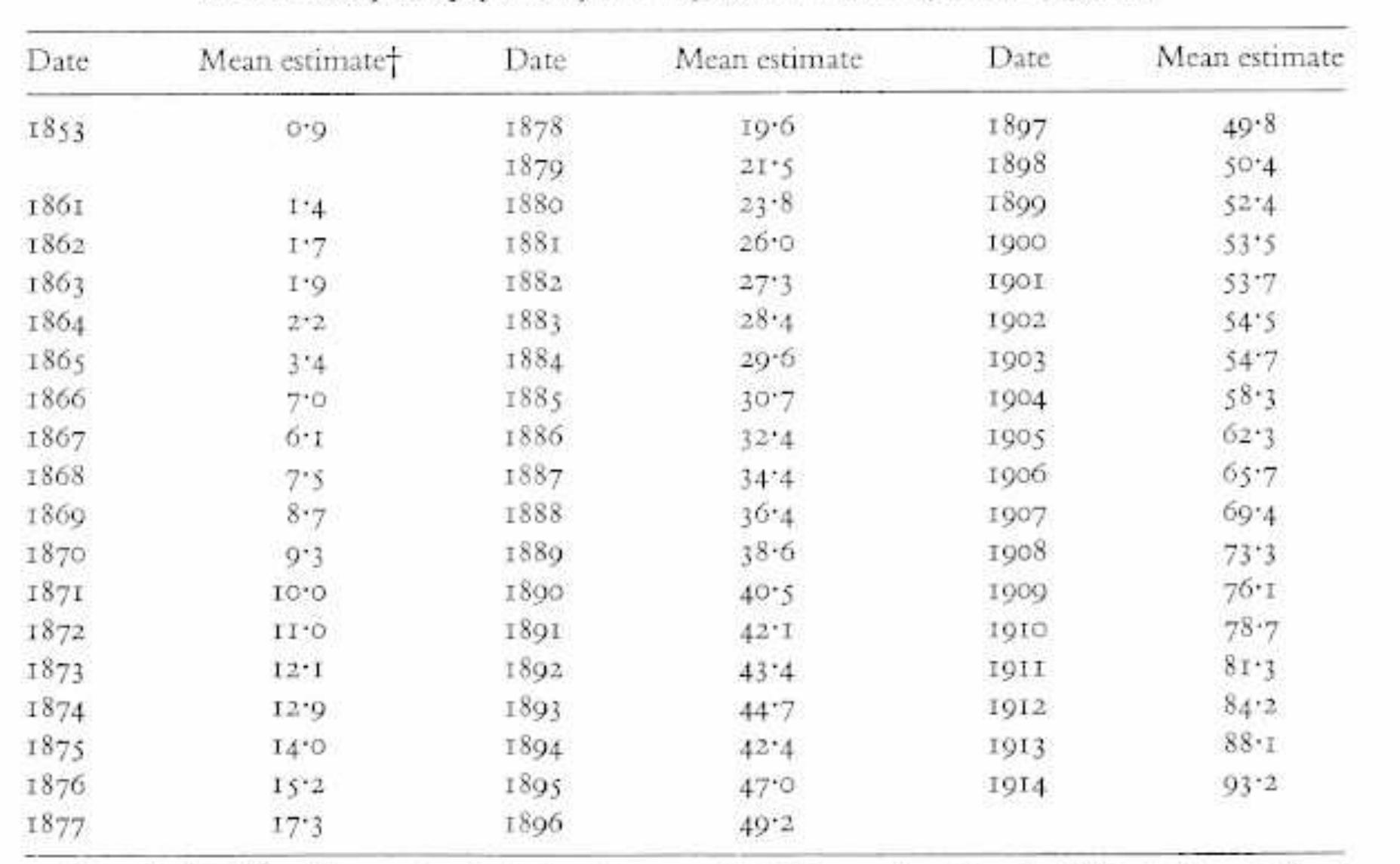
�In view of these and other difficulties, the importation by rail of 0.9 million gallons in 1853
(table I) was a considerable achievement to The Eastern Counties Railway (E.C.R.) carried
over 90 per cent, and the fanners in South Essex in particular had obviously grasped the
potential of the new trade from an early date. By the mid-1850s over 5 per cent of London’s
total milk supply was being transported by rail, and this proportion continued to increase
gradually over the next decade.
In 1865-6 a serious outbreak of rinderpest in London’s cowsheds created shortages, and a
great dea1 of accommodation milk was therefore imported by rail. But in 1867, as the
emergency receded and demand for this extraordinary supply declined, it seemed that events
might bear out a prediction made by J. C. Clutterbuck at the height of the epidemic that ‘the
carriage by railway from distant dairies will be superseded, and the original condition of the
metropolitan milk trade re-established’.6 This recession proved to be short-lived, for in the
following year imports increased once more, and continued to increase in every year but one
(1893-4) in the period up to 1914 (table I). By 1870, ‘railway milk’ was London’s principal
single source of supply, and by the mid-or late 1870s it amounted to more than all the other
sources combined (table 2).
Clearly, this imported country milk had an important and growing share of the market from
about the 1870s, and the circumstances of its supply therefore had important consequences
for the way the trade was conducted in London. The following sections examine this growth
�and its effects.
THE REMOVAL OF HINDRANCES TO RAILWAY MILK TRANSPORT
When the Great Western Railway (G.W.R.) took its first regular consignment of milk from
Maidenhead to London in 1860, the project was ridiculed. 7 The journey was one of only 24
miles, and if that seemed impracticable to the trade, then the idea of sending thousands of
gallons daily from a county such as Derbyshire ‘would have been regarded as the dream of a
mind diseased’.8 This judgment may have been coloured by vested interests in the status quo,
but several important technical, logistical and psychological factors did make it difficult to
visualize a trade sufficiently well organized to ensure the rapid and regular transportation of
fresh milk from distant farms to the urban dweller’s breakfast table.
Technical factors
Among the factors which made the milk trade ‘peculiarly resistant to the railways’9 was a
lack of railway vehicles suitable for conveying milk over distances of more than a few miles.
The goods wagons and parcel vans in general use for this sort of traffic were poorly
ventilated, difficult to clean, and badly sprung. Moreover, the milk itself had the inconvenient
characteristic of being both bulky and perishable; indeed, for most railway companies it was
a minor item in their turnover, yielding little profit and therefore not justifying the expense
of building special wagons.10 Even the Great Eastern Railway (G.E.R.), which as the E.C.R.
dominated the nascent London traffic in the 1850s and early I860s, had by 1874 reserved
only seven cars for the exclusive use of milk out of its total merchandise rolling-stock of
10,326 vehicles.11
The introduction of specially designed wagons was deferred until the 1880s and 1890s, and
was restricted to lines where consignments were of sufficient scale to guarantee full loads of
cans to London and empties back to the country. 12 The innovators tended to be companies
such as the G.W.R., whose turnover comprised a relatively high proportion of agricultural
items, and whose milk traffic was by then both large and over considerable distances. There
was little speculative initiative on the part of other railway companies hoping to encourage
new business, and even those changes made were partly in response to pressure from a
wholesale trade anxious to improve the quality of its supply. One result was to restrict the
amount of country milk brought to London from areas which were suitable for production in
all aspects of their cost structure other than in remoteness from the capital or from the nearest
�railway station. Moreover, the initial limitation of special wagons to those routes with direct
access to established dairying areas started a cumulative process; it encouraged other
producers there to enter the milk trade and therefore further stimulated traffic from districts
such as the Vales of Aylesbury and White Horse which had been prolific suppliers from the
1860s onwards.
A second technical problem was the primitive design of early railway cans. Design
competitions were organized in 1868 and 1879 to improve their durability and construction,
but no fundamental changes were made to the traditional conical shape until the early
twentieth century.13 This shape gave the can a low centre of gravity and made it
comparatively easy to roll, but with an average volume of eight ‘barn’ gallons (136 imperial
pints) it was very cumbersome to load into a railway van. 14 These large vessels were rarely
full, the average consignment being 13-14 gallons, and the milk was therefore subject to
considerable churning on a long journey, no doubt giving rise to the can’s ironic misnomer of
‘churn’.
No matter how perfect the container or means of transport, it would not have been possible to
sustain a long distance traffic without some means of prolonging the life of milk produced in
the insanitary conditions of country sheds. The total absence of practical methods of
preserving milk in the early years of the railway trade meant that in hot weather there was a
high risk of souring on the shortest of journeys. But with the introduction of cooling
apparatus in 187215 and chemical preservatives a few years later, it became possible for milk
to be brought from further afield in even the most unsuitable weather.
The spread of the milk-cooler or ‘refrigerator’ was a slow process, but its effect upon the
milk trade was important. According to one writer in 1889, ‘the milk must still have been
produced in the immediate neighbourhood of London, had not the method of reducing the
temperature ... by means of the refrigerator been discovered’.16 One major difficulty was the
initial cost of the apparatus, which many farmers were reluctant to incur, but a more
important drawback in many areas was the absence of cold well or spring water, because the
milk could only be cooled to the temperature of the water available. Perhaps the most
pressing incentive to the adoption of this innovation came in the 1870s and 1880s when
several of the large dairy companies, such as the Aylesbury Dairy Co., insisted upon its use
by their suppliers as a contractual obligation.17
Chemicals had been added to milk from the earliest times in the hope of retarding the souring
process, or simply to mask an adulteration. But it was not until the mid-1870s that patent
preserving compounds were employed on a large scale in the dairy trade. Borax and boracic
acid were popular, particularly for their cheapness, and they dominated the market until the
I890S when the more effective formalin was first used. By 1900 there were about 20 brands
of chemical milk preservative on sale.18 About half the dairymen in London used them, and it
was claimed that ‘the milk trade as it is at present carried on cannot be carried on without the
use of preservatives’.19 This practice undoubtedly extended beyond the attempts of city
wholesalers and retailers to ‘save’ deteriorating railway milk. The chemicals were
particularly useful to farmers located too far from a railway station or halt for two r0und trips
a day to be convenient. One ‘meal’ could now be kept fresh until it was mixed with the
second for joint delivery to the platform, but the result was that some milk was inevitably
over 24 hours old before it arrived in London. In 1899 Professor A. W. Blyth estimated that
‘in the height of summer I should imagine that quite a third of the milk supply would be
spoilt before it reached the metropolis, or when it reached the metropolis, unless some
�preservative was used’.20
Railway company policy
The negative attitude of most railway companies to the milk traffic in its early stages may be
illustrated in three ways. First, even after the solution of an initial problem of their delayed
access to terminal sites in central London, 21 several companies remained reluctant to grant
special facilities for the handling of milk at their stations. A major exception was the G.W.R.,
which became heavily committed to encouraging the milk trade. Drawing much of its milk
from the hinterland of Swindon in Wiltshire, this company found it worthwhile in the 1880s
to construct a special milk-halt nearby at Wootton Bassett; in addition, at the London end it
spent a considerable amount on special milk platforms at Paddington in 1881, 1890, 1913 and
1923, and at South Lambeth and West Ealing just before the First World War. While several
companies allowed cans to be unloaded on their normal ‘up’ passenger and parcel platforms,
in 1913 the G.W.R. opened a platform (no. 12) at Paddington for the exclusive use of its milk
traffic.22 Special trains were run straight in daily, in addition to the milk wagons shunted
there from mixed trains.
As late as 1890 the Great Western and Great Northern Railways (the latter with its London
milk depot at Finsbury Park) were the only companies to provide terminal facilities of this
kind. The chaos which accompanied the arrival of milk trains in London’s other stations, with
crowds of wholesalers attempting to identify and claim the cans of their respective suppliers,
was aggravated in the early decades of the country milk trade by the establishment of an ad
hoc platform market, where small lots were decanted from can to can and sold to retailers and
itinerant traders. This practice increased the risk of contamination and reduced the efficiency
of the platform as a collection point.
A second disadvantage of the early railway milk traffic was the reluctance of the railway
companies to make special provision for it in their timetables. Milk cans were forwarded in
ordinary passenger trains which of course had to stop at many stations on their journey, and
this did not enhance the chances of the milk reaching its destination unsoured. The risk was
even greater for milk sent from branchline stations because the cans were unloaded at a
mainline junction and often stood for hours on an open platform in the sun while awaiting a
connexion.
After 1865-6 some railway companies realized that they could improve the efficiency of both
their milk and passenger traffic by separating the two as far as possible. The G.W.R., for
instance, put on several passenger services per day largely with the milk-run in mind.
Stopping at every halt where a can or two of milk awaited transportation to London, these
trains were very slow, and initially they received a low priority from the timetable planners in
comparison with other mainline traffic. Only four trains a day carried milk to Paddington in
1867,23 and it was not until more than 20 years later that the G.W.R. judged the moment
expedient to run its first milk-only trains. From 1890, two special trains per weekday covered
the 77 miles from Swindon Junction; by 1897 their aggregate daily journey of 154 miles had
increased to 384, and by 1913 to 981.24 These were express services and could only be
justified, even from the dairy vales of Berkshire and Wiltshire, by focusing branchline traffic
on Swindon.25 By 1900 timetable concessions of this sort had become an important feature of
the railway companies’ policy.26 Some milk specials were put on at periods of peak passenger
traffic and were given priority over other trains in order to maintain average speeds of 30-40
m.p.h.; and on the G.W.R., the journey from Swindon Junction to London, which had at
times taken over ten hours before 1865, was covered in less than two in 1902.27
�Third, the early extent of the ‘milkshed’ (the area from which milk was drawn) was partly
limited by the great expense of sending milk further than 40 miles to London. In 1852, the
freight rate of 1.75d. (0.78p) per imperial gallon levied on distances of greater than 40 miles
must have been a discouragement to the dairying districts served by the G.W.R. But in
1865-6, with the disruption of supplies caused by the rinderpest, the company recognized the
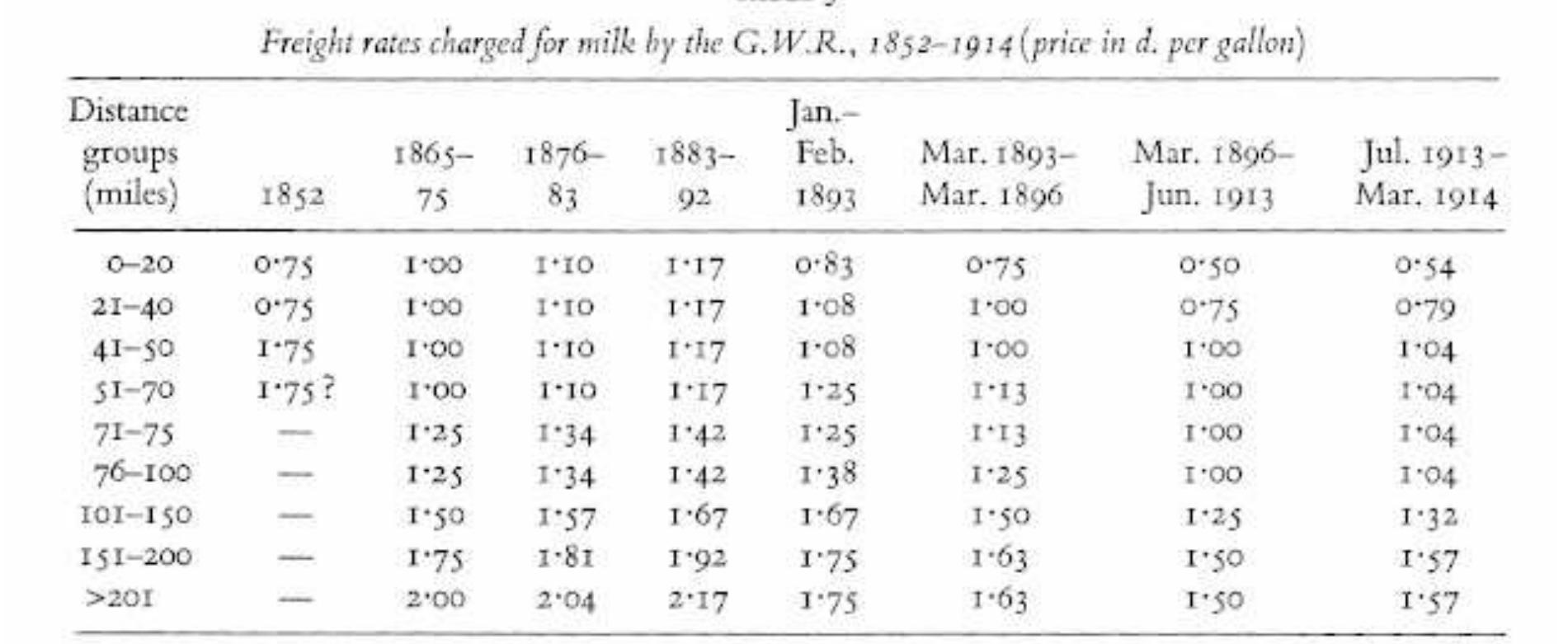
scale of potential revenue to be gained from a railway milk traffic. Table 3 shows that the
G.W.R adjusted its rating policy accordingly, increasing the cost of sending a gallon from
within 40 miles of London, but making possible a long-distance traffic by greatly reducing
rates from beyond that stage.
Despite a rapid increase in the quantity of milk carried from the 1870s onwards, the railway
companies constantly complained of the unprofitable nature of the trade and of its peculiar
and costly characteristics. In 1876, for instance, the G.W.R. sought to offset its costs by
imposing a blanket charge of 2d. (0.84p) per empty can returned to the country, irrespective
of the distance involved. Producers were of course hostile to additional charges of this sort,
but they had little power to influence such matters until the last decade or so of the century
when several regional associations of dairy farmers emerged as collective bargaining units,
and when the British Dairy Farmers’ Association became an important pressure group at the
Board of Trade.
The companies on the whole resisted the clamour of producers and wholesalers for rate
reductions, yet were reluctant to incur too much criticism by making direct increases. They
preferred indirect means of raising their charges such as the general decision in 1883 to
charge the traditional barn gallon measure (17 pints) as if it were two imperial gallons (16
pints), and the introduction by the G.E.R. in the early 1880s of a weekly labourage charge of
1s (5p) per consignor of milk.28 Meanwhile, discussions in the Railway Clearing House
Committee about raising (1876, 1888) or lowering (1881) tariffs were inconclusive.29
In January 1893 this piecemeal approach was abandoned in favour of a nationwide increase
in freight charges. The decision came after a long and acrimonious debate about the
rescheduling of an immensely complex and inefficient rating structure, and caused a furore
amongst those farmers and industrialists affected. 30 In the event, milk suffered less than many
other commodities, as the new G.W.R. rates in table 3 show; indeed, the trade enjoyed an
�overall benefit from the subsequent reductions made in March 1893 and March 1896.
One important result of this debate about rates and charges in the 1880s and 1890s was that
milk gained J special status as the most important of perishable agricultural products carried
by rail. A second result was that attempts by the companies to introduce a complex system of
charging by the can or the ton-mile, and to impose handling dues known as ‘station’ and
‘service terminals’, were forestalled. Finally, still more significant was the establishment of
the principle that producers could consign their milk ‘at their own risk’ for a considerable
reduction in cost.
We may conclude that in the early decades of the trade the absence of suitable arrangements
for special trains, the lack of timetable adjustments, and terminal handling facilities, and an
inappropriate freight rate structure, were all factors in the slow growth of London’s railway
milk traffic. But it would be wrong to assume that the railway companies were wholly
insensitive to the difficulties and needs of the dairy industry. The Midland Railway, for
instance, rapidly increased its share of London’s liquid milk supply by offering concessionary
rates to the producers of Derbyshire. This was an important factor in the decline of cheese
manufacture in that county in the 1870s and 1880s.31 Other companies such as the London,
Brighton & South Coast Railway introduced special rates for milk sent from particular
stations, or even for individual farmers, but this was largely a matter of bargaining. In the
later nineteenth century it seems that railway managers were well aware of the delicate nature
of profitability in the milk trade and the mutual damage which could be done by overcharging.
ADDITIONAL FACTORS IN THE EXPANSION Of THE RAILWAY MILK TRADE
The gradual removal of these technical constraints upon the transport of perishable
agricultural commodities by rail did not, of course, represent a sufficient condition for the
growth of the railway traffic. There were a number of other factors, both economic and
psychological, which influenced the decisions of those farmers, dealers and consumers who
were potential participants in the trade. In the following sections these factors will be
considered under the broad headings of production, supply organization and consumption.
The producer
The financial circumstances and the attitude of the dairy farmer in the second half of the
nineteenth century were important elements in his decision whether or not to produce liquid
milk for the urban market opened up by the railways. Both were influenced by the
medium-term fluctuations in prosperity epitomized by the so-called Great Agricultural
Depression c. 1873-96, and by longer-term economic trends, such as the expansion of urban
demand for food and competition from cheap imported foodstuffs.
Clayland arable farmers in counties such as Essex are generally thought to have suffered most
from the consequences of the agricultural depression, but it should not be forgotten that in
other parts of the country farm-based manufacturers of dairy produce were also seriously
affected. Imported factory-produced cheese of standardized quality and competitive price
undermined the market for anything less than the first quality English farmhouse varieties,
especially after the dramatic fall in wholesale cheese prices in the years 1878-9 and during a
period of more gradual decline from 1874 to 1898.32 This acted as a stimulus for many
farmers to seek compensation in the relatively safe liquid milk trade, and was in effect a
‘push’ factor in the expansion of the country supply. Many of the early entrants into
�London’s milk trade in the late 1870s and 1880s were therefore already dairy farmers for
whom the re-orientation of their system would have meant nothing more unusual than
seasonal calving, perhaps more intensive care of pastures, and the atrophy of a skill in
manufacture which their womenfolk were anyway happy to lose. In addition, it seems that
many mixed farmers must also have increased their emphasis upon milk output during this
period, helped perhaps by the production of more home-grown fodder. The luxury of selling
liquid milk was open only to those located within easy twice-daily reach of a railway station,
but it did account for the rapid decline in the 1880s and 1890s of farmhouse cheese-making in
the more accessible parts of Wiltshire, Derbyshire and Leicestershire. In particular, the clay
soils of the Vale of White Horse in Berkshire, with their extension in Wiltshire from Swindon
to Melksham, carried both pasture suited to grass-based dairying and a G.W.R. line with
direct and rapid access to London. The area was therefore in the forefront of the movement
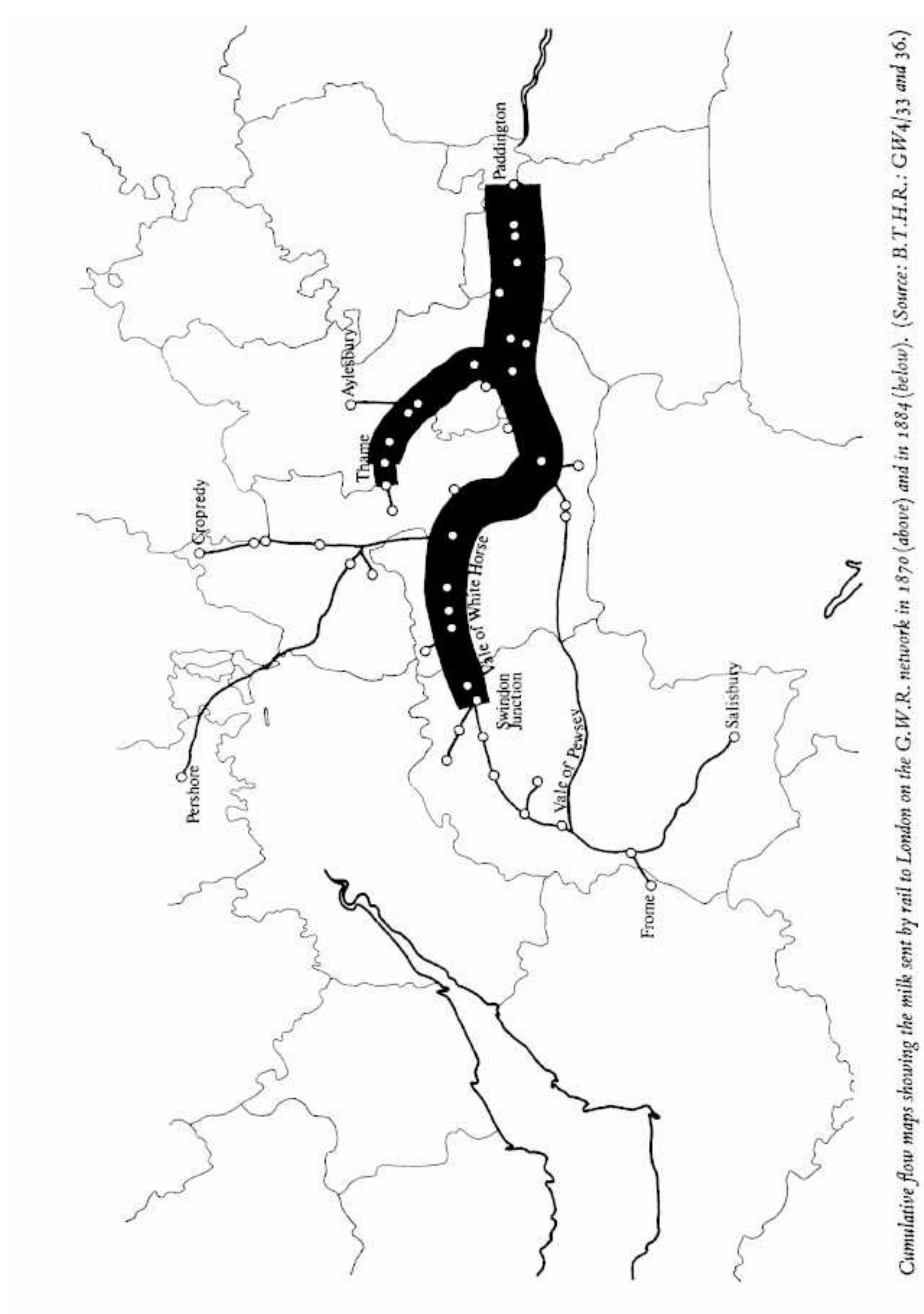
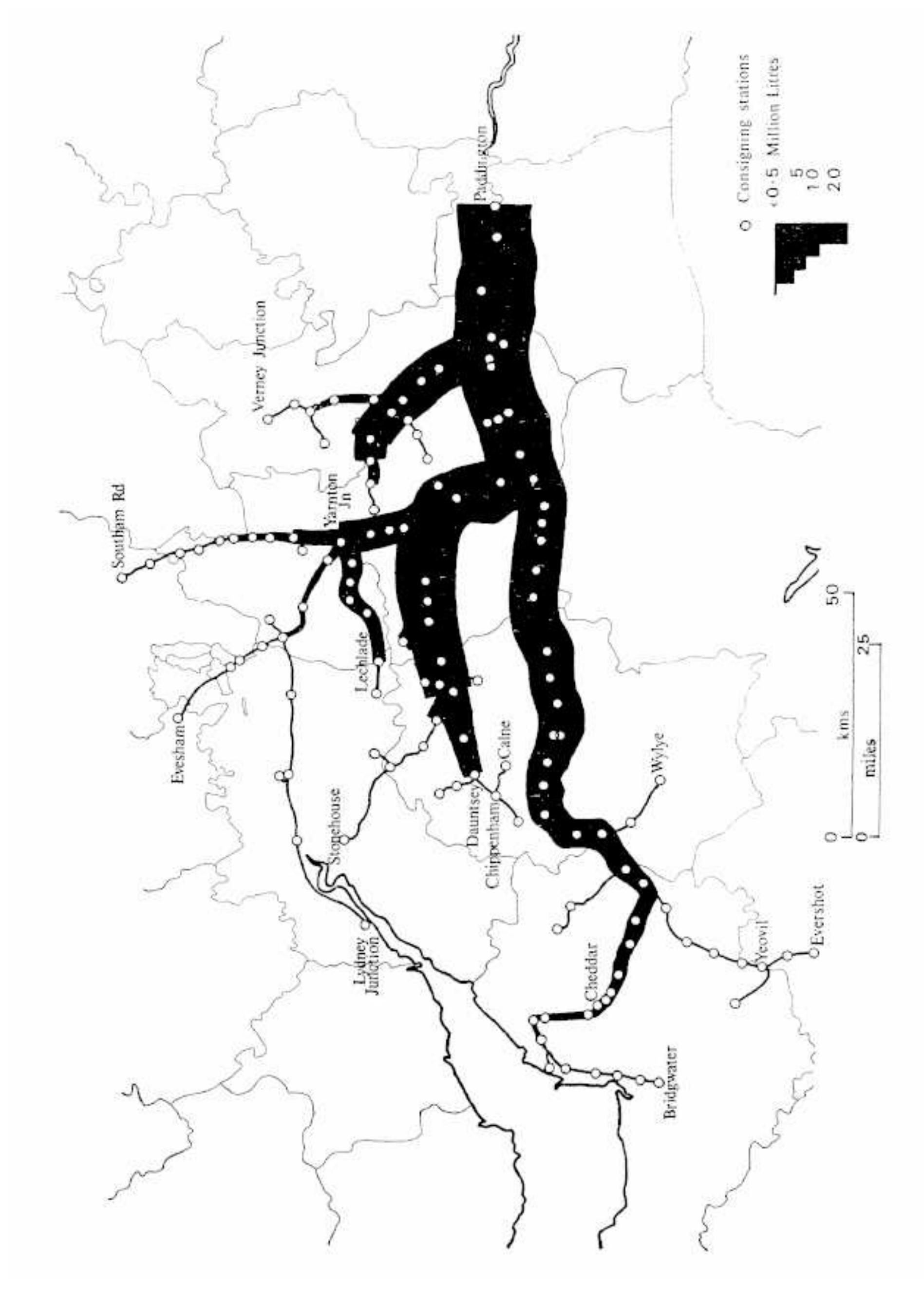
toward liquid milk production for the London market from the 1860s (fig. I).
As far as capital was concerned, this new trade had the considerable advantage of rapid
turnover, at a time when cheese-makers’ investment was tied up in maturing stock for
anything up to a year:
It was often stated to me by competent judges that, taking the value of the cheese and
butter and of the pigs or calves, the returns are as large from cheese or butter-making
as from milk selling, but that shortness of money predisposes the farmer towards the
latter.33
Liquid milk production was not inherently a more profitable enterprise than existing farming
systems, as the falling wholesale price and oversupply of the 1880s and 1890s showed, but it
did require less working capital It was therefore attractive by comparison with, for example,
the sheep and corn husbandry of southern Wiltshire, which was suffering from the effects of
diminishing returns on the high investment that had been made in the 1860s and 1870s. 34 Nor
were milk producers necessarily better farmers, but their cost-minimization was well adapted
to the economic circumstances of the day.
These incentives were insufficient on their own to convince many farmers of the advantages
of the milk trade over their traditional agricultural practice. In predominantly arable areas
such a change would have required a psychological and technical leap of insurmountable
proportions for land-owners and tenants alike. Restrictive clauses in leases had introduced a
degree of inertia into farming systems in some parts of the country, although the adverse
effects of the depression did bite into the resolve of landowners to maintain at all costs their
previously successful practices.35 In the event, other obstacles to change seem to have proved
formidable. First, the lack of suitable farm buildings for zero-grazing or winter production
was not easy to overcome when even the landowner’s capital was fully stretched, and this
discouraged the expansion of milk production on many farms and estates otherwise suitable
in terms of environment and location.36 Second, there was a lack of the necessary skill and
experience in a branch of farming which in some districts had been considered of a
technically and socially inferior status. The ploughing up of permanent pastures in the
Napoleonic Wars had meant a decline in the dairying tradition of counties such as Suffolk
which in the intervening period had not been recovered. In some arable areas farmers were
ignorant of how to lay their land down to permanent grass, 37 while temporary leys seemed
foreign and incomprehensible. But even in those parts of Dorset and Somerset where dairying
had traditionally played an important part in the farm economy farmers were not easily drawn
into milk production because they had been accustomed to let their dairy to a specialist
���dairyman on an annual basis, and had not played an active part in its operation themselves.
It seems that such psychological and technical factors were at times sufficient to hinder
change on all but the farms of new tenants. These were often men without a vested interest in
the customs of the district, and without the desire to establish a position in society through
their farming, but perhaps with the ear of a landowner desperate to let his land and therefore
willing to provide new facilities for cowkeeping rather than see a farm abandoned. 38 The
Ayrshire farmers who migrated to Essex in the 1880s and 1890s, bringing with them
expertise in milk production and the use of temporary leys, are the best-known example of
this agency ofchange;39 but a similar process was observable with Scots and West
Countrymen in Suffolk, Hertfordshire, Warwickshire and the east Midlands. 40 Their progress
was based upon hard work, the use of family labour, and a disinclination to expend much
effort upon maintenance such as hedging and ditching, or upon the costly cultivation of heavy
land. Theirs was a relative and often short-lived success, however, because many of them did
not understand the careful management necessary for clay soils, while others had to move
frequently to avoid the consequences of the soil impoverishment they encouraged by selling
hay and allowing their fie1ds to become foul with weeds. 41 Their most lasting achievement
was in demonstrating to neighbours that new methods could be advantageous if properly
adapted to local conditions.
In south Wiltshire, where dairying had been regarded as a poor substitute for sheep and corn,
it also took the example of a new enterprise to demonstrate the advantages of the milk trade.
This was less through newcomers to the district than by the individual efforts of S. W. Farmer
and F. Stratton who by 1895 had built up a 2,300-acre empire in the Vale of Pewsey and on
Salisbury Plain, where cattle had previously been ‘universally banished from the district’.
The cutting of costs in their case meant a lower output per unit area, but the sheer scale of the
operation ensured an annual sale of over half a million gallons to London.42
The wholesaler
In view of the increased separation of producer and consumer implied by the importation of
country milk, one might have expected entrepreneurs to profit rapidly from the necessary
logistical arrangements. But in the 1840s and early 1850s this does not seem to have
happened, first because the distances involved were not great, and an initial personal contact
between producer and retailer was therefore quite feasible, and second because much of the
early railway milk was a speculative or accommodation supply, and there was therefore no
need for the regularity of consignment associated with the contractual arrangements of later
decades.
In the late 1850s and early 1860s the scale of London’s railway milk traffic outgrew this
informal arrangement; indeed, the increasingly chaotic nature of its organization probably
retarded the rate of growth. Frauds were frequently committed by the itinerant milksellers,
who at this time were the major purchasers of country milk, at the expense of inexperienced
rural producers who had no power over the urban end of the transaction. In fact, as early as
1853, H. Evershed declared on behalf of farmers in Surrey that the new milk trade ‘would
answer well, were it not for the risk which attends the dealing with those parties, whose
business is to receive milk and hawk it about the streets; which often renders it a
troublesome and sometimes a profitless affair ... Some better organisation is demanded.’43 It
is no coincidence that the most rapid expansion was in milk brought to London on the E.CR.
by the one major wholesaling firm founded before 1860, Marriage & Impey, and by the
producer retailer Collinson Hall. By 1865 they were reputedly handling between them about
�20,000 gallons of country milk per week.44
Before 1865 railway milk had been merely a supplement to urban production. But during the
disruption caused by the Cattle Plague the country areas became a vital source of supply for
the London market. The desire of the urban cowkeepers to keep their customers satisfied
meant that their reliance upon country milk increased to the point where some at least
decided to abandon production altogether in favour of wholesaling. The effect of events in
1865-6 was psychological as well as financial in that it forced acceptance of the idea that
country milk could meet urban demand, a notion which a few years earlier had seemed
inconceivable. This new attitude was partly fostered in subsequent years by an increasing
number of wholesalers who had once been cowkeepers or retailers and who saw in the
structural changes of the 1860s and 1870s a rare opportunity to exploit a new niche in a
trade with which they were already familiar.
After 1868 the new-found regularity of demand for large quantities of country milk meant
that it was to the mutual advantage of the farmer and middleman for an agreement to be
reached about the nature of their arrangement. This frequently took the form of a fixed-period
contract in which the fanner undertook to send either the whole of his daily production of
milk on a ‘whole dairy contract’, or a pre-arranged quantity of milk each day on a ‘level dairy
contract’.
These contracts were usually made on a six-monthly basis, with the price per gallon for the
whole period agreed in advance.45 Prices therefore tended to fluctuate at half yearly intervals
if the balance of the demand-supply equation was upset, for instance by the vagaries of the
weather. The most serious threats to the equilibrium of the system came when exceptionally
favourable seasons in the mid-I 880s led to a persistent glut, and in 1893 when shortages of
fodder, and therefore of milk, caused panic buying of accommodation supplies at inflated
prices. On the whole the growth in the quantity of liquid milk produced for the London
market from the mid-1870s to the early 1890s seems to have out-paced the expansion of
demand. This made it a buyers’ market, and the producers’ price declined accordingly. In
fact, until the formation of Dairy Farmers’ Associations in the 1890s, the bargaining
advantage always lay with the wholesaler, who, based as he usually was in London, was
therefore more likely to have a comprehensive knowledge of market trends than the
individual producer.
By 1890 there were several thousand farmers sending their milk by rail to 20 or 30
middlemen in London, who in turn made it available to some 2,400 retail dairymen. The
wholesaler was an essential link, and without him it is doubtful if the railway traffic could
have developed to the extent that it did in the late nineteenth and early twentieth centuries.
Several wholesale functions were important in this respect.
First, the balancing of supply to meet demand was the particular responsibility of the
middleman. On a long-term basis this could be achieved by the arrangement of level dairy
contracts, or by the establishment in dairy areas of manufacturing depots which could meet
day-to-day and seasonal fluctuations in demand.46 In the short term, and especially in the
early decades when urban dealers had no country plant, the onus was often thrown on the
unsuspecting supplier. It was not unusual for him to receive a message by telegraph to
suspend shipment for a day or two; or simply for the wholesaler to hold on to the empty cans
so that no more milk could be sent.
�Second, the wholesale sector of the trade was responsible for a considerable improvement in
the ‘keeping’ quality of country milk. Several of the independent wholesalers, along with
integrated dairy companies such as the Aylesbury Dairy Co., insisted on the use of clean
milking methods and refrigeration. This denied access to and hence retarded the growth of
bacteria in the milk, and therefore improved its chance of arriving in London in a condition
fit for consumption throughout the summer. A further consequence was that milk could be
drawn from further afield. In the early twentieth century a related development was the use of
heat treatment, either in country depots or in London; this became essential with the official
disapproval of chemical additives after 1901.
Third, dealers who wished to expand their turnover sought additional producers willing to
sell their liquid milk.47 In this way they were instrumental in the expansion of the milkshed
into previously untapped areas. Supplies in the winter contract period were especially
difficult to find because farmers in grass-based dairying districts produced their greatest
flush of milk in the spring and early summer; urban demand did not fluctuate in parallel, and
in order to ensure a steady flow wholesalers therefore had to pay up to 30 per cent more for
milk in the six months after Michaelmas. This encouraged production in areas where fodder
costs in winter were otherwise considered too high, and made it feasible to send milk further
by railway during this contract period because the greater margin more than covered
additional transportation costs. In the 1870s and 1880s there developed as a result a distinct
oscillation of the milkshed with the seasons, and on the G.W.R. network in parts of Somerset
and Gloucestershire some districts manufactured their spring milk into butter, cheese and
cream, and sent their winter milk to London. Another important factor, of course, was the
longer life of milk produced and transported in cold weather.
The consumer
The condition, or apparent condition, of the milk delivered to households in London had a
great bearing upon the consumers’ willingness to repeat the purchase. Sourness was a
complaint frequently heard about the pre-1865 country supply which came largely from
Essex. This was partly because a scarcity of ground water in that county meant that the
cooling of cans in a stream or pond was rarely possible; mechanical refrigerators had yet to
become generally available. Railway milk in fact came to acquire an unfortunate reputation
among those more discerning consumers who could afford to ignore its relatively moderate
retail price. In 1854 a typical remark was that ‘it will not keep nearly so long as the
indigenous produce of the metropolitan dairies’,48 and in 1874 that ‘town-produced milk is
richer and more wholesome’.49 Suspicious retail customers preferred to pay ½-¾d.
(0·21-0.32p) more per quart for the urban produced article,50 and railway milk had the
notoriety, which lasted until the mid 1870s, of being a poor man’s beverage.51
The gradual amelioration in the poor conditions of transport and the increased use of methods
of preservation led to an improvement in the average quality of the country supply. This,
coupled with the better ‘image’ of milk after the enforcement of the 1875 anti-adulteration
legislation, and a gradual increase in the real wages of income groups that had previously
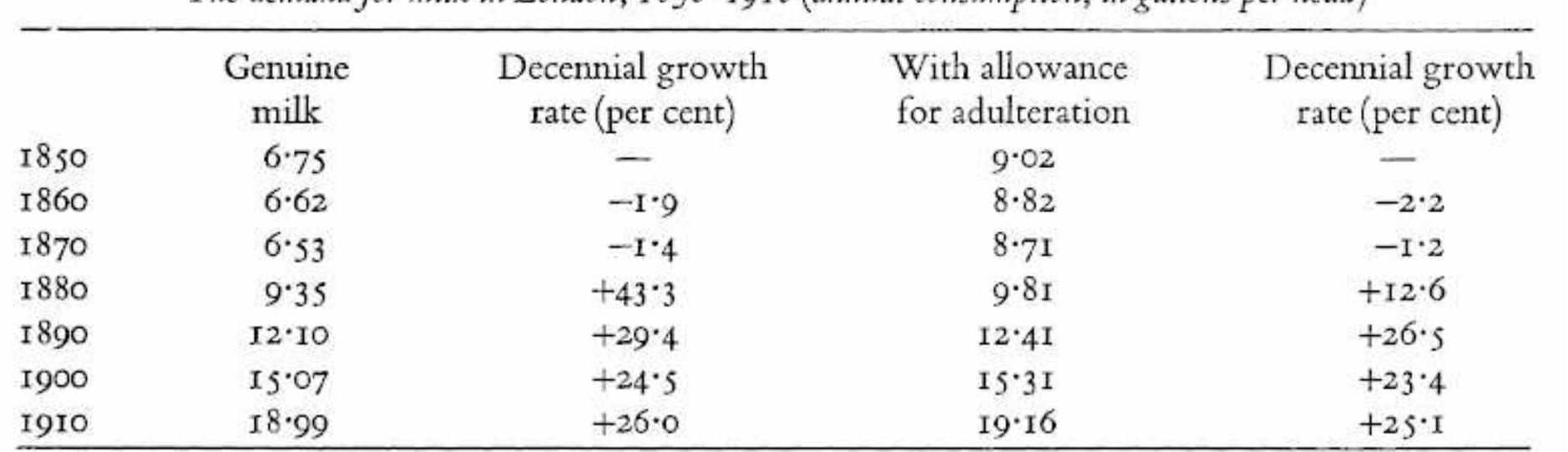
regarded it as a luxury food, was instrumental in a rapid expansion in the demand for milk in
London (table 4). One example of this were the middleclass customers of the Aylesbury
Dairy Co., who on average bought 11·67 gallons per head in 1876, and 23·86 gallons in
1902.52 Such a rapid growth in the market in the late nineteenth century, was an important
‘pull’ factor, especially at a time when the intra-urban production of London’s cowkeepers
was steadily declining in the face of rising costs and other pressures.
�CONCLUSION
The growth of country milk importation into London was a complex process. In this paper it
has been possible to identify a number of stimuli to change; and these have included not only
active factors such as the use of methods of preservation, or the more efficient organization
introduced by the wholesale trade, but also influences which must be described as passive,
such as the gradual erosion by technical change of hindrances to growth. Yet unravelling the
Gordian knot of cause and effect is exceptionally difficult in circumstances where the
necessary and sufficient conditions of change, whether social, economic, or purely
technological, cannot easily be distinguished.
Two hypotheses concerning the nature of trade evolution may be advanced. First, it may be
argued that variations in the operation of the factors described fell into two distinct periods.
Before about 1865 the trade grew slowly and was restricted both in its geographical extent
and its mode of organization; after this its growth accelerated and the trade structure was
transformed to the extent that it was possible to supply a demand much larger than the urban
cowsheds had ever been called upon to meet. The discontinuity between these pb.ses was,
however, Ill-defined. David Taylor has argued that elements of the mature trade were visible
before 1865,53 while other writers have accorded a great significance to the Cattle Plague of
I865-6 which forced the large scale importation of long-distance railway milk for the first
time.54 We may view this latter incident as merely one catalyst in a fundamental process of
change not brought to fruition until the I 870s, when the milkshed began to expand rapidly
into areas of dairy manufacture. The trade ‘looked’ very different in the 188cs in its structure
and its potential, and several crucial developments unfolded between 1875 and 1885. Intraurban production declined inexorably, thus eliminating one element of competition; there was
a rise in demand due to an improvement in real wages and in the public ‘image’ of liquid
milk as a beverage; a crisis in the supply situation was caused by a reduction in the incidence
of adulteration; agricultural prosperity was threatened by unfavourable seasons and the
importation of cheap food; methods of prolonging the life of new milk were first used on a
wide scale; and wholesale and integrated dairy companies strengthened the hold on the
supply organization they had begun to develop in the 1860s. Each of these changes was
important in its own right, and the difficulty lies in assessing their relative individual and
collective impact upon system-redirection. What can be asserted most confidently is that
monocausal or genetic explanations would be inappropriate in this context; a combination of
circumstances, both fortuitous and functionally related, was responsible for a rapid and
�radical change in the nature of London’s milk trade. This undoubtedly amounted to a
‘revolution’ in supply structure, with railway milk playing a key role. An aim of future
research will be the comparison of these changes with the circumstances in other cities in
Britain and Europe to ascertain if generalizations can be made about their common
characteristics.
A second hypothesis concerns the nature of the variables themselves. It seems likely that the
direction, nature and pace of change were moulded not only by the positive thrust of
innovation and technological development, but also by the passive attitude of many fanners to
the prevailing economic climate, and by a gradual erosion of economic, psychological and
other barriers to change. In other words, factors such as the ‘pull’ of urban demand and the
availability of coolers and chemical preservatives were important stimuli for change, but that
change was itself only possible as other constraints were lifted. Rural suppliers had continued
to find their dairy manufacturing or other agricultural activities more profitable than liquid
milk production, it is conceivable that London’s railway trade would have remained limited
in volume and geographical extent well into the late nineteenth century. Inertia would then
have helped prolong intra-urban cowkeeping, even though it was troubled by rising costs and
the hostility of the public. To use an anachronistic metaphor, one may view the evolution of
the milk trade as much in terms of the removal of pressure from the brake pedal as its
application to the accelerator.
By 1914 the railways were providing London with upward of 96 per cent of her liquid milk
supply.55 The ‘milkshed’ was extended from about 10 miles before 1840, to 20-25 miles in
1860, and to 200 miles by 1900, and the centre of gravity of production had shifted quite
dramatically in the intervening years. The last foodstuff in which the capital city had been
self-sufficient had therefore entered the national transportation system, although considerably
later than might have been expected in view of the availability of railway freight movement
since the late 1830s. This meant a reduction in the tyranny of distance as the main factor in
the location of production, in favour of a degree of specialization by environmentally suited
dairying districts. The changes which had taken place in this period were quite remarkable;
they were responsible for the growth of perhaps the most highly organized marketing system
available to any foodstuff in late nineteenth-century Britain, which Charles Knight described
decades before as ‘one of the most beautiful combinations of industry we have’.56
NOTES
1. For an assessment of the early progress of London's commissariat sec F.J. Fisher, ‘The
development of the London food market. 1540-1640’, Economic History Review, V
(1935), 46-64.
2. P.J. Atkins, ‘London’s intra-urban milk supply, circa 1790-1914’, Transactions of the
Institute of British Geographers, new. ser., II (1977), 383-99.
3. Railway Chronicle (30 May 1846), 533.
4. G. R. Porter, ‘On a comparative statement of prices and wages during the years from
1842-1849’, Journal of the Statistical Society of London, XIII (1850), 215.
5. M. M. Milburn, The Cow: Dairy Husbandry and Cattle Breeding (1851), 70.
6. J. C. Clutterbuck, ‘On the farming of Middlesex’, Journal of the Royal Agricultural
Society, 2nd ser., v (1869), 24.
7. O. Veltom, ‘The working of the parcels traffic, Proceedings of the Great Western Railway
Lecture and Debating Society, item 12 (1904-5), 5.
8. Dairyman, II (1878), 206.
�9. H.J. Dyos and D.H. Aldcroft, British Transport; an Economic Survey from the Seventeenth
Century to the Twentieth (1969). 215.
10. The cost of a six-wheeled milk truck was £235 in 1893 and £299 in 1913: Public Record
Office, British Transport Commission Historical Records (hereafter B.T.H.R.): MT1/67.
11. B.T.H.R.: G.E.R.. Reports and Accounts.
12. A full account of the types of wagon used by the various railway companies is
incorporated in their replies to a questionnaire circulated on 1900: Report of the
Departmental Committee ... into the Use of Preservatives and Colouring Matters in ...
Food, P.P. 1902 (Cd 833), XXXIV. 989-92.
13. J. P. Sheldon. Dairy Farming (1879), 342; G. Murray, ‘Report on the trial of dairy
implements and machinery at Bristol’, Journal of the Royal Agricultural Society, 2nd ser.,
XV (1879), 137.
14. A full can weighed about 230 lb.
15. C. G. Roberts, ‘Reports on trials of implements at Cardiff’, Journal of the Royal
Agricultural Society, 2nd ser., VIII (1872), 477.
16. G. Barham, ‘The milk trade’, in J. P. Sheldon, The Farm and the Dairy (1889), 128.
17. H. Swithinbank and G. Newman, The Bacteriology of Milk (1903), 481-4 and 581.
18. R. H. Wallace, The Adulteration of Dairy Produce (1898).
19. P.P. 1902 (Cd 833) XXXIV, 751, Q.3928.
20. Ibid., 733. Q.3447.
21. This impeded the growth of a country milk trade because of the additional cost of road
transport from the suburbs. Waterloo Road Station (L.S.W.R.) was opened in 1848,
King’s Cross (G.N.R.) in 1852, and St Pancras (M.R.) in 1868.
22. A.A. Jackson, London’s Termini (1969), 315.
23. Arriving at 04.30 12.30 21.30 and 23.10 hours: A. Wood, in evidence to the Milk
Committee of the Society of Arts Journal of the Society of Arts, XV (1867), 324.
24. A further 120miles were run by passenger trains put on primarily to give a milk service:
B.T.H.R.: MT1/67.
25. As late as 1914 one-third of the G.W.R.’s milk traffic had to change trains at least once
before reaching London: B.T.H.R.: MT1/67.
26. Concessions such as Sunday services on branch-lines were long delayed. It was as late as
1900 that the G.W.R. at last agreed to make arrangements on the branches to Calne,
Malmcsbury, Highworth and Fairford: P.P. 1902 (Cd 833) XXXIV. 990.
27. The fastest special from Swindon to London completed the journey in 95 minutes, at an
average speed of nearly 50 m.p.h.: P.P. 1902 (Cd 833) XXXIV. 990.
28. B.T.H.R.: R.C.H. 1/118: The Railway Clearing House Superintendents’ Conference,
minute 5064; P. A. Graham, The Revival of British Agriculture (1899), 26.
29. B.T.H.R.: K.C.H.1/117, 118and RAIL 256/61.
30. P. J. Cain. ‘Traders versus railways: the genesis of the Railway and Canal Traffic Act of
1894’, Journal of Transport History, new ser., II (1973), 65-84; idem, ‘Railways and price
discrimination: the case of agriculture, 1880-1914’, Business History, XVIII (1976),
190-204.
31. In the 1880s the M.R.’s rate from Derby was under 1d. (0.42p) per gallon as against their
standard charge of 2⅓d. (0.98p) for that distance (128 miles): Cowkeeper and Dairyman’s
Journal, II (1881), 116-17; Report from the Select Committee ... into the Charges of
Railway Companies ... , P.P. 1881 (374) XIII. 502, Q.11,019.
32. D. Taylor ‘The development of English Dairy farming, 1800-1930’ (unpublished D.Phil,
thesis. University of Oxford, 1971), Ch. 4.
33. A. Spencer, Report on Selected Districts in the Counties of Oxford, Gloucester, Wiltshire
and Berkshire, and on the Neighbourhood of Taunton, Somerset (1895), 11. (This report
�was prepared for the Royal Commission on the Agricultural Depression, but was not
published as a Parliamentary Paper.)
34. F. M. L. Thompson, ‘Agriculture since 1870’, in E. Crittall (ed.) Victoria County History,
Wiltshire, IV (1959), 94.
35. Even so some landowners were unenthusiastic about their tenants entering the milk trade:
‘A large landowner in the neighbourhood of Trowbridge, where farms are easy to let and
there is no difficulty of finding good tenants, told me that in letting his farms he always
refused to take any tenant who proposes to sell milk, and insists on all his tenants being
cheese or butter makers, as he considers that the land is exhausted by milk selling’:
Spencer, op. cit., 11.
36. One writer commented that ‘the principal obstacle which at present impedes the progress
of improved dairy husbandry is the want of adequate buildings’: Murray, op.cit., 136; J.
A. Smith of the Akenham Dairy Co. thought that in Suffolk ‘generally the
accommodation for dairying is wretched in the extreme and very discouraging to
farmers’: quoted by W. Fox, Assistant Commissioner’s Report on Suffolk to the Royal
Commission on the Agricultural Depression, P.P. 1895 (C7755) XVI, 695.
37. Fox, op. cit., 743; R. H. Pringle, The Ongar, Chelmsford, Maldon and Braintree Districts
of Essex, P.P. 1894 (C7374) XVI (I), 267.
38. On one estate in Essex, for instance, thousands of pounds were spent in the 1880s to meet
the requirements of incoming tenants intending to produce milk: Report of Mr F.J.
Coverdale upon the Agricultural Depression as Affecting the Thorndon Estate in the
County of Essex (1893), Essex Record Office: D/DP E17.
39. P. McConnell, ‘Experiences of a Scotsman on the Essex Clays’, Journal of the Royal
Agricultural Society, 3rd ser., II (1891), 311-25; Pringle, op.cit., 249-52.
40. Fox, op.cit., 746-52; J. Turner, Frome and Stratford-upon-Avon, P.P. 1894 (C7372) XVI
(I), 81; A. Spencer, The Vale of Aylesbury and Hertfordshire, P.P. 1895 (C7691) XVI,
86-7; R. H. Pringle, Counties of Bedford, Huntingdon and Northampton, P.P. 1895
(C7842) XVII, 24,42-3.
41. Pringle (1894), op.cit., 251 and 263; Fox, op.cit., 747 and 750.
42. R. H. Rew, Salisbury Plain District of Wiltshire, P.P. 1895 (C7624) XVI, 482;
Thompson, op.cit., 106-7.
43. H. Evershed, ‘On the farming of Surrey, Journal of the Royal Agricultural Society, 1st
ser., XIV (1853), 402.
44. J. C. Morton, ‘On London milk’, Journal of the Society of Arts, XIV (1865), 66.
45. Lady Day and Michaelmas were the usual dates for commencement.
46. The first wholesale milk depot for the London trade was founded at Semley, Dorset, in
1871: M. Saunders, ‘Dairy products’, in Crittall, op.cit., 227.
47. For a brief account of George Barham’s soliciting of supplies for the Express County
Milk Co. sec N. Morgan, Express Journey, 1864-1964: a Centenary History of the
Express Dairy Co. Ltd (1964), 16.
48. [A. Wyntcr] ‘The London commissariat’, Quarterly Review, CXC (1854), 293.
49. Report from the Select Committee ... into the Adulteration of Food Act, 1872, P.P. 1874
(262) VI, 399, Q.2673.
50. Morton, op.cit., 73.
51. A. E. Baxter, ‘Milksellers’, in C. Booth (ed.). Life and Labour of the People in London,
VII (1896), 173.
52. Dairyman, IV (1876), 40; P.P. 1902 (Cd 833) XXXIV, 815, QQ.5841, 5848.
53. D. Taylor ‘London’s milk supply, 1850-1900: a re-interpretation’, Agricultural History,
XLV (1971), 33-8.
�54. E. R. Duldyke, ‘The economic geography of die milk supply of London’ (unpublished
M.A. thesis, University of London, 1937); F. A. Barnes, ‘The evolution of the salient
patterns of milk production and distribution in England and Wales’, Transactions of the
Institute of British Geographers, XV (1958), 167-95; E. H. Whetham, ‘The London milk
trade, 1860-1900’, Economic History Review, 2nd ser.. XVII (1964), 369-80; G. E.
Fussell, The English Dairy Farmer, 1500-1900 (1966), Ch. 6.
55. Excluding condensed and separated milks.
56. C. Knight, London, I (1841), 137.
�


 Peter Atkins