mithradates’ antidote – a pharmacological ghost 1
MITHRADATES’ ANTIDOTE –
A PHARMACOLOGICAL GHOST
LAURENCE M.V. TOTELIN
The Wellcome Trust Centre at U.C.L.*
Abstract
Two kinds of sources are available to the historian to reconstruct the
first centuries of the history of Mithradates’ antidote: biographical in-
formation on Mithradates’ interests in medicine, and a series of recipes.
In this paper I argue that we cannot reconstruct the original recipe of
Mithridatium from our existing sources. Instead, I examine how the Ro-
mans remodelled the history of the King’s death and used the royal name
to create a “Roman” drug. This drug enjoyed a huge popularity in the
first centuries of the Roman Empire. An Emperor, Marcus Aurelius, con-
sumed it as well as members of the upper class; and many highly literate
physicians recommended it notwithstanding the medical sect they were
belonging to. With all its expensive ingredients, and its claim to work as
a panacea, Mithridatium responded to a real demand in a Roman Em-
pire at its commercial and political apogee.
Metridatum i[d est] mater omium antidotorum
Sive a Metridato rege dictum.
Antidotarium Nicolai (end of the 12th century A.D.
– beginning of the 13th century A.D.)1
By attempting to develop an antidote2 to protect himself against
the threat of poisons, Mithradates VI Eupator, King of Pontus (120-
*
I am grateful to Christine Salazar, Vivian Nutton, Liba Taub, Helen King
and an anonymous reviewer for their comments on earlier drafts of this paper.
This work was funded by a Wiener-Anspach scholarship (Cambridge) and a schol-
arship from the Wellcome Trust Centre for the History of Medicine at U.C.L. If
not stated otherwise, translations in this paper are mine.
1
s.v. Metridatum in the 1471 incunabula. See Dietliende Goltz, Mittelalterliche
Pharmazie und Medizin. Dargestellt an Geschichte und Inhalt des Antidotarium Nicolai.
Mit einem Nachdruck der Druckfassung von 1471 (Stuttgart, 1976).
2
The word “antidote” is used in this paper to translate the Greek �ντ�δοτος
or its Latin equivalent antidotus/um. The Greeks had more than one word to des-
ignate what we today call an antidote: θηριακ�ς, �λεξιφ�ρµακον, �θανασ�α, etc. See
Françoise Skoda, “Désignations de l’antidote en grec ancien,” in Docente Natura.
Mélanges de médecine ancienne et médievale offerts à Guy Sabbah, ed. Armelle Debru
and Nicoletta Palmieri (St-Etienne, 2001), 273-291. As we will see, the word
“�ντ�δοτος” was more ambiguous and covered more than our modern “antidote.”
© Koninklijke Brill NV, Leiden, 2004 Early Science and Medicine 9, 1
Also available online – www.brill.nl
esm-totelin.pmd 1 2/26/2004, 2:36 PM
� 2 laurence m.v. totelin
63 B.C.), originated a tradition that would last more than twenty
centuries: the tradition of the Mithridatic antidote or Mithridatium.3
Initially designed to counter poisons and venoms, the antidote
became used to prevent—or even cure—a series of afflictions and
diseases. Andromachos the Elder (first century A.D.), physician
to Nero, transformed the recipe of Mithridatium by adding viper
flesh and increasing the amount of opium, creating the famous
“Theriac.”4 Mithridatium and Theriac survived as panaceas through
the Middle Ages and the Renaissance, still figured in the German,
French and Spanish pharmacopoeias in the nineteenth century, 5
and may still be purchased on markets in the Middle East.6
However, when one starts looking for the original recipe of
Mithradates’ antidote, insuperable difficulties arise. Instead of a
stable tradition, giving one fixed recipe of Mithridatium, the histo-
rian finds, on the one hand, a series of recipes, all different, and
all dating from the first century A.D., i.e., one century after the
death of Mithradates; and on the other hand, spurious biographical
information and vague references to writings of Mithradates.
A review of these sources will show that a quest for the “origi-
nal Mithridatium” is misguided in the first place, that we will never
recover the original recipe of the Royal antidote. But despite of
this, Mithridatium has a story to tell which will lead us far away
from Pontus in the first century B.C.
3
For purposes of clarity, I will use the word “Mithridatium” to designate
Mithradates’ antidote. As the reader will see (table 1, column 2) there were dif-
ferent ways of calling this antidote in Antiquity.
4
Galen, De antidotis I, 1 (XIV. 2 Kühn). Andromachos the Elder wrote the
recipe under the form of a poem. See Galen, De antidotis I, 6 (XIV. 32-34 K);
Ernst Heitsch, Die griechischen Dichterfragmente der römischen Kaiserzeit. Gesammelt
und herausgegeben von E.H., vol. 2 (Göttingen, 1964), 8-15). His son, Andromachos
the Younger (fl. c. A.D. 70-80) translated the poem into a prose version. See Galen,
De antidotis I, 7 (XIV. 42-45 K). On the history of Theriac, see Véronique Boudon,
“La thériaque selon Galien : poison salutaire ou remède empoisonné,” in Le corps
à l’épreuve. Poisons, remèdes et chirurgie : aspects des pratiques médicales dans l’Antiquité
et au Moyen Âge, ed. Franck Collard and Evelyne Samama (Langres, 2002), 45-56;
Dusanka Parojcic, Dragan Stupar and Milica Mirica, “La thériaque: Médicament
et Antidote,” Vesalius 9 (2003), 28-32; Michael Stein, “La thériaque chez Galien:
sa préparation et son usage thérapeutique,” in Galen on Pharmacology. Philosophy,
History and Medicine. Proceedings of the Vth International Galen Colloquium. Lille,16-
18 March 1995, ed. Armelle Debru (Leiden, New York and Cologne, 1997), 199-
209.
5
David L. Cowen, “Expunctum est Mithridatium,” Pharmaceutical Historian 153
(1985), 2–3.
6
Vivian Nutton, personal communication.
esm-totelin.pmd 2 2/26/2004, 2:36 PM
� mithradates’ antidote – a pharmacological ghost 3
1.
The history of Mithridatium originates in the first century B.C.
with the “experiences”7 of Mithradates VI Eupator, King of Pon-
tus.8 It is particularly difficult to discern the reality in our sources
on Mithradates. As with each of her most dangerous enemies, Rome
has built a portrait of Mithradates in which “historical” and “leg-
endary” aspects are intertwined. It was a more impressive perfor-
mance for Rome to defeat an enemy of outstanding cleverness.
Allegedly, Mithradates could speak 22 or even 25 languages.9 In
addition, the king had a strong interest in medicine and particu-
larly in toxicology.10
Pliny the Elder (A.D. 23-79) gives us a very detailed account of
Mithradates’ commitment to medical studies:
For it was Mithridates, the greatest king of his time, whom Pompeius van-
quished, that was, we know by evidence as well as by report, a more atten-
tive investigator of life’s problems than any of those born before him. By
his unaided efforts he thought out the plan of drinking poison daily, after
first taking remedies, in order that sheer custom might render it harmless;
he was the first to discover the various antidotes (genera antidoti) (my italics),
one of which is even known by his name; he also discovered the mixing
with antidotes of the blood of Pontic ducks, because they lived on poison;
addressed to him were treatises, still extant, written by the famous physi-
cian Asclepiades, who when urgently invited to come from Rome sent in-
structions instead [here follows the passage on Mithradates’ language skills].
He then, with his brilliant intellect and wide interests, was an especially diligent
student of medicine, and collected detailed knowledge from all his subjects,
who comprised a great part of the world, leaving among his private posses-
sions a bookcase of these treatises (commentationum) with specimens (exem-
plaria) and the properties of each. Pompeius however on getting posses-
sion of all the royal booty ordered his freedman Lenaeus, a man of letters,
to translate these into Latin. This great victory therefore was as beneficent
to life as it was to the State.11
7
See below.
8
See Gilbert Watson, Theriac and Mithridatium. A Study in Therapeutics (Lon-
don, 1966), 33-44.
9
22 languages: Pliny, Naturalis Historia VII, 24, 88 and XXV, 3, 6; 25 languages:
Gellius, Noctes Atticae XVII, 17.
10
Mithradates was not the only Hellenistic king who developed an interest in
poisons, venoms and their antidotes. Famous for having poisoned many people
were: Antigonos Gonatas (Macedonia, c. 320-239 B.C.), Antiochos III (Seleucia,
c. 242-187 B.C.), Ptolemaios IV Philopator (Egypt, 244-205 B.C.) and the famous
Kleopatra VII (Egypt, 69–30 B.C.). However, Attalos III (Pergamon, 138-133 B.C.)
is probably our best parallel with Mithradates. According to Galen, similarly to
Mithradates, Attalos had a general interest in drugs and composed antidotes that
he tested on prisoners condemned to death. See De compositione medicamentorum
per genera I, 13 (XIII. 416 K); De antidotis I, 1 (XIV. 2 K).
11
Pliny, N.H. XXV, 3, 5-7; translation: William H. S. Jones, Pliny. Natural His-
esm-totelin.pmd 3 2/26/2004, 2:36 PM
� 4 laurence m.v. totelin
This text informs us on three main points. Firstly, Mithradates at-
tempted to immunise himself against poisons by drinking a daily
dose of poison and antidote.12 The King himself developed “vari-
ous antidotes” through practical experience (�µπειρ�α in Galen).13
All our sources agree on this point: Mithradates created several
antidotes, among which some included duck blood and one even
took his name, Mithridatium.14
Secondly, Mithradates was in contact with Asklepiades (fl. c. 95
B.C.), the most famous physician in Rome at that time, who ad-
dressed treatises to him still extant by Pliny’s time, but unfortu-
nately lost since then.15 In other sources, we learn that the King
was also in contact with Krateuas the famous rhizotomos (root-cut-
ter) (111–64 B.C.) who dedicated a plant to him.16 Another contact
tory. Books XXIV-XXVII. With an English Translation by W.H.S.J. (Cambridge, Mass.
and London, Loeb 1980), 139-141. On Pliny’s interest in pharmacy, see John
Scarborough, “Pharmacy in Pliny’s Natural History: Some Observations on Sub-
stances and Sources,” in Science in the Early Roman Empire: Pliny the Elder, his Sources
and Influence, eds. Roger K. French and Frank Greenaway (London and Sidney,
1986), 59-85.
12
See also Celsus, De medicina V, 23, 3. Georg Harig notes that in Celsus,
Mithradates’ immunity is attributed to his antidote only, whereas in Pliny it is
attributed to the combination of both the antidote and poison; “Die antike
Auffassung vom Gift und der Tod des Mithradates,” Schriftenreihe für Geschichte
der Naturwissenschaften, Technik und Medizin 14 (1977), 105.
13
Galen, De antidotis I, 1 (XIV. 2 K). The word “�µπειρ�α” is defined by Heinrich
von Staden as follows: “[Experiments led by the ancients empiricists] are not
motivated by causal explanation nor by a desire to generalise any hypothesis,
but rather the practical question ‘what will work in this particular case right now?’
—and the answer is uniformly simple: ‘Let us try whatever worked in a similar
case’. (…) ‘Similar’ itself is used in a very broad sense and its uses does not rep-
resent any attempt of scientific classification”; “Experiment and Experience in
Hellenistic Medicine,” Bulletin of the Institute of Classical Studies 22 (1975), 192.
On Mithradates’ experiments, see also Mirko D. Grmek and Danielle Gourevitch,
“Les expériences pharmacologiques dans l’Antiquité,” Archives internationales
d’histoire des sciences 35 (1985), 7-8; Mirko D. Grmek, Le chaudron de Médée: l’expéri-
mentation sur le vivant dans l’Antiquité (Le Plessis-Robinson, 1997), 119-121.
14
Appian, Bella Mithridatica CX; Galen, De antidotis I, 1 (XIV. 2 K); Gellius,
Noct. Attic. XVII, 16.
15
See also Pliny, N.H. VII, 37, 124. On Asklepiades, see John Vallance, “The
Medical System of Asclepiades of Bithynia,” in ANRW II 37.1, ed. Wolgang Haase
(Berlin and New York, 1993), 693-727.
16
Pliny, N.H. XV, 26, 62. Unfortunately, nothing in our sources allows us to
say that Krateuas assisted Mithradates in his experiences and helped him develop
his antidote, as we sometimes read. See for instance Armelle Debru, “The Gar-
dener and the Lady. Therapeutics and Society in the Age of Galen,” in The Phar-
macy. Windows on History, ed. Régine Pötzsch (Basel, 1996), 27; Andrew Dalby,
Dangerous Tastes. The Story of Spices (London, 2000), 135; J. Innes Miller, The Spice
Trade of the Roman Empire. 29 B.C. to A.D. 641 (Oxford, 1969), 5. On Krateuas,
see Ernst Kind, “Krateuas 2,” in Paulys Real-Encyclopädie der classischen Altertum-
esm-totelin.pmd 4 2/26/2004, 2:36 PM
� mithradates’ antidote – a pharmacological ghost 5
of Mithradates was the empiricist physician Zopyros of Alexandria
who sent to the king one of his antidotes to test on a man con-
demned to death accompanying the letter.17
Thirdly, Mithradates himself wrote treatises on the properties
of materia medica that were accompanied by specimens. The trea-
tises were translated into Latin by Lenaeus (c. 95-25 B.C.) and
seemed to have been influential in Rome. This translation was
probably not a verbatim translation but a re-elaboration of Mith-
radates’ writings, and it probably became known as Lenaeus’ oeuvre.18
Pliny had access to Lenaeus’ work, to which he makes two other
references.19 This work may even have been his source for the bio-
graphical information on Mithradates. We indeed learn from Gellius
that Lenaeus wrote on Mithradates’ character: “It was also writ-
ten by Lenaeus, the freedman of Cn. Pompeius, that the famous
king of Pontus, Mithridates, was skilled in medicine and in rem-
edies of that kind [i.e. antidotes] (…).”20 It is possible that Pompey’s
freedman introduced his translation of Mithradates’ writings with
some biographical material. This would not be surprising at a time
which saw the emergence of Latin biography.21
This “biography” may also have included one story, that we do
not find in Pliny but that is present in Gellius and many other
sources: the story of Mithradates’ failed suicide. Allegedly, Mithra-
dates was so accustomed to taking antidotes, that, when defeated
by the Romans, he tried to die by drinking poison, he could not.
The account by Galen in his De theriaca, ad Pisonem is particularly
theatrical:22
wissenschaft, 49 vols. (Stuttgart and Munich, 1893-1978), vol. XI/2 (1922), col.
1644-1645.
17
Galen, De antidotis II, 7 (XIV. 150 K). On Zopyros, see Jutta Kollesch, “Zopyros
15,” in RE, vol. XA (1972), col. 771-772.
18
See Will Richter, “Lenaeus,” in RE. Suppl., vol. IX (1962), col. 387. The
fact that this translation became known as Lenaeus’ oeuvre could explain why no
other ancient author mentions Mithradates’ writings. See for instance Plutarch,
Pompeius III.
19
H.N. XXIV, 41, 67 and XXV, 26, 63.
20
Gellius, Noct. Attic. XVII, 16, 2; translation: John C. Rolfe, The Attic Nights of
Aulus Gellius. With an English Translation by J.C.R. (Cambridge, Mass. and Lon-
don, 1927). It is difficult to determine whether Gellius had direct access to Lenaeus’
translation or not.
21
Varro (116-29 B.C.) and Nepos (99-24 B.C.) were among the first Roman
biographers, they were the contemporaries of Lenaeus. See Arnoldo Momigliano,
The Development of Greek Biography (Cambridge, Mass. and London, 1993), 96-100.
22
XVI (XIV. 283-284 K). The authenticity of De theriaca, ad Pisonem and of De
theriaca, ad Pamphilianum is discussed. Vivian Nutton concluded that the first treatise
is genuinely the work of Galen, while the second is not; “Galen on Theriac: Prob-
esm-totelin.pmd 5 2/26/2004, 2:36 PM
� 6 laurence m.v. totelin
They say (my italics) that Mithradates himself, the great warrior, having taken
not Theriac—as it did not exist yet—but another much-mixed antidote, the
one that is named by his name, indeed it is called Mithridatium, because of
the resistance of his body acquired by the antidote, could not die after hav-
ing taken poison. Indeed, in the war against the Romans, having been van-
quished by Pompey and being in the last extremities, he decided to die by
a venom. Having drunk the poison and taken a lot of it, he did not die,
whilst his daughters, who wanted, by filial love, to follow him in death, died
quickly after drinking the same poison. Then as Mithradates was slow to
die, the poison being ineffective because he was used to drinking antidotes,
he called Bistokos, one of his friends and ordered him to cut his throat
and to accomplish with the sword the work of the poison. By this means,
he forced himself to die violently.23
It should be noted that Galen introduces this story with the words
“they say” (φασ�), putting distances between him and his sources.
Galen was suspicious about this story, so should be the modern
historian. If the King truly believed in the efficacy of his antidote,
would he have chosen to die by drinking poison? This story must
have been developed soon after the death of Mithradates, and it
may be speculated that Lenaeus himself created it. Indeed, a de-
sire to show the extent of Mithradates’ knowledge of antidotes
may have proved a strong motivation for Pompey’s freedman.
Anyway, the story of Mithradates’ failed suicide was certainly in
circulation quite early after the King’s death, our first datable
sources being Livy (59 B.C.-A.D. 17)24 and Pompeius Trogus (Au-
gustan times).25
Unfortunately both Mithradates’ original writings and their trans-
lation are now entirely lost and we have no precise idea of what
they contained. Pliny is not clear on whether these writings con-
tained recipes of antidotes,26 and above all the recipe of the origi-
nal Mithridatium.
lems of Authenticity,” in Galen on Pharmacology. Philosophy, History and Medicine.
Proceedings of the Vth International Galen Colloquium. Lille, 16-18 March 1995, ed.
Armelle Debru (Leiden, New-York and Cologne, 1997), 133–151.
23
The story of Mithradates’ failed suicide is related by many ancient authors,
with many variations. The reader will find a list of sources in Harig, “Die antike
Auffassung vom Gift,” 104, note 3.
24
Periocha CII.
25
Trogus ap. Iustinum XXXVII, 2, 6.
26
For a different opinion, see Alain Touwaide, “Galien et la toxicologie,” in
ANRW II. 37.2, ed. Wolfgang Haase (Berlin and New York, 1994), 1891; Jacques
André, Pline l’Ancien. Histoire naturelle. Livre XXV. Texte établi et traduit par J.A.
(Paris, C.U.F 1974), 28.
esm-totelin.pmd 6 2/26/2004, 2:36 PM
� mithradates’ antidote – a pharmacological ghost 7
2.
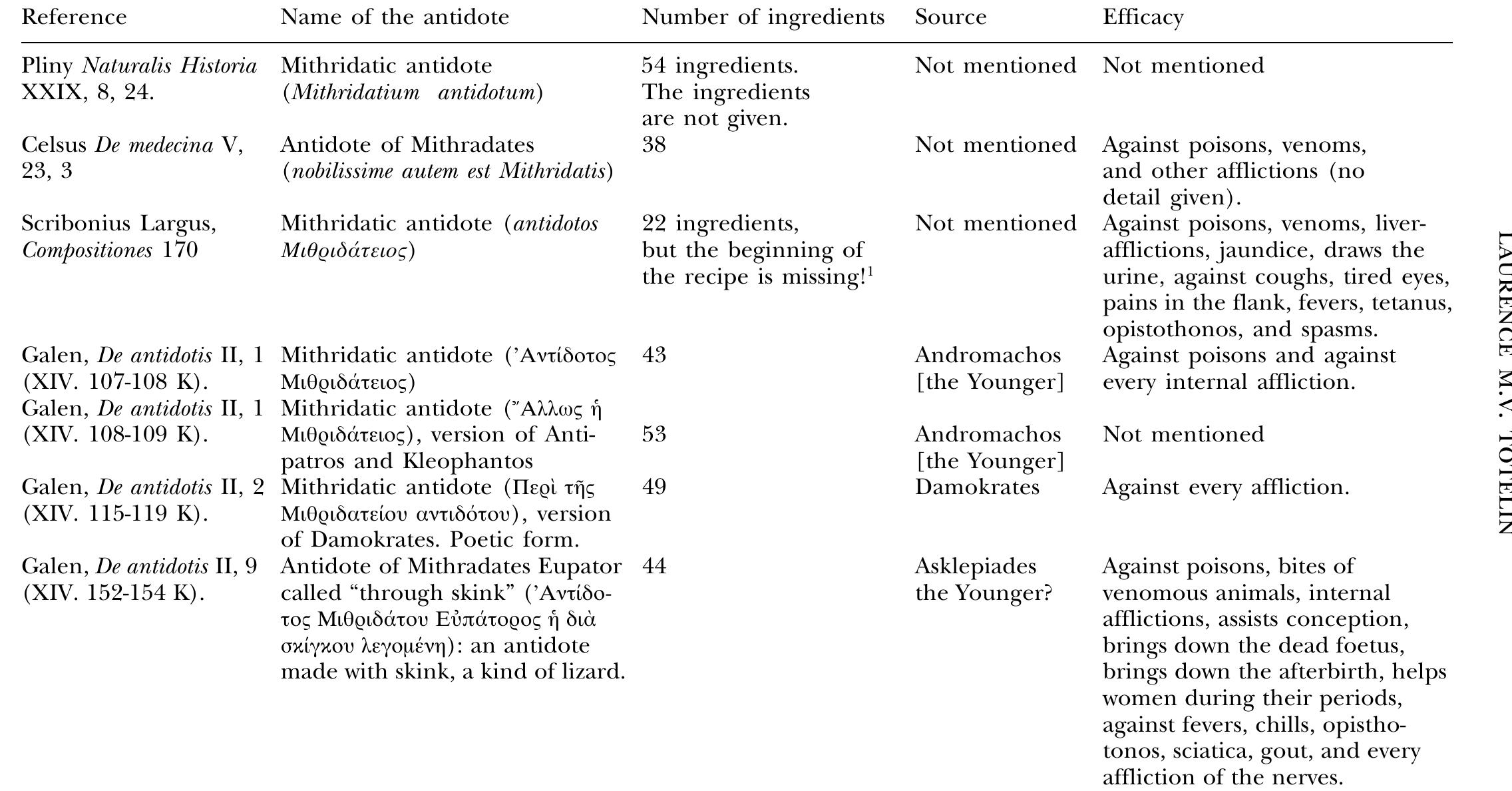
However, as already said, we have in our sources a series of reci-
pes bearing Mithradates’ name that I shall now examine, starting
with a very short recipe handed down to us by Pliny in a chapter
on the properties of walnuts:
When the mighty king Mithridates had been overcome, Cn. Pompeius found
in a private note-book (peculiari commentario) in his cabinet a prescription
(compositionem) for an antidote written in the king’s own hand-writing:—
two dried nuts, two figs, and twenty leaves of rue were to be pounded to-
gether with the addition of a pinch of salt; he who took this fasting would
be immune to all poison for that day.27
This recipe was included in a notebook (peculiari commentario) that
we should, as Pliny does, differentiate from Mithradates’ treatises
just mentioned (commentationum). This recipe raises a number of
questions: Was it the original recipe of Mithridatium? Was it the
only recipe contained in the notebook? Was the notebook trans-
lated into Latin? Did Pliny have direct access to the notebook or
is he reporting something he read, or heard about? Finally, yet
importantly, was this notebook genuinely by Mithradates or a forg-
ery? Unfortunately, it is impossible to answer these questions. I
can only stress that this recipe has nothing in common with the
other “Mithridatic antidotes” that we find in our sources, presented
in table one.
None of the recipes in table 1 is identical to another. No two
have the same number of ingredients; it varies from 22 to 54 (see
table 1, column 3). If we add to this the question of the quanti-
ties of each ingredient, the problem becomes even more compli-
cated, the amount of a same ingredient varying from one recipe
to another.
However, these recipes also have several points in common.
Firstly, they all include a high number of ingredients. Mithridatium
and Theriac—with up to 50 ingredients for Mithridatium and up
to 70 ingredients for Theriac—were the culmination of a trend
in Graeco-Roman medicine: polypharmacy, i.e. the multiplication
of the number of ingredients in compound drugs.28
27
Pliny, N.H. XXIII, 77, 149; translation: William H. S., Pliny. Natural History.
Books 20-23. With an English Translation by W.H.S.J. (Cambridge, Mass. and Lon-
don, 1969), 515.
28
Although Mantias (c. 165–90 B.C.), physician of the school of Herophilos,
was referred to in Antiquity as the first great writer on compound drugs (Heinrich
von Staden, Herophilus. The Art of Medicine in Early Alexandria. Edition, Translation
esm-totelin.pmd 7 2/26/2004, 2:36 PM
� 8 laurence m.v. totelin
Secondly, each of these recipes is for an electuary, i.e., a paste
taken orally containing a drug mixed with honey. This drug is
composed of various vegetable ingredients, both common herbs
and spices, varying from one recipe to another, with the excep-
tion of opium-poppy juice which appears in all the recipes. This
drug also always includes castoreum, a secretion allegedly found
in the testes of the beaver, largely used in ancient medicine.29
Thirdly, all our recipes claim to be effective as a prophylactic
against poisoning (by poison or venom)30 and in the treatment of
a series of internal afflictions, ranging from indigestion and fe-
vers to sciatica (see table 1, column five). Two recipes even claim
to work for every internal affliction.31 This is a major difference
from the “original” antidote that Mithradates designed to protect
himself “only” against poisoning.
Finally, all our recipes are from the first century A.D. Celsus
was an encyclopaedist at the time of Tiberius.32 Scribonius, the
author of a book on medicinal recipes (Compositiones), was close
to the imperial court in the time of Claudius even if he probably
was not an imperial physician.33 Similarly, the sources Galen uses
in his De antidotis can also be dated from the first century A.D.
and Essays by H.V.S. (Cambridge, 1989), 515-518), such remedies do not seem to
have had much success before the first century B.C., and Aelius Gallus’ expedi-
tion to Arabia (26-25 B.C.). See Alain Touwaide, “De la pratique populaire au
savoir codifié: les étapes de la conceptualisation du pharmakon dans le monde
grec antique,” in Monde rural et histoire des sciences en Méditerranée. Du bon sens à la
logique, ed. Aline Rouselle (Perpignan, 1998), 89.
29
Scribonius, Compositiones 170 does include neither opium nor castoreum,
but the beginning of the recipe is missing, and it can be suggested that both
ingredients were included in this missing passage.
30
Pierre Hadot affirms that, according to Galen, Mithridatium was efficacious
only against poison and not against venom; “Marc Aurèle était-il opiomane?,” in
Mémorial André-Jean Festugière. Antiquité païenne et chrétienne. Vingt-cinq études, ed.
Enzo Lucchesi and Henri D. Saffrey (Geneva, 1984), 34. This is wrong. For Galen,
Mithridatium had the same power as Theriac except against viper bites. In that
case, Theriac was more effective. See De antidotis II, 1 (XIV. 106 K).
31
Galen, De antidotis II, 1 (XIV. 108 K); II, 2 (XIV. 115 K).
32
On Celsus and toxicology, see Alain Touwaide, “La toxicologie dans le De
medicina: un système asclépiado-méthodique?,” in La médecine de Celse. Aspects historiques,
scientifiques et littéraires, ed. Guy Sabbah and Philippe Mudry (St. Etienne, 1994),
211-249.
33
On this author, see Barry Baldwin, “The Career and Work of Scribonius
Largus,” Rheinisches Museum 135 (1992), 74-82; Vivian Nutton, “Scribonius Largus,
The Unknown Pharmacologist,” Pharmaceutical Historian 25 (1995), 5-8; and Sergio
Sconocchia, “L’opera di Scribonio Largo e la letteratura medicina latina del 1
sec. d.C.,” in ANRW II 37.1, ed. Wolfgang Haase (Berlin and New York, 1993),
843-922.
esm-totelin.pmd 8 2/26/2004, 2:36 PM
� mithradates’ antidote – a pharmacological ghost 9
(table 1, column 4): Andromachos the Younger was active c. A.D.
70-80,34 Asklepiades the Younger in the last quarter of the first
century A.D.,35 and Damokrates was a physician in the times of
Nero and Vespasian.36 These authors, in turn, give the recipes of
physicians who, with the probable exception of Kleophantos – who
could be identified with a physician mentioned by Cicero37—prac-
tised their art in the first century A.D.: Xenokrates was a physi-
cian at the time of the Flavians, and Nikostratos must be later than
Xenokrates, since he quotes him. As we do not know from where
these physicians took their information on the antidote, we must
conclude that the history of the transmission of the Mithridatium
recipe before then is effectively lost.
Instead of chasing a will-o’-the-wisp,38 a pharmacological ghost,
we should concentrate on trying to understand why we have such
a proliferation of Mithridatium recipes and what are the implica-
tions of this proliferation. Touwaide’s theory about this is quite
convincing. According to this scholar, when Pompey discovered
the recipe of Mithridatium, he kept it secret or, at least, commu-
nicated it only to a small circle. In other words, Lenaeus did not
include it in his translation of Mithradates’ works. However, people
probably heard of or read about the existence of this miraculous
antidote.39 Consequently, physicians (and probably also quacks)
tried to develop their own Mithridatium, competing with each other
for the best formula, adding new ingredients, changing the quan-
tities of others to affect the therapeutic value of the drug, experi-
menting it in cases other than poisoning, in a quest for the universal
remedy.40 Galen himself did not hesitate to make some changes
34
On Andromachos, see Vivian Nutton, “Andromachos 5,” in Der Neue Pauly,
Enziklopädie der Antike, ed. Hubert Cancik and Helmuth Schneider (Stuttgart and
Weimar, 1996-), vol. I (1996), col. 692; Cajus Fabricius, Galens Exzerpte aus älteren
Pharmakologen (Berlin and New York, 1972), 185-189.
35
On Asklepiades, see Vivian Nutton, “Asklepiades Pharmakion,” in Der Neue
Pauly, vol. II (1997), col. 92-93; Fabricius, Galens Exzerpte, 192-198.
36
On Damokrates, see Max Wellmann, “Damokrates 8,” in RE, vol. IV/2 (1901),
col. 2069-2070; Fabricius, Galens Exzerpte, 189-190.
37
Cicero, Pro A. Cluentio 47. On Kleophantos, see Vivian Nutton, “Kleophantos,”
in Der Neue Pauly, vol. VI (1998), col. 594-595. We have no information on
Antipatros who is associated to Kleophantos.
38
To use the expression of Watson, who after devoting several pages to find-
ing the “original” recipe of Mithradates, came to the conclusion that this quest
was vain; Theriac and Mithridatium, 44.
39
Touwaide, “Galien et la toxicologie,” 1941-1943.
40
Alain Touwaide, “Strategie terapeutiche: I farmaci,” in Storia del pensiero medico
occidentale. 1. Antichità e Medioevo, ed. Mirko D. Grmek (Roma and Bari, 1993),
359-360; idem, “Galien et la toxicologie,” 1942.
esm-totelin.pmd 9 2/26/2004, 2:36 PM
� 10 laurence m.v. totelin
to one of the alleged Mithridatic recipe, the through-skink, to im-
prove it.41
The agonistic spirit of these physicians, their will to demonstrate
their expertise, surpassed their desire of secrecy and led to a
multiplication of written, published recipes. This process must have
taken some time, explaining why we have a gap between the death
of Mithradates and our first datable recipes.
Whether our preserved recipes had anything in common with
the “original” Mithridatium is, and will remain, as I have already
stressed, a mystery. However, their authors gave the name of
Mithradates to their preparations to confer credit on them and
promote them. What could indeed have better served the promo-
tion of this miraculous drug than the forged history of Mithradates’
failed suicide?
It seems that, little by little, with the multiplication of written
recipes, Mithridatium became a word to designate a kind of me-
dicinal preparation and not a fixed recipe. It is on this kind of
medication that I shall now concentrate, attempting to place it in
its socio-economic and cultural context.
3.
Trying to place Mithridatium in its context is important because
the existence of written recipes does not necessarily mean that
they were used. In other words, we should ask ourselves whether
the competition between physicians for the best recipe of Mithri-
datium was only a bookish one, or was the drug consumed? And
if so, by whom?
Galen provides us with an important element in the answer.
According to that physician, Theriac and Mithridatium were con-
sumed in large quantities by the Emperor and the wealthy under
the reign of Marcus Aurelius (A.D. 161-180):
Antoninus [Marcus Aurelius] being Emperor, Theriac was prepared by many
rich people and because of this, some products hard to procure were left
aside [in the making of this medication]. It is remarkable how the rich emulate
the imperial tastes (or at least desire to be seen to emulate them). When
the first among the men [i.e. the Emperor] died, very few continued to
prepare the antidote, as well as Mithridatium.42
Now we are not as well informed about the clientele of Mithri-
41
Galen, De antidotis II, 9 (XIV. 153-154 K).
42
Galen, De antidotis I, 4 (XIV. 24-25 K).
esm-totelin.pmd 10 2/26/2004, 2:36 PM
� mithradates’ antidote – a pharmacological ghost 11
datium before the reign of Marcus Aurelius; but we can quite safely
assume that it was also rather wealthy and close to imperial circles.
We should keep in mind that it is the physician to the Emperor
Nero, Andromachos the Elder, who created Theriac by “improv-
ing” the recipe of Mithridatium.43
Mihridatium was bound to be successful in imperial circles: it
bore the name of a King, it was used by Emperors and their per-
sonal physicians, and it was extremely expensive. And for a wealthy
clientele, an expensive drug was synonymous with a good drug.44
Each recipe of Mithridatium contained its share of rare and ex-
pensive ingredients. Among these, we can mention for instance
skink,45 and the red earth of Lemnos.46 The antidote also included
excellent quality wine—the Chian Wine47—and honey—the Attic
honey.48 However, the most striking feature of this recipe was its
high number of expensive spices and gums such as bdelion, gal-
banum, cardamom, cassia, cinnamon, costus-root, nard, opobal-
samum, pepper, storax, etc.; in a word “almost all the known spices
of the day.”49 These spices came from East Africa, Arabia, and in
some cases from as far as India.50 The making of Mithridatium
therefore implied a flourishing trade of materia medica with regions
43
See above, p. 2.
44
Vivian Nutton, “The Drug Trade in Antiquity,” Journal of the Royal Society of
Medicine 78 (1985), 142.
45
Galen, De antidotis II, 1 (XIV, 108 and 109 K); II, 2 (XIV. 117 K); II, 9 (XIV.
152 K). Skink was a kind of lizard found in Africa and the East. See Dioscorides,
Materia medica II, 66; Galen, De simpl. med. XI, 1, 16 (XII. 371 K).
46
Galen, De antidotis II, 1 (XIV. 109 K); Scribonius, Comp. 170. This earth was
made into a seal and stamped with the image of the goddess Diana to guarantee
its authenticity. See Marie-Hélène Marganne for further references; “Les médica-
ments estampillés dans le corpus galénique,” in Galen on Pharmacology. Philoso-
phy, History and Medicine. Proceedings of the Vth International Galen Colloquium. Lille,
16-18 March 1995, ed. Armelle Debru (Leiden, New York and Cologne, 1997),
158-164.
47
Galen, De antidotis II, 1 (XIV. 108 K); II, 9 (XIV. 153 K); Scribonius, Comp.
170.
48
Galen, De antidotis II, 1 (XIV. 108 and 109 K); II, 9 (XIV. 153 K); II, 10
(XIV. 165 K); Scribonius, Comp. 170.
49
Miller, Spice Trade, 5.
50
One has to be careful with the origin of spices: the adjective “Indian” used
by ancient authors does not necessarily mean that the spices came from India.
Many “Indian” spices are in reality from North Africa (especially Ethiopia and
regions along the Western shore of the Red Sea). See Manfred G. Raschke, “New
Studies in Roman Commerce with the East,” in ANRW I 9.2, ed. Hildegard
Temporini (Berlin and New York, 1978), 651-652; John Scarborough, “Roman
Pharmacy and the Eastern Drug Trade. Some Problems as Illustrated by the Ex-
ample of Aloe,” Pharmacy in History 24 (1982), 137; Dalby, Dangerous Tastes, 156.
esm-totelin.pmd 11 2/26/2004, 2:36 PM
� 12 laurence m.v. totelin
outside the Roman Empire and good commercial relations between
the different parts of the Empire.
Even in an empire at its apogee, at a time when the trade of
exotica reached a peak, only rich people may have been able to
afford a medication including, sometimes, more than 40 ingredi-
ents coming from all around the known world.51 Moreover, such
a medication must have been more or less impossible to find outside
of Rome and Alexandria, i.e. places strongly involved in the trade
of materia medica, where the ingredients were easily available.
Physicians were well aware of the attraction that such an expensive
drug could have on a wealthy clientele. To impress their clients,
they competed to introduce as many spices and other rare prod-
ucts in their recipes as possible. They multiplied the use of epi-
thets of origin (Pontic Phou,52 Arabic myrrh,53 Gallic nard,54 etc.)
to show off their knowledge of materia medica and give more rhe-
torical power to their recipes. Damokrates even wrote his recipe
in a poetic form to increase its rhetorical impact as well as to
preserve its details.55
These stratagems proved useful. Mithridatium became a fash-
ionable drug. But, at the same time, these bombastic learned
physicians became the victims of their own game. Rare ingredi-
ents became even more difficult to find, and consequently, dis-
honest aromatopolai (spice dealers) sold “expired” or adulterated
products. This was common practice if we may believe Pliny and
Galen,56 and it was not possible for every physician to travel the
world to procure himself the uncorrupted ingredients he needed
51
In the two first centuries of the Roman Empire, the importation of materia
medica, which was increasing since the death of Alexander the Great (323 B.C.),
reached a peak. Consequently, some products became more available and less
expensive. The classic example given by scholars is nard: the Gospels give us a
price of 300 denarii a pound (Marc XIV, 5), in Pliny this price falls to 50 denarii
(H.N. XII, 26, 45). See Miller, Spice Trade, 69; Nutton, “Drug Trade,” 141.
52
Galen, De antidotis II, 1 (XIV. 107 and 109 K).
53
Galen, De antidotis II, 2 (XIV. 115 K).
54
Celsus, De med. V, 23, 3; Galen, De antidotis I, 1 (XIV. 107 and 109 K); II, 2
(XIV. 116 K).
55
Damokrates probably wrote his recipe in a poetic form in imitation of
Andromachos the Elder. Andromachos may, in turn, have been influenced by
the poems Theriaka and Alexipharmaka of Nikandros of Kolophon (fl. c. 130 B.C.).
See Jean-Marie Jacques, Nicandre. Œuvres. Tome II. Les Thériaques. Fragments iologiques
antérieurs à Nicandre. Texte établi et traduit par J.-M. J. (Paris, 2002), LXIII and CIV.
56
For Pliny, see the numerous anecdotes in the books XII and XIII of his
Natural History. For Galen, see for instance De ther. ad Piso. XII (XIV. 257-258 K)
about the corruption of cinnamon.
esm-totelin.pmd 12 2/26/2004, 2:36 PM
� mithradates’ antidote – a pharmacological ghost 13
as Galen did with the earth of Lemnos.57 Moreover, as Galen points
out himself, people did not hesitate to leave out rare ingredients
when there were shortages.
Also, by producing a “fashionable drug,” the physicians attracted
the concurrence of all sorts of drug-makers: “In Rome, not only
the excellent physicians prepare these antidotes but also the myro-
polai [sellers of unguents], all making mistakes in one respect or
another in their preparation.”58 There might have been enormous
differences between the Mithridatium sold by the myropolai and
pharmakopolai (sellers of drugs) and the written recipes found in
Galen, Celsus or other highly literate authors.59 Unfortunately, the
information we have on these drug sellers and their remedies is
scanty and came to us mostly through these highly literate authors
who were unsympathetic to them. Epigraphy provides us with some
less biased information but not less difficult to interpret. For in-
stance, an inscription, found near the Via Appia bears the follow-
ing text: “Ego sum L. Lutatius | Paccius Thurarius | de familia rege
Mitredatis (sic.).”60 Theodor Mommsen believes this inscription
can be dated of Augustan times, and that the king to whom refer-
ence is made is therefore Mithradates VI, King of Pontus.61 This
L. Lutatius Paccius certainly arouses our curiosity. Did he sell
Mithridatium? Did he know the original recipe of Mithridatium?
To whom did he sell his products? Finally, and more sceptically,
was he really a member of Mithradates’ familia or did he use this
name to promote his drugs?62 If Lutatius Paccius used Mithradates’
name for “promotion” purposes, it would mean that “Mithridatic”
drugs were already widely diffused as early as Augustan times.
57
De simplium medicamentorum temperamentis et facultibus IX, 1 (XII. 171-175
K).
58
Galen, De antidotis I, 4 (XIV. 24 K).
59
On these drug-sellers, see Jukka Korpella, “Aromatarii, pharmacopolae, thurarii
et ceteri. Zur Sozialgeschichte Roms,” in Ancient Medicine in its Socio-Cultural Con-
text. Papers Read at the Congress Held at Leiden University. 13-15 April 1992, ed. Philip
van der Eijk, Herman F.J. Horstmanshoff, Piet H. Schrijvers (Amsterdam and
Atlanta, 1995), 101-118; Fridolf Kudlien, “Schaustellerei und Heilmittelvertrieb
in der Antike,” Gesnerus 2 (1983), 91-98; Nutton, “Drug Trade.”
60
CIL VI 5639; see also CIL VI 5638. See Korpella, “Aromatarii, pharmacopolae,”
106 and 108.
61
The King to whom reference is made could also be Mithradates VIII of
Bosporos, a king who was defeated by Rome and made a captive by Claudius.
See Iris von Bredow, “Mithradates VIII,” in Der Neue Pauly, vol. VIII (2000), col.
281.
62
This is what Korpella seems to imply when she writes “L. Lutatius Paccius
nennt sich ein Mitglied der familia des Königs Mithradates”; “Aromatarii, Pharma-
copolae,” 108.
esm-totelin.pmd 13 2/26/2004, 2:36 PM
� 14 laurence m.v. totelin
Mithridatium and Theriac went through periods of fashion and
disuse. After having enjoyed a great popularity under Marcus Au-
relius, the drugs fell into disuse under Commodus (A.D. 180-192).
Their vogue was, however, re-launched by Septimius Severus (A.D.
193-211) and Caracalla (A.D. 198-217). Galen tells us that under
the reign of these “great Emperors,” the drugs became accessible
to all.63 What Galen meant is unclear and surely motivated by his
closeness to the sovereigns. Certainly, Theriac and Mithridatium,
at least if the recipes of the literate physicians were followed, never
became available to more than a few rich people dwelling in big
cities such as Rome and Alexandria.
4.
Having attempted to replace Mithridatium in its socio-economic
context, one important question remains. How did the ancients
put their trust in a drug supposed to be effective against every
case of poisoning and various other afflictions? And how did phy-
sicians justify its efficacy?
For the modern reader, the efficacy of such a drug is a puzzle.
This modern reader is either tempted to consider Mithridatium
as an absolute nonsense, or to attribute the effectiveness of the
drug to a few ingredients. Myrrh for instance is bacteriostatic, opium
is an analgesic and modern pharmacology uses saffron in combi-
nation with opium.64 Many scholars have chosen the second solu-
tion and have attributed the efficacy of Mithridatium and Theriac
to one of their ingredients: opium.65 Putting too much emphasis
on opium led Africa to create a myth that was endorsed by several
scholars: the myth of Marcus Aurelius’ addiction to opium.66 But
63
Galen, De ther. ad Piso. II (XIV. 217 K): �π� δ� τ�ν ν�ν µεγ�στων α�τοκρατ�ρων
� χρ!σις ε"ς τ# κοιν#ν $φθασε.
64
John Scarborough, “The Opium Poppy in Hellenistic and Roman Medi-
cine,” in Drugs and Narcotics in History, ed. Roy Porter and Mikulás Teich (Cam-
bridge, 1995), 134.
65
See for instance Dalby, Dangerous Tastes, 134 (concerning Mithridatium)
and Stein, “La thériaque chez Galien,” 205-206 (concerning Theriac).
66
A mistranslation of Galen De antidotis I, 1 by Thomas W. Africa led to the
creation of the myth of Marcus Aurelius’ addiction to opium; “The Opium Ad-
diction of Marcus Aurelius,” Journal of the History of Ideas 22 (1961), 97–102. Al-
though the idea that Marcus Aurelius was an opium addict was already doubted
by Edward C. Whitke (“Marcus Aurelius and Mandragora,” Classical Philology 60
(1965), 23-24), it was endorsed by Scarborough (“The Opium Poppy,” 17-18)
and Watson (Theriac and Mithridatium, 87). This myth has been definitively re-
jected by Hadot, “Marc Aurèle était-il opiomane?”
esm-totelin.pmd 14 2/26/2004, 2:36 PM
� mithradates’ antidote – a pharmacological ghost 15
maybe more seriously, with such retrospective judgement on effi-
cacy scholars fail to appreciate the very nature of Mithridatium,
of Theriac, and indeed of most remedies of the time: the fact that
they are poly-pharmaceutical remedies in which any single ingre-
dient—even if like castoreum or skink they are inert from a mod-
ern medical point of view—had a role to play.
While the effectiveness of this drug is, and will remain, a mys-
tery for us, the ancients were convinced that drugs such as Mi-
thridatium “worked.” They were convinced that by multiplying
expensive, exotic ingredients in a drug, they would eventually create
a universal remedy. The consensus on the power of poly-pharma-
ceutical remedies was general, reaching beyond the boundaries
of the medical schools (or sects) that conflicted with each other
in the first centuries of the Roman Empire.67 We have come across
the recipe of Mithridatium in authors as different as Celsus, Scri-
bonius and Galen, who were not attached to any particular medi-
cal school, and, in the case of Galen, prided himself for such an
achievement. Further references to the drug can be found in Are-
taios (fl. c. A.D. 140?), a member of the Pneumatist sect (?),68 and
Caelius Aurelianus, an author of the fifth century A.D., but who
translated the works of the Methodist Soranos ( fl. c. A.D. 100).69
As Galen himself points out, members of different sects use the
same cures for the same afflictions, “they only disagree on the way
to find them.”70 However, if different schools used exactly the same
drugs, they had to develop justifications in concordance with their
medical theories.
67
For an introduction on these sects, see Philippe Mudry and Jackie Pigeaud,
Les écoles médicales à Rome. Actes du 2ème Colloque international sur les textes médicaux
latins antiques, Lausanne, septembre 1986 (Geneva, 1991).
68
CD VII, 4, 7 (prescribed in the cure of epilepsy) and VII, 5, 16 (prescribed
in the cure of melancholy). The bibliographical details on Aretaios are uncer-
tain. He has been dated widely and differently (third century B.C. - third cen-
tury A.D.). I accept here the date given by Vivian Nutton, “Roman Medicine,
250 BC to AD 200,” in The Western Medical Tradition. 800 BC to AD 1800, ed. Law-
rence I. Conrad et al. (Cambridge, 1995), 44. Aretaios’ links with the Pneumtist
sect, a medical school which based its theory upon the philosophical theories of
the Stoa, are also discussed. See, Steven M. Oberhelman, “On the Chronology
and Pneumatism of Aretaios of Cappadocia,” in ANRW II 37.2, ed. Wolfgang Haase
(Berlin and New York, 1994), 941-966.
69
Tardae Passiones IV, 12 (concerning the use of Mithridatium in the cure of
elephantiasis). On Caelius Aurelianus as a translator of Soranos, see Ann E. Hanson
and Monica H. Green, “Soranus of Ephesus: Methodicorum Princeps,” in ANRW II
37.2, ed. Wolfgang Haase (Berlin and New York, 1994), 1033-1034.
70
Galen, De sectis IV (I. 73 K).
esm-totelin.pmd 15 2/26/2004, 2:36 PM
� 16 laurence m.v. totelin
Let us take the example of how Galen justified the use of Mithri-
datium. For the famous physician, drug properties (δυν�µεις) were
four: two active properties, heating or chilling; and two passive
properties, drying or moistening.71 Each drug was a κρ&σις (mix-
ture) of one of the active properties with one of the passive prop-
erties; for instance, a drug could be heating and drying or cooling
and moistening. Drugs were a means to restore an imbalance of
humours in the body (blood, phlegm, yellow bile and black bile),
caused by diseases or poisonings. Prescriptions were generally made
according to the principle of “opposites are a cure for opposites.”
In compound-drugs, the various powers of the materia medica added
up to produce the desired effect.72 Overall, Mithridatium was dry
and hot and therefore, it could treat a moistening and chilling
affliction or a poisoning since most poisons were thought to be
“chilling” in Antiquity.73 However, Mithridatium also contained
opium that was thought to be particularly chilling.74 Galen tried
to justify this contradiction as follows:
If simple drugs alone could cure all maladies, compound ones would never
be needed. The case is quite different (…). The need for compound drugs
is greatest in the case of diseases requiring contrary forces simultaneously…
for instance, both thinning and thickening of the humours. The most use-
ful and finest drugs themselves possess or contain contrary forces. And this
compounding is necessary when we wish to have a single medicament effi-
cacious against many venomous creatures or many deadly poisons. Hence
the antidote called Theriake and, besides it, Mithridatium and many others.75
Galen’s use of compound drugs was based on what were for him
sound theoretical reasons, put in practice through his method of
“qualified experience” (διωρισµ'νη πε(ρα).76 However, to the modern
reader, Galen’s justification of the use of compound drugs may
seem a little circular. But it assumes another signification if we
71
These drug properties could be determined by the senses and were attrib-
uted a degree of intensity on a scale going from one to four.
72
This paragraph is based on the explanation of Galen’s complicated phar-
macological system as given by John M. Riddle, Dioscorides on Pharmacy and Medi-
cine (Austin, 1985), 168-176; idem, “High Medicine and Low Medicine in the
Roman Empire,” in ANRW II 37.1, ed. Wolfgang Haase (Berlin and New York,
1993), 113-117.
73
Touwaide, “Galien et la toxicologie,” 1983-1984.
74
Galen, De simpl. med. VII, 12, 13 (XII. 73 K).
75
Galen, Comp. med. per gen. I, 3 (XIII. 374 K); translation: Watson, Theriac
and Mithridatium, 75-76.
76
See Philip J. van der Eijk, “Galen’s Use of the Concept of ‘Qualified Expe-
rience’ in his Dietetic and Pharmacological Works,” in Galen on Pharmacology.
Philosophy, History and Medicine. Proceedings of the Vth International Galen Colloquium.
Lille,16-18 March 1995, ed. Armelle Debru (Leiden, New York and Cologne, 1997),
35-57.
esm-totelin.pmd 16 2/26/2004, 2:36 PM
� mithradates’ antidote – a pharmacological ghost 17
understand that Galen’s interest in poly-pharmaceutical remedies
was motivated as much by a humanistic search for a universal remedy
than by a will to compete with his fellows physicians to gain the
favours of a wealthy clientele.
In Antiquity already, the moralising Pliny understood that in
drugs like Mithridatium, science and conscience did not neces-
sarily go well together:
The Mithridatic antidote is composed of fifty-four ingredients, no two of
them having the same weight, while of some is prescribed one sixtieth part
of one denarius. Which of the gods, in the name of Truth, fixed these ab-
surd proportions? No human brain could have been sharp enough. It is
plainly a showy parade of the art, and a colossal boast of science.77
Pliny’s attack is only one aspect of his contempt for imported
medicinal fads and for the un-Roman character of medicine in
general, since, in his day, medicine in Rome was practiced largely
by Greek physicians or physicians following a Greek model of
medicine.78 However, Mithridatim needed the Roman Empire, its
wealthy clientele, its Emperors, and its imports of exotic materia
medica to become a fashionable drug. As a drug including all the
most expensive materia medica known at that time, Mithridatium
was truly the reflection of an Empire at its commercial and politi-
cal apogee.
This is the story Mithridatium has to tell us when we leave be-
hind us any hope of recovering its original recipe, when we stop
chasing the ghost of the Pontic drug, and concentrate instead on
how “Roman” physicians appropriated themselves the drug, trans-
formed it and made it “Roman.”
However, these physicians always kept a reference to the inven-
tor of the drug: Mithradates. The recipe of Mithridatium would
know further transformations and appropriations in late Antiq-
uity and the Middle Ages, but it would always keep its links with
Mithradates, a legendary king of the past, who, as we find in an
antidotarium of the eleventh century A.D. “regnauit apud Grecos in
Egyptum Ptolemei temporibus.”79
77
Pliny, N.H. XXIX, 8, 24; translation: William H. S. Jones, Pliny. Natural His-
tory. Books XXVIII-XXXII. With an English Translation by W.H.S.J. (Cambridge, Mass.
and London, Loeb 1963), 199.
78
See Vivian Nutton, “The Perils of Patriotism: Pliny and Roman Medicine,”
in Science in the Early Roman Empire: Pliny the Elder, his Sources and Influence, eds.
Roger K. French and Frank Greenaway (London and Sidney, 1986), 30-58.
79
Vendôme 109, f. 102 v. Quoted by Ernest Wickersheimer, Manuscrits latins de
médecine du haut Moyen Âge dans les bibliothèques de France (Paris, 1966), 179-180.
esm-totelin.pmd 17 2/26/2004, 2:36 PM
�esm-totelin.pmd
Table 1: Synopsis of Mithridatium recipes
18
Reference Name of the antidote Number of ingredients Source Efficacy
Pliny Naturalis Historia Mithridatic antidote 54 ingredients. Not mentioned Not mentioned
XXIX, 8, 24. (Mithridatium antidotum) The ingredients
18
are not given.
Celsus De medecina V, Antidote of Mithradates 38 Not mentioned Against poisons, venoms,
23, 3 (nobilissime autem est Mithridatis) and other afflictions (no
detail given).
Scribonius Largus, Mithridatic antidote (antidotos 22 ingredients, Not mentioned Against poisons, venoms, liver-
Compositiones 170 Μιθριδ�τειος) but the beginning of afflictions, jaundice, draws the
the recipe is missing!1 urine, against coughs, tired eyes,
pains in the flank, fevers, tetanus,
opistothonos, and spasms.
Galen, De antidotis II, 1 Mithridatic antidote (’Αντ�δοτος 43 Andromachos Against poisons and against
(XIV. 107-108 K). Μιθριδ�τειος) [the Younger] every internal affliction.
Galen, De antidotis II, 1 Mithridatic antidote (+Αλλως �
(XIV. 108-109 K). Μιθριδ�τειος), version of Anti- 53 Andromachos Not mentioned
patros and Kleophantos [the Younger]
Galen, De antidotis II, 2 Mithridatic antidote (Περ� τ-ς 49 Damokrates Against every affliction.
(XIV. 115-119 K). Μιθριδατε�ου αντιδ�του), version
laurence m.v. totelin
of Damokrates. Poetic form.
Galen, De antidotis II, 9 Antidote of Mithradates Eupator 44 Asklepiades Against poisons, bites of
(XIV. 152-154 K). called “through skink” (’Αντ�δο- the Younger? venomous animals, internal
τος Μιθριδ�του Ε�π�τορος � δι0 afflictions, assists conception,
σκ�γκου λεγοµ'νη): an antidote brings down the dead foetus,
2/26/2004, 2:36 PM
made with skink, a kind of lizard. brings down the afterbirth, helps
women during their periods,
against fevers, chills, opistho-
tonos, sciatica, gout, and every
affliction of the nerves.
�esm-totelin.pmd
Galen, De antidotis II, 10 Mithridatic antidote (’Αντ�δοτος 22 Andromachos Against poisons, bites of wild
(XIV. 164-165 K).81 Μιθριδ�τειος), version of Xeno- the Younger? beasts, indigestion, stomach
krates in Nikostratos. disorders, liver disorders, spleen
disorders, kidneys disorders,
sciatica, pleurisy, and peripneu-
monia.
80
Sergio Sconnochia, Scribonii Largi compositiones. Edidit S.S. (Leipzig, Teubner 1983), 81.
19
81
For space reasons, I have not included in this chart other shorter Mithridatic antidotes recorded by Galen: 3 versions of an athanasia
including respectively 14, 15 and 14 ingredients (De antidotis II, 8 (XIV. 148-149 K)); one arteriaca including 7 ingredients (De comp.
med. per loc. VII, 2 (XIII. 23 K)); two aromaticae including respectively 9 and 8 ingredients (De comp. med. per loc. VII, 2 (XIII. 52-53 K));
a panacea including 12 ingredients (De comp. med. per loc. VII, 2 (XIII. 53-54 K)); and an antidote “through-stones” including 18 ingre-
dients (De comp. med. per loc. X, 1 (XIII. 329-331 K)).
The text of Kühn’s edition of De antidotis II also bears a recipe of a “Theriac of Mithradates” (XIV. 154-155 K). Recent studies on
the manuscripts of this treatise have shown that there is no such thing as a “Mithridatic Theriac.” We have here a very corrupted text
of Andromachos’ Theriac. See Philippe Durand, “Sur la construction de livre II du ΠΕΡΙ ΑΝΤΙ∆ΟΤΩΝ de Galien,” Revue des Études
Anciennes 93 (1991), 105-107.
mithradates’ antidote – a pharmacological ghost
2/26/2004, 2:36 PM
19
�


 Laurence Totelin