When Did the Polynesians Settle
Hawai‘i?
A Review of 150 Years of Scholarly
Inquiry and a Tentative Answer1
Patrick V. Kirch
University of California, Berkeley
Departments of Anthropology & Integrative Biology
Abstract
The question of when Polynesians first discovered the Hawaiian Islands—the
most remote archipelago in the world—has engaged scholars for two centuries.
Abraham Fornander, Edward Handy, Te Rangi Hiroa, Kenneth Emory, and others
proposed theories and projected dates of first settlement based on oral traditions,
genealogies, and linguistic comparisons. With the advent of stratigraphic
archaeology and radiocarbon dating, new models of Polynesian settlement
emerged, seeming to push back the date of Polynesian settlement in Eastern
Polynesia. Until recently, orthodox opinion put initial Polynesian discovery of
Hawai‘i between ca. AD 300–750. In the past two decades, significant advances
in radiocarbon dating and the targeted re-dating of key Eastern Polynesian and
Hawaiian sites has strongly supported a “short chronology” model of Eastern
Polynesian settlement. It is suggested here that initial Polynesian discovery and
colonization of the Hawaiian Islands occurred between approximately AD 1000
and 1200. The only habitation site in the archipelago which has been securely
dated to this time frame is the O18 Bellows Beach site at Waimānalo, O‘ahu
Island.
3
�4
hawaiian archaeology
Among the general public and professional Polynesian discovery of Hawai‘i, so much
archaeologists alike, one of the most as to show how interpretation is affected by
pervasive questions concerning the Hawaiian changes in theory and method. I will, in my
past is: when did the Polynesian ancestors of conclusion, summarize what I believe to be
the Hawaiians first discover and settle the the best current estimate for the timeframe
islands? The Hawaiian archipelago is one of of first Polynesian colonization of Hawai‘i.
the most remote on Earth, thousands of But--caveat lector--the debate will continue.
kilometers from the probable immediate
Polynesian homelands of the Marquesas and
Society Islands in the South Pacific. It is even Before Radiocarbon Dating: Early
more distant from the Americas and Asia. Theories of Hawaiian Settlement
The very fact that Polynesian seafarers in
their double-hulled voyaging canoes were Various European explorers, traders,
able to carry out such a feat of exploration missionaries, and others--from Captain
and discovery is astounding. Our curiosity James Cook onwards--speculated about
naturally drives us to ask--at what period in where the ancestors of the Hawaiians and
history did this occur? Indeed, scholars have other Polynesians came from, and about
been posing this question for at least a when they had made their migrations into
century and a half, and attempting to answer and across the vast Pacific. But the first to
it by various means. Over this time, the systematically compile a large body of
methods at our disposal for resolving empirical data relevant to these questions,
questions of ancient chronology have been and to lay out a formal argument and theory,
greatly refined. Not surprisingly, the was Abraham Fornander, primarily in his
proposed answers to the question of classic An Account of the Polynesian Race
Hawaiian settlement have also changed. (1878–1885), but also in a posthumously
published summary (Fornander 1919).
This article surveys changing views about Fornander was not an archaeologist (indeed
initial Polynesian discovery and settlement of his main profession was law, and he
Hawai‘i, beginning with Abraham Fornander practiced as a Magistrate of the Hawaiian
th
in the late 19 century, continuing through Kingdom’s courts); he did not draw upon
early archaeological investigations of the the material record of ancient sites or
th
mid-20 century, to the radical re-thinking of artifacts. Fornander, who became fluent in
Eastern Polynesian chronology of the past Hawaiian, regarded the Hawaiian traditions
two decades. My personal involvement with as historical accounts of real individuals. He
this question now spans almost a half- also realized that these accounts could be
century, beginning with my participation in placed into a relative chronology using the
the excavation of several key sites at the genealogies of the chiefly lines which he
center of the debates. My aim here, however, also collected and analyzed.
is not to propose a definitive new date for the
�5
kirch
Based on his careful study of the Hawaiian Hawaiian Islands, and for the space of
genealogies, Fornander realized that five or six generations revived and
maintained an active intercourse with
“Hawaiian traditions on Hawaiian soil . . . do
the first-named groups and the mother-
not go back with any historical precision
stock (1919:233–34).
much more than twenty-eight generations
from the present (about 1865), or say 840 The “fresh immigrants” referred to were the
years” (1919:232). On this basis, Fornander several lineages of voyaging chiefs
felt he could safely assert “that these islands (especially Māweke and his descendants
were inhabited 800 or 900 years ago. . .” Mo‘ikeha and ‘Olopana, followed by Kila
(1919:233). Fornander did not believe that and La‘amaikahiki; and Pā‘ao) who traveled
this was the time of initial Polynesian arrival, back and forth between Hawai‘i and
but simply the greatest time depth that could “Kahiki” and whose exploits are recounted
be traced with historical accuracy based on in the traditions collected by Fornander.
the genealogies. In fact, Fornander argued
Fornander’s theory in many ways
that the islands had already been occupied for
foreshadows much of what came later in
some centuries, “ . . . by the same race of
discussions of Hawaiian origins and
people that inhabits them now” (1919:233).
chronology. It is remarkably modern in the
Fornander’s overall theory of Polynesian
overall scenario proposed for Polynesian
origins traced them back to “the Asiatic
migrations, and interesting in the two-phase
Archipelago” (i.e., Island Southeast Asia),
sequence for Hawaiian settlement (later to
and he allowed some centuries for the period
be a key element in the “orthodox model” of
of initial migrations into the central Pacific.
Kenneth Emory and Yosihiko Sinoto, see
His succinct views on the chronology of
below).
Hawaiian origins follow:
We get, then, the following leading Professional anthropology incorporating
propositions as chronological sign-posts, archaeology took hold in Polynesia in the
approximately at least, of the Polynesian early 20th century, especially after the
migrations in the Pacific: 1. During the
appointment of Herbert E. Gregory as
close of the first and the beginning of the
Director of the Bishop Museum in 1920.
second century of the present era, the
Polynesians left the Asiatic Archipelago Gregory proclaimed “the problem of
and entered the Pacific, establishing Polynesian origins” as the major scientific
themselves on the Samoa and Tonga question to be tackled by the Museum’s
groups and spreading eastward and scientists; expeditions using a multi-pronged
northward. 2. During the 5th century approach combining ethnography,
Polynesians settled on the Hawaiian
archaeology, and physical anthropology
Islands and remained there
were dispatched to most of Polynesia’s
comparatively unknown until 3. the
eleventh century when several parties of major islands and archipelagos (see Kirch
fresh immigrants from the Marquesas, 2000:20–24 for a summary of this period in
Tahiti and Samoa groups arrived at the Polynesian research). Archaeology at this
�6
hawaiian archaeology
time lacked any direct methods for dating between Hawai‘i and Tahiti--which he says
Polynesian sites or artifacts, and was largely was that of Pā‘ao--to AD 1275.
relegated to the mapping of surface
architecture. Oral traditions, along with Kenneth P. Emory joined the Bishop
detailed ethnographic comparisons, were the Museum staff in 1920 and was a major
main sources for historical reconstruction. contributor to the Museum’s research
The Maori ethnographer Te Rangi Hiroa (Sir program synthesized by Hiroa. Following
Peter H. Buck), who succeeded Gregory as the research hiatus imposed by World War
Director of the Bishop Museum, synthesized II, Emory matriculated at Yale University to
the results of the Museum’s major research obtain his long-delayed doctorate. His 1946
program in his popular book Vikings of the dissertation (never published but available
Sunrise (1938). on microfilm, Emory [1946]) broke new
methodological ground by turning to the
In spite of the decades of research by Bishop evidence from Polynesian languages in
Museum’s and other anthropologists, Hiroa’s order to infer migrations and times of
account of Hawaiian settlement differs little divergence between the cultures of Eastern
from that of Fornander. Hiroa places the first Polynesia. Emory used an early form of
arrival of Polynesians in Hawai‘i at AD 450 lexicostatistics or comparison of
(Hiroa 1938:249). He states that this may vocabularies (including estimates of
have been by the legendary voyager Hawai‘i- percentage agreement in word lists) to assess
loa, but argues “it is more likely that the the relationships among the various
name of the first settler was forgotten, and Polynesian cultures. Among his key
the [Polynesian] historians gave him the conclusions were that the original
name of the island in order to establish their Polynesian homeland was situated in
claim that he was the first settler.” Like Western Polynesia (Tonga and Samoa in
Fornander, Hiroa then picks up the thread of particular), and that these Polynesian
colonization with a “later influx of people ancestors “remained a considerable time in
from Tahiti . . . led by chiefs who became West Polynesia before moving on [to
distinguished ancestors of the chiefly families Eastern Polynesia]” (1946:274). Emory thus
of Hawai‘i” (1938:249). Hiroa identifies the anticipated the later debate regarding the so-
people who had already settled the Hawaiian called “long pause” between the settlement
archipelago prior to the arrival of the Tahitian of Western and Eastern Polynesia (on which
voyaging chiefs as “the Menehune people”. see more below).
He argues that they were especially
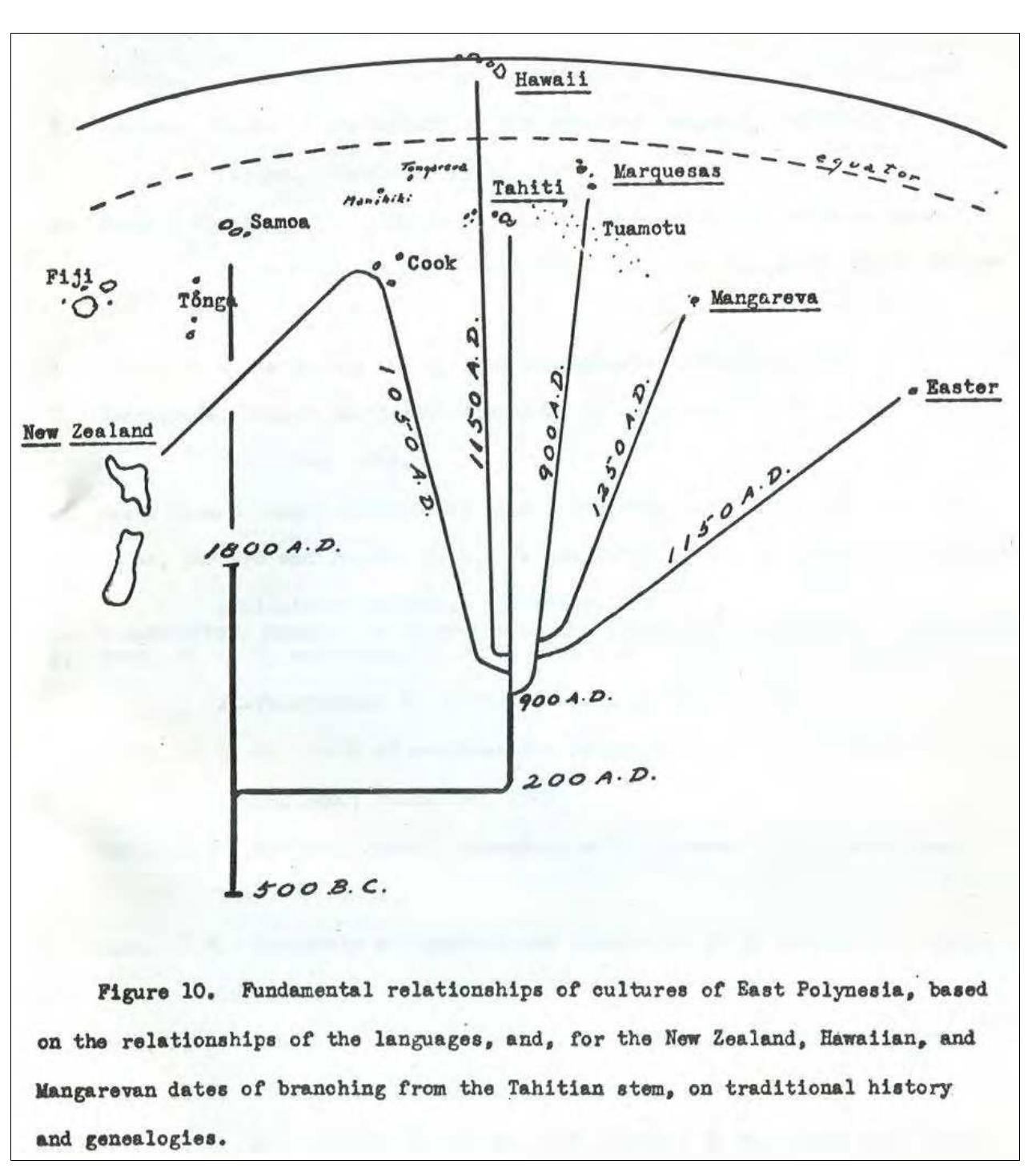
associated with Kaua‘i Island, and speculates Emory’s model for the settlement of
that eventually they were pushed out of the Polynesia--and the dates associated with the
main islands and “. . . withdrew to the barren divergence of various branches of
and rocky islets of Nihoa and Necker” Polynesian culture--was encapsulated in a
(1938:250). Hiroa dates the last voyage “tree” diagram, reproduced here as Figure 1.
�7
kirch
Figure 1. Emory’s tree diagram of Polynesian cultural relationships,
from his 1946 Yale dissertation, showing estimated “dates of
branching.” The settlement of Hawai‘i from Tahiti is estimated by
Emory to have occurred about AD 1150.
He situated the initial arrival of Polynesians of direct contact between Hawai‘i and the
from the Western Polynesian homeland to the Marquesas, after enough time had elapsed
Society Islands, dating their arrival to around for Marquesan culture to take on
AD 200. Emory then inferred a diaspora out peculiarities of its own.”
of Tahiti, beginning around AD 900, with
various “dates of branching” estimated on the
basis of the oral traditions and genealogies. The Radiocarbon Revolution and
The date of arrival in Hawai‘i was estimated Polynesian Settlement Chronology
to have been around AD 1150. Echoing
Fornander and Hiroa, however, Emory left At the time that Emory submitted his Yale
open the possibility of an earlier visit by dissertation, Pacific anthropology was on the
Marquesan voyagers to Hawai‘i (1946:278). cusp of a sea-change. Until then,
He wrote: “At least we have good evidence archaeology in Polynesia had largely
�8
hawaiian archaeology
contented itself with surface surveys of then from New Caledonia). Emory’s account
monumental architecture and studies of stone reveals the excitement provoked by the
artifacts. Excavation had rarely been invention of a means for directly dating the
ventured and even when it was, stratigraphy age of an archaeological site:
was ignored (J.F.G. Stokes’ 1913 excavations
While this [excavation] was in progress,
on Kaho‘olawe Island being a notable
in May of 1950, word came of W. F.
exception). More critically, there was no Libby’s momentous discovery of a
means to independently date the few artifacts method for dating charcoal through
recovered. But in 1947 Edward Gifford of the measuring radioactivity. A sample of
University of California at Berkeley led an charcoal from a fireplace . . . was
archaeological expedition to Fiji, on the submitted . . . revealing that the shelter
had been occupied about AD 1004. This
western boundary of Polynesia, revealing a
was the first radiocarbon date from any
deeply stratified succession of pottery types
island in the Pacific and it opened up
(see Kirch 2000:27–29 for an overview of undreamed of possibilities for
these developments). In 1950, Emory reconstructing the prehistory of the area.
commenced excavations at a rockshelter site (Emory, in Emory et al. 1959:ix).
at Kuli‘ou‘ou, O‘ahu; the shelter had been
unsystematically probed by Jack Porteus as The invention of radiocarbon dating helped
early as 1938, and Emory knew that its to spark a boom in Polynesian and Pacific
earthen floor contained a variety of artifacts archaeology. Emory launched a multi-year
(Emory and Sinoto 1961). Hawaiian Archaeology Program under the
auspices of the Bishop Museum, searching
These and other tentative forays into island nearly every island for rockshelter and sand-
sites might have had little impact on dune sites rich in artifacts which could be
Polynesian anthropology were it not for the radiocarbon dated to develop a cultural
contemporaneous development of the method sequence for the Hawaiian Islands. He was
of radiocarbon dating by chemist Willard soon joined by University of Hawai‘i
Libby (Libby 1952). By the late 1940s Libby student William J. Bonk, and Japanese
had confirmed that his method worked by archaeologist Yosihiko Sinoto. Other field
dating wooden lintel beams from Egyptian teams were also mobilized during the 1950s
temples whose age had been independently and early 60s, including Robert Suggs (from
given by hieroglyphic dates. With the support the American Museum of Natural History)
of the Viking Fund of New York, Libby put in the Marquesas, the Norwegian Expedition
out a call for archaeological samples from in Easter Island and other parts of Eastern
different parts of the world. Emory was the Polynesia, Jack Golson and then Roger
first in the Pacific to respond, sending a Green in New Zealand (and the latter in
charcoal sample from the base of the Mangareva as well). Emory and Sinoto
Kuli‘ou‘ou Rockshelter (Gifford followed extended the Bishop Museum’s program to
shortly thereafter with samples from Fiji, and the Society Islands and the Marquesas in the
�9
kirch
early 1960s. Golson, Green, and their (1966), expanding the Marquesan work to
students and colleagues also initiated Ua Huka and other islands of the group, also
programs in Tonga and Samoa in Western found pottery but his dates suggested to him
Polynesia. (For an overview of these that first settlement was somewhat later,
developments, see Kirch [2000:29–32].) As a perhaps around AD 300. Nonetheless,
result, by the mid-to-late 1960s, a new Sinoto believed that his data supported a
archaeologically-based and radiocarbon- primary role for the Marquesas as a
date defined chronology for Polynesia was “dispersal center” in Eastern Polynesia. (3)
emerging. The use of oral traditions and Relatively early Polynesian dispersal
genealogies was regarded as passé, having throughout at least parts of Eastern
been superseded by a new and thoroughly Polynesia was also reinforced by the early
“scientific” methodology privileging date obtained by the Norwegian Expedition
stratigraphic excavation of material remains, at Poike Ditch on Easter Island, AD 380
and dating the associated charcoal using the (Heyerdahl and Ferdon, eds., 1961:394).
increasingly sophisticated radiocarbon
technique. By the early 1960s, a consensus model for
the radiocarbon-based chronology of
Among the major outcomes of this burst of Polynesian settlement was emerging (Emory
excavation and radiocarbon dating, the 1959; Green 1966, 1967; Emory and Sinoto
following were especially significant in 1965). Based largely on the new
shaping views concerning the sequence of archaeological evidence, the model also
timing of settlement in Polynesia: (1) First, incorporated rapidly developing insights
the primacy of the Western Polynesian from historical linguistics, which also
archipelagoes as the original Polynesian indicated a later branching of the Eastern
homeland was confirmed by the much older Polynesian languages off of a considerably
archaeological sequences there, dating back older Proto Polynesian stem situated in the
to at least 400 BC in Samoa and possibly as Western Polynesian homeland. In brief, this
early as 1,500 BC in Tonga (Groube 1971). model had the ancestors of the Polynesians
In both Samoa and Tonga, the early periods arriving in the Tonga-Samoa region,
were marked by the presence of pottery, possibly as early as 1500 BC, where they
signaling a connection to Fiji and Melanesia developed a distinctive Proto Polynesian
to the west. (2) The surprisingly old language and culture. Further expansion
radiocarbon dates obtained by Suggs eastwards--possibly directly from Samoa to
(1961:Table 1) in the Marquesas, 150 BC in the Marquesas--took place by AD 300 if not
the case of the Ha‘atuatua dune site on slightly earlier (Figure 2). Easter Island
Nukuhiva, combined with small quantities of appeared to have been settled around the
potsherds, suggested that the Marquesas had same time. Exactly when the Society Islands
played a hitherto unsuspected role in the (which had played such a key role in
initial settlement of Eastern Polynesia. Sinoto Fornander’s and Hiroa’s theories) were
�10
hawaiian archaeology
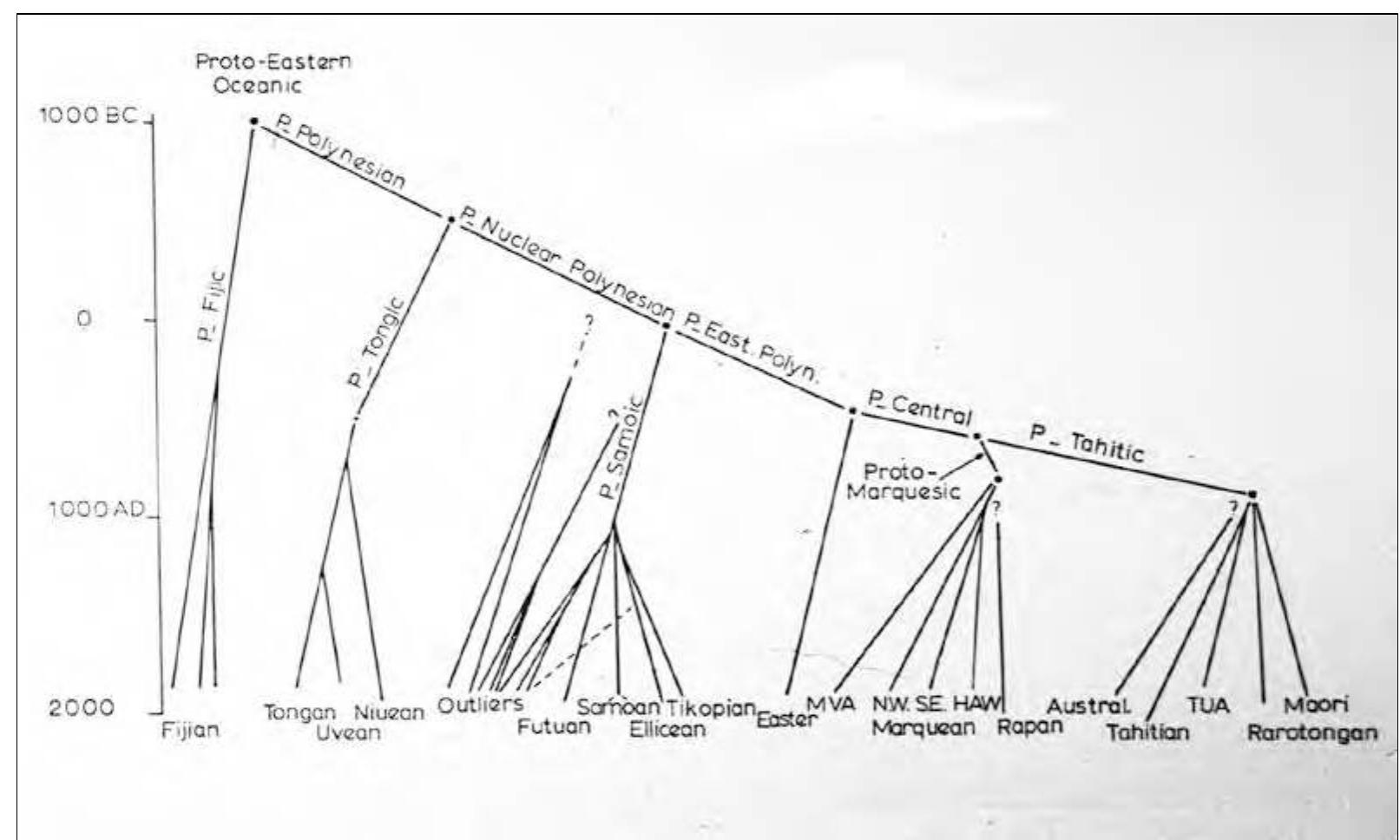
Figure 2. Roger Green’s “family tree for the Polynesian languages” (Green 1966:Table
9). In this model, Hawaiian diverges from the Proto-Marquesic branch around the
middle of the first millennium AD.
colonized was somewhat uncertain, as no and his colleagues Bonk and Sinoto had
early sites containing pottery were discovered scoured the archipelago for stratified sites,
by Emory and Sinoto’s explorations. This led testing at least 33 locations on all of the
to the view that Tahiti was settled from the major islands except for Maui. But it was in
Marquesas, and that it became a second the vicinity of Ka Lae (South Point) on
“dispersal center” for Eastern Polynesia by Hawai‘i Island that Emory’s team
around AD 1200 (thus continuing to fit the discovered and excavated three sites which
evidence from oral traditions). together seemed to provide a framework for
the entire Hawaiian cultural sequence, from
first settlement up until historic times. The
Early Radiocarbon-Dated Sites in the Pu‘u Ali‘i (H1) sand dune site anchored the
Hawaiian Islands sequence at the base, the Waiahukini Shelter
(H8) continued the sequence through the
It was within this emerging Polynesian middle time period, and the Makalai Shelter
settlement model that the empirical (H2) capped the sequence at the late end
archaeological and radiocarbon evidence (Emory et al. 1959:6–7, Figs. 23, 25). The
from several key Hawaiian sites first had to rich quantities of bone and shell fishhooks
be evaluated, in order to establish the place of from these sites provided a sequence of
Hawai‘i in the model, including a probable typological changes which Emory’s team
date for Polynesian discovery and settlement used to construct a master chronology for
of the islands. Throughout the 1950s, Emory the islands, reported in detail in their classic
�11
kirch
monograph Hawaiian Archaeology: They now proposed that the earliest deposits
Fishhooks (Emory et al. 1959). were those at the bottom of the H8
Waiahukini rockshelter, which they
Whereas the initial excavations at Kuli‘ou‘ou interpreted as beginning around AD 750
on O‘ahu had returned a radiocarbon date of (1969:15). The H1 sand dune site was
AD 1004 ± 180, a much older age was believed to overlap in time with the lower
obtained from the base of the Pu‘u Ali‘i sand part of H8, and the fishhook-rich deposits of
dune site at South Point: AD 124 ± 60. This the dune were suggested to have been
was far older than anyone had previously deposited between roughly AD 1000 to
postulated for initial Polynesian settlement in 1350. A revised settlement date for Hawai‘i
Hawai‘i--Fornander and Hiroa had estimated of AD 750 was seen by Emory and Sinoto as
that event at around AD 450, and Emory’s fitting better with Sinoto’s sequence for the
linguistic analyses had led him to propose a Marquesas Islands, which began at AD 300
date of around AD 1150. But in light of the (Sinoto 1979). If the Marquesas were the
new archaeological dates emerging from the immediate homeland of the first voyagers to
Marquesas and Easter Island, not to mention Hawai‘i, as seemed to be the case based on
the much earlier sites in Western Polynesia, a both material culture and linguistic
date in the second century AD for Polynesian evidence, then a date for initial Hawaiian
arrival in Hawai‘i was entirely plausible. In settlement several centuries after the
his preface to the Fishhooks monograph, Marquesas themselves were first occupied
Emory therefore wrote: “Radiocarbon dates was appropriate.
for excavations reveal that the Hawaiian
Islands were well populated by AD 1000, and At the same time that Emory and Sinoto
that the first settlers may have arrived by AD were revising their estimate for initial
125” (Emory, in Emory et al. 1959:ix). Hawaiian settlement from AD 125 to AD
750, two new sites were discovered and
By the mid-1960s, Emory and Sinoto (Bonk excavated which added evidence to the
had dropped out of the team) began to harbor emerging picture about the timing of
doubts about the single early date from H1 Polynesian colonization of the archipelago.
that had anchored their initial Hawaiian The Bellows dune site (O18) at Waimānalo,
fishhook chronology at AD 125. An O‘ahu, was excavated in 1967 under the
extensive program of radiocarbon dating of direction of Richard Pearson of the
59 samples from the H1 and H8 South Point University of Hawai‘i, and published a few
sites, carried out in conjunction with the years later by Pearson et al. (1971).2 A well-
Washington State University radiocarbon stratified coastal dune adjacent to
laboratory (Emory and Sinoto 1969) failed to Waimānalo Stream, O18 yielded a small but
replicate the early age first suggested for the striking assemblage of adzes, fishing gear,
base of site H1. Reviewing the expanded and other artifacts, many of which appeared
radiocarbon corpus, Emory and Sinoto closer to early Marquesan forms than to later
revised their Hawai‘i fishhook chronology. Hawaiian types. Five radiocarbon dates were
�12
hawaiian archaeology
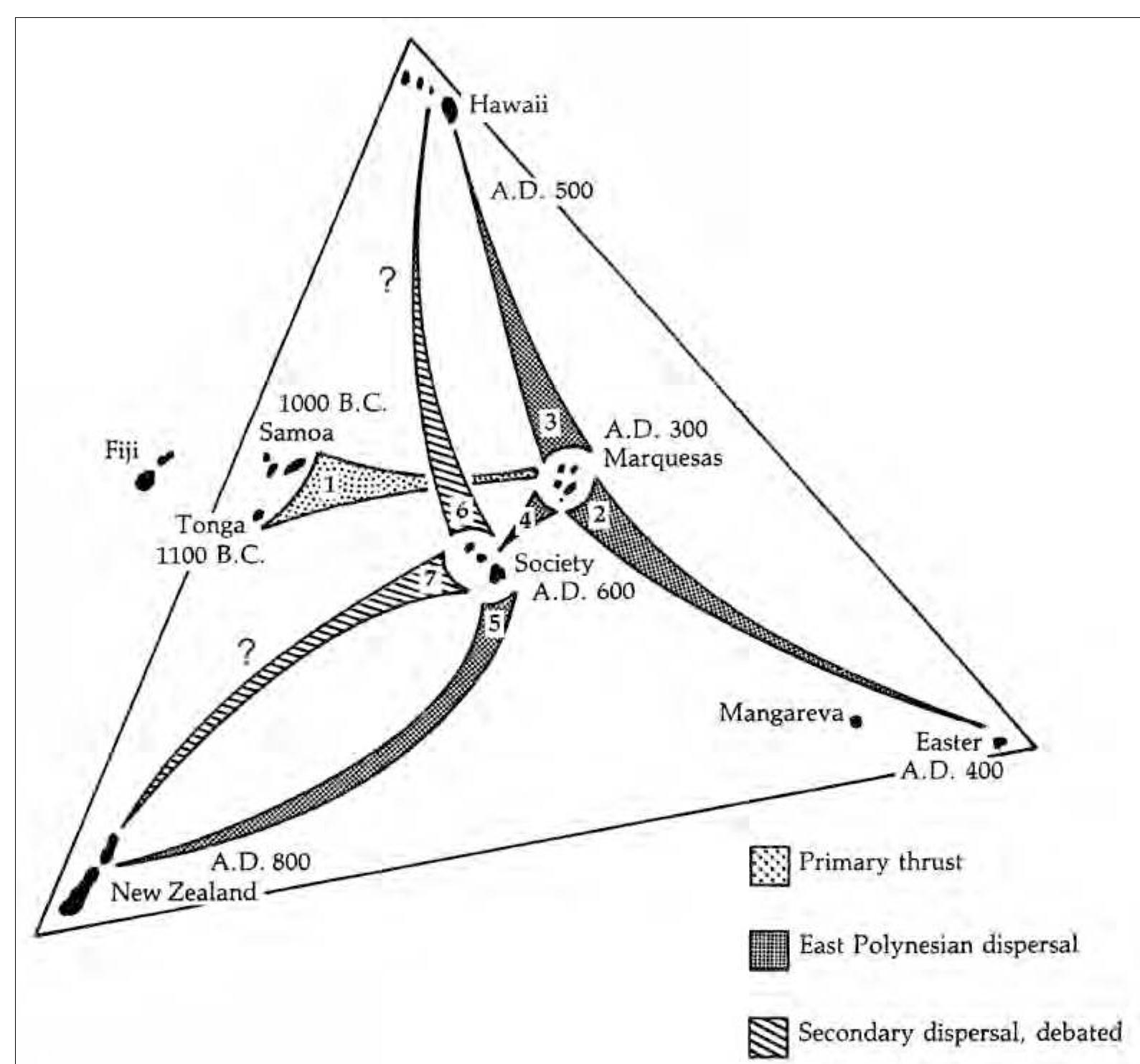
obtained; with the exception of one late date his Introduction, Jennings provided a
(<380 years), the dates spanned a range from graphic summary of the model, reproduced
1600 to 700 BP (Pearson et al. 1971:Figs. 13, here as Figure 3. His succinct text summed
14). However, two of the dates from Layers up the achievements of three decades of
II and III were stratigraphically inverted. excavations and radiocarbon dating:
Based on these dates, Pearson et al. Pioneer explorers called Lapita . . .
(1971:230–231, Fig. 14) argued that the two reached both Tonga and Samoa by 1000
deepest layers spanned a period between BC. The first eastwards movement
about AD 600 to 1100, and were farther into the Pacific is recorded for
contemporaneous with the older deposits at the Marquesas by AD 300. Thence went
two groups, one to Easter Island by AD
South Point sites H1 and H8.
400 and the other to Hawaii by AD 500.
It is possible that another group went to
On Moloka‘i Island, Kirch discovered a sand
the Societies shortly after their arrival in
dune site (Mo-A1-3) at the mouth of the
the Marquesas, but that thrust has not
Hālawa Valley in the mid-1960s, and been proved. Certainly, a second
excavated the deposits over two seasons in movement to Tahiti (the Societies)
1969–70 (Kirch 1971; Kirch and Kelly, eds., occurred by AD 600 and from thence to
1975). The Hālawa dune site also yielded New Zealand by AD 800. Secondary
artifact types arguably similar to early dispersals from Tahiti to Hawaii and
New Zealand after AD 1000 are
Marquesan forms (and with simple two-piece
possible but debated (Jennings 1979:2).
fishhooks very much like those from the O18
site on O‘ahu), as well as the stone Re-reading this summary, it is remarkable
foundations and postholes from simple oval- how faithful it remained to the old
ended houses. A radiocarbon date of 1380 ± Fornander and Hiroa theories, at least in so
90 BP from a hearth at the base of the far as Hawai‘i is concerned. An initial
cultural deposit was taken to indicate initial migration ca. AD 500 from the Marquesas
settlement between ca. AD 560–740 (Kirch (e.g., Hiroa’s “Menehune” people), was
and Kelly, eds., 1975:Table 41). followed by the arrival of Tahitian voyagers
after AD 1000 (e.g., the Māweke and Pā‘ao
voyaging sagas). Even though the new
The ‘Orthodox Scenario’ and the model was based on the scientific evidence
Debate Over Long Versus Short of archaeology and radiocarbon dating, it
Chronologies was still one that Fornander clearly would
have recognized!
By the close of the 1970s, a synthetic model
of Polynesian settlement chronology had The first book-length synthesis of Hawaiian
emerged, one that is well reflected by various archaeology, including a cultural sequence
chapters in The Prehistory of Polynesia of four named phases, was published by
volume edited by Jesse Jennings (1979). In Kirch (1985).3 With respect to initial
�13
kirch
Figure 3. The orthodox model of Polynesian settlement as summarized by Jennings in
1979 (from Jennings 1979, fig. 3).
Polynesian arrival in the islands, Kirch wrote: was based on its material culture (especially
“Although the information concerning the adze and fishhook types). Kirch agreed with
first few centuries of Polynesian occupation the orthodox synthesis in pointing to the
in Hawai‘i is scant, there is sufficient Marquesas Islands as the immediate
evidence to state that the archipelago was homeland of the voyagers who discovered
colonized sometime during the three Hawai‘i. He also opined that “there is some
centuries prior to AD 600” (1985:298). He element of historical reality in the Hawaiian
argued that Layer III at the O18 Bellows site, traditions of multiple contacts” (1985:66),
and Layer III at the Pu‘u Ali‘i sand dune site thus reinforcing the interpretation of a
(H1) were the only two assemblages that secondary phase of contact with the Society
could actually be assigned to this initial Islands.
Colonization Period. Given the problems of
radiocarbon dating at H1, the ascription of As is often the case in science, just when a
the Layer III assemblage there to this period particular paradigm appears to be
�14
hawaiian archaeology
unassailably constructed, cracks already have opined that there had been quite a long
begun to appear in the foundations. Such was pause between the settlement of Western
the case for the “orthodox scenario” of and Eastern Polynesia. They proposed
Polynesian settlement in the early 1980s. The applying “chronometric hygiene” to the
model which was so succinctly summarized available radiocarbon dates from Eastern
by Jennings (1979), based on the work of Polynesian sites, eliminating from the body
Emory, Sinoto, Green, Suggs, Golson, and of evidence dates which did not meet a set
others began to come under attack by the of strict criteria. Using their method of
early 1980s. In a provocative essay, Irwin screening, Spriggs and Anderson claimed
(1981) questioned whether there had actually that only for the Marquesas was there
been a significant “pause” in the eastward possible support for colonization ca. AD
expansion of early Polynesians from Western 300–600, with the “central, northern, and
Polynesia to Eastern Polynesia. Referencing eastern archipelagoes” being settled ca. AD
the early dates of Suggs in the Marquesas, 600–950, and New Zealand between AD
Irwin suggested that the loss of pottery may 1000–1200 (1993:211).
have made initial colonization sites in
Eastern Polynesia less visible to
archaeologists. Kirch (1986) followed with a Refinements in Radiocarbon Dating
more explicit critique of the “orthodox
scenario” as this applied to Eastern The “chronometric hygiene” approach
Polynesia, arguing that the earliest settlement advocated by Spriggs and Anderson (1993)
phases through the central Eastern Polynesian was based in part on the increasing
archipelagoes of the Societies, Marquesas, recognition of various problems with
Cook Islands, and Australs were as yet radiocarbon dating. Some of these had to do
inadequately defined. Again, the implication with laboratory methods (e.g., questions
was that the “pause” between the initial about pretreatment methods used by the
Lapita settlement of Tonga-Samoa and Gakushuin Laboratory in Japan), while
central Eastern Polynesia may have been others concerned issues of sample type and
shorter than the orthodox scenario allowed collection. Many of the early 14C dates, such
for. as those obtained by Emory and his
colleagues from the Hawaiian archaeology
A very different perspective on Eastern program in the 1950s, had rather large
Polynesian chronology was advanced by standard errors, a reflection of the crude
Spriggs and Anderson (1993). Influenced by solid-carbon counting methods first used by
radiocarbon dating developments in New Libby and other pioneers of the radiocarbon
Zealand which had increasingly supported a method. The shift to gas-proportional
very late colonization of those large, counting, or to liquid scintillation counting
temperate Eastern Polynesian islands methods, were significant improvements but
(Anderson 1991), Spriggs and Anderson the greatest advance came with Muller’s use
�15
kirch
of accelerator mass spectrometry or AMS old driftwood being collected and used for
14
(Muller 1977). By the late 1980s, AMS C fuel. With dating materials other than
dating was rapidly becoming the standard, charcoal, there were additional potential
largely replacing the older laboratory complications deriving from isotopic
methods. This advance in laboratory methods fractionation (especially in bone samples)
had two major consequences for and from reservoir effects (especially for
archaeological dating: (1) standard errors marine shell or other materials grown in the
were reduced; and (2) samples of relatively ocean).
small size could now be dated. For charcoal,
sample sizes as small as 10 milligrams could The most important step in developing new
be dated by AMS, opening up the possibility protocols for radiocarbon sample selection
of dating individual seeds or small twig was the taxonomic identification of wood
fragments. charcoal based on anatomical characteristics
by comparison to a reference collection of
Equally important to the refinements in known woody plant species for the
laboratory methods was the realization by particular region or island. In Hawai‘i, the
archaeologists that they needed to pay close first efforts at archaeological wood charcoal
attention to the kinds of samples they identification were made when Kirch, then
submitted for dating. This was especially the directing several large projects for the
case for wood charcoal, perhaps the most Bishop Museum, approached University of
commonly dated material from Polynesian Hawai‘i botanist Charles Lameroux about
sites. In the early years of radiocarbon dating, the problem. Lameroux’s laboratory
when the crude laboratory methods required assistant, Gail Murakami started to develop
large sample sizes, there was a tendency to a reference collection for Hawaiian wood
select the largest pieces of charcoal. Indeed, charcoal, and she has continued to be the
the entire contents of hearths or earth ovens main contributor to Hawaiian and other
(often including tens or even hundreds of Pacific wood identification (Murakami
individual charcoal fragments) were often 1983). In the 1990s, Kirch also encouraged
submitted in bulk to the dating laboratory. James Coil to establish a reference
The problem, of course, was that such collection at Berkeley’s Oceanic
samples in many cases included old growth Archaeology Laboratory (Coil 2004). These
timber, which had an “in built” age that was and similar efforts have now made it
potentially much older than the time at which possible for wood charcoal from Hawaiian
the wood was actually burnt in the hearth or and other Polynesian sites to be identified
14
oven. The date returned by the radiocarbon prior to C dating. Most importantly,
lab may have been an accurate indication of taxonomic identification allows the
the age of the timber, but not of the “target archaeologist to select short-lived species,
date” of human use of the site. With many and to reject wood samples that are likely to
coastal sites, there was also the likelihood of have a significant in-built age factor.
�16
hawaiian archaeology
Unfortunately, not all archaeologists working considerable support to a “short chronology”
Polynesia have availed themselves of the whereby the central archipelagoes of Eastern
ability to identify their samples prior to Polynesia did not begin to be colonized until
dating; it is still necessary when reviewing after AD 800 or later (Allen, 2004;
suites of dates from particular sites to Anderson et al., 1994, 1999; Anderson and
consider whether the samples in question Sinoto 2002; Conte and Anderson 2003;
meet the new standards for sample selection. Green and Weisler 2002; Kirch et al. 1995;
Rolett 1998; Rolett and Conte, 1995 Weisler
The methodological advances just 1994, 1995). Recently, Wilmhurst et al.
summarized--both in laboratory methods and (2011) have advanced claims that the
in sample selection criteria--have had a major settlement of all but the Society Islands
impact on the evolving radiocarbon occurred after AD 1190–1290; their
chronology for Eastern Polynesia. Targeted argument, however, depends on a fairly
AMS re-dating of identified samples from extreme form of chronometric hygiene,
previously excavated Eastern Polynesian sites which rejects dates on any samples other
such as Hane or Vaito‘otia-Fa‘ahia than charcoal from identified, short-lived
(Anderson and Sinoto 2002) have typically taxa.
shortened the chronologies for those sites,
while dating of newly excavated sites such as Most important from the perspective of
the Tangatatau Rockshelter (MAN-44) on Hawaiian settlement are the colonization
Mangaia (Kirch et al. 1995) or Onemea in dates for the Society Islands and the
Mangareva (Kirch et al. 2010) have failed to Marquesas, as these two archipelagoes have
replicate the kinds of early first-millennium long been considered to be the immediate
AD dates for initial Polynesian settlement source regions for the first Polynesian
obtained by Suggs or Sinoto. In short, the voyagers to Hawai‘i. For the Society
argument in favor of a “long pause” and a Islands, the oldest dates potentially
14
“short chronology” for Eastern Polynesia indicating a human presence are two C
have been greatly strengthened by the dates on anaerobically preserved coconuts
advances in radiocarbon dating over the past from water-logged sediments in the lower
two to three decades. ‘Opunohu Valley on Mo‘orea Island
(Lepofsky et al. 1992), with ages of 1270 ±
60 and 1360 ± 60 BP, possibly indicating
The Emerging Chronological Picture for settlement by about AD 600. However, no
Eastern Polynesia cultural materials were associated with these
putatively domesticated coconuts, and until
Over the past decade or so, dating of a confirmed by additional results, it is not
number of key Eastern Polynesian sites, using certain that these dates indicate human
AMS radiocarbon methods on better activity on Mo‘orea. The Vaito‘otia-Fa‘ahia
controlled (identified) samples has lent site on Huahine, originally thought to date as
�17
kirch
early as AD 800–850, was re-dated by from the Marquesas strongly suggests that
Anderson and Sinoto (2002). Although there initial Polynesian settlement of that
is considerable range in the ages of the newly archipelago was unlikely to have occurred
dated samples (Anderson and Sinoto before about AD 900, and may have been as
2002:Table 1, Fig. 1), they conclude that the late as AD 1000.
“most reliable” suite of shell dates from the
site has a range of about AD 1050–1450. Emerging chronologies for other Eastern
Polynesian islands are also relevant here. In
The Marquesas, as noted above, initially the southern Cook Islands, the Tangatatau
produced the earliest dates in Eastern Rockshelter on Mangaia was occupied by
Polynesia, as old as 150 BC in the case of around AD 1000, based on a large suite of
Suggs’s excavations at Ha‘atuatua (Suggs 14
C dates (Kirch et al. 1995:55, Table 2).
1961). The Hane dune site on Ua Huka Kirch et al. (2010) recently published a suite
Island, excavated by Sinoto (1966), yielded of 14C AMS dates from the Onemea site on
pottery and other artifacts similar to those Taravai Island in the Gambier (Mangareva)
from Ha‘atuatua, and Sinoto’s original suite Islands indicating initial Polynesian
14
of C dates led him to propose that Hane had colonization around AD 950. This age fits
been settled as early as AD 300–600. well with Weisler’s claims for the
Anderson and Sinoto (2002:Table 2, Fig. 2) colonization of Henderson Island no later
dated ten new samples from Hane, with than AD 1050, and possibly slightly earlier
results indicating that the site “. . . was (Weisler 1995:389, Table 2). Despite Hunt
probably not earlier than about AD 1000, and Lipo’s claims (2006, 2008) that Rapa
according to the lower calibrated ranges of Nui was not settled until AD 1200, the full
the new results, and if actually around the corpus of dates from the Anakena Dune Site
medians would be dated approximately AD (including those of Steadman et al. 1994) are
1100–1200” (2002:251). In 2009, Eric Conte also compatible with a colonization date of
conducted renewed excavations at Hane. A around AD 1000. In sum, the southeastern
suite of as yet unpublished radiocarbon dates archipelagoes and islands of Eastern
from these excavations yielded results similar Polynesia have a set of radiocarbon
to the Anderson and Sinoto (2002) re-dating, chronologies now converging on the period
again suggesting that the lowest levels at from AD 900–1000.
Hane are unlikely to be older than AD 900–
1000 (Conte, pers. comm., 2010). These With the caveat that the Society Islands
revised dates from Hane are also consistent might still prove to have initial settlement
with Rolett’s dating of the earliest levels at dates slightly earlier than elsewhere in
the Hanamiai site on Tahuata Island, which Eastern Polynesia, the extensive re-dating of
are bracketed in the interval between AD key sites and discovery and dating of new
1025–1300 (Rolett 1998:241, Table 4.1). In sites throughout central Eastern Polynesia
short, the emerging chronological evidence strongly supports a “short chronology” that
�18
hawaiian archaeology
begins no earlier than AD 900–1000. Given and his collaborators applied the methods of
that this region is widely regarded as the sediment coring and palynology to a number
immediate homeland for the first Polynesian of lake and swamp sites on O‘ahu Island,
settlers to Hawai‘i, the obvious implication is such as ‘Uko‘a Pond and Kawainui Marsh
that Hawaiian colonization is unlikely to be (Athens 1997; Athens and Ward 1993, 1997;
earlier than around AD 1000. Athens et al. 1992). Analysis of cores
showed unmistakable signals of
anthropogenic disturbance, especially with
Paleo-Environmental Evidence for the dramatic increases in microscopic charcoal
Initial Hawaiian Settlement (from near 0 in pre-human levels to 25
mm2/cc in upper levels) and in significant
Evidence for human colonization of an island declines in native plant taxa, especially the
or archipelago can come from two different endemic palm Pritchardia and a now
sources: (1) direct artifactual evidence from extirpated shrub Kanaloa. These data were
human settlements such as sand dune revolutionary for the information they
occupations or rockshelters; and, (2) indirect provided about changes to the O‘ahu
evidence in the form of proxy signals of landscape following Polynesian colonization
anthropogenic disturbance, such as increases and land use, but they also had potential to
in charcoal fluxes in lake or swamp help establish the date of Polynesian arrival.
sediments, rapid changes in pollen In an influential article, Athens wrote:
frequencies in these sediments, or the
What, then, is the very earliest coring
appearance of commensal or synanthropic evidence we have for the Polynesian
plants and animals such as weeds, insects, or presence in Hawaii? The answer is
rats. During the first few decades of approximately AD 800, which is from
Polynesian stratigraphic archaeology, the ‘Uko‘a Pond. The securest evidence is
emphasis was almost exclusively on the in the form of microscopic particulate
charcoal, though it is also supported by
search for early habitation sites. With the
the pollen evidence . . . Because
increased interest in an ecological or
particulate charcoal does not occur in
environmental archaeology from the late sample intervals predating Polynesian
1960s on, however, indirect evidence for occupation in any of our cores on
anthropogenic disturbance on islands began O‘ahu, we feel confident that its
to be considered in the debate on long versus presence in the ‘Uko‘a Pond core (and
short chronologies. The application of other cores) must be entirely due to
anthropogenic causes (Athens
palynological analysis to lake and swamp
1997:266).
sediments in Pacific islands has been
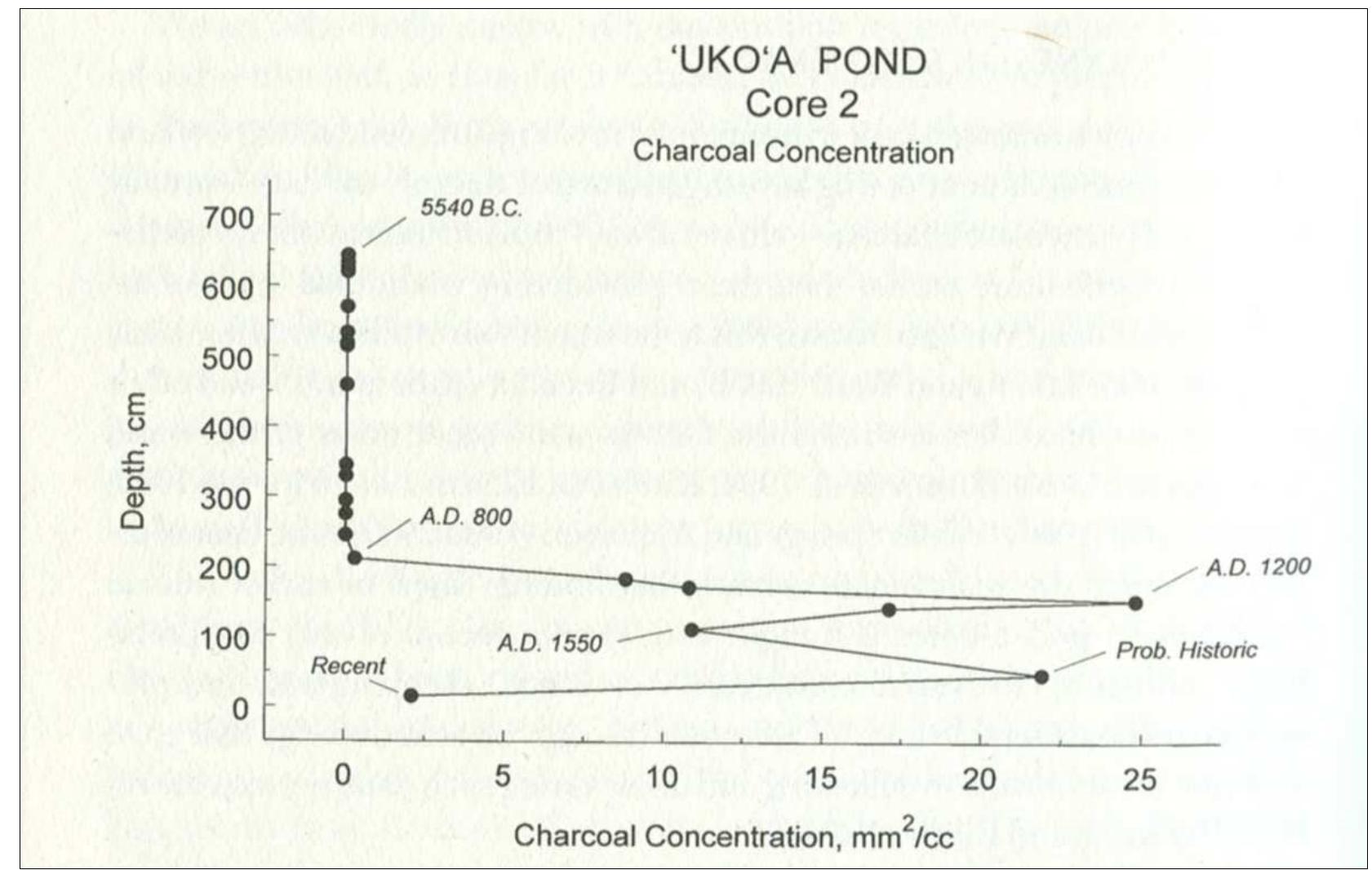
especially important in this regard (e.g., Figure 4 reproduces Athens’ plot of the
Kirch and Ellison 1994). ‘Uko‘a Pond charcoal concentrations. A 14C
date of approximately AD 800 (Athens did
Beginning in the early 1990s, Steve Athens not publish the full details of the
�19
kirch
Figure 4. Athens’ plot of charcoal concentrations in the ‘Uko‘a Pond core (Athens 1997:Fig.
12.7). Note that the dramatic rise in charcoal concentrations is bracketed between AD 800
and 1200.
radiocarbon dates from ‘Uko‘a Pond) is coring program on O‘ahu makes it clear that
associated with the first presence of charcoal, by AD 1200 anthropogenic disturbance was
while another date of AD 1200 is associated widespread on the island. Thus initial
with a dramatic spike in charcoal Polynesian colonization must have occurred
concentrations. Thus, while Athens placed some time prior to AD 1200, but is unlikely
the approximate date of Polynesian arrival at to have been much before AD 1000.
AD 800, it would probably be more accurate
say that a dramatic spike in anthropogenic On Kaua‘i Island, the team of David and
charcoal is bracketed by radiocarbon dates of Lida Burney (2003) has applied sediment
approximately AD 800 and 1200. In later coring and dating of charcoal influxes to
work at the Ordy Pond on O‘ahu, Athens et attempt to establish the earliest presence of
al. (1999) report that the first presence of Polynesians on various parts of the island.
charcoal is bracketed by two radiocarbon Their earliest reliable record for
dates as between AD 1000–1100. And, a core anthropogenic charcoal comes from
in an inland location in Maunawili Valley on Kekupua Fishpond on the island’s
the windward side of O‘ahu shows southwestern coast. The first presence of
Pritchardia and other indigenous taxa charcoal in a 2.2 m deep core comes at 1.4
beginning to decline after about AD 1200 m and has an associated 14C date of 830 ± 50
(Athens and Ward 1997). In all, Athens’ BP, or AD 1165–1260 when calibrated (at 1
�20
hawaiian archaeology
s.d.). Burney et al. (2001; Burney and dates strongly indicative of human presence
Kikuchi 2006) have also carried out extensive on O‘ahu by around AD 1000, with
work in the Makauwahi limestone sinkhole, evidence for widespread anthropogenic
an extraordinary sediment trap yielding a rich disturbance by AD 1200. For Kaua‘i, initial
record of biotic change on the island. Here human presence is indicated by at least AD
the earliest indication of human presence is 1200.
from the pelvis of a Polynesian-introduced rat
14
(Rattus exulans), directly C dated at 822 ±
60 BP, or AD 1160–1270 calibrated (at 1 Re-Evaluating “Early” Hawaiian Sites
s.d.).
The final set of evidence to consider before
Bones of R. exulans were also recovered returning to the question of when the
from limestone sinkholes in the ‘Ewa Plain Hawaiian Islands were first settled by
on O‘ahu, where they are associated with the Polynesians is the radiocarbon evidence
bones of extinct or extirpated avifauna, from the handful of habitation sites which
including large flightless ducks had been proposed as belonging to the
(Thambetochen sp.), and the shells of extinct earliest phases of the Hawaiian cultural
endemic terrestrial gastropods (Athens et al. sequence (Kirch 1985). For the South Point,
1999, 2002; see also Christensen and Kirch Hawai‘i Island sites there has been no recent
14
1986). Direct AMS C dating on several of attempt at re-dating, although the older sets
these rat bones also provides proxy evidence of radiocarbon dates have been reassessed
for initial Polynesian presence on O‘ahu, as (Dye 1992). Combining the four most
these rats were commensal and introduced by consistent 14C dates on charcoal from Layer
humans. Figure 5 is a combined Oxcal II at site H8 (Emory and Sinoto 1969:Table
probability plot of the two earliest dates from 1) yields calibrated age ranges of AD 1040–
R. exulans bones from ‘Ewa, with a highest 1090 and 1120–1280 (at 1 s.d.), which
probability calibrated age range of AD 970– would be consistent with the general time
1030 (at 1 s.d.), or AD 890–1040 (at 2 s.d.). frame suggested by the paleoenvironmental
evidence just reviewed, and with the
Some scholars are reluctant to use the kinds
emerging chronologies for Eastern
of proxy indicators of anthropogenic
Polynesia. Nonetheless, it would be
disturbance described above as evidence for
desirable to attempt to re-date the base of
human arrival on islands, and have rejected
site H8 (and possibly also Layer III at H1)
dates on charcoal in sediment cores or on rat
using AMS methods, if suitable samples can
bones (e.g., Wilmhurst et al. 2011). This
be located in the Bishop Museum
seems to me to be an extreme application of
collections.
“chronometric hygiene.” In the case of
Hawai‘i, the dates from numerous sediment A second site for which claims of relatively
14
cores, combined with direct AMS C dating early settlement had been advanced is the
of rat bones, has provided a consistent set of Hālawa Dune Site (Mo-A1-3) on Moloka‘i
�21
kirch
(Kirch and Kelly 1975). Kirch and McCoy earliest dates on Rattus exulans bones from
(2007) submitted six samples from the the ‘Ewa Plain (see Figure 5). This is not to
14
original 1969–70 excavations for AMS C say that the Bellows Dune site is the “ur-
dating. Based on the results of this re-dating colonization” settlement for Hawai‘i. But it
combined with a re-analysis of the original does strongly hint that the O18 occupation
suite of dates, Kirch and McCoy conclude dates to within the first century of
that the Hālawa site dates no earlier than Polynesian arrival in the archipelago.
about AD 1300, with the main occupation
phase dating to between AD 1400–1650
(2007:402). When Was Hawai‘i First Settled?
This leaves only the Bellows Dune site (O18) In this paper I have endeavored to trace the
at Waimānalo, O‘ahu, as having a possible efforts--over more than a century and a half-
claim of dating with the period of initial -of various scholars to determine the
Polynesian settlement of the Hawaiian approximate time when Polynesian
archipelago. In an attempt to establish the age explorers first made their remarkable voyage
of the deeper stratigraphic deposits at O18, from central Eastern Polynesia, across the
Dye and Pantaleo (2010) dated seven samples doldrums and into the North Pacific, to
obtained during the original 1967 discover Hawai‘i. Fornander and Hiroa were
excavations, selecting only short-lived limited to Polynesian oral traditions
materials. Based on the new results, and calibrated to chiefly genealogies, but
using a Bayesian statistical framework, they thought that this event occurred sometime in
conclude that the O18 site was “established in the mid-first millennium AD Emory applied
AD 1040–1219” (2010:113). Dye and linguistic analysis to arrive at a date of AD
Pantaleo argue that this was “some 260–459 1150. But with the advent of stratigraphic
years after the current estimate of first archaeology and radiocarbon dating, it
settlement” of Hawai‘i. That argument, appeared for a time that the date of initial
however, is based on the acceptance of AD settlement would be pushed back
800 as the date of Polynesian colonization of considerably, possibly to the beginning of
the islands, following Athens (1997). As I the first millennium AD. Then a long
have pointed out above, the ‘Uko‘a core from process of scientific investigation and self-
which Athens derived the AD 800 date correction set in. The initial uncritical
actually only shows anthropogenic influences enthusiasm for radiocarbon dating was
occurring between approximately AD 800 replaced by a more sober realization that
and 1200. Dye and Pantaleo’s new dates for radiocarbon dating was complicated, and
O18, in my opinion, establish the site as the that the early methods need improvement.
earliest documented habitation in the Archaeologists began to pay attention to
Hawaiian Islands. Their estimate of AD issues of sample type and selection. In the
1040–1219 is only marginally later than the half-century that has passed since Emory
�22
hawaiian archaeology
and Sinoto obtained their first 14C dates from 3. Re-dating of the O18 site at Bellows,
Kuli‘ou‘ou, South Point, and other Hawaiian Waimānalo, O‘ahu puts the occupation
sites, we have made huge strides forward in of that small hamlet at between AD
the hard work of establishing solid cultural 1040–1219. Obviously, this range falls
chronologies throughout Polynesia. closely between the lower and upper
bounds indicated by the Eastern
To the question of “when was Hawai‘i first Polynesian chronologies and the
settled by Polynesians” I would answer with paleoenvironmental evidence.
the following three points:
In my view, it is now reasonable to argue
1. Although the debate over the chronology
that the first arrival of Polynesians in
for Polynesian expansion into Eastern
Hawai‘i is unlikely to have occurred much
Polynesia still continues (e.g., Wilmhurst
before AD 1000, although the event could
et al. 2011; Mulrooney et al. 2011), there
conceivably have been sometime in the 10th
is no question that some form of “short
century. There is also no question that at
chronology” has prevailed. With the
least O‘ahu and Kaua‘i islands were already
exception of the Society Islands (for
well settled, with local populations
which our database for early settlement
established in several localities, by AD
remains inadequate), none of the main
1200. Beyond this I fear it would be
archipelagoes and islands of central
dangerous to tread. But the research will
Eastern Polynesia are likely to have been
continue, and with future improvements in
colonized by Polynesians before AD
methods accompanied by the inevitable
900–1000. Since this is the immediate
serendipity that archaeologists know they
homeland region from which the
must depend on, we may yet narrow down
voyagers to Hawai‘i are presumed to
the time frame of Polynesian discovery of
have come, a lower bound on the
this most amazing archipelago.
settlement date for Hawai‘i also has to be
AD 900–1000.
2. The “proxy” paleoenvironmental
Notes
evidence for human presence in Hawai‘i,
which for now comes almost exclusively 1. This article is based upon the Keynote
from O‘ahu and Kaua‘i Islands, leaves no Address delivered to the Society for
doubt that human activities were creating Hawaiian Archaeology at the 2010 Annual
significant disturbances on both of these Meeting at Wailua, Kaua‘i.
islands by AD 1200. This then sets an
2. The main excavation at O18 took place
upper bound on Polynesian settlement at
during the summer of 1967, as a University
this time. Moreover, the earliest dates on
of Hawai‘i field school. Although still a
human introduced Rattus exulans bones
Punahou student at the time, I participated in
on O‘ahu are consistent with Polynesian
the excavation at Pearson’s invitation, and
arrival around AD 1000.
later helped to analyze the collections.
�23
kirch
3. Although published by the University of ______. 1997. The Maunawili core:
Hawai‘i Press in 1985, the manuscript was Prehistoric inland expansion of settlement
based on lectures given by Kirch at the and agriculture, O‘ahu, Hawai‘i. Hawaiian
University of Hawai‘i in the early 1980s. Archaeology 6:37–51.
Athens, J.S., J. Ward, and S. Wickler. 1992.
Late Holocene lowland vegetation, O‘ahu,
References Cited Hawai‘i. New Zealand Journal of
Archaeology 14:9–34.
Allen, M.S. 2004. Revisiting and revising Athens, J.S., J.V. Ward, H.D. Tuggle, and
Marquesan culture history: New D.J. Welch. 1999. Environment, Vegetation
archaeological investigations at Anaho Bay, Change, and Early Human Settlement on the
Nuku Hiva Island. Journal of the Polynesian ‘Ewa Plain: A Cultural Resource Inventory
Society 113:143–196. of Naval Air Station, Barber’s Point, O‘ahu,
Anderson, A. 1991. The chronology of Hawai‘i, Part III, Paleoenvironmental
colonization in New Zealand. Antiquity 65: Investigations. International Archaeological
767. Research Institute, Inc., Honolulu.
Anderson, A., E. Conte, G. Clark, Y. Sinoto, Athens, J.S., H.D. Tuggle, J.V. Ward, and
and F. Petchy. 1999. Renewed excavations at D.J. Welch. 2002. Avifaunal extinctions,
Motu Paeao, Maupiti Island, French vegetation change, and Polynesian impacts
Polynesia. New Zealand Journal of in prehistoric Hawai‘i. Archaeology in
Archaeology 21: 47–66. Oceania 37:57–78.
Anderson, A., H. Leach, I. Smith, and R. Burney, D.A. and W.K.P. Kikuchi. 2006. A
Walter. 1994. Reconsideration of the millennium of human activity at Makauwahi
Marquesan sequence in East Polynesian Cave, Maha‘ulepu, Kaua‘i. Human Ecology
prehistory, with particular reference to Hane 34:219–247.
(MUH1). Archaeology in Oceania 29: 29–52. Burney, D.A., H.F. James, L.P. Burney, S.L.
Anderson, A. and Y.H. Sinoto. 2002. New Olson, W.K. Kikuchi, W. Wagner, M.
radiocarbon ages of colonization sites in East Burney, D. McCloskey, D. Kikuchi, F.V.
Polynesia. Asian Perspectives 41:242–257. Grady, R. Gage, and R. Nishek. 2001. Fossil
evidence for a diverse biota from Kaua‘i and
Athens, J.S. 1997. Hawaiian native lowland
its transformation since human arrival.
vegetation in prehistory. In P.V. Kirch and
Ecological Monographs 71:615–641.
T.L. Hunt, eds., Historical Ecology in the
Pacific Islands: Prehistoric Environmental Burney, L.P. and D.A. Burney. 2003.
and Landscape Change, pp. 248–70. Yale Charcoal stratigraphies for Kaua‘i and the
University Press, New Haven. timing of human arrival. Pacific Science
57:211–226.
Athens, J.S. and J.V. Ward. 1993.
Environmental change and prehistoric Christensen, C. and P.V. Kirch. 1986. Non-
Polynesian settlement in Hawai‘i. Asian marine mollusks and ecological change at
Perspectives 32:205–223. Barbers Point, O‘ahu, Hawai‘i. Bishop
Museum Occasional Papers 26:52–80.
�24
hawaiian archaeology
Coil, J.H. 2004. “The Beauty that Was”: Fornander, A. 1878, 1880, 1885. An Account
Archaeological Investigations of Ancient of the Polynesian Race: Its Origin and
Hawaiian Agriculture and Environmental Migration and the Ancient History of the
Change in Kahikinui, Maui. Unpublished Hawaiian People to the Time of
Ph.D. Dissertation. University of California, Kamehameha I. 3 vols. London.
Berkeley.
______. 1919. Source and migration of the
Conte, E. and A.J. Anderson. 2003. Polynesian race. In T.G. Thrum, ed.,
Radiocarbon ages for two sites on Ua Huka, Fornander Collection of Hawaiian
Marquesas. Asian Perspectives 42:155–160. Antiquities and Folk-Lore, Memoirs of the
Bernice P. Bishop Museum, Vol. VI, Part II,
Dye, T.S. 1992. The South Point radiocarbon
pp. 222–238. Bishop Museum Press,
dates thirty years later. New Zealand Journal
Honolulu.
of Archaeology 14:89–97.
Green, R.C. 1966. Linguistic subgrouping
Dye, T.S. and J. Pantaleo. 2010. Age of the
within Polynesia: the implications for
O18 site, Hawai‘i. Archaeology in Oceania
prehistoric settlement. Journal of the
45:113–119.
Polynesian Society 75:6–38.
Emory, K.P. 1946. Eastern Polynesia: Its
______. 1967. The immediate origins of the
Cultural Relationships. Unpublished
Polynesians. In G.A. Highland, et al., eds.,
Dissertation. Yale University, New Haven
Polynesian Culture History, pp. 215–240.
(University Microfilms, Ann Arbor).
Bishop Museum Press, Honolulu.
______. 1959. Origin of the Hawaiians.
Green, R.C. and M.I. Weisler. 2002. The
Journal of the Polynesian Society 68:29–35.
Mangarevan sequence and dating of the
Emory, K.P., W.J. Bonk and Y.H. Sinoto. geographic expansion into Southeast
1959. Hawaiian Archaeology: Fishhooks. Polynesia. Asian Perspectives 41:213–241.
Bernice P. Bishop Museum Special
Groube, L.M. 1971. Tonga, Lapita pottery,
Publication 47. Honolulu
and Polynesian origins. Journal of the
Emory, K.P. and Y.H. Sinoto. 1961. Polynesian Society 80:278–316.
Hawaiian Archaeology: O‘ahu Excavations.
Heyerdahl, T. and E.N. Ferdon, Jr., eds.
Bernice P. Bishop Museum Special
1961. Reports of the Norwegian
Publication No. 49. Bishop Museum Press,
Archaeological Expedition to Easter Island
Honolulu.
and the East Pacific. Vol. 1, Archaeology of
______. 1965. Preliminary Report on the Easter Island. Monographs of the School of
Archaeological Investigations in Polynesia. American Research 24(1). Santa Fe.
Mimeographed Report to the National
Hiroa, Te Rangi (P.H. Buck). 1938. Vikings
Science Foundation. Bernice P. Bishop
of the Sunrise. J.B. Lippincott, Philadelphia.
Museum, Honolulu.
Hunt, T.L. and C.P. Lipo. 2006. Late
______. 1969. Age of the Sites in the South
colonization of Easter Island. Science
Point Area, Ka‘u, Hawai‘i. Pacific
311:1603–1606.
Anthropological Records 8. Bishop Museum,
Honolulu.
�25
kirch
______. 2008. Evidence for a shorter Hawaiian Valley: Halawa Valley, Molokai.
chronology on Rapa Nui (Easter Island). Pacific Anthropological Records 24. Bernice
Journal of Island and Coastal Archaeology P. Bishop Museum, Honolulu.
3:140–148.
Kirch, P.V. and M.D. McCoy. 2007.
Irwin, G. 1981. How Lapita lost its pots: The Reconfiguring the Hawaiian cultural
question of continuity in the colonisation of sequence: Results of re-dating the Halawa
Oceania. Journal of the Polynesian Society Dune Site (Mo-A1-3), Moloka‘i Island.
90:481–94. Journal of the Polynesian Society 116:385–
406.
Jennings, J.D. 1979. Introduction. In J.D.
Jennings, ed., The Prehistory of Polynesia, Kirch, P.V., D.W. Steadman, V.L. Butler, J.
pp. 1–5. Harvard University Press, Hather, and M.I. Weisler. 1995. Prehistory
Cambridge. and human ecology in Eastern Polynesia:
Excavations at Tangatatau rockshelter,
Kirch, P.V. 1971. The Halawa Dune Site
Mangaia, Cook Islands. Archaeology in
(Hawaiian Islands): A Preliminary Report.
Oceania 30:47–65.
Journal of the Polynesian Society 80:228–
236. Lepofsky, D., H.C. Harries, and M. Kellum.
1992. Early coconuts on Mo‘orea Island,
______. 1985. Feathered Gods and
French Polynesia. Journal of the Polynesian
Fishhooks: An Introduction to Hawaiian
Society 101:299–308.
Archaeology and Prehistory. University of
Hawai‘i Press, Honolulu. Libby, W. 1952. Radiocarbon Dating.
University of Chicago Press, Chicago.
______. 1986. Rethinking East Polynesian
prehistory. Journal of the Polynesian Society Muller, R.A. 1977. Radiocarbon dating with
95: 9–40. a cyclotron. Science 196:489–494.
______. 2000. On the Road of the Winds: An Mulrooney, M., S.H. Bickler, M.S. Allen,
Archaeological History of the Pacific Islands and T.N. Ladefoged. 2011. High-precision
Before European Contact. University of dating of colonization and settlement in East
California Press, Berkeley. Polynesia. Proceedings of the National
Academy of Sciences, USA, 108:E192–E194.
Kirch, P.V., E. Conte, W. Sharp, and D.
Nickelsen. 2010. The Onemea site (Taravai Murakami, G.M. 1983. Analysis of charcoal
Island, Mangareva) and the human from archaeological contexts. In J.T. Clark
colonization of southeastern Polynesia. and P.V. Kirch, eds., Archaeological
Archaeology in Oceania 45:66–79. Investigations of the Mudlane-Waimea-
Kawaihae Road Corridor, Island of
Kirch, P.V. and J. Ellison. 1994.
Hawai‘i, pp. 514–526. Report 83-1,
Palaeoenvironmental evidence for human
Department of Anthropology. Bishop
colonization of remote Oceanic islands.
Museum, Honolulu.
Antiquity 68:310–21.
Pearson, R.J., P.V. Kirch, and M.
Kirch, P.V. and M. Kelly, eds. 1975.
Pietrusewsky. 1971. An early prehistoric site
Prehistory and Ecology in a Windward
at Bellows Beach, Waimanalo, Oahu,
�26
hawaiian archaeology
Hawaiian Islands. Archaeology and Physical Wilmhurst, J.M., T.L. Hunt, C.P. Lipo, and
Anthropology in Oceania 6:204–34. A.J. Anderson. 2011. High-precision
radiocarbon dating shows recent and rapid
Rolett, B.V. 1998. Hanamiai: Prehistoric
initial colonization of East Polynesia.
Colonization and Cultural Change in the
Proceedings of the National Academy of
Marquesas Islands (East Polynesia). Yale
Sciences, USA 108:1815–1820.
University Publications in Anthropology No.
84. New Haven.
Rolett, B.V. and E. Conte. 1995. Renewed
investigation of the Ha‘atuatua dune
(Nukuhiva, Marquesas Islands): A key site in
Polynesian prehistory. Journal of the
Polynesian Society 104:195–228.
Sinoto, Y.H. 1966. A tentative prehistoric
cultural sequence in the northern Marquesas
Islands, French Polynesia. Journal of the
Polynesian Society 75:287–303.
______. 1979. The Marquesas. In J. Jennings,
ed., The Prehistory of Polynesia, pp. 110–34.
Harvard University Press, Cambridge.
Spriggs, M.J.T. and A. Anderson. 1993. Late
colonization of East Polynesia. Antiquity
67:200–17.
Steadman, D.W., C. Vargas, and F. Cristino.
1994. Stratigraphy, chronology, and cultural
context of an early faunal assemblage from
Easter Island. Asian Perspectives 33:79–96.
Suggs, R.C. 1961. Archaeology of Nuku
Hiva, Marquesas Islands, French Polynesia.
Anthropological Papers of the American
Museum of Natural History 49, Part 1. New
York.
Weisler, M.I. 1994. The settlement of
marginal Polynesia: New evidence from
Henderson Island. Journal of Field
Archaeology 21:83–102.
______. 1995. Henderson Island prehistory:
Colonization and extinction on a remote
Polynesian island. Biological Journal of the
Linnean Society 56:377–404.
�


 Patrick Kirch